Customer Value Management Report: Home Base Retail Case Study
VerifiedAdded on 2020/07/22
|18
|5815
|50
Report
AI Summary
This report analyzes customer value management (CVM) within the context of Home Base, a British home improvement retailer. It begins by defining CVM and its significance in connecting customer behavior with key performance indicators. The report then delves into Task 1, identifying components crucial for determining Customer Lifetime Value (CLV), such as average revenue per user, cohort analysis, and individualized CLV. It highlights the benefits of CLV, including cost savings, improved marketing, and increased brand loyalty, and explores factors influencing CLV, including B2C and B2B models. Task 2 examines market segmentation strategies and their application in creating customer value. Task 3 covers techniques for enhancing customer relationships. The report concludes by emphasizing the importance of understanding customer expectations and providing innovative products and services to increase market share and foster long-term customer relationships. The report emphasizes the importance of customer satisfaction, retention, and the strategic role of marketing in driving revenue and profitability.

CUSTOMER VALUE
MANAGEMENT
MANAGEMENT

Paraphrase This Document
Need a fresh take? Get an instant paraphrase of this document with our AI Paraphraser
TABLE OF CONTENTS
INTRODUCTION...........................................................................................................................1
TASK 1............................................................................................................................................1
P1 Various components that enable organisation to determine CLVs...................................1
P2 Benefits of customers lifetime value to the organization..................................................4
P3 Factors influence customers lifetime values.....................................................................5
TASK 2............................................................................................................................................7
P4 Types Market segmentation strategies that can be applied to customers base..................7
P5 B2C and B2B models of decision making and application of customers value creation..9
TASK 3..........................................................................................................................................11
P6 Different techniques and methods used by enterprise to increase customer relationship11
CONCLUSION..............................................................................................................................11
REFERENCES..............................................................................................................................13
INTRODUCTION...........................................................................................................................1
TASK 1............................................................................................................................................1
P1 Various components that enable organisation to determine CLVs...................................1
P2 Benefits of customers lifetime value to the organization..................................................4
P3 Factors influence customers lifetime values.....................................................................5
TASK 2............................................................................................................................................7
P4 Types Market segmentation strategies that can be applied to customers base..................7
P5 B2C and B2B models of decision making and application of customers value creation..9
TASK 3..........................................................................................................................................11
P6 Different techniques and methods used by enterprise to increase customer relationship11
CONCLUSION..............................................................................................................................11
REFERENCES..............................................................................................................................13
INTRODUCTION
Customer value management is the most important measure of organisation's view of its
customers of the perceived value for funds delivered relative to that of their competitors’
customers. It is also considered as powerful business tool for companies because it connects their
customers to the key performance indicators by directly analysing the drivers of purchasing
behaviours (Weinstein and Pohlman, 2015). Impact of these will have upon the delivering KPIs
such as profit and loss, recommendation, share of wallet, market share and return on investments.
Present report is based on customer’s value creation for Home Base which is British home
improvement retailer brand and garden centre along with the stores across the UK and republic
of Ireland. Case study of company has been analysed in order to determine the various
components that enable the organisation to create value among the customers. Further, as new
marketing manager of Home Base, there are several benefits of customers lifetime values to the
Home base have been discussed along with the factors that influence their CLV. Moreover, B2B
and B2C models of customers decision making have also been discussed along with the major
activities that bear on the revenue and profitability potential of retail sector. At last, some
important tools and techniques used by company for creation of value of products and services
among customers through marketing have been evaluated in this report.
TASK 1
P1 Various components that enable organisation to determine CLVs
From the effective market research, it has been analysed that customer always seeks to
maximise value by analysing and estimating which products or firm will deliver the most
valuable products and services. Organisations in retail sector needs to understand that value
among the customers have created by forming an expectation of value and acting upon it along
with their usage of experience against their expectations (Goetsch and Davis, 2014). In present
context, Home base retail has achieved customer’s satisfaction by meeting their expectations and
provided innovative products and services to increase the market share. Satisfaction of customer
is defined as the person feeling of pleasure or resulting from comparing a perceived performance
of a product in the relation individuals expectation. In Home base, customer's retention is also an
important market oriented strategic planning in which the manager of enterprise will have to
retain customers through development of high barrier, providing them high level of satisfaction
1
Customer value management is the most important measure of organisation's view of its
customers of the perceived value for funds delivered relative to that of their competitors’
customers. It is also considered as powerful business tool for companies because it connects their
customers to the key performance indicators by directly analysing the drivers of purchasing
behaviours (Weinstein and Pohlman, 2015). Impact of these will have upon the delivering KPIs
such as profit and loss, recommendation, share of wallet, market share and return on investments.
Present report is based on customer’s value creation for Home Base which is British home
improvement retailer brand and garden centre along with the stores across the UK and republic
of Ireland. Case study of company has been analysed in order to determine the various
components that enable the organisation to create value among the customers. Further, as new
marketing manager of Home Base, there are several benefits of customers lifetime values to the
Home base have been discussed along with the factors that influence their CLV. Moreover, B2B
and B2C models of customers decision making have also been discussed along with the major
activities that bear on the revenue and profitability potential of retail sector. At last, some
important tools and techniques used by company for creation of value of products and services
among customers through marketing have been evaluated in this report.
TASK 1
P1 Various components that enable organisation to determine CLVs
From the effective market research, it has been analysed that customer always seeks to
maximise value by analysing and estimating which products or firm will deliver the most
valuable products and services. Organisations in retail sector needs to understand that value
among the customers have created by forming an expectation of value and acting upon it along
with their usage of experience against their expectations (Goetsch and Davis, 2014). In present
context, Home base retail has achieved customer’s satisfaction by meeting their expectations and
provided innovative products and services to increase the market share. Satisfaction of customer
is defined as the person feeling of pleasure or resulting from comparing a perceived performance
of a product in the relation individuals expectation. In Home base, customer's retention is also an
important market oriented strategic planning in which the manager of enterprise will have to
retain customers through development of high barrier, providing them high level of satisfaction
1
⊘ This is a preview!⊘
Do you want full access?
Subscribe today to unlock all pages.

Trusted by 1+ million students worldwide
and implementation of relationship marketing. According to various research and analysis, it is
being confirmed that consumer will purchase the products which provide them maximum
perceived value. Value of customers towards Homebase products will come from calculation of
cost associated with emotional level decision like brand, sales personnel, corporate brand and
functional image etc.
Customer’s lifetime values are the most common and single significant metric that helps
in understanding the customers. It provides a predication to cited organisation about the value of
their products and services between the customers as compared to rival brands in market which
provides similar quality products at low cost (Stark, 2015). In this, managers of Home base will
be able to calculate the customer's lifetime value by subtracting the cost of acquiring products
and serving a consumer from the amount gained from customer and by analysing the account
statistics like customer's expenditure per visit, total number of visit and then it's can be
distributed to analyse the average customer value per week or year.
Some important components which are used to calculate CLV for a company is:
Average revenue per user: It determines the Average revenue earned by company from
customers per month and then the value with the 12 and 24 in order to get annual or
Biannual CLV of Home base.
Cohort Analysis: It involves different factors that drive changes in the company within
specified time duration. It helps the organisation to analyse those changes in the
customers requirements with the passage of time. Calculation CLV of Home Base in
Cohort analysis is based on the factors such as market changes, seasonality and customers
requirements.
Individualized CLV: It is used to identify the total value created by individual customer
through various channels, campaign and other mediums such as coupons.
Merits of customers lifetime values.
Saves funds: CLV is the most effective and cheaper method that assists the manager of
Homebase in retaining their old customers rather than finding new ones. When the
organisation will understand their customer’s expectation and then will focus on
innovating the products and services rather than influencing the customers (The 5
Benefits of Customer Lifetime Value, 2016). It saves the money of organisation which
2
being confirmed that consumer will purchase the products which provide them maximum
perceived value. Value of customers towards Homebase products will come from calculation of
cost associated with emotional level decision like brand, sales personnel, corporate brand and
functional image etc.
Customer’s lifetime values are the most common and single significant metric that helps
in understanding the customers. It provides a predication to cited organisation about the value of
their products and services between the customers as compared to rival brands in market which
provides similar quality products at low cost (Stark, 2015). In this, managers of Home base will
be able to calculate the customer's lifetime value by subtracting the cost of acquiring products
and serving a consumer from the amount gained from customer and by analysing the account
statistics like customer's expenditure per visit, total number of visit and then it's can be
distributed to analyse the average customer value per week or year.
Some important components which are used to calculate CLV for a company is:
Average revenue per user: It determines the Average revenue earned by company from
customers per month and then the value with the 12 and 24 in order to get annual or
Biannual CLV of Home base.
Cohort Analysis: It involves different factors that drive changes in the company within
specified time duration. It helps the organisation to analyse those changes in the
customers requirements with the passage of time. Calculation CLV of Home Base in
Cohort analysis is based on the factors such as market changes, seasonality and customers
requirements.
Individualized CLV: It is used to identify the total value created by individual customer
through various channels, campaign and other mediums such as coupons.
Merits of customers lifetime values.
Saves funds: CLV is the most effective and cheaper method that assists the manager of
Homebase in retaining their old customers rather than finding new ones. When the
organisation will understand their customer’s expectation and then will focus on
innovating the products and services rather than influencing the customers (The 5
Benefits of Customer Lifetime Value, 2016). It saves the money of organisation which
2
Paraphrase This Document
Need a fresh take? Get an instant paraphrase of this document with our AI Paraphraser
they spend on occupying channels for finding new customers which are very expensive
and time consuming.
Better marketing: It will lead to marketing that concentrates on customer of Home base
by equating to tot the benefits of their products rather than the features.
Increasing brand loyalty: In this, manager of company will have regular contact with
customers which enable organisation in increasing its brand loyalty. Homebase will have
to provide extra benefits to customers.
Gain more sales: By creating lifetime values among the customers, the marketing
department of organisation will be able to increase the sales of products and services
along with profitability (Kumar and Reinartz, 2016). As per case study, by using the
method of SMS and Email marketing, sales of company has been increased up to 20 and
26.5% as compared to previous year.
Further, organization also need to provide value to customer data relating to their purchasing
power and expectation so that they will be able to make trust on companies that they will meet
their expectation. For this, Homebase has developed an appropriate security system at
workplace. According to the Marketing metrics, organization is old adage in which they have
kept low cost of their products to retain there existing customers rather than acquiring new
customers which is certainly correct for its marketers. Company can use simple formula for
calculation of CLV that is cost revenue minus the amount which is used to acquire and serve the
customers. For measuring the actual value, managers needs to identify the moments where the
value has been created, Bring and analyse the customers records together for creation of view of
their journey. They also need to measure the profits at each point of time and adding together
over the lifetime.
3
and time consuming.
Better marketing: It will lead to marketing that concentrates on customer of Home base
by equating to tot the benefits of their products rather than the features.
Increasing brand loyalty: In this, manager of company will have regular contact with
customers which enable organisation in increasing its brand loyalty. Homebase will have
to provide extra benefits to customers.
Gain more sales: By creating lifetime values among the customers, the marketing
department of organisation will be able to increase the sales of products and services
along with profitability (Kumar and Reinartz, 2016). As per case study, by using the
method of SMS and Email marketing, sales of company has been increased up to 20 and
26.5% as compared to previous year.
Further, organization also need to provide value to customer data relating to their purchasing
power and expectation so that they will be able to make trust on companies that they will meet
their expectation. For this, Homebase has developed an appropriate security system at
workplace. According to the Marketing metrics, organization is old adage in which they have
kept low cost of their products to retain there existing customers rather than acquiring new
customers which is certainly correct for its marketers. Company can use simple formula for
calculation of CLV that is cost revenue minus the amount which is used to acquire and serve the
customers. For measuring the actual value, managers needs to identify the moments where the
value has been created, Bring and analyse the customers records together for creation of view of
their journey. They also need to measure the profits at each point of time and adding together
over the lifetime.
3
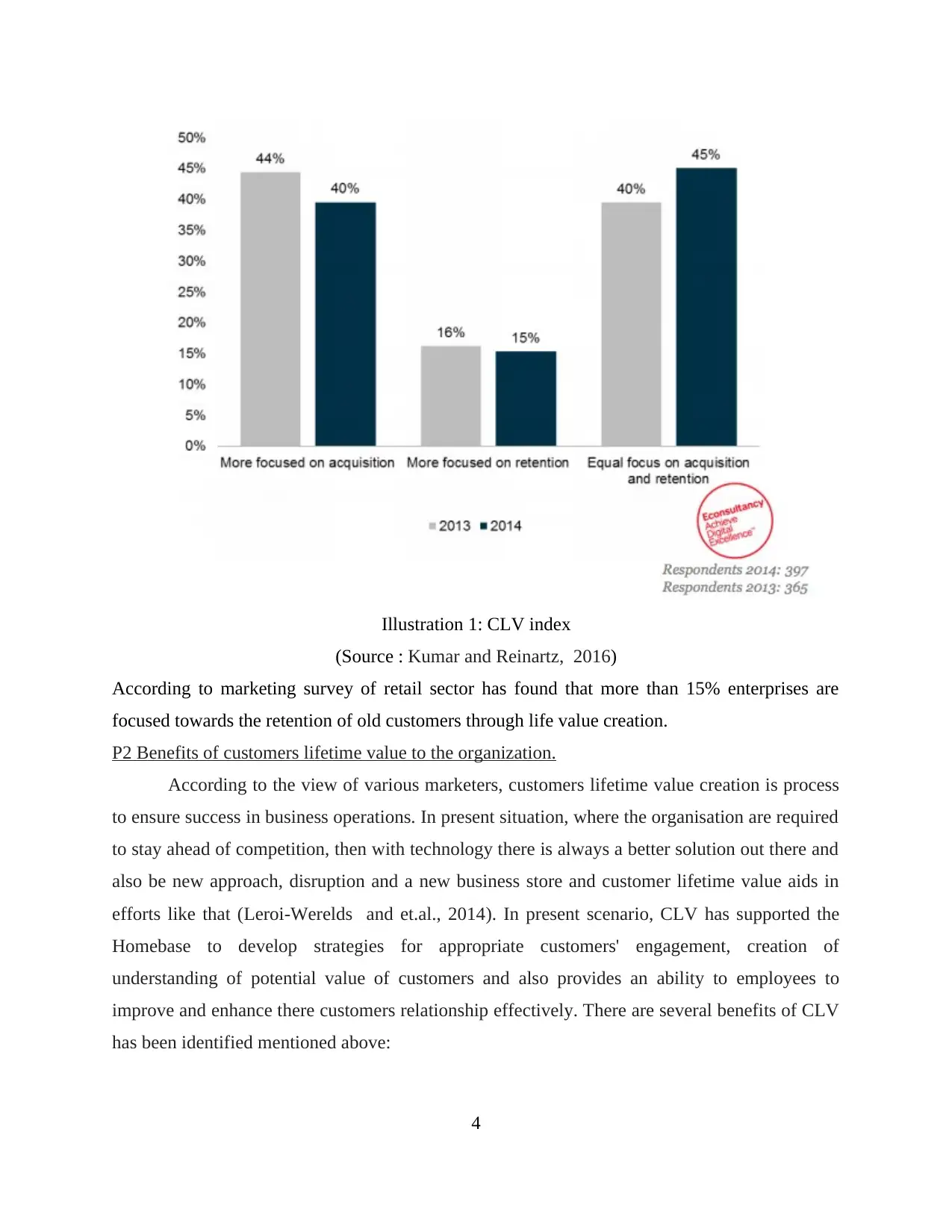
According to marketing survey of retail sector has found that more than 15% enterprises are
focused towards the retention of old customers through life value creation.
P2 Benefits of customers lifetime value to the organization.
According to the view of various marketers, customers lifetime value creation is process
to ensure success in business operations. In present situation, where the organisation are required
to stay ahead of competition, then with technology there is always a better solution out there and
also be new approach, disruption and a new business store and customer lifetime value aids in
efforts like that (Leroi-Werelds and et.al., 2014). In present scenario, CLV has supported the
Homebase to develop strategies for appropriate customers' engagement, creation of
understanding of potential value of customers and also provides an ability to employees to
improve and enhance there customers relationship effectively. There are several benefits of CLV
has been identified mentioned above:
4
Illustration 1: CLV index
(Source : Kumar and Reinartz, 2016)
focused towards the retention of old customers through life value creation.
P2 Benefits of customers lifetime value to the organization.
According to the view of various marketers, customers lifetime value creation is process
to ensure success in business operations. In present situation, where the organisation are required
to stay ahead of competition, then with technology there is always a better solution out there and
also be new approach, disruption and a new business store and customer lifetime value aids in
efforts like that (Leroi-Werelds and et.al., 2014). In present scenario, CLV has supported the
Homebase to develop strategies for appropriate customers' engagement, creation of
understanding of potential value of customers and also provides an ability to employees to
improve and enhance there customers relationship effectively. There are several benefits of CLV
has been identified mentioned above:
4
Illustration 1: CLV index
(Source : Kumar and Reinartz, 2016)
⊘ This is a preview!⊘
Do you want full access?
Subscribe today to unlock all pages.
Trusted by 1+ million students worldwide
Effective segmentation of customers: It is the most important factor that helps in effective
customers' identification and segmentation in order to offer customized services, leading
to the profile depends upon the dynamic pricing for receiving the maximum profits over
single customer (Martinsuo and Killen, 2014). Further, targeting of customer by manager
of Home-base is based on potential of values potentials and increasing the accuracy of
forecasting accuracy and leading to the conversion ratios through the segmentation. It
also provides an indication to the management related to the worth of lead and also
determined amount which is inured to covert the same.
Proper forecasting: Manager of Homebase will create a better for availability of services
or products by predicting the future demand of customers through use of CLV. In this
context, it helps the organisation to manage its optimum investments in assets, workers
and inventory which is based on the demand of its customer (Hammer, 2015). Further, it
also in cutting down the loss of productivity by guiding down the use the better resource
allocation strategies. In case of wide range of products and its categories, purchase
predication probabilities for every single product category will provide ability to home
base to effectively allocate resources which leads to higher profits.
Re development of customer loyalty: Customers continuous values will be considered as
an effective indication of improvement in operational efficiency of Homebase and
reduction of customers dissatisfaction towards its products and services in retail market
(Xu, Peak and Prybutok, 2015). A good understanding of requirement of customer and its
behaviour will completely support helps in improving the loyalty of customer for a
longer time duration. On the basis of this knowledge, Homebase can also redesign their
loyalty plans to develop and make them more appropriate and effective.
Retention of customers. Customers lifetime value creation will also provide long way in
predicting vessel and provides an ability to design of new programs for reducing
customer attrition. Home base can also priortize on which the customers needs to win
back, develop strategies and implement strategies for growth and development.
Thus, it can be said that customer's lifetime value is just an aspect that level of
involvement nad advantage might differ depends upon the business model of Homebase in place.
Further, there will be a lot assumptions that are responsible for process of calculating the lifetime
value. This will help the Home base to gain a better share of the market and help the company to
5
customers' identification and segmentation in order to offer customized services, leading
to the profile depends upon the dynamic pricing for receiving the maximum profits over
single customer (Martinsuo and Killen, 2014). Further, targeting of customer by manager
of Home-base is based on potential of values potentials and increasing the accuracy of
forecasting accuracy and leading to the conversion ratios through the segmentation. It
also provides an indication to the management related to the worth of lead and also
determined amount which is inured to covert the same.
Proper forecasting: Manager of Homebase will create a better for availability of services
or products by predicting the future demand of customers through use of CLV. In this
context, it helps the organisation to manage its optimum investments in assets, workers
and inventory which is based on the demand of its customer (Hammer, 2015). Further, it
also in cutting down the loss of productivity by guiding down the use the better resource
allocation strategies. In case of wide range of products and its categories, purchase
predication probabilities for every single product category will provide ability to home
base to effectively allocate resources which leads to higher profits.
Re development of customer loyalty: Customers continuous values will be considered as
an effective indication of improvement in operational efficiency of Homebase and
reduction of customers dissatisfaction towards its products and services in retail market
(Xu, Peak and Prybutok, 2015). A good understanding of requirement of customer and its
behaviour will completely support helps in improving the loyalty of customer for a
longer time duration. On the basis of this knowledge, Homebase can also redesign their
loyalty plans to develop and make them more appropriate and effective.
Retention of customers. Customers lifetime value creation will also provide long way in
predicting vessel and provides an ability to design of new programs for reducing
customer attrition. Home base can also priortize on which the customers needs to win
back, develop strategies and implement strategies for growth and development.
Thus, it can be said that customer's lifetime value is just an aspect that level of
involvement nad advantage might differ depends upon the business model of Homebase in place.
Further, there will be a lot assumptions that are responsible for process of calculating the lifetime
value. This will help the Home base to gain a better share of the market and help the company to
5
Paraphrase This Document
Need a fresh take? Get an instant paraphrase of this document with our AI Paraphraser
meet the requirements of the customers and gain a better revenue in return of the resources it has
implemented (Glennon and et.al., 2016).
P3 Factors influence customers lifetime values
In this competitive business environment, Marketers have faced several challenges in
influencing the customer's development of effective relationship so that they will purchase the
products and services. Marketers of Homebase also have major responsibilities in order to
increase the customer's lifetime values towards their stores there are several factors that has
provided major impact on the loyalty of customers towards increasing the lifetime achievement
of enterprise. Business to consumer is an important part of business or its transaction that
conducted directly between a organization and its consumers who are considered as the end users
of their products and services (Hsiao, Lee and Chen, 2015). CLV in business to customers is
very also an influencing factor that clearly implies that Homebase needs to analyse expectation
of end users of their because their behaviour towards the product also affects sale of enterprise.
B2B in many countries refers to the situation in which the organisation makes a commercial
transaction with another for example: Home base started sourcing its products from other retail
organisation, a business resells products and services produced by others. It also provides CLV
towards the products and services as the customers will not purchase the products of other
brands.
There some important factors have been identified which provides a major impact on the
customers' lifetime values towards the Homebase retail brand are as follows:
Long term relationships: According to marketers, it an essential factor that provides an
understanding development long term relationship by companies with their customers
across the countries is every much important as it positive impact by increasing
Customers life values towards the brand (Keränen and Jalkala, 2014). In Homebase,
manager needs to use an appropriate communication like Email, digital advertisement
and online marketing so that they will remain in touch with their target customers.
Further, creating of strategic partnership with their customer;s business is best and easiest
way for Home base to build trust and create a lifetime customers by referring their
business and acquiring products and using their services.
Brand loyalty: Loyalty of customers towards brand is also considered as important factor
that influence the values and behaviour of customers. It is also analysed that behaviours
6
implemented (Glennon and et.al., 2016).
P3 Factors influence customers lifetime values
In this competitive business environment, Marketers have faced several challenges in
influencing the customer's development of effective relationship so that they will purchase the
products and services. Marketers of Homebase also have major responsibilities in order to
increase the customer's lifetime values towards their stores there are several factors that has
provided major impact on the loyalty of customers towards increasing the lifetime achievement
of enterprise. Business to consumer is an important part of business or its transaction that
conducted directly between a organization and its consumers who are considered as the end users
of their products and services (Hsiao, Lee and Chen, 2015). CLV in business to customers is
very also an influencing factor that clearly implies that Homebase needs to analyse expectation
of end users of their because their behaviour towards the product also affects sale of enterprise.
B2B in many countries refers to the situation in which the organisation makes a commercial
transaction with another for example: Home base started sourcing its products from other retail
organisation, a business resells products and services produced by others. It also provides CLV
towards the products and services as the customers will not purchase the products of other
brands.
There some important factors have been identified which provides a major impact on the
customers' lifetime values towards the Homebase retail brand are as follows:
Long term relationships: According to marketers, it an essential factor that provides an
understanding development long term relationship by companies with their customers
across the countries is every much important as it positive impact by increasing
Customers life values towards the brand (Keränen and Jalkala, 2014). In Homebase,
manager needs to use an appropriate communication like Email, digital advertisement
and online marketing so that they will remain in touch with their target customers.
Further, creating of strategic partnership with their customer;s business is best and easiest
way for Home base to build trust and create a lifetime customers by referring their
business and acquiring products and using their services.
Brand loyalty: Loyalty of customers towards brand is also considered as important factor
that influence the values and behaviour of customers. It is also analysed that behaviours
6
consumer also gets affected with the brand loyalty of enterprise in market that determines
reliability of its products in meeting the requirements (Nyadzayo and Khajehzadeh,
2016). In present context, Homebase has developed and implemented various effective
business policies like development of innovative and quality products through research
and providing those products to the people in low prices which increases their brand
loyalty in market also provides a positive influence customers lifetime values towards its
products and services.
Rewards and incentives: companies use all types of offers to get an attention , but they
need to take an incentive scheme which not grabs their customers attention but sustain
them too. Homebase reward system will increase their CLV by promoting customer
loyalty and increasing the profitability in long term.
Providing superior customer service: Study has determined that 54% of people would
switch to another company if an alternative company offers more options in order to
connect them (Nyadzayo and Khajehzadeh, 2016). If the Home base is focusing on
increasing the loyalty and subsequently their CLV, they need to manage and organise
their communication channels.
Customer experience: It is also considered that previous experience of customers towards
the products of Home base also affects their business CLV as customers having positive
experience will purchase and products also influence the other to purchase their products
simultaneously if the experience of customers is negative then they will not purchase
products in future and also influence other value towards the brand.
Consumer purchasing: Purchasing capacity of consumers lays major and important impact on
the operations of Homebase. This will lead the company to provide better services to its
customers and tends to fulfil their requirements in effective manner.
Customer loyalty: It is also crucial factor which is required to be achieved by Homebase and
needs to be taken in to consideration by organisation. The loyal customer will help the company
to gain a better productivity and meet the requirements of the company.
Services by company: The services or the products that are been produced by the company will
have a deep impact on the operations of the company that will help the company to gain a better
customer satisfaction level.
7
reliability of its products in meeting the requirements (Nyadzayo and Khajehzadeh,
2016). In present context, Homebase has developed and implemented various effective
business policies like development of innovative and quality products through research
and providing those products to the people in low prices which increases their brand
loyalty in market also provides a positive influence customers lifetime values towards its
products and services.
Rewards and incentives: companies use all types of offers to get an attention , but they
need to take an incentive scheme which not grabs their customers attention but sustain
them too. Homebase reward system will increase their CLV by promoting customer
loyalty and increasing the profitability in long term.
Providing superior customer service: Study has determined that 54% of people would
switch to another company if an alternative company offers more options in order to
connect them (Nyadzayo and Khajehzadeh, 2016). If the Home base is focusing on
increasing the loyalty and subsequently their CLV, they need to manage and organise
their communication channels.
Customer experience: It is also considered that previous experience of customers towards
the products of Home base also affects their business CLV as customers having positive
experience will purchase and products also influence the other to purchase their products
simultaneously if the experience of customers is negative then they will not purchase
products in future and also influence other value towards the brand.
Consumer purchasing: Purchasing capacity of consumers lays major and important impact on
the operations of Homebase. This will lead the company to provide better services to its
customers and tends to fulfil their requirements in effective manner.
Customer loyalty: It is also crucial factor which is required to be achieved by Homebase and
needs to be taken in to consideration by organisation. The loyal customer will help the company
to gain a better productivity and meet the requirements of the company.
Services by company: The services or the products that are been produced by the company will
have a deep impact on the operations of the company that will help the company to gain a better
customer satisfaction level.
7
⊘ This is a preview!⊘
Do you want full access?
Subscribe today to unlock all pages.
Trusted by 1+ million students worldwide
TASK 2
P4 Types Market segmentation strategies that can be applied to customers base.
Segmentation is considered as important process use dividing large unit in to various
small units which also have more or less similar characteristics. Segmentation of market is
considered as marketing concept used for bifurcating the complete market set up within the
smaller subsets comparing similar of consumers with the similar taste, demand and preference. It
is a small unit within large market consists of like minded individuals (Kotler, 2015). In present
context, as marketing manager of Homebase, it is also identified that market segmentation ,
targeting of customers from the segmentation and positioning of brand also plays an important in
identification of lifetime value opportunities.
Effective segmentation of market will enable the brand to increase its sale by influencing its
customers to purchase the products which useful for them to fulfil their requirements. CLV gets
increased when the organization will develop its products as per expectation of customers
(McMurrian and Matulich, 2016).
Targeting is also important process in which the companies will target a particular people
in selected segments for analysing there demands towards the products and services so that they
will able to develop those products and fulfil the requirements of customers. Further, It is also
targeting of customers also helps the organisation in increasing their CLV by de terming their
present and future success of business. By targeting of customers Homebase will be able to
analyse the requirements of its customers to develop new products and service. These products
will meet the expectation of people and develops their loyalty towards which tends to rise CLV.
There are some important kinds of market segmentation strategies have been identified by the
organization with an aim to provide the major support to rise in practical services that needs to
be taken in to consideration by the organization which are as follows:
Geographic segmentation: It is type of segmentation strategy in which the company will
divide its market on the geography. It is analysed as important for the marketers as
customers belonging to different regions have different needs (Homburg, Jozić and
Kuehnl, 2017). In present context, customers lifetime value has to be created by the
organization on the basis of geographic segmentation of its market in which they will
target their customers on the basis of state, country, college and community etc.
Homebase is the retail sector organization which can also use these type of segmentation
8
P4 Types Market segmentation strategies that can be applied to customers base.
Segmentation is considered as important process use dividing large unit in to various
small units which also have more or less similar characteristics. Segmentation of market is
considered as marketing concept used for bifurcating the complete market set up within the
smaller subsets comparing similar of consumers with the similar taste, demand and preference. It
is a small unit within large market consists of like minded individuals (Kotler, 2015). In present
context, as marketing manager of Homebase, it is also identified that market segmentation ,
targeting of customers from the segmentation and positioning of brand also plays an important in
identification of lifetime value opportunities.
Effective segmentation of market will enable the brand to increase its sale by influencing its
customers to purchase the products which useful for them to fulfil their requirements. CLV gets
increased when the organization will develop its products as per expectation of customers
(McMurrian and Matulich, 2016).
Targeting is also important process in which the companies will target a particular people
in selected segments for analysing there demands towards the products and services so that they
will able to develop those products and fulfil the requirements of customers. Further, It is also
targeting of customers also helps the organisation in increasing their CLV by de terming their
present and future success of business. By targeting of customers Homebase will be able to
analyse the requirements of its customers to develop new products and service. These products
will meet the expectation of people and develops their loyalty towards which tends to rise CLV.
There are some important kinds of market segmentation strategies have been identified by the
organization with an aim to provide the major support to rise in practical services that needs to
be taken in to consideration by the organization which are as follows:
Geographic segmentation: It is type of segmentation strategy in which the company will
divide its market on the geography. It is analysed as important for the marketers as
customers belonging to different regions have different needs (Homburg, Jozić and
Kuehnl, 2017). In present context, customers lifetime value has to be created by the
organization on the basis of geographic segmentation of its market in which they will
target their customers on the basis of state, country, college and community etc.
Homebase is the retail sector organization which can also use these type of segmentation
8
Paraphrase This Document
Need a fresh take? Get an instant paraphrase of this document with our AI Paraphraser
for influencing their customers to purchase their products and services which also tends
to rise in customer lifetime values. It helps the marketers of company to draft their
personalized marketing campaigns for every market segments in which they found their
potential customers able to purchase its products.
Demographic: This is also important strategy of market segmentation which is used to
divide the market and customers on the basis of demographic variable like age, gender,
marital status, income, religion and race etc. (Martinsuo and Killen, 2014). Further, it is
also considered as one of the most common practice of segmentation which is also useful
for Homebase for analysing the expectation and values of consumer towards the products
in B2C marketing. Segmentation based on this strategy will also be useful for enterprise
in increasing their sale of their products as they will have to develop wide variety of
products to meet the value and expectation of customers.
Psycho-graphic segmentation: Most effective and useful strategy of market
segmentation which implies company needs to divide their customers on the basis of their
personality , lifestyle and attitude. Company based on this process of segmentation works
on premise that buying behaviour of consumer will be influenced by his personality and
life style. This will further influence the purchasing decision of consumers to the great
extent.
Behavioural segmentation: From the effective analysis, it has been identified that
market can also be segmented by the organization on the basis customer's behaviour,
usage, preference, choices and decision making (Hammer, 2015). In this, Homebase
segments are usually divided on the basis of customer's knowledge of the product and its
usage. Managers of company needs to analyse that the knowledge and usage of product
affects the buying decision of their customers and also affects their business decision
along with the products and services. Marketers in this strategies will focus on analysing
the products demands of customer so that they will be to provide them products which
meet their expectation and creates brand loyalty. This process will tend to develop
lifetime value of products between the target customers.
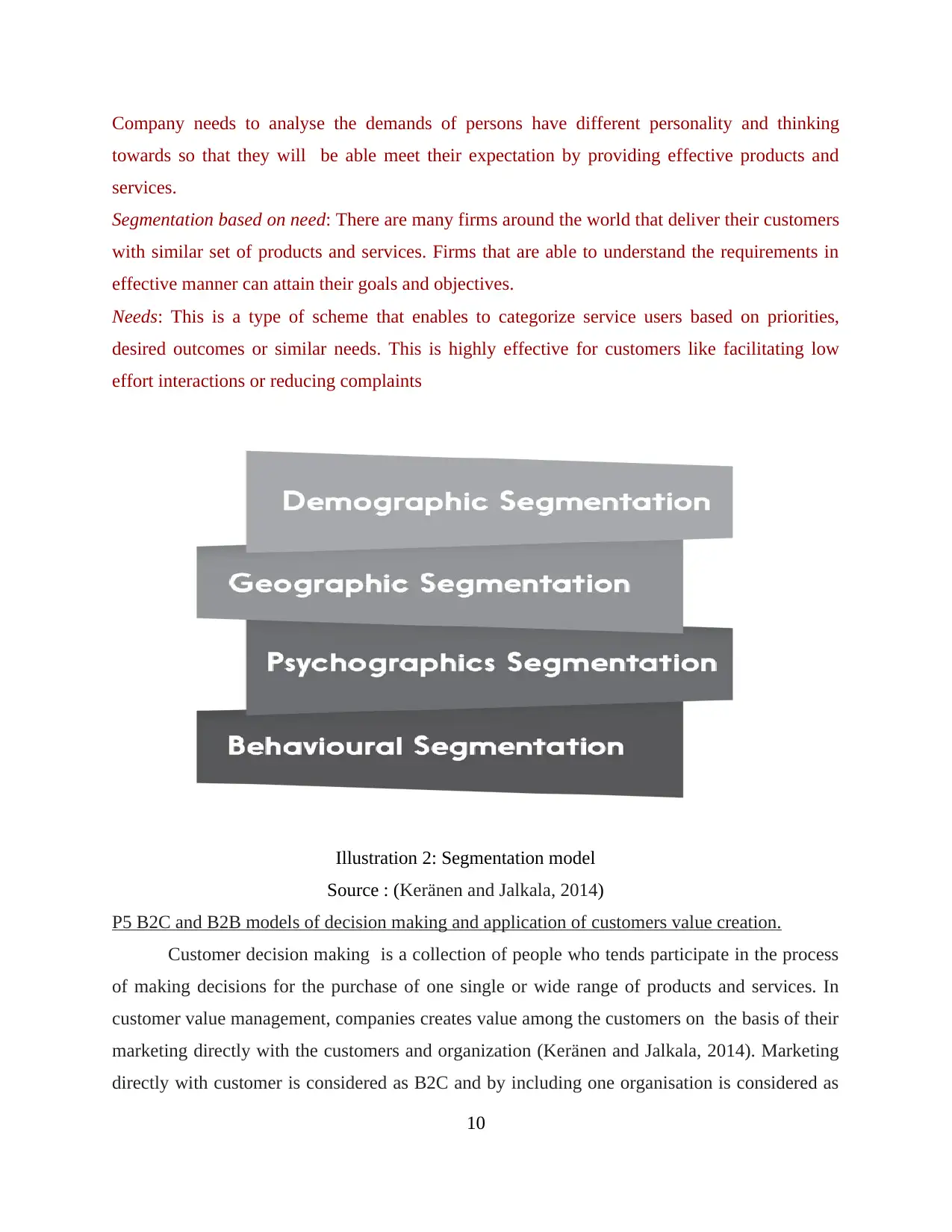
After making an analysis of these strategies, it can be said that Psycho-graphic
segmentation is most appropriate for the organisation in order to create lifetime value by
targeting the customer on the basis of their personality which affects the buying decisions.
9
to rise in customer lifetime values. It helps the marketers of company to draft their
personalized marketing campaigns for every market segments in which they found their
potential customers able to purchase its products.
Demographic: This is also important strategy of market segmentation which is used to
divide the market and customers on the basis of demographic variable like age, gender,
marital status, income, religion and race etc. (Martinsuo and Killen, 2014). Further, it is
also considered as one of the most common practice of segmentation which is also useful
for Homebase for analysing the expectation and values of consumer towards the products
in B2C marketing. Segmentation based on this strategy will also be useful for enterprise
in increasing their sale of their products as they will have to develop wide variety of
products to meet the value and expectation of customers.
Psycho-graphic segmentation: Most effective and useful strategy of market
segmentation which implies company needs to divide their customers on the basis of their
personality , lifestyle and attitude. Company based on this process of segmentation works
on premise that buying behaviour of consumer will be influenced by his personality and
life style. This will further influence the purchasing decision of consumers to the great
extent.
Behavioural segmentation: From the effective analysis, it has been identified that
market can also be segmented by the organization on the basis customer's behaviour,
usage, preference, choices and decision making (Hammer, 2015). In this, Homebase
segments are usually divided on the basis of customer's knowledge of the product and its
usage. Managers of company needs to analyse that the knowledge and usage of product
affects the buying decision of their customers and also affects their business decision
along with the products and services. Marketers in this strategies will focus on analysing
the products demands of customer so that they will be to provide them products which
meet their expectation and creates brand loyalty. This process will tend to develop
lifetime value of products between the target customers.
After making an analysis of these strategies, it can be said that Psycho-graphic
segmentation is most appropriate for the organisation in order to create lifetime value by
targeting the customer on the basis of their personality which affects the buying decisions.
9
Company needs to analyse the demands of persons have different personality and thinking
towards so that they will be able meet their expectation by providing effective products and
services.
Segmentation based on need: There are many firms around the world that deliver their customers
with similar set of products and services. Firms that are able to understand the requirements in
effective manner can attain their goals and objectives.
Needs: This is a type of scheme that enables to categorize service users based on priorities,
desired outcomes or similar needs. This is highly effective for customers like facilitating low
effort interactions or reducing complaints
P5 B2C and B2B models of decision making and application of customers value creation.
Customer decision making is a collection of people who tends participate in the process
of making decisions for the purchase of one single or wide range of products and services. In
customer value management, companies creates value among the customers on the basis of their
marketing directly with the customers and organization (Keränen and Jalkala, 2014). Marketing
directly with customer is considered as B2C and by including one organisation is considered as
10
Illustration 2: Segmentation model
Source : (Keränen and Jalkala, 2014)
towards so that they will be able meet their expectation by providing effective products and
services.
Segmentation based on need: There are many firms around the world that deliver their customers
with similar set of products and services. Firms that are able to understand the requirements in
effective manner can attain their goals and objectives.
Needs: This is a type of scheme that enables to categorize service users based on priorities,
desired outcomes or similar needs. This is highly effective for customers like facilitating low
effort interactions or reducing complaints
P5 B2C and B2B models of decision making and application of customers value creation.
Customer decision making is a collection of people who tends participate in the process
of making decisions for the purchase of one single or wide range of products and services. In
customer value management, companies creates value among the customers on the basis of their
marketing directly with the customers and organization (Keränen and Jalkala, 2014). Marketing
directly with customer is considered as B2C and by including one organisation is considered as
10
Illustration 2: Segmentation model
Source : (Keränen and Jalkala, 2014)
⊘ This is a preview!⊘
Do you want full access?
Subscribe today to unlock all pages.
Trusted by 1+ million students worldwide

1 out of 18


Related Documents


Your All-in-One AI-Powered Toolkit for Academic Success.
+13062052269
info@desklib.com
Available 24*7 on WhatsApp / Email
![[object Object]](/_next/static/media/star-bottom.7253800d.svg)
Unlock your academic potential
Copyright © 2020–2026 A2Z Services. All Rights Reserved. Developed and managed by ZUCOL.