NURS2004: Detailed Care Plan for an Elderly CVA Patient
VerifiedAdded on 2023/06/11
|11
|2920
|132
Report
AI Summary
This assignment presents a detailed care plan for an 83-year-old patient, Harold Graeme Blake, admitted to the hospital with a history of left cerebral vascular accident (CVA) and angina. The care plan addresses key issues arising from the CVA, including impaired verbal communication, self-care deficit, risk for impaired skin integrity, risk for injury, impaired physical mobility, and deficient knowledge. Interventions, short-term and long-term goals are outlined to improve patient outcomes. The plan also considers legal and ethical factors, such as informed consent and patient confidentiality, along with the importance of interprofessional collaboration involving medical officers, speech therapists, and physiotherapists to ensure comprehensive care and facilitate the patient's recovery.
Running head: CRITICAL NURSING CARE
CRITICAL NURSING CARE
Name of the Student:
Name of the University:
Author note:
CRITICAL NURSING CARE
Name of the Student:
Name of the University:
Author note:

Paraphrase This Document
Need a fresh take? Get an instant paraphrase of this document with our AI Paraphraser

1CRITICAL NURSING CARE
Table of Contents
Introduction......................................................................................................................................2
Plan of Care.....................................................................................................................................2
Impaired Verbal Communication................................................................................................3
Self Care Deficit..........................................................................................................................3
Risk for Impaired Skin Integrity..................................................................................................4
Risk for Injury..............................................................................................................................5
Impaired Physical Mobility.........................................................................................................5
Deficient Knowledge...................................................................................................................6
Legal and Ethical Considerations for the Care................................................................................6
Inter Professional Collaboration and referral..................................................................................7
Conclusion.......................................................................................................................................7
Reference:........................................................................................................................................9
Table of Contents
Introduction......................................................................................................................................2
Plan of Care.....................................................................................................................................2
Impaired Verbal Communication................................................................................................3
Self Care Deficit..........................................................................................................................3
Risk for Impaired Skin Integrity..................................................................................................4
Risk for Injury..............................................................................................................................5
Impaired Physical Mobility.........................................................................................................5
Deficient Knowledge...................................................................................................................6
Legal and Ethical Considerations for the Care................................................................................6
Inter Professional Collaboration and referral..................................................................................7
Conclusion.......................................................................................................................................7
Reference:........................................................................................................................................9
2CRITICAL NURSING CARE
1. Introduction
The case study is about the 83 years old patient Harold Graeme Blake, who has a past
medical history of left cerebral vascular attack or CVA and Angina and is admitted in the
hospital with an episode of Angina and another cerebral vascular attack. He got the attack while
he was waiting for taxi on his way to hospital for outpatient appointment and thus, he is admitted
in the emergency department. The purpose of the paper is to provide a plan care for the patient
based on second day observation. The following paper will discuss briefly about the consequence
of CVA regarding deficient knowledge, impaired verbal communication, impaired skin integrity,
self-care deficit, impaired mobility and risk of injury. The paper will discuss about the effective
intervention, short-term and long-term goal in order to provide better care service to the patient.
The assignment will provide an idea about the ethical and legal consideration and inter
professional collaboration regarding the care, which could help Harold to get rid of the illness in
an effective manner.
2. Plan of Care
Plan of care or care plan is defined as the outline of nursing process that includes all
central requirements of the patient and effective strategies for meeting them. It is a process of
documentation during the time of admission of the patient and remains in the state of continuous
change by the caring staff of the patient according to the diagnosis, possible intervention and
expected outcomes in order to ensure the consistency of the care service. It helps the nursing
staffs to communicate and organize the process of care in order to provide fruitful outcomes
(Alligood 2013).
1. Introduction
The case study is about the 83 years old patient Harold Graeme Blake, who has a past
medical history of left cerebral vascular attack or CVA and Angina and is admitted in the
hospital with an episode of Angina and another cerebral vascular attack. He got the attack while
he was waiting for taxi on his way to hospital for outpatient appointment and thus, he is admitted
in the emergency department. The purpose of the paper is to provide a plan care for the patient
based on second day observation. The following paper will discuss briefly about the consequence
of CVA regarding deficient knowledge, impaired verbal communication, impaired skin integrity,
self-care deficit, impaired mobility and risk of injury. The paper will discuss about the effective
intervention, short-term and long-term goal in order to provide better care service to the patient.
The assignment will provide an idea about the ethical and legal consideration and inter
professional collaboration regarding the care, which could help Harold to get rid of the illness in
an effective manner.
2. Plan of Care
Plan of care or care plan is defined as the outline of nursing process that includes all
central requirements of the patient and effective strategies for meeting them. It is a process of
documentation during the time of admission of the patient and remains in the state of continuous
change by the caring staff of the patient according to the diagnosis, possible intervention and
expected outcomes in order to ensure the consistency of the care service. It helps the nursing
staffs to communicate and organize the process of care in order to provide fruitful outcomes
(Alligood 2013).
⊘ This is a preview!⊘
Do you want full access?
Subscribe today to unlock all pages.

Trusted by 1+ million students worldwide
3CRITICAL NURSING CARE
2.1 Impaired Verbal Communication
Impaired verbal communication is one of the major problems that causes due to CVA.
CVA interferes in the process of cerebral circulation, which results in neuromuscular damage
(De-Marchis et al. 2014). The consequence of the incident includes general fatigue, limited
movement of the muscle and oral weakness, thus, the patient could suffer from improper
verbalization (Mazaux et al. 2013). It is important to include the communication issues of Harold
in the care plan in order to understand the level of difficulties. The effective intervention should
contain comfortable communication process. The nurses need to understand the needs of the
patient and observe the non-verbal cues of the patient. Nurses should maintain unhurried manner
and calm process during communicating with the patient (Gregory and Bryan 2015). Destructive
objects such as television, radio or phone need to be kept away during the time of conversation.
It is important to provide ample time to the patient to respond so that he feels comfortable;
otherwise, it could act as a trigger to Angina. The short-time goal regarding this is to help Harold
to understand words and long-term goal is to improve his communication skill. Further, the
patient could refer to a speech therapist that can communicate and understand the problem in an
effective manner and provide proper therapies to counter the issue.
2.2 Self Care Deficit
Self-care deficit is the secondary consequence of CVA (Clark et al. 2014). It is mainly
caused due to the destruction of motor neuron (De-Marchis et al. 2014). As a result, the patient
face difficulties in activities of daily living or ADLs, for example, the patient faces problem
related to eating, dressing, bathing and other regular activities. Thus, the plan of care should
include proper care process in order to address the problem of self-care deficit (Clark et al.
2014). The interventions should include providing adequate resources to make the patient self-
2.1 Impaired Verbal Communication
Impaired verbal communication is one of the major problems that causes due to CVA.
CVA interferes in the process of cerebral circulation, which results in neuromuscular damage
(De-Marchis et al. 2014). The consequence of the incident includes general fatigue, limited
movement of the muscle and oral weakness, thus, the patient could suffer from improper
verbalization (Mazaux et al. 2013). It is important to include the communication issues of Harold
in the care plan in order to understand the level of difficulties. The effective intervention should
contain comfortable communication process. The nurses need to understand the needs of the
patient and observe the non-verbal cues of the patient. Nurses should maintain unhurried manner
and calm process during communicating with the patient (Gregory and Bryan 2015). Destructive
objects such as television, radio or phone need to be kept away during the time of conversation.
It is important to provide ample time to the patient to respond so that he feels comfortable;
otherwise, it could act as a trigger to Angina. The short-time goal regarding this is to help Harold
to understand words and long-term goal is to improve his communication skill. Further, the
patient could refer to a speech therapist that can communicate and understand the problem in an
effective manner and provide proper therapies to counter the issue.
2.2 Self Care Deficit
Self-care deficit is the secondary consequence of CVA (Clark et al. 2014). It is mainly
caused due to the destruction of motor neuron (De-Marchis et al. 2014). As a result, the patient
face difficulties in activities of daily living or ADLs, for example, the patient faces problem
related to eating, dressing, bathing and other regular activities. Thus, the plan of care should
include proper care process in order to address the problem of self-care deficit (Clark et al.
2014). The interventions should include providing adequate resources to make the patient self-
Paraphrase This Document
Need a fresh take? Get an instant paraphrase of this document with our AI Paraphraser
4CRITICAL NURSING CARE
independence. Proper observation is needed in order to understand the weakness of the patient
(Harkness et al. 2014). The nurses should allocate some task to Harold, like dressing, walking,
writing and feed himself. It will help to build self-confidence. It is important to provide proper
environment to carry out such tasks. The nurses should keep patience and provide enough time to
the patient to complete the tasks. The short-term goal related to Harold is inspire him to do his
own work and long-term goal is to make him self-dependent. For fast recovery, the patient could
refer to a physiotherapist that could provide proper therapies in order to resolve the issue.
2.3 Risk for Impaired Skin Integrity
According to the case study, Harold is unable to move his right and left arm. There is
moderate weakness in his legs as well. Thus, he is resting in the bed. Such situation could
increase the friction and pressure that can affect blood circulation and cause skin break down.
The consequence leads to the risk of skin impairment that is mainly related to hemiparesis or
hemiplegia (Paganin and Rabelo 2013). Thus, daily observation of the impaired tissue integrity
should be an important part of the care plan. The intervention should include providing proper
risk assessment tools in order to assess the risk factors related to immobility. Nurses should
inform the patient about benefits of using pillow. It is important to turn and position the patient
in every two hours in order to reduce the pressure. Rubbing or scratching the impaired portion
could lead to serious issue, thus, glove or other covers should be provided to the patient if needed
(Holmes et al. 2014). The short-term goal regarding this is to reduce the pressure and long-term
goal is to reduce the risk factors of immobility. Such intervention could improve the blood
circulation and reduce the risk of impaired skin integrity.
independence. Proper observation is needed in order to understand the weakness of the patient
(Harkness et al. 2014). The nurses should allocate some task to Harold, like dressing, walking,
writing and feed himself. It will help to build self-confidence. It is important to provide proper
environment to carry out such tasks. The nurses should keep patience and provide enough time to
the patient to complete the tasks. The short-term goal related to Harold is inspire him to do his
own work and long-term goal is to make him self-dependent. For fast recovery, the patient could
refer to a physiotherapist that could provide proper therapies in order to resolve the issue.
2.3 Risk for Impaired Skin Integrity
According to the case study, Harold is unable to move his right and left arm. There is
moderate weakness in his legs as well. Thus, he is resting in the bed. Such situation could
increase the friction and pressure that can affect blood circulation and cause skin break down.
The consequence leads to the risk of skin impairment that is mainly related to hemiparesis or
hemiplegia (Paganin and Rabelo 2013). Thus, daily observation of the impaired tissue integrity
should be an important part of the care plan. The intervention should include providing proper
risk assessment tools in order to assess the risk factors related to immobility. Nurses should
inform the patient about benefits of using pillow. It is important to turn and position the patient
in every two hours in order to reduce the pressure. Rubbing or scratching the impaired portion
could lead to serious issue, thus, glove or other covers should be provided to the patient if needed
(Holmes et al. 2014). The short-term goal regarding this is to reduce the pressure and long-term
goal is to reduce the risk factors of immobility. Such intervention could improve the blood
circulation and reduce the risk of impaired skin integrity.
5CRITICAL NURSING CARE
2.4 Risk for Injury
In case of CVA, there is high risk of injury as the illness affects the anterior or the middle
cerebral artery. It increases the risk of injury due to fall as many body parts of the patient is not
functioning well. Among the risk of injury, hip fracture is one of the most common issues that
could lead to severe disability (Ambrose, Paul and Hausdorff 2013). Thus, the care plan should
contain the process of managing such risk of injury. The intervention should include keeping the
side rails of the patient’s bed raised in order to protect the patient from falling out of bed. In
order to reduce the pain related to the injury, proper pain assessment need to be provided. The
short-term goal of the intervention is to reduce the risk of falls and long-term goal is to reduce
the risk of getting serious injury that could lead to serious disability. If the intervention fails to
give expected outcomes, the patient could send to other physicians for proper treatment related to
serious injury.
2.5 Impaired Physical Mobility
As mentioned before, CVA affects the cerebral circulation and cause neuromuscular
damage. The motor neuron is the most affected area due to CVA, thus, the receptors in the nerve
fail to detect and transmit the signals (De-Marchis et al. 2014). Such incident could lead to
permanent or temporary restriction to the muscle movement. As mentioned in the case study, the
right arm and the right leg of Harold is affected due to CVA and he is facing difficulties in
moving, thus resting in the bed and nurses assists him to do regular activities. In order to resolve
the issue the care plan should include proper exercise. The exercise should include knee bend,
abdominal tightening exercise, stand on toes and moving hand around, which will be easy to
done by the patient. Mobility device such as,, trapeze and walker should be provided to the
patient (Sricharoenchai et al. 2014). The short-term goal regarding this is to encourage the
2.4 Risk for Injury
In case of CVA, there is high risk of injury as the illness affects the anterior or the middle
cerebral artery. It increases the risk of injury due to fall as many body parts of the patient is not
functioning well. Among the risk of injury, hip fracture is one of the most common issues that
could lead to severe disability (Ambrose, Paul and Hausdorff 2013). Thus, the care plan should
contain the process of managing such risk of injury. The intervention should include keeping the
side rails of the patient’s bed raised in order to protect the patient from falling out of bed. In
order to reduce the pain related to the injury, proper pain assessment need to be provided. The
short-term goal of the intervention is to reduce the risk of falls and long-term goal is to reduce
the risk of getting serious injury that could lead to serious disability. If the intervention fails to
give expected outcomes, the patient could send to other physicians for proper treatment related to
serious injury.
2.5 Impaired Physical Mobility
As mentioned before, CVA affects the cerebral circulation and cause neuromuscular
damage. The motor neuron is the most affected area due to CVA, thus, the receptors in the nerve
fail to detect and transmit the signals (De-Marchis et al. 2014). Such incident could lead to
permanent or temporary restriction to the muscle movement. As mentioned in the case study, the
right arm and the right leg of Harold is affected due to CVA and he is facing difficulties in
moving, thus resting in the bed and nurses assists him to do regular activities. In order to resolve
the issue the care plan should include proper exercise. The exercise should include knee bend,
abdominal tightening exercise, stand on toes and moving hand around, which will be easy to
done by the patient. Mobility device such as,, trapeze and walker should be provided to the
patient (Sricharoenchai et al. 2014). The short-term goal regarding this is to encourage the
⊘ This is a preview!⊘
Do you want full access?
Subscribe today to unlock all pages.
Trusted by 1+ million students worldwide
6CRITICAL NURSING CARE
movement of restricted body parts and long-term goal is to improve the muscle strength and the
mobility of the patient. Further, the patient could refer to physiotherapist that can help to increase
the mobility through proper therapies.
2.6 Deficient Knowledge
Due to lack of knowledge, most of the patient faces difficulties in understanding the
process of treatment. This is mainly due to lack of proper information and less access to
available resources. In order to counter the issue, the nurses should provide enough information
to the patient and his family, so that they could understand the treatment process. The nurses
should assess proper source of information that could help the patient to learn the impact of the
disease and the importance of treatment (Yeh and Park 2015). The short-term goal of providing
knowledge is to create awareness about the illness and the long-term goal is to make the patient
understand the treatment process so that he could contribute in the treatment in order to recover
fast.
3. Legal and Ethical Considerations for the Care
There are some legal and ethical factors that need to be considered by the nurses while
providing care to the patients. One of such important legal factor is informed consent. The
informed consent is refer to the process of obtaining valid consent during admission, treatment or
surgery of the patient. The nurses are bound to inform consent in order to respect the decision of
the patient or their families (Williams and Howe 2013). In case of Harold, he is adult, thus able
to provide valid consent. However, he is unconscious due to his illness. In this case, his wife
Gloria has the right to provide valid consent. Another legal fact is the confidentiality of the
information regarding the treatment of the patient. According to the code of law, all nurses are
movement of restricted body parts and long-term goal is to improve the muscle strength and the
mobility of the patient. Further, the patient could refer to physiotherapist that can help to increase
the mobility through proper therapies.
2.6 Deficient Knowledge
Due to lack of knowledge, most of the patient faces difficulties in understanding the
process of treatment. This is mainly due to lack of proper information and less access to
available resources. In order to counter the issue, the nurses should provide enough information
to the patient and his family, so that they could understand the treatment process. The nurses
should assess proper source of information that could help the patient to learn the impact of the
disease and the importance of treatment (Yeh and Park 2015). The short-term goal of providing
knowledge is to create awareness about the illness and the long-term goal is to make the patient
understand the treatment process so that he could contribute in the treatment in order to recover
fast.
3. Legal and Ethical Considerations for the Care
There are some legal and ethical factors that need to be considered by the nurses while
providing care to the patients. One of such important legal factor is informed consent. The
informed consent is refer to the process of obtaining valid consent during admission, treatment or
surgery of the patient. The nurses are bound to inform consent in order to respect the decision of
the patient or their families (Williams and Howe 2013). In case of Harold, he is adult, thus able
to provide valid consent. However, he is unconscious due to his illness. In this case, his wife
Gloria has the right to provide valid consent. Another legal fact is the confidentiality of the
information regarding the treatment of the patient. According to the code of law, all nurses are
Paraphrase This Document
Need a fresh take? Get an instant paraphrase of this document with our AI Paraphraser
7CRITICAL NURSING CARE
bound to keep confidential the information about the patient and his treatment (Williams and
Howe 2013). Nurses should remember such important factors while providing care to Harold.
The Australian Primary Health Care Nurses Association has provided some code of
ethics regarding nursing that need to be considered by the nurses while providing treatment.
According to the code, the nurses are bound to provide quality nursing to all. The nurses must
respect and value the diversity and decision making power of the patient. They should provide
the best treatment process to the patient according to their illness. They need to build reliable
relationship with the patient so that the patient could tryst them for their treatment (Kangasniemi,
Pakkanen and Korhonen 2015). Thus, the nurses that are providing treatment to Harold need to
consider such factors while handling the case.
4. Inter Professional Collaboration and referral
Inter professional collaboration is a strategy of health care in order to improve the patient
outcomes. It helps to build relationship within different health specialists. The effort of the team
leads to desired outcome for the patient (Reeves et al. 2013). In case of Harold, role of medical
officer is important, as he is the apex body that could introduce the effective intervention
regarding the treatment. In addition, help of a speech therapist is recommended in order to
address the issue of improper verbalization. To improve his mobility, he further refers to a
physiotherapist. Care provided by such experts will help Harold to recover soon.
5. Conclusion
From the above case study, it can be concluded that, the consequences of CVA could lead
to other serious health issues, as the illness cause neuromuscular damage and affect the motor
bound to keep confidential the information about the patient and his treatment (Williams and
Howe 2013). Nurses should remember such important factors while providing care to Harold.
The Australian Primary Health Care Nurses Association has provided some code of
ethics regarding nursing that need to be considered by the nurses while providing treatment.
According to the code, the nurses are bound to provide quality nursing to all. The nurses must
respect and value the diversity and decision making power of the patient. They should provide
the best treatment process to the patient according to their illness. They need to build reliable
relationship with the patient so that the patient could tryst them for their treatment (Kangasniemi,
Pakkanen and Korhonen 2015). Thus, the nurses that are providing treatment to Harold need to
consider such factors while handling the case.
4. Inter Professional Collaboration and referral
Inter professional collaboration is a strategy of health care in order to improve the patient
outcomes. It helps to build relationship within different health specialists. The effort of the team
leads to desired outcome for the patient (Reeves et al. 2013). In case of Harold, role of medical
officer is important, as he is the apex body that could introduce the effective intervention
regarding the treatment. In addition, help of a speech therapist is recommended in order to
address the issue of improper verbalization. To improve his mobility, he further refers to a
physiotherapist. Care provided by such experts will help Harold to recover soon.
5. Conclusion
From the above case study, it can be concluded that, the consequences of CVA could lead
to other serious health issues, as the illness cause neuromuscular damage and affect the motor
8CRITICAL NURSING CARE
neuron. There is a risk of impaired verbal communication, physical mobility, skin integrity and
injury. The patient is also susceptible to self-care deficit. Due to lack of proper information
patient might face difficulties in understanding the treatment process. Thus, proper interventions
are need to be introduced in order to provide effective service. If the interventions are not
satisfactory then the patient might refer to health specialists according to the need. It is expected
that, with the help of such interventions and referrals, desired outcomes will be achieved.
neuron. There is a risk of impaired verbal communication, physical mobility, skin integrity and
injury. The patient is also susceptible to self-care deficit. Due to lack of proper information
patient might face difficulties in understanding the treatment process. Thus, proper interventions
are need to be introduced in order to provide effective service. If the interventions are not
satisfactory then the patient might refer to health specialists according to the need. It is expected
that, with the help of such interventions and referrals, desired outcomes will be achieved.
⊘ This is a preview!⊘
Do you want full access?
Subscribe today to unlock all pages.
Trusted by 1+ million students worldwide
9CRITICAL NURSING CARE
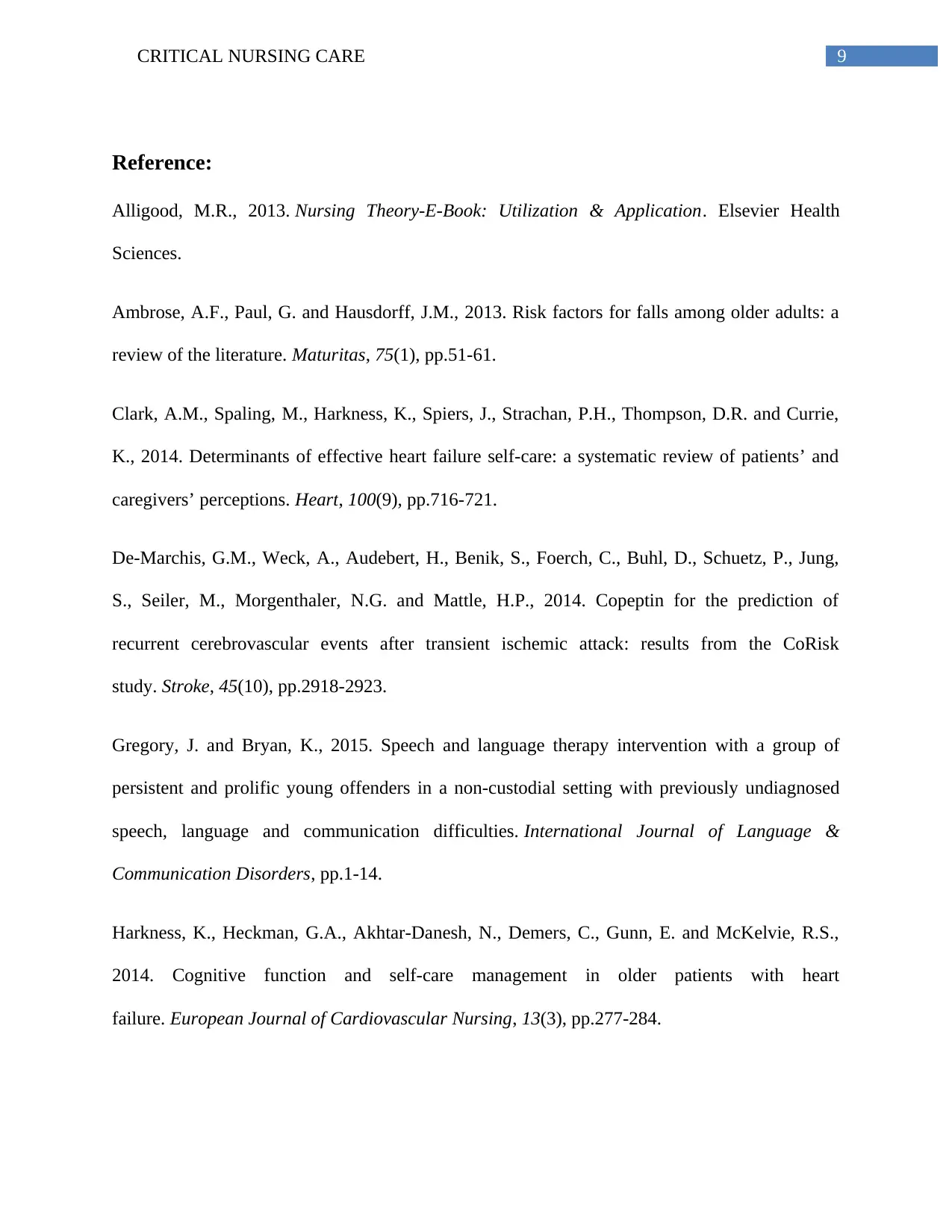
Reference:
Alligood, M.R., 2013. Nursing Theory-E-Book: Utilization & Application. Elsevier Health
Sciences.
Ambrose, A.F., Paul, G. and Hausdorff, J.M., 2013. Risk factors for falls among older adults: a
review of the literature. Maturitas, 75(1), pp.51-61.
Clark, A.M., Spaling, M., Harkness, K., Spiers, J., Strachan, P.H., Thompson, D.R. and Currie,
K., 2014. Determinants of effective heart failure self-care: a systematic review of patients’ and
caregivers’ perceptions. Heart, 100(9), pp.716-721.
De-Marchis, G.M., Weck, A., Audebert, H., Benik, S., Foerch, C., Buhl, D., Schuetz, P., Jung,
S., Seiler, M., Morgenthaler, N.G. and Mattle, H.P., 2014. Copeptin for the prediction of
recurrent cerebrovascular events after transient ischemic attack: results from the CoRisk
study. Stroke, 45(10), pp.2918-2923.
Gregory, J. and Bryan, K., 2015. Speech and language therapy intervention with a group of
persistent and prolific young offenders in a non-custodial setting with previously undiagnosed
speech, language and communication difficulties. International Journal of Language &
Communication Disorders, pp.1-14.
Harkness, K., Heckman, G.A., Akhtar-Danesh, N., Demers, C., Gunn, E. and McKelvie, R.S.,
2014. Cognitive function and self-care management in older patients with heart
failure. European Journal of Cardiovascular Nursing, 13(3), pp.277-284.
Reference:
Alligood, M.R., 2013. Nursing Theory-E-Book: Utilization & Application. Elsevier Health
Sciences.
Ambrose, A.F., Paul, G. and Hausdorff, J.M., 2013. Risk factors for falls among older adults: a
review of the literature. Maturitas, 75(1), pp.51-61.
Clark, A.M., Spaling, M., Harkness, K., Spiers, J., Strachan, P.H., Thompson, D.R. and Currie,
K., 2014. Determinants of effective heart failure self-care: a systematic review of patients’ and
caregivers’ perceptions. Heart, 100(9), pp.716-721.
De-Marchis, G.M., Weck, A., Audebert, H., Benik, S., Foerch, C., Buhl, D., Schuetz, P., Jung,
S., Seiler, M., Morgenthaler, N.G. and Mattle, H.P., 2014. Copeptin for the prediction of
recurrent cerebrovascular events after transient ischemic attack: results from the CoRisk
study. Stroke, 45(10), pp.2918-2923.
Gregory, J. and Bryan, K., 2015. Speech and language therapy intervention with a group of
persistent and prolific young offenders in a non-custodial setting with previously undiagnosed
speech, language and communication difficulties. International Journal of Language &
Communication Disorders, pp.1-14.
Harkness, K., Heckman, G.A., Akhtar-Danesh, N., Demers, C., Gunn, E. and McKelvie, R.S.,
2014. Cognitive function and self-care management in older patients with heart
failure. European Journal of Cardiovascular Nursing, 13(3), pp.277-284.
Paraphrase This Document
Need a fresh take? Get an instant paraphrase of this document with our AI Paraphraser
10CRITICAL NURSING CARE
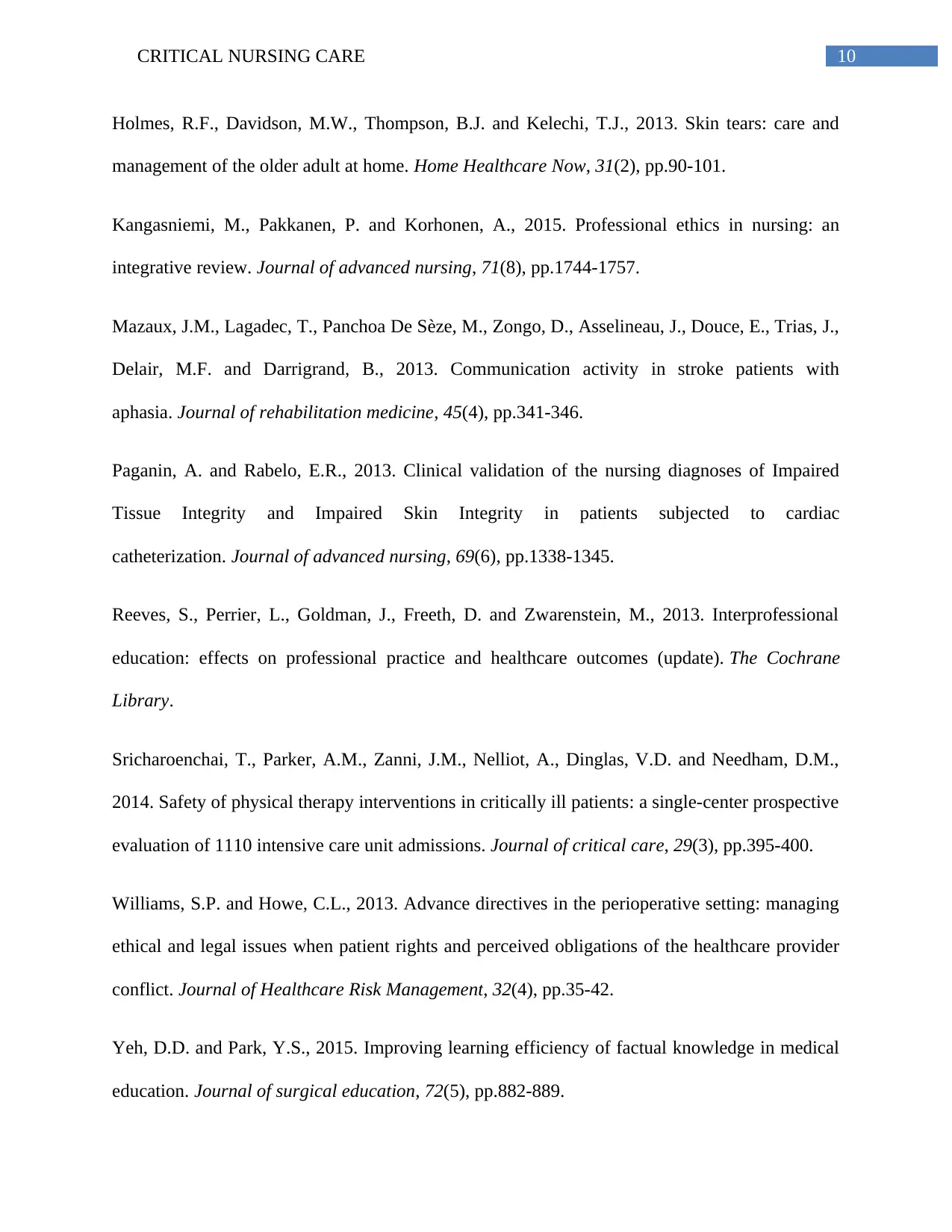
Holmes, R.F., Davidson, M.W., Thompson, B.J. and Kelechi, T.J., 2013. Skin tears: care and
management of the older adult at home. Home Healthcare Now, 31(2), pp.90-101.
Kangasniemi, M., Pakkanen, P. and Korhonen, A., 2015. Professional ethics in nursing: an
integrative review. Journal of advanced nursing, 71(8), pp.1744-1757.
Mazaux, J.M., Lagadec, T., Panchoa De Sèze, M., Zongo, D., Asselineau, J., Douce, E., Trias, J.,
Delair, M.F. and Darrigrand, B., 2013. Communication activity in stroke patients with
aphasia. Journal of rehabilitation medicine, 45(4), pp.341-346.
Paganin, A. and Rabelo, E.R., 2013. Clinical validation of the nursing diagnoses of Impaired
Tissue Integrity and Impaired Skin Integrity in patients subjected to cardiac
catheterization. Journal of advanced nursing, 69(6), pp.1338-1345.
Reeves, S., Perrier, L., Goldman, J., Freeth, D. and Zwarenstein, M., 2013. Interprofessional
education: effects on professional practice and healthcare outcomes (update). The Cochrane
Library.
Sricharoenchai, T., Parker, A.M., Zanni, J.M., Nelliot, A., Dinglas, V.D. and Needham, D.M.,
2014. Safety of physical therapy interventions in critically ill patients: a single-center prospective
evaluation of 1110 intensive care unit admissions. Journal of critical care, 29(3), pp.395-400.
Williams, S.P. and Howe, C.L., 2013. Advance directives in the perioperative setting: managing
ethical and legal issues when patient rights and perceived obligations of the healthcare provider
conflict. Journal of Healthcare Risk Management, 32(4), pp.35-42.
Yeh, D.D. and Park, Y.S., 2015. Improving learning efficiency of factual knowledge in medical
education. Journal of surgical education, 72(5), pp.882-889.
Holmes, R.F., Davidson, M.W., Thompson, B.J. and Kelechi, T.J., 2013. Skin tears: care and
management of the older adult at home. Home Healthcare Now, 31(2), pp.90-101.
Kangasniemi, M., Pakkanen, P. and Korhonen, A., 2015. Professional ethics in nursing: an
integrative review. Journal of advanced nursing, 71(8), pp.1744-1757.
Mazaux, J.M., Lagadec, T., Panchoa De Sèze, M., Zongo, D., Asselineau, J., Douce, E., Trias, J.,
Delair, M.F. and Darrigrand, B., 2013. Communication activity in stroke patients with
aphasia. Journal of rehabilitation medicine, 45(4), pp.341-346.
Paganin, A. and Rabelo, E.R., 2013. Clinical validation of the nursing diagnoses of Impaired
Tissue Integrity and Impaired Skin Integrity in patients subjected to cardiac
catheterization. Journal of advanced nursing, 69(6), pp.1338-1345.
Reeves, S., Perrier, L., Goldman, J., Freeth, D. and Zwarenstein, M., 2013. Interprofessional
education: effects on professional practice and healthcare outcomes (update). The Cochrane
Library.
Sricharoenchai, T., Parker, A.M., Zanni, J.M., Nelliot, A., Dinglas, V.D. and Needham, D.M.,
2014. Safety of physical therapy interventions in critically ill patients: a single-center prospective
evaluation of 1110 intensive care unit admissions. Journal of critical care, 29(3), pp.395-400.
Williams, S.P. and Howe, C.L., 2013. Advance directives in the perioperative setting: managing
ethical and legal issues when patient rights and perceived obligations of the healthcare provider
conflict. Journal of Healthcare Risk Management, 32(4), pp.35-42.
Yeh, D.D. and Park, Y.S., 2015. Improving learning efficiency of factual knowledge in medical
education. Journal of surgical education, 72(5), pp.882-889.

1 out of 11


Related Documents


Your All-in-One AI-Powered Toolkit for Academic Success.
+13062052269
info@desklib.com
Available 24*7 on WhatsApp / Email
![[object Object]](/_next/static/media/star-bottom.7253800d.svg)
Unlock your academic potential
Copyright © 2020–2026 A2Z Services. All Rights Reserved. Developed and managed by ZUCOL.