Case Study Analysis: Cyber Law in Google Gmail and EA Licensing
VerifiedAdded on 2022/10/10
|7
|1671
|448
Case Study
AI Summary
This case study analyzes two significant cyber law cases: Google, Inc. Gmail Litigation and Student-Athlete Name & Likeness Licensing Litigation v. Electronic Arts, Inc. The Google case involves accusations of violating anti-wiretapping laws by reading Gmail users' emails without authorization, raising issues of privacy violations and the application of the Information Technology Act. The student-athlete case concerns the unauthorized use of athletes' names and likenesses by the NCAA, CLC, and EA, focusing on issues of intellectual property rights and the violation of data protection laws, specifically the National ICT Policy and Strategy 2009. The analysis includes the facts of each case, the legal issues presented, the arguments of both sides, and the applicable cyber laws. The student assignment adheres to the APA format with peer-reviewed scholarly references.
Running head: CYBER LAW
Cyber Law
Name of the Student
Name of the University
Author Note
Cyber Law
Name of the Student
Name of the University
Author Note

Paraphrase This Document
Need a fresh take? Get an instant paraphrase of this document with our AI Paraphraser
1CYBER LAW
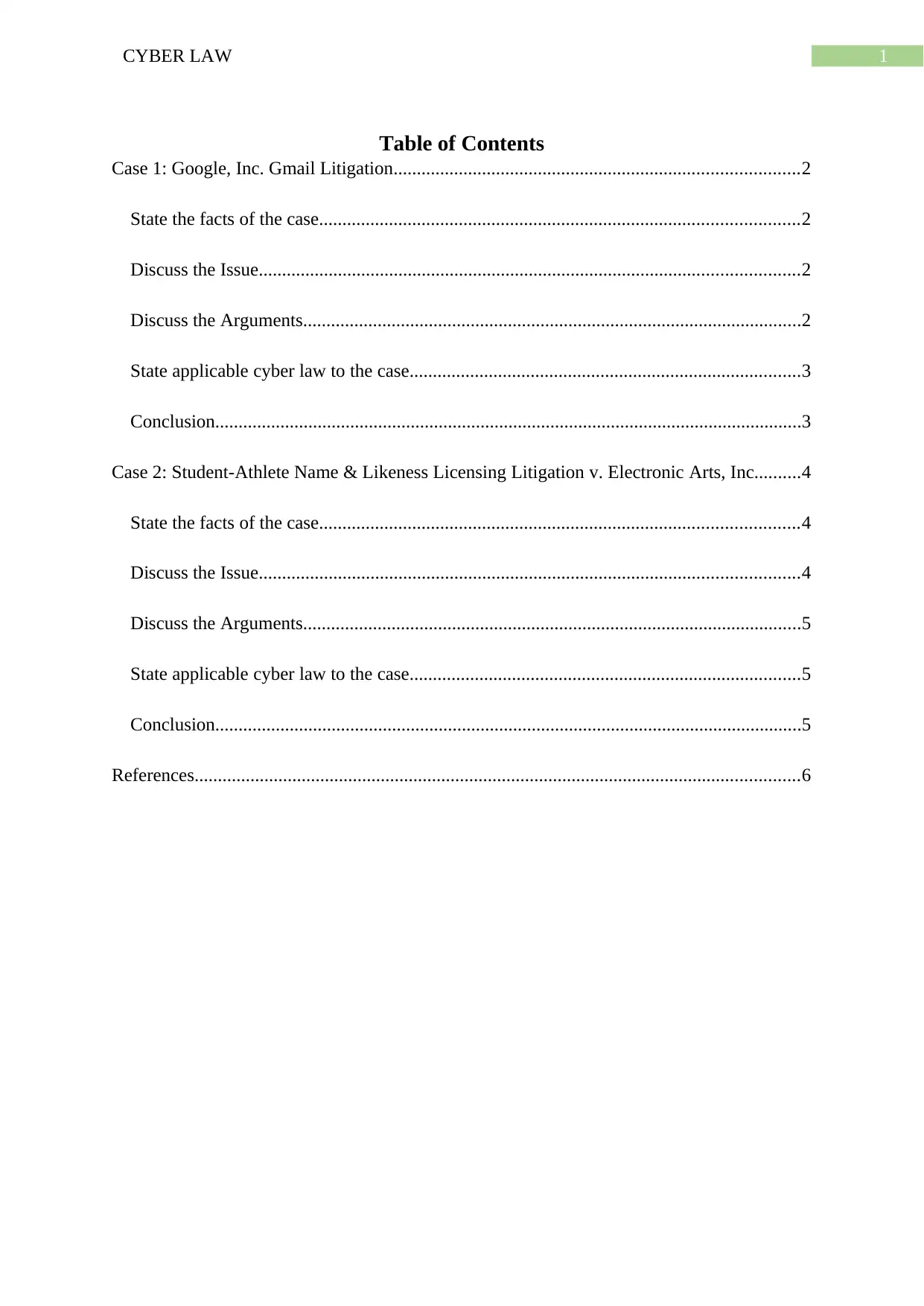
Table of Contents
Case 1: Google, Inc. Gmail Litigation.......................................................................................2
State the facts of the case.......................................................................................................2
Discuss the Issue....................................................................................................................2
Discuss the Arguments...........................................................................................................2
State applicable cyber law to the case....................................................................................3
Conclusion..............................................................................................................................3
Case 2: Student-Athlete Name & Likeness Licensing Litigation v. Electronic Arts, Inc..........4
State the facts of the case.......................................................................................................4
Discuss the Issue....................................................................................................................4
Discuss the Arguments...........................................................................................................5
State applicable cyber law to the case....................................................................................5
Conclusion..............................................................................................................................5
References..................................................................................................................................6
Table of Contents
Case 1: Google, Inc. Gmail Litigation.......................................................................................2
State the facts of the case.......................................................................................................2
Discuss the Issue....................................................................................................................2
Discuss the Arguments...........................................................................................................2
State applicable cyber law to the case....................................................................................3
Conclusion..............................................................................................................................3
Case 2: Student-Athlete Name & Likeness Licensing Litigation v. Electronic Arts, Inc..........4
State the facts of the case.......................................................................................................4
Discuss the Issue....................................................................................................................4
Discuss the Arguments...........................................................................................................5
State applicable cyber law to the case....................................................................................5
Conclusion..............................................................................................................................5
References..................................................................................................................................6
2CYBER LAW
Case 1: Google, Inc. Gmail Litigation
State the facts of the case
Google was accused of reading off the emails from multiple users of Gmail without
authorisation and it had been continuing to read the email services by violating state and
federal anti-wiretapping laws. The plaintiffs, many in number, accused Google of its services
as a consolidated complaint. Court denied in part and granted in part Google's motion and
dismiss the law with leaves to amend. The operation of Gmail by Google was under the
above-mentioned laws as per the state and federal laws, the consolidated complaint by
various plaintiffs against Google wanted to seek damages on behalf of the organisation for its
interception of laws by reading of email over a period of years (Yilma, 2017).
Discuss the Issue
The issue was regarding reading of emails by Google which was considered as
violation of personal privacy. Over a span of two years, the plaintiff's complaint against
Google for reading the emails and the contents by intercepting the sent and received email
changed during transit (Alshammari & Singh, 2018). The interception of the devices we done
by reading in acquiring the content of each of the emails sent or received along with the
purpose of sending and receiving advertisements from the communication that has been done
through email from the end of the recipient of the sender or from both. The acquiring and
reading of email in transit was still affiliated to catch the keywords used in emails and use
them for their own business purpose. The plaintiffs also alleged that Google use this data for
creating user profiles with fake references and be used affiliated data.
Discuss the Arguments
The arguments were raised when the types of email services that Google allows was
found out. It clearly stated that this different but related systems of email delivery here were
Case 1: Google, Inc. Gmail Litigation
State the facts of the case
Google was accused of reading off the emails from multiple users of Gmail without
authorisation and it had been continuing to read the email services by violating state and
federal anti-wiretapping laws. The plaintiffs, many in number, accused Google of its services
as a consolidated complaint. Court denied in part and granted in part Google's motion and
dismiss the law with leaves to amend. The operation of Gmail by Google was under the
above-mentioned laws as per the state and federal laws, the consolidated complaint by
various plaintiffs against Google wanted to seek damages on behalf of the organisation for its
interception of laws by reading of email over a period of years (Yilma, 2017).
Discuss the Issue
The issue was regarding reading of emails by Google which was considered as
violation of personal privacy. Over a span of two years, the plaintiff's complaint against
Google for reading the emails and the contents by intercepting the sent and received email
changed during transit (Alshammari & Singh, 2018). The interception of the devices we done
by reading in acquiring the content of each of the emails sent or received along with the
purpose of sending and receiving advertisements from the communication that has been done
through email from the end of the recipient of the sender or from both. The acquiring and
reading of email in transit was still affiliated to catch the keywords used in emails and use
them for their own business purpose. The plaintiffs also alleged that Google use this data for
creating user profiles with fake references and be used affiliated data.
Discuss the Arguments
The arguments were raised when the types of email services that Google allows was
found out. It clearly stated that this different but related systems of email delivery here were
⊘ This is a preview!⊘
Do you want full access?
Subscribe today to unlock all pages.

Trusted by 1+ million students worldwide
3CYBER LAW
forming an issue over here. The first of the systems is considered as a free service which
makes any user to register with an account with Google with using their Gmail ID. The
second type of operation for Google email is based on the internet service providers where it
enters into the contracts with ISP to provide email service branded by the internet service
providers. The customers of internet service providers can register into the email addresses
through their ISP however the email ids would still be powered by Google (Dunn & Boafo,
2016). The third operation instigates that Google apps for education would be operated by
Google itself which provides email on behalf of educational organisations deliberately
created for alumni, students, staff and faculty. They did not receive any content-based ads
and can obtain to receiving search advertising on their own choice. Receiving or not
receiving these advertisements were the choice of the users that Google agreements with
users clearly state.
State applicable cyber law to the case
The applicable cyber law in this case comes under the Section 10 of Contract Act
under the Information Technology Act in 2000 which denies litigation if any plaintiff that do
not read the terms of agreement properly and files cases against somebody after agreeing to
the online contracts (Mammo, 2016). This makes the court deny any action taken against the
complaint of the plaintiff.
Conclusion
Therefore, it can be concluded by stating that the action for the court case was filed by
the plaintiff without reading the terms of contract when their first trying to open the account
for Google email services. Without reading of the contract is also termed as a negligence
under Information Technology Act and this is why the case against Google was called off.
forming an issue over here. The first of the systems is considered as a free service which
makes any user to register with an account with Google with using their Gmail ID. The
second type of operation for Google email is based on the internet service providers where it
enters into the contracts with ISP to provide email service branded by the internet service
providers. The customers of internet service providers can register into the email addresses
through their ISP however the email ids would still be powered by Google (Dunn & Boafo,
2016). The third operation instigates that Google apps for education would be operated by
Google itself which provides email on behalf of educational organisations deliberately
created for alumni, students, staff and faculty. They did not receive any content-based ads
and can obtain to receiving search advertising on their own choice. Receiving or not
receiving these advertisements were the choice of the users that Google agreements with
users clearly state.
State applicable cyber law to the case
The applicable cyber law in this case comes under the Section 10 of Contract Act
under the Information Technology Act in 2000 which denies litigation if any plaintiff that do
not read the terms of agreement properly and files cases against somebody after agreeing to
the online contracts (Mammo, 2016). This makes the court deny any action taken against the
complaint of the plaintiff.
Conclusion
Therefore, it can be concluded by stating that the action for the court case was filed by
the plaintiff without reading the terms of contract when their first trying to open the account
for Google email services. Without reading of the contract is also termed as a negligence
under Information Technology Act and this is why the case against Google was called off.
Paraphrase This Document
Need a fresh take? Get an instant paraphrase of this document with our AI Paraphraser
4CYBER LAW
Case 2: Student-Athlete Name & Likeness Licensing Litigation v.
Electronic Arts, Inc.
State the facts of the case
This case was built up on the plaintiffs’ complaint against the Defendants National
Collegiate Athletic Association or NCAA, Collegiate Licensing Company or CLC and
Electronic Arts Inc. or EA over the fact that the associations were using their information,
both professional and personal during the ongoing member school and conferences regarding
the ongoing activities where these have been misused (Abraha, 2017). The plaintiffs
complained that the conspiration was against them, who were national level athletes who
have been claiming that their names have been tarnished on the grounds that class members
have been receiving compensations for the commercial exploitations about their names, other
personal information and other during the college playing days.
Discuss the Issue
The issue was regarding the sharing of these information about the plaintiff from their
college days without their information based on the knowledge that has been shared by the
class members. These class members served as the subpoenas or the people who were serving
as the main witnesses of the events. The other subpoenas were the Atlantic Coast Conference
or ACC who were requesting a total of 35 categories of the documents and it was their failure
that on demand, none of the responsive documents could be presented on court. For this, the
plaintiffs also suggested that ACC is obligated to pay them according to the Order of
Contempt (Hailu, 2015). The issue was raised in this matter as the court suggested that
according to law, the burden of the payment to the people in the non-parties would be
overburdening if they tried to accept the claims of the plaintiffs. On account of this, the court
also claimed that the time frame requested for the documents to be presented were not
Case 2: Student-Athlete Name & Likeness Licensing Litigation v.
Electronic Arts, Inc.
State the facts of the case
This case was built up on the plaintiffs’ complaint against the Defendants National
Collegiate Athletic Association or NCAA, Collegiate Licensing Company or CLC and
Electronic Arts Inc. or EA over the fact that the associations were using their information,
both professional and personal during the ongoing member school and conferences regarding
the ongoing activities where these have been misused (Abraha, 2017). The plaintiffs
complained that the conspiration was against them, who were national level athletes who
have been claiming that their names have been tarnished on the grounds that class members
have been receiving compensations for the commercial exploitations about their names, other
personal information and other during the college playing days.
Discuss the Issue
The issue was regarding the sharing of these information about the plaintiff from their
college days without their information based on the knowledge that has been shared by the
class members. These class members served as the subpoenas or the people who were serving
as the main witnesses of the events. The other subpoenas were the Atlantic Coast Conference
or ACC who were requesting a total of 35 categories of the documents and it was their failure
that on demand, none of the responsive documents could be presented on court. For this, the
plaintiffs also suggested that ACC is obligated to pay them according to the Order of
Contempt (Hailu, 2015). The issue was raised in this matter as the court suggested that
according to law, the burden of the payment to the people in the non-parties would be
overburdening if they tried to accept the claims of the plaintiffs. On account of this, the court
also claimed that the time frame requested for the documents to be presented were not
5CYBER LAW
adequate to tamper them or even collect them in the first place and hence, the claim of the
plaintiffs was dismissed.
Discuss the Arguments
The arguments about these cases were about the prominence and relevance of the
claims and the complaints that the plaintiffs made against the associations of NCAA, CLC,
EA and ACC (Enyew, 2016). While arguing about the presenting of the relevant documents
in the court about the previous claims that were made about the 35 documents to be
delivered, the organization could not bring about the relevant documents. This is why, the
plaintiffs claimed monetary charges on ACC, the subpoenas from the government regarding
the evaluation of the first case against NCAA, CLC and EA. The claims were discharged on
the basis that the collection and the presentation of the documents to the court were too short
to have a positive claim.
State applicable cyber law to the case
As per the first claim against NCAA, CLC and EA by the plaintiffs, there could be a
presented state cyber law to be presented as the National ICT Policy and Strategy 2009 that
states that the safeguarding of the user information is extremely required and so based on the
first case, this could be the imposed law that the associations of NCAA, CLC and EA have
violated (Shafqat & Masood, 2016).
Conclusion
Therefore, in conclusion, it can be stated that the first claim that the plaintiffs made
against NCAA, CLC and EA were relevant but the second claim that the plaintiffs had
against ACC, the subpoenas from the government side were irrelevant. This is why the claims
were dismissed from the side of the government.
adequate to tamper them or even collect them in the first place and hence, the claim of the
plaintiffs was dismissed.
Discuss the Arguments
The arguments about these cases were about the prominence and relevance of the
claims and the complaints that the plaintiffs made against the associations of NCAA, CLC,
EA and ACC (Enyew, 2016). While arguing about the presenting of the relevant documents
in the court about the previous claims that were made about the 35 documents to be
delivered, the organization could not bring about the relevant documents. This is why, the
plaintiffs claimed monetary charges on ACC, the subpoenas from the government regarding
the evaluation of the first case against NCAA, CLC and EA. The claims were discharged on
the basis that the collection and the presentation of the documents to the court were too short
to have a positive claim.
State applicable cyber law to the case
As per the first claim against NCAA, CLC and EA by the plaintiffs, there could be a
presented state cyber law to be presented as the National ICT Policy and Strategy 2009 that
states that the safeguarding of the user information is extremely required and so based on the
first case, this could be the imposed law that the associations of NCAA, CLC and EA have
violated (Shafqat & Masood, 2016).
Conclusion
Therefore, in conclusion, it can be stated that the first claim that the plaintiffs made
against NCAA, CLC and EA were relevant but the second claim that the plaintiffs had
against ACC, the subpoenas from the government side were irrelevant. This is why the claims
were dismissed from the side of the government.
⊘ This is a preview!⊘
Do you want full access?
Subscribe today to unlock all pages.
Trusted by 1+ million students worldwide
6CYBER LAW
References
Abraha, H. H. (2017). Examining approaches to internet regulation in Ethiopia. Information
& Communications Technology Law, 26(3), 293-311.
Alshammari, T. S., & Singh, H. P. (2018). Preparedness of Saudi Arabia to Defend Against
Cyber Crimes: An Assessment with Reference to Anti-Cyber Crime Law and GCI
Index. Archives of Business Research, 6(12).
Dunn, H. S., & Boafo, K. (2016). Digital domains and new development strategies: revisiting
ICT policy-making in the Global South. African Communication Research, Vol. 3,
No. 1, 2010: 37-60.
Enyew, A. B. (2016). Towards Data Protection Law in Ethiopia. In African Data Privacy
Laws (pp. 143-159). Springer, Cham.
Hailu, H. (2015). The state of cybercrime governance in Ethiopia. Abyssinialaw Blog,
http://www. abyssinialaw. com/blog-posts/entry/152-the-state-of-cybercrime-
governance-in-ethiopia. Accessed, 2.
Mammo, Y. (2016). Analysis of Ethiopia’s national ICT policy and strategy: insights into
policy issues and policy goals. Ethiopian Journal of Education and Sciences, 11(2),
75-89.
Shafqat, N., & Masood, A. (2016). Comparative analysis of various national cyber security
strategies. International Journal of Computer Science and Information
Security, 14(1), 129.
Yilma, K. M. (2017). Fake News and Its Discontent in Ethiopia. Mekelle ULJ, 5, 98.
References
Abraha, H. H. (2017). Examining approaches to internet regulation in Ethiopia. Information
& Communications Technology Law, 26(3), 293-311.
Alshammari, T. S., & Singh, H. P. (2018). Preparedness of Saudi Arabia to Defend Against
Cyber Crimes: An Assessment with Reference to Anti-Cyber Crime Law and GCI
Index. Archives of Business Research, 6(12).
Dunn, H. S., & Boafo, K. (2016). Digital domains and new development strategies: revisiting
ICT policy-making in the Global South. African Communication Research, Vol. 3,
No. 1, 2010: 37-60.
Enyew, A. B. (2016). Towards Data Protection Law in Ethiopia. In African Data Privacy
Laws (pp. 143-159). Springer, Cham.
Hailu, H. (2015). The state of cybercrime governance in Ethiopia. Abyssinialaw Blog,
http://www. abyssinialaw. com/blog-posts/entry/152-the-state-of-cybercrime-
governance-in-ethiopia. Accessed, 2.
Mammo, Y. (2016). Analysis of Ethiopia’s national ICT policy and strategy: insights into
policy issues and policy goals. Ethiopian Journal of Education and Sciences, 11(2),
75-89.
Shafqat, N., & Masood, A. (2016). Comparative analysis of various national cyber security
strategies. International Journal of Computer Science and Information
Security, 14(1), 129.
Yilma, K. M. (2017). Fake News and Its Discontent in Ethiopia. Mekelle ULJ, 5, 98.

1 out of 7


Your All-in-One AI-Powered Toolkit for Academic Success.
+13062052269
info@desklib.com
Available 24*7 on WhatsApp / Email
![[object Object]](/_next/static/media/star-bottom.7253800d.svg)
Unlock your academic potential
Copyright © 2020–2026 A2Z Services. All Rights Reserved. Developed and managed by ZUCOL.