Cyberstalking: Understanding the Psychology, Impact, and Solutions
VerifiedAdded on 2023/02/01
|11
|3269
|26
Presentation
AI Summary
This presentation provides a comprehensive overview of cyberstalking, addressing its definition, prevalence, and impact on victims. It delves into the motives behind cyberstalking, exploring the relationship between perpetrators and victims, and examining the various ways stalkers operate online, including the use of social media and other digital platforms. The presentation also discusses the psychological effects of cyberstalking, including the impact on victims' mental and physical health, and concludes by highlighting the importance of understanding and addressing this growing form of harassment. The presentation also explores the comparison between cyberstalking and physical stalking, highlighting the prevalence of cyberstalking in modern society. The content is based on the provided research papers and studies about cyberstalking.
Running head: CRIMINOLOGY
CRIMINOLOGY
Name of the Student
Name of the University
Author Note
CRIMINOLOGY
Name of the Student
Name of the University
Author Note

Paraphrase This Document
Need a fresh take? Get an instant paraphrase of this document with our AI Paraphraser
CRIMINOLOGY 1
Introduction:
The communication has been altered substantially via the Internet by applying some
new ideas and ways for accessing the information and for making a new connection with the
other individuals. Novel opportunities are provided by the communication technologies for
monitoring, pursuing and harassing other people. As an example, harassing others by instant
messenger, email, chat rooms, repeated and unwanted contacts through the social networking
sites, message boards as well as electronic sabotage and identity frauds such as computer
hacking and spamming (Al et al., 2016). The pursuit of one individual that is repeated, by
using electronic devices that are internet capable, has been referred to as Cyberstalking. On
the other hand, the research that is based on the stalking has evolved from the last two
decades. The research that is based on the cyber stalking is still in the sparse. The estimates
of the victimization of the cyber stalking considerably vary across the studies and ranging
from 3.7 to 82 percent. Primarily those variations are due to several definitions related to the
definitions of the phenomenon (al-Khateeb & Epiphaniou, 2016). The broad inclusion criteria
based studies have found rates that are prevalence for the cyber stalking of one third
approximately to half of the sample almost. Furthermore, the behavior of cyber stalking is
reported in stalking cases.
Question 1: What is stalking?
Answer: In this slide, I will discuss what stalking actually is. Stalking is basically repeated or
unwanted surveillance towards another person by a group or an individual. The stalking
behavior that is almost interrelated to the intimidation or harassment as well as following the
victim is also may include in monitoring or person them (Chandrashekhar, Muktha & Anjana,
2016). Virtually, any contact that is unwanted and between two people which communicates
indirectly or directly one of the threats or places that victim in fear, this can be considered as
Introduction:
The communication has been altered substantially via the Internet by applying some
new ideas and ways for accessing the information and for making a new connection with the
other individuals. Novel opportunities are provided by the communication technologies for
monitoring, pursuing and harassing other people. As an example, harassing others by instant
messenger, email, chat rooms, repeated and unwanted contacts through the social networking
sites, message boards as well as electronic sabotage and identity frauds such as computer
hacking and spamming (Al et al., 2016). The pursuit of one individual that is repeated, by
using electronic devices that are internet capable, has been referred to as Cyberstalking. On
the other hand, the research that is based on the stalking has evolved from the last two
decades. The research that is based on the cyber stalking is still in the sparse. The estimates
of the victimization of the cyber stalking considerably vary across the studies and ranging
from 3.7 to 82 percent. Primarily those variations are due to several definitions related to the
definitions of the phenomenon (al-Khateeb & Epiphaniou, 2016). The broad inclusion criteria
based studies have found rates that are prevalence for the cyber stalking of one third
approximately to half of the sample almost. Furthermore, the behavior of cyber stalking is
reported in stalking cases.
Question 1: What is stalking?
Answer: In this slide, I will discuss what stalking actually is. Stalking is basically repeated or
unwanted surveillance towards another person by a group or an individual. The stalking
behavior that is almost interrelated to the intimidation or harassment as well as following the
victim is also may include in monitoring or person them (Chandrashekhar, Muktha & Anjana,
2016). Virtually, any contact that is unwanted and between two people which communicates
indirectly or directly one of the threats or places that victim in fear, this can be considered as
2CRIMINOLOGY
Stalking. It can also be defined as repeated and wilful watching, following and harassing an
individual. However, stalking is an illegal activity in most of the areas of all over the world.
However, some actions may be legal that are related to the stalking, such as calling someone
via mobile, information breached gathering, texting, emailing, sending gifts or instant
messaging. These things can also become illegal only when the legal definition of the
harassment is breached. The people, who are characterized as the stalkers, May accused to
have mistaken belief that other person loves him or recurring is needed (Vasiu & Vasiu,
2013). The stalkers may use covert or overt violence, threats or intimidation for frightening
their victims. The stalkers may engage in property damage and vandalism or they can also
make physical attacks for frightening the victims. The most dangerous stalker is intimate
partners. Most of the stalkers are evidence and former partners. The stalking has been also
described as one of the forms a very close relationship between the people. There are so
many types of victims such as prior intimates, casual friends and acquaintances, professional
contacts, work place contacts, and the strangers. There are so many types of stalkers too as
well such as rejected stalkers, resentful stalkers, intimacy stackers, incompetent stalkers and
the predatory stalkers (Cox, 2014). One of the understandings and one of the most
uncertainties the origins that are related to the stalking is, at present, the concept of the
stalking is understood widely that have been found to be illegal as well as offensive. The
characteristics of the personality, which are discussed often as one of the antecedents for the
stalking may able to produce also the behavior that is not actually stalking. Some future
research will be needed for determining the theories of stalking.
Stalking. It can also be defined as repeated and wilful watching, following and harassing an
individual. However, stalking is an illegal activity in most of the areas of all over the world.
However, some actions may be legal that are related to the stalking, such as calling someone
via mobile, information breached gathering, texting, emailing, sending gifts or instant
messaging. These things can also become illegal only when the legal definition of the
harassment is breached. The people, who are characterized as the stalkers, May accused to
have mistaken belief that other person loves him or recurring is needed (Vasiu & Vasiu,
2013). The stalkers may use covert or overt violence, threats or intimidation for frightening
their victims. The stalkers may engage in property damage and vandalism or they can also
make physical attacks for frightening the victims. The most dangerous stalker is intimate
partners. Most of the stalkers are evidence and former partners. The stalking has been also
described as one of the forms a very close relationship between the people. There are so
many types of victims such as prior intimates, casual friends and acquaintances, professional
contacts, work place contacts, and the strangers. There are so many types of stalkers too as
well such as rejected stalkers, resentful stalkers, intimacy stackers, incompetent stalkers and
the predatory stalkers (Cox, 2014). One of the understandings and one of the most
uncertainties the origins that are related to the stalking is, at present, the concept of the
stalking is understood widely that have been found to be illegal as well as offensive. The
characteristics of the personality, which are discussed often as one of the antecedents for the
stalking may able to produce also the behavior that is not actually stalking. Some future
research will be needed for determining the theories of stalking.
⊘ This is a preview!⊘
Do you want full access?
Subscribe today to unlock all pages.

Trusted by 1+ million students worldwide
3CRIMINOLOGY
Question 2: Is cyber stalking more common than the physical stalking?
Answer: In this second slide, I will discuss that the cyber stalking more prevalent than the
physical stalking. Nowadays the cyber stalking is more prevalent than the physical stalking.
The cyber stalking is the use of computers or even some other technologies that are related to
the electronic for facilitating stalking. There is a separate category of the stalkers who are
called as the cyber stalkers, prefer to the crimes that are perpetrated against the targeted
victims of them via online and electronic means. At a level, the cyber stalking is more similar
to the cyber bullying, as the repeated or sending unwelcome, unwanted or annoying messages
are involved in it. However, the cyber stalking is going far beyond the cyber bullying in the
term of tactics and motivations (DeMatteo, Wagage & Fairfax, 2017). An obsession that is
distributed is involved by the cyber stalking with the target as well as a perverse desire for
controlling those targets in some of the other ways. The cyber stalkers like to use the
Facebook, email, foursquare, twitter, sexting and text messaging as the primary tools of them.
Sometimes the cyber stalker also use the online dating related services, smartphone based
mobile devices and discussion forums for stalking the pray of them. As an example, harassing
others by instant messenger, email, chat rooms, repeated and unwanted contacts through the
social networking sites, message boards as well as electronic sabotage and identity frauds
such as computer hacking and spamming (Dhillon, Challa & Smith, 2016). The pursuit of one
individual that is repeated, by using electronic devices that are internet capable, has been
referred to as Cyber stalking. On the other hand, the research that is based on the stalking has
evolved from the last two decades. The research that is based on the cyber stalking is still in
the sparse.
Question 3: What are the possible motives for cyber stalking?
Answer: In this slide, I will discuss Relationship between perpetrator and victim, and possible
motives for cyber stalking. There are so many types of victims such as prior intimates, casual
Question 2: Is cyber stalking more common than the physical stalking?
Answer: In this second slide, I will discuss that the cyber stalking more prevalent than the
physical stalking. Nowadays the cyber stalking is more prevalent than the physical stalking.
The cyber stalking is the use of computers or even some other technologies that are related to
the electronic for facilitating stalking. There is a separate category of the stalkers who are
called as the cyber stalkers, prefer to the crimes that are perpetrated against the targeted
victims of them via online and electronic means. At a level, the cyber stalking is more similar
to the cyber bullying, as the repeated or sending unwelcome, unwanted or annoying messages
are involved in it. However, the cyber stalking is going far beyond the cyber bullying in the
term of tactics and motivations (DeMatteo, Wagage & Fairfax, 2017). An obsession that is
distributed is involved by the cyber stalking with the target as well as a perverse desire for
controlling those targets in some of the other ways. The cyber stalkers like to use the
Facebook, email, foursquare, twitter, sexting and text messaging as the primary tools of them.
Sometimes the cyber stalker also use the online dating related services, smartphone based
mobile devices and discussion forums for stalking the pray of them. As an example, harassing
others by instant messenger, email, chat rooms, repeated and unwanted contacts through the
social networking sites, message boards as well as electronic sabotage and identity frauds
such as computer hacking and spamming (Dhillon, Challa & Smith, 2016). The pursuit of one
individual that is repeated, by using electronic devices that are internet capable, has been
referred to as Cyber stalking. On the other hand, the research that is based on the stalking has
evolved from the last two decades. The research that is based on the cyber stalking is still in
the sparse.
Question 3: What are the possible motives for cyber stalking?
Answer: In this slide, I will discuss Relationship between perpetrator and victim, and possible
motives for cyber stalking. There are so many types of victims such as prior intimates, casual
Paraphrase This Document
Need a fresh take? Get an instant paraphrase of this document with our AI Paraphraser
4CRIMINOLOGY
friends and acquaintances, professional contacts, work place contacts and the strangers
(Dreßing et al., 2014). With having the regard of the relation between the victims and the
perpetrators, the category that is reported frequently was the other person. The victims knew
that the reported data of the victims of the perpetrators as these things. These things can also
become illegal only when the legal definition of the harassment is breached. While the cyber
stalking is the most dangerous cyber-crime. In addition, this kind of attack happened mostly
against girls and woman (Halder, 2015). Most of the 10% of cases, the acquaintanceships
were truly based on the internet, while in terms of the other cases the offline based contacts
have occurred (Worsley et al., 2017).. It can also be defined as repeated and wilful watching,
following and harassing an individual. However, stalking is an illegal activity in most of the
areas of all over the world. However, some actions may be legal that are related to the
stalking, such as calling someone via mobile, information breached gathering, texting,
emailing, sending gifts or instant messaging. There are so many types of stalkers too as well
such as rejected stalkers, resentful stalkers, intimacy stackers, incompetent stalkers and the
predatory stalkers. At a level, the cyber stalking is more similar to the cyber bullying, as the
repeated or sending unwelcome, unwanted or annoying messages are involved in it.
However, the cyber stalking is going far beyond the cyber bullying in the term of tactics and
motivations. The pursuit of one individual that is repeated, by using electronic devices that
are internet capable, has been referred to as Cyber stalking (Frommholz et al., 2016). On the
other hand, the research that is based on the stalking has evolved from the last two decades.
The research that is based on cyber stalking is still in the sparse.
Question 4: What is the effect of cyber stalking?
Answer: In this fourth slide, I will talk about the impact of cyber stalking on the victims. The
cyber stalking is having a major psychological impact on the victims. The cyber stalkers like
to use the Facebook, email, Foursquare, twitter, sexting and text messaging as the primary
friends and acquaintances, professional contacts, work place contacts and the strangers
(Dreßing et al., 2014). With having the regard of the relation between the victims and the
perpetrators, the category that is reported frequently was the other person. The victims knew
that the reported data of the victims of the perpetrators as these things. These things can also
become illegal only when the legal definition of the harassment is breached. While the cyber
stalking is the most dangerous cyber-crime. In addition, this kind of attack happened mostly
against girls and woman (Halder, 2015). Most of the 10% of cases, the acquaintanceships
were truly based on the internet, while in terms of the other cases the offline based contacts
have occurred (Worsley et al., 2017).. It can also be defined as repeated and wilful watching,
following and harassing an individual. However, stalking is an illegal activity in most of the
areas of all over the world. However, some actions may be legal that are related to the
stalking, such as calling someone via mobile, information breached gathering, texting,
emailing, sending gifts or instant messaging. There are so many types of stalkers too as well
such as rejected stalkers, resentful stalkers, intimacy stackers, incompetent stalkers and the
predatory stalkers. At a level, the cyber stalking is more similar to the cyber bullying, as the
repeated or sending unwelcome, unwanted or annoying messages are involved in it.
However, the cyber stalking is going far beyond the cyber bullying in the term of tactics and
motivations. The pursuit of one individual that is repeated, by using electronic devices that
are internet capable, has been referred to as Cyber stalking (Frommholz et al., 2016). On the
other hand, the research that is based on the stalking has evolved from the last two decades.
The research that is based on cyber stalking is still in the sparse.
Question 4: What is the effect of cyber stalking?
Answer: In this fourth slide, I will talk about the impact of cyber stalking on the victims. The
cyber stalking is having a major psychological impact on the victims. The cyber stalkers like
to use the Facebook, email, Foursquare, twitter, sexting and text messaging as the primary
5CRIMINOLOGY
tools of them (Hango, 2016The pursuit of one individual that is repeated, by using electronic
devices that are internet capable, have been referred as Cyber stalking. The women are most
likely to be stalked in the everyday life of them. The online threats and online harassment
cause much fear among all the victims than the real life stalking. Most of the impact of the
cyber stalking on the victim is on the physical and mental health of them (Marcum, Higgins
& Ricketts, 2014). The concept of the stalking is understood widely that have been found to
be illegal as well as offensive. ). As an example, harassing others by instant messenger,
email, chat rooms, repeated and unwanted contacts through the social networking sites,
message boards as well as electronic sabotage and identity frauds such as computer hacking
and spamming (Hazelwood & Magnin, 2013).
Question 5: How do the stalkers perform cyber stalking?
Answer: In the last slide I will talk about what are the procedures of the cyber stalking. An
obsession that is distributed is involved by the cyber stalking with the target as well as a
perverse desire for controlling those targets in some of the other ways. However, the stalking
is an illegal activity in most of the areas of all over the world. However, some actions may be
legal that are related to the stalking, such as calling someone via mobile, information
breached gathering, texting, emailing, sending gifts or instant messaging. The cyber stalkers
like to use Facebook, email, Foursquare, twitter, sexting and text messaging as the primary
tools of them. Sometimes the cyber stalker also uses the online dating related services,
smartphone based mobile devices and discussion forums for stalking the pray of them
(Pereira & Matos, 2015). As an example, harassing others by instant messenger, email, chat
rooms, repeated and unwanted contacts through the social networking sites, message boards
as well as electronic sabotage and identity frauds such as computer hacking and spamming.
These things can also become illegal only when the legal definition of the harassment is
breached. It can also be defined as repeated and wilful watching, following and harassing an
tools of them (Hango, 2016The pursuit of one individual that is repeated, by using electronic
devices that are internet capable, have been referred as Cyber stalking. The women are most
likely to be stalked in the everyday life of them. The online threats and online harassment
cause much fear among all the victims than the real life stalking. Most of the impact of the
cyber stalking on the victim is on the physical and mental health of them (Marcum, Higgins
& Ricketts, 2014). The concept of the stalking is understood widely that have been found to
be illegal as well as offensive. ). As an example, harassing others by instant messenger,
email, chat rooms, repeated and unwanted contacts through the social networking sites,
message boards as well as electronic sabotage and identity frauds such as computer hacking
and spamming (Hazelwood & Magnin, 2013).
Question 5: How do the stalkers perform cyber stalking?
Answer: In the last slide I will talk about what are the procedures of the cyber stalking. An
obsession that is distributed is involved by the cyber stalking with the target as well as a
perverse desire for controlling those targets in some of the other ways. However, the stalking
is an illegal activity in most of the areas of all over the world. However, some actions may be
legal that are related to the stalking, such as calling someone via mobile, information
breached gathering, texting, emailing, sending gifts or instant messaging. The cyber stalkers
like to use Facebook, email, Foursquare, twitter, sexting and text messaging as the primary
tools of them. Sometimes the cyber stalker also uses the online dating related services,
smartphone based mobile devices and discussion forums for stalking the pray of them
(Pereira & Matos, 2015). As an example, harassing others by instant messenger, email, chat
rooms, repeated and unwanted contacts through the social networking sites, message boards
as well as electronic sabotage and identity frauds such as computer hacking and spamming.
These things can also become illegal only when the legal definition of the harassment is
breached. It can also be defined as repeated and wilful watching, following and harassing an
⊘ This is a preview!⊘
Do you want full access?
Subscribe today to unlock all pages.
Trusted by 1+ million students worldwide
6CRIMINOLOGY
individual. At a level, the cyber stalking is more similar to the cyber bullying, as the repeated
or sending unwelcome, unwanted or annoying messages are involved in it. However, the
cyber stalking is going far beyond the cyber bullying in the term of tactics and motivations
(Nobles et al., 2014).
Conclusion:
Thus, it can be concluded that the novel opportunities are provided by the
communication technologies for monitoring, pursuing and harassing other people. As an
example, harassing others by instant messenger, email, chat rooms, repeated and unwanted
contacts through the social networking sites, message boards as well as electronic sabotage
and identity frauds such as computer hacking and spamming (Short et al., 2015). The
research that is based on the cyber stalking is still in the sparse. It can also be defined as
repeated and wilful watching, following and harassing an individual. The pursuit of one
individual that is repeated, by using electronic devices that are internet capable, has been
referred to as Cyber stalking. However, stalking is an illegal action in most of the areas of all
over the world. However, some actions may be legal that are related to the stalking, such as
calling someone via mobile, information breached gathering, texting, emailing, sending gifts
or instant messaging. On the other hand, the research that is based on the stalking has evolved
from the last two decades. These things can also become illegal only when the legal
definition of the harassment is breached (Tokunaga & Aune, 2017). The people, who are
characterized as the stalkers, May accused to have mistaken belief that other person loves
him or recuing is needed. The stalkers may use covert or overt violence, threats or
intimidation for frightening their victims.
individual. At a level, the cyber stalking is more similar to the cyber bullying, as the repeated
or sending unwelcome, unwanted or annoying messages are involved in it. However, the
cyber stalking is going far beyond the cyber bullying in the term of tactics and motivations
(Nobles et al., 2014).
Conclusion:
Thus, it can be concluded that the novel opportunities are provided by the
communication technologies for monitoring, pursuing and harassing other people. As an
example, harassing others by instant messenger, email, chat rooms, repeated and unwanted
contacts through the social networking sites, message boards as well as electronic sabotage
and identity frauds such as computer hacking and spamming (Short et al., 2015). The
research that is based on the cyber stalking is still in the sparse. It can also be defined as
repeated and wilful watching, following and harassing an individual. The pursuit of one
individual that is repeated, by using electronic devices that are internet capable, has been
referred to as Cyber stalking. However, stalking is an illegal action in most of the areas of all
over the world. However, some actions may be legal that are related to the stalking, such as
calling someone via mobile, information breached gathering, texting, emailing, sending gifts
or instant messaging. On the other hand, the research that is based on the stalking has evolved
from the last two decades. These things can also become illegal only when the legal
definition of the harassment is breached (Tokunaga & Aune, 2017). The people, who are
characterized as the stalkers, May accused to have mistaken belief that other person loves
him or recuing is needed. The stalkers may use covert or overt violence, threats or
intimidation for frightening their victims.
Paraphrase This Document
Need a fresh take? Get an instant paraphrase of this document with our AI Paraphraser

7CRIMINOLOGY
8CRIMINOLOGY
References:
Al Mutawa, N., Bryce, J., Franqueira, V. N., & Marrington, A. (2016). Forensic investigation
of cyberstalking cases using Behavioural Evidence Analysis. Digital investigation, 16,
S96-S103.
al-Khateeb, H. M., & Epiphaniou, G. (2016). How technology can mitigate and counteract
cyber-stalking and online grooming. Computer Fraud & Security, 2016(1), 14-18.
Al-Khateeb, H. M., Epiphaniou, G., Alhaboby, Z. A., Barnes, J., & Short, E. (2017).
Cyberstalking: Investigating formal intervention and the role of Corporate Social
Responsibility. Telematics and Informatics, 34(4), 339-349.
Chandrashekhar, A. M., Muktha, G. S., & Anjana, D. K. (2016). Cyberstalking and
cyberbullying: Effects and prevention measures. Imperial Journal of Interdisciplinary
Research, 2(3), 95-102.
Cox, C. (2014). Protecting victims of cyberstalking, cyberharassment, and online
impersonation through prosecutions and effective laws. Jurimetrics, 277-302.
DeMatteo, D., Wagage, S., & Fairfax-Columbo, J. (2017). Cyberstalking: Are we on the
same (web) page? A comparison of statutes, case law, and public perception. Journal
of aggression, conflict and peace research, 9(2), 83-94.
Dhillon, G., Challa, C., & Smith, K. (2016, May). Defining objectives for preventing
cyberstalking. In IFIP International Conference on ICT Systems Security and Privacy
Protection(pp. 76-87). Springer, Cham.
Dreßing, H., Bailer, J., Anders, A., Wagner, H., & Gallas, C. (2014). Cyberstalking in a large
sample of social network users: Prevalence, characteristics, and impact upon
victims. Cyberpsychology, Behavior, and Social Networking, 17(2), 61-67.
References:
Al Mutawa, N., Bryce, J., Franqueira, V. N., & Marrington, A. (2016). Forensic investigation
of cyberstalking cases using Behavioural Evidence Analysis. Digital investigation, 16,
S96-S103.
al-Khateeb, H. M., & Epiphaniou, G. (2016). How technology can mitigate and counteract
cyber-stalking and online grooming. Computer Fraud & Security, 2016(1), 14-18.
Al-Khateeb, H. M., Epiphaniou, G., Alhaboby, Z. A., Barnes, J., & Short, E. (2017).
Cyberstalking: Investigating formal intervention and the role of Corporate Social
Responsibility. Telematics and Informatics, 34(4), 339-349.
Chandrashekhar, A. M., Muktha, G. S., & Anjana, D. K. (2016). Cyberstalking and
cyberbullying: Effects and prevention measures. Imperial Journal of Interdisciplinary
Research, 2(3), 95-102.
Cox, C. (2014). Protecting victims of cyberstalking, cyberharassment, and online
impersonation through prosecutions and effective laws. Jurimetrics, 277-302.
DeMatteo, D., Wagage, S., & Fairfax-Columbo, J. (2017). Cyberstalking: Are we on the
same (web) page? A comparison of statutes, case law, and public perception. Journal
of aggression, conflict and peace research, 9(2), 83-94.
Dhillon, G., Challa, C., & Smith, K. (2016, May). Defining objectives for preventing
cyberstalking. In IFIP International Conference on ICT Systems Security and Privacy
Protection(pp. 76-87). Springer, Cham.
Dreßing, H., Bailer, J., Anders, A., Wagner, H., & Gallas, C. (2014). Cyberstalking in a large
sample of social network users: Prevalence, characteristics, and impact upon
victims. Cyberpsychology, Behavior, and Social Networking, 17(2), 61-67.
⊘ This is a preview!⊘
Do you want full access?
Subscribe today to unlock all pages.
Trusted by 1+ million students worldwide
9CRIMINOLOGY
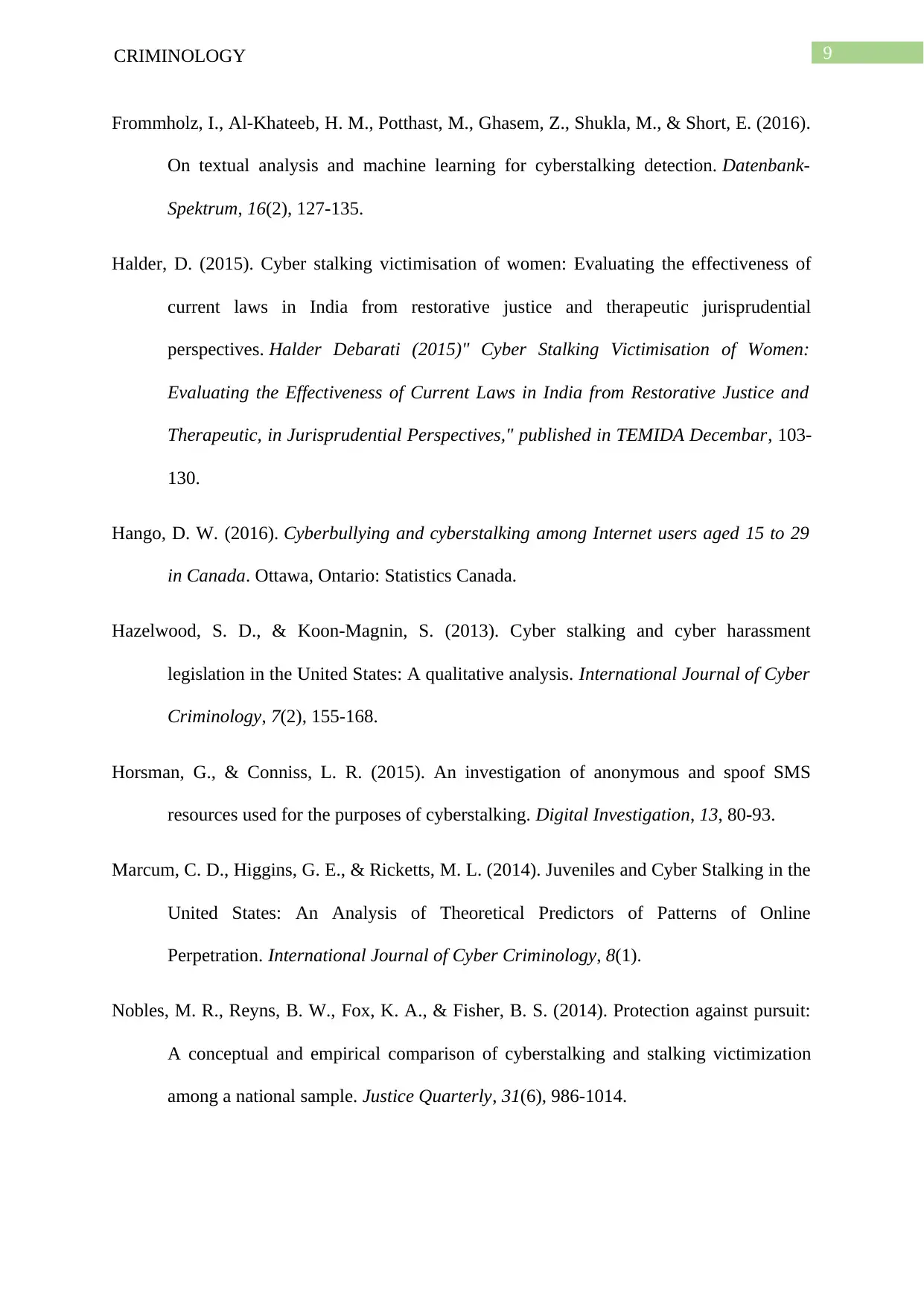
Frommholz, I., Al-Khateeb, H. M., Potthast, M., Ghasem, Z., Shukla, M., & Short, E. (2016).
On textual analysis and machine learning for cyberstalking detection. Datenbank-
Spektrum, 16(2), 127-135.
Halder, D. (2015). Cyber stalking victimisation of women: Evaluating the effectiveness of
current laws in India from restorative justice and therapeutic jurisprudential
perspectives. Halder Debarati (2015)" Cyber Stalking Victimisation of Women:
Evaluating the Effectiveness of Current Laws in India from Restorative Justice and
Therapeutic, in Jurisprudential Perspectives," published in TEMIDA Decembar, 103-
130.
Hango, D. W. (2016). Cyberbullying and cyberstalking among Internet users aged 15 to 29
in Canada. Ottawa, Ontario: Statistics Canada.
Hazelwood, S. D., & Koon-Magnin, S. (2013). Cyber stalking and cyber harassment
legislation in the United States: A qualitative analysis. International Journal of Cyber
Criminology, 7(2), 155-168.
Horsman, G., & Conniss, L. R. (2015). An investigation of anonymous and spoof SMS
resources used for the purposes of cyberstalking. Digital Investigation, 13, 80-93.
Marcum, C. D., Higgins, G. E., & Ricketts, M. L. (2014). Juveniles and Cyber Stalking in the
United States: An Analysis of Theoretical Predictors of Patterns of Online
Perpetration. International Journal of Cyber Criminology, 8(1).
Nobles, M. R., Reyns, B. W., Fox, K. A., & Fisher, B. S. (2014). Protection against pursuit:
A conceptual and empirical comparison of cyberstalking and stalking victimization
among a national sample. Justice Quarterly, 31(6), 986-1014.
Frommholz, I., Al-Khateeb, H. M., Potthast, M., Ghasem, Z., Shukla, M., & Short, E. (2016).
On textual analysis and machine learning for cyberstalking detection. Datenbank-
Spektrum, 16(2), 127-135.
Halder, D. (2015). Cyber stalking victimisation of women: Evaluating the effectiveness of
current laws in India from restorative justice and therapeutic jurisprudential
perspectives. Halder Debarati (2015)" Cyber Stalking Victimisation of Women:
Evaluating the Effectiveness of Current Laws in India from Restorative Justice and
Therapeutic, in Jurisprudential Perspectives," published in TEMIDA Decembar, 103-
130.
Hango, D. W. (2016). Cyberbullying and cyberstalking among Internet users aged 15 to 29
in Canada. Ottawa, Ontario: Statistics Canada.
Hazelwood, S. D., & Koon-Magnin, S. (2013). Cyber stalking and cyber harassment
legislation in the United States: A qualitative analysis. International Journal of Cyber
Criminology, 7(2), 155-168.
Horsman, G., & Conniss, L. R. (2015). An investigation of anonymous and spoof SMS
resources used for the purposes of cyberstalking. Digital Investigation, 13, 80-93.
Marcum, C. D., Higgins, G. E., & Ricketts, M. L. (2014). Juveniles and Cyber Stalking in the
United States: An Analysis of Theoretical Predictors of Patterns of Online
Perpetration. International Journal of Cyber Criminology, 8(1).
Nobles, M. R., Reyns, B. W., Fox, K. A., & Fisher, B. S. (2014). Protection against pursuit:
A conceptual and empirical comparison of cyberstalking and stalking victimization
among a national sample. Justice Quarterly, 31(6), 986-1014.
Paraphrase This Document
Need a fresh take? Get an instant paraphrase of this document with our AI Paraphraser
10CRIMINOLOGY
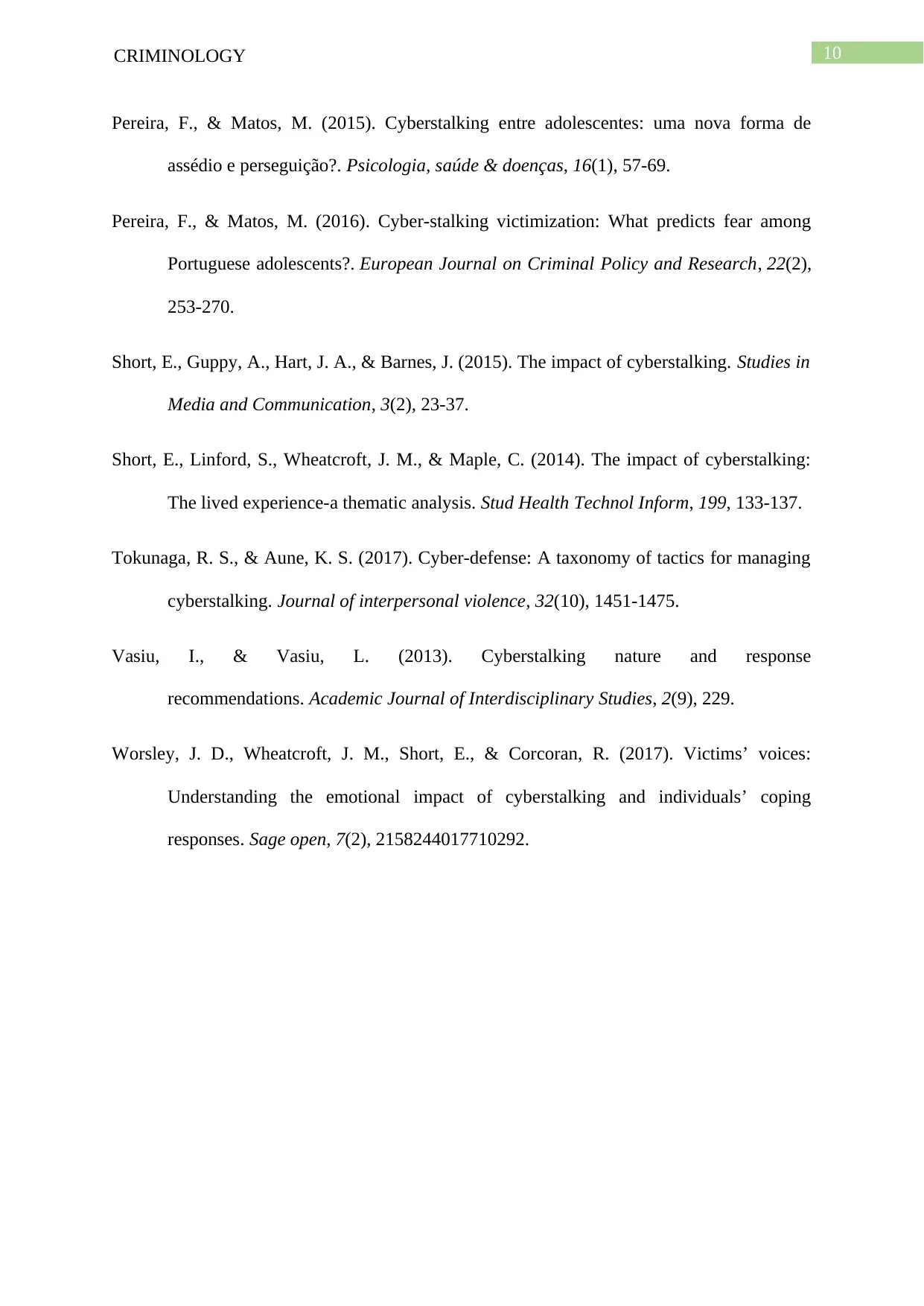
Pereira, F., & Matos, M. (2015). Cyberstalking entre adolescentes: uma nova forma de
assédio e perseguição?. Psicologia, saúde & doenças, 16(1), 57-69.
Pereira, F., & Matos, M. (2016). Cyber-stalking victimization: What predicts fear among
Portuguese adolescents?. European Journal on Criminal Policy and Research, 22(2),
253-270.
Short, E., Guppy, A., Hart, J. A., & Barnes, J. (2015). The impact of cyberstalking. Studies in
Media and Communication, 3(2), 23-37.
Short, E., Linford, S., Wheatcroft, J. M., & Maple, C. (2014). The impact of cyberstalking:
The lived experience-a thematic analysis. Stud Health Technol Inform, 199, 133-137.
Tokunaga, R. S., & Aune, K. S. (2017). Cyber-defense: A taxonomy of tactics for managing
cyberstalking. Journal of interpersonal violence, 32(10), 1451-1475.
Vasiu, I., & Vasiu, L. (2013). Cyberstalking nature and response
recommendations. Academic Journal of Interdisciplinary Studies, 2(9), 229.
Worsley, J. D., Wheatcroft, J. M., Short, E., & Corcoran, R. (2017). Victims’ voices:
Understanding the emotional impact of cyberstalking and individuals’ coping
responses. Sage open, 7(2), 2158244017710292.
Pereira, F., & Matos, M. (2015). Cyberstalking entre adolescentes: uma nova forma de
assédio e perseguição?. Psicologia, saúde & doenças, 16(1), 57-69.
Pereira, F., & Matos, M. (2016). Cyber-stalking victimization: What predicts fear among
Portuguese adolescents?. European Journal on Criminal Policy and Research, 22(2),
253-270.
Short, E., Guppy, A., Hart, J. A., & Barnes, J. (2015). The impact of cyberstalking. Studies in
Media and Communication, 3(2), 23-37.
Short, E., Linford, S., Wheatcroft, J. M., & Maple, C. (2014). The impact of cyberstalking:
The lived experience-a thematic analysis. Stud Health Technol Inform, 199, 133-137.
Tokunaga, R. S., & Aune, K. S. (2017). Cyber-defense: A taxonomy of tactics for managing
cyberstalking. Journal of interpersonal violence, 32(10), 1451-1475.
Vasiu, I., & Vasiu, L. (2013). Cyberstalking nature and response
recommendations. Academic Journal of Interdisciplinary Studies, 2(9), 229.
Worsley, J. D., Wheatcroft, J. M., Short, E., & Corcoran, R. (2017). Victims’ voices:
Understanding the emotional impact of cyberstalking and individuals’ coping
responses. Sage open, 7(2), 2158244017710292.

1 out of 11


Your All-in-One AI-Powered Toolkit for Academic Success.
+13062052269
info@desklib.com
Available 24*7 on WhatsApp / Email
![[object Object]](/_next/static/media/star-bottom.7253800d.svg)
Unlock your academic potential
Copyright © 2020–2026 A2Z Services. All Rights Reserved. Developed and managed by ZUCOL.