Cyclin F's Role in Cell Cycle Checkpoint Control: A Review
VerifiedAdded on 2023/06/10
|3
|1530
|337
Report
AI Summary
This report provides a comprehensive overview of the role of Cyclin F in cell cycle checkpoint control, based on a published article. It begins by defining the cell cycle and its phases, emphasizing the importance of checkpoints in DNA damage response, cell size control, and chromosome segregation. The report highlights the significance of Cyclin F in regulating the G2 phase checkpoint, particularly through the suppression of B-Myb-driven transcriptional programs. It summarizes key experiments that demonstrate Cyclin F's function, including ubiquitome library screens, analysis of Cyclin F-depleted cells, and studies on B-Myb transcriptional activity. The report details how Cyclin F interacts with B-Myb via the cyclin box domain, preventing cyclin A-mediated phosphorylation and thereby inhibiting cell cycle progression. The findings underscore the importance of Cyclin F in maintaining G2 cell cycle checkpoints following DNA damage, offering insights into checkpoint dysfunction and its potential implications for cancer development. The study of Cyclin F provides a detailed overview regarding how it blocks cells in G2 check points upon DNA damage along with the CDK phosphprylation and dephosphorylation of the transcription factor (B-Myb).
NEWS&VIEWS
SUBJECT HERE
Role of cyclin F in cell
cycle check point control
Cyclin B suppresses the activity of the transcription factor, B-Myb and thereby
arresting cell cycle progression through G2 phase of the cell cycle
YOUR NAME HERE
The cell cycle is defined as a
series of events in which cellular
components of cells are doubled
and then perfectly segregated
into two daughter cells1. In
eukaryotes, DNA synthesis
occurs in S-phase followed by
segregation of chromosome in
mitosis (M-phase). Two gap
phase separates mitosis from the
S-phase of the cell cycle and this
is known as G1 and G2 phase.
During this gap phase, the cells
obtain the desired bio-mass,
integrate the growth signals and
prepare for the chromosome
segregation2. The main pillar of
the cell cycle progression
through the G phase of the cell
cycle occurs via cyclin
dependent kinases (CDKs). This
are serine-threonine kinase that
phosphorylates key protein
substrates in order to promote
DNA synthesis and progression
into the mitotic phase3. Cell
cycle check points are used to
block the process of cell division
in order repair any damage DNA
during the ongoing cell-division
process. Such that the faulty
DNA is not transmitted to the
daughter cells. Apart from DNA
damage response, cell cycle
checkpoints also play an
important role in cell size
control and effective monitoring
of the process of DNA
replication. Moreover, there are
separate mitotic spindle check
points in the cell cycle which
ascertains whether the
chromosome has aligned over
the mitotic plate in order to
perform uniform segregation4.
However, it is not clear
regarding how this cell cycle
checkpoint maintenance phase is
regulated during the inter-
mediate phase of cell-cycle. At
the same time, it is important to
understand how this phase of
check-point is regulated because
improper maintenance of the
cell-cycle check-points can
result in unscheduled mitotic
progression with damaged
genome5.
This review mainly highlights
over the G2 cell cycle check
points, Cyclin F. This is because;
in order to explain an emerging
factor behind the control and co-
ordination of the cell-cycle
check-points the importance of
the role of cyclin-F was
highlighted6. Cyclin-F is CDK-
activating cyclin from ubiquitin
ligase protein family. Cyclin F
plays an important role in the
DNA damage check-point
regulation when cells are
radiated via ionizing radiation
(IR). The main check-point
control of cyclin F is in the G2
phase of the cell cycle via the
suppression of the B-Myb-driven
transcriptional programme which
mediates the accumulation of
mitosis-promoting factor.
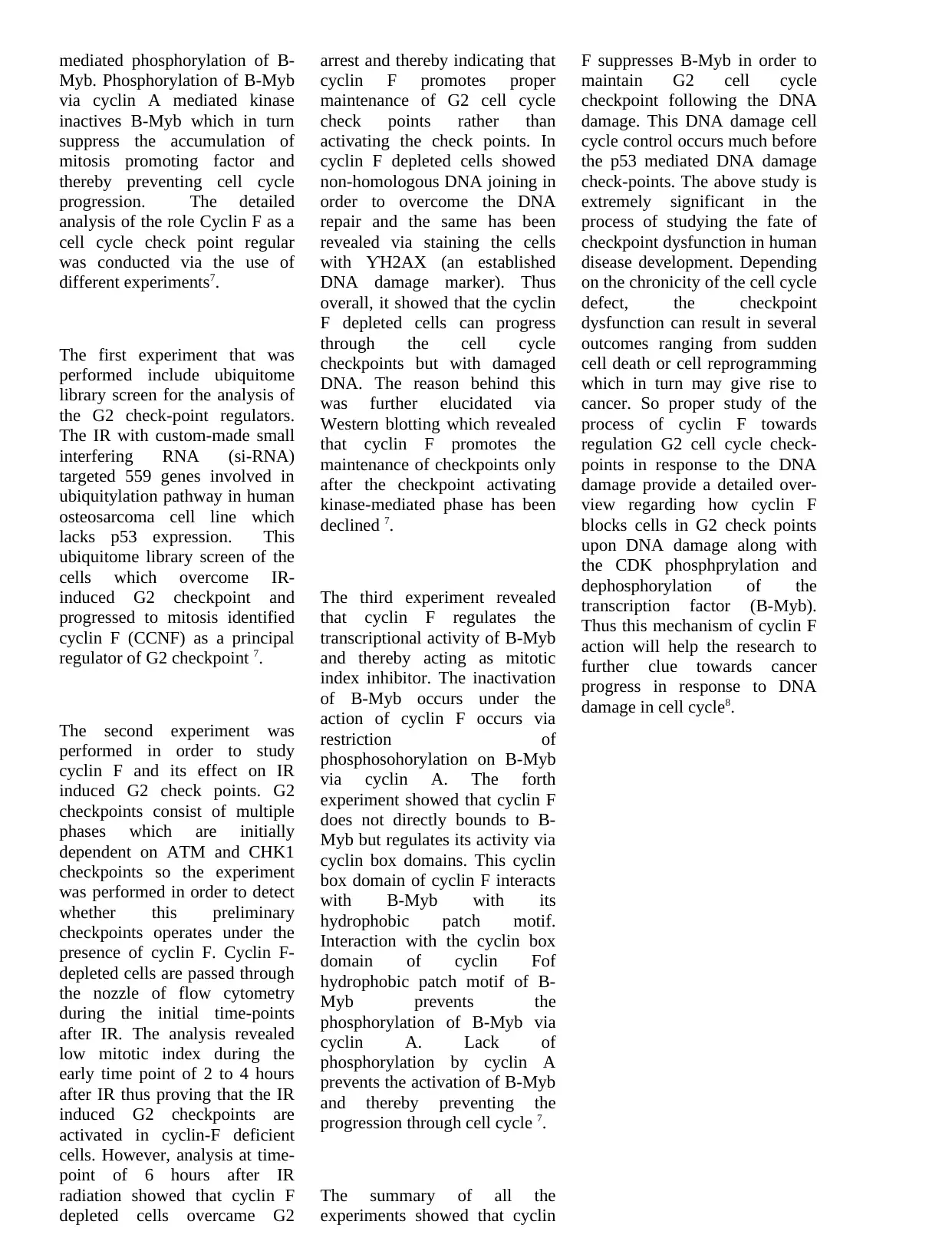
Cyclin F inhibits the action of B-
Myb via causing cyclin A-
Figure 1. Cell cycle arrest in G2 phase under the action of cyclin F
SUBJECT HERE
Role of cyclin F in cell
cycle check point control
Cyclin B suppresses the activity of the transcription factor, B-Myb and thereby
arresting cell cycle progression through G2 phase of the cell cycle
YOUR NAME HERE
The cell cycle is defined as a
series of events in which cellular
components of cells are doubled
and then perfectly segregated
into two daughter cells1. In
eukaryotes, DNA synthesis
occurs in S-phase followed by
segregation of chromosome in
mitosis (M-phase). Two gap
phase separates mitosis from the
S-phase of the cell cycle and this
is known as G1 and G2 phase.
During this gap phase, the cells
obtain the desired bio-mass,
integrate the growth signals and
prepare for the chromosome
segregation2. The main pillar of
the cell cycle progression
through the G phase of the cell
cycle occurs via cyclin
dependent kinases (CDKs). This
are serine-threonine kinase that
phosphorylates key protein
substrates in order to promote
DNA synthesis and progression
into the mitotic phase3. Cell
cycle check points are used to
block the process of cell division
in order repair any damage DNA
during the ongoing cell-division
process. Such that the faulty
DNA is not transmitted to the
daughter cells. Apart from DNA
damage response, cell cycle
checkpoints also play an
important role in cell size
control and effective monitoring
of the process of DNA
replication. Moreover, there are
separate mitotic spindle check
points in the cell cycle which
ascertains whether the
chromosome has aligned over
the mitotic plate in order to
perform uniform segregation4.
However, it is not clear
regarding how this cell cycle
checkpoint maintenance phase is
regulated during the inter-
mediate phase of cell-cycle. At
the same time, it is important to
understand how this phase of
check-point is regulated because
improper maintenance of the
cell-cycle check-points can
result in unscheduled mitotic
progression with damaged
genome5.
This review mainly highlights
over the G2 cell cycle check
points, Cyclin F. This is because;
in order to explain an emerging
factor behind the control and co-
ordination of the cell-cycle
check-points the importance of
the role of cyclin-F was
highlighted6. Cyclin-F is CDK-
activating cyclin from ubiquitin
ligase protein family. Cyclin F
plays an important role in the
DNA damage check-point
regulation when cells are
radiated via ionizing radiation
(IR). The main check-point
control of cyclin F is in the G2
phase of the cell cycle via the
suppression of the B-Myb-driven
transcriptional programme which
mediates the accumulation of
mitosis-promoting factor.
Cyclin F inhibits the action of B-
Myb via causing cyclin A-
Figure 1. Cell cycle arrest in G2 phase under the action of cyclin F
Paraphrase This Document
Need a fresh take? Get an instant paraphrase of this document with our AI Paraphraser

mediated phosphorylation of B-
Myb. Phosphorylation of B-Myb
via cyclin A mediated kinase
inactives B-Myb which in turn
suppress the accumulation of
mitosis promoting factor and
thereby preventing cell cycle
progression. The detailed
analysis of the role Cyclin F as a
cell cycle check point regular
was conducted via the use of
different experiments7.
The first experiment that was
performed include ubiquitome
library screen for the analysis of
the G2 check-point regulators.
The IR with custom-made small
interfering RNA (si-RNA)
targeted 559 genes involved in
ubiquitylation pathway in human
osteosarcoma cell line which
lacks p53 expression. This
ubiquitome library screen of the
cells which overcome IR-
induced G2 checkpoint and
progressed to mitosis identified
cyclin F (CCNF) as a principal
regulator of G2 checkpoint 7.
The second experiment was
performed in order to study
cyclin F and its effect on IR
induced G2 check points. G2
checkpoints consist of multiple
phases which are initially
dependent on ATM and CHK1
checkpoints so the experiment
was performed in order to detect
whether this preliminary
checkpoints operates under the
presence of cyclin F. Cyclin F-
depleted cells are passed through
the nozzle of flow cytometry
during the initial time-points
after IR. The analysis revealed
low mitotic index during the
early time point of 2 to 4 hours
after IR thus proving that the IR
induced G2 checkpoints are
activated in cyclin-F deficient
cells. However, analysis at time-
point of 6 hours after IR
radiation showed that cyclin F
depleted cells overcame G2
arrest and thereby indicating that
cyclin F promotes proper
maintenance of G2 cell cycle
check points rather than
activating the check points. In
cyclin F depleted cells showed
non-homologous DNA joining in
order to overcome the DNA
repair and the same has been
revealed via staining the cells
with ƳH2AX (an established
DNA damage marker). Thus
overall, it showed that the cyclin
F depleted cells can progress
through the cell cycle
checkpoints but with damaged
DNA. The reason behind this
was further elucidated via
Western blotting which revealed
that cyclin F promotes the
maintenance of checkpoints only
after the checkpoint activating
kinase-mediated phase has been
declined 7.
The third experiment revealed
that cyclin F regulates the
transcriptional activity of B-Myb
and thereby acting as mitotic
index inhibitor. The inactivation
of B-Myb occurs under the
action of cyclin F occurs via
restriction of
phosphosohorylation on B-Myb
via cyclin A. The forth
experiment showed that cyclin F
does not directly bounds to B-
Myb but regulates its activity via
cyclin box domains. This cyclin
box domain of cyclin F interacts
with B-Myb with its
hydrophobic patch motif.
Interaction with the cyclin box
domain of cyclin Fof
hydrophobic patch motif of B-
Myb prevents the
phosphorylation of B-Myb via
cyclin A. Lack of
phosphorylation by cyclin A
prevents the activation of B-Myb
and thereby preventing the
progression through cell cycle 7.
The summary of all the
experiments showed that cyclin
F suppresses B-Myb in order to
maintain G2 cell cycle
checkpoint following the DNA
damage. This DNA damage cell
cycle control occurs much before
the p53 mediated DNA damage
check-points. The above study is
extremely significant in the
process of studying the fate of
checkpoint dysfunction in human
disease development. Depending
on the chronicity of the cell cycle
defect, the checkpoint
dysfunction can result in several
outcomes ranging from sudden
cell death or cell reprogramming
which in turn may give rise to
cancer. So proper study of the
process of cyclin F towards
regulation G2 cell cycle check-
points in response to the DNA
damage provide a detailed over-
view regarding how cyclin F
blocks cells in G2 check points
upon DNA damage along with
the CDK phosphprylation and
dephosphorylation of the
transcription factor (B-Myb).
Thus this mechanism of cyclin F
action will help the research to
further clue towards cancer
progress in response to DNA
damage in cell cycle8.
Myb. Phosphorylation of B-Myb
via cyclin A mediated kinase
inactives B-Myb which in turn
suppress the accumulation of
mitosis promoting factor and
thereby preventing cell cycle
progression. The detailed
analysis of the role Cyclin F as a
cell cycle check point regular
was conducted via the use of
different experiments7.
The first experiment that was
performed include ubiquitome
library screen for the analysis of
the G2 check-point regulators.
The IR with custom-made small
interfering RNA (si-RNA)
targeted 559 genes involved in
ubiquitylation pathway in human
osteosarcoma cell line which
lacks p53 expression. This
ubiquitome library screen of the
cells which overcome IR-
induced G2 checkpoint and
progressed to mitosis identified
cyclin F (CCNF) as a principal
regulator of G2 checkpoint 7.
The second experiment was
performed in order to study
cyclin F and its effect on IR
induced G2 check points. G2
checkpoints consist of multiple
phases which are initially
dependent on ATM and CHK1
checkpoints so the experiment
was performed in order to detect
whether this preliminary
checkpoints operates under the
presence of cyclin F. Cyclin F-
depleted cells are passed through
the nozzle of flow cytometry
during the initial time-points
after IR. The analysis revealed
low mitotic index during the
early time point of 2 to 4 hours
after IR thus proving that the IR
induced G2 checkpoints are
activated in cyclin-F deficient
cells. However, analysis at time-
point of 6 hours after IR
radiation showed that cyclin F
depleted cells overcame G2
arrest and thereby indicating that
cyclin F promotes proper
maintenance of G2 cell cycle
check points rather than
activating the check points. In
cyclin F depleted cells showed
non-homologous DNA joining in
order to overcome the DNA
repair and the same has been
revealed via staining the cells
with ƳH2AX (an established
DNA damage marker). Thus
overall, it showed that the cyclin
F depleted cells can progress
through the cell cycle
checkpoints but with damaged
DNA. The reason behind this
was further elucidated via
Western blotting which revealed
that cyclin F promotes the
maintenance of checkpoints only
after the checkpoint activating
kinase-mediated phase has been
declined 7.
The third experiment revealed
that cyclin F regulates the
transcriptional activity of B-Myb
and thereby acting as mitotic
index inhibitor. The inactivation
of B-Myb occurs under the
action of cyclin F occurs via
restriction of
phosphosohorylation on B-Myb
via cyclin A. The forth
experiment showed that cyclin F
does not directly bounds to B-
Myb but regulates its activity via
cyclin box domains. This cyclin
box domain of cyclin F interacts
with B-Myb with its
hydrophobic patch motif.
Interaction with the cyclin box
domain of cyclin Fof
hydrophobic patch motif of B-
Myb prevents the
phosphorylation of B-Myb via
cyclin A. Lack of
phosphorylation by cyclin A
prevents the activation of B-Myb
and thereby preventing the
progression through cell cycle 7.
The summary of all the
experiments showed that cyclin
F suppresses B-Myb in order to
maintain G2 cell cycle
checkpoint following the DNA
damage. This DNA damage cell
cycle control occurs much before
the p53 mediated DNA damage
check-points. The above study is
extremely significant in the
process of studying the fate of
checkpoint dysfunction in human
disease development. Depending
on the chronicity of the cell cycle
defect, the checkpoint
dysfunction can result in several
outcomes ranging from sudden
cell death or cell reprogramming
which in turn may give rise to
cancer. So proper study of the
process of cyclin F towards
regulation G2 cell cycle check-
points in response to the DNA
damage provide a detailed over-
view regarding how cyclin F
blocks cells in G2 check points
upon DNA damage along with
the CDK phosphprylation and
dephosphorylation of the
transcription factor (B-Myb).
Thus this mechanism of cyclin F
action will help the research to
further clue towards cancer
progress in response to DNA
damage in cell cycle8.

References
1. Patil, M., Pabla, N., &
Dong, Z. (2013).
Checkpoint kinase 1 in
DNA damage response
and cell cycle
regulation. Cellular and
molecular life
sciences, 70(21), 4009-
4021.
2. Barnum, K. J., &
O’Connell, M. J. (2014).
Cell cycle regulation by
checkpoints. In Cell
Cycle Control (pp. 29-
40). Humana Press, New
York, NY.
3. Lim, S., & Kaldis, P.
(2013). Cdks, cyclins
and CKIs: roles beyond
cell cycle
regulation. Development,
140(15), 3079-3093.
4. Sperka, T., Wang, J., &
Rudolph, K. L. (2012).
DNA damage
checkpoints in stem
cells, ageing and
cancer. Nature reviews
Molecular cell
biology, 13(9), 579.
5. Shaltiel, I. A., Krenning,
L., Bruinsma, W., &
Medema, R. H. (2015).
The same, only
different–DNA damage
checkpoints and their
reversal throughout the
cell cycle. J Cell
Sci, 128(4), 607-620.
6. D'Angiolella, V.,
Donato, V., Forrester, F.
M., Jeong, Y. T.,
Pellacani, C., Kudo,
Y., ... & Pagano, M.
(2012). Cyclin F-
mediated degradation of
ribonucleotide reductase
M2 controls genome
integrity and DNA
repair. Cell, 149(5),
1023-1034.
7. Klein, D. K., Hoffmann,
S., Ahlskog, J. K.,
O’Hanlon, K., Quaas,
M., Larsen, B. D., ... &
Menzel, T. (2015).
Cyclin F suppresses B-
Myb activity to promote
cell cycle checkpoint
control. Nature
communications, 6,
5800.
8. Bassermann, F., Eichner,
R., & Pagano, M.
(2014). The ubiquitin
proteasome system—
implications for cell
cycle control and the
targeted treatment of
cancer. Biochimica et
Biophysica Acta (BBA)-
Molecular Cell
Research, 1843(1), 150-
162.
1. Patil, M., Pabla, N., &
Dong, Z. (2013).
Checkpoint kinase 1 in
DNA damage response
and cell cycle
regulation. Cellular and
molecular life
sciences, 70(21), 4009-
4021.
2. Barnum, K. J., &
O’Connell, M. J. (2014).
Cell cycle regulation by
checkpoints. In Cell
Cycle Control (pp. 29-
40). Humana Press, New
York, NY.
3. Lim, S., & Kaldis, P.
(2013). Cdks, cyclins
and CKIs: roles beyond
cell cycle
regulation. Development,
140(15), 3079-3093.
4. Sperka, T., Wang, J., &
Rudolph, K. L. (2012).
DNA damage
checkpoints in stem
cells, ageing and
cancer. Nature reviews
Molecular cell
biology, 13(9), 579.
5. Shaltiel, I. A., Krenning,
L., Bruinsma, W., &
Medema, R. H. (2015).
The same, only
different–DNA damage
checkpoints and their
reversal throughout the
cell cycle. J Cell
Sci, 128(4), 607-620.
6. D'Angiolella, V.,
Donato, V., Forrester, F.
M., Jeong, Y. T.,
Pellacani, C., Kudo,
Y., ... & Pagano, M.
(2012). Cyclin F-
mediated degradation of
ribonucleotide reductase
M2 controls genome
integrity and DNA
repair. Cell, 149(5),
1023-1034.
7. Klein, D. K., Hoffmann,
S., Ahlskog, J. K.,
O’Hanlon, K., Quaas,
M., Larsen, B. D., ... &
Menzel, T. (2015).
Cyclin F suppresses B-
Myb activity to promote
cell cycle checkpoint
control. Nature
communications, 6,
5800.
8. Bassermann, F., Eichner,
R., & Pagano, M.
(2014). The ubiquitin
proteasome system—
implications for cell
cycle control and the
targeted treatment of
cancer. Biochimica et
Biophysica Acta (BBA)-
Molecular Cell
Research, 1843(1), 150-
162.
⊘ This is a preview!⊘
Do you want full access?
Subscribe today to unlock all pages.

Trusted by 1+ million students worldwide
1 out of 3
Your All-in-One AI-Powered Toolkit for Academic Success.
+13062052269
info@desklib.com
Available 24*7 on WhatsApp / Email
Unlock your academic potential
Copyright © 2020–2025 A2Z Services. All Rights Reserved. Developed and managed by ZUCOL.

