Examining Civilization's Defense: A Deep Dive into Dalrymple's Essay
VerifiedAdded on 2023/06/10
|4
|1392
|116
Essay
AI Summary
This essay delves into Theodore Dalrymple's argument for the defense of civilization, highlighting its fragility and importance. It explores Dalrymple's central thesis that civilization gives life meaning and must be protected against barbaric actions. The essay presents examples used by Dalrymple, such as the Jewish singer during WWII and the story of men playing Beethoven, to support his claim that civilization is tied to everyday actions and values that transcend material existence. It further discusses Dalrymple's accounts of his mother's experiences as a refugee and the destructive nature of barbarism, emphasizing the potential loss of security and values. The essay concludes by aligning with Dalrymple's view that defending civilization is crucial and addresses the failures of contemporary society in upholding moral standards. It also references Albert Schweitzer's perspective on the importance of morality and reverence for life in maintaining a civilized world.
Surname 1
Students Name
Professor
Course
Date of Submission
What we have to loose
Introduction
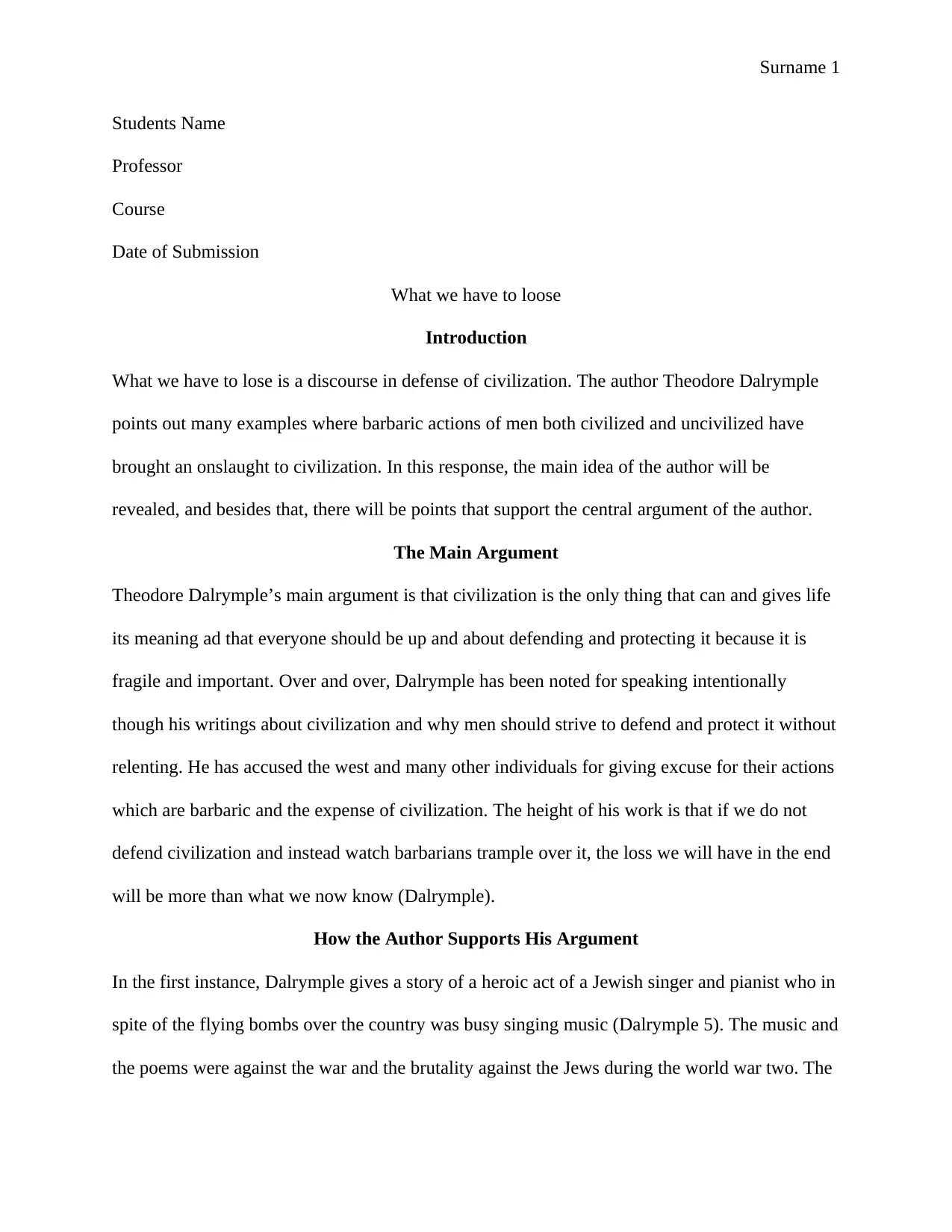
What we have to lose is a discourse in defense of civilization. The author Theodore Dalrymple
points out many examples where barbaric actions of men both civilized and uncivilized have
brought an onslaught to civilization. In this response, the main idea of the author will be
revealed, and besides that, there will be points that support the central argument of the author.
The Main Argument
Theodore Dalrymple’s main argument is that civilization is the only thing that can and gives life
its meaning ad that everyone should be up and about defending and protecting it because it is
fragile and important. Over and over, Dalrymple has been noted for speaking intentionally
though his writings about civilization and why men should strive to defend and protect it without
relenting. He has accused the west and many other individuals for giving excuse for their actions
which are barbaric and the expense of civilization. The height of his work is that if we do not
defend civilization and instead watch barbarians trample over it, the loss we will have in the end
will be more than what we now know (Dalrymple).
How the Author Supports His Argument
In the first instance, Dalrymple gives a story of a heroic act of a Jewish singer and pianist who in
spite of the flying bombs over the country was busy singing music (Dalrymple 5). The music and
the poems were against the war and the brutality against the Jews during the world war two. The
Students Name
Professor
Course
Date of Submission
What we have to loose
Introduction
What we have to lose is a discourse in defense of civilization. The author Theodore Dalrymple
points out many examples where barbaric actions of men both civilized and uncivilized have
brought an onslaught to civilization. In this response, the main idea of the author will be
revealed, and besides that, there will be points that support the central argument of the author.
The Main Argument
Theodore Dalrymple’s main argument is that civilization is the only thing that can and gives life
its meaning ad that everyone should be up and about defending and protecting it because it is
fragile and important. Over and over, Dalrymple has been noted for speaking intentionally
though his writings about civilization and why men should strive to defend and protect it without
relenting. He has accused the west and many other individuals for giving excuse for their actions
which are barbaric and the expense of civilization. The height of his work is that if we do not
defend civilization and instead watch barbarians trample over it, the loss we will have in the end
will be more than what we now know (Dalrymple).
How the Author Supports His Argument
In the first instance, Dalrymple gives a story of a heroic act of a Jewish singer and pianist who in
spite of the flying bombs over the country was busy singing music (Dalrymple 5). The music and
the poems were against the war and the brutality against the Jews during the world war two. The
Paraphrase This Document
Need a fresh take? Get an instant paraphrase of this document with our AI Paraphraser

Surname 2
songs and the concerts were a defiance against the barbaric actions of the leaders who were
spreading their brutality against human kind. The concerts stood for civilization and showed
contempt against all actions on inhumanity spread by the brutal regimes. Similarly, he used the
example of a story that was told by Sir Kirl Popper bout the four men who were destined to be
arrested in berlin and whose destiny was uncertain. On their presupposed last night they spent it
playing the Beethoven quartet which to them was a symbol of civilization. Their actions showed
that they valued civilization to the extent that nothing could frighten them or make them cower.
He argues that civilization is tied to the activities that we do daily, that we never stop doing them
for any other reason like the Pianist and the 4 men who played the Beethoven quartet.
Civilization is a combination of all the actions and activities of people which go beyond their
existence or materials they possess or even aspirations in life.
Besides that, he gives the second account of her story where he explains the troubles that
befell his mother who at the moment was a refugee from the Nazis who were in control of
Germany. He says that at one point she had everything and at some point she finds herself with
nothing. He says that if barbarians are left to thrive, our very own security cannot be certain like
mothers. His mother had come from a place of security, luxury, good life and parents to loosing
that all in a moment because of war (Dalrymple 90). He says that barbarism took away
everything that meant something from his mother and he adds that it can happen to anyone
anytime and anywhere.
Additionally, he says that barbarians thrive in the freedom they feel when they destroy
something that someone who they believed had over them or their lives. He gives the account of
their childhood where they destroyed a radio because it belonged to someone who they felt
deprived them of their freedom. He adds that rioters also destroy things because they feel that in
songs and the concerts were a defiance against the barbaric actions of the leaders who were
spreading their brutality against human kind. The concerts stood for civilization and showed
contempt against all actions on inhumanity spread by the brutal regimes. Similarly, he used the
example of a story that was told by Sir Kirl Popper bout the four men who were destined to be
arrested in berlin and whose destiny was uncertain. On their presupposed last night they spent it
playing the Beethoven quartet which to them was a symbol of civilization. Their actions showed
that they valued civilization to the extent that nothing could frighten them or make them cower.
He argues that civilization is tied to the activities that we do daily, that we never stop doing them
for any other reason like the Pianist and the 4 men who played the Beethoven quartet.
Civilization is a combination of all the actions and activities of people which go beyond their
existence or materials they possess or even aspirations in life.
Besides that, he gives the second account of her story where he explains the troubles that
befell his mother who at the moment was a refugee from the Nazis who were in control of
Germany. He says that at one point she had everything and at some point she finds herself with
nothing. He says that if barbarians are left to thrive, our very own security cannot be certain like
mothers. His mother had come from a place of security, luxury, good life and parents to loosing
that all in a moment because of war (Dalrymple 90). He says that barbarism took away
everything that meant something from his mother and he adds that it can happen to anyone
anytime and anywhere.
Additionally, he says that barbarians thrive in the freedom they feel when they destroy
something that someone who they believed had over them or their lives. He gives the account of
their childhood where they destroyed a radio because it belonged to someone who they felt
deprived them of their freedom. He adds that rioters also destroy things because they feel that in

Surname 3
destruction they will have power over those they are demonstrating or rebelling against at that
time. He calls such revolutions as revolts against civilization because they destroy the very
objects that support the livelihood of the people in the society including the rioters. He even adds
the incidents where people riot and destroy property is the vengeance of barbarians against
civilization.
I agree with Dalrymple that civilization is worth defending and that when men fail to rise
to the call, they are worse than the barbarians (Dalrymple 213). My reasons are similar to his but
I must add that if the society is bent on enjoying the pleasures of a moment while ignoring the
eternal and long lasting consequences, then there is little that is left of life. My contempt is in the
actions of a mother who stops his son from giving evidence of brutality against a man who is
violent and deserves to be in jail because the man satisfies her well in bed. Besides that, the
society has embraces people who have no values or morals in the society who thrive in violence
and hurting others (Dalrymple 20). It is important that men who are civilized rise to the occasion
and defend civilization. Additionally, the author’s argument depicts the failures of the present
society in the sense that men and women who are seen to be modest and civilized when in
different places are easily swallowed in acts of barbarism and change in a split second. The
evidence is the example that the author gave of fans in a stadium who are given security from
their opponents because if they are left to each other they will end up fighting and the end result
will be bloodshed, injury and even death (Dalrymple 28).
Albert Schweitzer had a similar view, he believed that without civilization the destruction
of the world would be swifter than anyone could imagine. He believed that the morality and the
reverence for life are the pillars a civilized world (LIB). He added that spirituality and fulfilment
that sprouts from ethics can be able to guide a man to the path of civilization. Besides that, he
destruction they will have power over those they are demonstrating or rebelling against at that
time. He calls such revolutions as revolts against civilization because they destroy the very
objects that support the livelihood of the people in the society including the rioters. He even adds
the incidents where people riot and destroy property is the vengeance of barbarians against
civilization.
I agree with Dalrymple that civilization is worth defending and that when men fail to rise
to the call, they are worse than the barbarians (Dalrymple 213). My reasons are similar to his but
I must add that if the society is bent on enjoying the pleasures of a moment while ignoring the
eternal and long lasting consequences, then there is little that is left of life. My contempt is in the
actions of a mother who stops his son from giving evidence of brutality against a man who is
violent and deserves to be in jail because the man satisfies her well in bed. Besides that, the
society has embraces people who have no values or morals in the society who thrive in violence
and hurting others (Dalrymple 20). It is important that men who are civilized rise to the occasion
and defend civilization. Additionally, the author’s argument depicts the failures of the present
society in the sense that men and women who are seen to be modest and civilized when in
different places are easily swallowed in acts of barbarism and change in a split second. The
evidence is the example that the author gave of fans in a stadium who are given security from
their opponents because if they are left to each other they will end up fighting and the end result
will be bloodshed, injury and even death (Dalrymple 28).
Albert Schweitzer had a similar view, he believed that without civilization the destruction
of the world would be swifter than anyone could imagine. He believed that the morality and the
reverence for life are the pillars a civilized world (LIB). He added that spirituality and fulfilment
that sprouts from ethics can be able to guide a man to the path of civilization. Besides that, he
⊘ This is a preview!⊘
Do you want full access?
Subscribe today to unlock all pages.

Trusted by 1+ million students worldwide

Surname 4
believed that the loss of civilization in the current world is as a result of man lacking a
perspective on the theory of the universe. Both the philosophers have the same thoughts on who
is the enemy of civilization, they agree that the enemy of civilization is within the man himself
(Schweitzer 203). Civilization deserves the efforts of all men to defend it regardless of the people
that are on the rise to oppose and bring it down. Moreover, as nations continue to develop and
grow and the desires of men grow, there is need to defend the tenets of civilization and to ensure
that man remains civilized as he ought.
Works Cited
Dalrymple, Theodore. “What We Have to Lose.” City Journal, 27 Jan. 2016, www.city-
journal.org/html/what-we-have-lose-12199.html.
Dalrymple, Theodore. Our culture, what's left of it. Chicago: Ivan R. Dee, 2005..
Dalrymple, Theodore. "Life at the bottom." Chicago: Ivan R. Dee (2001).
Dalrymple, Theodore. "The roads to serfdom [The welfare state and the decline of
Britain.]." Policy: A Journal of Public Policy and Ideas 21.4 (2005): 3.
Dalrymple, Theodore. Life at the bottom: The worldview that makes the underclass. Ivan R. Dee,
2003.
Dalrymple, Theodore. "The New Vichy Syndrome." (2009).
Dalrymple, Theodore. "Don’t Legalize Drugs." City Journal 7.2 (1997): 14-22.
LIB, T. "NHS “reform” in England: where is the public interest?." BMJ 344 (2012): 33.
Schweitzer, Albert. Reverence for Life: The Ethics of Albert Schweitzer for the Twenty-First
Century. Open Road Media, 2014.
believed that the loss of civilization in the current world is as a result of man lacking a
perspective on the theory of the universe. Both the philosophers have the same thoughts on who
is the enemy of civilization, they agree that the enemy of civilization is within the man himself
(Schweitzer 203). Civilization deserves the efforts of all men to defend it regardless of the people
that are on the rise to oppose and bring it down. Moreover, as nations continue to develop and
grow and the desires of men grow, there is need to defend the tenets of civilization and to ensure
that man remains civilized as he ought.
Works Cited
Dalrymple, Theodore. “What We Have to Lose.” City Journal, 27 Jan. 2016, www.city-
journal.org/html/what-we-have-lose-12199.html.
Dalrymple, Theodore. Our culture, what's left of it. Chicago: Ivan R. Dee, 2005..
Dalrymple, Theodore. "Life at the bottom." Chicago: Ivan R. Dee (2001).
Dalrymple, Theodore. "The roads to serfdom [The welfare state and the decline of
Britain.]." Policy: A Journal of Public Policy and Ideas 21.4 (2005): 3.
Dalrymple, Theodore. Life at the bottom: The worldview that makes the underclass. Ivan R. Dee,
2003.
Dalrymple, Theodore. "The New Vichy Syndrome." (2009).
Dalrymple, Theodore. "Don’t Legalize Drugs." City Journal 7.2 (1997): 14-22.
LIB, T. "NHS “reform” in England: where is the public interest?." BMJ 344 (2012): 33.
Schweitzer, Albert. Reverence for Life: The Ethics of Albert Schweitzer for the Twenty-First
Century. Open Road Media, 2014.
1 out of 4
Your All-in-One AI-Powered Toolkit for Academic Success.
+13062052269
info@desklib.com
Available 24*7 on WhatsApp / Email
Unlock your academic potential
Copyright © 2020–2025 A2Z Services. All Rights Reserved. Developed and managed by ZUCOL.