Method Section Report

Verified

Added on  2019/10/30

|4
|612
|155
Report
AI Summary
This report presents the methodology of a quantitative study investigating the relationship between daily cycling hours and Caroline levels in a sample of 30 participants from South Australia. Participants, aged 12-45, were selected using random sampling to minimize bias. Data, collected via questionnaires, was numerical and focused on cycling duration and Caroline levels. Health background checks ensured participant suitability. Data cleaning involved outlier removal and checking for missing responses in Microsoft Excel and SPSS. Correlation analysis in SPSS determined the relationship between cycling hours and Caroline levels. The study emphasizes the use of numerical data for its ease of analysis and comparison, leading to reliable scientific conclusions.

Document Page
Running head: THE METHOD SECTION
Name
Institution
tabler-icon-diamond-filled.svg

Paraphrase This Document

Need a fresh take? Get an instant paraphrase of this document with our AI Paraphraser
Document Page
THE METHOD SECTION
1
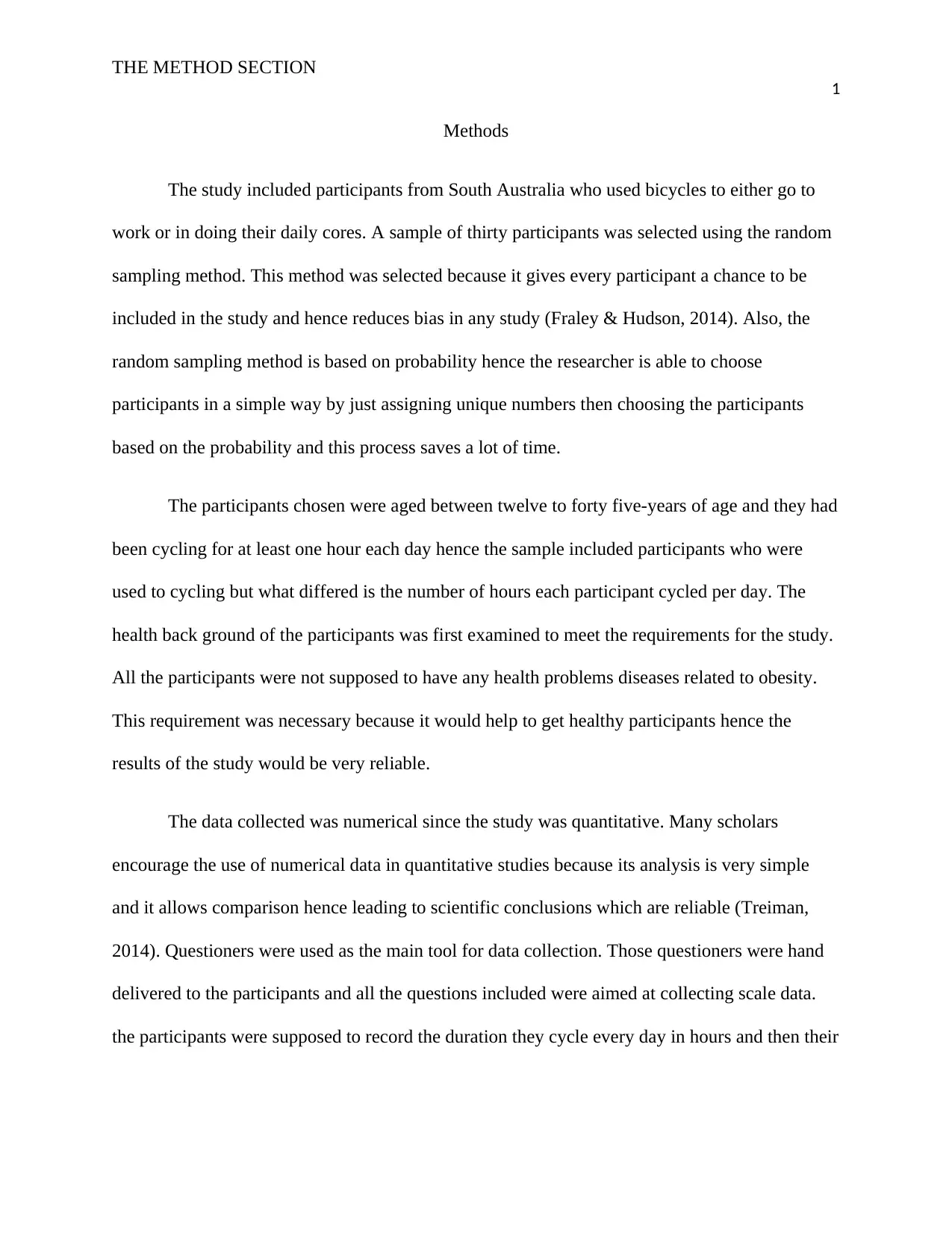
Methods
The study included participants from South Australia who used bicycles to either go to
work or in doing their daily cores. A sample of thirty participants was selected using the random
sampling method. This method was selected because it gives every participant a chance to be
included in the study and hence reduces bias in any study (Fraley & Hudson, 2014). Also, the
random sampling method is based on probability hence the researcher is able to choose
participants in a simple way by just assigning unique numbers then choosing the participants
based on the probability and this process saves a lot of time.
The participants chosen were aged between twelve to forty five-years of age and they had
been cycling for at least one hour each day hence the sample included participants who were
used to cycling but what differed is the number of hours each participant cycled per day. The
health back ground of the participants was first examined to meet the requirements for the study.
All the participants were not supposed to have any health problems diseases related to obesity.
This requirement was necessary because it would help to get healthy participants hence the
results of the study would be very reliable.
The data collected was numerical since the study was quantitative. Many scholars
encourage the use of numerical data in quantitative studies because its analysis is very simple
and it allows comparison hence leading to scientific conclusions which are reliable (Treiman,
2014). Questioners were used as the main tool for data collection. Those questioners were hand
delivered to the participants and all the questions included were aimed at collecting scale data.
the participants were supposed to record the duration they cycle every day in hours and then their
Document Page
THE METHOD SECTION
2
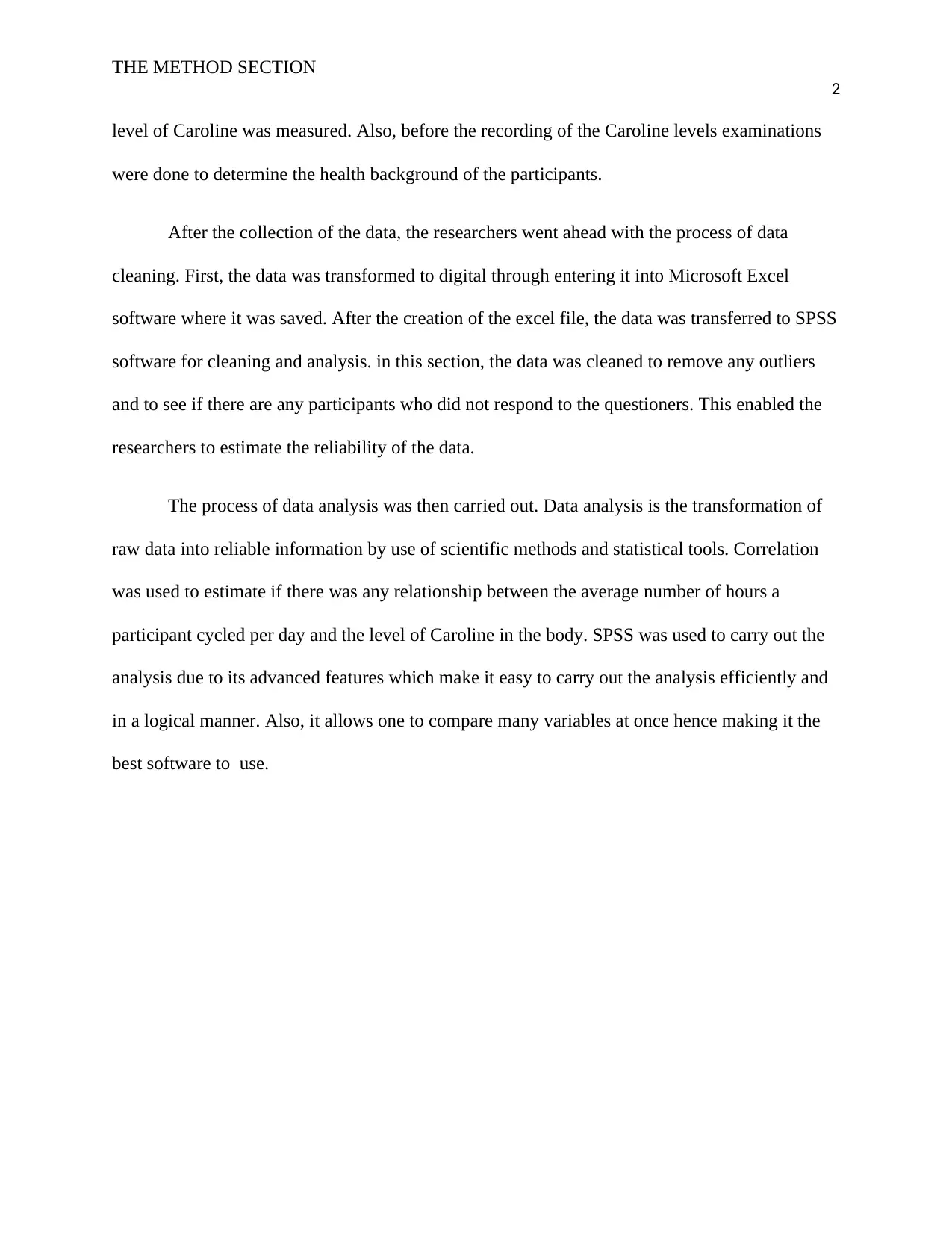
level of Caroline was measured. Also, before the recording of the Caroline levels examinations
were done to determine the health background of the participants.
After the collection of the data, the researchers went ahead with the process of data
cleaning. First, the data was transformed to digital through entering it into Microsoft Excel
software where it was saved. After the creation of the excel file, the data was transferred to SPSS
software for cleaning and analysis. in this section, the data was cleaned to remove any outliers
and to see if there are any participants who did not respond to the questioners. This enabled the
researchers to estimate the reliability of the data.
The process of data analysis was then carried out. Data analysis is the transformation of
raw data into reliable information by use of scientific methods and statistical tools. Correlation
was used to estimate if there was any relationship between the average number of hours a
participant cycled per day and the level of Caroline in the body. SPSS was used to carry out the
analysis due to its advanced features which make it easy to carry out the analysis efficiently and
in a logical manner. Also, it allows one to compare many variables at once hence making it the
best software to use.
Document Page
THE METHOD SECTION
3
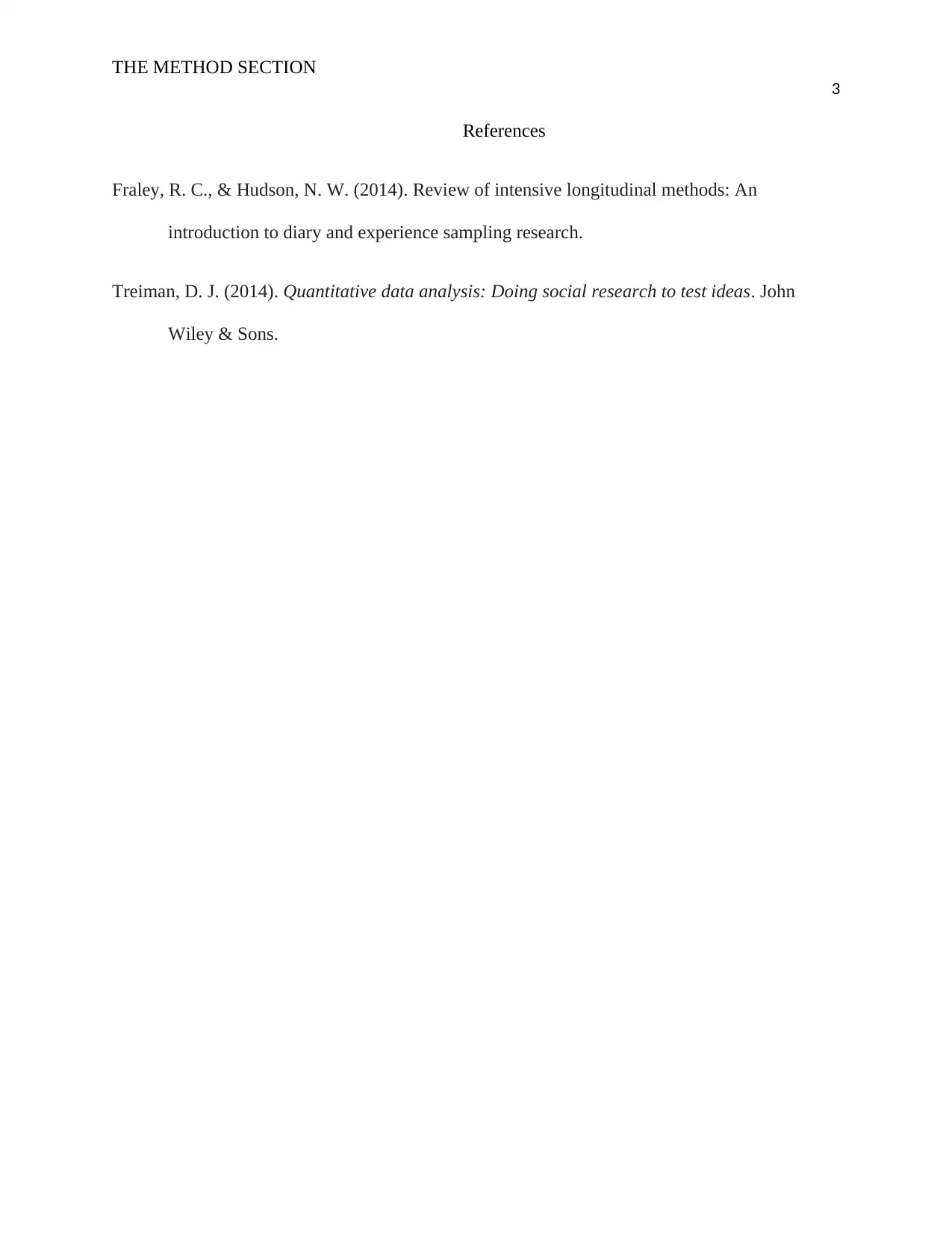
References
Fraley, R. C., & Hudson, N. W. (2014). Review of intensive longitudinal methods: An
introduction to diary and experience sampling research.
Treiman, D. J. (2014). Quantitative data analysis: Doing social research to test ideas. John
Wiley & Sons.
chevron_up_icon
1 out of 4
circle_padding
hide_on_mobile
zoom_out_icon
[object Object]