Employee Job Satisfaction and Union Membership at SuperPart: Analysis
VerifiedAdded on 2020/07/22
|8
|2391
|251
Report
AI Summary
This report presents a statistical analysis of employee data from SuperPart, examining various aspects of the workforce. The analysis begins with an overview of employee age demographics, providing insights into potential retirement trends. It then explores associations between employee age, occupation, working hours, and pre-tax income using correlation analysis. The report investigates job satisfaction levels, revealing that the majority of employees are very satisfied. It also assesses the relationship between job satisfaction and union membership, finding no significant difference between the two. Furthermore, the report analyzes the impact of working hours on job satisfaction. The report also includes an analysis of employee retention and union membership, including average working hours for union and non-union members. The report concludes by highlighting future survey plans to assess working weeks and employee satisfaction.

DATA ANALYSIS

Paraphrase This Document
Need a fresh take? Get an instant paraphrase of this document with our AI Paraphraser
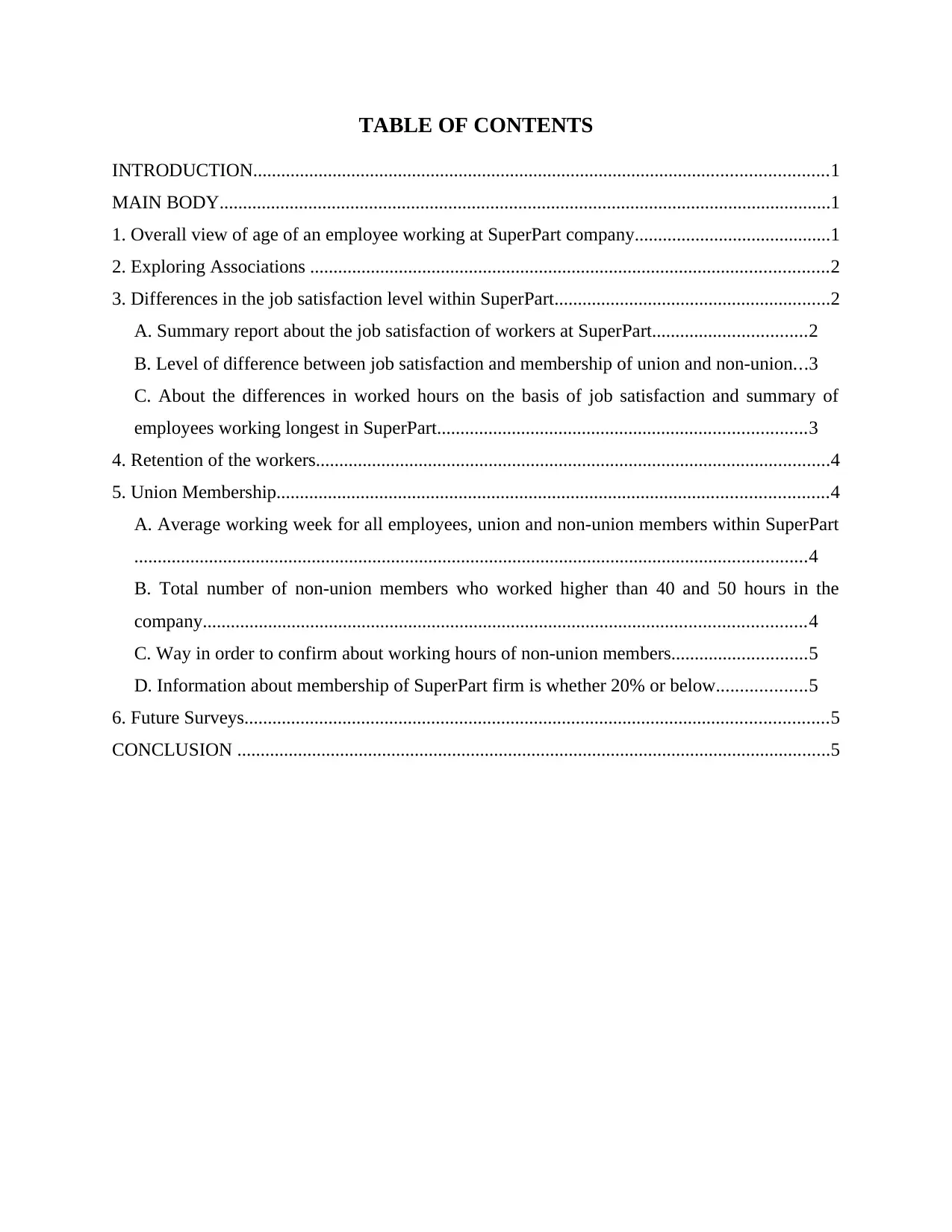
TABLE OF CONTENTS
INTRODUCTION...........................................................................................................................1
MAIN BODY...................................................................................................................................1
1. Overall view of age of an employee working at SuperPart company..........................................1
2. Exploring Associations ...............................................................................................................2
3. Differences in the job satisfaction level within SuperPart...........................................................2
A. Summary report about the job satisfaction of workers at SuperPart.................................2
B. Level of difference between job satisfaction and membership of union and non-union...3
C. About the differences in worked hours on the basis of job satisfaction and summary of
employees working longest in SuperPart...............................................................................3
4. Retention of the workers..............................................................................................................4
5. Union Membership......................................................................................................................4
A. Average working week for all employees, union and non-union members within SuperPart
................................................................................................................................................4
B. Total number of non-union members who worked higher than 40 and 50 hours in the
company.................................................................................................................................4
C. Way in order to confirm about working hours of non-union members.............................5
D. Information about membership of SuperPart firm is whether 20% or below...................5
6. Future Surveys.............................................................................................................................5
CONCLUSION ...............................................................................................................................5
INTRODUCTION...........................................................................................................................1
MAIN BODY...................................................................................................................................1
1. Overall view of age of an employee working at SuperPart company..........................................1
2. Exploring Associations ...............................................................................................................2
3. Differences in the job satisfaction level within SuperPart...........................................................2
A. Summary report about the job satisfaction of workers at SuperPart.................................2
B. Level of difference between job satisfaction and membership of union and non-union...3
C. About the differences in worked hours on the basis of job satisfaction and summary of
employees working longest in SuperPart...............................................................................3
4. Retention of the workers..............................................................................................................4
5. Union Membership......................................................................................................................4
A. Average working week for all employees, union and non-union members within SuperPart
................................................................................................................................................4
B. Total number of non-union members who worked higher than 40 and 50 hours in the
company.................................................................................................................................4
C. Way in order to confirm about working hours of non-union members.............................5
D. Information about membership of SuperPart firm is whether 20% or below...................5
6. Future Surveys.............................................................................................................................5
CONCLUSION ...............................................................................................................................5
INTRODUCTION
In any kind of research, part of analysing data and information has the very pivotal part
through which valid conclusion can be derived in an effective manner. There are basically two
kinds of the methods available in order to interpret or analyse data which are like thematic and
statistical. In the present study, statistical tools applied on the data set which collected from the
employees and members of SuperPart company. It shows about the level of satisfaction of
workers from the job offered by the selected entity. The study indicates overall age of each
employees who are working in the SuperPart working environment and providing services to it.
Apart from this, it shows that in which ways age of workers is related with some factor of them
as well as differences between job satisfaction extents of different employees. Beside this, about
the retention of workers providing their services and membership of unions is analysed with
reference to SuperPart firm.
MAIN BODY
1. Overall view of age of an employee working at SuperPart company
Cited case situation presents that Super Part wants to assess the age demographics of
employees. The rationale behind this, such information will provide high level of assistance to
firm in making estimation about the level of potential retirement. Moreover, aspect of retirement
has direct impact on superannuation funding and creates requirement for more personnel. Hence,
to meet such objective and assess the age of employees pivot table has been created via excel. In
this regard, table 1 clearly presents that 19 individuals are of the age of 33 years. Besides this,
other 19 employees are in the age of 38 years which in turn clearly shows that around 38
personnel are above the age of 33. On the other side, 18 individuals are in the age of 39 years and
other eighteen of 41 years old. It presents that approximately 36 personnel are falling into the age
group of 39-41 years.
Further, pivot table highlights those 32 employees of the company having age within the
range of 35-40 years. In addition to this, personnel who are 42, 43 and 44 are around 11, 15 & 14
respectively. Apart from this, 10 employees belong from the age of 48 years. Thus, by
considering the overall trend it can be stated that most of the employees are above the age of 33
years. Through assessment, it has been found that personnel pertaining to the age group of 56 to
69 years account for 38. Hence, as per the company’s policies and other aspect Super Part can
1
In any kind of research, part of analysing data and information has the very pivotal part
through which valid conclusion can be derived in an effective manner. There are basically two
kinds of the methods available in order to interpret or analyse data which are like thematic and
statistical. In the present study, statistical tools applied on the data set which collected from the
employees and members of SuperPart company. It shows about the level of satisfaction of
workers from the job offered by the selected entity. The study indicates overall age of each
employees who are working in the SuperPart working environment and providing services to it.
Apart from this, it shows that in which ways age of workers is related with some factor of them
as well as differences between job satisfaction extents of different employees. Beside this, about
the retention of workers providing their services and membership of unions is analysed with
reference to SuperPart firm.
MAIN BODY
1. Overall view of age of an employee working at SuperPart company
Cited case situation presents that Super Part wants to assess the age demographics of
employees. The rationale behind this, such information will provide high level of assistance to
firm in making estimation about the level of potential retirement. Moreover, aspect of retirement
has direct impact on superannuation funding and creates requirement for more personnel. Hence,
to meet such objective and assess the age of employees pivot table has been created via excel. In
this regard, table 1 clearly presents that 19 individuals are of the age of 33 years. Besides this,
other 19 employees are in the age of 38 years which in turn clearly shows that around 38
personnel are above the age of 33. On the other side, 18 individuals are in the age of 39 years and
other eighteen of 41 years old. It presents that approximately 36 personnel are falling into the age
group of 39-41 years.
Further, pivot table highlights those 32 employees of the company having age within the
range of 35-40 years. In addition to this, personnel who are 42, 43 and 44 are around 11, 15 & 14
respectively. Apart from this, 10 employees belong from the age of 48 years. Thus, by
considering the overall trend it can be stated that most of the employees are above the age of 33
years. Through assessment, it has been found that personnel pertaining to the age group of 56 to
69 years account for 38. Hence, as per the company’s policies and other aspect Super Part can
1
⊘ This is a preview!⊘
Do you want full access?
Subscribe today to unlock all pages.

Trusted by 1+ million students worldwide
estimate the number of potential requirement more effectually and thereby would become able to
take appropriate decisions regarding future aspects.
2. Exploring Associations
In the present times, there are several factors that have significant impact on the job
satisfaction of employees such as salary, status, working conditions or environment etc.
According to the given case situation, business unit wishes to know the extent to which
employee’s age and other factors like occupation, working hours as well as income before tax are
related with each other. For this purpose, correlation tool has been applied to assess whether all
such variables are positively correlated or not. The main reason behind the selection of such tool
is that it helps in assessing the level to which one factor has impact on another. Table 2
pertaining to correlation clearly entails that lower and negative correlation takes place between
the working hours and employee’s age. In accordance with such aspect working hours decreases
when age of the personnel increases due to having inverse relationship.
Further, outcome of correlation shows that, age and pre-tax income of personnel are
correlated. However, level of such correlation is lower which presents that income of the
employee’s increases as per age but not with higher rate. Moreover, when age of the individuals
increases then company do less increment in their salaries. Usually, with the motive to retain and
young people company offers high salary and other benefits. By considering the correlation
analysis, it can be said that age and occupation aspect of the personnel are inversely correlated
with each other. Thus, on the basis of all such aspects it can be stated that age does not have
significant influence on occupational aspect.
3. Differences in the job satisfaction level within SuperPart
A. Summary report about the job satisfaction of workers at SuperPart
In the company various number of employees working where level of job satisfaction is
not always same of all them. In the SuperPart company 400 number of workers are providing
their services to it in which satisfaction level of job differs. From the calculation and results
generated it can be found that, 185 employees among overall are very satisfied from the job
offered by the selected company. Apart from this, 171 and 27 number of workers are moderately
satisfied and dissatisfied up to the little extent respectively. When looking at the very dissatisfied
option then only 17 employees among 400 are responding. Therefore, it can be concluded that
majority of the workforce are very satisfied from the job of the SuperPart entity.
2
take appropriate decisions regarding future aspects.
2. Exploring Associations
In the present times, there are several factors that have significant impact on the job
satisfaction of employees such as salary, status, working conditions or environment etc.
According to the given case situation, business unit wishes to know the extent to which
employee’s age and other factors like occupation, working hours as well as income before tax are
related with each other. For this purpose, correlation tool has been applied to assess whether all
such variables are positively correlated or not. The main reason behind the selection of such tool
is that it helps in assessing the level to which one factor has impact on another. Table 2
pertaining to correlation clearly entails that lower and negative correlation takes place between
the working hours and employee’s age. In accordance with such aspect working hours decreases
when age of the personnel increases due to having inverse relationship.
Further, outcome of correlation shows that, age and pre-tax income of personnel are
correlated. However, level of such correlation is lower which presents that income of the
employee’s increases as per age but not with higher rate. Moreover, when age of the individuals
increases then company do less increment in their salaries. Usually, with the motive to retain and
young people company offers high salary and other benefits. By considering the correlation
analysis, it can be said that age and occupation aspect of the personnel are inversely correlated
with each other. Thus, on the basis of all such aspects it can be stated that age does not have
significant influence on occupational aspect.
3. Differences in the job satisfaction level within SuperPart
A. Summary report about the job satisfaction of workers at SuperPart
In the company various number of employees working where level of job satisfaction is
not always same of all them. In the SuperPart company 400 number of workers are providing
their services to it in which satisfaction level of job differs. From the calculation and results
generated it can be found that, 185 employees among overall are very satisfied from the job
offered by the selected company. Apart from this, 171 and 27 number of workers are moderately
satisfied and dissatisfied up to the little extent respectively. When looking at the very dissatisfied
option then only 17 employees among 400 are responding. Therefore, it can be concluded that
majority of the workforce are very satisfied from the job of the SuperPart entity.
2
Paraphrase This Document
Need a fresh take? Get an instant paraphrase of this document with our AI Paraphraser
B. Level of difference between job satisfaction and membership of union and non-union
Ho: There is significant difference among job satisfaction and union or non-union membership.
H1: There is no significant difference among job satisfaction and union or non-union
membership.
Apart from the employees within workplace of SuperPart company, union and non-union
members are also working. The present section analyses about the level of satisfaction of these
both the kinds of members. It can be found from the statistical test that value of significant
difference among these both the variables is 0.22. When significance value of any statistical test
is 0.5 or more than this, then the null hypothesis is accepted and another rejected. In the present
criteria 0.22 is lesser than 0.5, therefore, there is no mean difference in the level of job
satisfaction as well as union and non-union membership in the working environment of
SuperPart.
C. About the differences in worked hours on the basis of job satisfaction and summary of
employees working longest in SuperPart
Ho: There is mean significant difference between worked hours based on the job satisfaction.
H1: There is no mean significant difference between worked hours based on the job satisfaction.
Within working environment different number of employees working at different hours.
Along with this, workforce not satisfied with same extent from the company selected. From the
data analysis it can be found that value of multiple regression is only 0.036 which is negligible.
On the basis of this particular data it can be analysed that as one data or value differs then it will
not create effective impact on another data set. The 0.036 multiple R value denotes that, because
of changing in worked hours by the employee any change will not occur in the level of job
satisfaction. Apart from this, R square reflects variance then with how much percentage one
variable impact on another. In the present case scenario, variance in worked hour basis on
satisfaction of job is 0.0013. This particular digit indicates that due to occurring any kind of
change in the hours completed job satisfaction will fluctuate with only 0.0013% which is
negligible. At the end mean significance value in the present case is 0.468 which denotes level of
significant difference among two independent variables. Standard value of this statistical tool is
0.5 where null hypothesis is to be accepted and alternate rejected. In this, 0.468 is lower than 0.5
3
Ho: There is significant difference among job satisfaction and union or non-union membership.
H1: There is no significant difference among job satisfaction and union or non-union
membership.
Apart from the employees within workplace of SuperPart company, union and non-union
members are also working. The present section analyses about the level of satisfaction of these
both the kinds of members. It can be found from the statistical test that value of significant
difference among these both the variables is 0.22. When significance value of any statistical test
is 0.5 or more than this, then the null hypothesis is accepted and another rejected. In the present
criteria 0.22 is lesser than 0.5, therefore, there is no mean difference in the level of job
satisfaction as well as union and non-union membership in the working environment of
SuperPart.
C. About the differences in worked hours on the basis of job satisfaction and summary of
employees working longest in SuperPart
Ho: There is mean significant difference between worked hours based on the job satisfaction.
H1: There is no mean significant difference between worked hours based on the job satisfaction.
Within working environment different number of employees working at different hours.
Along with this, workforce not satisfied with same extent from the company selected. From the
data analysis it can be found that value of multiple regression is only 0.036 which is negligible.
On the basis of this particular data it can be analysed that as one data or value differs then it will
not create effective impact on another data set. The 0.036 multiple R value denotes that, because
of changing in worked hours by the employee any change will not occur in the level of job
satisfaction. Apart from this, R square reflects variance then with how much percentage one
variable impact on another. In the present case scenario, variance in worked hour basis on
satisfaction of job is 0.0013. This particular digit indicates that due to occurring any kind of
change in the hours completed job satisfaction will fluctuate with only 0.0013% which is
negligible. At the end mean significance value in the present case is 0.468 which denotes level of
significant difference among two independent variables. Standard value of this statistical tool is
0.5 where null hypothesis is to be accepted and alternate rejected. In this, 0.468 is lower than 0.5
3
due to which it can be interpreted that, there is no mean significant difference between worked
hours based on the job satisfaction.
In the SuperPart company all the group of employees working at the different hours. It
can be summarised from the output that group of little dissatisfied employees is working for the
longest hours. At the second number and third level, group of very satisfied and moderately
satisfied worked within firm. Further, very dissatisfied group worked for the shortest hours
within working environment.
4. Retention of the workers
On the basis of presented scenario about the retention level of employee within industry it
is not possible for working out the opportunities within the company. The reason behind this is
that, it is not known that the SuperPart has how much level of employees. Due to having
knowledge about only retention rate of employees, chances to work out are possible there until
and unless number of workforce is not known.
5. Union Membership
A. Average working week for all employees, union and non-union members within SuperPart
Within the SuperPart company, working hours in week of union members are 45 hours
and same of the another group i.e. non-union members. On the basis of this data it can be
estimated that, working hours in each week of all the employees are total 90 hours.
B. Total number of non-union members who worked higher than 40 and 50 hours in the
company
In the selected company employees working for the different hours like 20, 30, 40, 50 or
more or in between these. The present section of the report provide information about the union
membership as well as non-union. Those non-union members who are provided their services or
worked in SuperPart company for more than 40 hours are 178 from the total workforce. When
looking at the data of non-union members who worked within firm for more than 50 hours then
these are 67. On the basis of this data and result it can be said that major number of non-union
members worked for the lesser hours like 40 as compared to the 50 hours.
4
hours based on the job satisfaction.
In the SuperPart company all the group of employees working at the different hours. It
can be summarised from the output that group of little dissatisfied employees is working for the
longest hours. At the second number and third level, group of very satisfied and moderately
satisfied worked within firm. Further, very dissatisfied group worked for the shortest hours
within working environment.
4. Retention of the workers
On the basis of presented scenario about the retention level of employee within industry it
is not possible for working out the opportunities within the company. The reason behind this is
that, it is not known that the SuperPart has how much level of employees. Due to having
knowledge about only retention rate of employees, chances to work out are possible there until
and unless number of workforce is not known.
5. Union Membership
A. Average working week for all employees, union and non-union members within SuperPart
Within the SuperPart company, working hours in week of union members are 45 hours
and same of the another group i.e. non-union members. On the basis of this data it can be
estimated that, working hours in each week of all the employees are total 90 hours.
B. Total number of non-union members who worked higher than 40 and 50 hours in the
company
In the selected company employees working for the different hours like 20, 30, 40, 50 or
more or in between these. The present section of the report provide information about the union
membership as well as non-union. Those non-union members who are provided their services or
worked in SuperPart company for more than 40 hours are 178 from the total workforce. When
looking at the data of non-union members who worked within firm for more than 50 hours then
these are 67. On the basis of this data and result it can be said that major number of non-union
members worked for the lesser hours like 40 as compared to the 50 hours.
4
⊘ This is a preview!⊘
Do you want full access?
Subscribe today to unlock all pages.
Trusted by 1+ million students worldwide
C. Way in order to confirm about working hours of non-union members
In the above section it has been found that non-union members working within SuperPart
for 45 hours in a week. Further, for confirming that such ascertained value is actual or not the
average function method will be used in excel sheet. It will help to make sure that really the non-
union members are completing more than 45 working hours in the company or not.
D. Information about membership of SuperPart firm is whether 20% or below
On the basis of the recent manufactured survey it has been identified that unionised staff
was at least 20% on the basis of nation. Further an analyst suspected that the selected company is
not meet the standard criteria of unionised in the industry. On the basis of data analysis it has
been ascertained that, unionised members in the SuperPart company are 17% only. It reflects that
the cited firm is at the side of low unioinised as compared to the overall country. Therefore, the
results identified by the researcher was correct that membership within SuperPart is lower than
20%.
6. Future Surveys
At this particular section of the report, the entity wants to survey about the average
working week within per hour and satisfaction level of employees for overall company. From
assessment, on the basis of 95% interval and 50% population proportion it has been identified
that sample size for further research should be 385 or more. By considering this, it can be
presented that through conducting research on 400 personnel researcher would become able to
derive suitable results
CONCLUSION
On the basis of above statistical analysis about the job satisfaction level within SuperPart
it can be concluded that, majority of the employees working in the cite firm are more than 33
years. It can be found from the study that there is no mean significant difference among two
variable like job satisfaction and union or non-union membership due to having 0.22 significance
value which is lower than 0.5. Apart from this, there is no any kind of mean significant
difference between worked hours based on the job satisfaction where value is 0.46. Beside this, it
can be ascertained that working hours of all the employees are 90. Further, number of union and
non-union workers who worked more than 40 and 50 hours are like 178 and 67 respectively. It
5
In the above section it has been found that non-union members working within SuperPart
for 45 hours in a week. Further, for confirming that such ascertained value is actual or not the
average function method will be used in excel sheet. It will help to make sure that really the non-
union members are completing more than 45 working hours in the company or not.
D. Information about membership of SuperPart firm is whether 20% or below
On the basis of the recent manufactured survey it has been identified that unionised staff
was at least 20% on the basis of nation. Further an analyst suspected that the selected company is
not meet the standard criteria of unionised in the industry. On the basis of data analysis it has
been ascertained that, unionised members in the SuperPart company are 17% only. It reflects that
the cited firm is at the side of low unioinised as compared to the overall country. Therefore, the
results identified by the researcher was correct that membership within SuperPart is lower than
20%.
6. Future Surveys
At this particular section of the report, the entity wants to survey about the average
working week within per hour and satisfaction level of employees for overall company. From
assessment, on the basis of 95% interval and 50% population proportion it has been identified
that sample size for further research should be 385 or more. By considering this, it can be
presented that through conducting research on 400 personnel researcher would become able to
derive suitable results
CONCLUSION
On the basis of above statistical analysis about the job satisfaction level within SuperPart
it can be concluded that, majority of the employees working in the cite firm are more than 33
years. It can be found from the study that there is no mean significant difference among two
variable like job satisfaction and union or non-union membership due to having 0.22 significance
value which is lower than 0.5. Apart from this, there is no any kind of mean significant
difference between worked hours based on the job satisfaction where value is 0.46. Beside this, it
can be ascertained that working hours of all the employees are 90. Further, number of union and
non-union workers who worked more than 40 and 50 hours are like 178 and 67 respectively. It
5
Paraphrase This Document
Need a fresh take? Get an instant paraphrase of this document with our AI Paraphraser
can be found that SuperPart company is at the position of low-unionised due to having
membership is below standard which is 17%.
6
membership is below standard which is 17%.
6

1 out of 8


Related Documents


Your All-in-One AI-Powered Toolkit for Academic Success.
+13062052269
info@desklib.com
Available 24*7 on WhatsApp / Email
![[object Object]](/_next/static/media/star-bottom.7253800d.svg)
Unlock your academic potential
Copyright © 2020–2026 A2Z Services. All Rights Reserved. Developed and managed by ZUCOL.