University Report: Business Decision Analytics and Data Analysis
VerifiedAdded on 2022/09/16
|16
|2929
|15
Report
AI Summary
This report, prepared for a university assignment, delves into the critical role of data and data analytics in business decision-making. It begins by exploring various sources of data, categorizing them as internal and external, and highlighting their significance in informing business strategies. The report then examines different types of data analytics, including descriptive, diagnostic, predictive, and prescriptive analytics, illustrating their application in analyzing past performance, identifying patterns, forecasting future trends, and suggesting optimal courses of action. Furthermore, the report outlines the decision-making process and assesses the usefulness of several decision-making tools, such as cost-benefit analysis, Pareto analysis, and SWOT analysis, within the context of a marketing problem for Torrens. Through these tools, the report aims to determine effective marketing campaigns to extend the market reach and counter market competition. The analysis includes a cost-benefit analysis of marketing campaigns, a Pareto analysis to identify optimal strategies, and a SWOT analysis to evaluate the strengths, weaknesses, opportunities, and threats of the business.
1
RUNNINGHEAD: Business Decision Analytics
Title: Business Decision Analytics
Task: Explore the role of Data and Data Analytics in Decision-Making
University:
Lecturer’s Name:
Student Name:
Due Date:
RUNNINGHEAD: Business Decision Analytics
Title: Business Decision Analytics
Task: Explore the role of Data and Data Analytics in Decision-Making
University:
Lecturer’s Name:
Student Name:
Due Date:

Paraphrase This Document
Need a fresh take? Get an instant paraphrase of this document with our AI Paraphraser
2
Business Decision Analytics
Table of Contents
Executive Summary...................................................................................................................2
Purpose...................................................................................................................................2
Results....................................................................................................................................2
Conclusion.............................................................................................................................2
Introduction................................................................................................................................3
Objective................................................................................................................................4
Sources of Data and Role of Data Analytics in Decision-making.............................................5
Data........................................................................................................................................5
Data analytics.........................................................................................................................6
Descriptive analytics..........................................................................................................6
Diagnostic analytics...........................................................................................................6
Predictive analytics............................................................................................................7
Prescriptive analytics.........................................................................................................7
Decision Making Process...........................................................................................................8
Decision Making Tools..............................................................................................................9
Cost-Benefit Analysis............................................................................................................9
Pareto Analysis....................................................................................................................10
SWOT Analysis...................................................................................................................12
Conclusion...............................................................................................................................13
References................................................................................................................................14
Business Decision Analytics
Table of Contents
Executive Summary...................................................................................................................2
Purpose...................................................................................................................................2
Results....................................................................................................................................2
Conclusion.............................................................................................................................2
Introduction................................................................................................................................3
Objective................................................................................................................................4
Sources of Data and Role of Data Analytics in Decision-making.............................................5
Data........................................................................................................................................5
Data analytics.........................................................................................................................6
Descriptive analytics..........................................................................................................6
Diagnostic analytics...........................................................................................................6
Predictive analytics............................................................................................................7
Prescriptive analytics.........................................................................................................7
Decision Making Process...........................................................................................................8
Decision Making Tools..............................................................................................................9
Cost-Benefit Analysis............................................................................................................9
Pareto Analysis....................................................................................................................10
SWOT Analysis...................................................................................................................12
Conclusion...............................................................................................................................13
References................................................................................................................................14
3
Business Decision Analytics
Executive Summary
Purpose
Decision-making is among the important components of business management. To understand
the concept, context and process of business decision-making it is fundamental that the building
structures of “decision-making” be considered. To examine the building blocks of decision-
making ranging from data, data analytics and their relation with business decision making to
determine the optimal marketing strategy and dealing with competition, is precisely the objective
of this paper.
Results
In this paper, it is demonstrated that data is crucial in decision-making hence it is fundamental
that the sources of data be reliable. Moreover, the paper explores up to 4 types of data analytics
which include descriptive, prescriptive, diagnostic, and predictive analytics. Further, three types
of decision-making based on data are adopted for implementation in solving the business
problem. The tools include: Pareto analysis, cost-benefit analysis, and SWOT analysis.
Conclusion
The paper concludes that data and data analytics are crucial in decision-making and that it is
advisable to consider the use of a number of decision-making tools before making a decision
Keywords
SWOT analysis, Pareto analysis, Data analytics
Business Decision Analytics
Executive Summary
Purpose
Decision-making is among the important components of business management. To understand
the concept, context and process of business decision-making it is fundamental that the building
structures of “decision-making” be considered. To examine the building blocks of decision-
making ranging from data, data analytics and their relation with business decision making to
determine the optimal marketing strategy and dealing with competition, is precisely the objective
of this paper.
Results
In this paper, it is demonstrated that data is crucial in decision-making hence it is fundamental
that the sources of data be reliable. Moreover, the paper explores up to 4 types of data analytics
which include descriptive, prescriptive, diagnostic, and predictive analytics. Further, three types
of decision-making based on data are adopted for implementation in solving the business
problem. The tools include: Pareto analysis, cost-benefit analysis, and SWOT analysis.
Conclusion
The paper concludes that data and data analytics are crucial in decision-making and that it is
advisable to consider the use of a number of decision-making tools before making a decision
Keywords
SWOT analysis, Pareto analysis, Data analytics
⊘ This is a preview!⊘
Do you want full access?
Subscribe today to unlock all pages.

Trusted by 1+ million students worldwide
4
Business Decision Analytics
Introduction
In researching business decision-making, it is important to consider the following questions:
what factors drive the decisions that people make, be it as an individual or as a group? What is
the effect of modern business practices on such factors? And how does data and related
applications of data analytics actually influence business decision making? These, are among the
fundamental questions that underlay the study of data, data analytics and their relation to
business decision making.
With the advent of technology and its widespread adoption in business practices, there have
been emerging trends related to how well such technologies can be optimized so as to sustain
businesses and even improve business performances. Ideally, the question of business
performance is often in tandem with business aspects of decision-making. In his paper “Main
Factors beyond Decision Making” (Al-Tarawneh, 2011) defines decision making as, “…the
process of identifying and selecting from among possible solutions to a problem according to the
demands of the situation.” In practice, decision making is split into two i.e. individual and group
decisions where, individual decisions refer to the decisions made by a single individual while
group decisions are those taken by individuals who are identified as a group tasked with making
the decisions (Academic Library, 2018).
Risk as (Buchanan & O’Connell, 2016) notes, is in escapable when it comes to decision
making. In day to day activities, the risk is often small but when scaling up to corporate, the
effects of any decision are often felt throughout the business usually appearing in the form of
opportunity cost of the choices not made, even if it is in win-win scenarios.
As such, it is important that decisions are made with reference to credible sources that is, they
are based on firm ground and to do so, decisions ought to be data-driven. In this regard,
Business Decision Analytics
Introduction
In researching business decision-making, it is important to consider the following questions:
what factors drive the decisions that people make, be it as an individual or as a group? What is
the effect of modern business practices on such factors? And how does data and related
applications of data analytics actually influence business decision making? These, are among the
fundamental questions that underlay the study of data, data analytics and their relation to
business decision making.
With the advent of technology and its widespread adoption in business practices, there have
been emerging trends related to how well such technologies can be optimized so as to sustain
businesses and even improve business performances. Ideally, the question of business
performance is often in tandem with business aspects of decision-making. In his paper “Main
Factors beyond Decision Making” (Al-Tarawneh, 2011) defines decision making as, “…the
process of identifying and selecting from among possible solutions to a problem according to the
demands of the situation.” In practice, decision making is split into two i.e. individual and group
decisions where, individual decisions refer to the decisions made by a single individual while
group decisions are those taken by individuals who are identified as a group tasked with making
the decisions (Academic Library, 2018).
Risk as (Buchanan & O’Connell, 2016) notes, is in escapable when it comes to decision
making. In day to day activities, the risk is often small but when scaling up to corporate, the
effects of any decision are often felt throughout the business usually appearing in the form of
opportunity cost of the choices not made, even if it is in win-win scenarios.
As such, it is important that decisions are made with reference to credible sources that is, they
are based on firm ground and to do so, decisions ought to be data-driven. In this regard,
Paraphrase This Document
Need a fresh take? Get an instant paraphrase of this document with our AI Paraphraser
5
Business Decision Analytics
(Durcevic, 2019) acknowledges the role of data-driven decision making in defining a success
path for businesses.
According to (Durcevic, 2019), to make data driven decisions, the business should try and:
i. Leverage the potential held by digital insights as well as utilize the business
intelligence and the power it holds
ii. Implement the right and relevant reporting tools as well as develop a keen
understanding of how to measure and analyze data effectively and with relative
precision and accuracy
After exploring the major concepts underlying business decision making and linking them
with data, the question that remains pertains to the kind of tools that can be used in decision-
making.
Objective
Given the above introduction, this paper therefore seeks to fulfill the following objectives:
i. Examine different sources of data for business and how data analytics can be used to
identify, “trends/ patterns that form the evidence for decision-making”
ii. Provide a visualization of decision making process as well that of analytics in
supporting decision making
iii. Explore up to three decision-making tools and technologies
The context of this paper will be focused towards the role of data, data analytics and
decision-making regarding ways with which to extend the market and counter market
competition faced by Torrens.
To accomplish the stated objectives within the context of their application in Torrens, the rest
of the paper will be split into four sections which will include: sources of data and data analytics
in business decision making, decision making process, decision making tools and a conclusion.
Business Decision Analytics
(Durcevic, 2019) acknowledges the role of data-driven decision making in defining a success
path for businesses.
According to (Durcevic, 2019), to make data driven decisions, the business should try and:
i. Leverage the potential held by digital insights as well as utilize the business
intelligence and the power it holds
ii. Implement the right and relevant reporting tools as well as develop a keen
understanding of how to measure and analyze data effectively and with relative
precision and accuracy
After exploring the major concepts underlying business decision making and linking them
with data, the question that remains pertains to the kind of tools that can be used in decision-
making.
Objective
Given the above introduction, this paper therefore seeks to fulfill the following objectives:
i. Examine different sources of data for business and how data analytics can be used to
identify, “trends/ patterns that form the evidence for decision-making”
ii. Provide a visualization of decision making process as well that of analytics in
supporting decision making
iii. Explore up to three decision-making tools and technologies
The context of this paper will be focused towards the role of data, data analytics and
decision-making regarding ways with which to extend the market and counter market
competition faced by Torrens.
To accomplish the stated objectives within the context of their application in Torrens, the rest
of the paper will be split into four sections which will include: sources of data and data analytics
in business decision making, decision making process, decision making tools and a conclusion.
6
Business Decision Analytics
Sources of Data and Role of Data Analytics in Decision-making
Data
A report by (The Economist, 2017) quotes, “…The world’s most valuable resource is no
longer oil, but data.” This quote forms a bedrock for the arguments related to the influence of
data on business decision making made in this paper. In business, sources of data are categorized
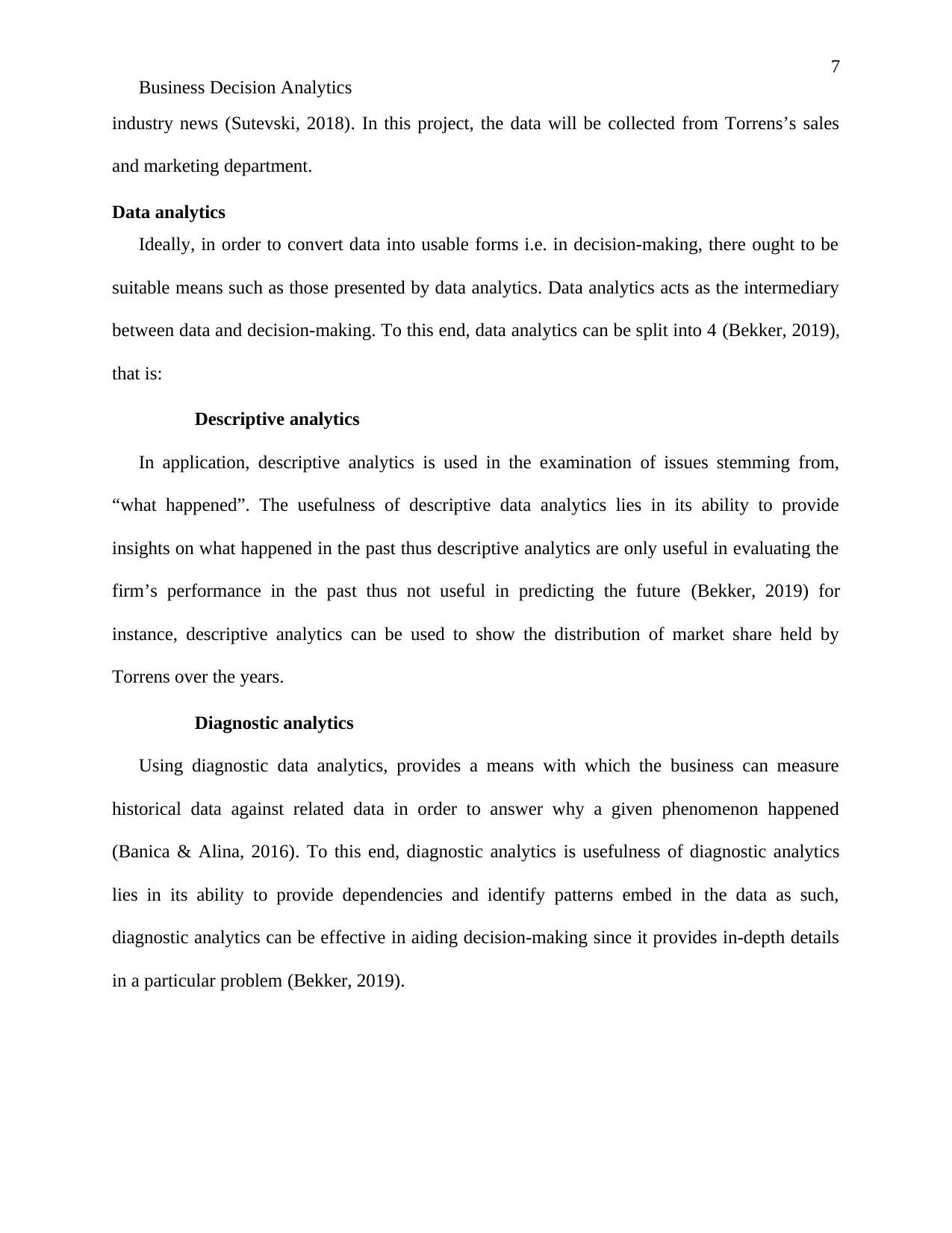
as either internal or external. According to a survey by www.bi-survey.com the usage of data in
terms of internal and external sources is distributed as in figure 1 below.
Figure 1: Data Usage, Source: https://bi-survey.com/data-sources
From the graph, it is evident that most firms use less than 5 external data sources of data with
most firms preferring to use more than 10 sources of internal data compared to external sources.
The logic behind increased use of internal data sources compared to external might lie with the
need for businesses to learn from their strengths and weaknesses after which they can adopt
external sources to study issues regarding to market competition or requirements.
(Sutevski, 2018) lists some of internal business data sources as including: internal statistics,
IT department, sales department, business researches, market research, and IT department.
External data sources include: external researches, media, internet, social media, research papers,
Business Decision Analytics
Sources of Data and Role of Data Analytics in Decision-making
Data
A report by (The Economist, 2017) quotes, “…The world’s most valuable resource is no
longer oil, but data.” This quote forms a bedrock for the arguments related to the influence of
data on business decision making made in this paper. In business, sources of data are categorized
as either internal or external. According to a survey by www.bi-survey.com the usage of data in
terms of internal and external sources is distributed as in figure 1 below.
Figure 1: Data Usage, Source: https://bi-survey.com/data-sources
From the graph, it is evident that most firms use less than 5 external data sources of data with
most firms preferring to use more than 10 sources of internal data compared to external sources.
The logic behind increased use of internal data sources compared to external might lie with the
need for businesses to learn from their strengths and weaknesses after which they can adopt
external sources to study issues regarding to market competition or requirements.
(Sutevski, 2018) lists some of internal business data sources as including: internal statistics,
IT department, sales department, business researches, market research, and IT department.
External data sources include: external researches, media, internet, social media, research papers,
⊘ This is a preview!⊘
Do you want full access?
Subscribe today to unlock all pages.
Trusted by 1+ million students worldwide
7
Business Decision Analytics
industry news (Sutevski, 2018). In this project, the data will be collected from Torrens’s sales
and marketing department.
Data analytics
Ideally, in order to convert data into usable forms i.e. in decision-making, there ought to be
suitable means such as those presented by data analytics. Data analytics acts as the intermediary
between data and decision-making. To this end, data analytics can be split into 4 (Bekker, 2019),
that is:
Descriptive analytics
In application, descriptive analytics is used in the examination of issues stemming from,
“what happened”. The usefulness of descriptive data analytics lies in its ability to provide
insights on what happened in the past thus descriptive analytics are only useful in evaluating the
firm’s performance in the past thus not useful in predicting the future (Bekker, 2019) for
instance, descriptive analytics can be used to show the distribution of market share held by
Torrens over the years.
Diagnostic analytics
Using diagnostic data analytics, provides a means with which the business can measure
historical data against related data in order to answer why a given phenomenon happened
(Banica & Alina, 2016). To this end, diagnostic analytics is usefulness of diagnostic analytics
lies in its ability to provide dependencies and identify patterns embed in the data as such,
diagnostic analytics can be effective in aiding decision-making since it provides in-depth details
in a particular problem (Bekker, 2019).
Business Decision Analytics
industry news (Sutevski, 2018). In this project, the data will be collected from Torrens’s sales
and marketing department.
Data analytics
Ideally, in order to convert data into usable forms i.e. in decision-making, there ought to be
suitable means such as those presented by data analytics. Data analytics acts as the intermediary
between data and decision-making. To this end, data analytics can be split into 4 (Bekker, 2019),
that is:
Descriptive analytics
In application, descriptive analytics is used in the examination of issues stemming from,
“what happened”. The usefulness of descriptive data analytics lies in its ability to provide
insights on what happened in the past thus descriptive analytics are only useful in evaluating the
firm’s performance in the past thus not useful in predicting the future (Bekker, 2019) for
instance, descriptive analytics can be used to show the distribution of market share held by
Torrens over the years.
Diagnostic analytics
Using diagnostic data analytics, provides a means with which the business can measure
historical data against related data in order to answer why a given phenomenon happened
(Banica & Alina, 2016). To this end, diagnostic analytics is usefulness of diagnostic analytics
lies in its ability to provide dependencies and identify patterns embed in the data as such,
diagnostic analytics can be effective in aiding decision-making since it provides in-depth details
in a particular problem (Bekker, 2019).
Paraphrase This Document
Need a fresh take? Get an instant paraphrase of this document with our AI Paraphraser
8
Business Decision Analytics
Predictive analytics
Predictive analytics provides a means with which the business can estimate what is going to
happen if what happens (Bekker, 2019). To a large extent, it incorporates the elements of both
diagnostic and predictive analytics in an attempt to detect, “…tendencies, clusters and
exceptions, and to predict future trends” (Saidali, Rahich, Tabaa, & Medouri, 2019). Predictive
analytics can be used to show the effect of certain choices on the Torrens’s competing strength
and market opportunities. Such might include how branding, positioning, etcetera.
Prescriptive analytics
In data analytics, prescriptive analytics is used to prescribe, the best course of action in an
effort to handle any future issue or optimize the potential of a given trend. Such insights are
useful for decisions ranging from sales to production (Bekker, 2019), (Saidali, Rahich, Tabaa, &
Medouri, 2019). Using prescriptive analytics, we can actually advice the executive on what
measures to adopt in Torrens.
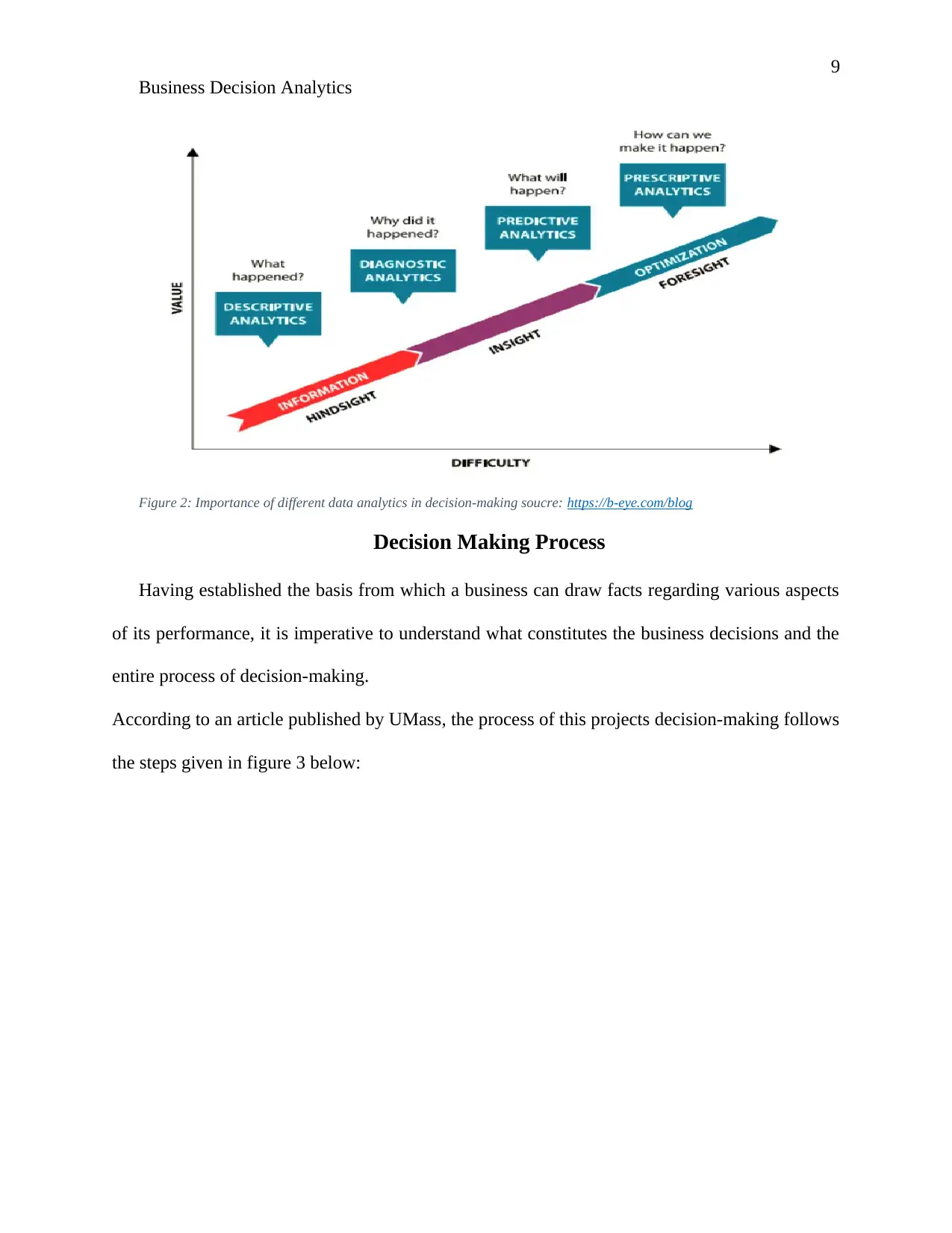
In order to determine the contribution of the different data analytics tools used in decision
making, www.b-eye.com uses the following visualization below to show the importance of
different data analytic techniques.
Business Decision Analytics
Predictive analytics
Predictive analytics provides a means with which the business can estimate what is going to
happen if what happens (Bekker, 2019). To a large extent, it incorporates the elements of both
diagnostic and predictive analytics in an attempt to detect, “…tendencies, clusters and
exceptions, and to predict future trends” (Saidali, Rahich, Tabaa, & Medouri, 2019). Predictive
analytics can be used to show the effect of certain choices on the Torrens’s competing strength
and market opportunities. Such might include how branding, positioning, etcetera.
Prescriptive analytics
In data analytics, prescriptive analytics is used to prescribe, the best course of action in an
effort to handle any future issue or optimize the potential of a given trend. Such insights are
useful for decisions ranging from sales to production (Bekker, 2019), (Saidali, Rahich, Tabaa, &
Medouri, 2019). Using prescriptive analytics, we can actually advice the executive on what
measures to adopt in Torrens.
In order to determine the contribution of the different data analytics tools used in decision
making, www.b-eye.com uses the following visualization below to show the importance of
different data analytic techniques.
9
Business Decision Analytics
Figure 2: Importance of different data analytics in decision-making soucre: https://b-eye.com/blog
Decision Making Process
Having established the basis from which a business can draw facts regarding various aspects
of its performance, it is imperative to understand what constitutes the business decisions and the
entire process of decision-making.
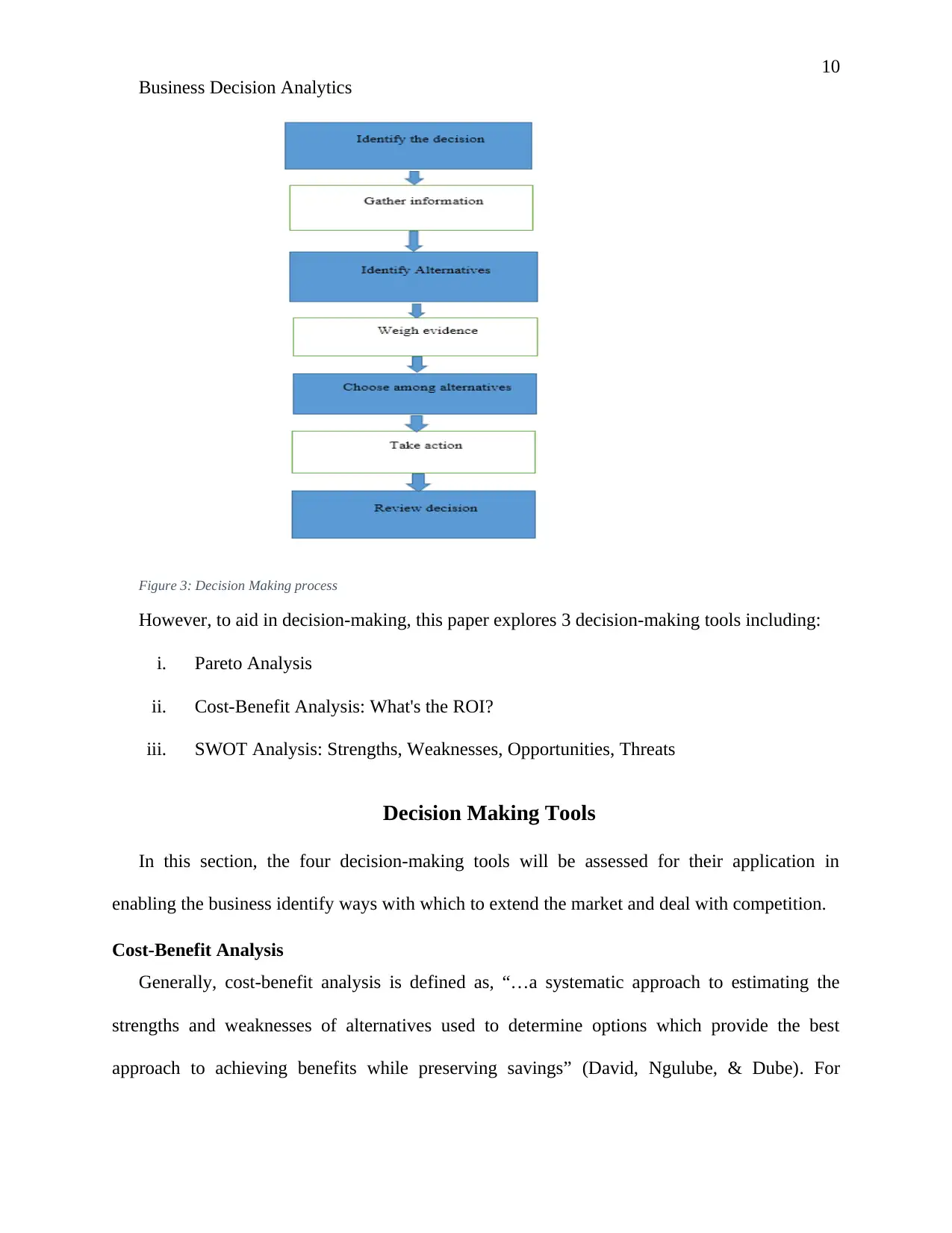
According to an article published by UMass, the process of this projects decision-making follows
the steps given in figure 3 below:
Business Decision Analytics
Figure 2: Importance of different data analytics in decision-making soucre: https://b-eye.com/blog
Decision Making Process
Having established the basis from which a business can draw facts regarding various aspects
of its performance, it is imperative to understand what constitutes the business decisions and the
entire process of decision-making.
According to an article published by UMass, the process of this projects decision-making follows
the steps given in figure 3 below:
⊘ This is a preview!⊘
Do you want full access?
Subscribe today to unlock all pages.
Trusted by 1+ million students worldwide
10
Business Decision Analytics
Figure 3: Decision Making process
However, to aid in decision-making, this paper explores 3 decision-making tools including:
i. Pareto Analysis
ii. Cost-Benefit Analysis: What's the ROI?
iii. SWOT Analysis: Strengths, Weaknesses, Opportunities, Threats
Decision Making Tools
In this section, the four decision-making tools will be assessed for their application in
enabling the business identify ways with which to extend the market and deal with competition.
Cost-Benefit Analysis
Generally, cost-benefit analysis is defined as, “…a systematic approach to estimating the
strengths and weaknesses of alternatives used to determine options which provide the best
approach to achieving benefits while preserving savings” (David, Ngulube, & Dube). For
Business Decision Analytics
Figure 3: Decision Making process
However, to aid in decision-making, this paper explores 3 decision-making tools including:
i. Pareto Analysis
ii. Cost-Benefit Analysis: What's the ROI?
iii. SWOT Analysis: Strengths, Weaknesses, Opportunities, Threats
Decision Making Tools
In this section, the four decision-making tools will be assessed for their application in
enabling the business identify ways with which to extend the market and deal with competition.
Cost-Benefit Analysis
Generally, cost-benefit analysis is defined as, “…a systematic approach to estimating the
strengths and weaknesses of alternatives used to determine options which provide the best
approach to achieving benefits while preserving savings” (David, Ngulube, & Dube). For
Paraphrase This Document
Need a fresh take? Get an instant paraphrase of this document with our AI Paraphraser
11
Business Decision Analytics
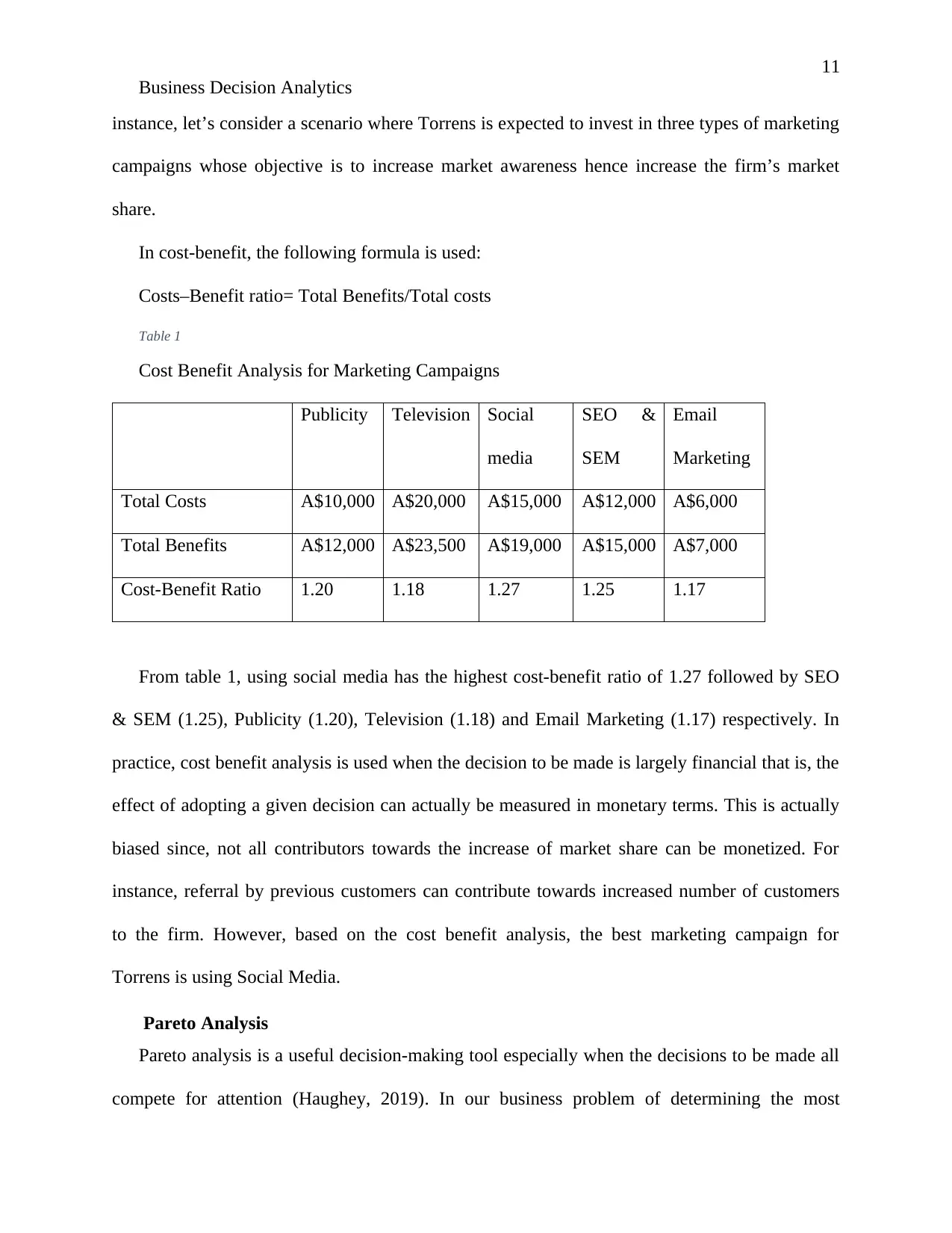
instance, let’s consider a scenario where Torrens is expected to invest in three types of marketing
campaigns whose objective is to increase market awareness hence increase the firm’s market
share.
In cost-benefit, the following formula is used:
Costs–Benefit ratio= Total Benefits/Total costs
Table 1
Cost Benefit Analysis for Marketing Campaigns
Publicity Television Social
media
SEO &
SEM
Email
Marketing
Total Costs A$10,000 A$20,000 A$15,000 A$12,000 A$6,000
Total Benefits A$12,000 A$23,500 A$19,000 A$15,000 A$7,000
Cost-Benefit Ratio 1.20 1.18 1.27 1.25 1.17
From table 1, using social media has the highest cost-benefit ratio of 1.27 followed by SEO
& SEM (1.25), Publicity (1.20), Television (1.18) and Email Marketing (1.17) respectively. In
practice, cost benefit analysis is used when the decision to be made is largely financial that is, the
effect of adopting a given decision can actually be measured in monetary terms. This is actually
biased since, not all contributors towards the increase of market share can be monetized. For
instance, referral by previous customers can contribute towards increased number of customers
to the firm. However, based on the cost benefit analysis, the best marketing campaign for
Torrens is using Social Media.
Pareto Analysis
Pareto analysis is a useful decision-making tool especially when the decisions to be made all
compete for attention (Haughey, 2019). In our business problem of determining the most
Business Decision Analytics
instance, let’s consider a scenario where Torrens is expected to invest in three types of marketing
campaigns whose objective is to increase market awareness hence increase the firm’s market
share.
In cost-benefit, the following formula is used:
Costs–Benefit ratio= Total Benefits/Total costs
Table 1
Cost Benefit Analysis for Marketing Campaigns
Publicity Television Social
media
SEO &
SEM
Marketing
Total Costs A$10,000 A$20,000 A$15,000 A$12,000 A$6,000
Total Benefits A$12,000 A$23,500 A$19,000 A$15,000 A$7,000
Cost-Benefit Ratio 1.20 1.18 1.27 1.25 1.17
From table 1, using social media has the highest cost-benefit ratio of 1.27 followed by SEO
& SEM (1.25), Publicity (1.20), Television (1.18) and Email Marketing (1.17) respectively. In
practice, cost benefit analysis is used when the decision to be made is largely financial that is, the
effect of adopting a given decision can actually be measured in monetary terms. This is actually
biased since, not all contributors towards the increase of market share can be monetized. For
instance, referral by previous customers can contribute towards increased number of customers
to the firm. However, based on the cost benefit analysis, the best marketing campaign for
Torrens is using Social Media.
Pareto Analysis
Pareto analysis is a useful decision-making tool especially when the decisions to be made all
compete for attention (Haughey, 2019). In our business problem of determining the most
12
Business Decision Analytics
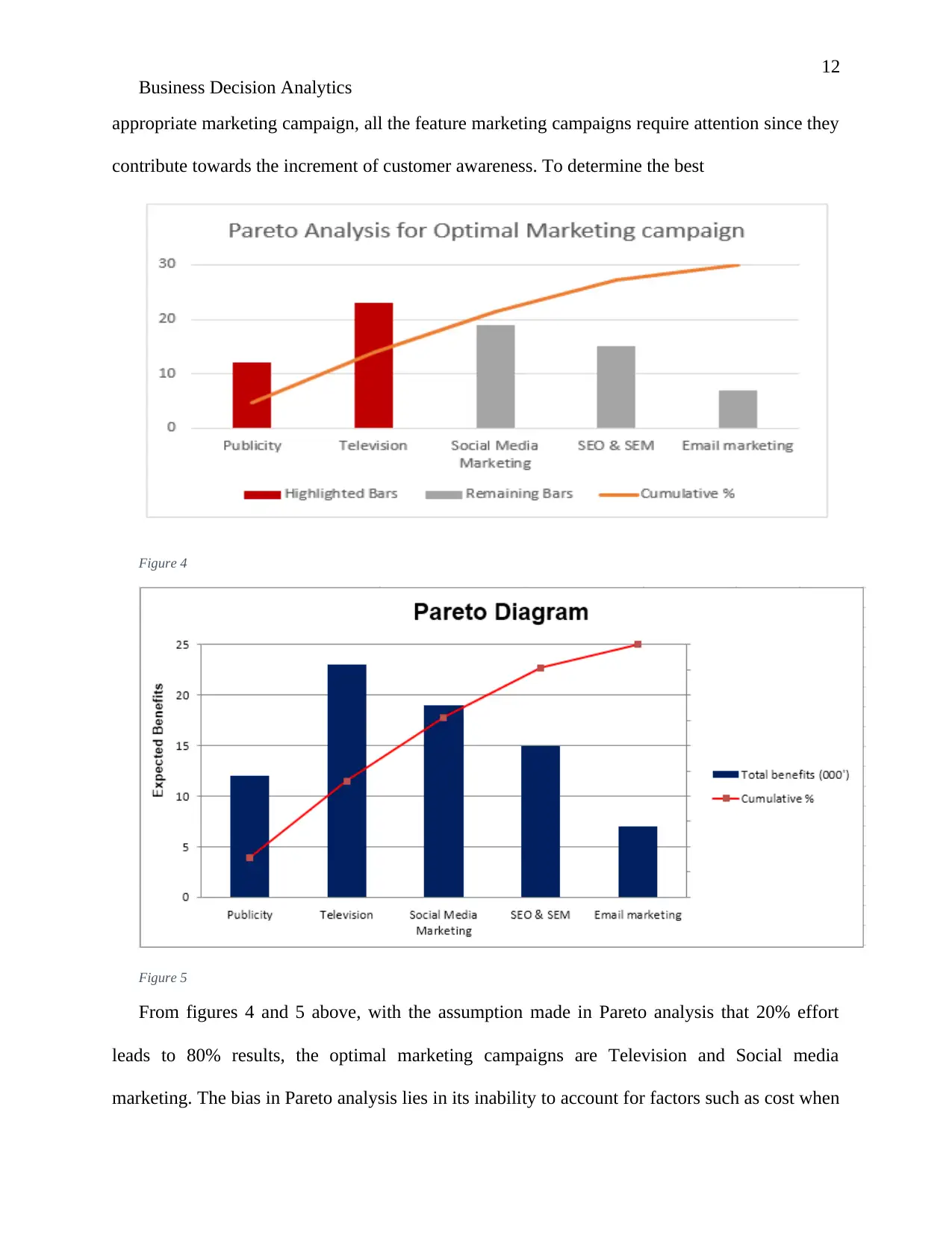
appropriate marketing campaign, all the feature marketing campaigns require attention since they
contribute towards the increment of customer awareness. To determine the best
Figure 4
Figure 5
From figures 4 and 5 above, with the assumption made in Pareto analysis that 20% effort
leads to 80% results, the optimal marketing campaigns are Television and Social media
marketing. The bias in Pareto analysis lies in its inability to account for factors such as cost when
Business Decision Analytics
appropriate marketing campaign, all the feature marketing campaigns require attention since they
contribute towards the increment of customer awareness. To determine the best
Figure 4
Figure 5
From figures 4 and 5 above, with the assumption made in Pareto analysis that 20% effort
leads to 80% results, the optimal marketing campaigns are Television and Social media
marketing. The bias in Pareto analysis lies in its inability to account for factors such as cost when
⊘ This is a preview!⊘
Do you want full access?
Subscribe today to unlock all pages.
Trusted by 1+ million students worldwide

1 out of 16


Related Documents


Your All-in-One AI-Powered Toolkit for Academic Success.
+13062052269
info@desklib.com
Available 24*7 on WhatsApp / Email
![[object Object]](/_next/static/media/star-bottom.7253800d.svg)
Unlock your academic potential
Copyright © 2020–2026 A2Z Services. All Rights Reserved. Developed and managed by ZUCOL.