MG413 - Data Insights for Business Decisions Presentation 2021

Verified

Added on  2023/06/17

|9
|414
|486
Presentation
AI Summary
This presentation delves into the crucial role of data insights in business decision-making, emphasizing the importance of identifying and selecting relevant data sources. It differentiates between orthodox market research and big data, outlining various database and management information systems. The presentation details a five-step process for utilizing data in decision-making, highlighting how organizations use data to find new customers, improve customer retention, manage marketing efforts, track social media interaction, and predict sales trends. It also touches on research into improving data capture methods, noting the challenges and evolving tools in data extraction and analysis. The presentation concludes by emphasizing the increasing expense of traditional surveys and the need for efficient data management.
Document Page
Data insights For Business Decisions
tabler-icon-diamond-filled.svg

Paraphrase This Document

Need a fresh take? Get an instant paraphrase of this document with our AI Paraphraser
Document Page
Introduction
Business decision making is considered as a important part of
an organisation. The size of organisation doesn't matter.
This presentation covers the identification and selection of
relevant sources of data and information for the purpose of
making decisions. Furthermore it also deals with the
information to support decision making.
Document Page
Data collected and used by the
organisation
It is found at the organisations
collect and use the big data.
It refers to a modern
analytics trend which allows
the organisations to make
more data driven decision
some than ever before.
Document Page
Describe orthodox market research and
how this is different from Big Data
Orthodox market research refers to the objective and formal
process which is performed for the purpose of systematically
obtaining, analysing and interpreting data in order to taking
decision in marketing.
Due to the wealth of information that big data provides, it is
impossible to use traditional market research techniques to
attempt to interpret and understand the data
tabler-icon-diamond-filled.svg

Paraphrase This Document

Need a fresh take? Get an instant paraphrase of this document with our AI Paraphraser
Document Page
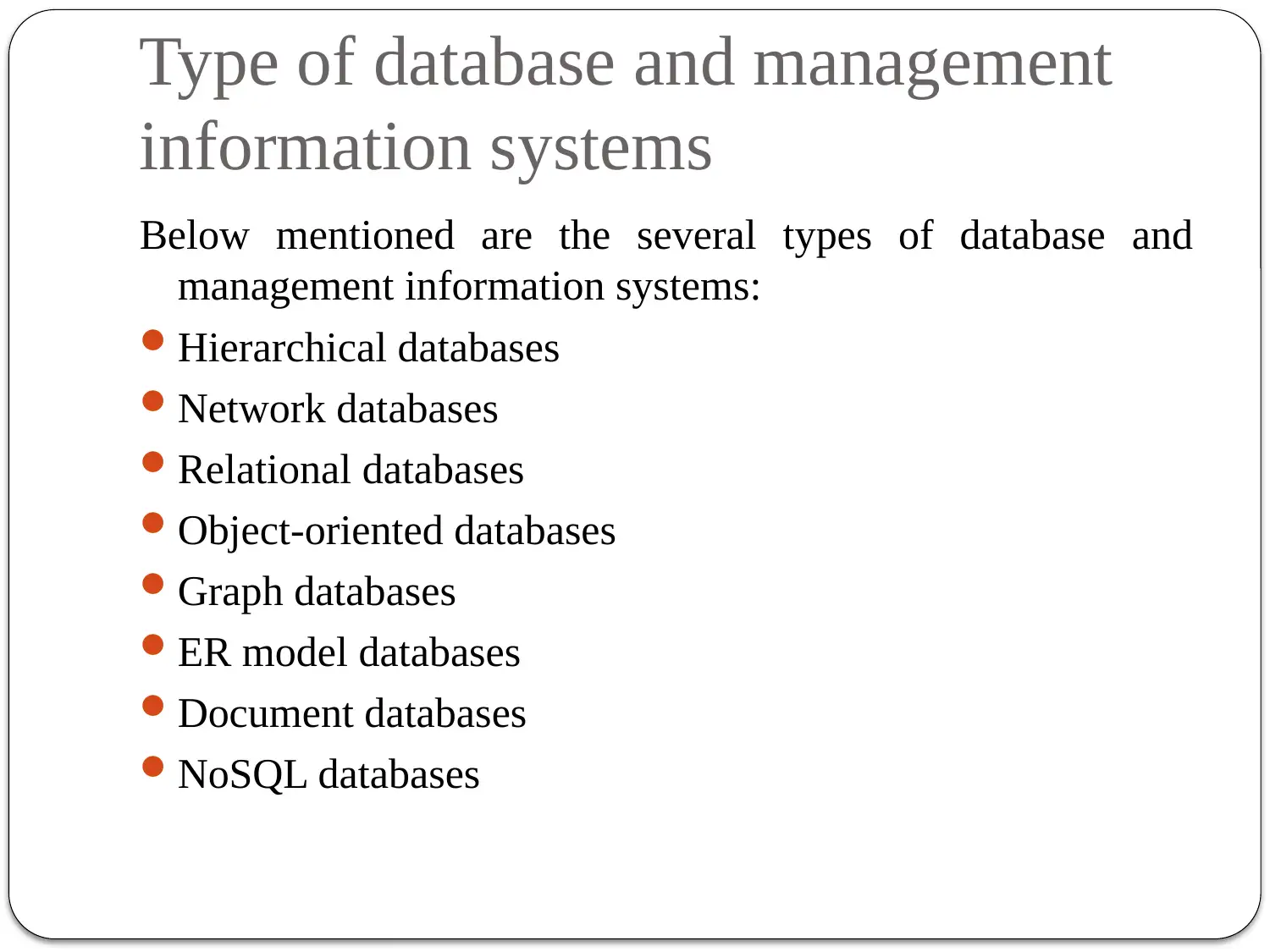
Type of database and management
information systems
Below mentioned are the several types of database and
management information systems:
Hierarchical databases
Network databases
Relational databases
Object-oriented databases
Graph databases
ER model databases
Document databases
NoSQL databases
Document Page
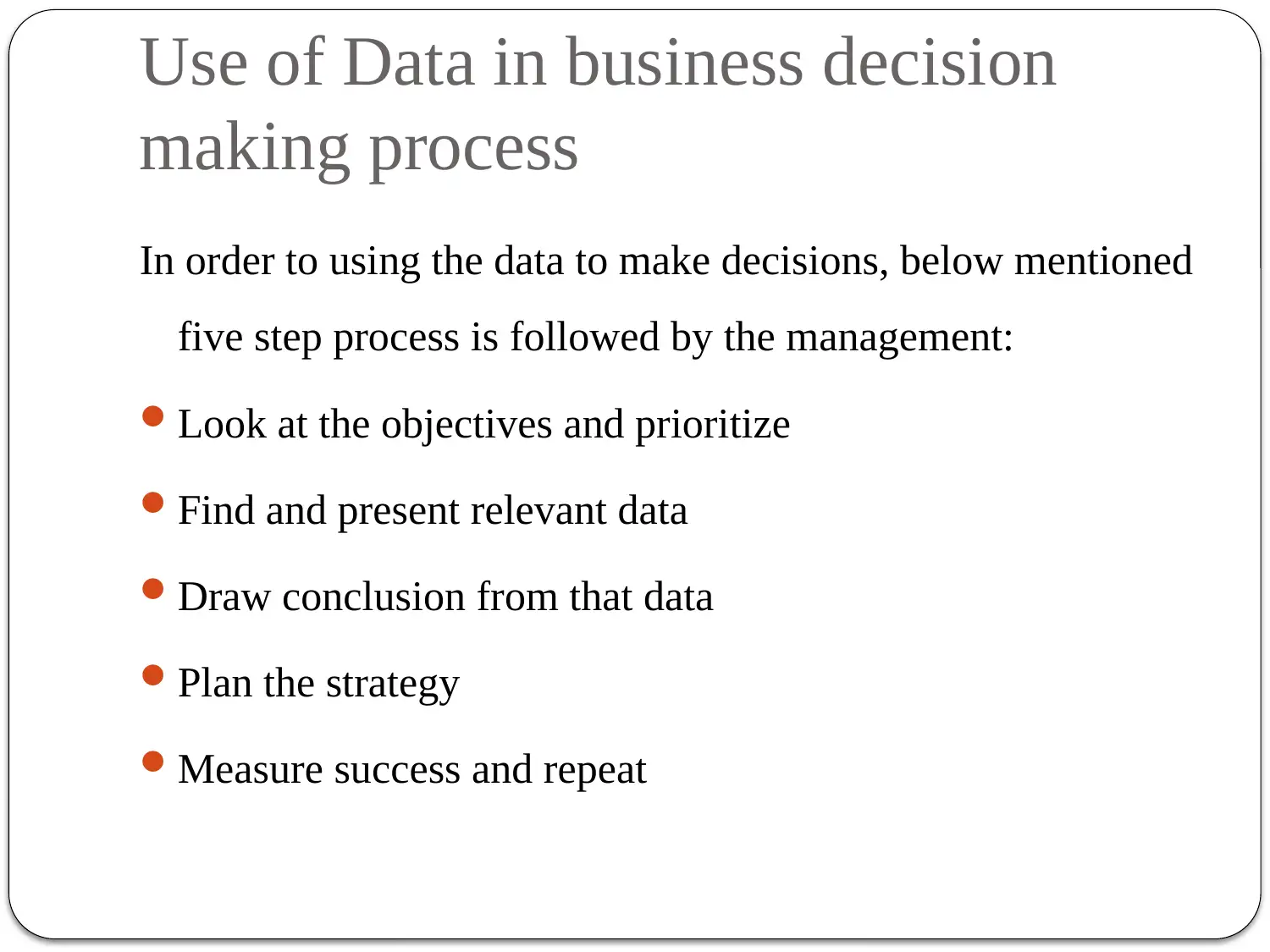
Use of Data in business decision
making process
In order to using the data to make decisions, below mentioned
five step process is followed by the management:
Look at the objectives and prioritize
Find and present relevant data
Draw conclusion from that data
Plan the strategy
Measure success and repeat
Document Page
t how information and data is used within the
day to operations of organisations
Several of business organizations use the data according to their
requirements, but below mentioned are some common use of data in
business operations:
Finding new customers
Increasing customer retention
Improving customer service
Better managing marketing efforts
Tracking social media interaction
Predicting sales trends
tabler-icon-diamond-filled.svg

Paraphrase This Document

Need a fresh take? Get an instant paraphrase of this document with our AI Paraphraser
Document Page
Outline for research into improving
data capture
Traditional surveys face increasing expense, declining response
rates, and lengthy time lags between when data are gathered and
when derived indicators and other statistics can be published.
Tools for data extraction, manipulation, and analysis are rapidly
evolving.
Repositories of STI measures that users demand are distributed
among several statistical agencies, and private repositories.
Document Page
Thank You
chevron_up_icon
1 out of 9
circle_padding
hide_on_mobile
zoom_out_icon
[object Object]