University Assignment: Data Modeling and Database History Report

Verified

Added on  2022/09/30

|5
|452
|24
Report
AI Summary
This report provides a comprehensive overview of data modeling and the history of databases. It begins by exploring the evolution of data storage, starting with flat files and progressing through the development of database management systems (DBMS). The report details the transition from file-based systems to the introduction of hierarchical and network data models, such as IMS and IDS. It then highlights the advent of relational databases, including the contributions of Ted Codd and Peter Chen, and the impact of SQL servers, Oracle 9i, and IBM IMS/DB, DB2. The report also includes an ER-Diagram. The content is based on research from sources like Lake & Crowther (2013), and Nayak, Poriya & Poojary (2013).
Document Page
Running Head: DATA MODELING AND DATABASE HISTORY
DATA MODELING AND DATABASE HISTORY
Name of the Student:
Name of the University:
Author Note:
tabler-icon-diamond-filled.svg

Paraphrase This Document

Need a fresh take? Get an instant paraphrase of this document with our AI Paraphraser
Document Page
1DATA MODELING AND DATABASE HISTORY
Table of Contents
Assessment item 2...........................................................................................................................2
Part A: History of database..........................................................................................................2
Part B: ER-Diagram.....................................................................................................................3
References........................................................................................................................................4
Document Page
2DATA MODELING AND DATABASE HISTORY
Assessment item 2
Part A: History of database
Databases are a very important part in the modern world and the importance to collect
and store data for future use are immense. The data storing and processing methods have
advanced since the first introduction of the databases. Data is the raw fact that constructs a useful
information. In the ancient times, files were used to store data and after that with the introduction
of Database Management System (DBMS), the storing and processing of data became much
easier (Lake & Crowther, 2013).
Evolution of database
In the year from 1960-1968 file based databases were used to store data. Data was
maintained in a flat file. Magnetic tapes are one example of the flat file system. The storing
method was time consuming.
After that in between 1968 and 1980 there were some notable contributions in the field of
databases. In the mid-1960s Information management systems (IMS) was introduced by
Rockwell in association with IBM. This was based on the binary trees. This provided efficient
searching with less redundancy. The time between 1968 and 1980 is also known as the era of
non-relational database. The IMS falls under the Hierarchical data model. In the same era
Network data models like the Integrated Data Store (IDS) was also introduced, by Charles
Bachmann at Honeywell and is considered as the first DBMS (Nayak, Poriya & Poojary, 2013).
In the present world, relational database are used. In the 1970s Ted Codd proposed
relational model at IBM. Following that, the Entity-relationship(ER) model was defined by Peter
Document Page
3DATA MODELING AND DATABASE HISTORY
Chen in the year 1976. Presently there are SQL servers, Oracle 9i and IBM IMS/DB, DB2 that
are most prominent in the field of databases.
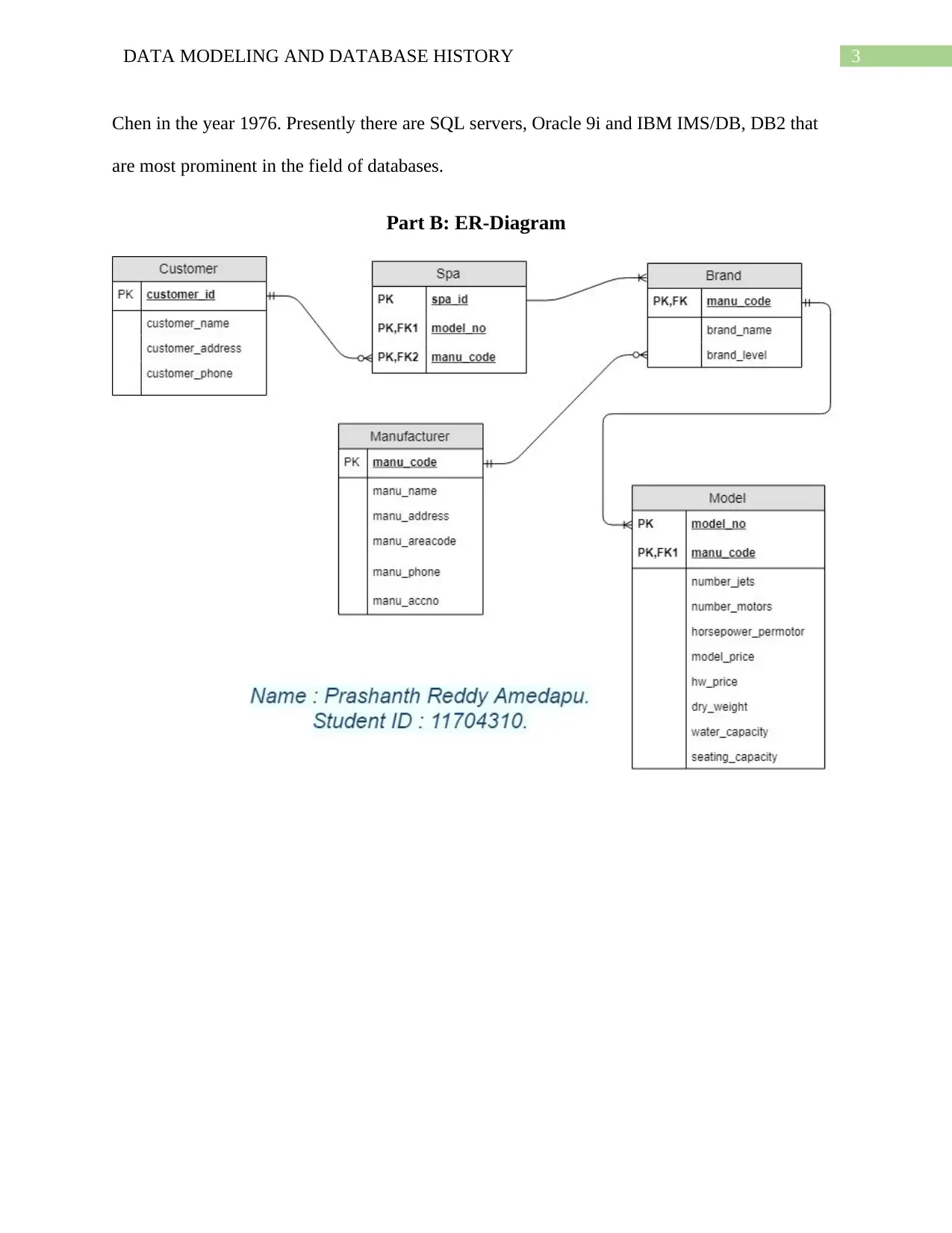
Part B: ER-Diagram
tabler-icon-diamond-filled.svg

Paraphrase This Document

Need a fresh take? Get an instant paraphrase of this document with our AI Paraphraser
Document Page
4DATA MODELING AND DATABASE HISTORY
References
Lake, P., & Crowther, P. (2013). Concise guide to databases. Springer, London.
Nayak, A., Poriya, A., & Poojary, D. (2013). Type of NOSQL databases and its comparison with
relational databases. International Journal of Applied Information Systems, 5(4), 16-19.
chevron_up_icon
1 out of 5
circle_padding
hide_on_mobile
zoom_out_icon
[object Object]