Data Modeling Report: Conceptual, Logical, and Physical ERDs
VerifiedAdded on  2023/04/20
|11
|428
|116
Report
AI Summary
This report provides a comprehensive overview of data modeling, starting with the relational schema, including conceptual, logical, and physical ERDs. It then moves on to an Access database implementation, followed by a discussion of database reports and concludes with a detailed explanation of normalization, covering zero, first, second, and third normal forms with examples. The report is designed to help students understand and apply data modeling principles in database design and management. The assignment includes tables and figures to represent different forms of data modeling and database structure. The bibliography includes sources used for the report.
Running head: DATA MODELING
Data Modeling
Name of the Student
Name of the University
Author’s note:
Data Modeling
Name of the Student
Name of the University
Author’s note:
Paraphrase This Document
Need a fresh take? Get an instant paraphrase of this document with our AI Paraphraser

1DATA MODELING
Table of Contents
1. Relational Schema:......................................................................................................................2
1.1 Conceptual ERD:...................................................................................................................2
1.2 Logical ERD:.........................................................................................................................3
1.3 Physical ERD:........................................................................................................................4
2. Access Database:.........................................................................................................................5
3 Reports:.........................................................................................................................................6
4. Normalization:.............................................................................................................................6
Bibliography:.................................................................................................................................10
Table of Contents
1. Relational Schema:......................................................................................................................2
1.1 Conceptual ERD:...................................................................................................................2
1.2 Logical ERD:.........................................................................................................................3
1.3 Physical ERD:........................................................................................................................4
2. Access Database:.........................................................................................................................5
3 Reports:.........................................................................................................................................6
4. Normalization:.............................................................................................................................6
Bibliography:.................................................................................................................................10

2DATA MODELING
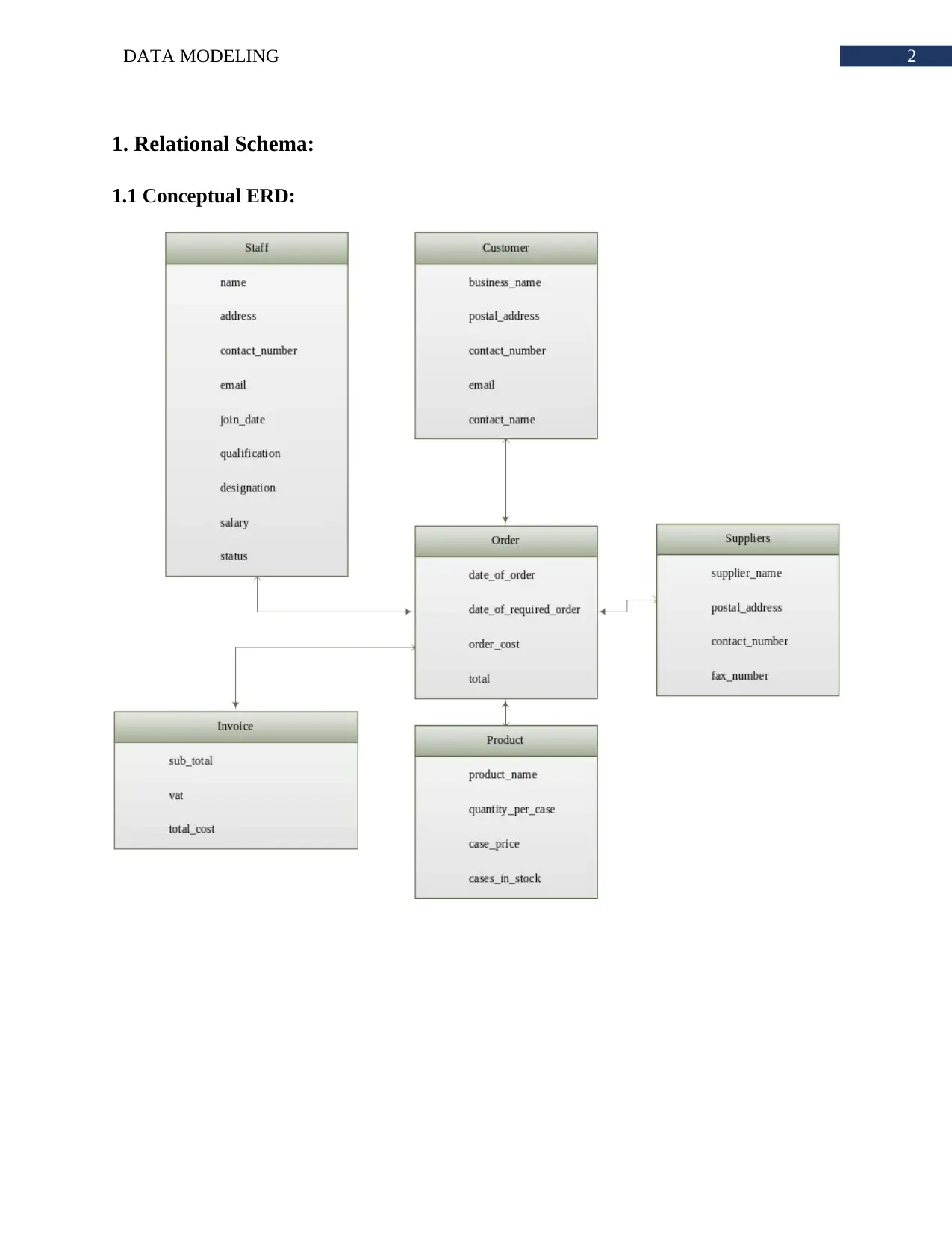
1. Relational Schema:
1.1 Conceptual ERD:
1. Relational Schema:
1.1 Conceptual ERD:
⊘ This is a preview!⊘
Do you want full access?
Subscribe today to unlock all pages.

Trusted by 1+ million students worldwide

3DATA MODELING
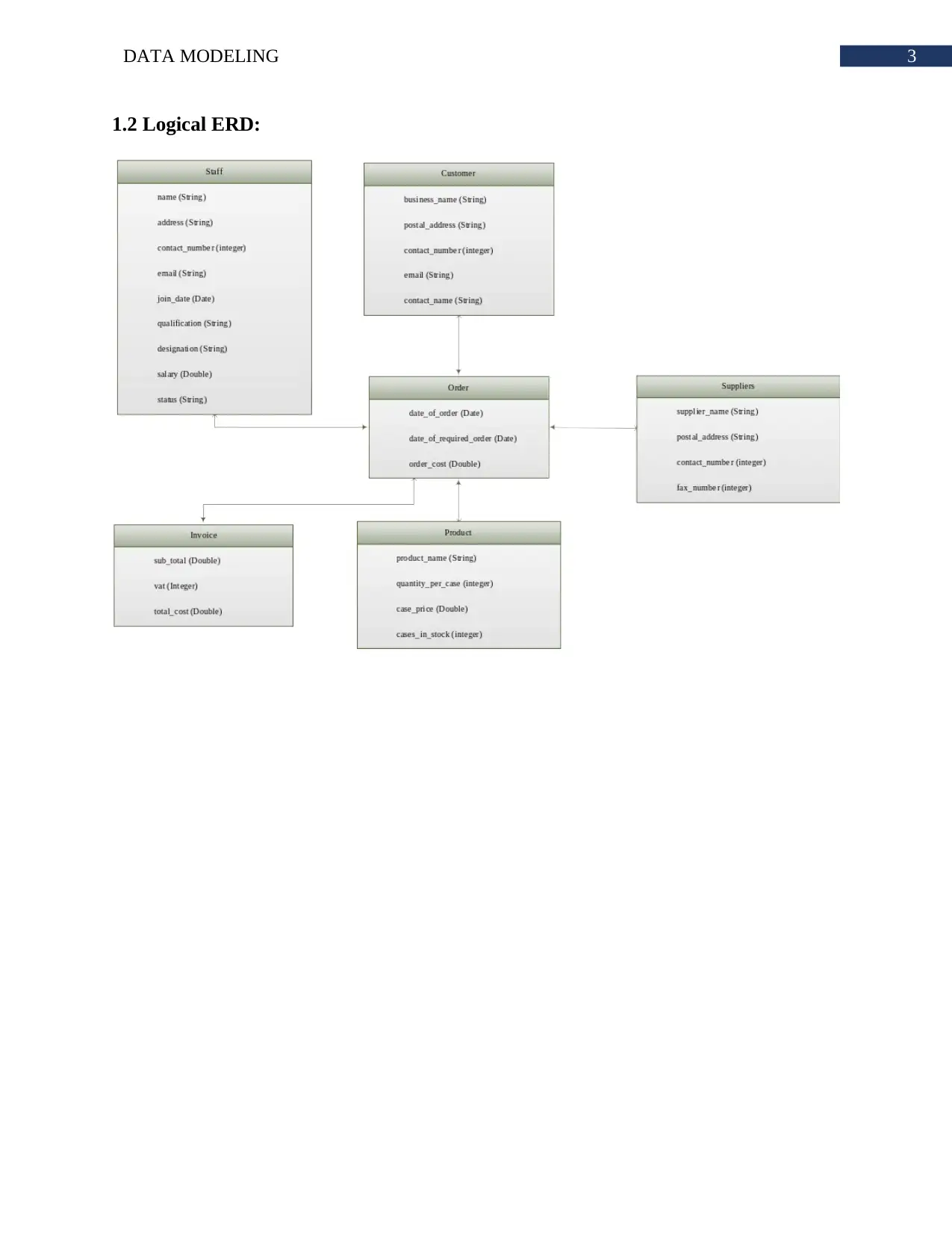
1.2 Logical ERD:
1.2 Logical ERD:
Paraphrase This Document
Need a fresh take? Get an instant paraphrase of this document with our AI Paraphraser

4DATA MODELING
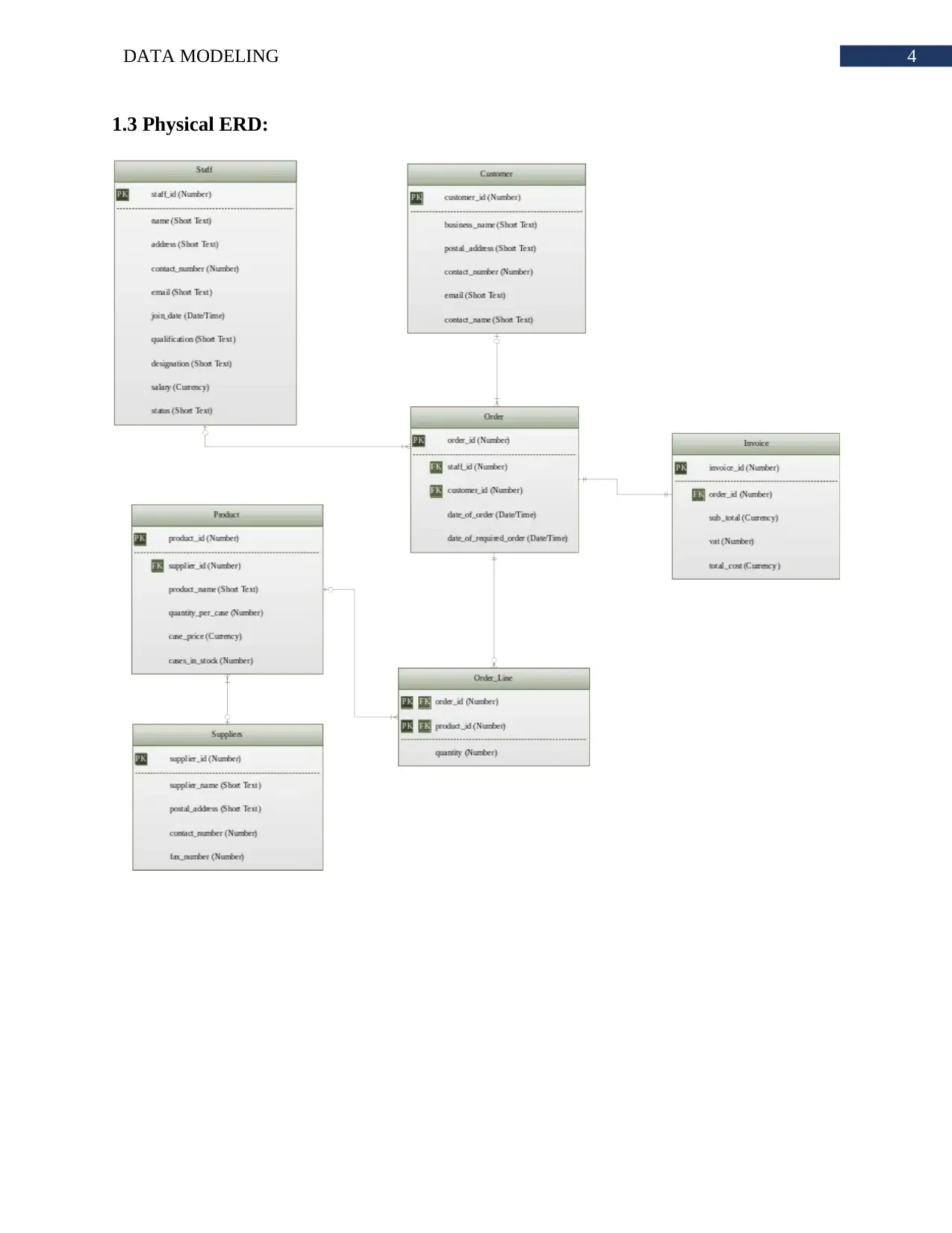
1.3 Physical ERD:
1.3 Physical ERD:

5DATA MODELING
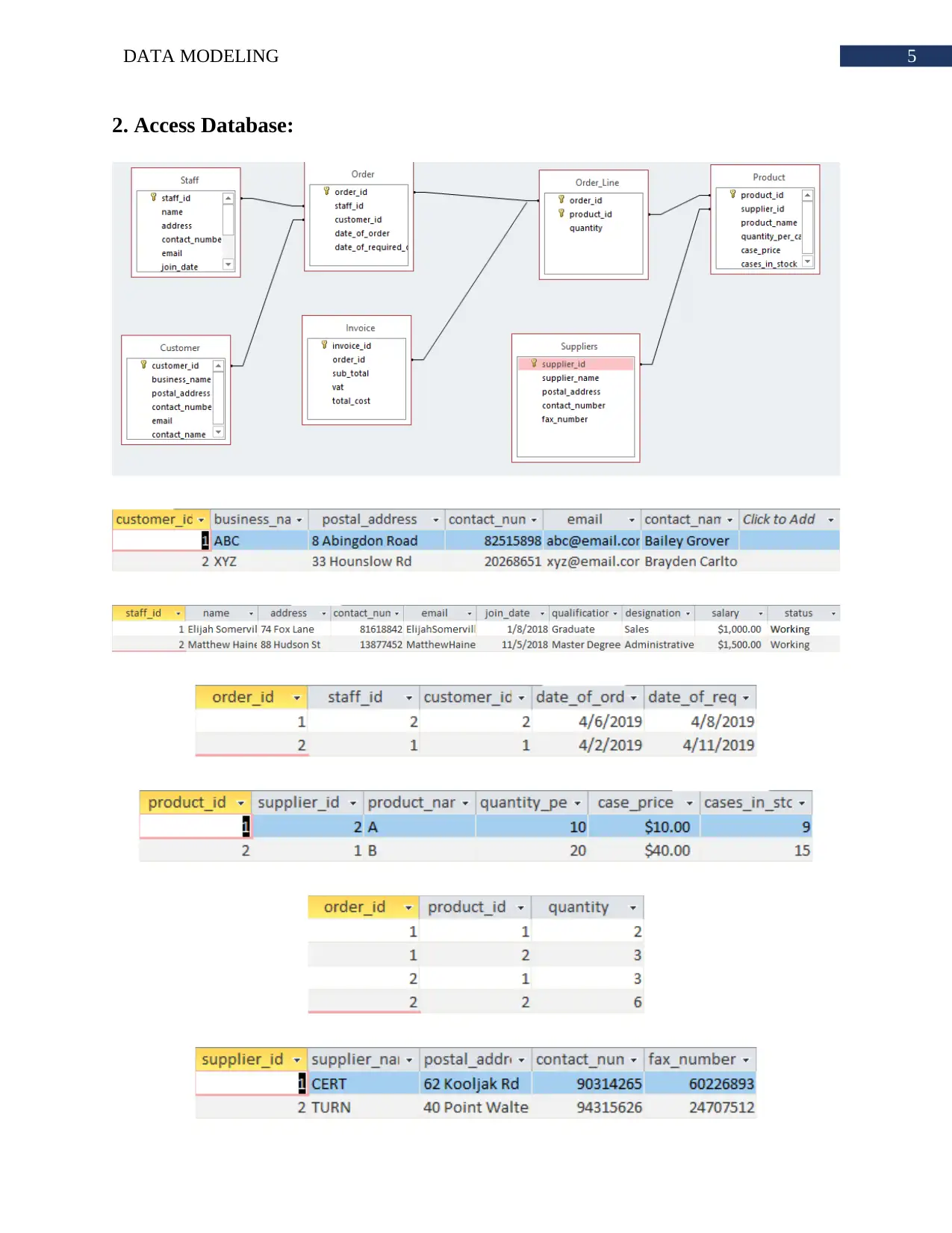
2. Access Database:
2. Access Database:
⊘ This is a preview!⊘
Do you want full access?
Subscribe today to unlock all pages.

Trusted by 1+ million students worldwide

6DATA MODELING
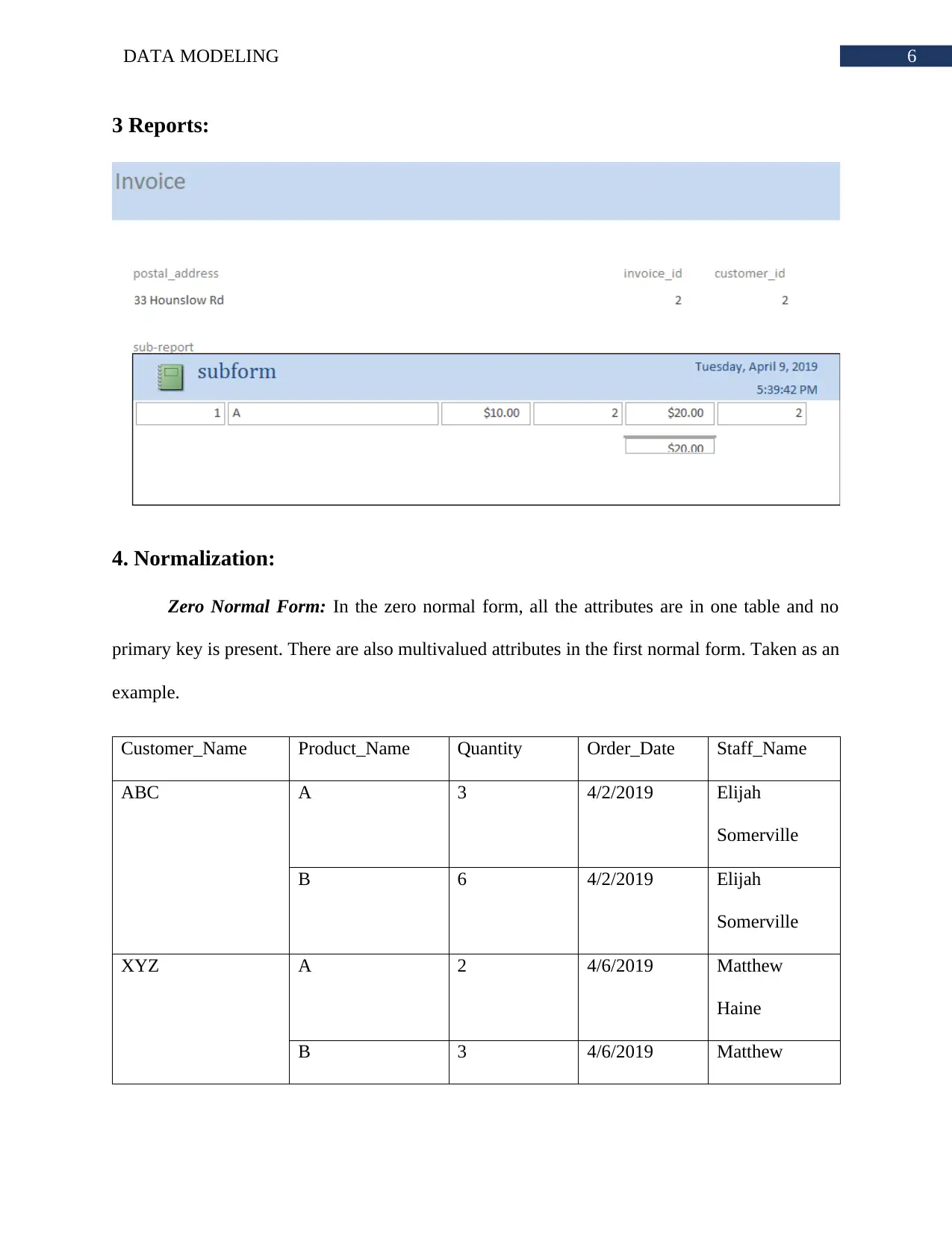
3 Reports:
4. Normalization:
Zero Normal Form: In the zero normal form, all the attributes are in one table and no
primary key is present. There are also multivalued attributes in the first normal form. Taken as an
example.
Customer_Name Product_Name Quantity Order_Date Staff_Name
ABC A 3 4/2/2019 Elijah
Somerville
B 6 4/2/2019 Elijah
Somerville
XYZ A 2 4/6/2019 Matthew
Haine
B 3 4/6/2019 Matthew
3 Reports:
4. Normalization:
Zero Normal Form: In the zero normal form, all the attributes are in one table and no
primary key is present. There are also multivalued attributes in the first normal form. Taken as an
example.
Customer_Name Product_Name Quantity Order_Date Staff_Name
ABC A 3 4/2/2019 Elijah
Somerville
B 6 4/2/2019 Elijah
Somerville
XYZ A 2 4/6/2019 Matthew
Haine
B 3 4/6/2019 Matthew
Paraphrase This Document
Need a fresh take? Get an instant paraphrase of this document with our AI Paraphraser

7DATA MODELING
Haine
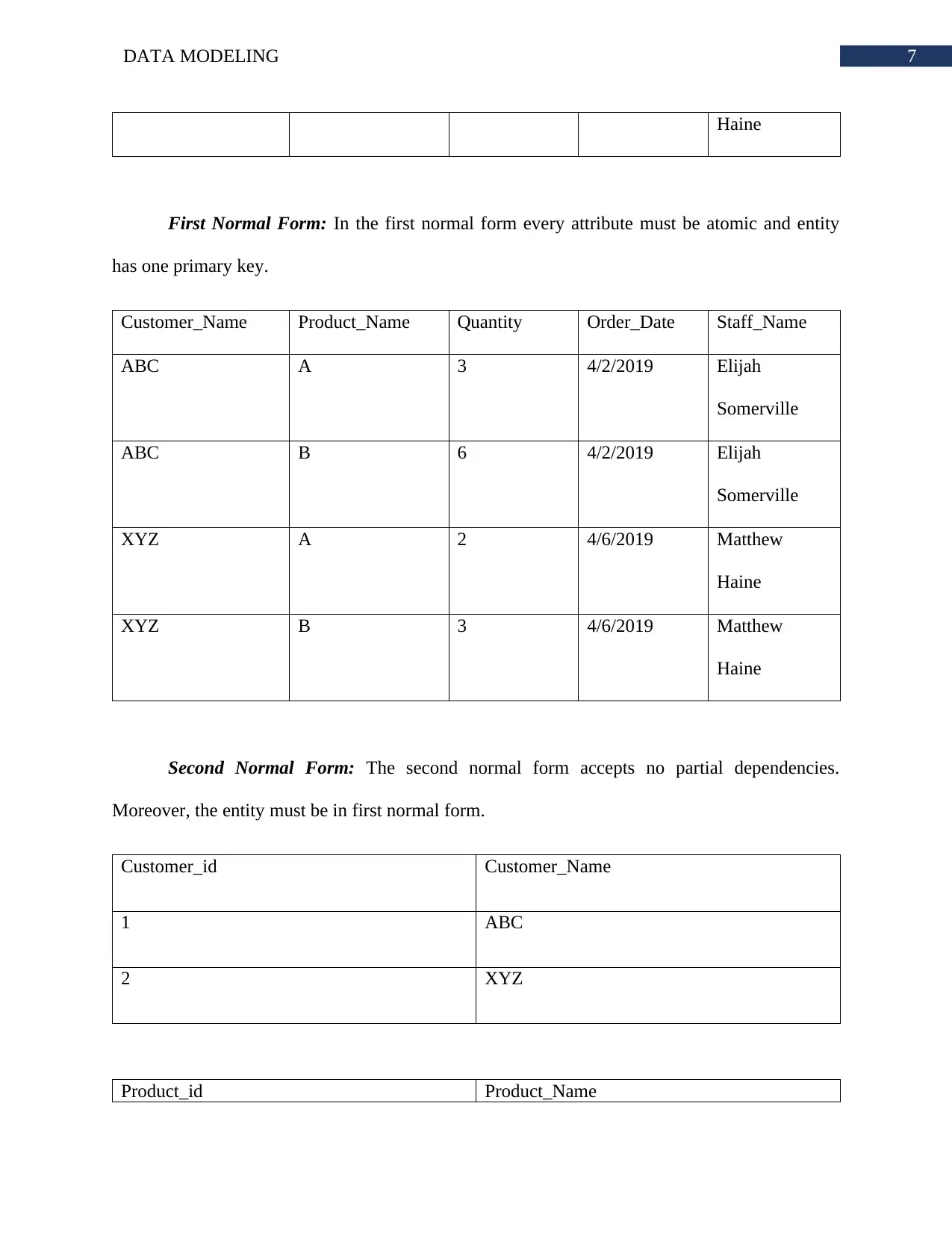
First Normal Form: In the first normal form every attribute must be atomic and entity
has one primary key.
Customer_Name Product_Name Quantity Order_Date Staff_Name
ABC A 3 4/2/2019 Elijah
Somerville
ABC B 6 4/2/2019 Elijah
Somerville
XYZ A 2 4/6/2019 Matthew
Haine
XYZ B 3 4/6/2019 Matthew
Haine
Second Normal Form: The second normal form accepts no partial dependencies.
Moreover, the entity must be in first normal form.
Customer_id Customer_Name
1 ABC
2 XYZ
Product_id Product_Name
Haine
First Normal Form: In the first normal form every attribute must be atomic and entity
has one primary key.
Customer_Name Product_Name Quantity Order_Date Staff_Name
ABC A 3 4/2/2019 Elijah
Somerville
ABC B 6 4/2/2019 Elijah
Somerville
XYZ A 2 4/6/2019 Matthew
Haine
XYZ B 3 4/6/2019 Matthew
Haine
Second Normal Form: The second normal form accepts no partial dependencies.
Moreover, the entity must be in first normal form.
Customer_id Customer_Name
1 ABC
2 XYZ
Product_id Product_Name

8DATA MODELING
1 A
2 B
Order_id Customer_id Product_id Quantity Order_date Staff_id
1 2 1 2 4/2/2019 2
1 2 2 3 4/2/2019 2
2 1 2 6 4/6/2019 1
2 1 1 3 4/6/2019 1
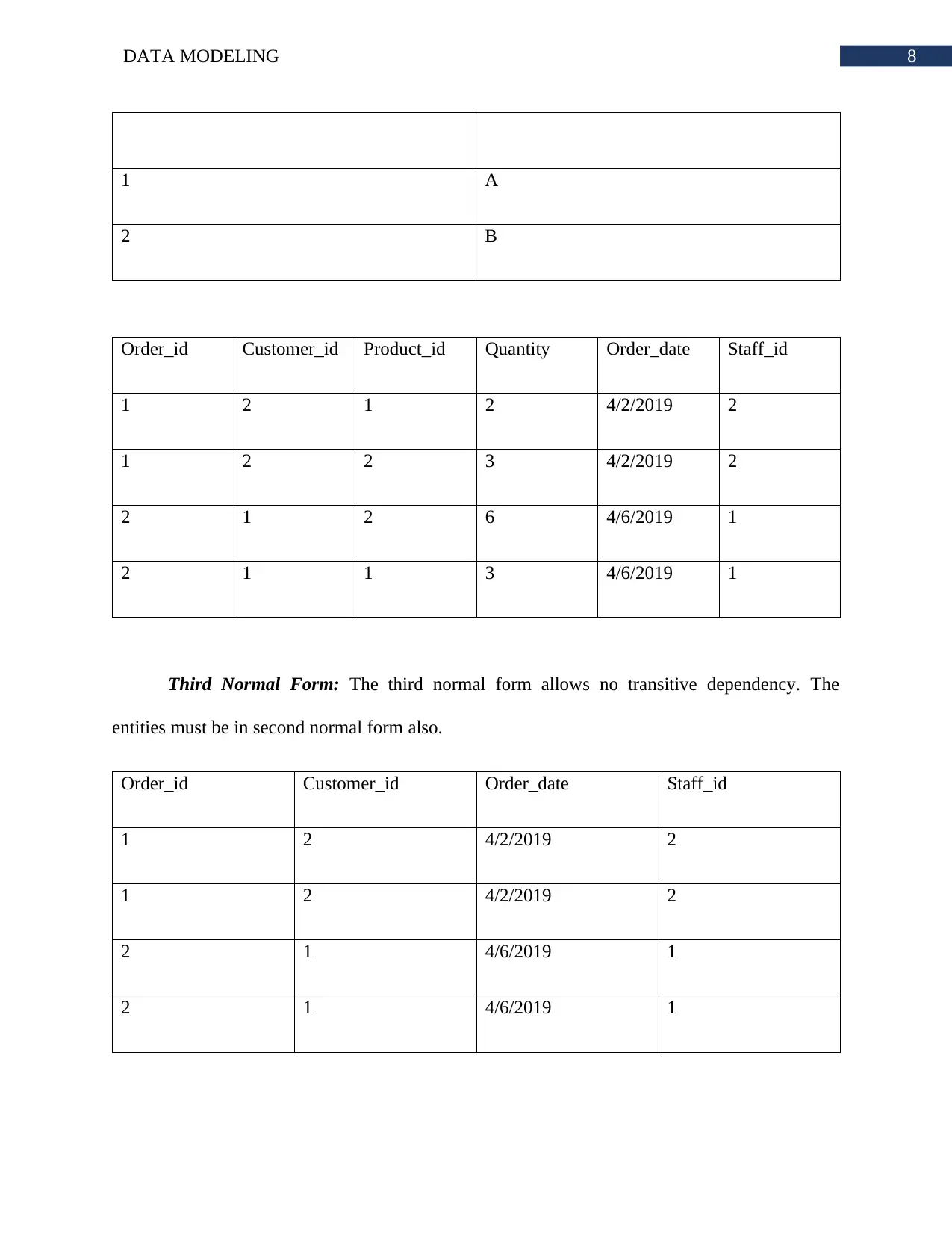
Third Normal Form: The third normal form allows no transitive dependency. The
entities must be in second normal form also.
Order_id Customer_id Order_date Staff_id
1 2 4/2/2019 2
1 2 4/2/2019 2
2 1 4/6/2019 1
2 1 4/6/2019 1
1 A
2 B
Order_id Customer_id Product_id Quantity Order_date Staff_id
1 2 1 2 4/2/2019 2
1 2 2 3 4/2/2019 2
2 1 2 6 4/6/2019 1
2 1 1 3 4/6/2019 1
Third Normal Form: The third normal form allows no transitive dependency. The
entities must be in second normal form also.
Order_id Customer_id Order_date Staff_id
1 2 4/2/2019 2
1 2 4/2/2019 2
2 1 4/6/2019 1
2 1 4/6/2019 1
⊘ This is a preview!⊘
Do you want full access?
Subscribe today to unlock all pages.

Trusted by 1+ million students worldwide

9DATA MODELING
Order_id Product_id Quantity
1 1 2
1 2 3
2 2 6
2 1 3
Order_id Product_id Quantity
1 1 2
1 2 3
2 2 6
2 1 3
Paraphrase This Document
Need a fresh take? Get an instant paraphrase of this document with our AI Paraphraser

10DATA MODELING
Bibliography:
Coronel, C. and Morris, S., 2016. Database systems: design, implementation, & management.
Cengage Learning.
Roy-Hubara, N., Rokach, L., Shapira, B. and Shoval, P., 2017. Modeling graph database
schema. IT Professional, 19(6), pp.34-43.
Bibliography:
Coronel, C. and Morris, S., 2016. Database systems: design, implementation, & management.
Cengage Learning.
Roy-Hubara, N., Rokach, L., Shapira, B. and Shoval, P., 2017. Modeling graph database
schema. IT Professional, 19(6), pp.34-43.
1 out of 11
Related Documents
Your All-in-One AI-Powered Toolkit for Academic Success.
 +13062052269
info@desklib.com
Available 24*7 on WhatsApp / Email
Unlock your academic potential
Copyright © 2020–2025 A2Z Services. All Rights Reserved. Developed and managed by ZUCOL.