Conflict Serializability: Transaction Schedule Analysis in Database

Verified

Added on  2023/06/12

|4
|533
|136
Homework Assignment
AI Summary
This assignment delves into the concepts of concurrency control and serializability within database systems, focusing on transaction schedules and conflict serializability. It addresses a specific question regarding transaction precedence and conflict-serializability, providing a detailed example of a schedule S where transaction T1 precedes T2, but in every conflict-equivalent serial schedule, T2 precedes T1. The solution involves analyzing possible scenarios with transactions T1 and T2, highlighting conditions for conflict-serializability and the construction of serializable graphs. Additionally, the assignment outlines possible write and read operations within the context of concurrency control, referencing relevant academic literature on serializable multiversion concurrency control and distributed concurrency control, which is available on Desklib along with other solved assignments and past papers.
Document Page
Running head: DATABASE SYSTEM
Database System
Name of the Student:
Name of the University:
Author Note
tabler-icon-diamond-filled.svg

Paraphrase This Document

Need a fresh take? Get an instant paraphrase of this document with our AI Paraphraser
Document Page
1
DATABASE SYSTEM
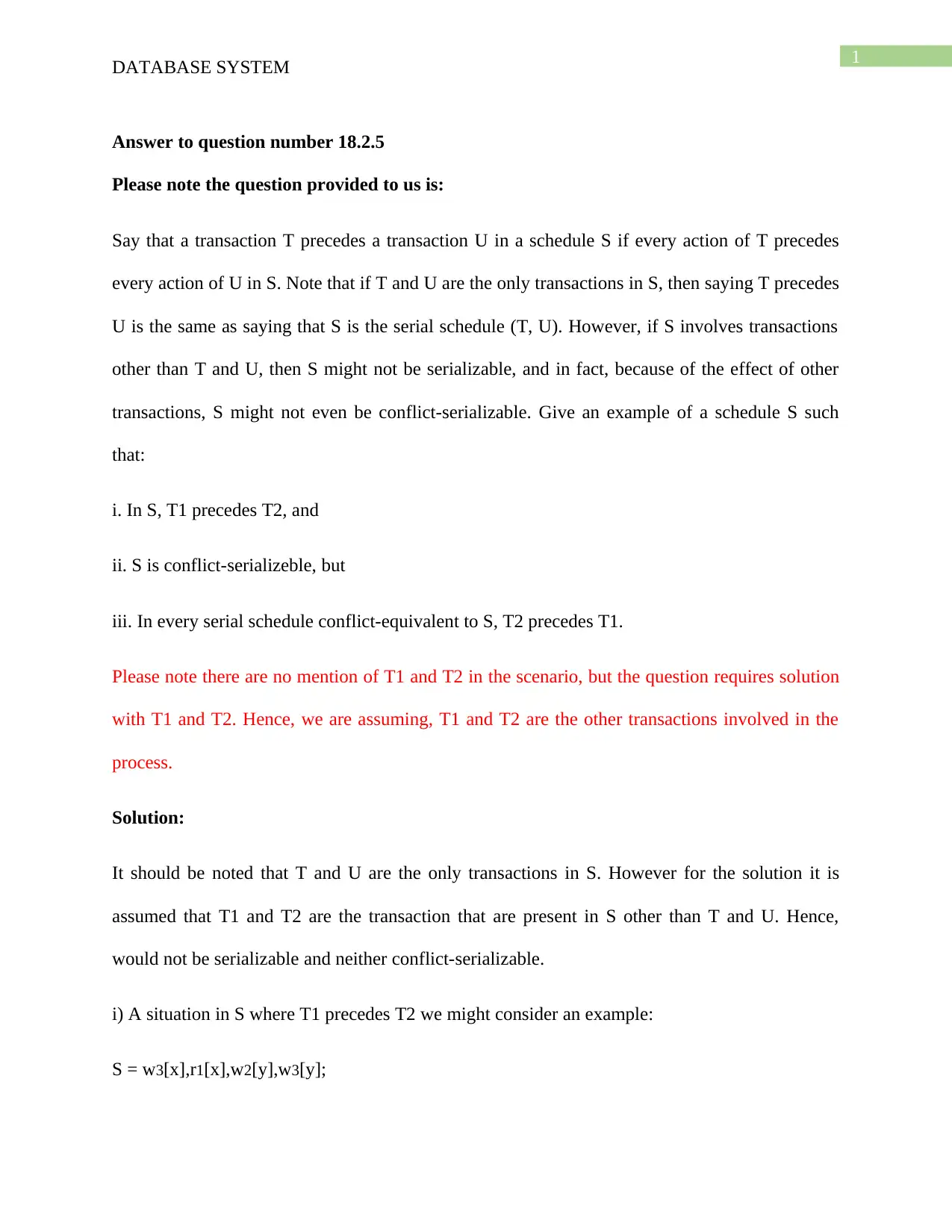
Answer to question number 18.2.5
Please note the question provided to us is:
Say that a transaction T precedes a transaction U in a schedule S if every action of T precedes
every action of U in S. Note that if T and U are the only transactions in S, then saying T precedes
U is the same as saying that S is the serial schedule (T, U). However, if S involves transactions
other than T and U, then S might not be serializable, and in fact, because of the effect of other
transactions, S might not even be conflict-serializable. Give an example of a schedule S such
that:
i. In S, T1 precedes T2, and
ii. S is conflict-serializeble, but
iii. In every serial schedule conflict-equivalent to S, T2 precedes T1.
Please note there are no mention of T1 and T2 in the scenario, but the question requires solution
with T1 and T2. Hence, we are assuming, T1 and T2 are the other transactions involved in the
process.
Solution:
It should be noted that T and U are the only transactions in S. However for the solution it is
assumed that T1 and T2 are the transaction that are present in S other than T and U. Hence,
would not be serializable and neither conflict-serializable.
i) A situation in S where T1 precedes T2 we might consider an example:
S = w3[x],r1[x],w2[y],w3[y];
Document Page
2
DATABASE SYSTEM
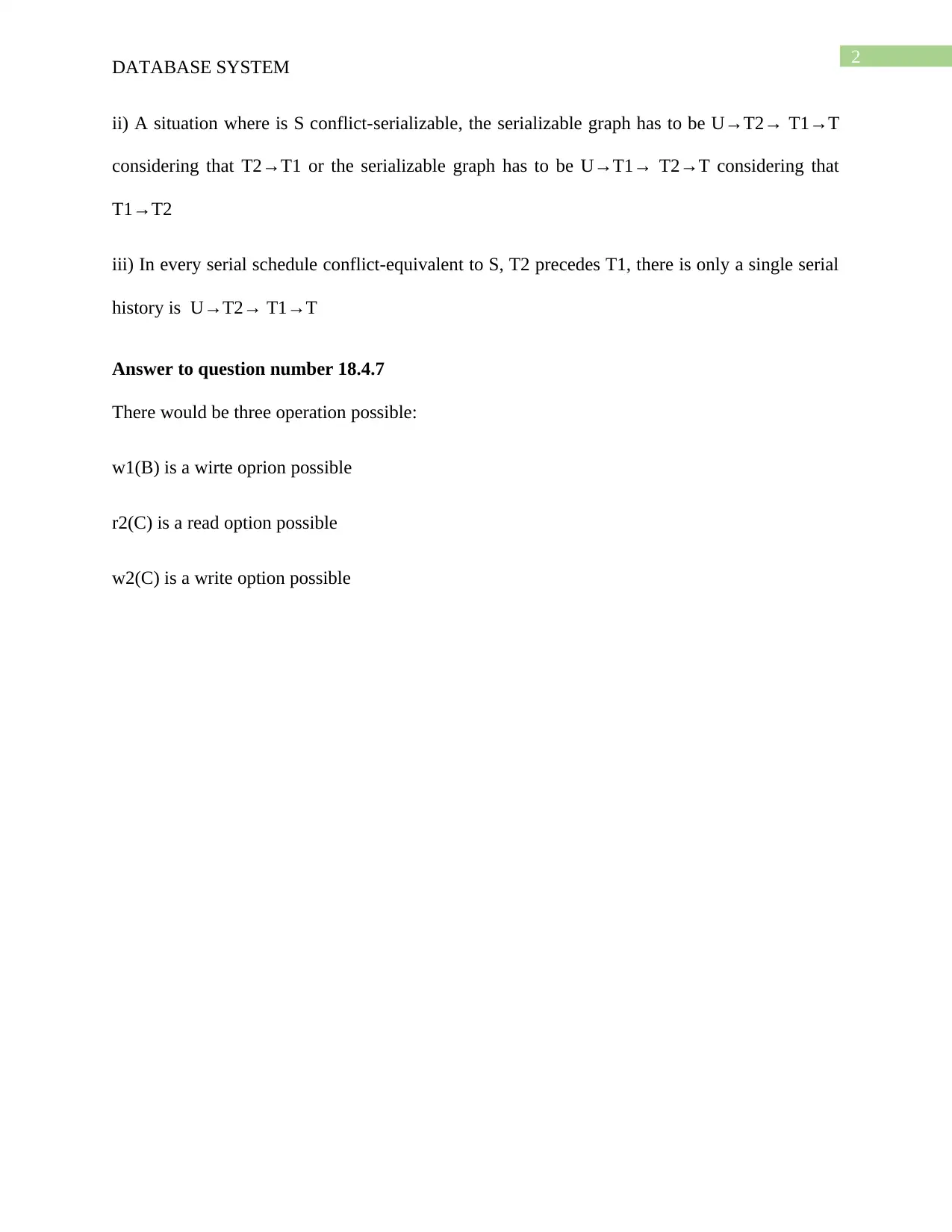
ii) A situation where is S conflict-serializable, the serializable graph has to be U→T2→ T1→T
considering that T2→T1 or the serializable graph has to be U→T1→ T2→T considering that
T1→T2
iii) In every serial schedule conflict-equivalent to S, T2 precedes T1, there is only a single serial
history is U→T2→ T1→T
Answer to question number 18.4.7
There would be three operation possible:
w1(B) is a wirte oprion possible
r2(C) is a read option possible
w2(C) is a write option possible
Document Page
3
DATABASE SYSTEM
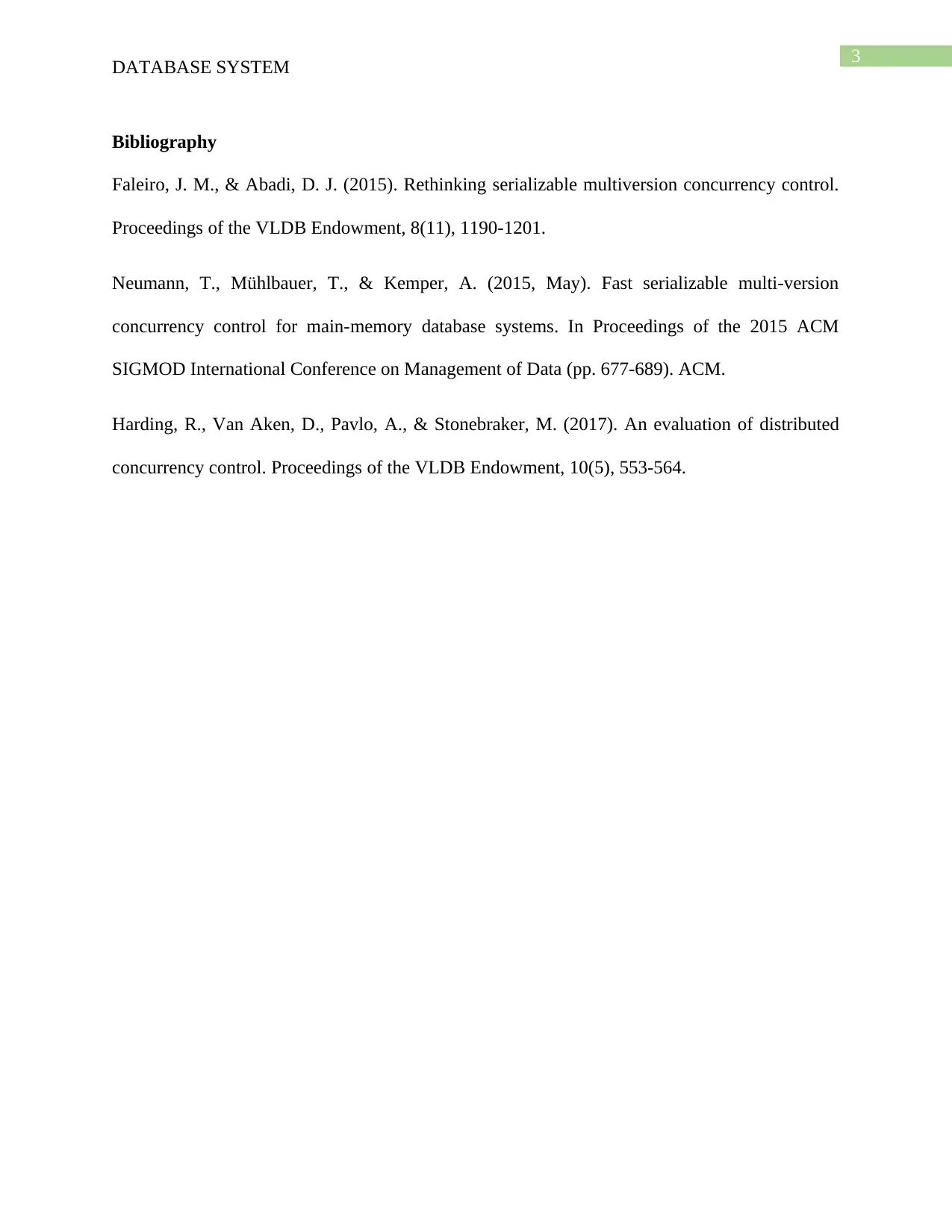
Bibliography
Faleiro, J. M., & Abadi, D. J. (2015). Rethinking serializable multiversion concurrency control.
Proceedings of the VLDB Endowment, 8(11), 1190-1201.
Neumann, T., Mühlbauer, T., & Kemper, A. (2015, May). Fast serializable multi-version
concurrency control for main-memory database systems. In Proceedings of the 2015 ACM
SIGMOD International Conference on Management of Data (pp. 677-689). ACM.
Harding, R., Van Aken, D., Pavlo, A., & Stonebraker, M. (2017). An evaluation of distributed
concurrency control. Proceedings of the VLDB Endowment, 10(5), 553-564.
chevron_up_icon
1 out of 4
circle_padding
hide_on_mobile
zoom_out_icon
[object Object]