Database Management System: Database Design and Normalization Report

Verified

Added on  2023/06/07

|9
|1222
|383
Report
AI Summary
This report provides a detailed analysis of a database management system, starting with a dependency diagram illustrating the relationships between different entities within the database. The report then delves into the normalization process, converting a given database table through First Normal Form (1NF), Second Normal Form (2NF), and Third Normal Form (3NF) to eliminate redundancy and improve data integrity. The relational schema is presented, visually representing the database structure and relationships between tables. Finally, an Entity Relationship Diagram (ERD) is included to provide a graphical overview of the entities and their relationships within the database. The report concludes with a bibliography of cited sources.
Document Page
Running head: DATABASE MANAGEMENT SYSTEM
Database Management System
Name of the Student
Name of the University
Author’s note
tabler-icon-diamond-filled.svg

Paraphrase This Document

Need a fresh take? Get an instant paraphrase of this document with our AI Paraphraser
Document Page
1DATABASE MANAGEMENT SYSTEM
Table of Contents
Dependency Diagram:.....................................................................................................................2
Normalization:.................................................................................................................................2
Relational Schema:..........................................................................................................................5
Entity Relationship Diagram:..........................................................................................................6
Bibliography:...................................................................................................................................7
Document Page
2DATABASE MANAGEMENT SYSTEM
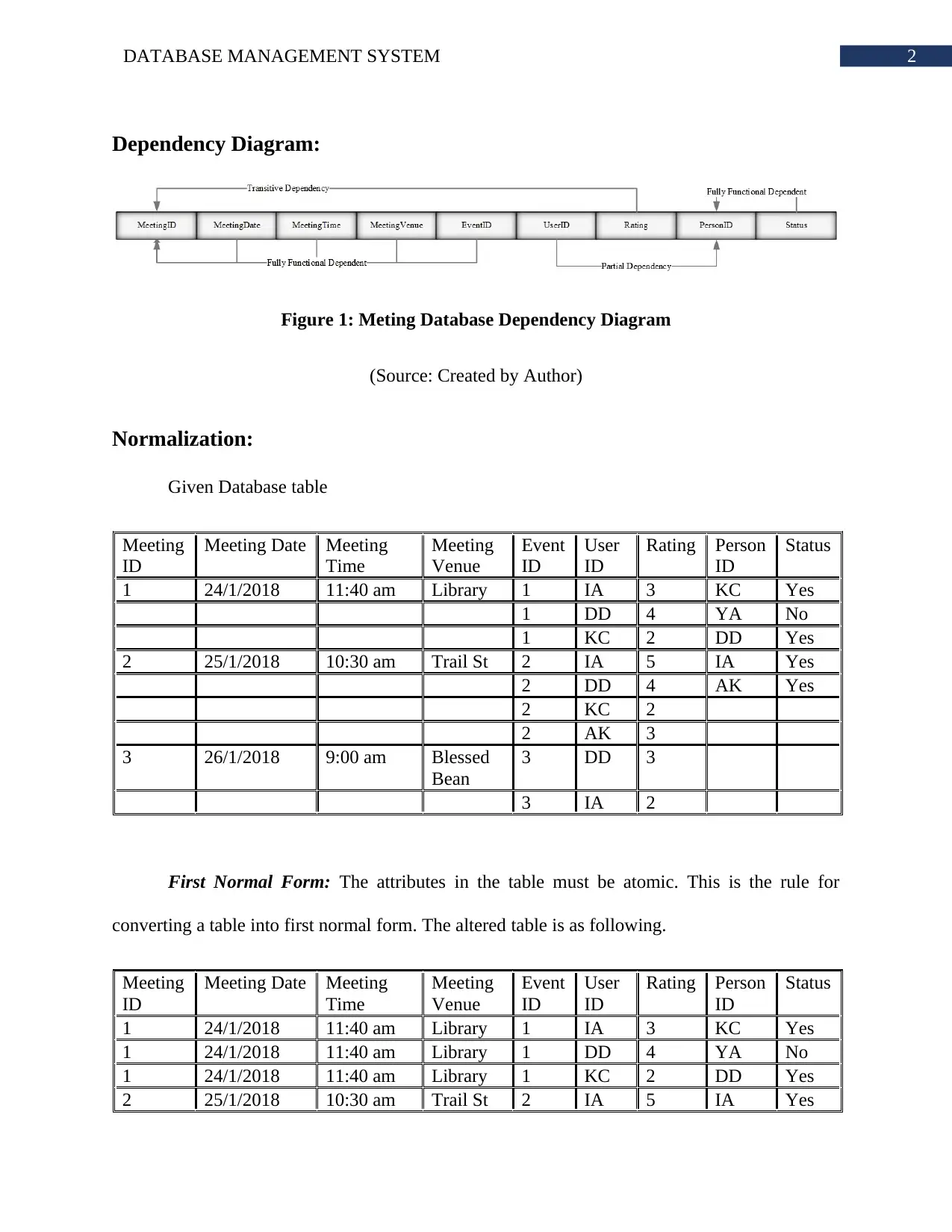
Dependency Diagram:
Figure 1: Meting Database Dependency Diagram
(Source: Created by Author)
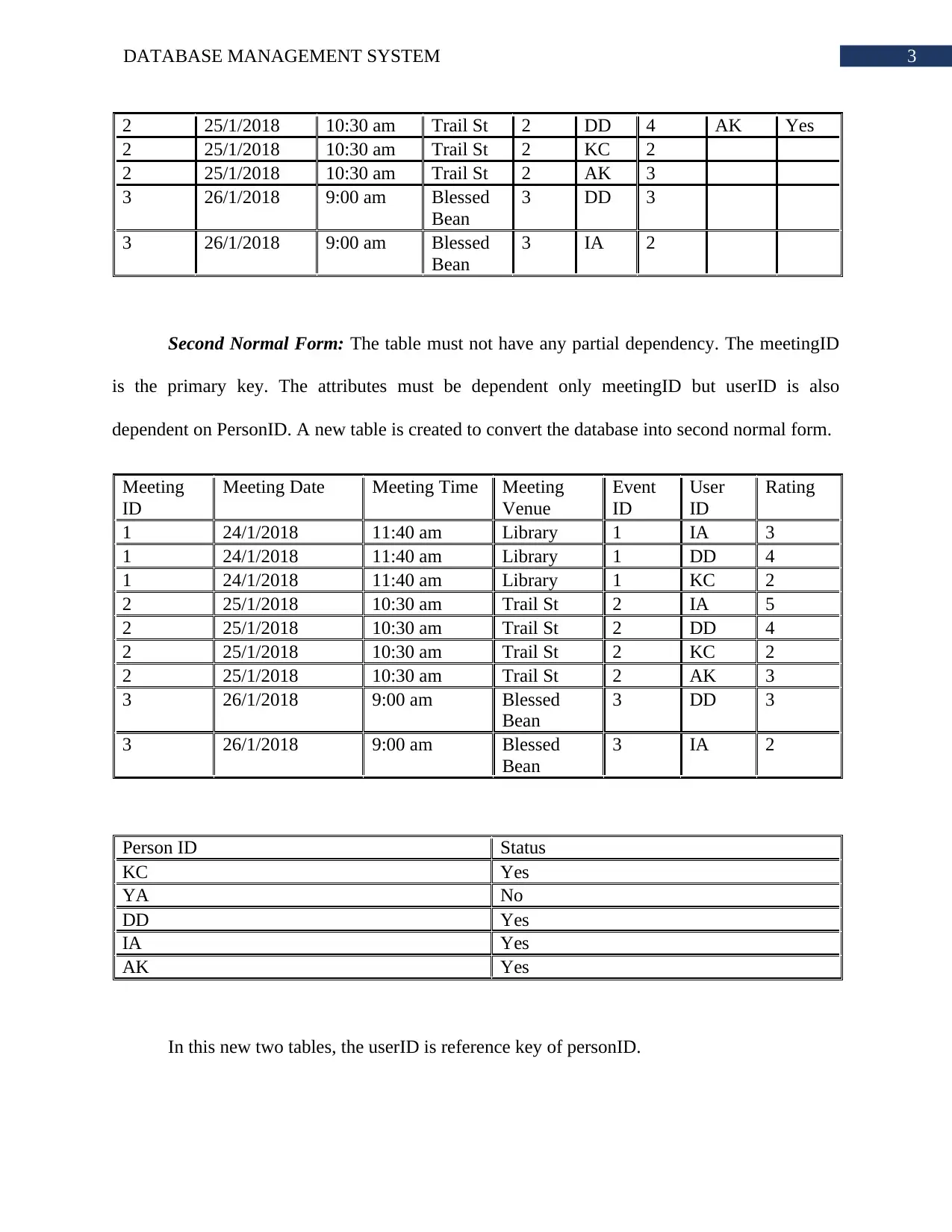
Normalization:
Given Database table
Meeting
ID
Meeting Date Meeting
Time
Meeting
Venue
Event
ID
User
ID
Rating Person
ID
Status
1 24/1/2018 11:40 am Library 1 IA 3 KC Yes
1 DD 4 YA No
1 KC 2 DD Yes
2 25/1/2018 10:30 am Trail St 2 IA 5 IA Yes
2 DD 4 AK Yes
2 KC 2
2 AK 3
3 26/1/2018 9:00 am Blessed
Bean
3 DD 3
3 IA 2
First Normal Form: The attributes in the table must be atomic. This is the rule for
converting a table into first normal form. The altered table is as following.
Meeting
ID
Meeting Date Meeting
Time
Meeting
Venue
Event
ID
User
ID
Rating Person
ID
Status
1 24/1/2018 11:40 am Library 1 IA 3 KC Yes
1 24/1/2018 11:40 am Library 1 DD 4 YA No
1 24/1/2018 11:40 am Library 1 KC 2 DD Yes
2 25/1/2018 10:30 am Trail St 2 IA 5 IA Yes
Document Page
3DATABASE MANAGEMENT SYSTEM
2 25/1/2018 10:30 am Trail St 2 DD 4 AK Yes
2 25/1/2018 10:30 am Trail St 2 KC 2
2 25/1/2018 10:30 am Trail St 2 AK 3
3 26/1/2018 9:00 am Blessed
Bean
3 DD 3
3 26/1/2018 9:00 am Blessed
Bean
3 IA 2
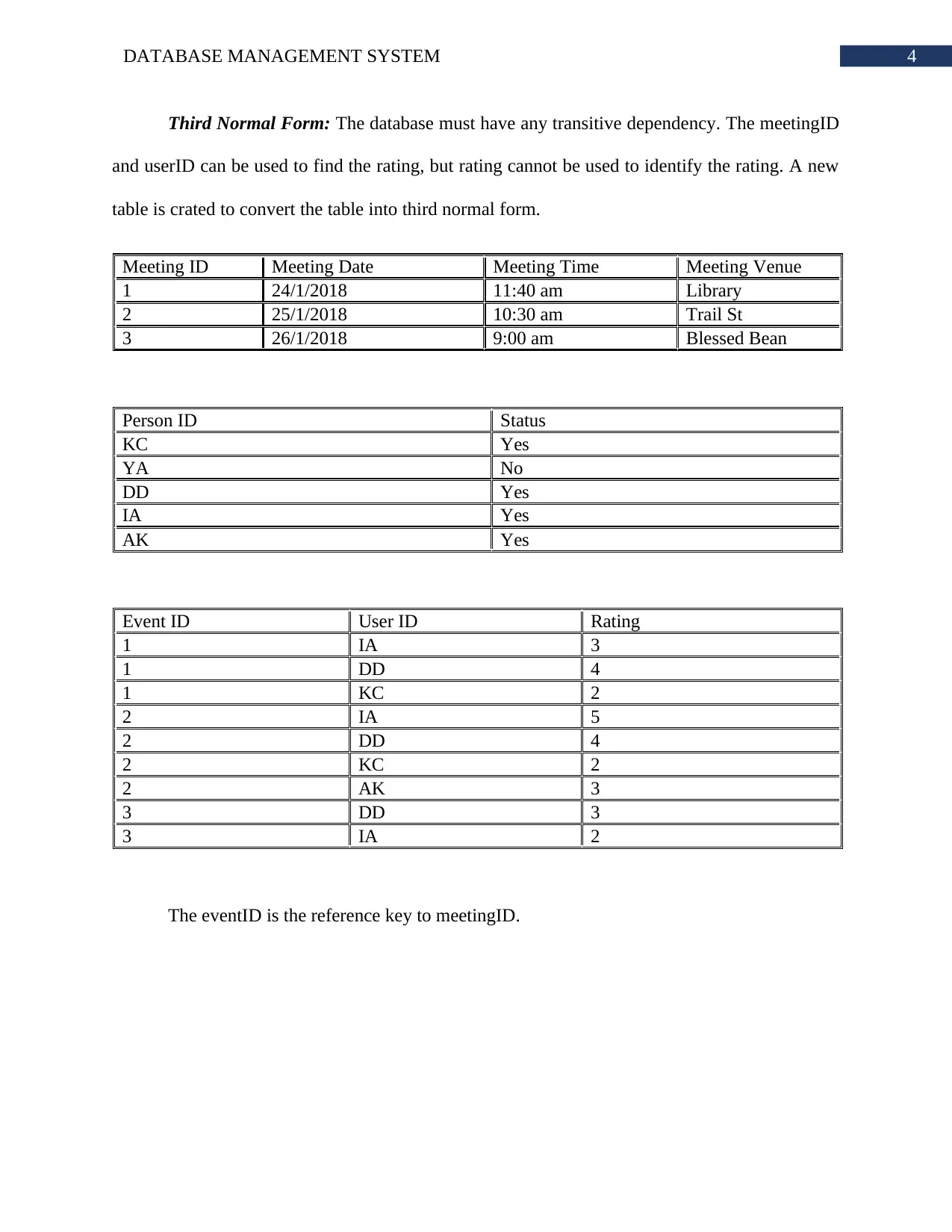
Second Normal Form: The table must not have any partial dependency. The meetingID
is the primary key. The attributes must be dependent only meetingID but userID is also
dependent on PersonID. A new table is created to convert the database into second normal form.
Meeting
ID
Meeting Date Meeting Time Meeting
Venue
Event
ID
User
ID
Rating
1 24/1/2018 11:40 am Library 1 IA 3
1 24/1/2018 11:40 am Library 1 DD 4
1 24/1/2018 11:40 am Library 1 KC 2
2 25/1/2018 10:30 am Trail St 2 IA 5
2 25/1/2018 10:30 am Trail St 2 DD 4
2 25/1/2018 10:30 am Trail St 2 KC 2
2 25/1/2018 10:30 am Trail St 2 AK 3
3 26/1/2018 9:00 am Blessed
Bean
3 DD 3
3 26/1/2018 9:00 am Blessed
Bean
3 IA 2
Person ID Status
KC Yes
YA No
DD Yes
IA Yes
AK Yes
In this new two tables, the userID is reference key of personID.
tabler-icon-diamond-filled.svg

Paraphrase This Document

Need a fresh take? Get an instant paraphrase of this document with our AI Paraphraser
Document Page
4DATABASE MANAGEMENT SYSTEM
Third Normal Form: The database must have any transitive dependency. The meetingID
and userID can be used to find the rating, but rating cannot be used to identify the rating. A new
table is crated to convert the table into third normal form.
Meeting ID Meeting Date Meeting Time Meeting Venue
1 24/1/2018 11:40 am Library
2 25/1/2018 10:30 am Trail St
3 26/1/2018 9:00 am Blessed Bean
Person ID Status
KC Yes
YA No
DD Yes
IA Yes
AK Yes
Event ID User ID Rating
1 IA 3
1 DD 4
1 KC 2
2 IA 5
2 DD 4
2 KC 2
2 AK 3
3 DD 3
3 IA 2
The eventID is the reference key to meetingID.
Document Page
5DATABASE MANAGEMENT SYSTEM
Relational Schema:
Figure 2: Meting Database Relational Schema Diagram
(Source: Created by Author)
Document Page
6DATABASE MANAGEMENT SYSTEM
Entity Relationship Diagram:
Figure 3: Meting Database Entity Relationship Diagram
(Source: Created by Author)
tabler-icon-diamond-filled.svg

Paraphrase This Document

Need a fresh take? Get an instant paraphrase of this document with our AI Paraphraser
Document Page
7DATABASE MANAGEMENT SYSTEM
Bibliography:
Al-Masree, H. K. (2015). Extracting Entity Relationship Diagram (ERD) from relational
database schema. International Journal of Database Theory and Application, 8(3), 15-26.
Al-Othman, A. (2018). Database Systems.
Barokati, N., Wajdi, N., & Barid, M. (2017). Application Design Library With gamification
concept. Jurnal Lentera: Kajian Keagamaan, Keilmuan dan Teknologi, 3(1), 93-102.
Brisaboa, N. R., Cortiñas, A., Luaces, M. R., & Pol’la, M. (2015). A reusable software
architecture for geographic information systems based on software product line
engineering. In Model and Data Engineering (pp. 320-331). Springer, Cham.
Calvanese, D., Cogrel, B., Komla-Ebri, S., Kontchakov, R., Lanti, D., Rezk, M., ... & Xiao, G.
(2017). Ontop: Answering SPARQL queries over relational databases. Semantic Web,
8(3), 471-487.
Coronel, C., & Morris, S. (2016). Database systems: design, implementation, & management.
Cengage Learning.
Dennis, A., Wixom, B. H., & Tegarden, D. (2015). Systems analysis and design: An object-
oriented approach with UML. John wiley & sons.
Elmasri, R., & Navathe, S. (2016). Fundamentals of database systems. London: Pearson.
Li, F., & Jagadish, H. V. (2014). Constructing an interactive natural language interface for
relational databases. Proceedings of the VLDB Endowment, 8(1), 73-84.
Document Page
8DATABASE MANAGEMENT SYSTEM
Link, S., & Prade, H. (2016, October). Relational database schema design for uncertain data. In
Proceedings of the 25th ACM International on Conference on Information and
Knowledge Management (pp. 1211-1220). ACM.
Ma, J., Wang, Q., Dong, C., & Li, H. (2017). The research infrastructure of Chinese foundations,
a database for Chinese civil society studies. Scientific data, 4, 170094.
Muhlfellner, P., Furgale, P., Derendarz, W., & Philippsen, R. (2015). Designing a relational
database for long-term visual mapping.
Sarkar, D., Jana, T., & Saha, S. (2015). LMPID: A manually curated database of linear motifs
mediating protein–protein interactions. Database, 2015.
Shen, Z. (2018). Database Programming Project Proposals.
Van Aken, D., Pavlo, A., Gordon, G. J., & Zhang, B. (2017, May). Automatic database
management system tuning through large-scale machine learning. In Proceedings of the
2017 ACM International Conference on Management of Data (pp. 1009-1024). ACM.
Vassiliadis, P., Zarras, A. V., & Skoulis, I. (2015, October). How is life for a table in an evolving
relational schema? Birth, death and everything in between. In International Conference
on Conceptual Modeling (pp. 453-466). Springer, Cham.
chevron_up_icon
1 out of 9
circle_padding
hide_on_mobile
zoom_out_icon
[object Object]