Report: Analyzing William Davies' Article on Truth in the Digital Age
VerifiedAdded on 2022/09/09
|6
|1153
|16
Report
AI Summary
This report provides a critical analysis of William Davies' article, "Why can't we agree on what's true anymore?" The article explores how technology and social media have influenced the public's perception of truth, leading to the spread of conspiracy theories and a decline in trust in traditional media. The author examines the role of social media in generating propaganda, the manipulation of information, and the anxieties surrounding democratic societies. The analysis covers the author's use of language and evidence, the reasons behind the persistence of conspiracy theories, and the overall argument of the piece. The report also discusses the significance of these theories and their impact on society, drawing on evidence from the article and related studies.

Student Name
INSTITUTIONAL AFFILIATION(S)
CRITICAL THINKING
INSTITUTIONAL AFFILIATION(S)
CRITICAL THINKING
Paraphrase This Document
Need a fresh take? Get an instant paraphrase of this document with our AI Paraphraser

P a g e | 1
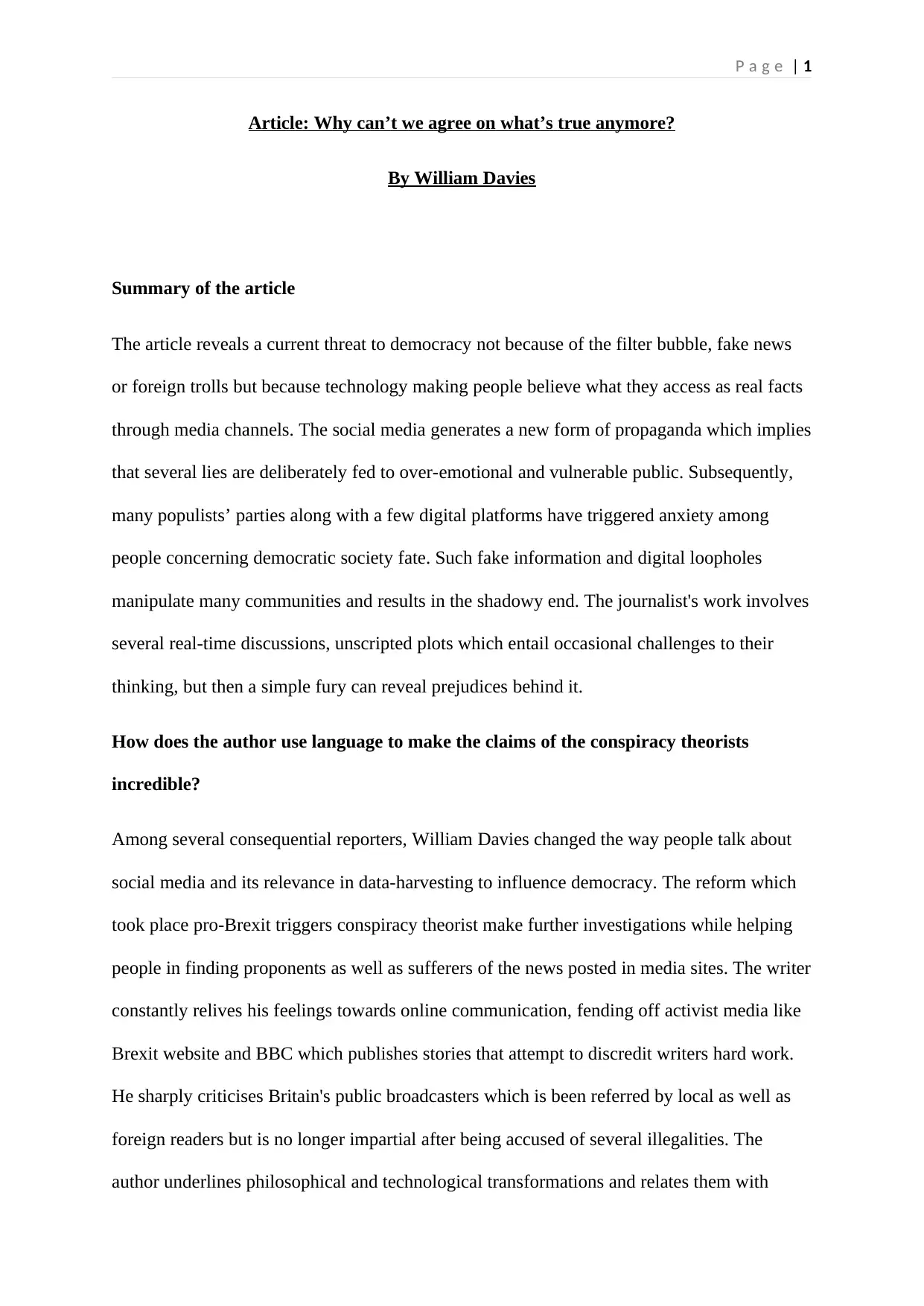
Article: Why can’t we agree on what’s true anymore?
By William Davies
Summary of the article
The article reveals a current threat to democracy not because of the filter bubble, fake news
or foreign trolls but because technology making people believe what they access as real facts
through media channels. The social media generates a new form of propaganda which implies
that several lies are deliberately fed to over-emotional and vulnerable public. Subsequently,
many populists’ parties along with a few digital platforms have triggered anxiety among
people concerning democratic society fate. Such fake information and digital loopholes
manipulate many communities and results in the shadowy end. The journalist's work involves
several real-time discussions, unscripted plots which entail occasional challenges to their
thinking, but then a simple fury can reveal prejudices behind it.
How does the author use language to make the claims of the conspiracy theorists
incredible?
Among several consequential reporters, William Davies changed the way people talk about
social media and its relevance in data-harvesting to influence democracy. The reform which
took place pro-Brexit triggers conspiracy theorist make further investigations while helping
people in finding proponents as well as sufferers of the news posted in media sites. The writer
constantly relives his feelings towards online communication, fending off activist media like
Brexit website and BBC which publishes stories that attempt to discredit writers hard work.
He sharply criticises Britain's public broadcasters which is been referred by local as well as
foreign readers but is no longer impartial after being accused of several illegalities. The
author underlines philosophical and technological transformations and relates them with
Article: Why can’t we agree on what’s true anymore?
By William Davies
Summary of the article
The article reveals a current threat to democracy not because of the filter bubble, fake news
or foreign trolls but because technology making people believe what they access as real facts
through media channels. The social media generates a new form of propaganda which implies
that several lies are deliberately fed to over-emotional and vulnerable public. Subsequently,
many populists’ parties along with a few digital platforms have triggered anxiety among
people concerning democratic society fate. Such fake information and digital loopholes
manipulate many communities and results in the shadowy end. The journalist's work involves
several real-time discussions, unscripted plots which entail occasional challenges to their
thinking, but then a simple fury can reveal prejudices behind it.
How does the author use language to make the claims of the conspiracy theorists
incredible?
Among several consequential reporters, William Davies changed the way people talk about
social media and its relevance in data-harvesting to influence democracy. The reform which
took place pro-Brexit triggers conspiracy theorist make further investigations while helping
people in finding proponents as well as sufferers of the news posted in media sites. The writer
constantly relives his feelings towards online communication, fending off activist media like
Brexit website and BBC which publishes stories that attempt to discredit writers hard work.
He sharply criticises Britain's public broadcasters which is been referred by local as well as
foreign readers but is no longer impartial after being accused of several illegalities. The
author underlines philosophical and technological transformations and relates them with

P a g e | 2
cultural critique made by theorist and intellectuals like Stuart hall and Pierre Bourdieu who
revealed injustice can be embedded by making cultural interactions and expressions.
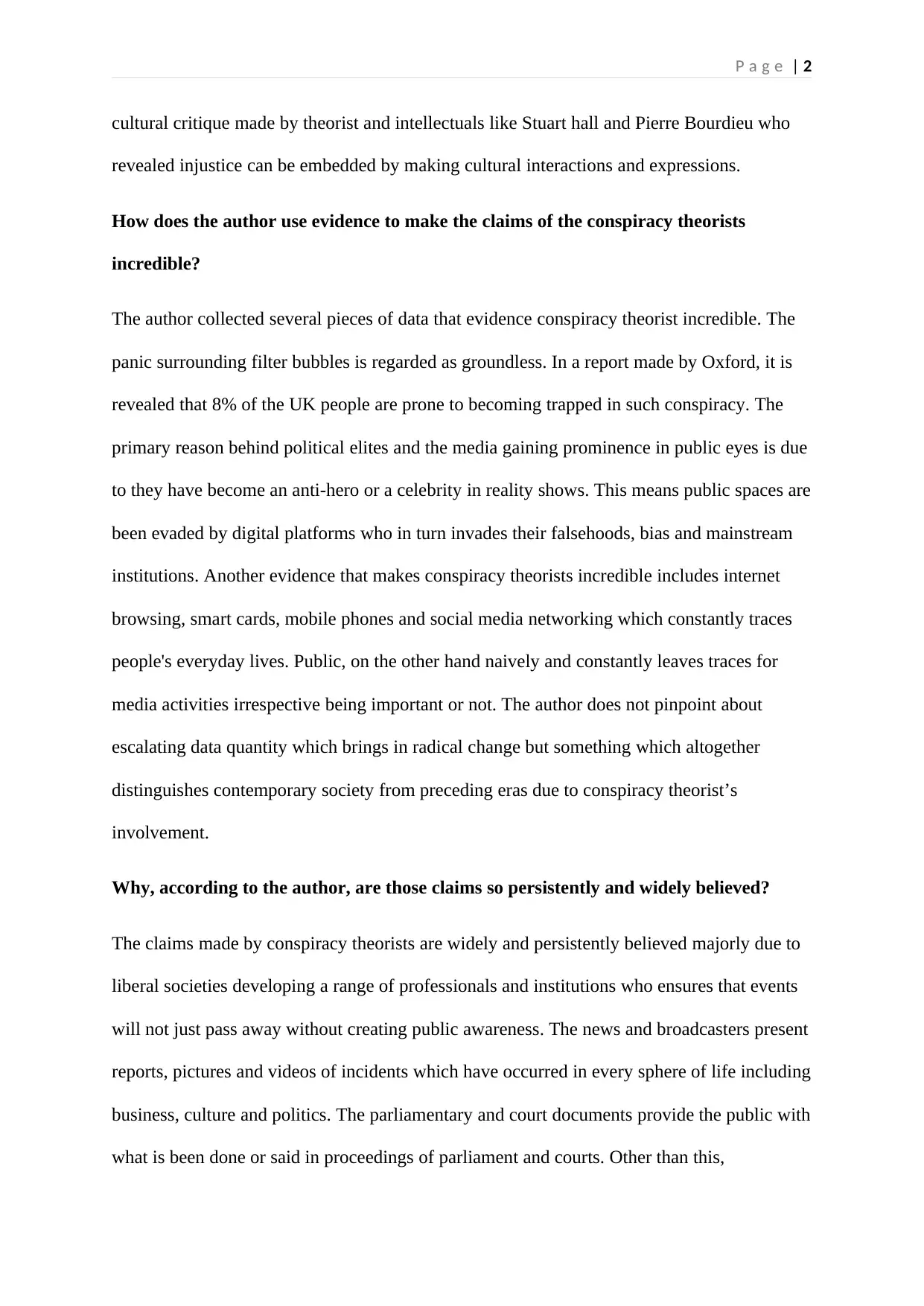
How does the author use evidence to make the claims of the conspiracy theorists
incredible?
The author collected several pieces of data that evidence conspiracy theorist incredible. The
panic surrounding filter bubbles is regarded as groundless. In a report made by Oxford, it is
revealed that 8% of the UK people are prone to becoming trapped in such conspiracy. The
primary reason behind political elites and the media gaining prominence in public eyes is due
to they have become an anti-hero or a celebrity in reality shows. This means public spaces are
been evaded by digital platforms who in turn invades their falsehoods, bias and mainstream
institutions. Another evidence that makes conspiracy theorists incredible includes internet
browsing, smart cards, mobile phones and social media networking which constantly traces
people's everyday lives. Public, on the other hand naively and constantly leaves traces for
media activities irrespective being important or not. The author does not pinpoint about
escalating data quantity which brings in radical change but something which altogether
distinguishes contemporary society from preceding eras due to conspiracy theorist’s
involvement.
Why, according to the author, are those claims so persistently and widely believed?
The claims made by conspiracy theorists are widely and persistently believed majorly due to
liberal societies developing a range of professionals and institutions who ensures that events
will not just pass away without creating public awareness. The news and broadcasters present
reports, pictures and videos of incidents which have occurred in every sphere of life including
business, culture and politics. The parliamentary and court documents provide the public with
what is been done or said in proceedings of parliament and courts. Other than this,
cultural critique made by theorist and intellectuals like Stuart hall and Pierre Bourdieu who
revealed injustice can be embedded by making cultural interactions and expressions.
How does the author use evidence to make the claims of the conspiracy theorists
incredible?
The author collected several pieces of data that evidence conspiracy theorist incredible. The
panic surrounding filter bubbles is regarded as groundless. In a report made by Oxford, it is
revealed that 8% of the UK people are prone to becoming trapped in such conspiracy. The
primary reason behind political elites and the media gaining prominence in public eyes is due
to they have become an anti-hero or a celebrity in reality shows. This means public spaces are
been evaded by digital platforms who in turn invades their falsehoods, bias and mainstream
institutions. Another evidence that makes conspiracy theorists incredible includes internet
browsing, smart cards, mobile phones and social media networking which constantly traces
people's everyday lives. Public, on the other hand naively and constantly leaves traces for
media activities irrespective being important or not. The author does not pinpoint about
escalating data quantity which brings in radical change but something which altogether
distinguishes contemporary society from preceding eras due to conspiracy theorist’s
involvement.
Why, according to the author, are those claims so persistently and widely believed?
The claims made by conspiracy theorists are widely and persistently believed majorly due to
liberal societies developing a range of professionals and institutions who ensures that events
will not just pass away without creating public awareness. The news and broadcasters present
reports, pictures and videos of incidents which have occurred in every sphere of life including
business, culture and politics. The parliamentary and court documents provide the public with
what is been done or said in proceedings of parliament and courts. Other than this,
⊘ This is a preview!⊘
Do you want full access?
Subscribe today to unlock all pages.

Trusted by 1+ million students worldwide

P a g e | 3
economics, accounting and audits help people establish basic data of what is happening in
markets and businesses to make plans. Traditionally, it is assumed that it is through social
media and news reports, grounded on public statements and testimonies which makes the
public aware of what is going throughout the globe.
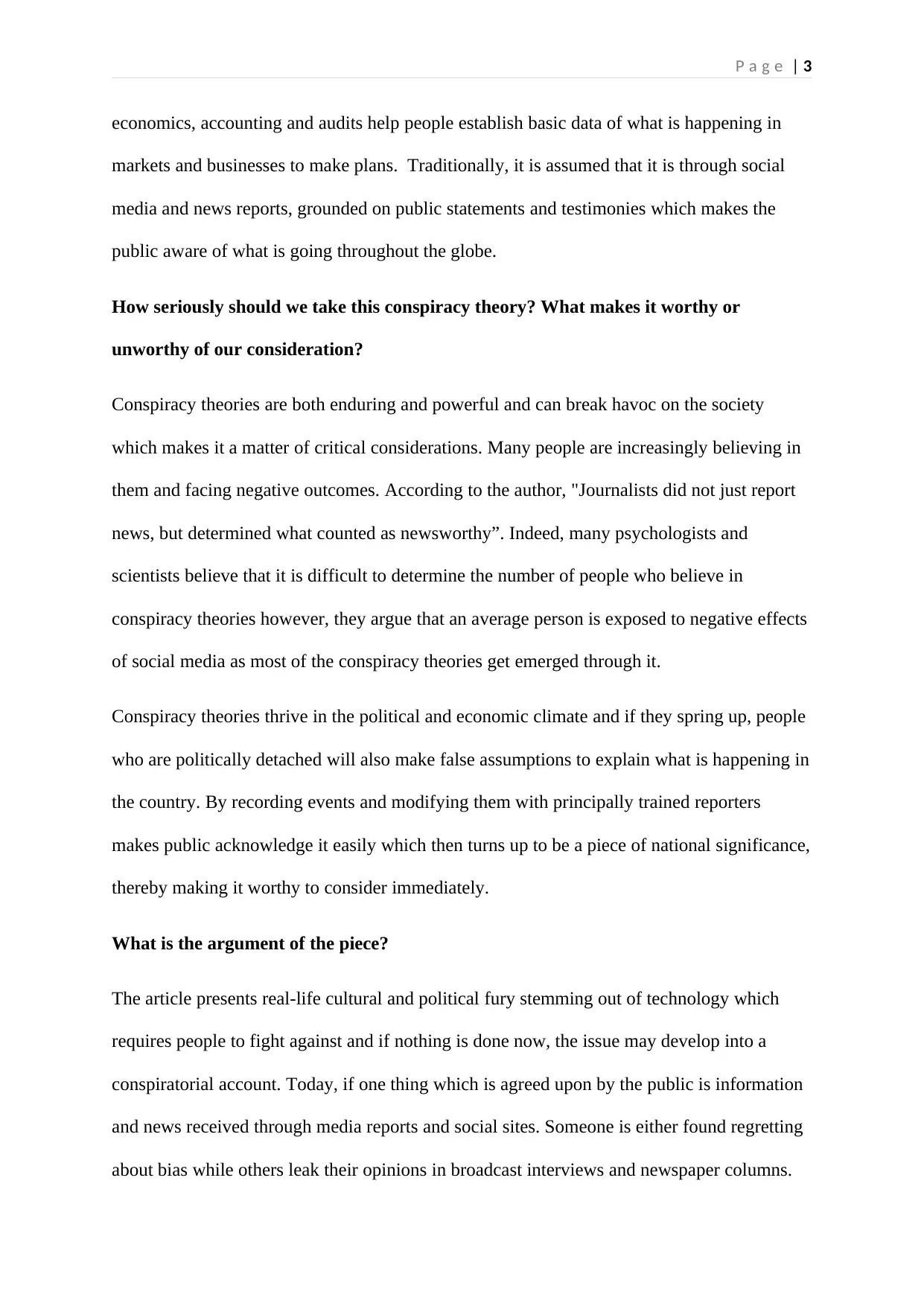
How seriously should we take this conspiracy theory? What makes it worthy or
unworthy of our consideration?
Conspiracy theories are both enduring and powerful and can break havoc on the society
which makes it a matter of critical considerations. Many people are increasingly believing in
them and facing negative outcomes. According to the author, "Journalists did not just report
news, but determined what counted as newsworthy”. Indeed, many psychologists and
scientists believe that it is difficult to determine the number of people who believe in
conspiracy theories however, they argue that an average person is exposed to negative effects
of social media as most of the conspiracy theories get emerged through it.
Conspiracy theories thrive in the political and economic climate and if they spring up, people
who are politically detached will also make false assumptions to explain what is happening in
the country. By recording events and modifying them with principally trained reporters
makes public acknowledge it easily which then turns up to be a piece of national significance,
thereby making it worthy to consider immediately.
What is the argument of the piece?
The article presents real-life cultural and political fury stemming out of technology which
requires people to fight against and if nothing is done now, the issue may develop into a
conspiratorial account. Today, if one thing which is agreed upon by the public is information
and news received through media reports and social sites. Someone is either found regretting
about bias while others leak their opinions in broadcast interviews and newspaper columns.
economics, accounting and audits help people establish basic data of what is happening in
markets and businesses to make plans. Traditionally, it is assumed that it is through social
media and news reports, grounded on public statements and testimonies which makes the
public aware of what is going throughout the globe.
How seriously should we take this conspiracy theory? What makes it worthy or
unworthy of our consideration?
Conspiracy theories are both enduring and powerful and can break havoc on the society
which makes it a matter of critical considerations. Many people are increasingly believing in
them and facing negative outcomes. According to the author, "Journalists did not just report
news, but determined what counted as newsworthy”. Indeed, many psychologists and
scientists believe that it is difficult to determine the number of people who believe in
conspiracy theories however, they argue that an average person is exposed to negative effects
of social media as most of the conspiracy theories get emerged through it.
Conspiracy theories thrive in the political and economic climate and if they spring up, people
who are politically detached will also make false assumptions to explain what is happening in
the country. By recording events and modifying them with principally trained reporters
makes public acknowledge it easily which then turns up to be a piece of national significance,
thereby making it worthy to consider immediately.
What is the argument of the piece?
The article presents real-life cultural and political fury stemming out of technology which
requires people to fight against and if nothing is done now, the issue may develop into a
conspiratorial account. Today, if one thing which is agreed upon by the public is information
and news received through media reports and social sites. Someone is either found regretting
about bias while others leak their opinions in broadcast interviews and newspaper columns.
Paraphrase This Document
Need a fresh take? Get an instant paraphrase of this document with our AI Paraphraser

P a g e | 4
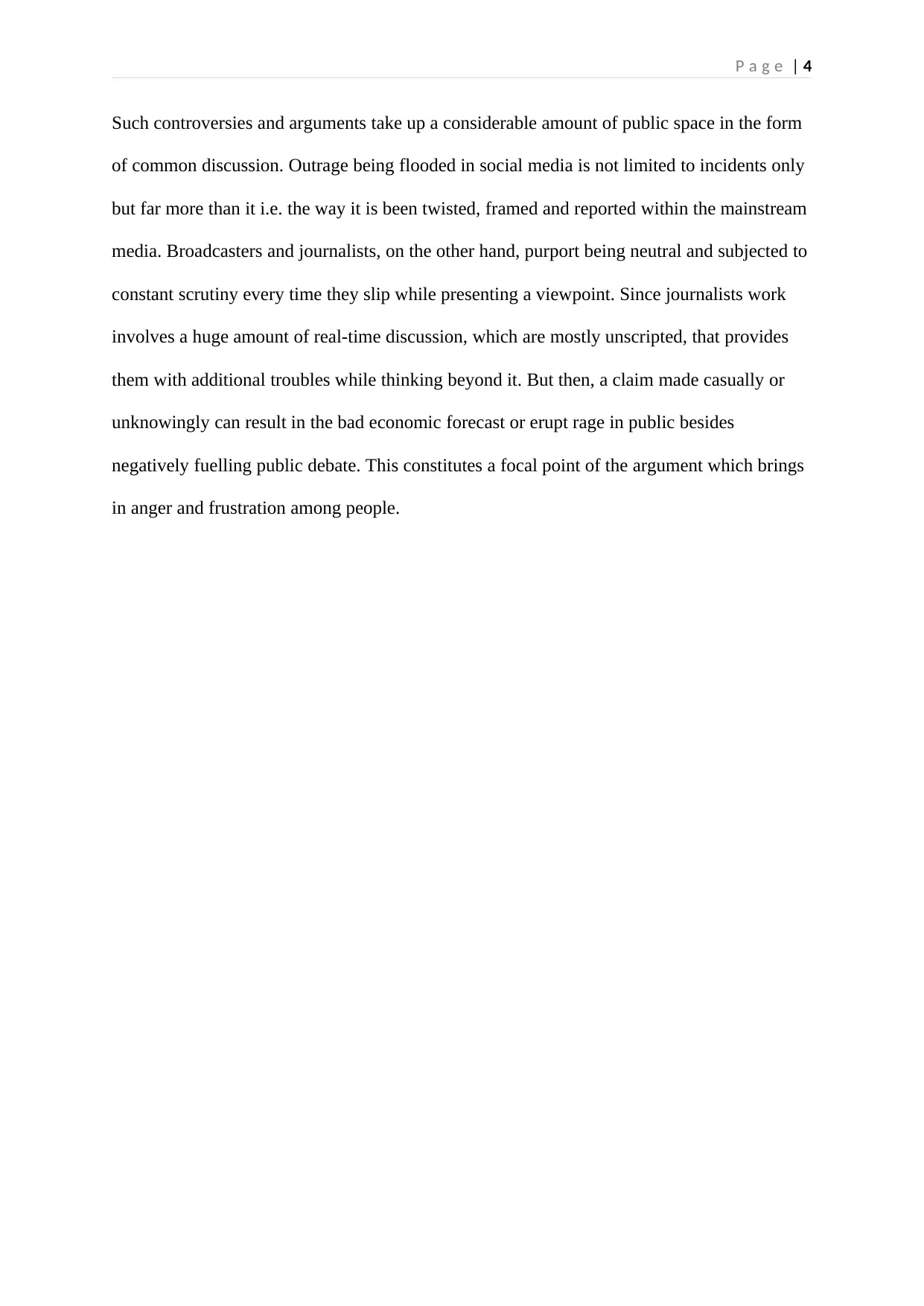
Such controversies and arguments take up a considerable amount of public space in the form
of common discussion. Outrage being flooded in social media is not limited to incidents only
but far more than it i.e. the way it is been twisted, framed and reported within the mainstream
media. Broadcasters and journalists, on the other hand, purport being neutral and subjected to
constant scrutiny every time they slip while presenting a viewpoint. Since journalists work
involves a huge amount of real-time discussion, which are mostly unscripted, that provides
them with additional troubles while thinking beyond it. But then, a claim made casually or
unknowingly can result in the bad economic forecast or erupt rage in public besides
negatively fuelling public debate. This constitutes a focal point of the argument which brings
in anger and frustration among people.
Such controversies and arguments take up a considerable amount of public space in the form
of common discussion. Outrage being flooded in social media is not limited to incidents only
but far more than it i.e. the way it is been twisted, framed and reported within the mainstream
media. Broadcasters and journalists, on the other hand, purport being neutral and subjected to
constant scrutiny every time they slip while presenting a viewpoint. Since journalists work
involves a huge amount of real-time discussion, which are mostly unscripted, that provides
them with additional troubles while thinking beyond it. But then, a claim made casually or
unknowingly can result in the bad economic forecast or erupt rage in public besides
negatively fuelling public debate. This constitutes a focal point of the argument which brings
in anger and frustration among people.

P a g e | 5
References
Davies, W. (2019, September 19). Why can’t we agree on what’s true any more? Retrieved
from https://www.theguardian.com/media/2019/sep/19/why-cant-we-agree-on-whats-
true-anymore
References
Davies, W. (2019, September 19). Why can’t we agree on what’s true any more? Retrieved
from https://www.theguardian.com/media/2019/sep/19/why-cant-we-agree-on-whats-
true-anymore
⊘ This is a preview!⊘
Do you want full access?
Subscribe today to unlock all pages.

Trusted by 1+ million students worldwide
1 out of 6
Your All-in-One AI-Powered Toolkit for Academic Success.
+13062052269
info@desklib.com
Available 24*7 on WhatsApp / Email
Unlock your academic potential
Copyright © 2020–2025 A2Z Services. All Rights Reserved. Developed and managed by ZUCOL.