DBCL In-sourcing Case Study
VerifiedAdded on 2020/01/28
|13
|4165
|55
Case Study
AI Summary
This case study examines DBCL, an international engineering and contracting organization, and its decision to in-source its engineering consultancy services. It critically evaluates the decision, weighing the advantages (cost reduction, increased control, improved customer satisfaction) against the challenges (skill gaps, technology issues, integration difficulties). The study then identifies critical success factors for successful integration, including competitive advantage, differentiation, quality certainty, and cost efficiency. Major risks are analyzed, such as impacts on distribution channels, unprofitable outcomes, technological obsolescence, and labor issues, along with mitigation strategies. Finally, the case study evaluates options for improving program, project, and portfolio management performance, recommending actions such as training, KPI implementation, and organizational restructuring to address challenges and ensure the success of the in-sourcing initiative.
Case Study
1
1

Paraphrase This Document
Need a fresh take? Get an instant paraphrase of this document with our AI Paraphraser
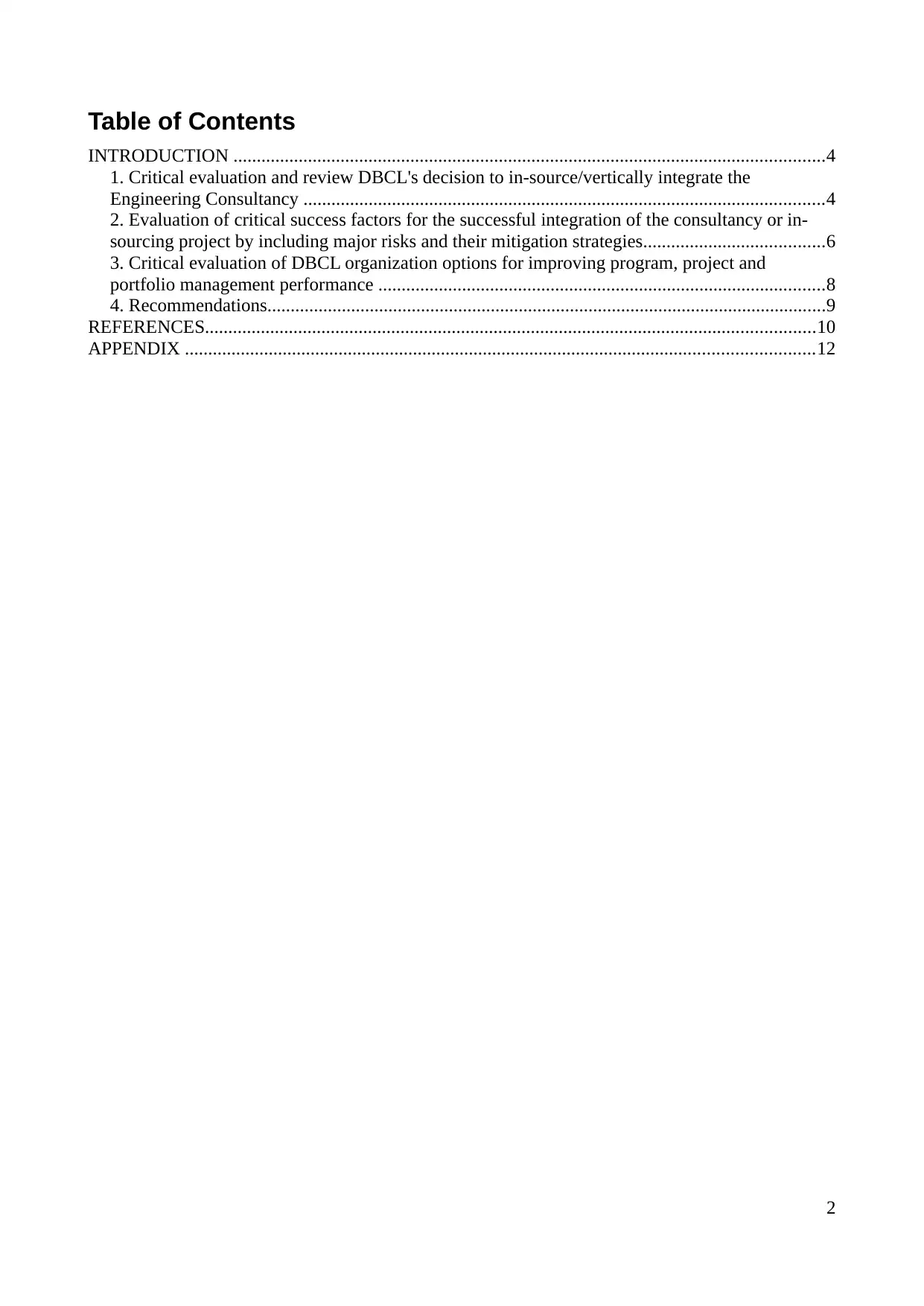
Table of Contents
INTRODUCTION ...............................................................................................................................4
1. Critical evaluation and review DBCL's decision to in-source/vertically integrate the
Engineering Consultancy ................................................................................................................4
2. Evaluation of critical success factors for the successful integration of the consultancy or in-
sourcing project by including major risks and their mitigation strategies.......................................6
3. Critical evaluation of DBCL organization options for improving program, project and
portfolio management performance ................................................................................................8
4. Recommendations........................................................................................................................9
REFERENCES...................................................................................................................................10
APPENDIX .......................................................................................................................................12
2
INTRODUCTION ...............................................................................................................................4
1. Critical evaluation and review DBCL's decision to in-source/vertically integrate the
Engineering Consultancy ................................................................................................................4
2. Evaluation of critical success factors for the successful integration of the consultancy or in-
sourcing project by including major risks and their mitigation strategies.......................................6
3. Critical evaluation of DBCL organization options for improving program, project and
portfolio management performance ................................................................................................8
4. Recommendations........................................................................................................................9
REFERENCES...................................................................................................................................10
APPENDIX .......................................................................................................................................12
2

Index of Tables
Table 1: Risk Breakdown Structure of In-sourcing project .................................................................7
Table 2: Risk Register ........................................................................................................................12
3
Table 1: Risk Breakdown Structure of In-sourcing project .................................................................7
Table 2: Risk Register ........................................................................................................................12
3
⊘ This is a preview!⊘
Do you want full access?
Subscribe today to unlock all pages.

Trusted by 1+ million students worldwide
INTRODUCTION
DBCL is an international multi-disciplinary engineering and contracting organization with
interest in heavy engineering manufacture, programme/project management and infrastructure
contracting engineering consultancy. Infrastructure Contracting is one of the largest division and
gives almost 70% contribution in terms of turnover. Headquarter of the company is situating in UK
and more than 10,000 employees are currently working in different divisions across the world. The
significant presence of firm in Europe and Middle East. By working as a tier 1 supplier to clients in
heavy engineering manufacture and infrastructure contracting, company has developed its business
more successfully. Although, DBCL financially well stable but it has followed traditional formate to
run the business. It has outsourced the project management consultancy and engineering services.
But due to conflicts with external service providers and deliver poor services to the client, enterprise
has decided to in-source infrastructure consultancy. During this phase, the several issues have faxed
by DBCL
1. Critical evaluation and review DBCL's decision to in-source/vertically integrate the Engineering
Consultancy
As per the research of Young, Young and Romero Zapata, 2014, it is find that “in-sourcing is
a business decision that is generally take to keep control over critical competencies or production”
(Young, Young and Romero Zapata, 2014). Basically, it is used in manufacturing or production
industry with the aim of reduction in labour, transportation and taxes costs. When a enterprise
decide to in-source some activity than it means that it is brining a third party out-sourcer to work
inside the company's building. According to Beringer, Jonas and Kock, 2013, “for this, DBCL has
acquired TBT Company which was considering as a leading firm in consultancy sector” (Beringer,
Jonas and Kock, 2013). In this situation, management has taken decision to in-source Engineering
Consultancy to over conflicts with external service providers and clients. The research of Finch,
2014, shows that “during in-sourcing of consultancy, DBCL has faced various issues in which first
is in-house skills and systems capabilities have reduced that increased several risks and expenses”
(Finch, 2014). This situation has raised the problems for the organization in terms of decrease
efficiency of the staff members.
But Schultz, 2014 has not agreed with the above statement and explored that “repatriation is
a biggest challenge or a issue for DBCL Company because due to vertical integration of in-sourcing
of consultancy services has taken more time to made coordination with other activities” (Schultz,
2014). It has created operational differences among the various business operational tasks. In this
context, Frenkel, 2013 has stated that “due to in-sourcing of Engineering Consultancy service,
4
DBCL is an international multi-disciplinary engineering and contracting organization with
interest in heavy engineering manufacture, programme/project management and infrastructure
contracting engineering consultancy. Infrastructure Contracting is one of the largest division and
gives almost 70% contribution in terms of turnover. Headquarter of the company is situating in UK
and more than 10,000 employees are currently working in different divisions across the world. The
significant presence of firm in Europe and Middle East. By working as a tier 1 supplier to clients in
heavy engineering manufacture and infrastructure contracting, company has developed its business
more successfully. Although, DBCL financially well stable but it has followed traditional formate to
run the business. It has outsourced the project management consultancy and engineering services.
But due to conflicts with external service providers and deliver poor services to the client, enterprise
has decided to in-source infrastructure consultancy. During this phase, the several issues have faxed
by DBCL
1. Critical evaluation and review DBCL's decision to in-source/vertically integrate the Engineering
Consultancy
As per the research of Young, Young and Romero Zapata, 2014, it is find that “in-sourcing is
a business decision that is generally take to keep control over critical competencies or production”
(Young, Young and Romero Zapata, 2014). Basically, it is used in manufacturing or production
industry with the aim of reduction in labour, transportation and taxes costs. When a enterprise
decide to in-source some activity than it means that it is brining a third party out-sourcer to work
inside the company's building. According to Beringer, Jonas and Kock, 2013, “for this, DBCL has
acquired TBT Company which was considering as a leading firm in consultancy sector” (Beringer,
Jonas and Kock, 2013). In this situation, management has taken decision to in-source Engineering
Consultancy to over conflicts with external service providers and clients. The research of Finch,
2014, shows that “during in-sourcing of consultancy, DBCL has faced various issues in which first
is in-house skills and systems capabilities have reduced that increased several risks and expenses”
(Finch, 2014). This situation has raised the problems for the organization in terms of decrease
efficiency of the staff members.
But Schultz, 2014 has not agreed with the above statement and explored that “repatriation is
a biggest challenge or a issue for DBCL Company because due to vertical integration of in-sourcing
of consultancy services has taken more time to made coordination with other activities” (Schultz,
2014). It has created operational differences among the various business operational tasks. In this
context, Frenkel, 2013 has stated that “due to in-sourcing of Engineering Consultancy service,
4
Paraphrase This Document
Need a fresh take? Get an instant paraphrase of this document with our AI Paraphraser
DBCL Company has faced technology issues” (Frenkel, 2013). It has became hard to move data to
a new platform, monitor the performance of new in-source services and manage entire database.
These all things have required to developed a new IT infrastructure that is difficult to develop
within short duration or run on existing IT systems.
On the other hand, from the research of Watson, 2015, it is determine that “in-sourcing
decision of DBCL Company has delivered various benefits to the business” (Watson, 2015). In this
context, first advantage of in-sourcing to the organization has control over the business because to
kept Engineering Consultancy facility within the house has enabled the staff members to put more
control over the services. It has lead to increased the customers satisfaction and minimize the issues
regarding the services. But Elston, 2014 has not supported the argument of above stated author and
explained that “the decision of DBCL to in-sourcing of Engineering Consultancy services within the
organization has delivered the major benefits to business in terms of costs” (Elston, 2014). By using
existing employees, business skills, resources and equipments to give right consultancy to the
service users has reduced the costs which has low as compare to outsourcing. Similarly, Teo and
Bhattacherjee, 2014 has explored that “the employees of a company already understand the business
where they are currently working and know how to meet the needs” (Teo and Bhattacherjee, 2014).
So, DBCL decision of in-sourcing has increased the employment opportunities within the
organization and developed their new skills.
After the in-sourcing of Engineering Consultancy with in-house of DBCL by the acquisition
of TBT Company, organization wants to make it as part of vertical integration. The aim behind this
is to build synergies with in-sourcing with other business operations in order to provide value added
service to the clients and improve profit margins. It will deliver long term growth to the firm in
future. In this context, Davy, 2014 has found from his research that “during building of synergies of
in-sourcing with vertical integration, the first issue has faced by firm is capacity balancing problem”
(Davy, 2014). For this DBCL has required to build a extra upstream capacity to ensure that its
existing downstream operations have got sufficient supply in all type of demand situations. In the
contrast of the above statement, Beringer, Jonas and Kock, 2013 has stated that “to develop
synergies between in-sourcing and vertical integration, DBCL has deal with one of the most
important issue that is compromise with existing competencies after developed new abilities”
(Beringer, Jonas and Kock, 2013). Due to this, most of the existing core capabilities of company has
dissolved.
But Reiss and Rayner, 2012 has determined in his study that “vertical integration has
delivered several benefits to DBCL Company at the time of develop a synergy with in-sourcing
facility” (Reiss and Rayner, 2012). It has helped organization to kept the tight control over inputs
5
a new platform, monitor the performance of new in-source services and manage entire database.
These all things have required to developed a new IT infrastructure that is difficult to develop
within short duration or run on existing IT systems.
On the other hand, from the research of Watson, 2015, it is determine that “in-sourcing
decision of DBCL Company has delivered various benefits to the business” (Watson, 2015). In this
context, first advantage of in-sourcing to the organization has control over the business because to
kept Engineering Consultancy facility within the house has enabled the staff members to put more
control over the services. It has lead to increased the customers satisfaction and minimize the issues
regarding the services. But Elston, 2014 has not supported the argument of above stated author and
explained that “the decision of DBCL to in-sourcing of Engineering Consultancy services within the
organization has delivered the major benefits to business in terms of costs” (Elston, 2014). By using
existing employees, business skills, resources and equipments to give right consultancy to the
service users has reduced the costs which has low as compare to outsourcing. Similarly, Teo and
Bhattacherjee, 2014 has explored that “the employees of a company already understand the business
where they are currently working and know how to meet the needs” (Teo and Bhattacherjee, 2014).
So, DBCL decision of in-sourcing has increased the employment opportunities within the
organization and developed their new skills.
After the in-sourcing of Engineering Consultancy with in-house of DBCL by the acquisition
of TBT Company, organization wants to make it as part of vertical integration. The aim behind this
is to build synergies with in-sourcing with other business operations in order to provide value added
service to the clients and improve profit margins. It will deliver long term growth to the firm in
future. In this context, Davy, 2014 has found from his research that “during building of synergies of
in-sourcing with vertical integration, the first issue has faced by firm is capacity balancing problem”
(Davy, 2014). For this DBCL has required to build a extra upstream capacity to ensure that its
existing downstream operations have got sufficient supply in all type of demand situations. In the
contrast of the above statement, Beringer, Jonas and Kock, 2013 has stated that “to develop
synergies between in-sourcing and vertical integration, DBCL has deal with one of the most
important issue that is compromise with existing competencies after developed new abilities”
(Beringer, Jonas and Kock, 2013). Due to this, most of the existing core capabilities of company has
dissolved.
But Reiss and Rayner, 2012 has determined in his study that “vertical integration has
delivered several benefits to DBCL Company at the time of develop a synergy with in-sourcing
facility” (Reiss and Rayner, 2012). It has helped organization to kept the tight control over inputs
5
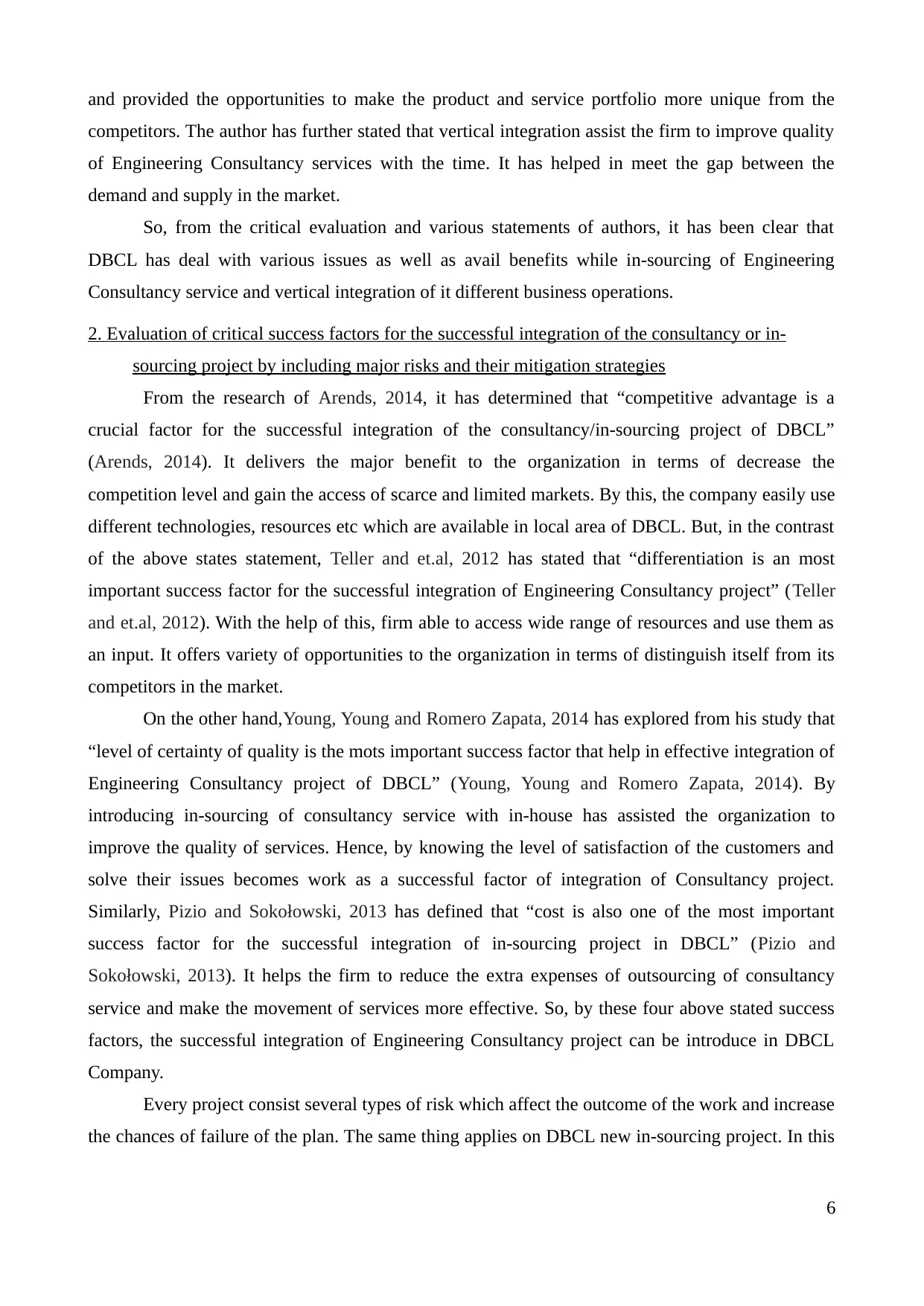
and provided the opportunities to make the product and service portfolio more unique from the
competitors. The author has further stated that vertical integration assist the firm to improve quality
of Engineering Consultancy services with the time. It has helped in meet the gap between the
demand and supply in the market.
So, from the critical evaluation and various statements of authors, it has been clear that
DBCL has deal with various issues as well as avail benefits while in-sourcing of Engineering
Consultancy service and vertical integration of it different business operations.
2. Evaluation of critical success factors for the successful integration of the consultancy or in-
sourcing project by including major risks and their mitigation strategies
From the research of Arends, 2014, it has determined that “competitive advantage is a
crucial factor for the successful integration of the consultancy/in-sourcing project of DBCL”
(Arends, 2014). It delivers the major benefit to the organization in terms of decrease the
competition level and gain the access of scarce and limited markets. By this, the company easily use
different technologies, resources etc which are available in local area of DBCL. But, in the contrast
of the above states statement, Teller and et.al, 2012 has stated that “differentiation is an most
important success factor for the successful integration of Engineering Consultancy project” (Teller
and et.al, 2012). With the help of this, firm able to access wide range of resources and use them as
an input. It offers variety of opportunities to the organization in terms of distinguish itself from its
competitors in the market.
On the other hand,Young, Young and Romero Zapata, 2014 has explored from his study that
“level of certainty of quality is the mots important success factor that help in effective integration of
Engineering Consultancy project of DBCL” (Young, Young and Romero Zapata, 2014). By
introducing in-sourcing of consultancy service with in-house has assisted the organization to
improve the quality of services. Hence, by knowing the level of satisfaction of the customers and
solve their issues becomes work as a successful factor of integration of Consultancy project.
Similarly, Pizio and Sokołowski, 2013 has defined that “cost is also one of the most important
success factor for the successful integration of in-sourcing project in DBCL” (Pizio and
Sokołowski, 2013). It helps the firm to reduce the extra expenses of outsourcing of consultancy
service and make the movement of services more effective. So, by these four above stated success
factors, the successful integration of Engineering Consultancy project can be introduce in DBCL
Company.
Every project consist several types of risk which affect the outcome of the work and increase
the chances of failure of the plan. The same thing applies on DBCL new in-sourcing project. In this
6
competitors. The author has further stated that vertical integration assist the firm to improve quality
of Engineering Consultancy services with the time. It has helped in meet the gap between the
demand and supply in the market.
So, from the critical evaluation and various statements of authors, it has been clear that
DBCL has deal with various issues as well as avail benefits while in-sourcing of Engineering
Consultancy service and vertical integration of it different business operations.
2. Evaluation of critical success factors for the successful integration of the consultancy or in-
sourcing project by including major risks and their mitigation strategies
From the research of Arends, 2014, it has determined that “competitive advantage is a
crucial factor for the successful integration of the consultancy/in-sourcing project of DBCL”
(Arends, 2014). It delivers the major benefit to the organization in terms of decrease the
competition level and gain the access of scarce and limited markets. By this, the company easily use
different technologies, resources etc which are available in local area of DBCL. But, in the contrast
of the above states statement, Teller and et.al, 2012 has stated that “differentiation is an most
important success factor for the successful integration of Engineering Consultancy project” (Teller
and et.al, 2012). With the help of this, firm able to access wide range of resources and use them as
an input. It offers variety of opportunities to the organization in terms of distinguish itself from its
competitors in the market.
On the other hand,Young, Young and Romero Zapata, 2014 has explored from his study that
“level of certainty of quality is the mots important success factor that help in effective integration of
Engineering Consultancy project of DBCL” (Young, Young and Romero Zapata, 2014). By
introducing in-sourcing of consultancy service with in-house has assisted the organization to
improve the quality of services. Hence, by knowing the level of satisfaction of the customers and
solve their issues becomes work as a successful factor of integration of Consultancy project.
Similarly, Pizio and Sokołowski, 2013 has defined that “cost is also one of the most important
success factor for the successful integration of in-sourcing project in DBCL” (Pizio and
Sokołowski, 2013). It helps the firm to reduce the extra expenses of outsourcing of consultancy
service and make the movement of services more effective. So, by these four above stated success
factors, the successful integration of Engineering Consultancy project can be introduce in DBCL
Company.
Every project consist several types of risk which affect the outcome of the work and increase
the chances of failure of the plan. The same thing applies on DBCL new in-sourcing project. In this
6
⊘ This is a preview!⊘
Do you want full access?
Subscribe today to unlock all pages.
Trusted by 1+ million students worldwide
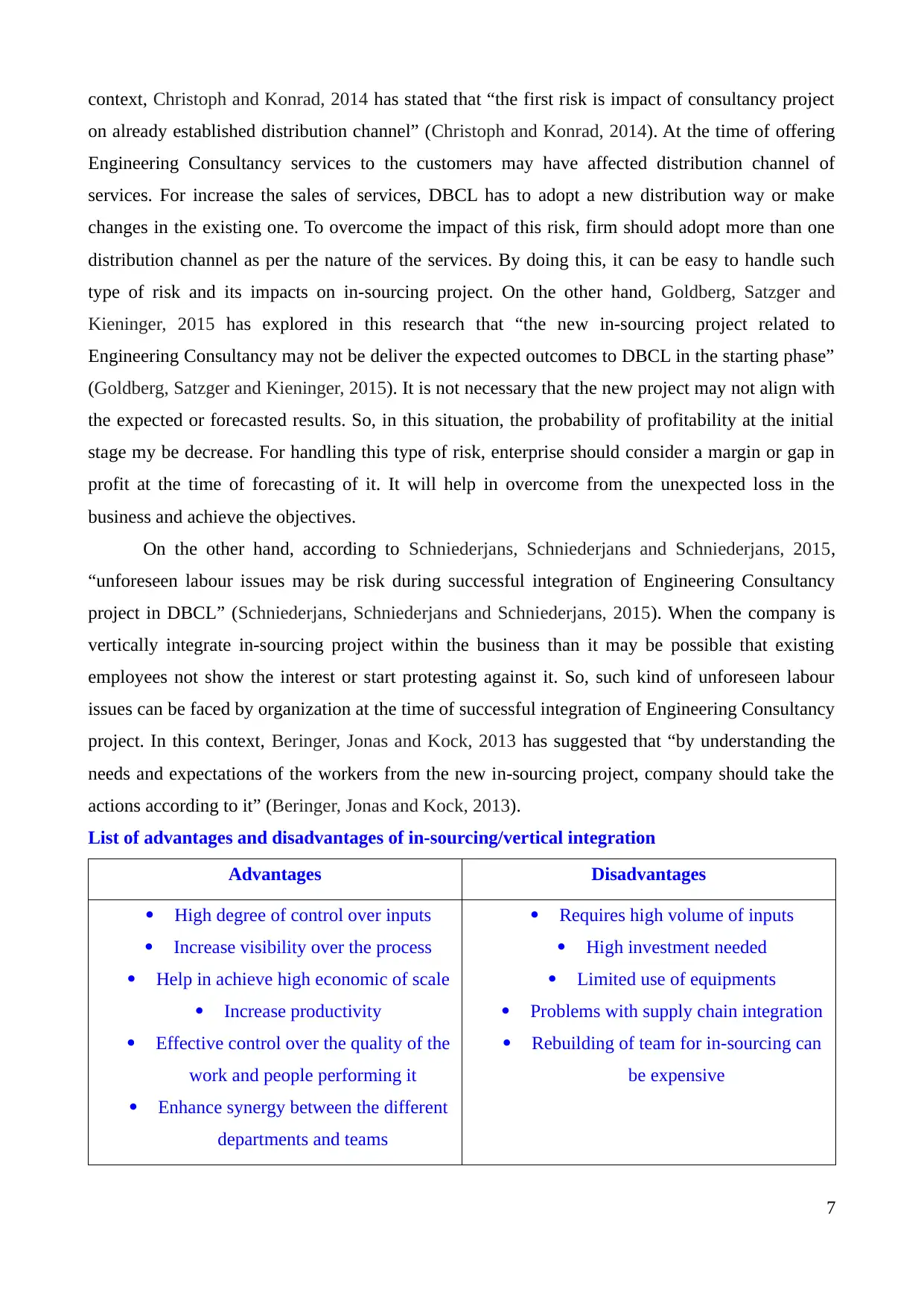
context, Christoph and Konrad, 2014 has stated that “the first risk is impact of consultancy project
on already established distribution channel” (Christoph and Konrad, 2014). At the time of offering
Engineering Consultancy services to the customers may have affected distribution channel of
services. For increase the sales of services, DBCL has to adopt a new distribution way or make
changes in the existing one. To overcome the impact of this risk, firm should adopt more than one
distribution channel as per the nature of the services. By doing this, it can be easy to handle such
type of risk and its impacts on in-sourcing project. On the other hand, Goldberg, Satzger and
Kieninger, 2015 has explored in this research that “the new in-sourcing project related to
Engineering Consultancy may not be deliver the expected outcomes to DBCL in the starting phase”
(Goldberg, Satzger and Kieninger, 2015). It is not necessary that the new project may not align with
the expected or forecasted results. So, in this situation, the probability of profitability at the initial
stage my be decrease. For handling this type of risk, enterprise should consider a margin or gap in
profit at the time of forecasting of it. It will help in overcome from the unexpected loss in the
business and achieve the objectives.
On the other hand, according to Schniederjans, Schniederjans and Schniederjans, 2015,
“unforeseen labour issues may be risk during successful integration of Engineering Consultancy
project in DBCL” (Schniederjans, Schniederjans and Schniederjans, 2015). When the company is
vertically integrate in-sourcing project within the business than it may be possible that existing
employees not show the interest or start protesting against it. So, such kind of unforeseen labour
issues can be faced by organization at the time of successful integration of Engineering Consultancy
project. In this context, Beringer, Jonas and Kock, 2013 has suggested that “by understanding the
needs and expectations of the workers from the new in-sourcing project, company should take the
actions according to it” (Beringer, Jonas and Kock, 2013).
List of advantages and disadvantages of in-sourcing/vertical integration
Advantages Disadvantages
High degree of control over inputs
Increase visibility over the process
Help in achieve high economic of scale
Increase productivity
Effective control over the quality of the
work and people performing it
Enhance synergy between the different
departments and teams
Requires high volume of inputs
High investment needed
Limited use of equipments
Problems with supply chain integration
Rebuilding of team for in-sourcing can
be expensive
7
on already established distribution channel” (Christoph and Konrad, 2014). At the time of offering
Engineering Consultancy services to the customers may have affected distribution channel of
services. For increase the sales of services, DBCL has to adopt a new distribution way or make
changes in the existing one. To overcome the impact of this risk, firm should adopt more than one
distribution channel as per the nature of the services. By doing this, it can be easy to handle such
type of risk and its impacts on in-sourcing project. On the other hand, Goldberg, Satzger and
Kieninger, 2015 has explored in this research that “the new in-sourcing project related to
Engineering Consultancy may not be deliver the expected outcomes to DBCL in the starting phase”
(Goldberg, Satzger and Kieninger, 2015). It is not necessary that the new project may not align with
the expected or forecasted results. So, in this situation, the probability of profitability at the initial
stage my be decrease. For handling this type of risk, enterprise should consider a margin or gap in
profit at the time of forecasting of it. It will help in overcome from the unexpected loss in the
business and achieve the objectives.
On the other hand, according to Schniederjans, Schniederjans and Schniederjans, 2015,
“unforeseen labour issues may be risk during successful integration of Engineering Consultancy
project in DBCL” (Schniederjans, Schniederjans and Schniederjans, 2015). When the company is
vertically integrate in-sourcing project within the business than it may be possible that existing
employees not show the interest or start protesting against it. So, such kind of unforeseen labour
issues can be faced by organization at the time of successful integration of Engineering Consultancy
project. In this context, Beringer, Jonas and Kock, 2013 has suggested that “by understanding the
needs and expectations of the workers from the new in-sourcing project, company should take the
actions according to it” (Beringer, Jonas and Kock, 2013).
List of advantages and disadvantages of in-sourcing/vertical integration
Advantages Disadvantages
High degree of control over inputs
Increase visibility over the process
Help in achieve high economic of scale
Increase productivity
Effective control over the quality of the
work and people performing it
Enhance synergy between the different
departments and teams
Requires high volume of inputs
High investment needed
Limited use of equipments
Problems with supply chain integration
Rebuilding of team for in-sourcing can
be expensive
7
Paraphrase This Document
Need a fresh take? Get an instant paraphrase of this document with our AI Paraphraser
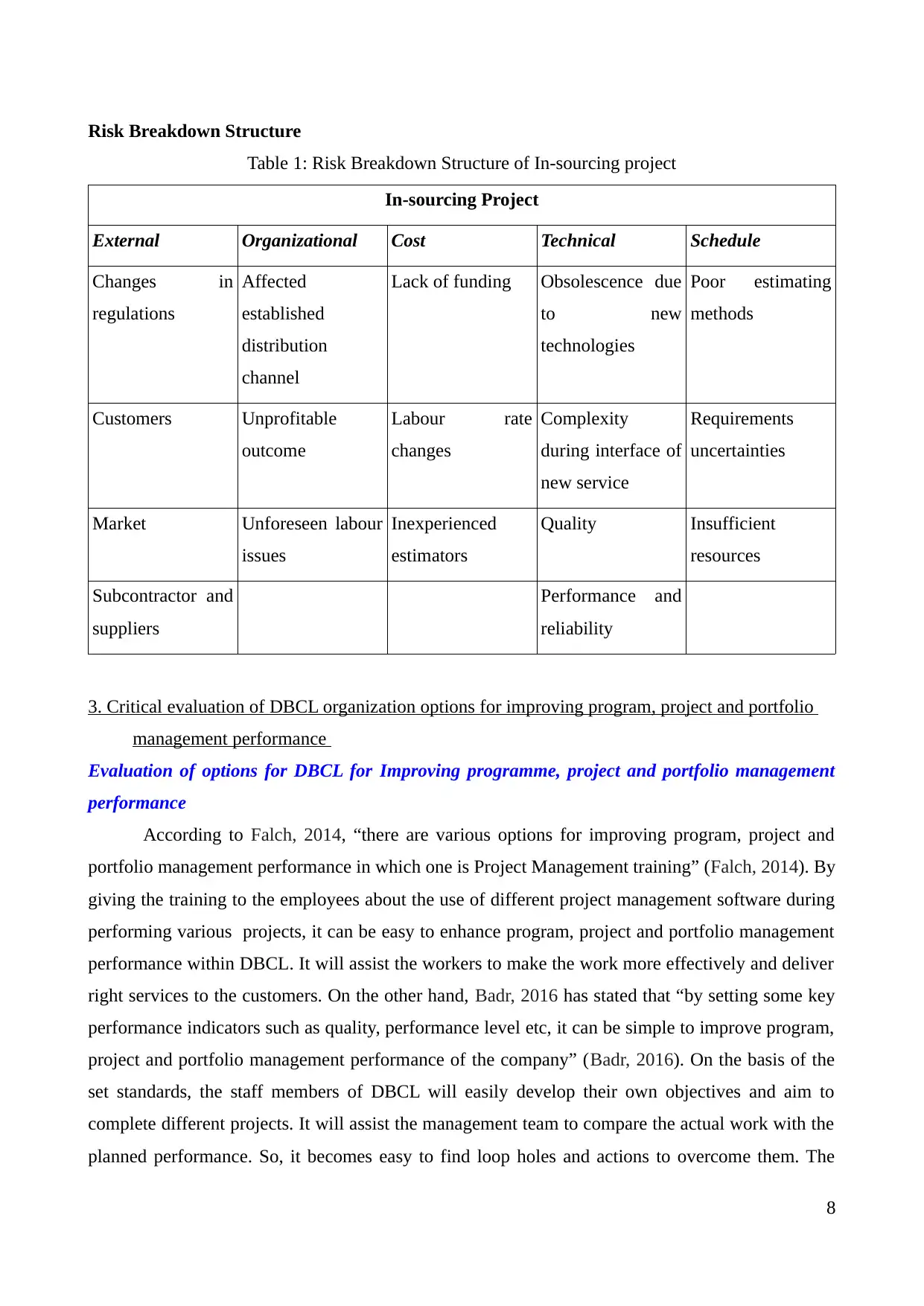
Risk Breakdown Structure
Table 1: Risk Breakdown Structure of In-sourcing project
In-sourcing Project
External Organizational Cost Technical Schedule
Changes in
regulations
Affected
established
distribution
channel
Lack of funding Obsolescence due
to new
technologies
Poor estimating
methods
Customers Unprofitable
outcome
Labour rate
changes
Complexity
during interface of
new service
Requirements
uncertainties
Market Unforeseen labour
issues
Inexperienced
estimators
Quality Insufficient
resources
Subcontractor and
suppliers
Performance and
reliability
3. Critical evaluation of DBCL organization options for improving program, project and portfolio
management performance
Evaluation of options for DBCL for Improving programme, project and portfolio management
performance
According to Falch, 2014, “there are various options for improving program, project and
portfolio management performance in which one is Project Management training” (Falch, 2014). By
giving the training to the employees about the use of different project management software during
performing various projects, it can be easy to enhance program, project and portfolio management
performance within DBCL. It will assist the workers to make the work more effectively and deliver
right services to the customers. On the other hand, Badr, 2016 has stated that “by setting some key
performance indicators such as quality, performance level etc, it can be simple to improve program,
project and portfolio management performance of the company” (Badr, 2016). On the basis of the
set standards, the staff members of DBCL will easily develop their own objectives and aim to
complete different projects. It will assist the management team to compare the actual work with the
planned performance. So, it becomes easy to find loop holes and actions to overcome them. The
8
Table 1: Risk Breakdown Structure of In-sourcing project
In-sourcing Project
External Organizational Cost Technical Schedule
Changes in
regulations
Affected
established
distribution
channel
Lack of funding Obsolescence due
to new
technologies
Poor estimating
methods
Customers Unprofitable
outcome
Labour rate
changes
Complexity
during interface of
new service
Requirements
uncertainties
Market Unforeseen labour
issues
Inexperienced
estimators
Quality Insufficient
resources
Subcontractor and
suppliers
Performance and
reliability
3. Critical evaluation of DBCL organization options for improving program, project and portfolio
management performance
Evaluation of options for DBCL for Improving programme, project and portfolio management
performance
According to Falch, 2014, “there are various options for improving program, project and
portfolio management performance in which one is Project Management training” (Falch, 2014). By
giving the training to the employees about the use of different project management software during
performing various projects, it can be easy to enhance program, project and portfolio management
performance within DBCL. It will assist the workers to make the work more effectively and deliver
right services to the customers. On the other hand, Badr, 2016 has stated that “by setting some key
performance indicators such as quality, performance level etc, it can be simple to improve program,
project and portfolio management performance of the company” (Badr, 2016). On the basis of the
set standards, the staff members of DBCL will easily develop their own objectives and aim to
complete different projects. It will assist the management team to compare the actual work with the
planned performance. So, it becomes easy to find loop holes and actions to overcome them. The
8
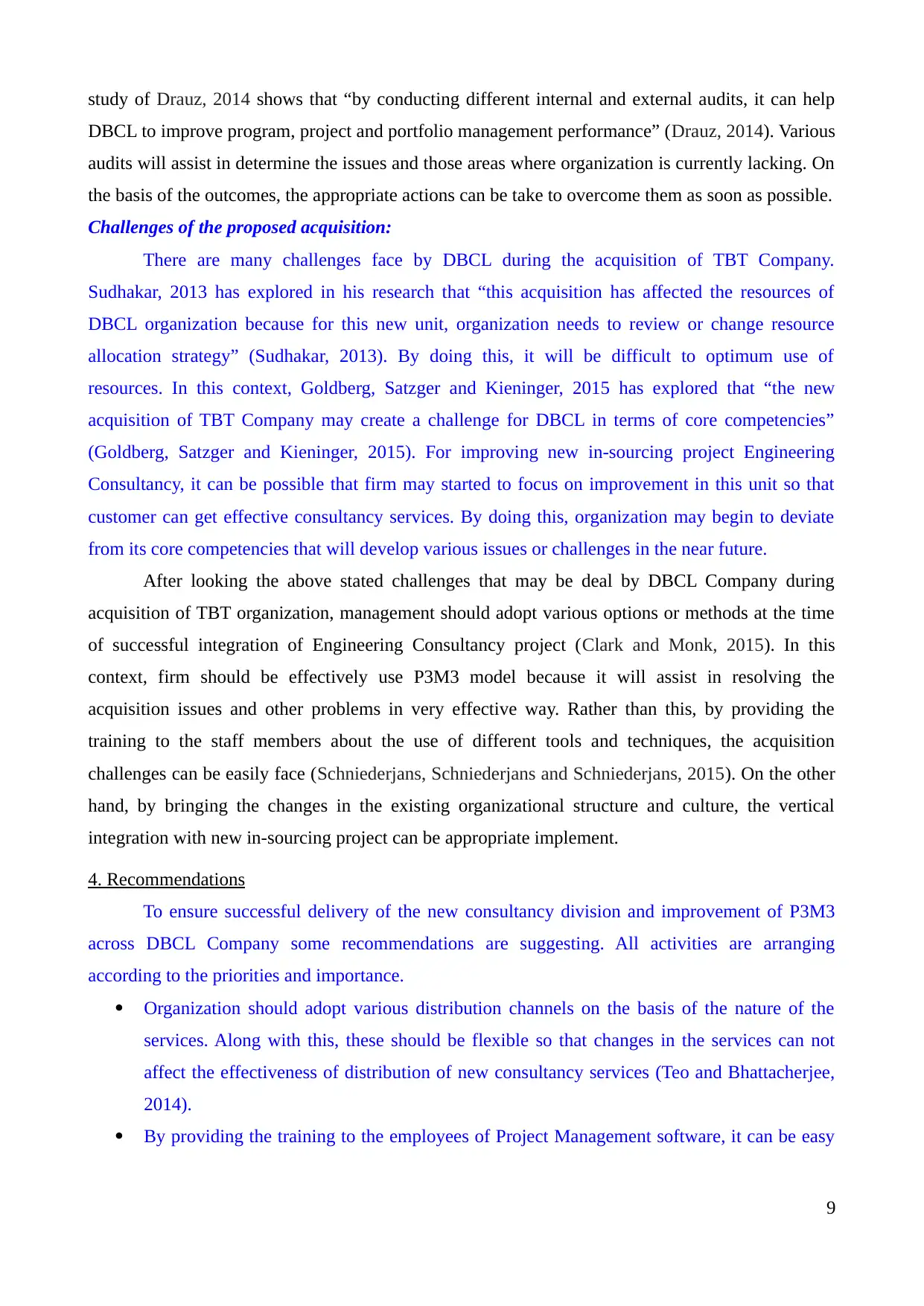
study of Drauz, 2014 shows that “by conducting different internal and external audits, it can help
DBCL to improve program, project and portfolio management performance” (Drauz, 2014). Various
audits will assist in determine the issues and those areas where organization is currently lacking. On
the basis of the outcomes, the appropriate actions can be take to overcome them as soon as possible.
Challenges of the proposed acquisition:
There are many challenges face by DBCL during the acquisition of TBT Company.
Sudhakar, 2013 has explored in his research that “this acquisition has affected the resources of
DBCL organization because for this new unit, organization needs to review or change resource
allocation strategy” (Sudhakar, 2013). By doing this, it will be difficult to optimum use of
resources. In this context, Goldberg, Satzger and Kieninger, 2015 has explored that “the new
acquisition of TBT Company may create a challenge for DBCL in terms of core competencies”
(Goldberg, Satzger and Kieninger, 2015). For improving new in-sourcing project Engineering
Consultancy, it can be possible that firm may started to focus on improvement in this unit so that
customer can get effective consultancy services. By doing this, organization may begin to deviate
from its core competencies that will develop various issues or challenges in the near future.
After looking the above stated challenges that may be deal by DBCL Company during
acquisition of TBT organization, management should adopt various options or methods at the time
of successful integration of Engineering Consultancy project (Clark and Monk, 2015). In this
context, firm should be effectively use P3M3 model because it will assist in resolving the
acquisition issues and other problems in very effective way. Rather than this, by providing the
training to the staff members about the use of different tools and techniques, the acquisition
challenges can be easily face (Schniederjans, Schniederjans and Schniederjans, 2015). On the other
hand, by bringing the changes in the existing organizational structure and culture, the vertical
integration with new in-sourcing project can be appropriate implement.
4. Recommendations
To ensure successful delivery of the new consultancy division and improvement of P3M3
across DBCL Company some recommendations are suggesting. All activities are arranging
according to the priorities and importance.
Organization should adopt various distribution channels on the basis of the nature of the
services. Along with this, these should be flexible so that changes in the services can not
affect the effectiveness of distribution of new consultancy services (Teo and Bhattacherjee,
2014).
By providing the training to the employees of Project Management software, it can be easy
9
DBCL to improve program, project and portfolio management performance” (Drauz, 2014). Various
audits will assist in determine the issues and those areas where organization is currently lacking. On
the basis of the outcomes, the appropriate actions can be take to overcome them as soon as possible.
Challenges of the proposed acquisition:
There are many challenges face by DBCL during the acquisition of TBT Company.
Sudhakar, 2013 has explored in his research that “this acquisition has affected the resources of
DBCL organization because for this new unit, organization needs to review or change resource
allocation strategy” (Sudhakar, 2013). By doing this, it will be difficult to optimum use of
resources. In this context, Goldberg, Satzger and Kieninger, 2015 has explored that “the new
acquisition of TBT Company may create a challenge for DBCL in terms of core competencies”
(Goldberg, Satzger and Kieninger, 2015). For improving new in-sourcing project Engineering
Consultancy, it can be possible that firm may started to focus on improvement in this unit so that
customer can get effective consultancy services. By doing this, organization may begin to deviate
from its core competencies that will develop various issues or challenges in the near future.
After looking the above stated challenges that may be deal by DBCL Company during
acquisition of TBT organization, management should adopt various options or methods at the time
of successful integration of Engineering Consultancy project (Clark and Monk, 2015). In this
context, firm should be effectively use P3M3 model because it will assist in resolving the
acquisition issues and other problems in very effective way. Rather than this, by providing the
training to the staff members about the use of different tools and techniques, the acquisition
challenges can be easily face (Schniederjans, Schniederjans and Schniederjans, 2015). On the other
hand, by bringing the changes in the existing organizational structure and culture, the vertical
integration with new in-sourcing project can be appropriate implement.
4. Recommendations
To ensure successful delivery of the new consultancy division and improvement of P3M3
across DBCL Company some recommendations are suggesting. All activities are arranging
according to the priorities and importance.
Organization should adopt various distribution channels on the basis of the nature of the
services. Along with this, these should be flexible so that changes in the services can not
affect the effectiveness of distribution of new consultancy services (Teo and Bhattacherjee,
2014).
By providing the training to the employees of Project Management software, it can be easy
9
⊘ This is a preview!⊘
Do you want full access?
Subscribe today to unlock all pages.
Trusted by 1+ million students worldwide
to improve the utilization of P3M3 with the firm. This should be completed within 1 year.
The risk assessment process should be conducted by the organization before the acquisition
of new consultancy unit. It will assist in knowing those areas which may affect the
productivity of DBCL organization (Beringer, Jonas and Kock, 2013). It should be achieve
at the end of June, 2016.
By adopting the flexible organizational structure and culture, it can be easy to ensure
successful delivery of new consultancy services to the customers and improvement in use pf
P3M3 model. It should be completed at the end of August 2016.
By setting of various key performance indicators and quality standards, the new services can
be improve and effectively deliver to the clients. It will assist in compare the actual work
with the planned work (Young, Young and Romero Zapata, 2014).
By knowing the unforeseen labour issues, the management of DBCL Company can
understand the problem of the staff members and try to find out the solutions to overcome as
soon as possible (Goldberg, Satzger and Kieninger, 2015).
10
The risk assessment process should be conducted by the organization before the acquisition
of new consultancy unit. It will assist in knowing those areas which may affect the
productivity of DBCL organization (Beringer, Jonas and Kock, 2013). It should be achieve
at the end of June, 2016.
By adopting the flexible organizational structure and culture, it can be easy to ensure
successful delivery of new consultancy services to the customers and improvement in use pf
P3M3 model. It should be completed at the end of August 2016.
By setting of various key performance indicators and quality standards, the new services can
be improve and effectively deliver to the clients. It will assist in compare the actual work
with the planned work (Young, Young and Romero Zapata, 2014).
By knowing the unforeseen labour issues, the management of DBCL Company can
understand the problem of the staff members and try to find out the solutions to overcome as
soon as possible (Goldberg, Satzger and Kieninger, 2015).
10
Paraphrase This Document
Need a fresh take? Get an instant paraphrase of this document with our AI Paraphraser
REFERENCES
Books and Journals
Arends, R., 2014. Learning to teach. McGraw-Hill Higher Education.
Badr, N.G., 2016. A Framework of Mechanisms for Integrating Emerging Technology Innovations
in IT Services Companies. In Information and Communication Technologies in
Organizations and Society (pp. 101-123). Springer International Publishing.
Beringer, C., Jonas, D. and Kock, A., 2013. Behavior of internal stakeholders in project portfolio
management and its impact on success.International Journal of Project Management. 31(6).
pp.830-846.
Christoph, A.J. and Konrad, S., 2014. Project Complexity as an Influence Factor on the Balance of
Costs and Benefits in Project Management Maturity Modeling. Procedia-Social and
Behavioral Sciences. 119. pp.162-171.
Clark, G.L. and Monk, A.H., 2015. The Contested Role of Investment Consultants: Ambiguity,
Contract, and Innovation in Financial Institutions.Contract, and Innovation in Financial
Institutions (June 3, 2015).
Davy, A., 2014. Sourcing of ITservices: industry trends. Information Systems in Management. 3(2).
pp.102-112.
Drauz, R., 2014. Re-insourcing as a manufacturing-strategic option during a crisis—Cases from the
automobile industry. Journal of Business Research. 67(3). pp.346-353.
Elston, T., 2014, April. Shared corporate services in the public sector: A critical review. In panel
Public Service Delivery in the Trans forming State, convened by the Public Policy and
Administration group of the Political Studies Association at its 64th Annual International
Conference in Manchester (pp. 14-16).
Falch, M., 2014. The impact of ICT on market organisation–A case of 3D-models in engineering
consultancy. Telematics and Informatics. 31(2). pp.282-291.
Goldberg, M., Satzger, G. and Kieninger, A., 2015, May. A Capability Framework for IT Service
Integration and Management in Multi-Sourcing. In Proceedings of the 23rd European
Conference on Information Systems.
Pizio, O. and Sokołowski, S., 2013. Restricted primitive model for electrolyte solutions in slit-like
pores with grafted chains: Microscopic structure, thermodynamics of adsorption, and
electric properties from a density functional approach. The Journal of chemical
physics. 138(20). p.204715.
Reiss, G. and Rayner, P., 2012. Portfolio and Programme Management Demystified: Managing
11
Books and Journals
Arends, R., 2014. Learning to teach. McGraw-Hill Higher Education.
Badr, N.G., 2016. A Framework of Mechanisms for Integrating Emerging Technology Innovations
in IT Services Companies. In Information and Communication Technologies in
Organizations and Society (pp. 101-123). Springer International Publishing.
Beringer, C., Jonas, D. and Kock, A., 2013. Behavior of internal stakeholders in project portfolio
management and its impact on success.International Journal of Project Management. 31(6).
pp.830-846.
Christoph, A.J. and Konrad, S., 2014. Project Complexity as an Influence Factor on the Balance of
Costs and Benefits in Project Management Maturity Modeling. Procedia-Social and
Behavioral Sciences. 119. pp.162-171.
Clark, G.L. and Monk, A.H., 2015. The Contested Role of Investment Consultants: Ambiguity,
Contract, and Innovation in Financial Institutions.Contract, and Innovation in Financial
Institutions (June 3, 2015).
Davy, A., 2014. Sourcing of ITservices: industry trends. Information Systems in Management. 3(2).
pp.102-112.
Drauz, R., 2014. Re-insourcing as a manufacturing-strategic option during a crisis—Cases from the
automobile industry. Journal of Business Research. 67(3). pp.346-353.
Elston, T., 2014, April. Shared corporate services in the public sector: A critical review. In panel
Public Service Delivery in the Trans forming State, convened by the Public Policy and
Administration group of the Political Studies Association at its 64th Annual International
Conference in Manchester (pp. 14-16).
Falch, M., 2014. The impact of ICT on market organisation–A case of 3D-models in engineering
consultancy. Telematics and Informatics. 31(2). pp.282-291.
Goldberg, M., Satzger, G. and Kieninger, A., 2015, May. A Capability Framework for IT Service
Integration and Management in Multi-Sourcing. In Proceedings of the 23rd European
Conference on Information Systems.
Pizio, O. and Sokołowski, S., 2013. Restricted primitive model for electrolyte solutions in slit-like
pores with grafted chains: Microscopic structure, thermodynamics of adsorption, and
electric properties from a density functional approach. The Journal of chemical
physics. 138(20). p.204715.
Reiss, G. and Rayner, P., 2012. Portfolio and Programme Management Demystified: Managing
11
Multiple Projects Successfully. Routledge.
Schniederjans, M.J., Schniederjans, A.M. and Schniederjans, D.G., 2015.Outsourcing and
insourcing in an international context. Routledge.
Sudhakar, G.P., 2013. A review of critical success factors for offshore software development
projects. Organizacija. 46(6). pp.282-296.
Teller, J. and et.al., H.G., 2012. Formalization of project portfolio management: The moderating
role of project portfolio complexity. International Journal of Project Management. 30(5).
pp.596-607.
Teo, T.S. and Bhattacherjee, A., 2014. Knowledge transfer and utilization in IT outsourcing
partnerships: A preliminary model of antecedents and outcomes. Information &
Management.51(2). pp.177-186.
Young, M., Young, R. and Romero Zapata, J., 2014. Project, programme and portfolio maturity: a
case study of Australian Federal Government.International Journal of Managing Projects in
Business. 7(2). pp.215-230.
Online
Finch, C., 2014. Advantages & disadvantages of insourcing. [Online]. Available through:
<http://www.ehow.com/info_10015686_advantages-disadvantages-insourcing.html>.
[Accessed on: 14th April, 2016].
Frenkel, K., 2013. Navigating the challenges of insourcing. [Online]. Available through:
<http://www.cioinsight.com/it-services/outsourcing/navigating-the-challenges-of-
insourcing>. [Accessed on: 14th April, 2016].
Harris, M., 2015. Insourcing can drive competitive advantages. [Online]. Available through:
<http://www.cips.org/en-SG/supply-management/news/2015/march/insourcing-can-drive-
competitive-advantage/>. [Accessed on: 14th April, 2016].
Schultz, P., 2014. Advantages and disadvantages of insourcing. [Online]. Available through:
<http://www.businessproweekly.com/business-development/advantages-and-disadvantages-
of-in-sourcing/?mode=featured>. [Accessed on: 14th April, 2016].
Watson, M., 2015. Advantages of insourcing vs outsourcing. [Online]. Available through:
<http://www.communicate.co.za/_blog/Communicate_Blog/post/advantages-of-insourcing-
vs-outsourcing/>. [Accessed on: 14th April, 2016].
12
Schniederjans, M.J., Schniederjans, A.M. and Schniederjans, D.G., 2015.Outsourcing and
insourcing in an international context. Routledge.
Sudhakar, G.P., 2013. A review of critical success factors for offshore software development
projects. Organizacija. 46(6). pp.282-296.
Teller, J. and et.al., H.G., 2012. Formalization of project portfolio management: The moderating
role of project portfolio complexity. International Journal of Project Management. 30(5).
pp.596-607.
Teo, T.S. and Bhattacherjee, A., 2014. Knowledge transfer and utilization in IT outsourcing
partnerships: A preliminary model of antecedents and outcomes. Information &
Management.51(2). pp.177-186.
Young, M., Young, R. and Romero Zapata, J., 2014. Project, programme and portfolio maturity: a
case study of Australian Federal Government.International Journal of Managing Projects in
Business. 7(2). pp.215-230.
Online
Finch, C., 2014. Advantages & disadvantages of insourcing. [Online]. Available through:
<http://www.ehow.com/info_10015686_advantages-disadvantages-insourcing.html>.
[Accessed on: 14th April, 2016].
Frenkel, K., 2013. Navigating the challenges of insourcing. [Online]. Available through:
<http://www.cioinsight.com/it-services/outsourcing/navigating-the-challenges-of-
insourcing>. [Accessed on: 14th April, 2016].
Harris, M., 2015. Insourcing can drive competitive advantages. [Online]. Available through:
<http://www.cips.org/en-SG/supply-management/news/2015/march/insourcing-can-drive-
competitive-advantage/>. [Accessed on: 14th April, 2016].
Schultz, P., 2014. Advantages and disadvantages of insourcing. [Online]. Available through:
<http://www.businessproweekly.com/business-development/advantages-and-disadvantages-
of-in-sourcing/?mode=featured>. [Accessed on: 14th April, 2016].
Watson, M., 2015. Advantages of insourcing vs outsourcing. [Online]. Available through:
<http://www.communicate.co.za/_blog/Communicate_Blog/post/advantages-of-insourcing-
vs-outsourcing/>. [Accessed on: 14th April, 2016].
12
⊘ This is a preview!⊘
Do you want full access?
Subscribe today to unlock all pages.
Trusted by 1+ million students worldwide

1 out of 13


Your All-in-One AI-Powered Toolkit for Academic Success.
+13062052269
info@desklib.com
Available 24*7 on WhatsApp / Email
![[object Object]](/_next/static/media/star-bottom.7253800d.svg)
Unlock your academic potential
Copyright © 2020–2026 A2Z Services. All Rights Reserved. Developed and managed by ZUCOL.