Exploring Rasa Theory in DDLJ: Theatre and Communication Analysis

Verified

Added on  2022/09/02

|4
|1540
|29
Report
AI Summary
This report provides a detailed analysis of the application of Rasa theory in the Bollywood movie Dilwale Dulhania Le Jayenge (DDLJ). The report explores how the film utilizes the Navrasas, or the nine fundamental emotions outlined in the Natya Shastra, to create a profound impact on the audience. It examines the portrayal of Shringara (romance), Karuna (sorrow), Veera (heroism), Hasya (comedy), and Adbhuta (wonder), among others, through the use of color, gestures, and music. The analysis highlights specific scenes and instances where these Rasas are effectively employed to evoke emotions and enhance the narrative. The report also discusses how the visual aspects of the film, such as the iconic yellow mustard fields, contribute to the creation of specific emotional responses in the viewers. Furthermore, it delves into the significance of gestures, particularly eye contact, in conveying emotions and strengthening the portrayal of the various Rasas. Overall, the report offers insights into how DDLJ successfully blends the elements of Rasa theory to create a timeless and emotionally resonant cinematic experience.
Document Page
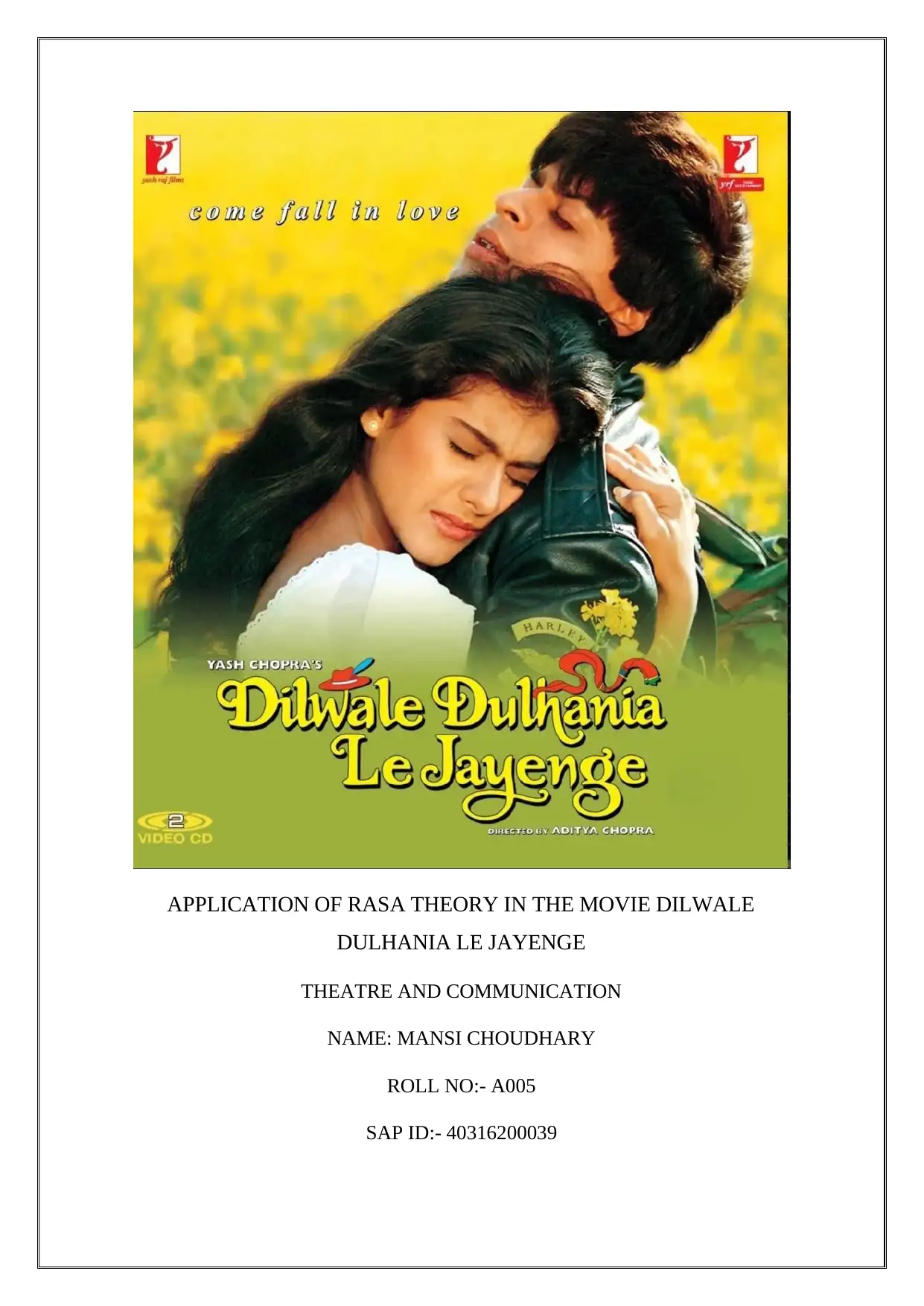
APPLICATION OF RASA THEORY IN THE MOVIE DILWALE
DULHANIA LE JAYENGE
THEATRE AND COMMUNICATION
NAME: MANSI CHOUDHARY
ROLL NO:- A005
SAP ID:- 40316200039
tabler-icon-diamond-filled.svg

Paraphrase This Document

Need a fresh take? Get an instant paraphrase of this document with our AI Paraphraser
Document Page
Dilwale Dulhania Le Jayenge also known as DDLJ, is an Indian Hindi-language musical
romance film written and directed by Aditya Chopra in his directorial debut and produced by
his father Yash Chopra. Released on 20 October 1995, the film stars Shah Rukh Khan and
Kajol. DDLJ broke all the box office records, as well as the record for the longest theatre run.
DDLJ is a phenomenal movie which abides by a simple storyline that follows Raj and Simran,
two young non-resident Indians, who fall in love during a vacation through Europe with their
friends. Raj tries to win over Simran's family so the couple can marry, but Simran's father has
long since promised her hand to his friend's son. Even though the storyline seems very simple,
it still has a dominant impact over the minds of the Indian folks even after 26 years of its
release. People appreciate the great star cast and the catchy dialogues of the script but beyond
the performance and dialogues, it is the extraordinary blend of the various rasas of the Natya
Shastra that drives the characters, dialogues and the complete flow of the script.
The rasa is a word derived from the word ‘rasa’ meaning sap or juice, or flavour. Bharata states
that Natya (or performance) is the imitation of life, wherein the various human emotions have
to be dramatically emphasized in such a way that the spectator is able to flavour the portrayed
pleasure and pain. There are nine kinds of rasa basically known as Navrasa are as follows:
1. Shringara (meaning “romance” or “passion”)
2. Hasya (meaning “comedy” or “laughter”)
3. Karuna (meaning “sorrow”)
4. Raudra (meaning “fury”)
5. Veera (meaning “heroism”)
6. Bhayanaka (meaning “horror”)
7. Bibhatsa (meaning “disgust”)
8. Adbutha (meaning “amazement”)
9. Shanta (meaning “peace” or “tranquillity”)
Let us now talk about how these rasas are used in the movie Dilwale Dulhania Le Jayenge.
DDLJ unlocks with a scene set in London. Everything is grey: the buildings, the sky, and the
roads. And in this, we see a man in subdued Indian clothing, but a deep red coat, feeding
pigeons from a pouch in his hands. A voiceover plays in a sombre tone. And as the voiceover
continues, the tempo changes, and the audience is transported to Baldev’s memories of vibrant
Punjab, where the fields are yellow, and the people are colourfully clad. As the scene ends, the
viewers and Baldev return to England, where he has done feeding the pigeons for the day. The
Document Page
tone of the start and end of the scene is melancholic which clearly portrays karuna rasa. The
rasa is also portrayed when Kajol (Simran) is shown in the train when she is coming to India
to marry his father friend’s son.
Baldev wears a deep red/maroon coat which is perhaps an indication of Baldev Singh’s
character, for this is a man prone to rage. But as he is transported to Punjab, he has a small
smile on his face, an expression of wonder, and of joy, here comes the adbhuta rasa. The yellow
fields and the song and dance in Punjab, indicates to the audience that this is a place of his
dreams, where he wants to be and isn’t able to be. And at the end of the scene, he walks away,
with the pigeons dispersing behind him, flying into the grey sky. Nostalgia, sadness, and
memories, these are all tinged with the happiness of Baldev’s yellow dreams.
The theory of Rasa clearly states that the visual sight, including colour, gesture, dance, and
song all contribute to creating the intended Rasa within the spectators. The visual aspects of
DDLJ clearly supersede the spoken effects. When speaking of DDLJ, viewers most often
mention the yellow fields in Punjab, and it is obvious that this is an iconic message, reinforced
by several scenes in the film, as well as the film’s poster. Clearly, the yellow fields evoke an
emotional response within the viewers, enough that every viewer who have ever spoken to
about the film mentions them in their descriptions of the film. In the Natyashastra, the colour
yellow is associated with the Adbhuta Rasa which is connected with the emotional state of
amazement and wonder. In DDLJ’s iconic reunion scene, Simran is in a dream state, when she
runs outside into the fields and comes upon Raj in a yellow mustard field. The yellow mustard
fields are a repeated visual image in the film, with Baldev seeing them in his memories, from
the train as he arrives with his family from the UK, in Simran and Raj’s reunion scene, and in
subsequent scenes between Raj and Baldev feeding the pigeons, indicating that they are motifs.
Yellow is also the colour of the outfit in the scene where Simran walks away from Raj toward
the train. Raj says to himself, “Raj, if this girl loves you, she will turn around.” As he mouths
to himself, “turn,” The audience sees Simran walking away in a pale-yellow haze. When she
turns, around, the audience is amazed. Also, at the end when Simran finally goes with raj in
the train, the colour of her dress is yellow. Overall, the colour yellow is ubiquitous in DDLJ.
The song “Tujhe dekha tho yhe jana sanam” is an apt example of the Shringara rasa. The
formation of Rasa comprises the use of gestures and the body. The use of the eyes is connected
closely to the Sringara Rasa. There are numerous scenes in the film where Raj and Simran’s
eyes are seen to do the conversation. However, the most eminent among these would be the
Document Page
scene where Simran wakes up wearing Raj’s shirt and is afraid she has slept with him. Raj
teases her at first, but as she becomes agitated, tells her the truth. And as he realizes her
agitation, he looks into her eyes, and tells her the truth, calming her down, and assuring her of
his honesty. The scene is rife with emotion. In addition to his gaze, and his gesture, Raj declares
that he is a “Hindustani,” and that he knows what an Indian woman’s virtue means to her. The
audience is impressed. It is one of the very first times in the film where Raj’s character evokes
the Veera Rasa, that of heroism. The veera rasa was also portrayed in a scene when Raj says to
Simran’s mother “I don’t want to steal Simran, I want to earn her, I will take her with me only
when her father will give her hands in my hand”.
Raudra rasa is conveyed in a scene where Simran’s father hear the conversation going on
between her mother and her. Her father is very angry after listening that her daughter is fallen
in love with some guy. His eyes convey his anger in the last scene where he gets to know about
Raj’s truth.
There are many scenes which convey joy and laughter which means hasya rasa. The character
of Raj himself is shown as a naughty, fun loving character in the first part of the movie who
can never get serious in his life. The things he does like playing a prank of flower with Simran
or taking the bottles of beer from the store or saying to his friend all the best during the
graduation ceremony all conveys Hasya rasa.
Thus, Rasa is produced in the audience in many ways by this film, where the audience cries
with Raj and Simran, but recognizes Baldev’s dharmic attitude. The effective use of colour,
gesture, and music is a great example of the different Bhavas that have led to Rasa.
chevron_up_icon
1 out of 4
circle_padding
hide_on_mobile
zoom_out_icon
[object Object]