Discussion on De-globalization's Impact on International Business

Verified

Added on  2022/09/12

|3
|982
|15
Discussion Board Post
AI Summary
This discussion post analyzes the article by Witt (2019) on de-globalization, focusing on its potential impact on international business. The student highlights the article's discussion of economic blocs and political engagements leading to de-globalization, and the implications for multinational enterprises (MNEs). The post explores the potential disruption to supply chains, organizational structures, and the overall global economic climate. The student agrees with the article's predictions and emphasizes the importance of considering the infrastructure capabilities of countries and the impact on MNEs' investments. The post also mentions the relevance of the IBS theoretical framework and the potential shift in the role of MNEs. The student would ask the author about the consequences of de-globalization on social and cultural factors and references relevant literature. The student concludes that de-globalization could lead to economic crashes and emphasizes the importance of further discussions on the topic.
Document Page
Internationalization and Strategic Alliances 241
Resource: Witt, M.A. 2019, "De-globalization: Theories, predictions, and opportunities for
international business research", Journal of International Business Studies.
The most interesting thing that I learnt from this article was de-globalization. I had not come across
material that discussed the futuristic perception of experts on the chances of de-globalization in the
future. The article sheds light on this subject with the use of theories and other relevant materials
that predict economic blocs between countries that is expected to lead to de-globalization from the
political and economic perspective both. It further discusses the overall impact of this aspect on the
organizations that function internationally and have branch offices in different parts of the globe.
I completely agree that the emergence of de-centralization would lead a severe impact on the
supply chains, economies and the overall organizational structures that are currently emergent in
the world. When an organization expands its shores to another country, the new branch reflects the
organizational culture and structure of the parent company. In this way globalization has an impact
on the world in general. With de-globalization, a complete change in the trends and the world as we
see it, might change drastically. I also agree that political engagements between countries tend to
have a strong impact on the economic climate as well. Looking closely at the world economics now,
de-globalization certainly seems the next step in the world economic climate in the days to come.
However, how soon that might be cannot be predicted but its overall impact on multinational
companies might be very severe and would lead to disruptions of large scale.
The article has helped me get a closer understanding about the infrastructure capabilities of
countries and their development over time to comfort the growing needs of multinational companies.
The economies of several countries have worked rigorously towards infrastructural development to
comfort the call of globalization. However, with de-globalization the large investments made in the
economic and buildings of certain countries might come to a halt. I have also learnt about the fact
that de-globalization will have an impact on organizational structures and political standing of
governments which clearly relates to the IBS Theoretical Framework.
The issue of de-globalization is directly related to the MNEs. If countries start to pull back on their
globalization initiatives, it will have a direct impact on the companies that have invested largely in
growing their branches in other nations. It is perceived that the role of multinational companies will
completely change and this will lead to the fall of such organizations. The author directly states that
multinational organizations will have little choice but to bring back their operations in other nations
since the supply chain will also be taking a hit. Apart from this, the world economy might see little
liberalism in allowing foreign countries to invest in their economy which would lead to the closure of
many multinational companies. The political conditions and the regulations of a country are some of
the primary factors that are taken into account when a company decides to expand its functions to
tabler-icon-diamond-filled.svg

Paraphrase This Document

Need a fresh take? Get an instant paraphrase of this document with our AI Paraphraser
Document Page
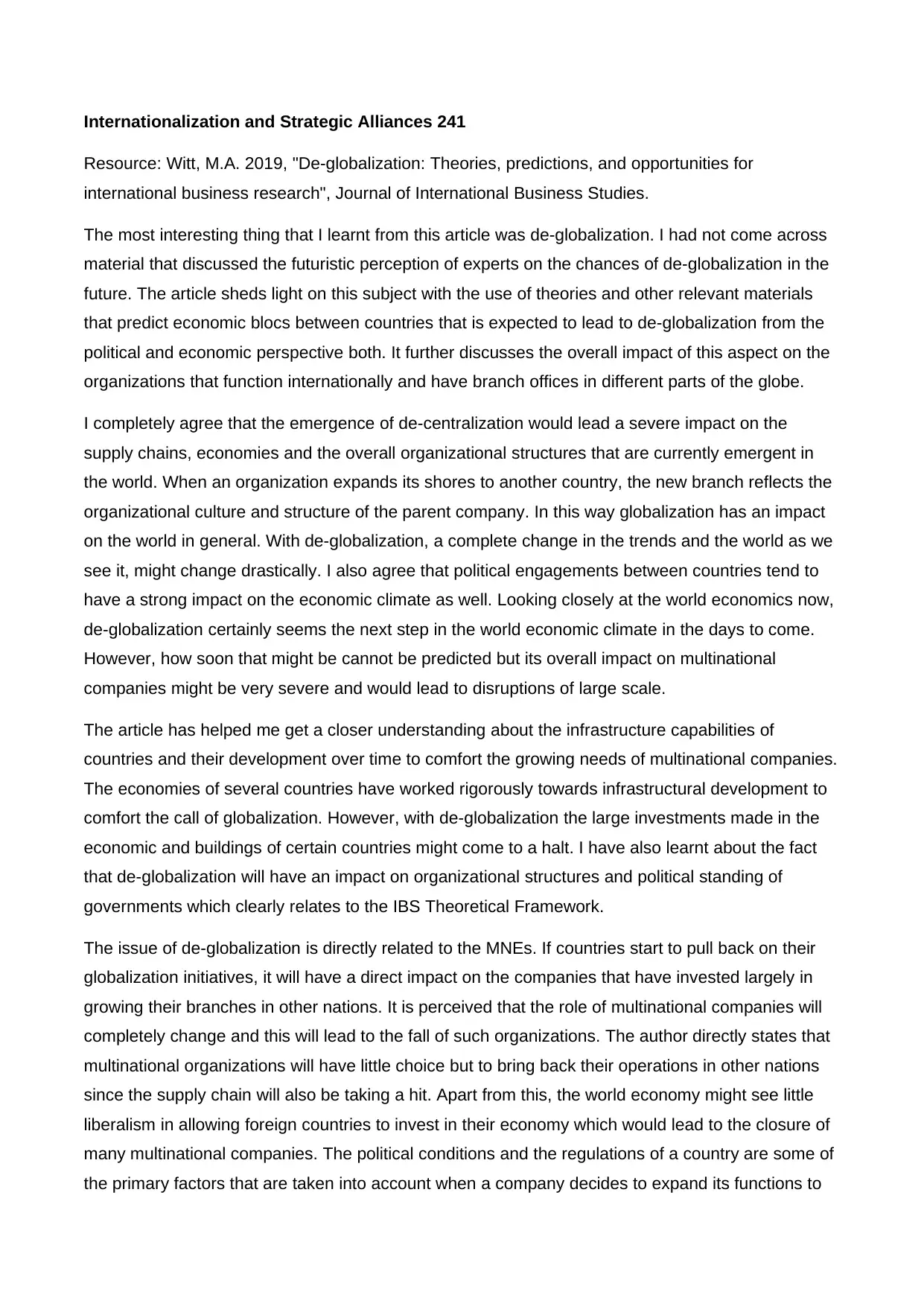
another nation. If this change, then multinational companies would have no reason but to pull their
investment. This in turn would not only cause MNEs to take a strong hit on their income but might
also lead to a crisis in the world economy. Globalization is the primary way by which companies
grow today. De-globalization would cause a huge problem. So, the impact on MNE’s would
definitely be high and in fact the name of MNEs could be completely eliminated from the books as
there would no such things after that.
If the author were present, the primary question that I would ask would be to know about the
consequences of the de-globalization consequences that the author has mentioned. I understand
that there is already been a specification of that but I would want a further discussion on the impact
of de-globalization on the social and cultural factors. The author has laid focus mainly on the
economic and political factors and their role in the de-globalization in the future but there is also a
possibility that social and cultural factors can cause such things. The role of society is very
important to be considered to achieve more information on de-globalization. Overall, economies can
crash due to the de-globalization and I am certain that this must be discussed even further.
Document Page
References
Aggarwal, A. (2017). Impact of Internationalization on Firm Performance: A Literature Review. IOSR
Journal of Business and Management, vol 1.
Capik, P. and Brockerhoff, A. (2017). The Role of Strategic Partnerships in the Internationalization
of Small Born Global Firms. Entrepreneurial Business and Economics Review, vol 5, no. 3.
Figueiredo, S. F. (2012). Strategic Alliances in the Internationalization of SMEs: A Qualitative Study.
Semantic Scholar.
Kumlungsua, N. (2008). SME’s Internationalization Process via Strategic Alliances: A Case Study of
Anoto Group AB. Halmstad University.
Moreno-Menendez, A. M. and Casillas, J. C. (2014). Open Innovation and Internationalization
Behavior: The Case of Spanish Firms. Open Innovation through Strategic Alliances, pp 85-106.
Veilleux, S. and Haskell, N. (2012). Going Global: How Smaller Enterprises Benefit from Strategic
Alliances. Journal of Business Strategy, vol 33, no. 5, pp. 22-31.
chevron_up_icon
1 out of 3
circle_padding
hide_on_mobile
zoom_out_icon
[object Object]