Case Study: Death Certificates - Analyzing Etiology & Prognosis
VerifiedAdded on 2023/06/11
|88
|22319
|236
Case Study
AI Summary
This assignment presents a case study involving the analysis of several death certificates, focusing on identifying the etiology, symptoms, diagnosis, treatment, and prognosis of the diseases leading to death. The analysis covers cases of Hypertensive Heart Disease, End-Stage COPD, Extreme Pulmonary Fibrosis, and Cor Pulmonale due to sarcoidosis. Each case includes a detailed examination of the underlying causes, characteristic symptoms, diagnostic methods employed, treatment approaches, and the expected prognosis. Resources and references are provided for each case to support the analysis. This document is available on Desklib, a platform offering study tools and resources for students.

Student Name
Student ID#
Course Name, Number, Section, Year, Semester
Death Certificate Assignment
Due Date
1
Student ID#
Course Name, Number, Section, Year, Semester
Death Certificate Assignment
Due Date
1

Paraphrase This Document
Need a fresh take? Get an instant paraphrase of this document with our AI Paraphraser
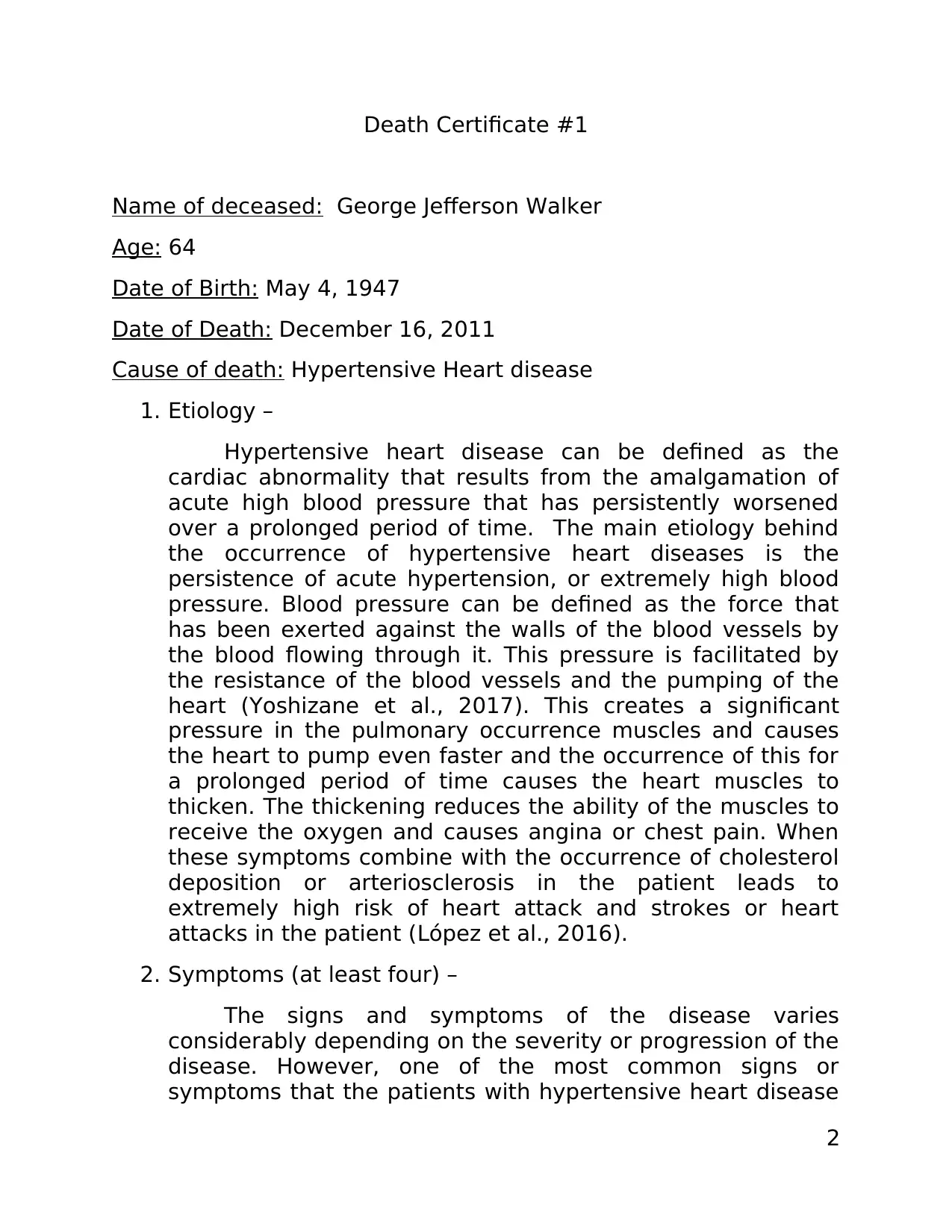
Death Certificate #1
Name of deceased: George Jefferson Walker
Age: 64
Date of Birth: May 4, 1947
Date of Death: December 16, 2011
Cause of death: Hypertensive Heart disease
1. Etiology –
Hypertensive heart disease can be defined as the
cardiac abnormality that results from the amalgamation of
acute high blood pressure that has persistently worsened
over a prolonged period of time. The main etiology behind
the occurrence of hypertensive heart diseases is the
persistence of acute hypertension, or extremely high blood
pressure. Blood pressure can be defined as the force that
has been exerted against the walls of the blood vessels by
the blood flowing through it. This pressure is facilitated by
the resistance of the blood vessels and the pumping of the
heart (Yoshizane et al., 2017). This creates a significant
pressure in the pulmonary occurrence muscles and causes
the heart to pump even faster and the occurrence of this for
a prolonged period of time causes the heart muscles to
thicken. The thickening reduces the ability of the muscles to
receive the oxygen and causes angina or chest pain. When
these symptoms combine with the occurrence of cholesterol
deposition or arteriosclerosis in the patient leads to
extremely high risk of heart attack and strokes or heart
attacks in the patient (López et al., 2016).
2. Symptoms (at least four) –
The signs and symptoms of the disease varies
considerably depending on the severity or progression of the
disease. However, one of the most common signs or
symptoms that the patients with hypertensive heart disease
2
Name of deceased: George Jefferson Walker
Age: 64
Date of Birth: May 4, 1947
Date of Death: December 16, 2011
Cause of death: Hypertensive Heart disease
1. Etiology –
Hypertensive heart disease can be defined as the
cardiac abnormality that results from the amalgamation of
acute high blood pressure that has persistently worsened
over a prolonged period of time. The main etiology behind
the occurrence of hypertensive heart diseases is the
persistence of acute hypertension, or extremely high blood
pressure. Blood pressure can be defined as the force that
has been exerted against the walls of the blood vessels by
the blood flowing through it. This pressure is facilitated by
the resistance of the blood vessels and the pumping of the
heart (Yoshizane et al., 2017). This creates a significant
pressure in the pulmonary occurrence muscles and causes
the heart to pump even faster and the occurrence of this for
a prolonged period of time causes the heart muscles to
thicken. The thickening reduces the ability of the muscles to
receive the oxygen and causes angina or chest pain. When
these symptoms combine with the occurrence of cholesterol
deposition or arteriosclerosis in the patient leads to
extremely high risk of heart attack and strokes or heart
attacks in the patient (López et al., 2016).
2. Symptoms (at least four) –
The signs and symptoms of the disease varies
considerably depending on the severity or progression of the
disease. However, one of the most common signs or
symptoms that the patients with hypertensive heart disease
2
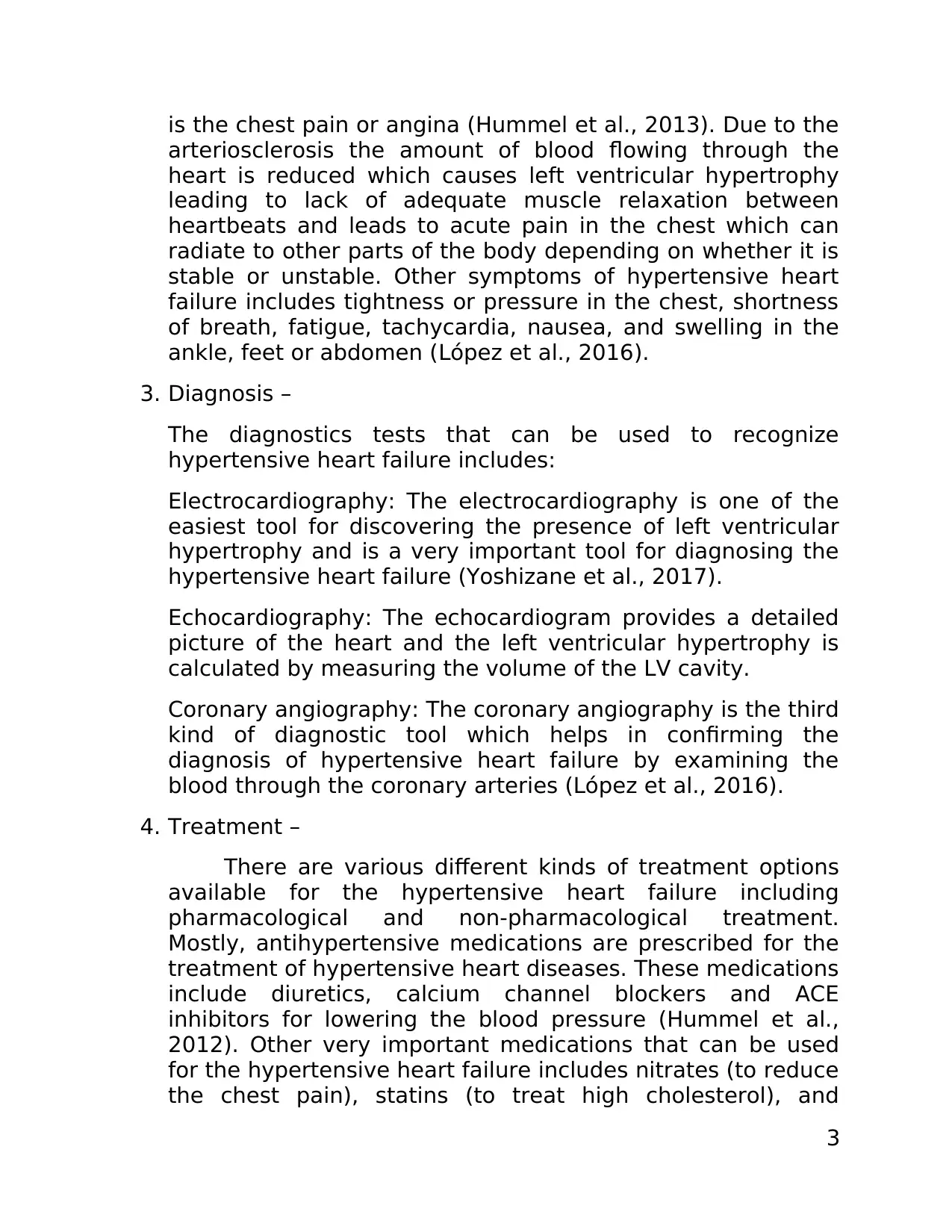
is the chest pain or angina (Hummel et al., 2013). Due to the
arteriosclerosis the amount of blood flowing through the
heart is reduced which causes left ventricular hypertrophy
leading to lack of adequate muscle relaxation between
heartbeats and leads to acute pain in the chest which can
radiate to other parts of the body depending on whether it is
stable or unstable. Other symptoms of hypertensive heart
failure includes tightness or pressure in the chest, shortness
of breath, fatigue, tachycardia, nausea, and swelling in the
ankle, feet or abdomen (López et al., 2016).
3. Diagnosis –
The diagnostics tests that can be used to recognize
hypertensive heart failure includes:
Electrocardiography: The electrocardiography is one of the
easiest tool for discovering the presence of left ventricular
hypertrophy and is a very important tool for diagnosing the
hypertensive heart failure (Yoshizane et al., 2017).
Echocardiography: The echocardiogram provides a detailed
picture of the heart and the left ventricular hypertrophy is
calculated by measuring the volume of the LV cavity.
Coronary angiography: The coronary angiography is the third
kind of diagnostic tool which helps in confirming the
diagnosis of hypertensive heart failure by examining the
blood through the coronary arteries (López et al., 2016).
4. Treatment –
There are various different kinds of treatment options
available for the hypertensive heart failure including
pharmacological and non-pharmacological treatment.
Mostly, antihypertensive medications are prescribed for the
treatment of hypertensive heart diseases. These medications
include diuretics, calcium channel blockers and ACE
inhibitors for lowering the blood pressure (Hummel et al.,
2012). Other very important medications that can be used
for the hypertensive heart failure includes nitrates (to reduce
the chest pain), statins (to treat high cholesterol), and
3
arteriosclerosis the amount of blood flowing through the
heart is reduced which causes left ventricular hypertrophy
leading to lack of adequate muscle relaxation between
heartbeats and leads to acute pain in the chest which can
radiate to other parts of the body depending on whether it is
stable or unstable. Other symptoms of hypertensive heart
failure includes tightness or pressure in the chest, shortness
of breath, fatigue, tachycardia, nausea, and swelling in the
ankle, feet or abdomen (López et al., 2016).
3. Diagnosis –
The diagnostics tests that can be used to recognize
hypertensive heart failure includes:
Electrocardiography: The electrocardiography is one of the
easiest tool for discovering the presence of left ventricular
hypertrophy and is a very important tool for diagnosing the
hypertensive heart failure (Yoshizane et al., 2017).
Echocardiography: The echocardiogram provides a detailed
picture of the heart and the left ventricular hypertrophy is
calculated by measuring the volume of the LV cavity.
Coronary angiography: The coronary angiography is the third
kind of diagnostic tool which helps in confirming the
diagnosis of hypertensive heart failure by examining the
blood through the coronary arteries (López et al., 2016).
4. Treatment –
There are various different kinds of treatment options
available for the hypertensive heart failure including
pharmacological and non-pharmacological treatment.
Mostly, antihypertensive medications are prescribed for the
treatment of hypertensive heart diseases. These medications
include diuretics, calcium channel blockers and ACE
inhibitors for lowering the blood pressure (Hummel et al.,
2012). Other very important medications that can be used
for the hypertensive heart failure includes nitrates (to reduce
the chest pain), statins (to treat high cholesterol), and
3
⊘ This is a preview!⊘
Do you want full access?
Subscribe today to unlock all pages.

Trusted by 1+ million students worldwide
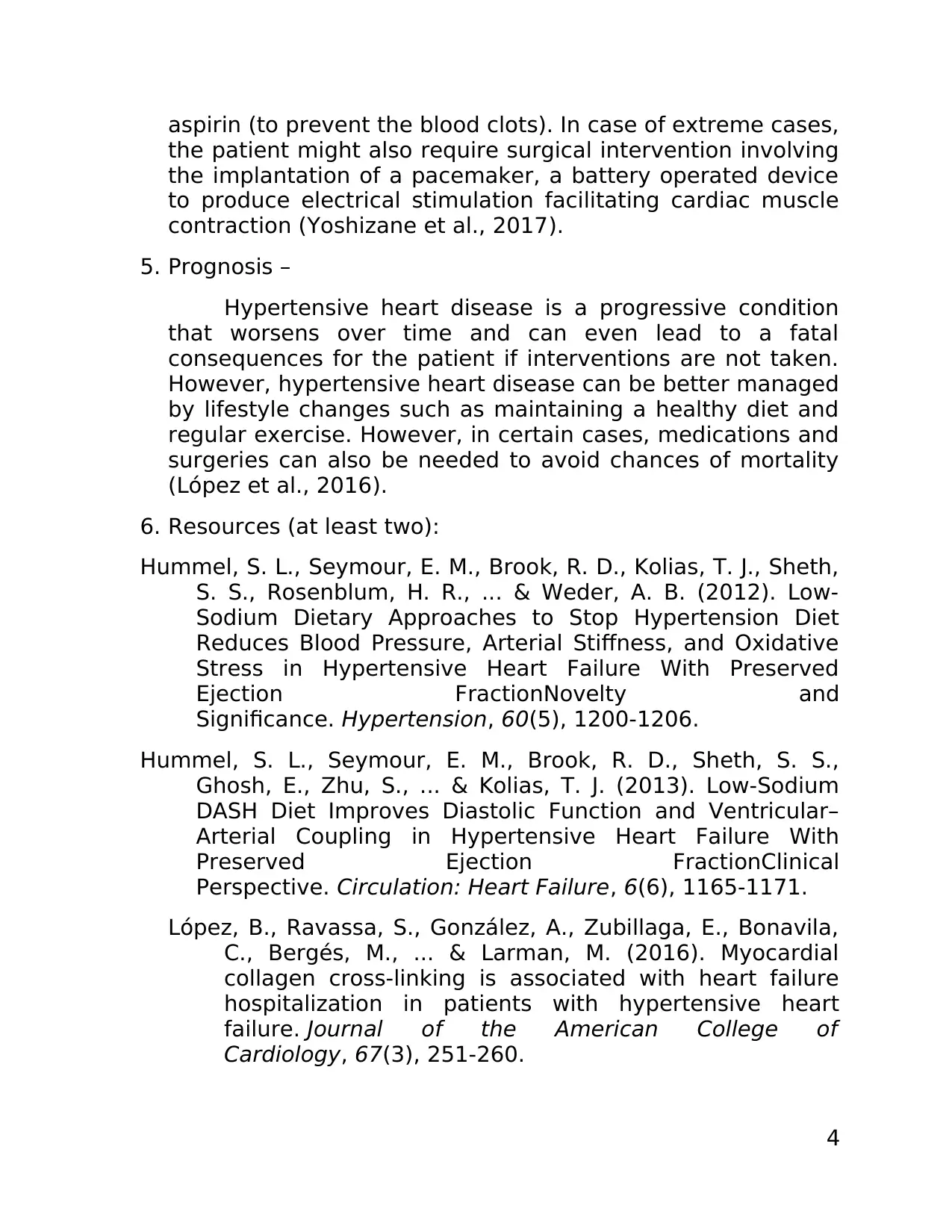
aspirin (to prevent the blood clots). In case of extreme cases,
the patient might also require surgical intervention involving
the implantation of a pacemaker, a battery operated device
to produce electrical stimulation facilitating cardiac muscle
contraction (Yoshizane et al., 2017).
5. Prognosis –
Hypertensive heart disease is a progressive condition
that worsens over time and can even lead to a fatal
consequences for the patient if interventions are not taken.
However, hypertensive heart disease can be better managed
by lifestyle changes such as maintaining a healthy diet and
regular exercise. However, in certain cases, medications and
surgeries can also be needed to avoid chances of mortality
(López et al., 2016).
6. Resources (at least two):
Hummel, S. L., Seymour, E. M., Brook, R. D., Kolias, T. J., Sheth,
S. S., Rosenblum, H. R., ... & Weder, A. B. (2012). Low-
Sodium Dietary Approaches to Stop Hypertension Diet
Reduces Blood Pressure, Arterial Stiffness, and Oxidative
Stress in Hypertensive Heart Failure With Preserved
Ejection FractionNovelty and
Significance. Hypertension, 60(5), 1200-1206.
Hummel, S. L., Seymour, E. M., Brook, R. D., Sheth, S. S.,
Ghosh, E., Zhu, S., ... & Kolias, T. J. (2013). Low-Sodium
DASH Diet Improves Diastolic Function and Ventricular–
Arterial Coupling in Hypertensive Heart Failure With
Preserved Ejection FractionClinical
Perspective. Circulation: Heart Failure, 6(6), 1165-1171.
López, B., Ravassa, S., González, A., Zubillaga, E., Bonavila,
C., Bergés, M., ... & Larman, M. (2016). Myocardial
collagen cross-linking is associated with heart failure
hospitalization in patients with hypertensive heart
failure. Journal of the American College of
Cardiology, 67(3), 251-260.
4
the patient might also require surgical intervention involving
the implantation of a pacemaker, a battery operated device
to produce electrical stimulation facilitating cardiac muscle
contraction (Yoshizane et al., 2017).
5. Prognosis –
Hypertensive heart disease is a progressive condition
that worsens over time and can even lead to a fatal
consequences for the patient if interventions are not taken.
However, hypertensive heart disease can be better managed
by lifestyle changes such as maintaining a healthy diet and
regular exercise. However, in certain cases, medications and
surgeries can also be needed to avoid chances of mortality
(López et al., 2016).
6. Resources (at least two):
Hummel, S. L., Seymour, E. M., Brook, R. D., Kolias, T. J., Sheth,
S. S., Rosenblum, H. R., ... & Weder, A. B. (2012). Low-
Sodium Dietary Approaches to Stop Hypertension Diet
Reduces Blood Pressure, Arterial Stiffness, and Oxidative
Stress in Hypertensive Heart Failure With Preserved
Ejection FractionNovelty and
Significance. Hypertension, 60(5), 1200-1206.
Hummel, S. L., Seymour, E. M., Brook, R. D., Sheth, S. S.,
Ghosh, E., Zhu, S., ... & Kolias, T. J. (2013). Low-Sodium
DASH Diet Improves Diastolic Function and Ventricular–
Arterial Coupling in Hypertensive Heart Failure With
Preserved Ejection FractionClinical
Perspective. Circulation: Heart Failure, 6(6), 1165-1171.
López, B., Ravassa, S., González, A., Zubillaga, E., Bonavila,
C., Bergés, M., ... & Larman, M. (2016). Myocardial
collagen cross-linking is associated with heart failure
hospitalization in patients with hypertensive heart
failure. Journal of the American College of
Cardiology, 67(3), 251-260.
4
Paraphrase This Document
Need a fresh take? Get an instant paraphrase of this document with our AI Paraphraser

Yoshizane, T., Kawasaki, M., Tanaka, R., Horio, S., Ishiguro,
M., Minatoguchi, S., ... & Arai, M. (2017). P4369Left
ventricular layer strain and torsion in hypertensive
heart failure with preserved and reduced ejection
fraction: 3-dimensional speckle tracking
echocardiography studv. European Heart
Journal, 38(suppl_1).
5
M., Minatoguchi, S., ... & Arai, M. (2017). P4369Left
ventricular layer strain and torsion in hypertensive
heart failure with preserved and reduced ejection
fraction: 3-dimensional speckle tracking
echocardiography studv. European Heart
Journal, 38(suppl_1).
5
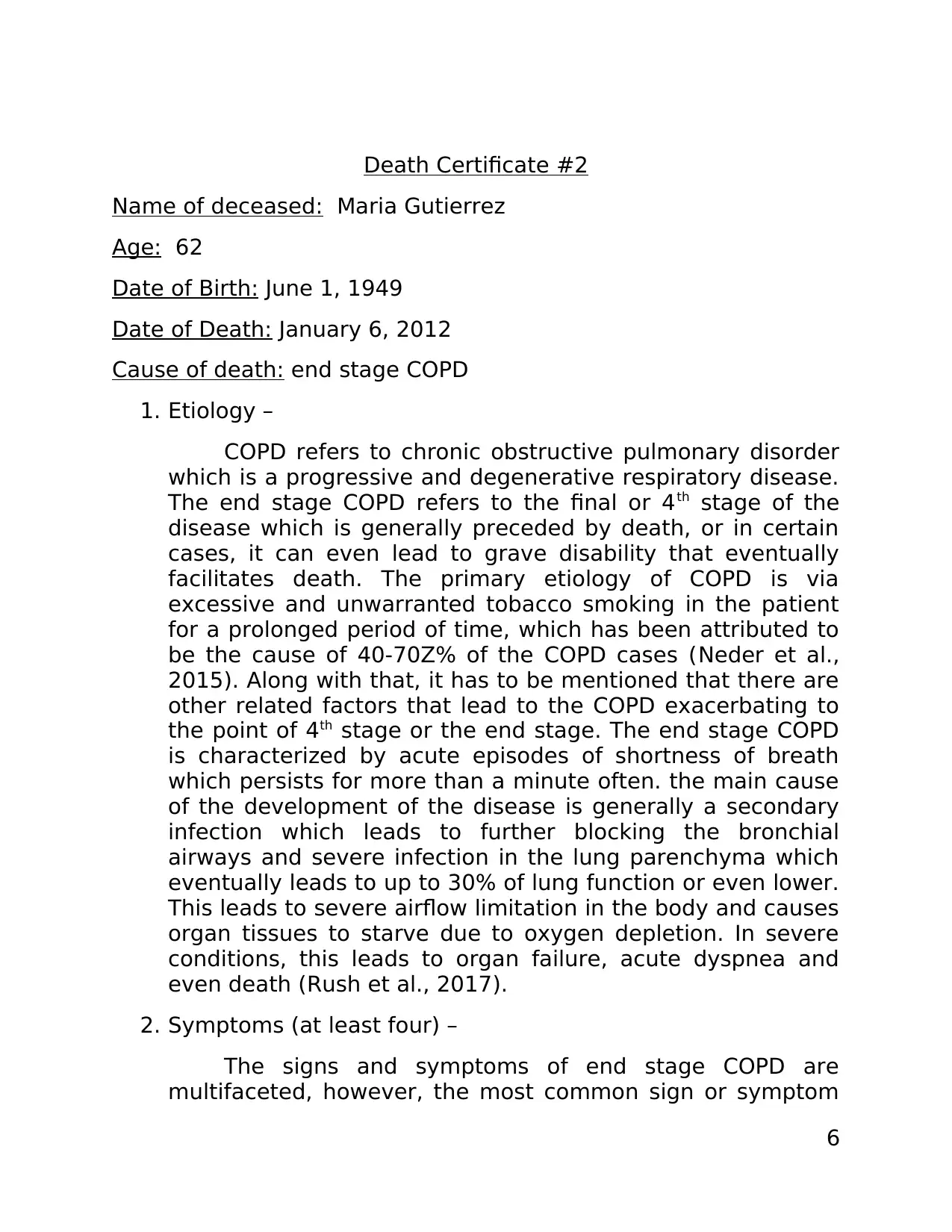
Death Certificate #2
Name of deceased: Maria Gutierrez
Age: 62
Date of Birth: June 1, 1949
Date of Death: January 6, 2012
Cause of death: end stage COPD
1. Etiology –
COPD refers to chronic obstructive pulmonary disorder
which is a progressive and degenerative respiratory disease.
The end stage COPD refers to the final or 4th stage of the
disease which is generally preceded by death, or in certain
cases, it can even lead to grave disability that eventually
facilitates death. The primary etiology of COPD is via
excessive and unwarranted tobacco smoking in the patient
for a prolonged period of time, which has been attributed to
be the cause of 40-70Z% of the COPD cases (Neder et al.,
2015). Along with that, it has to be mentioned that there are
other related factors that lead to the COPD exacerbating to
the point of 4th stage or the end stage. The end stage COPD
is characterized by acute episodes of shortness of breath
which persists for more than a minute often. the main cause
of the development of the disease is generally a secondary
infection which leads to further blocking the bronchial
airways and severe infection in the lung parenchyma which
eventually leads to up to 30% of lung function or even lower.
This leads to severe airflow limitation in the body and causes
organ tissues to starve due to oxygen depletion. In severe
conditions, this leads to organ failure, acute dyspnea and
even death (Rush et al., 2017).
2. Symptoms (at least four) –
The signs and symptoms of end stage COPD are
multifaceted, however, the most common sign or symptom
6
Name of deceased: Maria Gutierrez
Age: 62
Date of Birth: June 1, 1949
Date of Death: January 6, 2012
Cause of death: end stage COPD
1. Etiology –
COPD refers to chronic obstructive pulmonary disorder
which is a progressive and degenerative respiratory disease.
The end stage COPD refers to the final or 4th stage of the
disease which is generally preceded by death, or in certain
cases, it can even lead to grave disability that eventually
facilitates death. The primary etiology of COPD is via
excessive and unwarranted tobacco smoking in the patient
for a prolonged period of time, which has been attributed to
be the cause of 40-70Z% of the COPD cases (Neder et al.,
2015). Along with that, it has to be mentioned that there are
other related factors that lead to the COPD exacerbating to
the point of 4th stage or the end stage. The end stage COPD
is characterized by acute episodes of shortness of breath
which persists for more than a minute often. the main cause
of the development of the disease is generally a secondary
infection which leads to further blocking the bronchial
airways and severe infection in the lung parenchyma which
eventually leads to up to 30% of lung function or even lower.
This leads to severe airflow limitation in the body and causes
organ tissues to starve due to oxygen depletion. In severe
conditions, this leads to organ failure, acute dyspnea and
even death (Rush et al., 2017).
2. Symptoms (at least four) –
The signs and symptoms of end stage COPD are
multifaceted, however, the most common sign or symptom
6
⊘ This is a preview!⊘
Do you want full access?
Subscribe today to unlock all pages.
Trusted by 1+ million students worldwide
of the end stage COPD is the severe shortness of breath or
dyspnea. It has to be mentioned in this context that at this
stage the regular COPD medications generally do not
function properly due to the excessive lung infection and the
respiratory failure. Hence, another very common sign or
symptom of the complication such as end stage COPD is
sever wheezing and other such breathing complications due
to the infection and sever bronchospasm. Another, very
common symptom of the end stage COPD is the accelerated
resting heart rate or tachycardia. Lastly, common
complication that can be considered as the symptom of the
severe end stage COPD is the right sided hearty failure
which generally contributes to the patient going through
acute end stage COPD (Ahmadi et al., 2016).
3. Diagnosis –
The diagnostic tools that can be utilized to diagnose the
end stage COPD includes the:
GOLD staging system: This particular diagnostic tool helps to
determine the stage of COPD that the patient is suffering
from by the help of forced expiratory volume test and
pulmonary function test. With the progressive severity stage
of the diseases, this test shows the level of airflow limitation
(Rush et al., 2017).
BODE index of COPD: This particular index helps in
determination of the end stage COPD with the help of Body
mass, Airflow obstruction, Dyspnea, and Exercise capability.
Combining all four elements of the index, the results helps in
the practitioner discovering the stage that the patient is in of
COPD and the severity of respiratory damage (Cohen, 2014).
Pulmonary function test: This diagnostic test combines two
different diagnostic assessments, spirometry and
plethysmography, both of which determine the amount of air
a patient is breathing in and out to measure the airflow
limitation and in turn discover the severity or stage of COPD
that the patient is in (Ahmadi et al., 2016).
7
dyspnea. It has to be mentioned in this context that at this
stage the regular COPD medications generally do not
function properly due to the excessive lung infection and the
respiratory failure. Hence, another very common sign or
symptom of the complication such as end stage COPD is
sever wheezing and other such breathing complications due
to the infection and sever bronchospasm. Another, very
common symptom of the end stage COPD is the accelerated
resting heart rate or tachycardia. Lastly, common
complication that can be considered as the symptom of the
severe end stage COPD is the right sided hearty failure
which generally contributes to the patient going through
acute end stage COPD (Ahmadi et al., 2016).
3. Diagnosis –
The diagnostic tools that can be utilized to diagnose the
end stage COPD includes the:
GOLD staging system: This particular diagnostic tool helps to
determine the stage of COPD that the patient is suffering
from by the help of forced expiratory volume test and
pulmonary function test. With the progressive severity stage
of the diseases, this test shows the level of airflow limitation
(Rush et al., 2017).
BODE index of COPD: This particular index helps in
determination of the end stage COPD with the help of Body
mass, Airflow obstruction, Dyspnea, and Exercise capability.
Combining all four elements of the index, the results helps in
the practitioner discovering the stage that the patient is in of
COPD and the severity of respiratory damage (Cohen, 2014).
Pulmonary function test: This diagnostic test combines two
different diagnostic assessments, spirometry and
plethysmography, both of which determine the amount of air
a patient is breathing in and out to measure the airflow
limitation and in turn discover the severity or stage of COPD
that the patient is in (Ahmadi et al., 2016).
7
Paraphrase This Document
Need a fresh take? Get an instant paraphrase of this document with our AI Paraphraser
4. Treatment –
The treatment for the end stage COPD includes:
Bronchodilators: administration of both short acting and long
acting bronchodilators help in minimizing the impact of the
bronchospasms and help relive the severity and duration of
the shortness of breath.
Glucocorticoids: In severe cases of end stage COPD where
the FEV1 of the patient is at less than even 50% of the
predicted figure, the COPD exacerbations are generally
frequent and persistent. In this case, inhaled glucocorticoids
are prescribed to ease the airway obstruction and facilitate
better airflow (Rush et al., 2017).
Supplemental oxygen: is generally used for end stage COPD
patients in order to reduce breathlessness and improves
activity tolerance for patients with acutely low blood oxygen
levels.
Non-invasive positive pressure ventilation: In patients with
grave end stage COPD preceding death, this therapeutic
intervention has been reported to reduce the levels of
carbon dioxide retention and in turn helps in reducing the
frequency and severity of shortness of breath to prolong
mortality (Neder et al., 2015).
5. Prognosis –
COPD is progressive disease and the severity of the
disease undoubtedly worsens over time. The patient
experiences deteriorating symptoms as the disease in
progressing in stages. In the last stage however, the
symptoms worsen to acute, persistent and frequent
dyspnea, excessive airway obstruction, secondary infections
in the lung parenchyma, generally pneumonia leading to
lung function loss up to 30% (Cohen, 2014). Although with
proper treatment measures and precautions taken, mortality
risk can be prolonged if not completely eradicated.
6. Resources (at least two):
8
The treatment for the end stage COPD includes:
Bronchodilators: administration of both short acting and long
acting bronchodilators help in minimizing the impact of the
bronchospasms and help relive the severity and duration of
the shortness of breath.
Glucocorticoids: In severe cases of end stage COPD where
the FEV1 of the patient is at less than even 50% of the
predicted figure, the COPD exacerbations are generally
frequent and persistent. In this case, inhaled glucocorticoids
are prescribed to ease the airway obstruction and facilitate
better airflow (Rush et al., 2017).
Supplemental oxygen: is generally used for end stage COPD
patients in order to reduce breathlessness and improves
activity tolerance for patients with acutely low blood oxygen
levels.
Non-invasive positive pressure ventilation: In patients with
grave end stage COPD preceding death, this therapeutic
intervention has been reported to reduce the levels of
carbon dioxide retention and in turn helps in reducing the
frequency and severity of shortness of breath to prolong
mortality (Neder et al., 2015).
5. Prognosis –
COPD is progressive disease and the severity of the
disease undoubtedly worsens over time. The patient
experiences deteriorating symptoms as the disease in
progressing in stages. In the last stage however, the
symptoms worsen to acute, persistent and frequent
dyspnea, excessive airway obstruction, secondary infections
in the lung parenchyma, generally pneumonia leading to
lung function loss up to 30% (Cohen, 2014). Although with
proper treatment measures and precautions taken, mortality
risk can be prolonged if not completely eradicated.
6. Resources (at least two):
8
Ahmadi, Z., Bernelid, E., Currow, D. C., & Ekström, M. (2016).
Prescription of opioids for breathlessness in end-stage
COPD: a national population-based study. International
journal of chronic obstructive pulmonary disease, 11,
2651.
Neder, J. A., Arbex, F. F., Alencar, M. C. N., O’Donnell, C. D.,
Cory, J., Webb, K. A., & O’Donnell, D. E. (2015). Exercise
ventilatory inefficiency in mild to end-stage
COPD. European Respiratory Journal, 45(2), 377-387.
Rush, B., Hertz, P., Bond, A., McDermid, R. C., & Celi, L. A.
(2017). Use of palliative care in patients with end-stage
COPD and receiving home oxygen: national trends and
barriers to care in the United States. Chest, 151(1), 41-
46.
Cohen, E. (2014). Bronchoscopic treatment of end-
stage chronic obstructive pulmonary disease. Current
Opinion in Anesthesiology, 27(1), 36-43.
9
Prescription of opioids for breathlessness in end-stage
COPD: a national population-based study. International
journal of chronic obstructive pulmonary disease, 11,
2651.
Neder, J. A., Arbex, F. F., Alencar, M. C. N., O’Donnell, C. D.,
Cory, J., Webb, K. A., & O’Donnell, D. E. (2015). Exercise
ventilatory inefficiency in mild to end-stage
COPD. European Respiratory Journal, 45(2), 377-387.
Rush, B., Hertz, P., Bond, A., McDermid, R. C., & Celi, L. A.
(2017). Use of palliative care in patients with end-stage
COPD and receiving home oxygen: national trends and
barriers to care in the United States. Chest, 151(1), 41-
46.
Cohen, E. (2014). Bronchoscopic treatment of end-
stage chronic obstructive pulmonary disease. Current
Opinion in Anesthesiology, 27(1), 36-43.
9
⊘ This is a preview!⊘
Do you want full access?
Subscribe today to unlock all pages.
Trusted by 1+ million students worldwide
Death Certificate #3
Name of deceased: Louvenia Alexander Forrester
Age: 30
Date of Birth: November 8, 1981
Date of Death: January 13, 2012
Cause of death: Extreme Pulmonary Fibrosis; Pulmonary
Hypertension
1. Etiology –
Pulmonary fibrosis can be defined as the lung disorder
that is facilitated by the intrinsic and extrinsic damages and
tissue scarring in the lung tissues. The thickening or scarring
reduces the flexibility of the lung tissue the functionality of
the lung tissues are worsened further and the patient
experiences a progressive worsening of the shortness of
breath (Kimura et al., 2013). The primary cause of the
disease is generally the long-term exposure to toxin and
pollutants of fundamentally occupational origin and in
certain cases are environmental as well. Another common
cause of the disease is the prolonged exposure to radiation
therapy for lung or breast cancer, the severity or progress of
the disease; in most cases, this condition is also associated
with pulmonary hypertension, which is enhanced blood
pressure within the pulmonary arteries. In this case,
pulmonary fibrosis is one of the most common causes of
pulmonary hypertension facilitated by the scarring produced
in the lung tissues due to the fibrosis which affects the lung
functionality of the lungs (Farkas et al., 2011). The scarred
tissue affects the pulmonary arteries by compressing the
vessels, this increases blood flow from the heart to the
lungs. As a result of this, this increases the blood pressure in
the pulmonary arteries and the right ventricle of the heart
leading to pulmonary hypertension
2. Symptoms (at least four) –
10
Name of deceased: Louvenia Alexander Forrester
Age: 30
Date of Birth: November 8, 1981
Date of Death: January 13, 2012
Cause of death: Extreme Pulmonary Fibrosis; Pulmonary
Hypertension
1. Etiology –
Pulmonary fibrosis can be defined as the lung disorder
that is facilitated by the intrinsic and extrinsic damages and
tissue scarring in the lung tissues. The thickening or scarring
reduces the flexibility of the lung tissue the functionality of
the lung tissues are worsened further and the patient
experiences a progressive worsening of the shortness of
breath (Kimura et al., 2013). The primary cause of the
disease is generally the long-term exposure to toxin and
pollutants of fundamentally occupational origin and in
certain cases are environmental as well. Another common
cause of the disease is the prolonged exposure to radiation
therapy for lung or breast cancer, the severity or progress of
the disease; in most cases, this condition is also associated
with pulmonary hypertension, which is enhanced blood
pressure within the pulmonary arteries. In this case,
pulmonary fibrosis is one of the most common causes of
pulmonary hypertension facilitated by the scarring produced
in the lung tissues due to the fibrosis which affects the lung
functionality of the lungs (Farkas et al., 2011). The scarred
tissue affects the pulmonary arteries by compressing the
vessels, this increases blood flow from the heart to the
lungs. As a result of this, this increases the blood pressure in
the pulmonary arteries and the right ventricle of the heart
leading to pulmonary hypertension
2. Symptoms (at least four) –
10
Paraphrase This Document
Need a fresh take? Get an instant paraphrase of this document with our AI Paraphraser
The common signs and symptoms of pulmonary fibrosis
include:
Shortness of breath or dyspnea, dry cough, fatigue,
unexplained weight loss, aching muscles, and joints,
Widening and rounding of the tips of the fingers or toes
(Kimura et al., 2013).
The common signs and symptoms of pulmonary
hypertension include:
Shortness of breath, fatigue, chest pain, palpitations, and
pain in the right side of the abdomen (Farkas et al., 2011).
3. Diagnosis –
The diagnostic tests that can be carried out for
pulmonary fibrosis include:
Pulmonary function test: the pulmonary function test that is
going to be performed for this patient is the spirometry test.
This diagnostic method recognizes the presence of air-
holding capacity of the lungs and how quickly is the airflow
in and out of the lungs (King Jr et al., 2014).
Pulse oximetry: This is a simple test utilizing a simple device
placed on one of the fingers of the patient and it measures
the level of oxygen saturation in the blood that is a very
important step to monitor the spread of the disease.
Bronchoscopy: The bronchoscopy provides a more accurate
diagnosis for pulmonary fibrosis and it is generally used for
ruling out other possible options of a differential diagnosis.
The only viable diagnostic method or tool for pulmonary
hypertension in the patients with pulmonary fibrosis is right
heart catheterization. This procedure takes approximately an
hour and provides a definitive diagnosis of pulmonary
hypertension as the catheter is equipped to measure
pressure in the chambers of the right heart and pulmonary
along with oxygen concentration of the blood and cardiac
output levels of the patient (Rosenkranz & Preston, 2015)
11
include:
Shortness of breath or dyspnea, dry cough, fatigue,
unexplained weight loss, aching muscles, and joints,
Widening and rounding of the tips of the fingers or toes
(Kimura et al., 2013).
The common signs and symptoms of pulmonary
hypertension include:
Shortness of breath, fatigue, chest pain, palpitations, and
pain in the right side of the abdomen (Farkas et al., 2011).
3. Diagnosis –
The diagnostic tests that can be carried out for
pulmonary fibrosis include:
Pulmonary function test: the pulmonary function test that is
going to be performed for this patient is the spirometry test.
This diagnostic method recognizes the presence of air-
holding capacity of the lungs and how quickly is the airflow
in and out of the lungs (King Jr et al., 2014).
Pulse oximetry: This is a simple test utilizing a simple device
placed on one of the fingers of the patient and it measures
the level of oxygen saturation in the blood that is a very
important step to monitor the spread of the disease.
Bronchoscopy: The bronchoscopy provides a more accurate
diagnosis for pulmonary fibrosis and it is generally used for
ruling out other possible options of a differential diagnosis.
The only viable diagnostic method or tool for pulmonary
hypertension in the patients with pulmonary fibrosis is right
heart catheterization. This procedure takes approximately an
hour and provides a definitive diagnosis of pulmonary
hypertension as the catheter is equipped to measure
pressure in the chambers of the right heart and pulmonary
along with oxygen concentration of the blood and cardiac
output levels of the patient (Rosenkranz & Preston, 2015)
11
4. Treatment –
The most common treatments that can be utilized for
the co-occurring disorder for both pulmonary hypertension
and pulmonary fibrosis include medications such as
phosphodiesterase-5 inhibitors, nonselective endothelin
receptor antagonists, and prostacyclin analogs. Pirfenidone
is a newly developed drug that has been reported to be very
effective against pulmonary fibrosis due to its combined
antifibrotic anti-inflammatory, antioxidant, and anti-
inflammatory properties (King Jr et al., 2014). Selective
pulmonary artery vasodilator therapy is another multifaceted
therapeutic intervention that has been reported to be very
useful against this disorder
5. Prognosis –
Pulmonary hypertension is progressive disorder and it is
facilitated and worsened by the occurrence of pulmonary
fibrosis. This complex disorder deteriorates with time and
there is no definitive cure for both of the disorders, although
there are a few combinations of therapeutic management
options available (Farkas et al., 2011). However, without
adequate measures taken for management of this disorder
can become life-threatening within 1-2 years of time.
6. Resources (at least two):
Farkas, L., Gauldie, J., Voelkel, N. F., & Kolb, M. (2011).
Pulmonary hypertension and idiopathic pulmonary
fibrosis: a tale of angiogenesis, apoptosis, and growth
factors. American journal of respiratory cell and
molecular biology, 45(1), 1-15.
Kimura, M., Taniguchi, H., Kondoh, Y., Kimura, T., Kataoka,
K., Nishiyama, O., ... & Hasegawa, Y. (2013). Pulmonary
hypertension as a prognostic indicator at the initial
evaluation in idiopathic pulmonary
fibrosis. Respiration, 85(6), 456-463.
King Jr, T. E., Bradford, W. Z., Castro-Bernardini, S., Fagan, E.
A., Glaspole, I., Glassberg, M. K., ... & Lederer, D. J.
12
The most common treatments that can be utilized for
the co-occurring disorder for both pulmonary hypertension
and pulmonary fibrosis include medications such as
phosphodiesterase-5 inhibitors, nonselective endothelin
receptor antagonists, and prostacyclin analogs. Pirfenidone
is a newly developed drug that has been reported to be very
effective against pulmonary fibrosis due to its combined
antifibrotic anti-inflammatory, antioxidant, and anti-
inflammatory properties (King Jr et al., 2014). Selective
pulmonary artery vasodilator therapy is another multifaceted
therapeutic intervention that has been reported to be very
useful against this disorder
5. Prognosis –
Pulmonary hypertension is progressive disorder and it is
facilitated and worsened by the occurrence of pulmonary
fibrosis. This complex disorder deteriorates with time and
there is no definitive cure for both of the disorders, although
there are a few combinations of therapeutic management
options available (Farkas et al., 2011). However, without
adequate measures taken for management of this disorder
can become life-threatening within 1-2 years of time.
6. Resources (at least two):
Farkas, L., Gauldie, J., Voelkel, N. F., & Kolb, M. (2011).
Pulmonary hypertension and idiopathic pulmonary
fibrosis: a tale of angiogenesis, apoptosis, and growth
factors. American journal of respiratory cell and
molecular biology, 45(1), 1-15.
Kimura, M., Taniguchi, H., Kondoh, Y., Kimura, T., Kataoka,
K., Nishiyama, O., ... & Hasegawa, Y. (2013). Pulmonary
hypertension as a prognostic indicator at the initial
evaluation in idiopathic pulmonary
fibrosis. Respiration, 85(6), 456-463.
King Jr, T. E., Bradford, W. Z., Castro-Bernardini, S., Fagan, E.
A., Glaspole, I., Glassberg, M. K., ... & Lederer, D. J.
12
⊘ This is a preview!⊘
Do you want full access?
Subscribe today to unlock all pages.
Trusted by 1+ million students worldwide

1 out of 88


Related Documents


Your All-in-One AI-Powered Toolkit for Academic Success.
+13062052269
info@desklib.com
Available 24*7 on WhatsApp / Email
![[object Object]](/_next/static/media/star-bottom.7253800d.svg)
Unlock your academic potential
Copyright © 2020–2026 A2Z Services. All Rights Reserved. Developed and managed by ZUCOL.