Research: Decision-Making Under Pressure in Automobile Industry
VerifiedAdded on 2020/03/16
|17
|3776
|269
Project
AI Summary
This research project investigates decision-making processes within the automobile industry, particularly focusing on the impact of pressure. It aims to identify the reasons behind pressure, its positive and negative consequences, and strategies for mitigation. The study employs a mixed-methods approach, incorporating both interpretivism and positivism research philosophies, with data collection through interviews and surveys. The research design includes secondary, primary, and triangulated methods to gather comprehensive insights. Key areas of focus include the role of information sharing, collaboration, and the use of analytical tools in enhancing decision-making productivity. The project also examines the influence of external factors, such as changing consumer demands and technological advancements, on the decision-making environment. The expected outcome is a comprehensive understanding of how to improve decision-making effectiveness in the automobile industry under pressure.
Decision-Making in Automobile 1
A Research on Decision-Making under
Pressure in the Automobile Industry
A Research on Decision-Making under
Pressure in the Automobile Industry

Paraphrase This Document
Need a fresh take? Get an instant paraphrase of this document with our AI Paraphraser
Decision-Making in Automobile 2
Table of Contents
Introduction................................................................................................................................3
Statement of the Problem...........................................................................................................3
Research Aims and Objectives...................................................................................................3
Research Aims.......................................................................................................................3
Research Objectives...............................................................................................................3
Research Questions....................................................................................................................4
Justification and Potential Outcome of the Research.................................................................4
Conceptual Framework and Research Hypotheses....................................................................4
Reasons for Decision-Making under Pressure in Automobile Industry.................................4
Positive and Negative Impacts of Decision-Making under Pressure in Automobile Industry
................................................................................................................................................5
Ways for reducing pressure concerning decision-making in automobile industry................5
Conceptual Framework..........................................................................................................6
Research Hypotheses.............................................................................................................6
Research Methodology...............................................................................................................6
Research Philosophy..............................................................................................................6
Research Technique...............................................................................................................7
Research Design.....................................................................................................................8
Data Collection.......................................................................................................................8
Sampling Procedure...............................................................................................................9
Data Analysis.......................................................................................................................10
Research Ethics....................................................................................................................10
Organization of the Study........................................................................................................11
Chapter 1..............................................................................................................................11
Chapter 2..............................................................................................................................11
Table of Contents
Introduction................................................................................................................................3
Statement of the Problem...........................................................................................................3
Research Aims and Objectives...................................................................................................3
Research Aims.......................................................................................................................3
Research Objectives...............................................................................................................3
Research Questions....................................................................................................................4
Justification and Potential Outcome of the Research.................................................................4
Conceptual Framework and Research Hypotheses....................................................................4
Reasons for Decision-Making under Pressure in Automobile Industry.................................4
Positive and Negative Impacts of Decision-Making under Pressure in Automobile Industry
................................................................................................................................................5
Ways for reducing pressure concerning decision-making in automobile industry................5
Conceptual Framework..........................................................................................................6
Research Hypotheses.............................................................................................................6
Research Methodology...............................................................................................................6
Research Philosophy..............................................................................................................6
Research Technique...............................................................................................................7
Research Design.....................................................................................................................8
Data Collection.......................................................................................................................8
Sampling Procedure...............................................................................................................9
Data Analysis.......................................................................................................................10
Research Ethics....................................................................................................................10
Organization of the Study........................................................................................................11
Chapter 1..............................................................................................................................11
Chapter 2..............................................................................................................................11

Decision-Making in Automobile 3
Chapter 3..............................................................................................................................11
Chapter 4..............................................................................................................................11
Chapter 5..............................................................................................................................11
Project Budget..........................................................................................................................12
Project Scheduling...................................................................................................................13
References................................................................................................................................15
Chapter 3..............................................................................................................................11
Chapter 4..............................................................................................................................11
Chapter 5..............................................................................................................................11
Project Budget..........................................................................................................................12
Project Scheduling...................................................................................................................13
References................................................................................................................................15
⊘ This is a preview!⊘
Do you want full access?
Subscribe today to unlock all pages.

Trusted by 1+ million students worldwide
Decision-Making in Automobile 4
Introduction
The research paper would potentially focus on conducting both empirical research and also in
designing an effective methodology for data collection and analysis for understanding the
factors that enhance the level of pressure concerning decision-making functions in
automobile industry. The research would also probe in understanding the impacts of pressure
of decision-making functions and the manner the pressure can be reduced for enhancing
productivity of decision-making in automobile industry.
Statement of the Problem
Decision-making activities are required to be carried out in an information-sharing and
collaborative environment between the different stakeholders such that the same helps in
reducing the level of pressure concerning decision-making functions. Thus, effective
information technology tools are required to be aligned contributing in information-sharing
such that the same would help in reducing pressure concerning decision-making activities.
Research Aims and Objectives
Research Aims
The research aims in finding out the reasons and rationale regarding decision making under
pressure in automobile industry. It would thereby aim in understanding the impacts behind
generating decision making under pressure in automobile industry. Finally the research
activity would also aim in understanding the process through which pressure can be reduced
regards decision making in the automobile industry.
Research Objectives
The objectives of the research activity are outlined as follows.
To understand the reasons behind growth of pressure regards decision making activity
in automobile industry.
To reflect on the positive and negative impacts of decision making under pressure in
automobile industry.
Introduction
The research paper would potentially focus on conducting both empirical research and also in
designing an effective methodology for data collection and analysis for understanding the
factors that enhance the level of pressure concerning decision-making functions in
automobile industry. The research would also probe in understanding the impacts of pressure
of decision-making functions and the manner the pressure can be reduced for enhancing
productivity of decision-making in automobile industry.
Statement of the Problem
Decision-making activities are required to be carried out in an information-sharing and
collaborative environment between the different stakeholders such that the same helps in
reducing the level of pressure concerning decision-making functions. Thus, effective
information technology tools are required to be aligned contributing in information-sharing
such that the same would help in reducing pressure concerning decision-making activities.
Research Aims and Objectives
Research Aims
The research aims in finding out the reasons and rationale regarding decision making under
pressure in automobile industry. It would thereby aim in understanding the impacts behind
generating decision making under pressure in automobile industry. Finally the research
activity would also aim in understanding the process through which pressure can be reduced
regards decision making in the automobile industry.
Research Objectives
The objectives of the research activity are outlined as follows.
To understand the reasons behind growth of pressure regards decision making activity
in automobile industry.
To reflect on the positive and negative impacts of decision making under pressure in
automobile industry.
Paraphrase This Document
Need a fresh take? Get an instant paraphrase of this document with our AI Paraphraser
Decision-Making in Automobile 5
To reflect on the fashion by which pressure can be lessened for enhancing
productivity of decision making in automobile industry.
Research Questions
1. What are the reasons for conducting decision making activity in the automobile
industry under pressure?
2. What are the impacts of the decision making activities conducted under pressure on
the automobile firms?
3. How can the pressure be reduced for aiding in effective decision making in the
automobile industry?
Justification and Potential Outcome of the Research
The growing levels of complexity concerning changing structure of consumer demands with
also the demand for new technological levels and sustainable products run on renewable
energy sources is observed to increase the level of complexity concerning decision-making
functions in automobile industry. The research activity thus focuses on understanding the
different processes through which pressure concerning decision-making can be reduced in
automobile firms and its impacts thereof.
Conceptual Framework and Research Hypotheses
Reasons behind growth of pressure concerning decision-making in the
Automobile Industry
Nowadays the activities concerning decision-making in the automobile industry are observed
to turn increasingly complex owing to growing intricacies concerning the product
development stages, enhancing the productivity of the supply chains and also in terms of
meeting the sustainability objectives while introducing new technologies, operational
processes and products. Moreover, the decision-making activities in the automobile industry
are now governed with a demand for acting in a transparent, flexible and collaborative
fashion through involving ideas generated by different stakeholders to the decision-making
process (Ghemawat, 2011). Thus lack of availability of effective connectivity and online or
To reflect on the fashion by which pressure can be lessened for enhancing
productivity of decision making in automobile industry.
Research Questions
1. What are the reasons for conducting decision making activity in the automobile
industry under pressure?
2. What are the impacts of the decision making activities conducted under pressure on
the automobile firms?
3. How can the pressure be reduced for aiding in effective decision making in the
automobile industry?
Justification and Potential Outcome of the Research
The growing levels of complexity concerning changing structure of consumer demands with
also the demand for new technological levels and sustainable products run on renewable
energy sources is observed to increase the level of complexity concerning decision-making
functions in automobile industry. The research activity thus focuses on understanding the
different processes through which pressure concerning decision-making can be reduced in
automobile firms and its impacts thereof.
Conceptual Framework and Research Hypotheses
Reasons behind growth of pressure concerning decision-making in the
Automobile Industry
Nowadays the activities concerning decision-making in the automobile industry are observed
to turn increasingly complex owing to growing intricacies concerning the product
development stages, enhancing the productivity of the supply chains and also in terms of
meeting the sustainability objectives while introducing new technologies, operational
processes and products. Moreover, the decision-making activities in the automobile industry
are now governed with a demand for acting in a transparent, flexible and collaborative
fashion through involving ideas generated by different stakeholders to the decision-making
process (Ghemawat, 2011). Thus lack of availability of effective connectivity and online or
Decision-Making in Automobile 6
virtual sharing platforms creates pressure concerning carrying out the decision-making
functions in automobile industry. Continual changes in consumer demand regarding new and
sustainable car models with also the growth of external competition contribute in growth of
pressure regarding decision-making in automobile industry (Kapoor, 2017).
Positive and Negative Impacts of making decisions in pressure in the
Automobile Industry
Decision-making activities under pressure are observed to have both positive and negative
impacts for the automobile industry. On a positive note decision-making activities under
immense pressure contribute in generating faster decisions and in rapidly redesigning the
production and customer servicing processes to meet external and stakeholder demands. It
thereby enhances the responsive nature of the automobile firms (Heugten, 2011).
On the negative front, decision-making activities under pressure signify a failure concerning
the sharing of effective information aiding in decision-making functions between the
different stakeholder groups. The same affects the productivity of the decision-making
functions leading to a failure in meeting of desired objectives (Baumruková, 2016).
Ways for reducing pressure concerning decision-making in automobile
industry
The amount of pressure concerning decision-making activities in the automobile industry can
be effectively reduced through the incorporation of effective information technology systems
and processes that would enable greater collaboration between the different stakeholders like
suppliers, production and operation managers and customers. Development of effective
collaboration between the parties involved in decision-making helps the production and
operation team gain key access to effective resources and infrastructure while also in gaining
access to key ideas from customers for designing of effective and sustainable vehicle models
(Machado & Davim, 2016). Different types of analytical tools are required to be rightly
incorporated for contributing in generating productive decision-making under pressure. Use
of different types of analytical and designing tools are required to be incorporated for aiding
the decision-making process concerning automobile designing (Tavana, 2014).
virtual sharing platforms creates pressure concerning carrying out the decision-making
functions in automobile industry. Continual changes in consumer demand regarding new and
sustainable car models with also the growth of external competition contribute in growth of
pressure regarding decision-making in automobile industry (Kapoor, 2017).
Positive and Negative Impacts of making decisions in pressure in the
Automobile Industry
Decision-making activities under pressure are observed to have both positive and negative
impacts for the automobile industry. On a positive note decision-making activities under
immense pressure contribute in generating faster decisions and in rapidly redesigning the
production and customer servicing processes to meet external and stakeholder demands. It
thereby enhances the responsive nature of the automobile firms (Heugten, 2011).
On the negative front, decision-making activities under pressure signify a failure concerning
the sharing of effective information aiding in decision-making functions between the
different stakeholder groups. The same affects the productivity of the decision-making
functions leading to a failure in meeting of desired objectives (Baumruková, 2016).
Ways for reducing pressure concerning decision-making in automobile
industry
The amount of pressure concerning decision-making activities in the automobile industry can
be effectively reduced through the incorporation of effective information technology systems
and processes that would enable greater collaboration between the different stakeholders like
suppliers, production and operation managers and customers. Development of effective
collaboration between the parties involved in decision-making helps the production and
operation team gain key access to effective resources and infrastructure while also in gaining
access to key ideas from customers for designing of effective and sustainable vehicle models
(Machado & Davim, 2016). Different types of analytical tools are required to be rightly
incorporated for contributing in generating productive decision-making under pressure. Use
of different types of analytical and designing tools are required to be incorporated for aiding
the decision-making process concerning automobile designing (Tavana, 2014).
⊘ This is a preview!⊘
Do you want full access?
Subscribe today to unlock all pages.
Trusted by 1+ million students worldwide
Decision-Making in Automobile 7
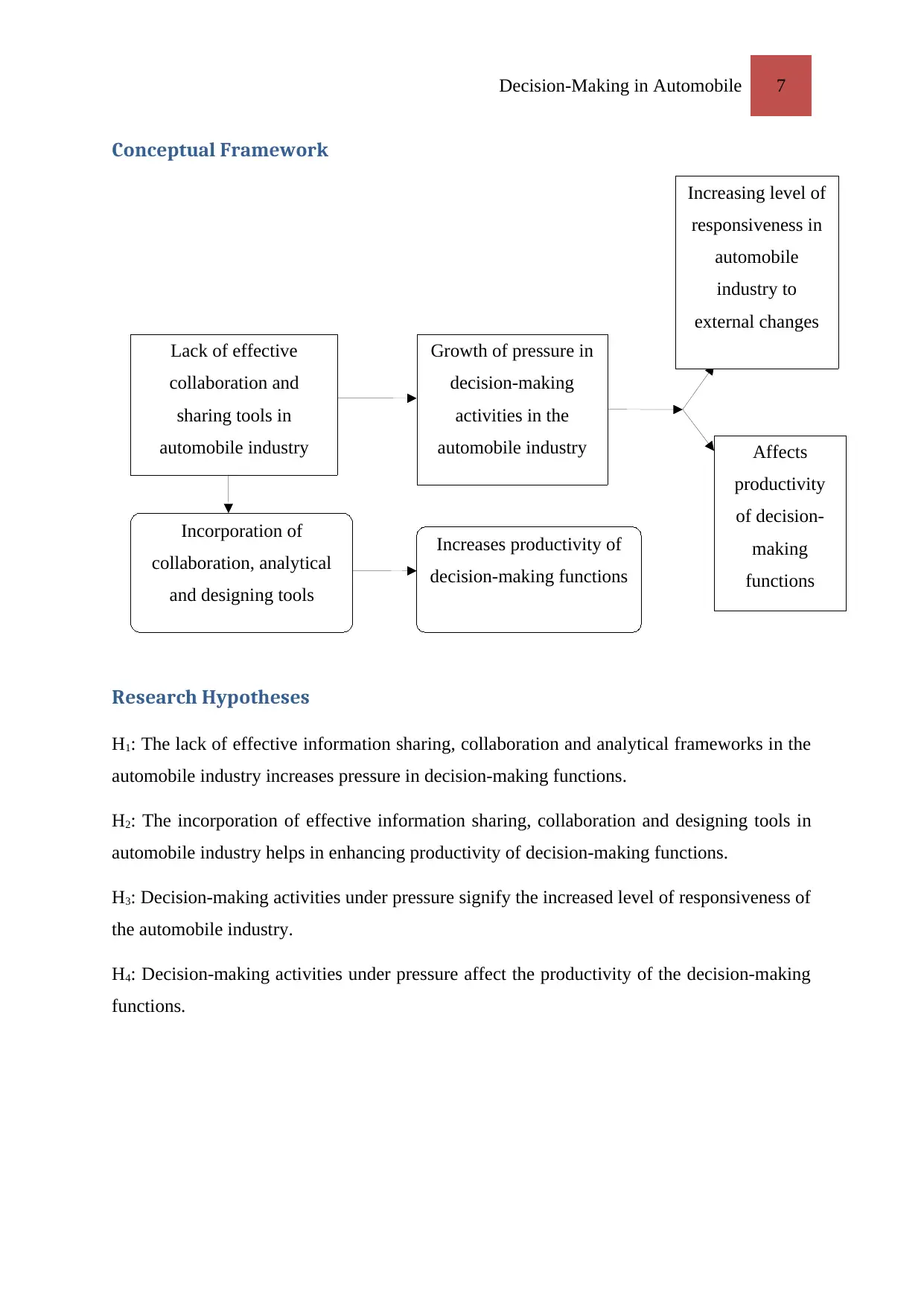
Conceptual Framework
Research Hypotheses
H1: The lack of effective information sharing, collaboration and analytical frameworks in the
automobile industry increases pressure in decision-making functions.
H2: The incorporation of effective information sharing, collaboration and designing tools in
automobile industry helps in enhancing productivity of decision-making functions.
H3: Decision-making activities under pressure signify the increased level of responsiveness of
the automobile industry.
H4: Decision-making activities under pressure affect the productivity of the decision-making
functions.
Lack of effective
collaboration and
sharing tools in
automobile industry
Growth of pressure in
decision-making
activities in the
automobile industry
Increasing level of
responsiveness in
automobile
industry to
external changes
Affects
productivity
of decision-
making
functions
Incorporation of
collaboration, analytical
and designing tools
Increases productivity of
decision-making functions
Conceptual Framework
Research Hypotheses
H1: The lack of effective information sharing, collaboration and analytical frameworks in the
automobile industry increases pressure in decision-making functions.
H2: The incorporation of effective information sharing, collaboration and designing tools in
automobile industry helps in enhancing productivity of decision-making functions.
H3: Decision-making activities under pressure signify the increased level of responsiveness of
the automobile industry.
H4: Decision-making activities under pressure affect the productivity of the decision-making
functions.
Lack of effective
collaboration and
sharing tools in
automobile industry
Growth of pressure in
decision-making
activities in the
automobile industry
Increasing level of
responsiveness in
automobile
industry to
external changes
Affects
productivity
of decision-
making
functions
Incorporation of
collaboration, analytical
and designing tools
Increases productivity of
decision-making functions
Paraphrase This Document
Need a fresh take? Get an instant paraphrase of this document with our AI Paraphraser
Decision-Making in Automobile 8
Research Methodology
Research Philosophy
The research would be carried out through the involvement of two research philosophies like
Interpretivism and Positivism.
Interpretivism based research activity requires the focus to be made on the development on
unstructured questions that helps in generating narrative inferences addressing the research
problem. It focuses on interpreting the perception and feelings of the respondents associated
to the context of the research. The open-ended questions are employed by the researcher for
undertaking of interviews of respondent groups to meet the objectives of interpretivism
research. Employment of interpretivism research philosophy contributes in generating
qualitative inferences (Hussein, 2009).
The deployment of Positivism Research is identified as that which requires the use of
statistical tools and diagrammatic research styles for aptly addressing the research objectives.
Positivism research philosophy focuses on generation of research hypotheses and thereby in
employing quantitative techniques for proving the same. The researcher in terms of
employing Positivism Research aims in the development of unstructured or close-ended
questionnaire sets that contributes in generating specific and quantitative inferences for
meeting research objectives (Hammer, 2015).
Research Technique
The employment of inductive research styles requires the researcher to focus on studying
different literary sources for gaining access to qualitative and conceptual inferences. The
study of contextual research activity ideally contributes in the development of novel contexts
and theoretical approaches while also helps in the generation of a conceptual diagram
associated to the research problem. Qualitative inferences are generated based on the
employment of inductive research (Gioia, Corley, & Hamilton, 2013).
The incorporation of deductive research activity focuses on generating research hypotheses
and thereby conducts survey activity through the generation of structured questionnaires that
are employed for conducting surveys. Conducting of deductive research ideally contributes in
Research Methodology
Research Philosophy
The research would be carried out through the involvement of two research philosophies like
Interpretivism and Positivism.
Interpretivism based research activity requires the focus to be made on the development on
unstructured questions that helps in generating narrative inferences addressing the research
problem. It focuses on interpreting the perception and feelings of the respondents associated
to the context of the research. The open-ended questions are employed by the researcher for
undertaking of interviews of respondent groups to meet the objectives of interpretivism
research. Employment of interpretivism research philosophy contributes in generating
qualitative inferences (Hussein, 2009).
The deployment of Positivism Research is identified as that which requires the use of
statistical tools and diagrammatic research styles for aptly addressing the research objectives.
Positivism research philosophy focuses on generation of research hypotheses and thereby in
employing quantitative techniques for proving the same. The researcher in terms of
employing Positivism Research aims in the development of unstructured or close-ended
questionnaire sets that contributes in generating specific and quantitative inferences for
meeting research objectives (Hammer, 2015).
Research Technique
The employment of inductive research styles requires the researcher to focus on studying
different literary sources for gaining access to qualitative and conceptual inferences. The
study of contextual research activity ideally contributes in the development of novel contexts
and theoretical approaches while also helps in the generation of a conceptual diagram
associated to the research problem. Qualitative inferences are generated based on the
employment of inductive research (Gioia, Corley, & Hamilton, 2013).
The incorporation of deductive research activity focuses on generating research hypotheses
and thereby conducts survey activity through the generation of structured questionnaires that
are employed for conducting surveys. Conducting of deductive research ideally contributes in
Decision-Making in Automobile 9
the generation of quantitative and specific inferences that meets the different research
hypotheses (Cortina, Aguinis, & DeShon, 2017).
Research Design
Different research designs like secondary, primary and triangulated research would be
employed for carrying out the research.
The use of secondary or empirical research is made in terms of study of potential literatures
like books, journals and other online articles and reports in the research context. Employment
of secondary research design helps the researcher for gaining access to authentic and
qualitative data in a faster and cheaper manner. Qualitative inferences gained from the use of
secondary research ideally serve as an effective background for carrying out primary research
activities in future (Parker, Morgeson, & Johns, 2017).
Employment of primary research activity requires the development of both open and close-
ended questionnaires. The questionnaires are used for conducting of interviews and surveys
respectively. The application of primary research activity is identified to be time consuming
and costly in nature. However, the application of primary research contributes in generating
current inferences for effectively addressing different research objectives (Venable, Pries-
Heje, & Baskerville, 2016).
Carrying of interview and survey research ideally contributes in generating both qualitative
and also quantitative inferences associated to the research issue. The combination of both
qualitative and also quantitative research approaches ideally helps in meeting the objectives
of triangulated research. Employing triangulated research enhances the potential of research
in that the same addresses both the research questions and objectives. Qualitative inferences
gained based on conducting of interview and quantitative inferences gained based on
employing survey activity rightly helps in the generating both elucidatory and specific
inferences (Wolf & Floyd, 2013).
Data Collection
The conducting of interview based research activity requires the generation of focused groups
that are subjected to interviews based on the construction of open-ended questionnaires. Here,
the researcher focuses on incorporating different types of instruments like good quality
microphones, recording gadgets, pen and paper for capturing and recording inferences
the generation of quantitative and specific inferences that meets the different research
hypotheses (Cortina, Aguinis, & DeShon, 2017).
Research Design
Different research designs like secondary, primary and triangulated research would be
employed for carrying out the research.
The use of secondary or empirical research is made in terms of study of potential literatures
like books, journals and other online articles and reports in the research context. Employment
of secondary research design helps the researcher for gaining access to authentic and
qualitative data in a faster and cheaper manner. Qualitative inferences gained from the use of
secondary research ideally serve as an effective background for carrying out primary research
activities in future (Parker, Morgeson, & Johns, 2017).
Employment of primary research activity requires the development of both open and close-
ended questionnaires. The questionnaires are used for conducting of interviews and surveys
respectively. The application of primary research activity is identified to be time consuming
and costly in nature. However, the application of primary research contributes in generating
current inferences for effectively addressing different research objectives (Venable, Pries-
Heje, & Baskerville, 2016).
Carrying of interview and survey research ideally contributes in generating both qualitative
and also quantitative inferences associated to the research issue. The combination of both
qualitative and also quantitative research approaches ideally helps in meeting the objectives
of triangulated research. Employing triangulated research enhances the potential of research
in that the same addresses both the research questions and objectives. Qualitative inferences
gained based on conducting of interview and quantitative inferences gained based on
employing survey activity rightly helps in the generating both elucidatory and specific
inferences (Wolf & Floyd, 2013).
Data Collection
The conducting of interview based research activity requires the generation of focused groups
that are subjected to interviews based on the construction of open-ended questionnaires. Here,
the researcher focuses on incorporating different types of instruments like good quality
microphones, recording gadgets, pen and paper for capturing and recording inferences
⊘ This is a preview!⊘
Do you want full access?
Subscribe today to unlock all pages.
Trusted by 1+ million students worldwide
Decision-Making in Automobile 10
rendered by respondents. The use of the above tools rightly helps in generating interview
transcripts which in turn fulfills the conducting of the research activity. Focused groups are
required to be constructed of managerial respondents pertaining to different automobile
companies which would be interviewed for gaining of in-depth inferences associated to the
research context. Face-to-face interviews are carried out such that the same helps the
researcher for undertaking of notes regarding observation made of the respondent groups
(Wright, Wahoush, Gabel, & Jack, 2016).
Data collection regarding survey activity is conducted by the researcher through the
development of structured questions for generating specific inferences to address the research
objectives. The structured questionnaires thus constructed are required to be dispatched to the
respondents either through the use of physical mailers or based on the application of survey
monkey as an online survey tool. Quantitative data is collected through the development of
five-point likert scales against the different structured questions such that the percentage of
responses gained associated to the different questions are tabulated in an excel sheet for
conducting of needful analysis (McCarthy, Wagner, & Sanders, 2017).
Sampling Procedure
The undertaking of focused group interviews requires the researcher for designing of focused
groups through the incorporation of non-probability sampling approaches like convenient
sampling. The use of convenient sampling ideally contributes in selection of respondents for
conducting of focused groups in a faster and simpler fashion. Convenient sampling style
requires the researcher to randomly select managerial respondents of around 20 in number
from the larger population of managers (Etikan, Musa, & Sunus, 2016).
The carrying out of survey research activity requires the researcher for selection of large
number of sample respondents through the employment of probability sampling like stratified
random sampling. The employment of stratified random sampling requires the researcher for
development of the survey population based on two different strata sets like that of
supervisors or front-line managers and employee groups. Around 100 respondents are
required to be selected from two strata groups in a random fashion. The incorporation of
stratified random sampling approach ideally contributes in reducing the chances of
emergence of sampling errors had in the case of simple random sampling (Cekim & Kadilar,
2017).
rendered by respondents. The use of the above tools rightly helps in generating interview
transcripts which in turn fulfills the conducting of the research activity. Focused groups are
required to be constructed of managerial respondents pertaining to different automobile
companies which would be interviewed for gaining of in-depth inferences associated to the
research context. Face-to-face interviews are carried out such that the same helps the
researcher for undertaking of notes regarding observation made of the respondent groups
(Wright, Wahoush, Gabel, & Jack, 2016).
Data collection regarding survey activity is conducted by the researcher through the
development of structured questions for generating specific inferences to address the research
objectives. The structured questionnaires thus constructed are required to be dispatched to the
respondents either through the use of physical mailers or based on the application of survey
monkey as an online survey tool. Quantitative data is collected through the development of
five-point likert scales against the different structured questions such that the percentage of
responses gained associated to the different questions are tabulated in an excel sheet for
conducting of needful analysis (McCarthy, Wagner, & Sanders, 2017).
Sampling Procedure
The undertaking of focused group interviews requires the researcher for designing of focused
groups through the incorporation of non-probability sampling approaches like convenient
sampling. The use of convenient sampling ideally contributes in selection of respondents for
conducting of focused groups in a faster and simpler fashion. Convenient sampling style
requires the researcher to randomly select managerial respondents of around 20 in number
from the larger population of managers (Etikan, Musa, & Sunus, 2016).
The carrying out of survey research activity requires the researcher for selection of large
number of sample respondents through the employment of probability sampling like stratified
random sampling. The employment of stratified random sampling requires the researcher for
development of the survey population based on two different strata sets like that of
supervisors or front-line managers and employee groups. Around 100 respondents are
required to be selected from two strata groups in a random fashion. The incorporation of
stratified random sampling approach ideally contributes in reducing the chances of
emergence of sampling errors had in the case of simple random sampling (Cekim & Kadilar,
2017).
Paraphrase This Document
Need a fresh take? Get an instant paraphrase of this document with our AI Paraphraser
Decision-Making in Automobile 11
Data Analysis
The carrying out of interview based research activity contributing in the generation of
qualitative inferences requires the researcher for focusing on conducting of qualitative data
analysis. The conducing of qualitative data analysis requires the researcher for development
of codes through the identification of words and phrases and thereby in identification of
correlation between the different codes for generation of qualitative inferences. Herein,
different codes like ‘decision making’, ‘decision making under pressure’, ‘productivity of
decision making’, ‘automobile industry’, ‘decision making in automobile industry’ and
‘decision making under pressure in automobile industry’ are required to be identified and
thereby the relationship between such are required to be analyzed for gaining of qualitative
inferences (Gioia, Corley, & Hamilton, 2013).
The conducting of quantitative data analysis requires the researcher for incorporation of
different statistical and diagrammatic research tools for generation of specific and
quantitative inferences in addressing the research objectives. Statistical tools like descriptive
statistics can be employed for generation of quantitative inferences like mean, median and
mode values and also skewness associated to the research variables. Similarly, different
diagrammatic tools like pie, bar and line charts are needed to be constructed for enhancing
the quality of the inferences gained based on the use of quantitative research (Wright,
Wahoush, Gabel, & Jack, 2016).
Research Ethics
The undertaking of interviews and surveys requires the fulfillment of some ethical guidelines.
The researcher firstly focuses on helping the respondents understand and approve the
rationale and objectives regarding conducting the stated research. Approval of the research
objectives and rationale rightly helps in generating needed support of the respondent groups
for the undertaking of the research activity. Secondly, the researcher also requires in
generating a statement reflecting that inferences rendered by the respondents are restricted in
being published in printed and online fashion without gaining needed approval from the
respondents. This would help in retaining the trust of the respondents on the researcher
(Graf, 2017).
Data Analysis
The carrying out of interview based research activity contributing in the generation of
qualitative inferences requires the researcher for focusing on conducting of qualitative data
analysis. The conducing of qualitative data analysis requires the researcher for development
of codes through the identification of words and phrases and thereby in identification of
correlation between the different codes for generation of qualitative inferences. Herein,
different codes like ‘decision making’, ‘decision making under pressure’, ‘productivity of
decision making’, ‘automobile industry’, ‘decision making in automobile industry’ and
‘decision making under pressure in automobile industry’ are required to be identified and
thereby the relationship between such are required to be analyzed for gaining of qualitative
inferences (Gioia, Corley, & Hamilton, 2013).
The conducting of quantitative data analysis requires the researcher for incorporation of
different statistical and diagrammatic research tools for generation of specific and
quantitative inferences in addressing the research objectives. Statistical tools like descriptive
statistics can be employed for generation of quantitative inferences like mean, median and
mode values and also skewness associated to the research variables. Similarly, different
diagrammatic tools like pie, bar and line charts are needed to be constructed for enhancing
the quality of the inferences gained based on the use of quantitative research (Wright,
Wahoush, Gabel, & Jack, 2016).
Research Ethics
The undertaking of interviews and surveys requires the fulfillment of some ethical guidelines.
The researcher firstly focuses on helping the respondents understand and approve the
rationale and objectives regarding conducting the stated research. Approval of the research
objectives and rationale rightly helps in generating needed support of the respondent groups
for the undertaking of the research activity. Secondly, the researcher also requires in
generating a statement reflecting that inferences rendered by the respondents are restricted in
being published in printed and online fashion without gaining needed approval from the
respondents. This would help in retaining the trust of the respondents on the researcher
(Graf, 2017).
Decision-Making in Automobile 12
Organization of the Study
The study would be organised in the following fashion.
Chapter 1
The first chapter focuses on generating an introduction to the research issue. It would also
focus on generating research aims and objectives. It would also reflect the research questions
that need to be answered for conducting the research.
Chapter 2
The second chapter ideally focuses on conducting a literature review in terms of studying of
books, journals and other online articles associated to the research issue. The study of
potential literature ideally contributes in the development of a contextual diagram. Further,
the second chapter also focuses on development of research hypotheses for carrying out the
research analysis.
Chapter 3
The third chapter would ideally focus on identifying the different research methods for
carrying out the research activity. The chapter in addition to identifying the different research
methods also focuses on identifying the fashion based on which data can be collected and
analyzed for addressing the research questions and objectives.
Chapter 4
The third chapter would ideally focus on conducting a detailed analysis through the
generation of open and close-ended questionnaires for conducting of interview and survey
based research respectively. Collection of qualitative and quantitative inferences through the
conducting of interviews and surveys requires the incorporation of qualitative and
quantitative research analysis for generation of needful inferences.
Chapter 5
The fourth chapter focuses on generating a summary of the research activity conducted along
the research report. It would also focus on the generation of effective recommendations based
on the inferences gained from the analysis.
Organization of the Study
The study would be organised in the following fashion.
Chapter 1
The first chapter focuses on generating an introduction to the research issue. It would also
focus on generating research aims and objectives. It would also reflect the research questions
that need to be answered for conducting the research.
Chapter 2
The second chapter ideally focuses on conducting a literature review in terms of studying of
books, journals and other online articles associated to the research issue. The study of
potential literature ideally contributes in the development of a contextual diagram. Further,
the second chapter also focuses on development of research hypotheses for carrying out the
research analysis.
Chapter 3
The third chapter would ideally focus on identifying the different research methods for
carrying out the research activity. The chapter in addition to identifying the different research
methods also focuses on identifying the fashion based on which data can be collected and
analyzed for addressing the research questions and objectives.
Chapter 4
The third chapter would ideally focus on conducting a detailed analysis through the
generation of open and close-ended questionnaires for conducting of interview and survey
based research respectively. Collection of qualitative and quantitative inferences through the
conducting of interviews and surveys requires the incorporation of qualitative and
quantitative research analysis for generation of needful inferences.
Chapter 5
The fourth chapter focuses on generating a summary of the research activity conducted along
the research report. It would also focus on the generation of effective recommendations based
on the inferences gained from the analysis.
⊘ This is a preview!⊘
Do you want full access?
Subscribe today to unlock all pages.
Trusted by 1+ million students worldwide

1 out of 17


Related Documents


Your All-in-One AI-Powered Toolkit for Academic Success.
+13062052269
info@desklib.com
Available 24*7 on WhatsApp / Email
![[object Object]](/_next/static/media/star-bottom.7253800d.svg)
Unlock your academic potential
Copyright © 2020–2026 A2Z Services. All Rights Reserved. Developed and managed by ZUCOL.