Decision Making: Applying SMART Analysis in Business Context
VerifiedAdded on 2023/06/15
|22
|3837
|184
Report
AI Summary
This report delves into the importance of decision-making and the application of decision analysis within a business context. It begins by highlighting the crucial role of decision-making in modern management, emphasizing its impact on achieving organizational goals. A specific decision problem is presented: a small retail shop in Melbourne needing to relocate and choosing the best location from five shortlisted shopping malls, considering factors like rent, location, and shop size. The report employs the SMART analysis technique to evaluate each potential location, assigning weights and values to attributes such as goodwill, location, size, and health and safety. The analysis calculates aggregate benefits for each mall, providing a graphical representation of cost versus benefits to aid in the decision-making process. The report concludes by summarizing the findings and discussing the strengths and limitations of the SMART analysis in this context.

Running Head: ANALYTICAL THINKING AND DECISION MAKING
Decision making and analysis
Decision making and analysis

Paraphrase This Document
Need a fresh take? Get an instant paraphrase of this document with our AI Paraphraser
Analytical Thinking and Decision Making 1
Contents
Introduction...........................................................................................................................................2
Question 1.............................................................................................................................................2
Decision making- Importance............................................................................................................2
Decision analysis- Application..........................................................................................................4
Question 2.............................................................................................................................................5
Decision problem- identification and outline.....................................................................................5
Question 3.............................................................................................................................................6
SMART Analysis..............................................................................................................................6
Question 4...........................................................................................................................................14
Analysis – Strengths and Limitations..............................................................................................14
Conclusion...........................................................................................................................................15
References...........................................................................................................................................17
Contents
Introduction...........................................................................................................................................2
Question 1.............................................................................................................................................2
Decision making- Importance............................................................................................................2
Decision analysis- Application..........................................................................................................4
Question 2.............................................................................................................................................5
Decision problem- identification and outline.....................................................................................5
Question 3.............................................................................................................................................6
SMART Analysis..............................................................................................................................6
Question 4...........................................................................................................................................14
Analysis – Strengths and Limitations..............................................................................................14
Conclusion...........................................................................................................................................15
References...........................................................................................................................................17
Analytical Thinking and Decision Making 2
Introduction
Decision making is basically a process of taking or making important decisions. It is
considered as an essential part of modern management and is a primary function performed
by the managers. Decisions plays an important role in achieving the organization
predetermined goals. They are been taken at every level of management, to ensure growth
and drivability in the products and services provided by the organization (Nicholas, 2017).
The process of decision making is continuous and is been done by the professionals for better
functioning of the business. A systematic and quantitative approach used for evaluating the
relevant information, which is required in the decision making process, is known as decision
analysis. The approach uses various tools which helps in assessing the decisions made in
respect of multiple variables and which have various possible outcomes (Nutt and Wilson,
2010).
This report explains the importance of decision making and application of decision analysis.
In addition to this, a decision problem is also stated in form of a business case in the report,
which is evaluated by using SMART analysis tool. In the last the limitations and the strength
of the analysis are mentioned, followed by a conclusion.
Question 1.
Decision making- Importance
According to Oxford Dictionary, decision making is generally defined as the process of
deciding something important among the group of individuals or in the organization
(Crowley and Zentall, 2013). As the name suggest, it is very important for the business
managers to take appropriate and correct decisions. Following are the points which reflects
the importance of decision making:
Introduction
Decision making is basically a process of taking or making important decisions. It is
considered as an essential part of modern management and is a primary function performed
by the managers. Decisions plays an important role in achieving the organization
predetermined goals. They are been taken at every level of management, to ensure growth
and drivability in the products and services provided by the organization (Nicholas, 2017).
The process of decision making is continuous and is been done by the professionals for better
functioning of the business. A systematic and quantitative approach used for evaluating the
relevant information, which is required in the decision making process, is known as decision
analysis. The approach uses various tools which helps in assessing the decisions made in
respect of multiple variables and which have various possible outcomes (Nutt and Wilson,
2010).
This report explains the importance of decision making and application of decision analysis.
In addition to this, a decision problem is also stated in form of a business case in the report,
which is evaluated by using SMART analysis tool. In the last the limitations and the strength
of the analysis are mentioned, followed by a conclusion.
Question 1.
Decision making- Importance
According to Oxford Dictionary, decision making is generally defined as the process of
deciding something important among the group of individuals or in the organization
(Crowley and Zentall, 2013). As the name suggest, it is very important for the business
managers to take appropriate and correct decisions. Following are the points which reflects
the importance of decision making:
⊘ This is a preview!⊘
Do you want full access?
Subscribe today to unlock all pages.

Trusted by 1+ million students worldwide
Analytical Thinking and Decision Making 3
It is a pervasive function of management which is performed in the best interest of the
organization. The manager take decisions at all the stages, for the purpose of smooth
functioning of the business (Kumar and Sharma, 2000).
The decisions may lead to the downfall in the business, if taken wrongly. So it is very
important for the management to follow a correct procedure while making the
decisions.
Decision making is very crucial for an organization as it provides a base for utilizing
the resources available within the business, required for achieving the desired
objectives (Morato, 2013).
There are various resources such as materials, man power, money, machines and
many more. Right decision at right time facilitates the efficient and effective use of all
these resources, without any wastage.
The importance of decision making also lies with the fact that it helps in choosing the
best alternative among the available ones. A problem has multiple solutions and to
select the best alternative, management needs to analyse each of them with the use
various analytical tools (Noyes, Cook and Masakowski, 2012).
Apart from choosing best option, it also assist in evaluating the performance of a
manager. The success and expertise of a manager largely depends upon its capability
to take right decisions in the business. Therefore, decision making is one of the
important criteria used for measuring the performance of the top level management.
Making of decisions also results in the formation of a framework or guidelines for the
operational staff. It also includes different benefits and facilities available to the
employees. As a result, employees feel motivated and work according to the
organization requirements (Conroy and Peterson, 2013).
It is a pervasive function of management which is performed in the best interest of the
organization. The manager take decisions at all the stages, for the purpose of smooth
functioning of the business (Kumar and Sharma, 2000).
The decisions may lead to the downfall in the business, if taken wrongly. So it is very
important for the management to follow a correct procedure while making the
decisions.
Decision making is very crucial for an organization as it provides a base for utilizing
the resources available within the business, required for achieving the desired
objectives (Morato, 2013).
There are various resources such as materials, man power, money, machines and
many more. Right decision at right time facilitates the efficient and effective use of all
these resources, without any wastage.
The importance of decision making also lies with the fact that it helps in choosing the
best alternative among the available ones. A problem has multiple solutions and to
select the best alternative, management needs to analyse each of them with the use
various analytical tools (Noyes, Cook and Masakowski, 2012).
Apart from choosing best option, it also assist in evaluating the performance of a
manager. The success and expertise of a manager largely depends upon its capability
to take right decisions in the business. Therefore, decision making is one of the
important criteria used for measuring the performance of the top level management.
Making of decisions also results in the formation of a framework or guidelines for the
operational staff. It also includes different benefits and facilities available to the
employees. As a result, employees feel motivated and work according to the
organization requirements (Conroy and Peterson, 2013).
Paraphrase This Document
Need a fresh take? Get an instant paraphrase of this document with our AI Paraphraser
Analytical Thinking and Decision Making 4
Decision analysis- Application
It is a process that deals with analysing, modelling and optimizing the decisions made by the
individuals or organizations. The main objective of decision analysis is to help the decision
makers in taking appropriate decisions, especially under uncertainty and complex situations.
It also provides insights to the managers into how the available alternatives are different from
each other and then provides suggestions for improved options (Parnell, Terry, Tani and
Johnson, 2013). Businesses and government widely use this analysis in order to make right
decisions. Some of the applications of the analysis are:
1. In business
Ensuring quality and control
Launching a new product
Selecting a project
Managing the operations in the business like airlines, hotel management, oil
refinery and many more.
Making the management efficient.
Choosing a best loan portfolio.
Making the organization reliable and successful (Covaliu, 2001).
2. Government
Managing the risk associated with environment.
Choosing the new energy resources.
Implementing research and development programs.
Managing the emergency situations (Covaliu, 2001).
3. Other Applications
Bidding.
Treatment and diagnosis.
Decision analysis- Application
It is a process that deals with analysing, modelling and optimizing the decisions made by the
individuals or organizations. The main objective of decision analysis is to help the decision
makers in taking appropriate decisions, especially under uncertainty and complex situations.
It also provides insights to the managers into how the available alternatives are different from
each other and then provides suggestions for improved options (Parnell, Terry, Tani and
Johnson, 2013). Businesses and government widely use this analysis in order to make right
decisions. Some of the applications of the analysis are:
1. In business
Ensuring quality and control
Launching a new product
Selecting a project
Managing the operations in the business like airlines, hotel management, oil
refinery and many more.
Making the management efficient.
Choosing a best loan portfolio.
Making the organization reliable and successful (Covaliu, 2001).
2. Government
Managing the risk associated with environment.
Choosing the new energy resources.
Implementing research and development programs.
Managing the emergency situations (Covaliu, 2001).
3. Other Applications
Bidding.
Treatment and diagnosis.
Analytical Thinking and Decision Making 5
Legal process (Covaliu, 2001).
Question 2.
Decision problem- identification and outline
In general terms, decision problem is a difference between the current situation and the target
situation which can be solved with the number of options available (Grünig and Kühn, 2017).
In order to analyse the decisions which includes multiple objectives, following problem is
been identified and framed:
A small retail shop situated in Melbourne has to shift its entire business to another location.
The owner of the shop decides to expand its business by renovating and reconstructing his
existing shop, and for this he needs to shift his business to some other location. In order to do
this, he need to take a shop on rent. The owner decide to keep the cost low and takes into
account the other factors which affects its turnover and profits.
Five shopping malls are been shortlisted by the owner, each of which provides shop on rent.
Among the five, Melbourne Central is in a prestigious location and have several popular
stores under one roof. It is very close to customers, as they can easily reach there with public
transport. But the problem is that owner has to pay high rent for taking a shop in this mall. On
the top of that, the size of the shop is small, which will be uncomfortable for the staff to work
in. In contrast to this, Queen Victoria Village is a mall, popularly known for business and
shopping. The shop in this mall is pretty much spacious and provides excellent working
conditions. But it is located far away from the main market, where customers can not reach
easily. The mall has a wide range of big retail stores such as Woolworths, Big W,
Officeworks and many more. The owner is now confused about making his choice, as the
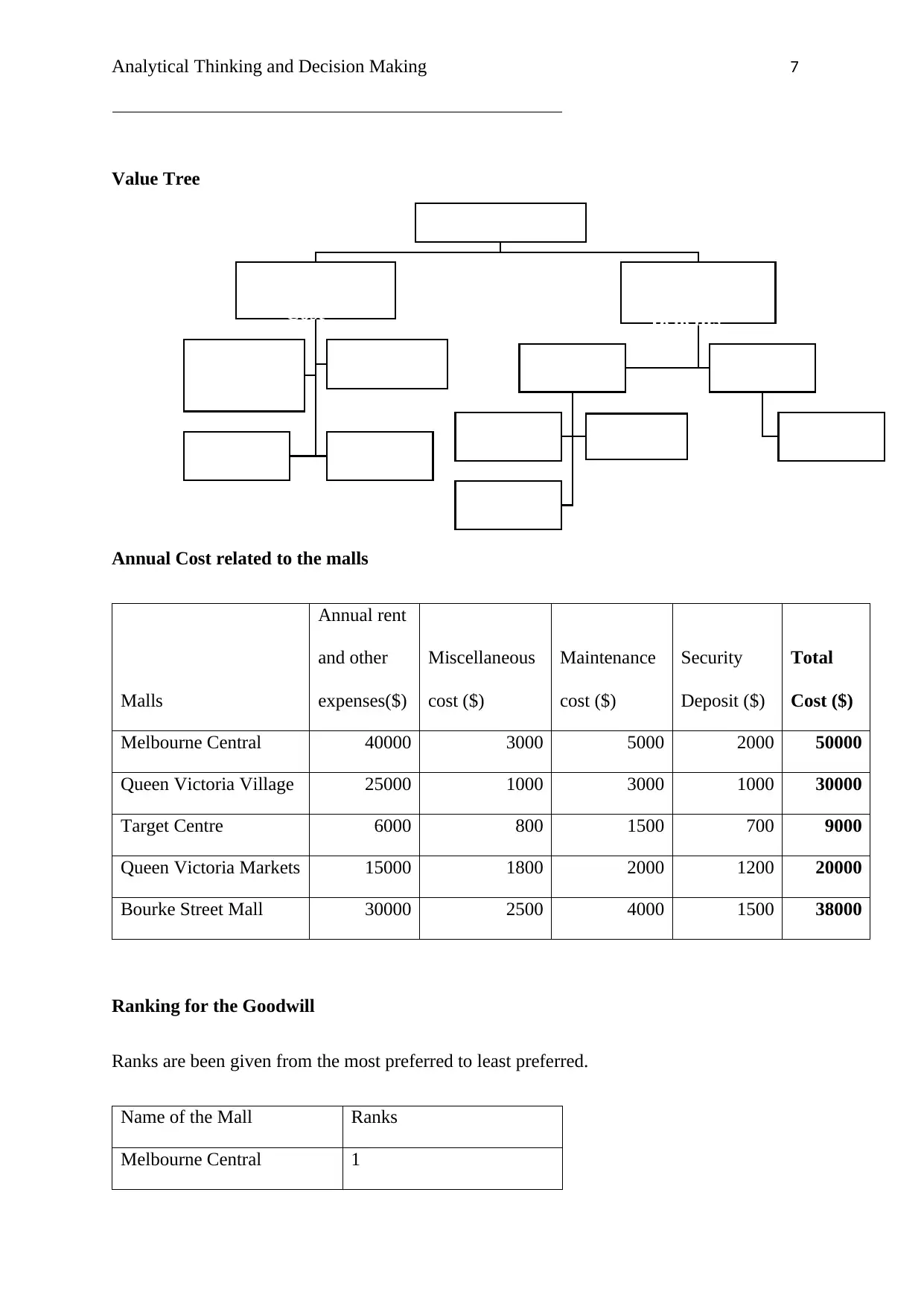
problem of choosing shop location involves both cost and benefits. Factors like rent,
electricity charges, maintenance charges and cleaning expenses contributes the cost of shop.
Legal process (Covaliu, 2001).
Question 2.
Decision problem- identification and outline
In general terms, decision problem is a difference between the current situation and the target
situation which can be solved with the number of options available (Grünig and Kühn, 2017).
In order to analyse the decisions which includes multiple objectives, following problem is
been identified and framed:
A small retail shop situated in Melbourne has to shift its entire business to another location.
The owner of the shop decides to expand its business by renovating and reconstructing his
existing shop, and for this he needs to shift his business to some other location. In order to do
this, he need to take a shop on rent. The owner decide to keep the cost low and takes into
account the other factors which affects its turnover and profits.
Five shopping malls are been shortlisted by the owner, each of which provides shop on rent.
Among the five, Melbourne Central is in a prestigious location and have several popular
stores under one roof. It is very close to customers, as they can easily reach there with public
transport. But the problem is that owner has to pay high rent for taking a shop in this mall. On
the top of that, the size of the shop is small, which will be uncomfortable for the staff to work
in. In contrast to this, Queen Victoria Village is a mall, popularly known for business and
shopping. The shop in this mall is pretty much spacious and provides excellent working
conditions. But it is located far away from the main market, where customers can not reach
easily. The mall has a wide range of big retail stores such as Woolworths, Big W,
Officeworks and many more. The owner is now confused about making his choice, as the
problem of choosing shop location involves both cost and benefits. Factors like rent,
electricity charges, maintenance charges and cleaning expenses contributes the cost of shop.
⊘ This is a preview!⊘
Do you want full access?
Subscribe today to unlock all pages.
Trusted by 1+ million students worldwide
Analytical Thinking and Decision Making 6
On the other hand, benefits are derived from the turnover and working environment. Factors
that affect the benefits are goodwill of the mall, location or closeness to customers, comfort
of the workers and size of the shop.
The owner needs to take a decision regarding shop location, taking into account all these
factors. In order to make correct and appropriate choice, SMART technique has been used to
evaluate all these points and choose the best option. Following five options are:
Melbourne Central
Target Centre
Queen Victoria Village
Bourke Street Mall
Queen Victoria Markets
Question 3.
SMART Analysis
It is a simple technique that implements the principle of MAUT (Multi Attributable Utility
Theory). It believes that decisions taken depends upon the values and the weights assigned to
each and every attribute. These weights and values make it easy for the decision maker to
analyse the best option and take the decision accordingly. (Olson, 2012).
A shop location problem
Name of the Mall Annual Rent ($)
Melbourne Central (A) 40,000
Queen Victoria Village (B) 25,000
Target Centre (C) 6,000
Queen Victoria Markets (D) 15,000
Bourke Street Mall (E) 30,000
On the other hand, benefits are derived from the turnover and working environment. Factors
that affect the benefits are goodwill of the mall, location or closeness to customers, comfort
of the workers and size of the shop.
The owner needs to take a decision regarding shop location, taking into account all these
factors. In order to make correct and appropriate choice, SMART technique has been used to
evaluate all these points and choose the best option. Following five options are:
Melbourne Central
Target Centre
Queen Victoria Village
Bourke Street Mall
Queen Victoria Markets
Question 3.
SMART Analysis
It is a simple technique that implements the principle of MAUT (Multi Attributable Utility
Theory). It believes that decisions taken depends upon the values and the weights assigned to
each and every attribute. These weights and values make it easy for the decision maker to
analyse the best option and take the decision accordingly. (Olson, 2012).
A shop location problem
Name of the Mall Annual Rent ($)
Melbourne Central (A) 40,000
Queen Victoria Village (B) 25,000
Target Centre (C) 6,000
Queen Victoria Markets (D) 15,000
Bourke Street Mall (E) 30,000
Paraphrase This Document
Need a fresh take? Get an instant paraphrase of this document with our AI Paraphraser
Analytical Thinking and Decision Making 7
Value Tree
Annual Cost related to the malls
Malls
Annual rent
and other
expenses($)
Miscellaneous
cost ($)
Maintenance
cost ($)
Security
Deposit ($)
Total
Cost ($)
Melbourne Central 40000 3000 5000 2000 50000
Queen Victoria Village 25000 1000 3000 1000 30000
Target Centre 6000 800 1500 700 9000
Queen Victoria Markets 15000 1800 2000 1200 20000
Bourke Street Mall 30000 2500 4000 1500 38000
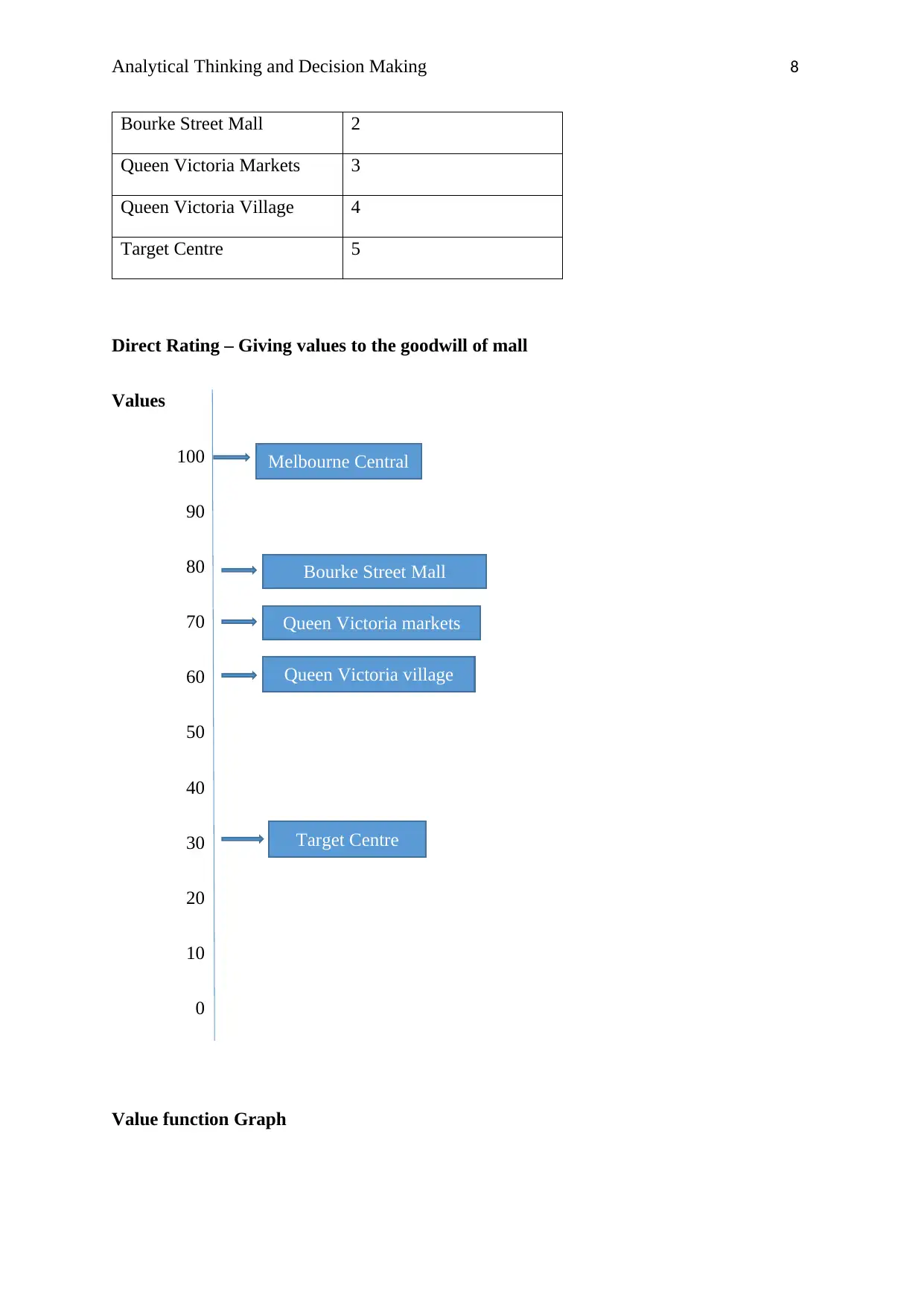
Ranking for the Goodwill
Ranks are been given from the most preferred to least preferred.
Name of the Mall Ranks
Melbourne Central 1
Value Tree
Cost
Rent and
other
expenses
Miscellaneous
Expenses
Maintenance Security
Deposit
Benefits
Turnover
Goodwill Location
Size
Working
Conditions
Health and
Saftey
Value Tree
Annual Cost related to the malls
Malls
Annual rent
and other
expenses($)
Miscellaneous
cost ($)
Maintenance
cost ($)
Security
Deposit ($)
Total
Cost ($)
Melbourne Central 40000 3000 5000 2000 50000
Queen Victoria Village 25000 1000 3000 1000 30000
Target Centre 6000 800 1500 700 9000
Queen Victoria Markets 15000 1800 2000 1200 20000
Bourke Street Mall 30000 2500 4000 1500 38000
Ranking for the Goodwill
Ranks are been given from the most preferred to least preferred.
Name of the Mall Ranks
Melbourne Central 1
Value Tree
Cost
Rent and
other
expenses
Miscellaneous
Expenses
Maintenance Security
Deposit
Benefits
Turnover
Goodwill Location
Size
Working
Conditions
Health and
Saftey
Analytical Thinking and Decision Making 8
Bourke Street Mall 2
Queen Victoria Markets 3
Queen Victoria Village 4
Target Centre 5
Direct Rating – Giving values to the goodwill of mall
Values
100
90
80
70
60
50
40
30
20
10
0
Value function Graph
Melbourne Central
Queen Victoria village
Queen Victoria markets
Bourke Street Mall
Target Centre
Bourke Street Mall 2
Queen Victoria Markets 3
Queen Victoria Village 4
Target Centre 5
Direct Rating – Giving values to the goodwill of mall
Values
100
90
80
70
60
50
40
30
20
10
0
Value function Graph
Melbourne Central
Queen Victoria village
Queen Victoria markets
Bourke Street Mall
Target Centre
⊘ This is a preview!⊘
Do you want full access?
Subscribe today to unlock all pages.
Trusted by 1+ million students worldwide
Analytical Thinking and Decision Making 9
50 100 150 200 250 300 350 400 450 500 550
0
5
10
15
20
25
30
35
$ Rent
Shop floor area ft
Rent
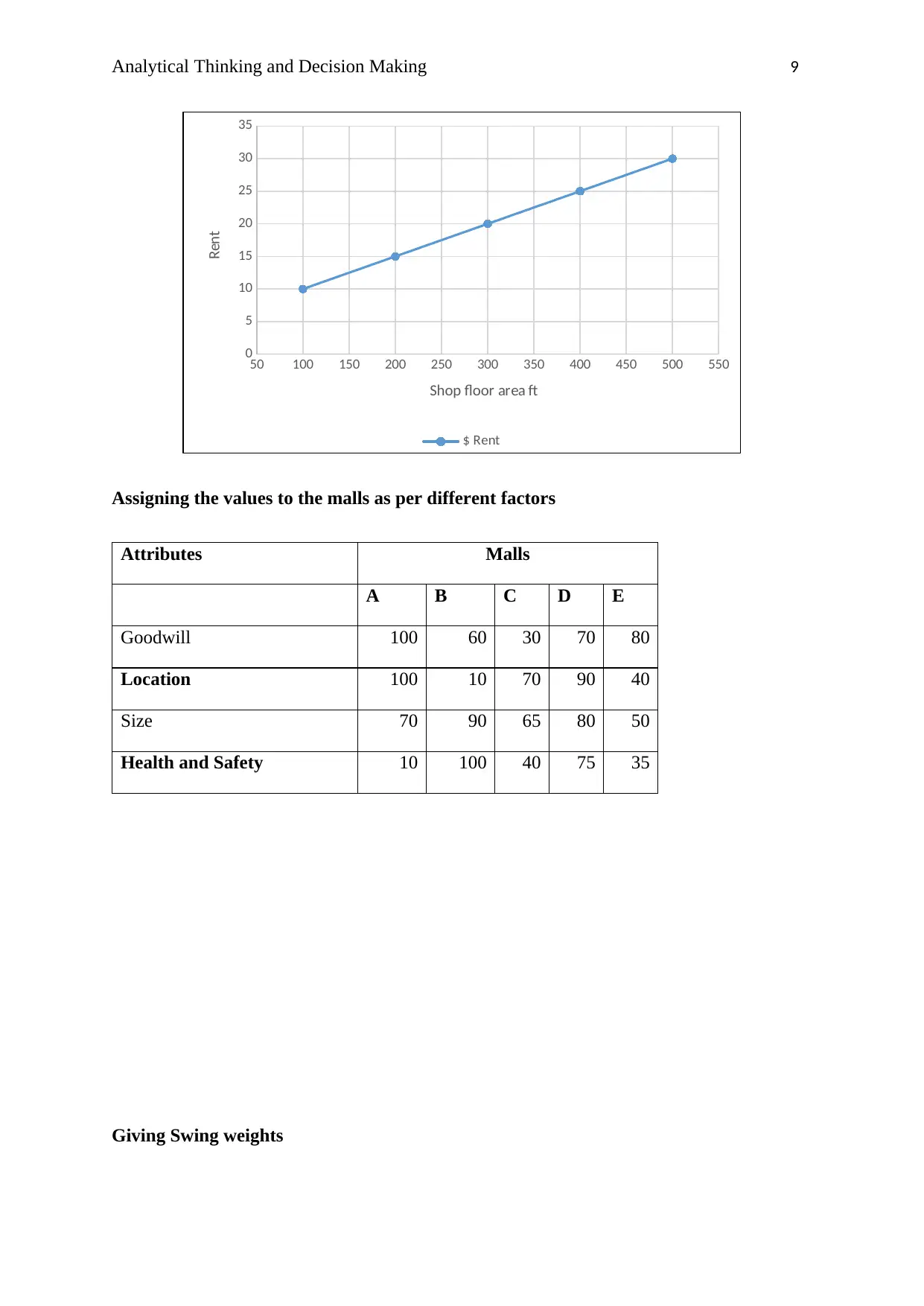
Assigning the values to the malls as per different factors
Attributes Malls
A B C D E
Goodwill 100 60 30 70 80
Location 100 10 70 90 40
Size 70 90 65 80 50
Health and Safety 10 100 40 75 35
Giving Swing weights
50 100 150 200 250 300 350 400 450 500 550
0
5
10
15
20
25
30
35
$ Rent
Shop floor area ft
Rent
Assigning the values to the malls as per different factors
Attributes Malls
A B C D E
Goodwill 100 60 30 70 80
Location 100 10 70 90 40
Size 70 90 65 80 50
Health and Safety 10 100 40 75 35
Giving Swing weights
Paraphrase This Document
Need a fresh take? Get an instant paraphrase of this document with our AI Paraphraser
Analytical Thinking and Decision Making 10
Location Goodwill Size Health and Safety
100 Best
90
80 Best
70
60 Best
50
40 Best
30
20
10
0 Worst Worst Worst Worst
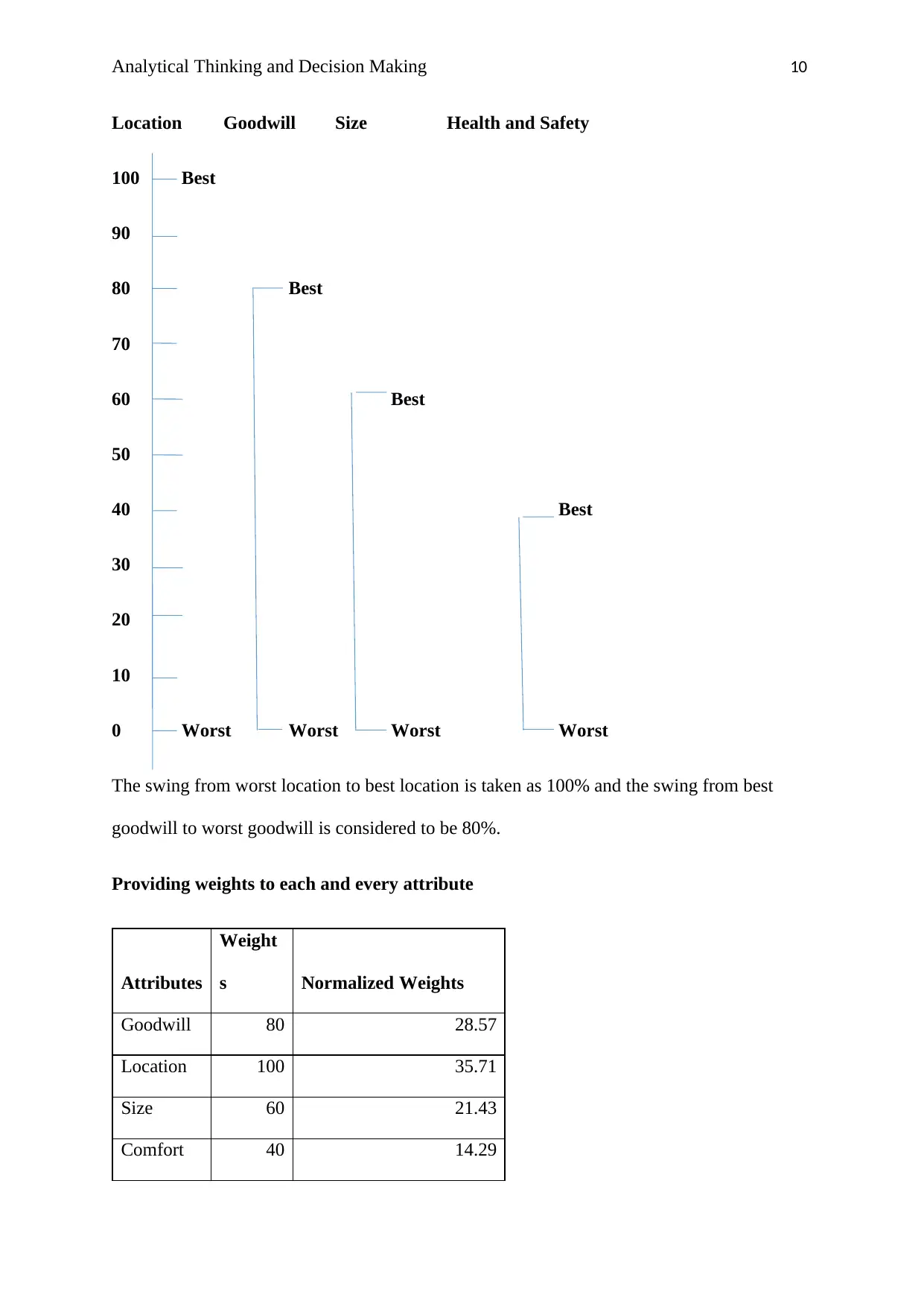
The swing from worst location to best location is taken as 100% and the swing from best
goodwill to worst goodwill is considered to be 80%.
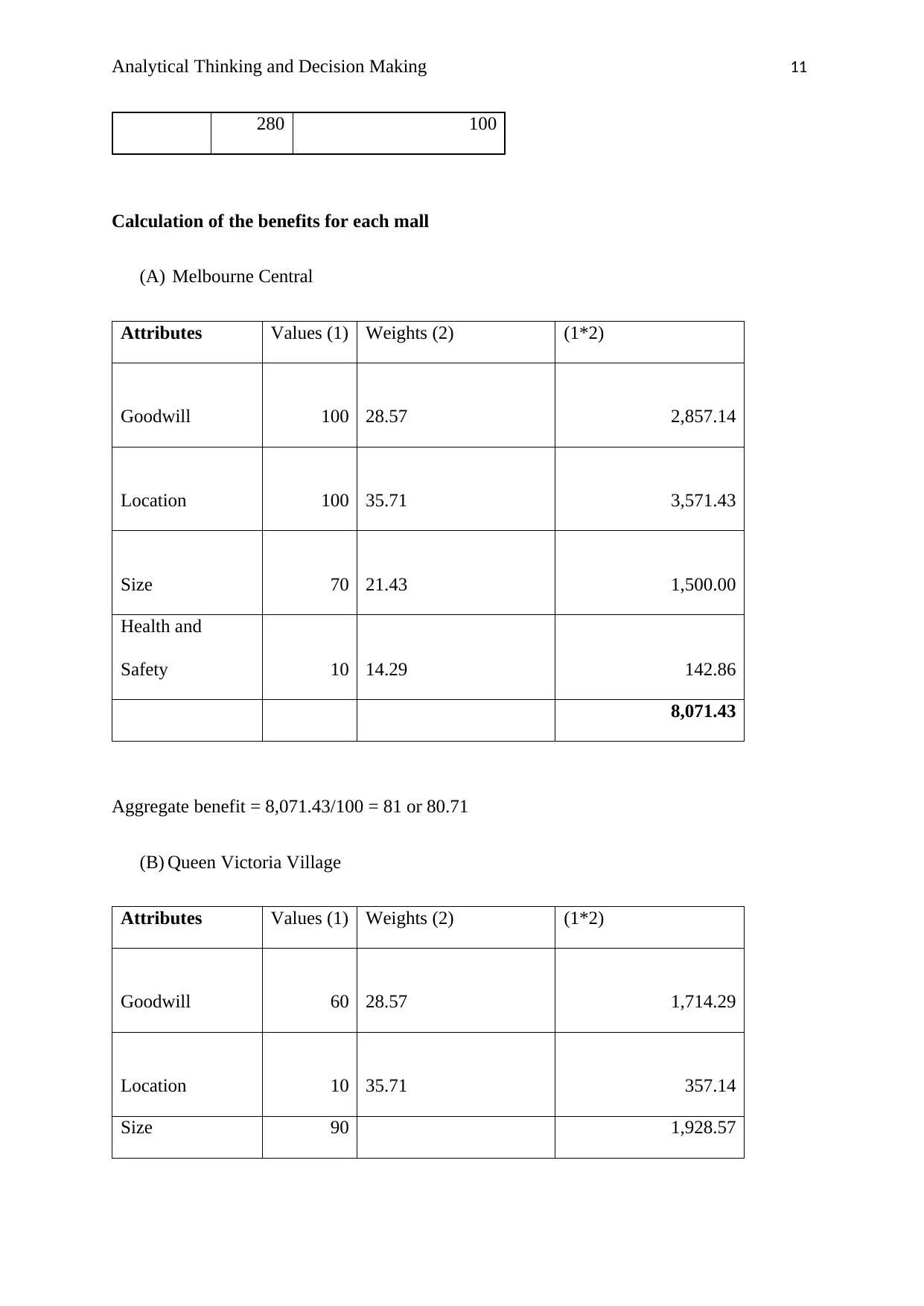
Providing weights to each and every attribute
Attributes
Weight
s Normalized Weights
Goodwill 80 28.57
Location 100 35.71
Size 60 21.43
Comfort 40 14.29
Location Goodwill Size Health and Safety
100 Best
90
80 Best
70
60 Best
50
40 Best
30
20
10
0 Worst Worst Worst Worst
The swing from worst location to best location is taken as 100% and the swing from best
goodwill to worst goodwill is considered to be 80%.
Providing weights to each and every attribute
Attributes
Weight
s Normalized Weights
Goodwill 80 28.57
Location 100 35.71
Size 60 21.43
Comfort 40 14.29
Analytical Thinking and Decision Making 11
280 100
Calculation of the benefits for each mall
(A) Melbourne Central
Attributes Values (1) Weights (2) (1*2)
Goodwill 100 28.57 2,857.14
Location 100 35.71 3,571.43
Size 70 21.43 1,500.00
Health and
Safety 10 14.29 142.86
8,071.43
Aggregate benefit = 8,071.43/100 = 81 or 80.71
(B) Queen Victoria Village
Attributes Values (1) Weights (2) (1*2)
Goodwill 60 28.57 1,714.29
Location 10 35.71 357.14
Size 90 1,928.57
280 100
Calculation of the benefits for each mall
(A) Melbourne Central
Attributes Values (1) Weights (2) (1*2)
Goodwill 100 28.57 2,857.14
Location 100 35.71 3,571.43
Size 70 21.43 1,500.00
Health and
Safety 10 14.29 142.86
8,071.43
Aggregate benefit = 8,071.43/100 = 81 or 80.71
(B) Queen Victoria Village
Attributes Values (1) Weights (2) (1*2)
Goodwill 60 28.57 1,714.29
Location 10 35.71 357.14
Size 90 1,928.57
⊘ This is a preview!⊘
Do you want full access?
Subscribe today to unlock all pages.
Trusted by 1+ million students worldwide

1 out of 22


Related Documents


Your All-in-One AI-Powered Toolkit for Academic Success.
+13062052269
info@desklib.com
Available 24*7 on WhatsApp / Email
![[object Object]](/_next/static/media/star-bottom.7253800d.svg)
Unlock your academic potential
Copyright © 2020–2026 A2Z Services. All Rights Reserved. Developed and managed by ZUCOL.