University Decision-Making Process: OODA Loop Model Assignment

Verified

Added on  2022/11/22

|8
|839
|349
Homework Assignment
AI Summary
This assignment delves into the concept of decision-making, highlighting its significance in problem-solving. It explores various models and processes, with a specific focus on the OODA Loop model (Observe, Orient, Decide, Act). The paper provides a detailed discussion of each stage of the OODA Loop, emphasizing its effectiveness in guiding individuals through the decision-making process. A practical example of employee retention in a company is used to illustrate the application of the model. The assignment concludes by reiterating the importance of informed decision-making and the selection of appropriate alternatives in achieving desired outcomes, as demonstrated through the OODA Loop model. References supporting the concepts are also included.
Document Page
Running head: Decision-making process
Decision-making process
Name of the Student:
Name of the University:
Author note:
tabler-icon-diamond-filled.svg

Paraphrase This Document

Need a fresh take? Get an instant paraphrase of this document with our AI Paraphraser
Document Page
1Decision-Making
Table of Contents
Introduction......................................................................................................................................2
Discussion........................................................................................................................................2
OADA Loop Model.....................................................................................................................2
Conclusion.......................................................................................................................................5
Reference.........................................................................................................................................6
Document Page
2Decision-Making
Introduction
The current assignment focuses on describing the concept of decison0making and the
ways a decision is assessed. Decision- making is the most critical activity assessed by individuals
to solve problem (Anderson et al., 2015). The concept of decision-making is explained by
various process and models. The paper particularly focuses on OADA Loop model. This model
helps in understanding the decision-making process and the ways decisions are made. The study
also provides a reasonable approach for the above model with example.
Discussion
Decision-making is an integral approach for an individual. In simple words, decision-
making is the process to determine and select alternatives which is based on decision-makers
personal preferences, values and beliefs.
In order to make appropriate and relevant decision-making, decision-making process
helps to find out alternatives and seek ways to approach. There are various models which
supports the approach of decision-making process (Robert, Thomas & Bergez 2016). The model
which is more suitable and relatively simple to process is OADA Loop model.
OADA Loop Model
The OADA Loop model stands for observe, orient, decide and act. Though the model is
straightforward and simple, it is highly effective and gives correct path to approach a problem
(Kochenderfer, 2015). This model make it easier for the individual to take right decisions. It is
basically a loop with no ending.
Document Page
3Decision-Making
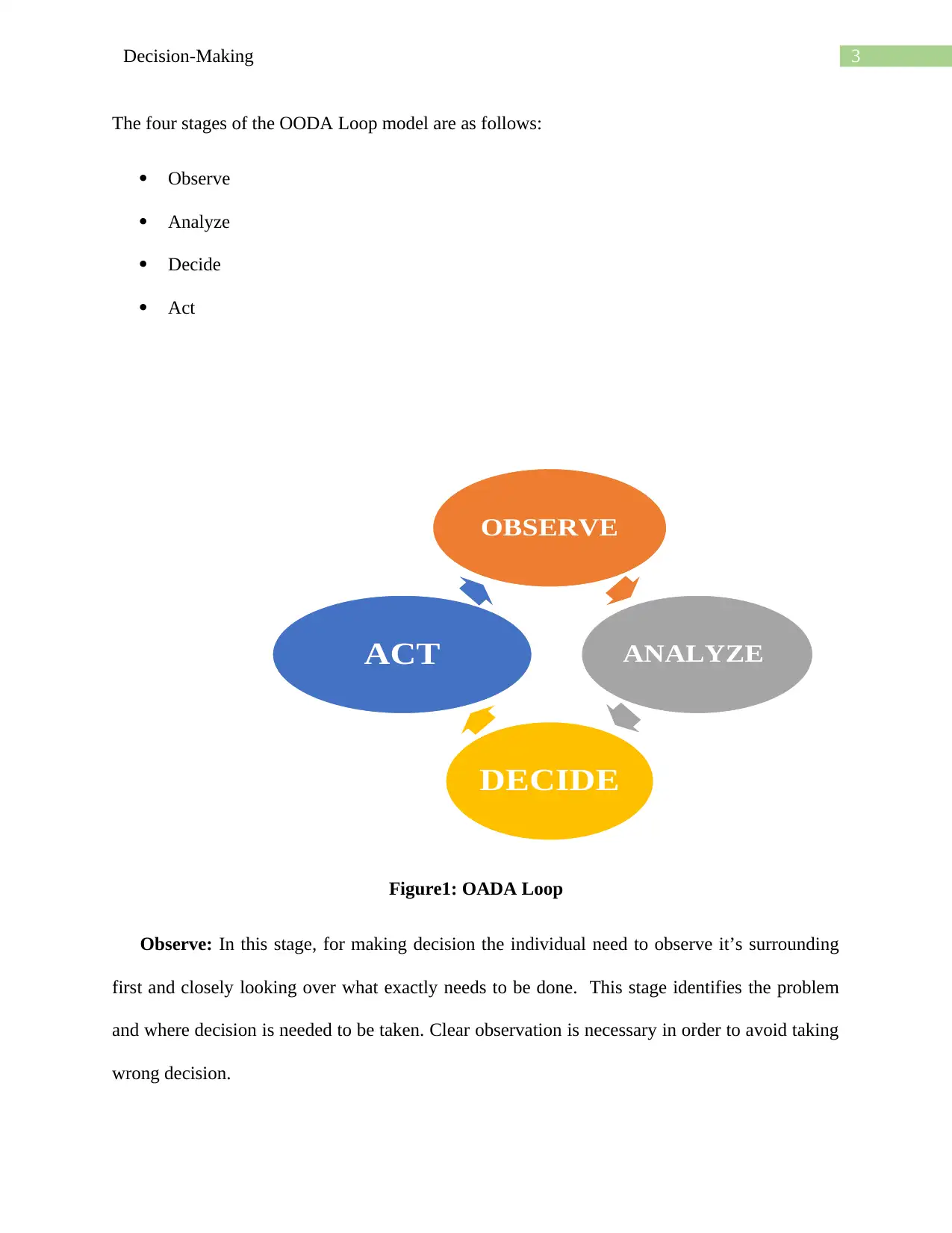
The four stages of the OODA Loop model are as follows:
Observe
Analyze
Decide
Act
Figure1: OADA Loop
Observe: In this stage, for making decision the individual need to observe it’s surrounding
first and closely looking over what exactly needs to be done. This stage identifies the problem
and where decision is needed to be taken. Clear observation is necessary in order to avoid taking
wrong decision.
OBSERVE
ANALYZE
DECIDE
ACT
tabler-icon-diamond-filled.svg

Paraphrase This Document

Need a fresh take? Get an instant paraphrase of this document with our AI Paraphraser
Document Page
4Decision-Making
Analyze: Analyzing stage critically identifies what can be the alternatives for the problems.
This stage generally take oneself to confusion as there are various choices to make. It also
understanding the source of the problem or situation (Lerner et al., 2015). Analyzing includes
collecting data and gathering of information.
Decide: This stage is the most crucial stage in the decision making process since, in the
previous stage individual has already got the alternatives for the situation or the problem
(Kochenderfer, 2015). Therefore, decide helps to take the most appropriate measure out of the all
alternatives.
Act: After deciding the alternative this stage is the acting upon the alternative and
reanalyzing the particular alternative. This stage executes the decision made for the situation.
This model is considered to be effective because it is very simple to understand and does not take
much time to think what ought to be done. The steps are very specific and gives specific result
without any confusion.
For example: Employee Retention
OBSERVE:
Employees are leaving their job in XYZ Company. Since last year 2017 to current year 2018,
almost more than 20% employees have left the job.
ANALYZE:
Why the employee leaving the job? What are all the reason of leaving the job?
It is due to job dissatisfaction and why is there job dissatisfaction?
DECIDE:
Document Page
5Decision-Making
Alternative to solve the problem are:
Providing scope for growth, recognition to employees with non-monetary and monetary rewards.
ACT:
Implementing those alternatives in the organization and evaluating the result.
Conclusion
It is concluded from the above discussion that the above mentioned model is found to be
effective in decision-making process. The above given example shows insight of how companies
take decisions and it is deferred that taking appropriate decision and alternatives is highly
important.
Document Page
6Decision-Making
Reference
Anderson, D. R., Sweeney, D. J., Williams, T. A., Camm, J. D., & Cochran, J. J. (2015). An
introduction to management science: quantitative approaches to decision making.
Cengage learning.
Kochenderfer, M. J. (2015). Decision making under uncertainty: theory and application. MIT
press.
Lerner, J. S., Li, Y., Valdesolo, P., & Kassam, K. S. (2015). Emotion and decision
making. Annual review of psychology, 66, 799-823.
Robert, M., Thomas, A., & Bergez, J. E. (2016). Processes of adaptation in farm decision-
making models. A review. Agronomy for sustainable development, 36(4), 64.
tabler-icon-diamond-filled.svg

Paraphrase This Document

Need a fresh take? Get an instant paraphrase of this document with our AI Paraphraser
Document Page
7Decision-Making
chevron_up_icon
1 out of 8
circle_padding
hide_on_mobile
zoom_out_icon
[object Object]