Decision Making Skills: Group Closures, Team Evolution & Emotions
VerifiedAdded on 2023/06/15
|8
|2408
|141
Essay
AI Summary
This essay explores various aspects of decision-making within groups and teams. It discusses different group closure approaches that leaders can adopt, such as command style, voting approach, and consultative approach, highlighting the advantages and disadvantages of each. Furthermore, it outlines four ways a group can evolve into a team, emphasizing the importance of socialization, delegation of authority and responsibility, information sharing, and collaboration. The essay also examines the effects of emotions, both positive and negative, on decision-making processes, providing examples to illustrate how emotions can impact the quality and outcomes of decisions. The paper concludes by underscoring the significance of understanding these dynamics for effective leadership and team management. Desklib provides access to similar solved assignments for students.

Running Head- DECISION MAKING 0
group Decision making
group Decision making

Paraphrase This Document
Need a fresh take? Get an instant paraphrase of this document with our AI Paraphraser
DECISION MAKING 1
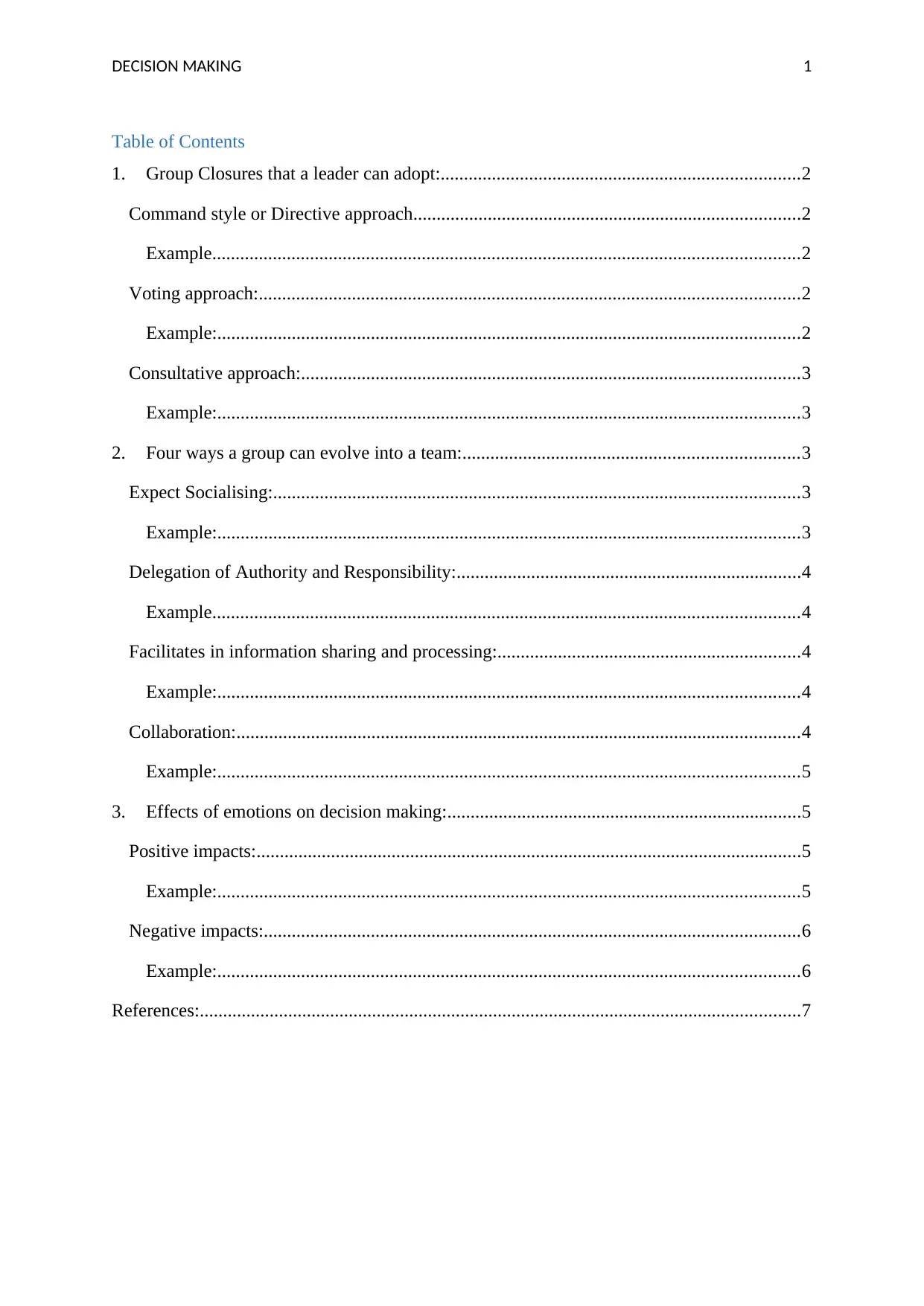
Table of Contents
1. Group Closures that a leader can adopt:.............................................................................2
Command style or Directive approach...................................................................................2
Example..............................................................................................................................2
Voting approach:....................................................................................................................2
Example:.............................................................................................................................2
Consultative approach:...........................................................................................................3
Example:.............................................................................................................................3
2. Four ways a group can evolve into a team:........................................................................3
Expect Socialising:.................................................................................................................3
Example:.............................................................................................................................3
Delegation of Authority and Responsibility:..........................................................................4
Example..............................................................................................................................4
Facilitates in information sharing and processing:.................................................................4
Example:.............................................................................................................................4
Collaboration:.........................................................................................................................4
Example:.............................................................................................................................5
3. Effects of emotions on decision making:............................................................................5
Positive impacts:.....................................................................................................................5
Example:.............................................................................................................................5
Negative impacts:...................................................................................................................6
Example:.............................................................................................................................6
References:.................................................................................................................................7
Table of Contents
1. Group Closures that a leader can adopt:.............................................................................2
Command style or Directive approach...................................................................................2
Example..............................................................................................................................2
Voting approach:....................................................................................................................2
Example:.............................................................................................................................2
Consultative approach:...........................................................................................................3
Example:.............................................................................................................................3
2. Four ways a group can evolve into a team:........................................................................3
Expect Socialising:.................................................................................................................3
Example:.............................................................................................................................3
Delegation of Authority and Responsibility:..........................................................................4
Example..............................................................................................................................4
Facilitates in information sharing and processing:.................................................................4
Example:.............................................................................................................................4
Collaboration:.........................................................................................................................4
Example:.............................................................................................................................5
3. Effects of emotions on decision making:............................................................................5
Positive impacts:.....................................................................................................................5
Example:.............................................................................................................................5
Negative impacts:...................................................................................................................6
Example:.............................................................................................................................6
References:.................................................................................................................................7
DECISION MAKING 2
1. Group Closures that a leader can adopt:
Healthy and strong closure in any group is very important. It can help the members of
the group in functioning, defining their experiences and positively fix the stage for a new
group (Kaner, 2014). Following are the closures that a leader can adopt to make decision:
Command style or Directive approach:
It is a style of decision making where leaders don’t consult with team members while
making decisions. This is an active style specifically when changes are moving rapidly and
the whole group is expecting for immediate direction. In business firms, leaders use this
approach effectively on major financial decisions and in critical situation.
Example:
While working with a consumer products manufacturing firm, a task related to
research and development of a particular product was assigned to me. A team of four
members was given to me to assist in the task. I and my team worked as per the requirements
and researched about all aspects. By following command approach I took all the final
decision by myself and directed my team to work in that manner. The final report was very
appreciated by board of directors of our company. The directive decision taken by me proved
beneficial for the whole group (Wysocki, 2010).
Voting approach:
This is one of the widely used forms to attain closure in decision making. It is done
like a democratic poll. In this process, every member of the team votes and the decision is
achieved by following majority rules. This form of closure is effective when the result of the
decision marks the entire group. But in a rapid changing business environment, this form is
does not work in most efficient way. In a business firm, this form of group decision making
can help in shaping the culture when the members are permitted to express their opinion by
vote (Hwang & Lin, 2012).
Example:
When I was working in a marketing firm as a senior manager, I needed to hire an
assistant manager for help. For selecting of assistant manager, I followed voting approach to
know the employees willingness and prevent any opposition. All the employees appreciated
this step and elected a senior and experienced person as an assistant manager.
1. Group Closures that a leader can adopt:
Healthy and strong closure in any group is very important. It can help the members of
the group in functioning, defining their experiences and positively fix the stage for a new
group (Kaner, 2014). Following are the closures that a leader can adopt to make decision:
Command style or Directive approach:
It is a style of decision making where leaders don’t consult with team members while
making decisions. This is an active style specifically when changes are moving rapidly and
the whole group is expecting for immediate direction. In business firms, leaders use this
approach effectively on major financial decisions and in critical situation.
Example:
While working with a consumer products manufacturing firm, a task related to
research and development of a particular product was assigned to me. A team of four
members was given to me to assist in the task. I and my team worked as per the requirements
and researched about all aspects. By following command approach I took all the final
decision by myself and directed my team to work in that manner. The final report was very
appreciated by board of directors of our company. The directive decision taken by me proved
beneficial for the whole group (Wysocki, 2010).
Voting approach:
This is one of the widely used forms to attain closure in decision making. It is done
like a democratic poll. In this process, every member of the team votes and the decision is
achieved by following majority rules. This form of closure is effective when the result of the
decision marks the entire group. But in a rapid changing business environment, this form is
does not work in most efficient way. In a business firm, this form of group decision making
can help in shaping the culture when the members are permitted to express their opinion by
vote (Hwang & Lin, 2012).
Example:
When I was working in a marketing firm as a senior manager, I needed to hire an
assistant manager for help. For selecting of assistant manager, I followed voting approach to
know the employees willingness and prevent any opposition. All the employees appreciated
this step and elected a senior and experienced person as an assistant manager.
⊘ This is a preview!⊘
Do you want full access?
Subscribe today to unlock all pages.

Trusted by 1+ million students worldwide
DECISION MAKING 3
Consultative approach:
It is an approach where leaders are allowed to gather their team and consult the matter
with team members to take final decisions. However, right of making final decision lies in the
hands of the leader only. This style of decision making is time consuming than others two
approaches. If it is used appropriately, it can lead to more nimble, more educated and
engaged personnel. It is used when leaders have sufficient time to make their decision on
major issue and needs suggestions from employees who can be openly affected by the
decisions (Levi, 2015).
Example:
I was employed by a telecommunication service provider. I and my team of four members
were assigned a task to organise an event to inform customers about the new plans and
services. For this purpose I used consultative approach and exchange our ideas with one
another. The event took place successfully and liked by the customers and managers too. The
event resulted in increasing in our sales and walk-in of customers.
2. Four ways a group can evolve into a team:
A group is a gathering of individuals who organise their separate determinations. On
the other hand, a team is a collection of people who share a lot of puzzling aims and common
team objectives. Mutual commitment to the objectives is an essential feature of a team. This
mutual understanding and commitment creates combined responsibility which helps to form a
durable bond and motivation to accomplish the task (DiTullio, 2010). Following are the ways
to develop an efficient team from a group:
Expect Socialising:
This step involves developing the interaction and conversation among the employees.
Members of a good team should possess good communications and interpersonal interactions
with each other. This will help them to complete the given task more efficiently with the
support of one another. The leader should reserve some time for this purpose by organising
some socialising activities like playing indoor games, going for a lunch with team members
so that they can interact with each other in positive manner (Aldag & Kuzuhara, 2015).
Example:
Consultative approach:
It is an approach where leaders are allowed to gather their team and consult the matter
with team members to take final decisions. However, right of making final decision lies in the
hands of the leader only. This style of decision making is time consuming than others two
approaches. If it is used appropriately, it can lead to more nimble, more educated and
engaged personnel. It is used when leaders have sufficient time to make their decision on
major issue and needs suggestions from employees who can be openly affected by the
decisions (Levi, 2015).
Example:
I was employed by a telecommunication service provider. I and my team of four members
were assigned a task to organise an event to inform customers about the new plans and
services. For this purpose I used consultative approach and exchange our ideas with one
another. The event took place successfully and liked by the customers and managers too. The
event resulted in increasing in our sales and walk-in of customers.
2. Four ways a group can evolve into a team:
A group is a gathering of individuals who organise their separate determinations. On
the other hand, a team is a collection of people who share a lot of puzzling aims and common
team objectives. Mutual commitment to the objectives is an essential feature of a team. This
mutual understanding and commitment creates combined responsibility which helps to form a
durable bond and motivation to accomplish the task (DiTullio, 2010). Following are the ways
to develop an efficient team from a group:
Expect Socialising:
This step involves developing the interaction and conversation among the employees.
Members of a good team should possess good communications and interpersonal interactions
with each other. This will help them to complete the given task more efficiently with the
support of one another. The leader should reserve some time for this purpose by organising
some socialising activities like playing indoor games, going for a lunch with team members
so that they can interact with each other in positive manner (Aldag & Kuzuhara, 2015).
Example:
Paraphrase This Document
Need a fresh take? Get an instant paraphrase of this document with our AI Paraphraser
DECISION MAKING 4
Once I was given a task to managing a product launching event. A group was
assigned to me to accomplish the task. Since I and my group were new to each other, I
decided to go for a lunch with my group to interact with all of them. This step proved very
beneficial because after the casual meeting at lunch, we all were able to communicate with
one another.
Delegation of Authority and Responsibility:
At this stage a leader should decide the roles and responsibilities of each person
within the organisation. Division of labour includes distributing the tasks in the system,
assigning their authorities with their responsibilities. In this stage leader needs to make
decisions about the expectations from every team member and convey the same to all
members. Leaders are also required to suggest the best possible ways to employees to fulfil
the tasks assigned to them (Harvard Business Review, 2014).
Example:
At this stage, I assigned tasks to the group members according to their specialization.
I organised the entire framework and encouraged the members time to time by words or by
action.
Facilitates in information sharing and processing:
Sharing of knowledge and information is the sign of a good and efficient team
management. After completion the given tasks and all important activities, members may feel
to sharing the information with each other in order to achieve the desired results in effective
manner. So, it is the responsibility of leaders to create an environment where employees can
share information and help to each other (Griffith & Jessica, 2014).
Example:
At this stage I gave permission to my team members to share their knowledge and
information after completing their own tasks. This step resulted in completing all the
requirements of organising the events before time.
Collaboration:
This is the stage where a group is almost converted into a team. All is need is just to
work together to attain the desired results with the cooperation of all members. At this stage
members are well known to each other and wishes to help each other. All group members
work together following the principle of “one for all and all for one” (Sawyer, 2017).
Once I was given a task to managing a product launching event. A group was
assigned to me to accomplish the task. Since I and my group were new to each other, I
decided to go for a lunch with my group to interact with all of them. This step proved very
beneficial because after the casual meeting at lunch, we all were able to communicate with
one another.
Delegation of Authority and Responsibility:
At this stage a leader should decide the roles and responsibilities of each person
within the organisation. Division of labour includes distributing the tasks in the system,
assigning their authorities with their responsibilities. In this stage leader needs to make
decisions about the expectations from every team member and convey the same to all
members. Leaders are also required to suggest the best possible ways to employees to fulfil
the tasks assigned to them (Harvard Business Review, 2014).
Example:
At this stage, I assigned tasks to the group members according to their specialization.
I organised the entire framework and encouraged the members time to time by words or by
action.
Facilitates in information sharing and processing:
Sharing of knowledge and information is the sign of a good and efficient team
management. After completion the given tasks and all important activities, members may feel
to sharing the information with each other in order to achieve the desired results in effective
manner. So, it is the responsibility of leaders to create an environment where employees can
share information and help to each other (Griffith & Jessica, 2014).
Example:
At this stage I gave permission to my team members to share their knowledge and
information after completing their own tasks. This step resulted in completing all the
requirements of organising the events before time.
Collaboration:
This is the stage where a group is almost converted into a team. All is need is just to
work together to attain the desired results with the cooperation of all members. At this stage
members are well known to each other and wishes to help each other. All group members
work together following the principle of “one for all and all for one” (Sawyer, 2017).
DECISION MAKING 5
Example:
After all preparations I and my team organised a very successful event which was liked
by the board of directors as well as the audience. The personal and social bods between the
team members resulted in achieving desired result in effective manner.
3. Effects of emotions on decision making:
Emotions are the decisions regarding the extent to which present state meets the
desired objectives. Emotions can also be explained as the name of a compound psychological
situation including three different factors- a sensitive behaviour or response, a particular
experience, and a physical reaction. It is said that emotional people mostly make emotions
based decisions rather than considering other facts. According to research, when a person is
in positive state, he will automatically make positive decisions and if he is facing some
negative situations or emotions, there will be more chances to make a negative decision.
Over-pessimism and over-optimism can also affect the decisions and it will caused in cloud
thinking, which may result in poor or negative decision making (Hughes & Miller, 2010).
Some of the positive and negative impacts of emotions in decisions are as follows:
Positive impacts:
An emotional decision is fast and easy in comparison to a normal decision. This is of
reactive in nature and can be used in decisions of negligible significance.
Emotion is a dominant factor when it is related to making purchase of any product.
For example the customers who are emotionally connected to a brand by some way
would always like to make purchase form the same even the evidence supports better
alternative decision.
When an employee has emotions and feelings of self-motivation than he will work
with more enthusiasm and will able to achieve higher positive results (Tan, 2012).
Example:
Once I performed a task very well in my office and got appreciation for that. At that
time, I was very happy and in excitement I picked another challenging task. My team leader
appraised me for having a risk facing nature of work. I got appraisal from senior managers
also.
Example:
After all preparations I and my team organised a very successful event which was liked
by the board of directors as well as the audience. The personal and social bods between the
team members resulted in achieving desired result in effective manner.
3. Effects of emotions on decision making:
Emotions are the decisions regarding the extent to which present state meets the
desired objectives. Emotions can also be explained as the name of a compound psychological
situation including three different factors- a sensitive behaviour or response, a particular
experience, and a physical reaction. It is said that emotional people mostly make emotions
based decisions rather than considering other facts. According to research, when a person is
in positive state, he will automatically make positive decisions and if he is facing some
negative situations or emotions, there will be more chances to make a negative decision.
Over-pessimism and over-optimism can also affect the decisions and it will caused in cloud
thinking, which may result in poor or negative decision making (Hughes & Miller, 2010).
Some of the positive and negative impacts of emotions in decisions are as follows:
Positive impacts:
An emotional decision is fast and easy in comparison to a normal decision. This is of
reactive in nature and can be used in decisions of negligible significance.
Emotion is a dominant factor when it is related to making purchase of any product.
For example the customers who are emotionally connected to a brand by some way
would always like to make purchase form the same even the evidence supports better
alternative decision.
When an employee has emotions and feelings of self-motivation than he will work
with more enthusiasm and will able to achieve higher positive results (Tan, 2012).
Example:
Once I performed a task very well in my office and got appreciation for that. At that
time, I was very happy and in excitement I picked another challenging task. My team leader
appraised me for having a risk facing nature of work. I got appraisal from senior managers
also.
⊘ This is a preview!⊘
Do you want full access?
Subscribe today to unlock all pages.
Trusted by 1+ million students worldwide
DECISION MAKING 6
Negative impacts:
Over excitement can lead to overestimation of possibilities of success. While feeling
excited about a particular task, the individual takes the risk too lightly associated with
that task. For example casinos always use loud noises and sharp lights to make the
customers more excited. Another example is taking out a huge sum of loan for
capturing an exciting opportunity can force a person to do anything. In both examples,
risks associated with the tasks are very high and they can cause to have negative result
in future.
Emotions or sadness can lead to settle low goals in comparison to the other person
having emotions of happiness. Setting out low goals can stop a person from attaining
greatest possibilities.
Anger may results in dismissing each other’s opinions and ideas of other employees
working in the organisation. This may lead to conflict among the employees. The
ultimate effect of the anger can be seen on the decision making by the leaders. For
example if one employee is angry to any other employee that he will never agree with
the opinion of that person and this will create a problem for decision maker (Hames,
2011).
Example:
Once as a senior manager in a manufacturing firm, I was assigned a task to launch an
energy drink for students. I and my team did research and development on the product and
analysed market conditions. The results of research and development were very impressive.
90% of the students liked our product. We were very happy and anxious and stepped towards
the launch. But results after the launch were not impressive. Our product did not proved
beneficial to the company and it was retrieved from the market. In the excitement and
anxiousness of research results, we took the wrong decision.
Negative impacts:
Over excitement can lead to overestimation of possibilities of success. While feeling
excited about a particular task, the individual takes the risk too lightly associated with
that task. For example casinos always use loud noises and sharp lights to make the
customers more excited. Another example is taking out a huge sum of loan for
capturing an exciting opportunity can force a person to do anything. In both examples,
risks associated with the tasks are very high and they can cause to have negative result
in future.
Emotions or sadness can lead to settle low goals in comparison to the other person
having emotions of happiness. Setting out low goals can stop a person from attaining
greatest possibilities.
Anger may results in dismissing each other’s opinions and ideas of other employees
working in the organisation. This may lead to conflict among the employees. The
ultimate effect of the anger can be seen on the decision making by the leaders. For
example if one employee is angry to any other employee that he will never agree with
the opinion of that person and this will create a problem for decision maker (Hames,
2011).
Example:
Once as a senior manager in a manufacturing firm, I was assigned a task to launch an
energy drink for students. I and my team did research and development on the product and
analysed market conditions. The results of research and development were very impressive.
90% of the students liked our product. We were very happy and anxious and stepped towards
the launch. But results after the launch were not impressive. Our product did not proved
beneficial to the company and it was retrieved from the market. In the excitement and
anxiousness of research results, we took the wrong decision.
Paraphrase This Document
Need a fresh take? Get an instant paraphrase of this document with our AI Paraphraser
DECISION MAKING 7
References:
Aldag, R., & Kuzuhara, L. (2015). Creating High Performance Teams: Applied Strategies
and Tools for Managers and Team Members. Howick Place: Routledge.
DiTullio, L. (2010). Project Team Dynamics: Enhamcing Performance, Improving Results.
Oakland: Berrett-Koehler Publishers.
Griffith, R. L., & Jessica, W. L. (2014). Leading Global Teams: Translating
Multidisciplinary Science to Practice. New York: Springer.
Hames, D. S. (2011, April 9). Negotiation: Closing Deals, Settling Disputes, and Making
Team Decisions: Closing Deals, Settling Disputes, and Making Team Decisions. Los
Angeles: SAGE Publications.
Harvard Business Review. (2014). Delegating Work (HBR 20-Minute Manager Series).
Cambridge: Harvard Business Review Press.
Hughes, M., & Miller, A. (2010). The Emotional Intelligence in Action Activities Guide. New
Jersey: John Wiley & Sons.
Hwang, C. L., & Lin, M. J. (2012). Group Decision Making under Multiple Criteria:
Methods and Applications. New York: Springer Science & Business Media.
Kaner, S. (2014). Facilitator's Guide to Participatory Decision-Making (3rd ed.). New
Jersey: John Wiley & Sons.
Levi, D. (2015). Group Dynamics for Teams. California: Sage Publications.
Sawyer, K. (2017). Group Genius: The Creative Power of Collaboration (2nd ed.). New
York: Hachette.
Tan, H. (2012). Technology for Education and Learning. Berlin: Springer Science &
Business Media.
Wysocki, R. K. (2010). Effective Project Management: Traditional, Adaptive, Extreme (4
ed.). New Jersey: John Wiley & Sons.
References:
Aldag, R., & Kuzuhara, L. (2015). Creating High Performance Teams: Applied Strategies
and Tools for Managers and Team Members. Howick Place: Routledge.
DiTullio, L. (2010). Project Team Dynamics: Enhamcing Performance, Improving Results.
Oakland: Berrett-Koehler Publishers.
Griffith, R. L., & Jessica, W. L. (2014). Leading Global Teams: Translating
Multidisciplinary Science to Practice. New York: Springer.
Hames, D. S. (2011, April 9). Negotiation: Closing Deals, Settling Disputes, and Making
Team Decisions: Closing Deals, Settling Disputes, and Making Team Decisions. Los
Angeles: SAGE Publications.
Harvard Business Review. (2014). Delegating Work (HBR 20-Minute Manager Series).
Cambridge: Harvard Business Review Press.
Hughes, M., & Miller, A. (2010). The Emotional Intelligence in Action Activities Guide. New
Jersey: John Wiley & Sons.
Hwang, C. L., & Lin, M. J. (2012). Group Decision Making under Multiple Criteria:
Methods and Applications. New York: Springer Science & Business Media.
Kaner, S. (2014). Facilitator's Guide to Participatory Decision-Making (3rd ed.). New
Jersey: John Wiley & Sons.
Levi, D. (2015). Group Dynamics for Teams. California: Sage Publications.
Sawyer, K. (2017). Group Genius: The Creative Power of Collaboration (2nd ed.). New
York: Hachette.
Tan, H. (2012). Technology for Education and Learning. Berlin: Springer Science &
Business Media.
Wysocki, R. K. (2010). Effective Project Management: Traditional, Adaptive, Extreme (4
ed.). New Jersey: John Wiley & Sons.

1 out of 8


Related Documents


Your All-in-One AI-Powered Toolkit for Academic Success.
+13062052269
info@desklib.com
Available 24*7 on WhatsApp / Email
![[object Object]](/_next/static/media/star-bottom.7253800d.svg)
Unlock your academic potential
Copyright © 2020–2026 A2Z Services. All Rights Reserved. Developed and managed by ZUCOL.