Analysis of Group Dynamics: Managing Under Uncertainty Report
VerifiedAdded on 2020/04/21
|10
|2186
|78
Report
AI Summary
This report examines the challenges of managing under uncertainty, focusing on decision-making processes, leadership styles, and group dynamics within a team setting. The report details a case study where a group of students were tasked with producing a magazine, highlighting the importance of effective leadership in navigating conflicts, biases, and asymmetric information distribution. It explores cognitive biases, the impact of technology on communication, and the influence of individual personalities on decision outcomes. The report emphasizes the need for strategic decision-making, the consideration of various alternatives, and the role of emotional intelligence in fostering effective teamwork. Recommendations include reducing biases, leveraging technology, and promoting open communication to improve decision quality and team performance in uncertain environments. The author emphasizes the importance of understanding the impact of biasness on decision making and the importance of effective leadership.
Running head: MANAGING UNDER CERTAINITY
Managing Under Uncertainty
Name of the Student:
Name of the University:
Author Note:
Managing Under Uncertainty
Name of the Student:
Name of the University:
Author Note:

Paraphrase This Document
Need a fresh take? Get an instant paraphrase of this document with our AI Paraphraser
1MANAGING UNDER UNCERTAINITY
Contents
Introduction......................................................................................................................................2
Discussion........................................................................................................................................2
Critical Discussions.........................................................................................................................5
Recommendation and Conclusion...................................................................................................6
References........................................................................................................................................8
Contents
Introduction......................................................................................................................................2
Discussion........................................................................................................................................2
Critical Discussions.........................................................................................................................5
Recommendation and Conclusion...................................................................................................6
References........................................................................................................................................8
2MANAGING UNDER UNCERTAINITY
Introduction
Decision making is shaped by certain behavioral characteristics and individual
personality. Biasness is regarded as one of the major obstacle in the decision making process.
There are certain factors which lead to biasness in the team. According to me, I think decision
making is regarded as a cognitive ability and it is based on certain assumptions. Mr G was made
the leader of the group consisting of four members, Mr H, I, J and Mr G himself. He was chosen
as the leader of the group after much more chaos in the classroom. The leader who took the
responsibility prior to Mr G did not fulfill her duty in an appropriate manner. As a result, the
members disagreed with his opinion and they decided to remove him from the position. In a
group, biasness disrupts and distorts the objective contemplation which is one of the most
important issue in the decision making process. I believe that if an individual understands the
biasness in the group, it will affect the decision making process of an individual. In our group,
the leaders must use the knowledge and the information effectively which will help them to take
important decisions. It is because of this biasness the individuals who are engaged in the group
are unable to share the information under various conditions of distributed knowledge.
Moreover, this distribution is considered as asymmetric and the entire process is considered as
symmetric (Driskell, Radtke & Salas, 2003).
Discussion
The four group members were assigned with an important task. It was seen in
most of the cases that two of the group members did not actively participate in the decision
making process. The team members were assigned to write a magazine and assist the other
students for contributing good articles for the magazine. In our group, effectiveness of the group
Introduction
Decision making is shaped by certain behavioral characteristics and individual
personality. Biasness is regarded as one of the major obstacle in the decision making process.
There are certain factors which lead to biasness in the team. According to me, I think decision
making is regarded as a cognitive ability and it is based on certain assumptions. Mr G was made
the leader of the group consisting of four members, Mr H, I, J and Mr G himself. He was chosen
as the leader of the group after much more chaos in the classroom. The leader who took the
responsibility prior to Mr G did not fulfill her duty in an appropriate manner. As a result, the
members disagreed with his opinion and they decided to remove him from the position. In a
group, biasness disrupts and distorts the objective contemplation which is one of the most
important issue in the decision making process. I believe that if an individual understands the
biasness in the group, it will affect the decision making process of an individual. In our group,
the leaders must use the knowledge and the information effectively which will help them to take
important decisions. It is because of this biasness the individuals who are engaged in the group
are unable to share the information under various conditions of distributed knowledge.
Moreover, this distribution is considered as asymmetric and the entire process is considered as
symmetric (Driskell, Radtke & Salas, 2003).
Discussion
The four group members were assigned with an important task. It was seen in
most of the cases that two of the group members did not actively participate in the decision
making process. The team members were assigned to write a magazine and assist the other
students for contributing good articles for the magazine. In our group, effectiveness of the group
⊘ This is a preview!⊘
Do you want full access?
Subscribe today to unlock all pages.

Trusted by 1+ million students worldwide
3MANAGING UNDER UNCERTAINITY
decision making process was an important concern for the organization. The decision making in
group was regarded as much more costlier than individual decision making process. As Mr G
was assigned with the responsibility of leading the group, he tried hard to manage all the group
members and also motivate other members to write quality articles for the magazines. The
information asymmetric mode of the group decision making process helped us in the interaction
process within the group and it also influenced the decision making quality in the group. I think
there must be a specific type of asymmetry in the distribution of information within the group
members. In certain cases, there are specific types of asymmetries in the processing of
information which are absent in the group. The prediscussion in the distribution of information
helps in the determination of group decision and this can result in the superior decision quality.
Similarly, the team leader also carried out important discussions with the management as well as
his co-workers to find out important ways to manage the team. There must be some unique ideas
which are provided by each member in the organization. This unique information of all the group
members forms the total information which must be analyzed in the entire group. The entire
situation changes when asymmetric information is distributed among the group members and this
has different decisional implications. It has helped our group to focus on the three categories of
asymmetric information i.e. discussion bias, negotiation bias and evaluation bias. It has also
favored individual learning through group interaction when it is manifested and distributed in
certain conditions (Fjermestad, 2004). It has also the team leader in improving the quality of
decision when the information is distributed asymmetrically in the entire process. Moreover, I
think in a group decision making process there are some basic distinction on how groups are
formed and how they exert social influences on the team members.
decision making process was an important concern for the organization. The decision making in
group was regarded as much more costlier than individual decision making process. As Mr G
was assigned with the responsibility of leading the group, he tried hard to manage all the group
members and also motivate other members to write quality articles for the magazines. The
information asymmetric mode of the group decision making process helped us in the interaction
process within the group and it also influenced the decision making quality in the group. I think
there must be a specific type of asymmetry in the distribution of information within the group
members. In certain cases, there are specific types of asymmetries in the processing of
information which are absent in the group. The prediscussion in the distribution of information
helps in the determination of group decision and this can result in the superior decision quality.
Similarly, the team leader also carried out important discussions with the management as well as
his co-workers to find out important ways to manage the team. There must be some unique ideas
which are provided by each member in the organization. This unique information of all the group
members forms the total information which must be analyzed in the entire group. The entire
situation changes when asymmetric information is distributed among the group members and this
has different decisional implications. It has helped our group to focus on the three categories of
asymmetric information i.e. discussion bias, negotiation bias and evaluation bias. It has also
favored individual learning through group interaction when it is manifested and distributed in
certain conditions (Fjermestad, 2004). It has also the team leader in improving the quality of
decision when the information is distributed asymmetrically in the entire process. Moreover, I
think in a group decision making process there are some basic distinction on how groups are
formed and how they exert social influences on the team members.
Paraphrase This Document
Need a fresh take? Get an instant paraphrase of this document with our AI Paraphraser
4MANAGING UNDER UNCERTAINITY
Mr H and J tried to dissent from their original position and they are motivated by
the desire to please other. It is also seen that under informational influence the opinion of the
individual and it helps in new learning experiences. The students who were in other teams helped
us in choosing the articles which were to be included in the magazine. This has helped in
revaluating the preferred decisions in the light of the fresh information. On the other hand, there
are certain pattern of social interaction which serves as an exertion of various types of
informational influence and thus it is regarded as information pooling.
I think there are certain areas of biasness in the decision making process and this
must be taken into consideration. Mr G and J did not agree with the decision made the team
members and thus there was chaos in the team. The individuals in the group must act according
to their way and thus this will help in reducing heuristics and biasness. However, it was not the
same in our group. There are certain stages of strategic decisions which must be taken into
consideration and this is considered beneficial in the early years of business. I think the decision
makers must have a proper tendency so as to choose the default and standard action among the
various possible actions. The heuristic model also shows that there are certain strategies which
must be followed by default without any additional information and this is considered to be more
optimal in searching the information. It will also help in collecting the accurate information and
the cost of this information may be much lower (Fjermestad, 2004). As our team members were
assigned with the responsibility of collecting articles and setting up the magazine, the leader, Mr
G was put under much pressure. I think there are certain implications for designing the decision
making process in the dynamic environment so that it will help to facilitate learning and various
kinds of adaptivity (Bartel & Saavedra,2000).
Mr H and J tried to dissent from their original position and they are motivated by
the desire to please other. It is also seen that under informational influence the opinion of the
individual and it helps in new learning experiences. The students who were in other teams helped
us in choosing the articles which were to be included in the magazine. This has helped in
revaluating the preferred decisions in the light of the fresh information. On the other hand, there
are certain pattern of social interaction which serves as an exertion of various types of
informational influence and thus it is regarded as information pooling.
I think there are certain areas of biasness in the decision making process and this
must be taken into consideration. Mr G and J did not agree with the decision made the team
members and thus there was chaos in the team. The individuals in the group must act according
to their way and thus this will help in reducing heuristics and biasness. However, it was not the
same in our group. There are certain stages of strategic decisions which must be taken into
consideration and this is considered beneficial in the early years of business. I think the decision
makers must have a proper tendency so as to choose the default and standard action among the
various possible actions. The heuristic model also shows that there are certain strategies which
must be followed by default without any additional information and this is considered to be more
optimal in searching the information. It will also help in collecting the accurate information and
the cost of this information may be much lower (Fjermestad, 2004). As our team members were
assigned with the responsibility of collecting articles and setting up the magazine, the leader, Mr
G was put under much pressure. I think there are certain implications for designing the decision
making process in the dynamic environment so that it will help to facilitate learning and various
kinds of adaptivity (Bartel & Saavedra,2000).
5MANAGING UNDER UNCERTAINITY
Critical Discussions
It is important to identify the best decisions with accuracy and to check how the
alternatives of the various decision making process will help an individual. In the real world,
there are consequences whose exact and correct choices are difficult to be known and analyzed.
There may be certain level of uncertainty because these processes might be considered as vague
at the initial level (Driskell, Radtke & Salas, 2003). I think the rational decision theory which
relies on the extensive use of mathematical and logic models will help an individual to identify
the answers and analyze them accordingly in the framework. In our team, this type of approach
tried to encompass a substantial amount of the various levels of educational content which is
easier to test. These rational models cannot help in identifying or assisting the problem. It is
necessary to generate various kinds of alternatives and elements of the decision making process
must be analyzed before taking any important decisions.
In our team, the relationship between technology and decision making process
played an important role in the organization. The impact of the computer mediated
communication in the workplace suggests that there must be consistency in organizing the
computer oriented communication. As all the four team members did not have adequate
knowledge of the software’s and the designing tools which are necessary for the development of
the magazine, Mr. G had to face several challenges. The relationship between the satisfaction
level and communication must for projected so as to analyze the approaches in different
situations. It is necessary to carry out various experiments with the interpersonal and the hyper
personal dimensions of the computer mediated communication. The correlation with the act of
evaluating the effectiveness and feasibility of the communication system is important in the
workplace. In our group this will enhance the clarity and it will help in providing training to
Critical Discussions
It is important to identify the best decisions with accuracy and to check how the
alternatives of the various decision making process will help an individual. In the real world,
there are consequences whose exact and correct choices are difficult to be known and analyzed.
There may be certain level of uncertainty because these processes might be considered as vague
at the initial level (Driskell, Radtke & Salas, 2003). I think the rational decision theory which
relies on the extensive use of mathematical and logic models will help an individual to identify
the answers and analyze them accordingly in the framework. In our team, this type of approach
tried to encompass a substantial amount of the various levels of educational content which is
easier to test. These rational models cannot help in identifying or assisting the problem. It is
necessary to generate various kinds of alternatives and elements of the decision making process
must be analyzed before taking any important decisions.
In our team, the relationship between technology and decision making process
played an important role in the organization. The impact of the computer mediated
communication in the workplace suggests that there must be consistency in organizing the
computer oriented communication. As all the four team members did not have adequate
knowledge of the software’s and the designing tools which are necessary for the development of
the magazine, Mr. G had to face several challenges. The relationship between the satisfaction
level and communication must for projected so as to analyze the approaches in different
situations. It is necessary to carry out various experiments with the interpersonal and the hyper
personal dimensions of the computer mediated communication. The correlation with the act of
evaluating the effectiveness and feasibility of the communication system is important in the
workplace. In our group this will enhance the clarity and it will help in providing training to
⊘ This is a preview!⊘
Do you want full access?
Subscribe today to unlock all pages.
Trusted by 1+ million students worldwide
6MANAGING UNDER UNCERTAINITY
other students (Barsade, 2002). The exposure to various kinds of collaborative output in
organizing this decision making process will help an individual to complete the task successfully.
I think there must be certain interrogative parameters which are to be derived in the decision
making process with certain recommendations.
In our group, the team members depend on affective homogeneity and written
words and this will become an unlikely outcome in the future. I think the team members must be
encouraged by advancement in their knowledge and thus it has a direct impact o the emotional
group of people. It is also important to conduct further research by providing a separate
framework of emotional influences in the group. I think that when the team members, Mr G, H, I
and J communicates with other person in other group, it becomes easier to clear the
misunderstandings which has occurred and thus they can work for the development of the
magazine. Moreover, I also think that communication helps in sharing the emotions and concerns
of an individual. It can make a person happy, supportive and lovable.
Recommendation and Conclusion
Thus, it can be said that the background and experience of the people reveals that
there are some biasness in the decision making process. There must be certain important factors
are associated in the decision making process of an individual as it includes various risk taking
factors. The increasing use of technology in the decision making process will help to reduce the
biaseness. The use of technology in the decision making process by removing the human
experiences factors are analyzed in various aspects.
Thus, it is important to work with the decision making process and identify the
answers that weigh alternatives within the framework. There are certain strategic factors which
other students (Barsade, 2002). The exposure to various kinds of collaborative output in
organizing this decision making process will help an individual to complete the task successfully.
I think there must be certain interrogative parameters which are to be derived in the decision
making process with certain recommendations.
In our group, the team members depend on affective homogeneity and written
words and this will become an unlikely outcome in the future. I think the team members must be
encouraged by advancement in their knowledge and thus it has a direct impact o the emotional
group of people. It is also important to conduct further research by providing a separate
framework of emotional influences in the group. I think that when the team members, Mr G, H, I
and J communicates with other person in other group, it becomes easier to clear the
misunderstandings which has occurred and thus they can work for the development of the
magazine. Moreover, I also think that communication helps in sharing the emotions and concerns
of an individual. It can make a person happy, supportive and lovable.
Recommendation and Conclusion
Thus, it can be said that the background and experience of the people reveals that
there are some biasness in the decision making process. There must be certain important factors
are associated in the decision making process of an individual as it includes various risk taking
factors. The increasing use of technology in the decision making process will help to reduce the
biaseness. The use of technology in the decision making process by removing the human
experiences factors are analyzed in various aspects.
Thus, it is important to work with the decision making process and identify the
answers that weigh alternatives within the framework. There are certain strategic factors which
Paraphrase This Document
Need a fresh take? Get an instant paraphrase of this document with our AI Paraphraser
7MANAGING UNDER UNCERTAINITY
must be developed by the leaders in the organization and this will help in the strategic decision
making process. Therefore, to develop and identify an important cue, it is necessary to
accomplish an individual’s expectations.
must be developed by the leaders in the organization and this will help in the strategic decision
making process. Therefore, to develop and identify an important cue, it is necessary to
accomplish an individual’s expectations.
8MANAGING UNDER UNCERTAINITY
References
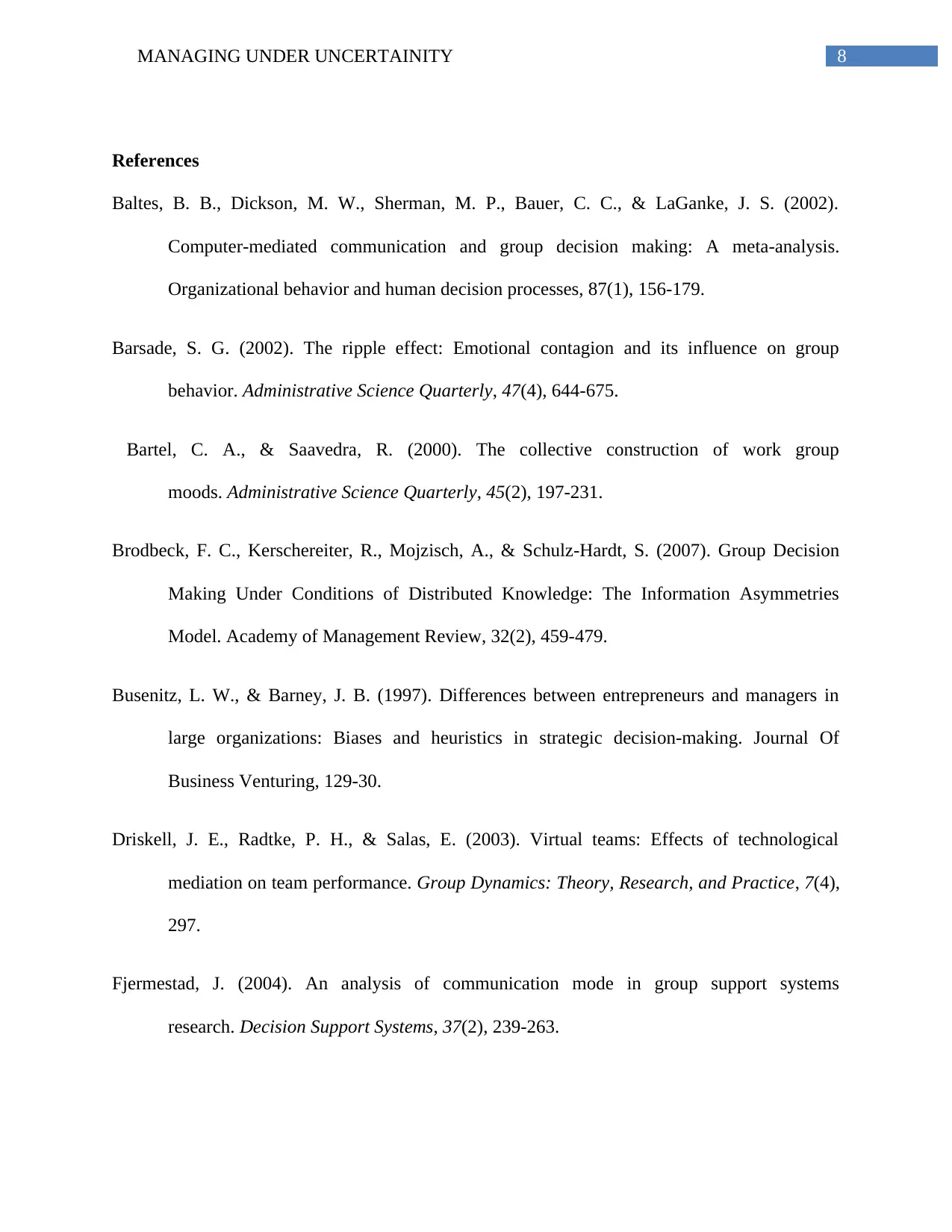
Baltes, B. B., Dickson, M. W., Sherman, M. P., Bauer, C. C., & LaGanke, J. S. (2002).
Computer-mediated communication and group decision making: A meta-analysis.
Organizational behavior and human decision processes, 87(1), 156-179.
Barsade, S. G. (2002). The ripple effect: Emotional contagion and its influence on group
behavior. Administrative Science Quarterly, 47(4), 644-675.
Bartel, C. A., & Saavedra, R. (2000). The collective construction of work group
moods. Administrative Science Quarterly, 45(2), 197-231.
Brodbeck, F. C., Kerschereiter, R., Mojzisch, A., & Schulz-Hardt, S. (2007). Group Decision
Making Under Conditions of Distributed Knowledge: The Information Asymmetries
Model. Academy of Management Review, 32(2), 459-479.
Busenitz, L. W., & Barney, J. B. (1997). Differences between entrepreneurs and managers in
large organizations: Biases and heuristics in strategic decision-making. Journal Of
Business Venturing, 129-30.
Driskell, J. E., Radtke, P. H., & Salas, E. (2003). Virtual teams: Effects of technological
mediation on team performance. Group Dynamics: Theory, Research, and Practice, 7(4),
297.
Fjermestad, J. (2004). An analysis of communication mode in group support systems
research. Decision Support Systems, 37(2), 239-263.
References
Baltes, B. B., Dickson, M. W., Sherman, M. P., Bauer, C. C., & LaGanke, J. S. (2002).
Computer-mediated communication and group decision making: A meta-analysis.
Organizational behavior and human decision processes, 87(1), 156-179.
Barsade, S. G. (2002). The ripple effect: Emotional contagion and its influence on group
behavior. Administrative Science Quarterly, 47(4), 644-675.
Bartel, C. A., & Saavedra, R. (2000). The collective construction of work group
moods. Administrative Science Quarterly, 45(2), 197-231.
Brodbeck, F. C., Kerschereiter, R., Mojzisch, A., & Schulz-Hardt, S. (2007). Group Decision
Making Under Conditions of Distributed Knowledge: The Information Asymmetries
Model. Academy of Management Review, 32(2), 459-479.
Busenitz, L. W., & Barney, J. B. (1997). Differences between entrepreneurs and managers in
large organizations: Biases and heuristics in strategic decision-making. Journal Of
Business Venturing, 129-30.
Driskell, J. E., Radtke, P. H., & Salas, E. (2003). Virtual teams: Effects of technological
mediation on team performance. Group Dynamics: Theory, Research, and Practice, 7(4),
297.
Fjermestad, J. (2004). An analysis of communication mode in group support systems
research. Decision Support Systems, 37(2), 239-263.
⊘ This is a preview!⊘
Do you want full access?
Subscribe today to unlock all pages.
Trusted by 1+ million students worldwide
9MANAGING UNDER UNCERTAINITY
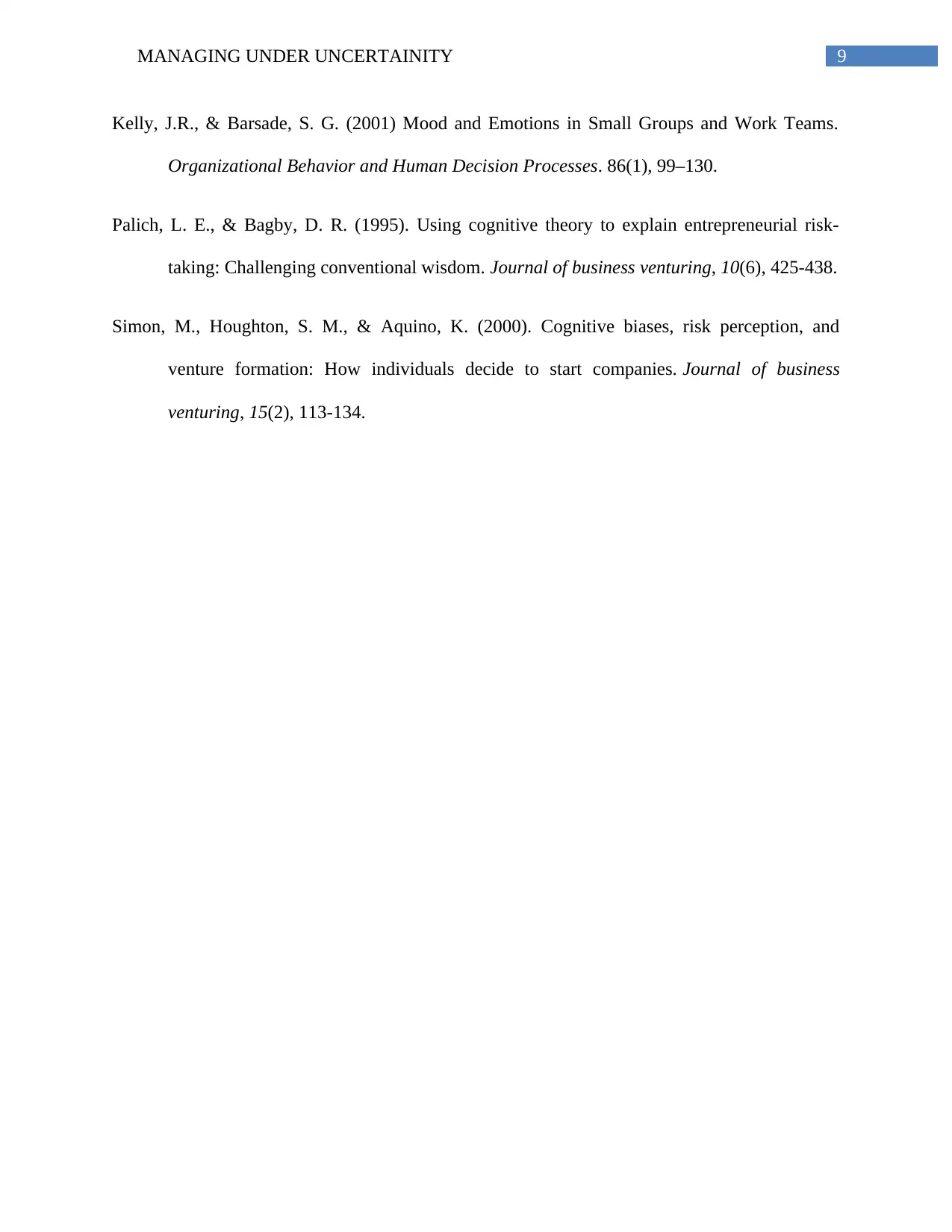
Kelly, J.R., & Barsade, S. G. (2001) Mood and Emotions in Small Groups and Work Teams.
Organizational Behavior and Human Decision Processes. 86(1), 99–130.
Palich, L. E., & Bagby, D. R. (1995). Using cognitive theory to explain entrepreneurial risk-
taking: Challenging conventional wisdom. Journal of business venturing, 10(6), 425-438.
Simon, M., Houghton, S. M., & Aquino, K. (2000). Cognitive biases, risk perception, and
venture formation: How individuals decide to start companies. Journal of business
venturing, 15(2), 113-134.
Kelly, J.R., & Barsade, S. G. (2001) Mood and Emotions in Small Groups and Work Teams.
Organizational Behavior and Human Decision Processes. 86(1), 99–130.
Palich, L. E., & Bagby, D. R. (1995). Using cognitive theory to explain entrepreneurial risk-
taking: Challenging conventional wisdom. Journal of business venturing, 10(6), 425-438.
Simon, M., Houghton, S. M., & Aquino, K. (2000). Cognitive biases, risk perception, and
venture formation: How individuals decide to start companies. Journal of business
venturing, 15(2), 113-134.

1 out of 10


Related Documents


Your All-in-One AI-Powered Toolkit for Academic Success.
+13062052269
info@desklib.com
Available 24*7 on WhatsApp / Email
![[object Object]](/_next/static/media/star-bottom.7253800d.svg)
Unlock your academic potential
Copyright © 2020–2026 A2Z Services. All Rights Reserved. Developed and managed by ZUCOL.