Applying Decision Theory: Enhancing Business Decision Making
VerifiedAdded on 2023/06/06
|15
|4602
|430
Report
AI Summary
This report delves into the practical application of decision theory within a business context, focusing on three key themes: harnessing the power of groups, leveraging big data for organizational decision-making, and avoiding biases in decision processes. It examines various group decision-making techniques such as brainstorming, Delphi method, and affinity diagrams, highlighting the importance of communication, leadership style, and clearly defined roles for group effectiveness. The report also discusses how big data is utilized to gain a 360-degree view of customers, improving customer service and strategic planning. Finally, it addresses the critical issue of cognitive biases in decision-making, offering strategies to mitigate their impact and improve the overall quality of organizational decisions. This analysis is crucial for organizations seeking to enhance their decision-making processes and achieve better outcomes.

Running head: DECISION THEORY IN PRACTISE
Business Decision Making
Name of Student:
Name of College:
Authors Note:
1| P a g e
Business Decision Making
Name of Student:
Name of College:
Authors Note:
1| P a g e

Paraphrase This Document
Need a fresh take? Get an instant paraphrase of this document with our AI Paraphraser
DECISION THEORY IN PRACTISE
Executive Summary
The process of making effective group decision is very complex in nature as it involves
considering various aspects such as the size of the group, the leadership style being practiced in
the group, communication within the group, clarity regarding roles and responsibility, norms of
the group and equal participation of the members of the group in the decision making process.
The process of taking effective group decision is also considered as very tough as it involves
various cognitive biases which possesses the ability to change the outcome of a decision and
therefore it is very important for the top management of an organization to analyse various
decisions and recommendations which are put forward by various groups as it contains different
elements of cognitive biases which ends in disrupting the operations of an organization. This
report focuses on three different themes regarding decision making in groups namely harnessing
the power of groups, big data in organizational decision making and avoiding biases in decision
making and illustrates their features and effectiveness.
2| P a g e
Executive Summary
The process of making effective group decision is very complex in nature as it involves
considering various aspects such as the size of the group, the leadership style being practiced in
the group, communication within the group, clarity regarding roles and responsibility, norms of
the group and equal participation of the members of the group in the decision making process.
The process of taking effective group decision is also considered as very tough as it involves
various cognitive biases which possesses the ability to change the outcome of a decision and
therefore it is very important for the top management of an organization to analyse various
decisions and recommendations which are put forward by various groups as it contains different
elements of cognitive biases which ends in disrupting the operations of an organization. This
report focuses on three different themes regarding decision making in groups namely harnessing
the power of groups, big data in organizational decision making and avoiding biases in decision
making and illustrates their features and effectiveness.
2| P a g e
DECISION THEORY IN PRACTISE
Contents
Executive Summary.........................................................................................................................2
Theme 1- Harnessing the power of groups......................................................................................4
Theme 2- Big Data...........................................................................................................................7
Theme 3- Avoiding bias in decision making.................................................................................10
References......................................................................................................................................14
3| P a g e
Contents
Executive Summary.........................................................................................................................2
Theme 1- Harnessing the power of groups......................................................................................4
Theme 2- Big Data...........................................................................................................................7
Theme 3- Avoiding bias in decision making.................................................................................10
References......................................................................................................................................14
3| P a g e
⊘ This is a preview!⊘
Do you want full access?
Subscribe today to unlock all pages.

Trusted by 1+ million students worldwide

DECISION THEORY IN PRACTISE
Theme 1- Harnessing the power of groups
There are various group decision making technique which are used by our organization while
taking various important decisions regarding the organization and it is ensured that all groups of
the organization have equally participated in it and have contributed equally to the decision
making process. Recently the organization is facing a dilemma regarding choosing the most
effective advertisement and promotional strategy and the top management of the organization is
seeking advice from various groups of the organization in context to selecting the most
appropriate decisions for the promotional strategy to be adopted by the company. According to
Castro, Maldonado, Garcıa, Castanón-Puga & Figueroa (2016), there are various group decision
making technique which can be implemented in the current situation such as Delphi technique,
brainstorming technique and affinity diagram.
Brainstorming- The brainstorming technique is one of the most popular group decision making
techniques which involves group of people sitting around a table and initiating ideas in the form
of open cooperation. As opined by Trotman, Bauer & Humphreys (2015), the main focus of the
brainstorming technique is greater on the generation of idea rather than on the evaluation of the
idea and the logic behind the idea is that in case many ideas are initiated, then it is very likely
that there will be an ideal and innovative solution amongst them.
In the context of our organization a meeting could be organized presided by the top management
of the company including selected members of various groups of the company. The top
management can ask all the members of the meeting to write down their ideas on the blackboard
so that it can be visible to all the participants of the meeting and then other participants of the
meeting can be requested to improve upon the idea by providing effective suggestions against the
ideas. The main aim of the brainstorming technique of the company will be to strive for quantity
and not for quality as quality can be improved at the end. In this way every participant of the
meeting will be asked to comment and improve on the idea of others rather than criticizing it and
the most effective solution will be accepted by all at the end of the meeting.
4| P a g e
Theme 1- Harnessing the power of groups
There are various group decision making technique which are used by our organization while
taking various important decisions regarding the organization and it is ensured that all groups of
the organization have equally participated in it and have contributed equally to the decision
making process. Recently the organization is facing a dilemma regarding choosing the most
effective advertisement and promotional strategy and the top management of the organization is
seeking advice from various groups of the organization in context to selecting the most
appropriate decisions for the promotional strategy to be adopted by the company. According to
Castro, Maldonado, Garcıa, Castanón-Puga & Figueroa (2016), there are various group decision
making technique which can be implemented in the current situation such as Delphi technique,
brainstorming technique and affinity diagram.
Brainstorming- The brainstorming technique is one of the most popular group decision making
techniques which involves group of people sitting around a table and initiating ideas in the form
of open cooperation. As opined by Trotman, Bauer & Humphreys (2015), the main focus of the
brainstorming technique is greater on the generation of idea rather than on the evaluation of the
idea and the logic behind the idea is that in case many ideas are initiated, then it is very likely
that there will be an ideal and innovative solution amongst them.
In the context of our organization a meeting could be organized presided by the top management
of the company including selected members of various groups of the company. The top
management can ask all the members of the meeting to write down their ideas on the blackboard
so that it can be visible to all the participants of the meeting and then other participants of the
meeting can be requested to improve upon the idea by providing effective suggestions against the
ideas. The main aim of the brainstorming technique of the company will be to strive for quantity
and not for quality as quality can be improved at the end. In this way every participant of the
meeting will be asked to comment and improve on the idea of others rather than criticizing it and
the most effective solution will be accepted by all at the end of the meeting.
4| P a g e
Paraphrase This Document
Need a fresh take? Get an instant paraphrase of this document with our AI Paraphraser
DECISION THEORY IN PRACTISE
Delphi Technique- According to Mardani, Jusoh & Zavadskas (2015), the Delphi technique is
another group decision making method which is a modification of the brainstorming technique as
it involves reaching out to the experts and obtaining their suggestions who are physically
separated from each other and are unknown to one another until a consensus is reached.
In the context of our organization, the top management of the organization can appoint a co-
ordinator who will be responsible for sending questionnaires to various experts within the
organization who will be unfamiliar to each other and their responses will be sought. After
receiving their responses, the co-ordinator can analyse and compile the responses which will be
received and the compiled responses will be again sent back to the experts in the form of another
questionnaire and their responses will be sought and this process will continue till a consensus
will be reached and after a consensus will be reached the co-ordinator can prepare a final report
in which all the solutions will be defined and the various concerning issues will also be defined.
Affinity diagram- An affinity diagram is also a useful group decision making tool which helps in
organizing data and ideas. As stated by Pangsri (2015), the affinity diagram tool is extensively
used in project management which allows large number of ideas that arises from brainstorming
sessions to be sorted into various groups based on their natural relationship for further review
and analysis. Affinity diagram is also extensively applied in provisional inspection in order to
formulate notes, understanding and observations from field interviews. The affinity diagram tool
also helps in formulating several open types of comments such as support call logs, open-ended
survey responses or any other qualitative data.
In the context of our organization, the top management should ask various groups of the
company to record the idea of each team member on cards and ask the leader of the group to
look for the ideas which seems to be related and accordingly sort the cards into groups until all
the cards have been used. After the cards will be sorted in to groups, the top management of the
company can divide large cluster in various sub-groups which will help in easy analysis and
management and once the process gets completed, the affinity diagram can be used to create a
cause and effect diagram.
The most effective group decision making technique for the above mentioned situation is
brainstorming technique as it satisfies all the factors which affect the effectiveness of a group in
5| P a g e
Delphi Technique- According to Mardani, Jusoh & Zavadskas (2015), the Delphi technique is
another group decision making method which is a modification of the brainstorming technique as
it involves reaching out to the experts and obtaining their suggestions who are physically
separated from each other and are unknown to one another until a consensus is reached.
In the context of our organization, the top management of the organization can appoint a co-
ordinator who will be responsible for sending questionnaires to various experts within the
organization who will be unfamiliar to each other and their responses will be sought. After
receiving their responses, the co-ordinator can analyse and compile the responses which will be
received and the compiled responses will be again sent back to the experts in the form of another
questionnaire and their responses will be sought and this process will continue till a consensus
will be reached and after a consensus will be reached the co-ordinator can prepare a final report
in which all the solutions will be defined and the various concerning issues will also be defined.
Affinity diagram- An affinity diagram is also a useful group decision making tool which helps in
organizing data and ideas. As stated by Pangsri (2015), the affinity diagram tool is extensively
used in project management which allows large number of ideas that arises from brainstorming
sessions to be sorted into various groups based on their natural relationship for further review
and analysis. Affinity diagram is also extensively applied in provisional inspection in order to
formulate notes, understanding and observations from field interviews. The affinity diagram tool
also helps in formulating several open types of comments such as support call logs, open-ended
survey responses or any other qualitative data.
In the context of our organization, the top management should ask various groups of the
company to record the idea of each team member on cards and ask the leader of the group to
look for the ideas which seems to be related and accordingly sort the cards into groups until all
the cards have been used. After the cards will be sorted in to groups, the top management of the
company can divide large cluster in various sub-groups which will help in easy analysis and
management and once the process gets completed, the affinity diagram can be used to create a
cause and effect diagram.
The most effective group decision making technique for the above mentioned situation is
brainstorming technique as it satisfies all the factors which affect the effectiveness of a group in
5| P a g e
DECISION THEORY IN PRACTISE
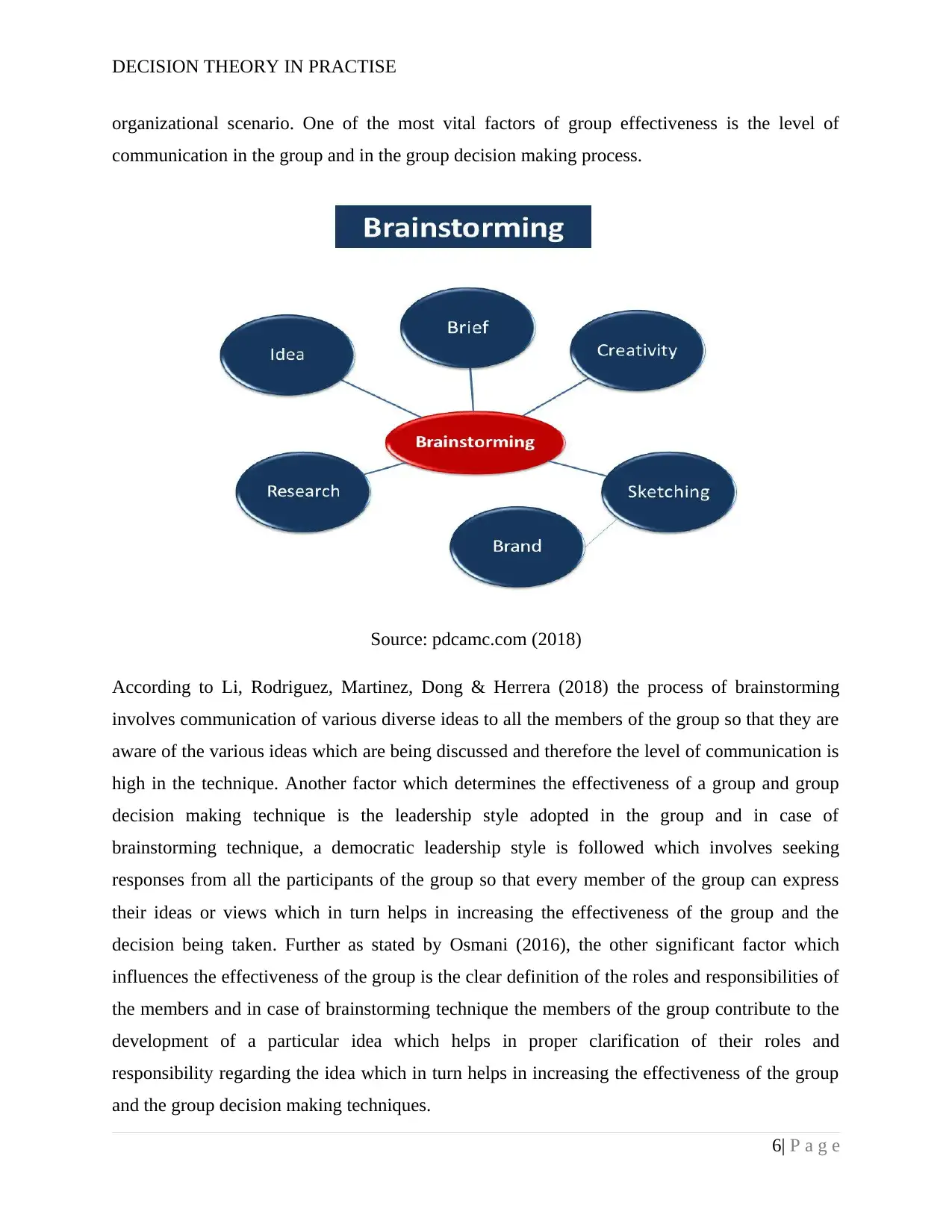
organizational scenario. One of the most vital factors of group effectiveness is the level of
communication in the group and in the group decision making process.
Source: pdcamc.com (2018)
According to Li, Rodriguez, Martinez, Dong & Herrera (2018) the process of brainstorming
involves communication of various diverse ideas to all the members of the group so that they are
aware of the various ideas which are being discussed and therefore the level of communication is
high in the technique. Another factor which determines the effectiveness of a group and group
decision making technique is the leadership style adopted in the group and in case of
brainstorming technique, a democratic leadership style is followed which involves seeking
responses from all the participants of the group so that every member of the group can express
their ideas or views which in turn helps in increasing the effectiveness of the group and the
decision being taken. Further as stated by Osmani (2016), the other significant factor which
influences the effectiveness of the group is the clear definition of the roles and responsibilities of
the members and in case of brainstorming technique the members of the group contribute to the
development of a particular idea which helps in proper clarification of their roles and
responsibility regarding the idea which in turn helps in increasing the effectiveness of the group
and the group decision making techniques.
6| P a g e
organizational scenario. One of the most vital factors of group effectiveness is the level of
communication in the group and in the group decision making process.
Source: pdcamc.com (2018)
According to Li, Rodriguez, Martinez, Dong & Herrera (2018) the process of brainstorming
involves communication of various diverse ideas to all the members of the group so that they are
aware of the various ideas which are being discussed and therefore the level of communication is
high in the technique. Another factor which determines the effectiveness of a group and group
decision making technique is the leadership style adopted in the group and in case of
brainstorming technique, a democratic leadership style is followed which involves seeking
responses from all the participants of the group so that every member of the group can express
their ideas or views which in turn helps in increasing the effectiveness of the group and the
decision being taken. Further as stated by Osmani (2016), the other significant factor which
influences the effectiveness of the group is the clear definition of the roles and responsibilities of
the members and in case of brainstorming technique the members of the group contribute to the
development of a particular idea which helps in proper clarification of their roles and
responsibility regarding the idea which in turn helps in increasing the effectiveness of the group
and the group decision making techniques.
6| P a g e
⊘ This is a preview!⊘
Do you want full access?
Subscribe today to unlock all pages.
Trusted by 1+ million students worldwide
DECISION THEORY IN PRACTISE
The specific recommendation in order to enhance the group efficaciousness in decision making
process of the organization is to invite various experts during making of important decisions in
various groups of the organization as the opinion of the experts will provide added effectiveness
in the decision which is being taken by the group. Another recommendation according to my
opinion that can improve the group effectiveness in decision making process for the organization
is to create such an environment in the group in which every member can come forward with
their various inputs without the fear of being criticized or ridiculed, no matter how weird the
input may be which will boost the confidence level of the members.
Theme 2- Big Data
According to Yin & Kaynak (2015) Big data is defined as a terminology which illustrates large
volumes of data in both structured and unstructured form which overpowers a business on a day
to day process. Big data is utilized by various organizations for better decision making and to
make strategic business decision. Also it is used in various sectors such as banking, education,
government, healthcare, manufacturing and retail sector as it is used for a variety of purposes by
firms of various sector which includes 360 degree view of customer, fraud prevention, security
intelligence, price optimization, operational efficiency, data warehouse offload, recommendation
engines, internet of things, preventive maintenance and support and social media analysis and
response in addition to the usual marketing, advertising and human resource management
activities.
Big data is currently being used in my present organization for getting a 360 degree view of the
customers of the company. My organization has utilized big data to develop a dashboard
application which helps in providing a 360 degree outlook of the customers of the firm. The
dashboard of the firm helps in collecting data from various internal and external sources and
after analysis of the data it is presented to the customer service department or sales or marketing
department in such a way which suits their requirements and helps them to perfectly carry out
their jobs.
7| P a g e
The specific recommendation in order to enhance the group efficaciousness in decision making
process of the organization is to invite various experts during making of important decisions in
various groups of the organization as the opinion of the experts will provide added effectiveness
in the decision which is being taken by the group. Another recommendation according to my
opinion that can improve the group effectiveness in decision making process for the organization
is to create such an environment in the group in which every member can come forward with
their various inputs without the fear of being criticized or ridiculed, no matter how weird the
input may be which will boost the confidence level of the members.
Theme 2- Big Data
According to Yin & Kaynak (2015) Big data is defined as a terminology which illustrates large
volumes of data in both structured and unstructured form which overpowers a business on a day
to day process. Big data is utilized by various organizations for better decision making and to
make strategic business decision. Also it is used in various sectors such as banking, education,
government, healthcare, manufacturing and retail sector as it is used for a variety of purposes by
firms of various sector which includes 360 degree view of customer, fraud prevention, security
intelligence, price optimization, operational efficiency, data warehouse offload, recommendation
engines, internet of things, preventive maintenance and support and social media analysis and
response in addition to the usual marketing, advertising and human resource management
activities.
Big data is currently being used in my present organization for getting a 360 degree view of the
customers of the company. My organization has utilized big data to develop a dashboard
application which helps in providing a 360 degree outlook of the customers of the firm. The
dashboard of the firm helps in collecting data from various internal and external sources and
after analysis of the data it is presented to the customer service department or sales or marketing
department in such a way which suits their requirements and helps them to perfectly carry out
their jobs.
7| P a g e
Paraphrase This Document
Need a fresh take? Get an instant paraphrase of this document with our AI Paraphraser
DECISION THEORY IN PRACTISE
As stated by Erevelles, Fukawa & Swayne (2016), the dashboard contains detailed information
about the existing and the potential customers of the company in the form of various
demographic data such as names of the customers, addresses of the customers, household income
of the customers and the family members of the customers and as well as various types of sales
information such as type of products the customer have bought till date from the company,
purchase patterns of the customers, preferred purchasing platform of the customers, frequency of
purchase, rate of repeat purchase and referrals made by the customers to other potential
customers. Further Gandomi & Haider (2015) states that the dashboard of the company also
retrieves information from the Customer Relationship Management (CRM) solutions of the
company regarding the past interactions of the company with the customers that provides various
links to transcripts of recent calls, emails and chat session between the company and the
customers. The dashboard of the company also displays information regarding the pages and
links of the website of the company that a particular customer has recently visited which
provides valuable information to the company regarding the reason of contacting the company
by the customer. According to Marshall et al. (2015), the dashboard of the company even helps
in displaying external information such as the recent social media posts of the customers and also
displays information regarding a particular customer’s current location if the customer has
allowed the company to install a tracking device of the company.
Big Data is used in my organization as a customer data analytics tool which helps the company
to provide better service to the customers which help in increasing the level of customer
satisfaction and also to design and implement strategies based on the demands and requirements
of the customers.
The customer insights which the company is seeking includes buying behaviour of the
customers, customer expectations regarding the products of the company, level of customer
satisfaction that the customer seeks from the company, customer demand regarding the products
which helps the company to design its future marketing strategy, advertisement strategy and
promotional strategy. According to Chen, Preston & Swink (2015), the customer insights will
enable the company to determine the pricing strategy of the products so that the customer
purchases the products non-hesitantly to push demand.
8| P a g e
As stated by Erevelles, Fukawa & Swayne (2016), the dashboard contains detailed information
about the existing and the potential customers of the company in the form of various
demographic data such as names of the customers, addresses of the customers, household income
of the customers and the family members of the customers and as well as various types of sales
information such as type of products the customer have bought till date from the company,
purchase patterns of the customers, preferred purchasing platform of the customers, frequency of
purchase, rate of repeat purchase and referrals made by the customers to other potential
customers. Further Gandomi & Haider (2015) states that the dashboard of the company also
retrieves information from the Customer Relationship Management (CRM) solutions of the
company regarding the past interactions of the company with the customers that provides various
links to transcripts of recent calls, emails and chat session between the company and the
customers. The dashboard of the company also displays information regarding the pages and
links of the website of the company that a particular customer has recently visited which
provides valuable information to the company regarding the reason of contacting the company
by the customer. According to Marshall et al. (2015), the dashboard of the company even helps
in displaying external information such as the recent social media posts of the customers and also
displays information regarding a particular customer’s current location if the customer has
allowed the company to install a tracking device of the company.
Big Data is used in my organization as a customer data analytics tool which helps the company
to provide better service to the customers which help in increasing the level of customer
satisfaction and also to design and implement strategies based on the demands and requirements
of the customers.
The customer insights which the company is seeking includes buying behaviour of the
customers, customer expectations regarding the products of the company, level of customer
satisfaction that the customer seeks from the company, customer demand regarding the products
which helps the company to design its future marketing strategy, advertisement strategy and
promotional strategy. According to Chen, Preston & Swink (2015), the customer insights will
enable the company to determine the pricing strategy of the products so that the customer
purchases the products non-hesitantly to push demand.
8| P a g e
DECISION THEORY IN PRACTISE
The data which will be required to deliver the insights of the company are various demographical
data such as the household income of the customers, disposable income of the customers,
addresses of the customers, external data such as social media activities of the customers, sales
data of the customer such as purchase frequency of the customers, purchase quantity of the
customers, average billing amount of the customers, purchasing tendency of the customers,
frequency of purchase of the customers, customer activity data such as the pages of the company
website the customer mostly visits, the offers of the product sought after by the customers,
platform of purchase of the customers and also data from the customer relationship management
system of the company such as service ratings of the customer, any issues faced by the
customers, most effective promotional activity which attracts the customers and popularity of
quality of service expected by the customers and market analysis data such as viewership rates of
the advertising campaign of the company in both online and offline platforms.
The processes which are needed to collect, collate, analyse and deliver value from the data are
big data analytics processes. Whereas the system that is required to deliver value from the data
are customer relationship management system, supply chain management system and enterprise
resource planning system. Further, the capabilities which is required to collect, collate and
deliver value from the data are high quality server of the company, highly secure database and
effective big data analytics platform.
The cost which is associated with big data analytics for the company is approximately $675,000
which includes the costs of the system along with the cost of the resources required for the
system.
As stated by Xu, Frankwick & Ramirez (2016), the main benefit of employing big data to assist
with decision making is that big data helps in making informed decision making which are based
on facts and information and not just simply on assumptions and forecasts. The other benefit of
employing big data to assist with decision making is that big data helps in enabling calculated
risk taking regarding decision making.
The recommendation for developing and improving the current capability of my organization is
to implement various advanced analytics or machine learning tools which will help the
dashboard of the organization to deliver sophisticated information such as guessing the reason of
9| P a g e
The data which will be required to deliver the insights of the company are various demographical
data such as the household income of the customers, disposable income of the customers,
addresses of the customers, external data such as social media activities of the customers, sales
data of the customer such as purchase frequency of the customers, purchase quantity of the
customers, average billing amount of the customers, purchasing tendency of the customers,
frequency of purchase of the customers, customer activity data such as the pages of the company
website the customer mostly visits, the offers of the product sought after by the customers,
platform of purchase of the customers and also data from the customer relationship management
system of the company such as service ratings of the customer, any issues faced by the
customers, most effective promotional activity which attracts the customers and popularity of
quality of service expected by the customers and market analysis data such as viewership rates of
the advertising campaign of the company in both online and offline platforms.
The processes which are needed to collect, collate, analyse and deliver value from the data are
big data analytics processes. Whereas the system that is required to deliver value from the data
are customer relationship management system, supply chain management system and enterprise
resource planning system. Further, the capabilities which is required to collect, collate and
deliver value from the data are high quality server of the company, highly secure database and
effective big data analytics platform.
The cost which is associated with big data analytics for the company is approximately $675,000
which includes the costs of the system along with the cost of the resources required for the
system.
As stated by Xu, Frankwick & Ramirez (2016), the main benefit of employing big data to assist
with decision making is that big data helps in making informed decision making which are based
on facts and information and not just simply on assumptions and forecasts. The other benefit of
employing big data to assist with decision making is that big data helps in enabling calculated
risk taking regarding decision making.
The recommendation for developing and improving the current capability of my organization is
to implement various advanced analytics or machine learning tools which will help the
dashboard of the organization to deliver sophisticated information such as guessing the reason of
9| P a g e
⊘ This is a preview!⊘
Do you want full access?
Subscribe today to unlock all pages.
Trusted by 1+ million students worldwide
DECISION THEORY IN PRACTISE
call of a customer, suggesting opportunities regarding cross-selling or up-selling consumers on
products, indicating when a customer might be in danger of switching to a competitor or has the
ability to suggest potential discounts which could lower the customer rate and possessing the
ability to detect the emotions of the customer by analysing their language and accordingly
suggesting appropriate response to the sales or marketing personnel of the company which will
in turn help in increasing the capability of my organization.
Theme 3- Avoiding bias in decision making
According to Koch, D'mello & Sackett (2015) the top management of every organization
depends on the judgement of a team which has put together a plan for a strategic action in the
organization after analysing the pros and cons which are associated with the proposal but the
problem which lies in this process is that biases invariably creeps in to the reasoning of the team
and hence often tends to distort thinking and therefore it becomes the responsibility of the top
management of the organization to review not only the contents of the recommendations put
together by a team but also review the recommendation process followed in it. Hence according
to Kahneman, Lovallo & Sibony, (2011) it is very essential for the top management of an
organization to follow the 12 question checklist approach that they have suggested to test the
significant effectiveness of a decision or decision process in order to neutralize the defects in the
thinking of the recommendation team.
All the heads of the various units of my organization have put forward a recommendation to the
top management of the company which suggest that the company should consider reviewing the
pricing policy of the products and accordingly reduce the prices in order to sustain the
competition level and to maintain the market share of the company. The heads of the various
units of my organization have discussed the issue among themselves and after gaining consensus
they have decided to recommend the same to the top management of the company. The top
management of the company have decided to analyse the recommendation put forward based on
the 12 question checklist approach in order to neutralize any defects in the recommendation.
10| P a g e
call of a customer, suggesting opportunities regarding cross-selling or up-selling consumers on
products, indicating when a customer might be in danger of switching to a competitor or has the
ability to suggest potential discounts which could lower the customer rate and possessing the
ability to detect the emotions of the customer by analysing their language and accordingly
suggesting appropriate response to the sales or marketing personnel of the company which will
in turn help in increasing the capability of my organization.
Theme 3- Avoiding bias in decision making
According to Koch, D'mello & Sackett (2015) the top management of every organization
depends on the judgement of a team which has put together a plan for a strategic action in the
organization after analysing the pros and cons which are associated with the proposal but the
problem which lies in this process is that biases invariably creeps in to the reasoning of the team
and hence often tends to distort thinking and therefore it becomes the responsibility of the top
management of the organization to review not only the contents of the recommendations put
together by a team but also review the recommendation process followed in it. Hence according
to Kahneman, Lovallo & Sibony, (2011) it is very essential for the top management of an
organization to follow the 12 question checklist approach that they have suggested to test the
significant effectiveness of a decision or decision process in order to neutralize the defects in the
thinking of the recommendation team.
All the heads of the various units of my organization have put forward a recommendation to the
top management of the company which suggest that the company should consider reviewing the
pricing policy of the products and accordingly reduce the prices in order to sustain the
competition level and to maintain the market share of the company. The heads of the various
units of my organization have discussed the issue among themselves and after gaining consensus
they have decided to recommend the same to the top management of the company. The top
management of the company have decided to analyse the recommendation put forward based on
the 12 question checklist approach in order to neutralize any defects in the recommendation.
10| P a g e
Paraphrase This Document
Need a fresh take? Get an instant paraphrase of this document with our AI Paraphraser
DECISION THEORY IN PRACTISE
Question 1- Is there any reason to suspect motivated errors, or errors driven by self-interest of
the recommending team?
Regarding above suggestion, there is a logic to doubt motivated errors or inaccuracies lead by
self-interests of the recommending teams as approval of the suggestion will lead to stable sales
of the products of the company which will lead to the achievement of the monthly or quarterly
targets of the heads of various units which will help in satisfying their self-interests and will
eventually provide them and their teams with increased job security in the company while not
considering the expectations of the shareholders of the company.
Question 2- Have the people making the recommendation fallen in love with it?
Regarding above recommendation it can be said that people giving suggestion have fallen in love
with it as they are not ready to consider and analyse any other alternative solutions to the
problem, as the people feel that that this is the best possible solution for the current situation of
the company.
Question 3- Were there dissenting opinions within the recommending team?
Regarding above recommendation it can be stated that there were dissenting opinions within the
recommending team as various dissenting members were of the view that the solution which is
being discussed might prove effective in the short run for the company but it is not a worthy
solution long term solution for the company as it will lead to disruption in the operations of the
company in the long run and also various other issues can arise on implementing the above
mentioned solution.
Question 4- Could the diagnosis of the situation be overly influenced by salient analogies?
Regarding above recommendation diagnosis of circumstance is extensively impacted by notable
analogies as the recommending team have recommended above mentioned solution after
analysing other similar organizations who had faced the same problem and has implemented the
same approach as put forward by the recommending team although the context of other
companies were different in nature.
Question 5- Have credible alternatives be considered?
11| P a g e
Question 1- Is there any reason to suspect motivated errors, or errors driven by self-interest of
the recommending team?
Regarding above suggestion, there is a logic to doubt motivated errors or inaccuracies lead by
self-interests of the recommending teams as approval of the suggestion will lead to stable sales
of the products of the company which will lead to the achievement of the monthly or quarterly
targets of the heads of various units which will help in satisfying their self-interests and will
eventually provide them and their teams with increased job security in the company while not
considering the expectations of the shareholders of the company.
Question 2- Have the people making the recommendation fallen in love with it?
Regarding above recommendation it can be said that people giving suggestion have fallen in love
with it as they are not ready to consider and analyse any other alternative solutions to the
problem, as the people feel that that this is the best possible solution for the current situation of
the company.
Question 3- Were there dissenting opinions within the recommending team?
Regarding above recommendation it can be stated that there were dissenting opinions within the
recommending team as various dissenting members were of the view that the solution which is
being discussed might prove effective in the short run for the company but it is not a worthy
solution long term solution for the company as it will lead to disruption in the operations of the
company in the long run and also various other issues can arise on implementing the above
mentioned solution.
Question 4- Could the diagnosis of the situation be overly influenced by salient analogies?
Regarding above recommendation diagnosis of circumstance is extensively impacted by notable
analogies as the recommending team have recommended above mentioned solution after
analysing other similar organizations who had faced the same problem and has implemented the
same approach as put forward by the recommending team although the context of other
companies were different in nature.
Question 5- Have credible alternatives be considered?
11| P a g e
DECISION THEORY IN PRACTISE
Regarding the given recommendation, the recommending team had considered other alternatives
in the form of introducing attractive offers and schemes related with the products of the company
or by overhauling the advertising strategy of the company but the alternatives which were
considered could not be considered as fully credible in nature.
Questions 6- If you had to make this decision again in a year, what information would you want,
and can you get more of it now?
Regarding the given recommendation if I had to take this decision again in a year the information
which I look for are the sales report of the company for the last one year, market share report of
the products of the company, inputs of the shareholders of the company, precise information of
the various issues which had arose due to the decision and information regarding the
performance of other companies and their strategies and whether there is any possibility to get
additional information currently.
Question 7- Do you know where the numbers came from?
Regarding the above recommendation it was stated in the recommendation that the numbers
came from the market analysis and market research report and were not based on estimation and
forecasts.
Question 8- Can you see a halo effect?
Regarding above suggestion a halo effect can be observed as the vast amount of experience of an
individual in the recommending team forced the other individuals of the team believe in the
credibility of the solution as the other individuals perceived the experienced individual as a very
trust-worthy individual owing to his vast amount of experiences in various organizations
spanning different sectors.
Question 9- Are the people making the recommendation overly attached to past decisions?
Regarding above recommendation, people are making suggestion extensively correlated to
previous decisions as in instance of a similar scenario when a different approach was taken by
the organization, the approach of the organization did not perform according to expectations and
12| P a g e
Regarding the given recommendation, the recommending team had considered other alternatives
in the form of introducing attractive offers and schemes related with the products of the company
or by overhauling the advertising strategy of the company but the alternatives which were
considered could not be considered as fully credible in nature.
Questions 6- If you had to make this decision again in a year, what information would you want,
and can you get more of it now?
Regarding the given recommendation if I had to take this decision again in a year the information
which I look for are the sales report of the company for the last one year, market share report of
the products of the company, inputs of the shareholders of the company, precise information of
the various issues which had arose due to the decision and information regarding the
performance of other companies and their strategies and whether there is any possibility to get
additional information currently.
Question 7- Do you know where the numbers came from?
Regarding the above recommendation it was stated in the recommendation that the numbers
came from the market analysis and market research report and were not based on estimation and
forecasts.
Question 8- Can you see a halo effect?
Regarding above suggestion a halo effect can be observed as the vast amount of experience of an
individual in the recommending team forced the other individuals of the team believe in the
credibility of the solution as the other individuals perceived the experienced individual as a very
trust-worthy individual owing to his vast amount of experiences in various organizations
spanning different sectors.
Question 9- Are the people making the recommendation overly attached to past decisions?
Regarding above recommendation, people are making suggestion extensively correlated to
previous decisions as in instance of a similar scenario when a different approach was taken by
the organization, the approach of the organization did not perform according to expectations and
12| P a g e
⊘ This is a preview!⊘
Do you want full access?
Subscribe today to unlock all pages.
Trusted by 1+ million students worldwide

1 out of 15


Related Documents


Your All-in-One AI-Powered Toolkit for Academic Success.
+13062052269
info@desklib.com
Available 24*7 on WhatsApp / Email
![[object Object]](/_next/static/media/star-bottom.7253800d.svg)
Unlock your academic potential
Copyright © 2020–2026 A2Z Services. All Rights Reserved. Developed and managed by ZUCOL.