MANA 5336 - Strategic Management Case Study: Deere & Company Analysis
VerifiedAdded on 2023/01/23
|7
|2468
|52
Case Study
AI Summary
This case study analyzes Deere & Company's strategic management in the global agricultural and construction equipment market. It begins with a Porter's Five Forces analysis to assess the competitive landscape, including buyer power, threat of substitution, supplier power, competitive rivalry, and the threat of new entrants. The analysis then examines Deere's business strategy choices, assessing how these choices have strengthened or weakened its competitive position. The study also explores Deere's international strategy, determining whether it is best characterized as a multi-domestic, global, or transnational strategy. Financial performance is evaluated using metrics like ROA, ROE, and ROIC. Finally, the case concludes with strategic recommendations for Deere's management, including the best-cost provider strategy, and considers potential strategic options like divestitures and acquisitions, along with their pros and cons.
Running head: STRATEGIC MANAGEMENT 1
Strategic Management
Name
Institution
Strategic Management
Name
Institution

Paraphrase This Document
Need a fresh take? Get an instant paraphrase of this document with our AI Paraphraser
STRATEGIC MANAGEMENT 2
STRATEGIC MANAGEMENT
1. How strong are the competitive forces confronting Deere in the global market for
agricultural and construction equipment? Do a five-forces analysis and identify the key driving
forces and key success factors to support your answer.
Porter’s Five Forces Analysis
Buyer Power: In 2013, the organization was the leading producer of forestry and
agricultural equipment globally, having a market share of 35.4%. The main competitors in the
manufacture of tractors as well as agricultural equipment comprise of AGCO Corporation that is
involved in the manufacture of Massey Ferguson, CNH Industrial N.V that manufactures Case
and New Holland tractors along with construction equipment, as well as Caterpillar Inc.
However, compared to its rivals, Deere owns buyer power. Owning a Deere equipment is unique
since it comes with complementaries such as fit and color ("John Deere Included in 2016
Business Roundtable Sustainability Report," 2017). As such, the farmers that own the
organization’s equipment remain loyal and only purchase the parts associated to Deere’s brand
name. The organization has efficiently expanded its operations to international markets and this
has enabled it to strengthen its brand name through the provision of humanitarian support.
The threat of Substitution: The business of manufacturing heavy equipment almost has
got no substitutes. The reason behind this is that producing heavy equipment is a very specialized
market and the substitutes could only comprise of using manpower as an alternative but there is
no other product that exists to perform tasks done by heavy equipment (Wortman, et al., 2012).
In addition, Deere’s aftermarket, as well as its unique color and brand color, make its products
special.
Supplier Power: Deere has effectively managed to prevent its rivals from influencing
prices as a result of supplier pricing by constructing its own supply channels. For example, Deere
established and set up manufacturing plants that were meant to support its main production line
in each of the six identified regions (Azadbakht, Shayan & Jafari, 2013). Deere primarily
focused on three businesses: Construction and Forestry Equipment along with Agriculture and
Turf equipment. In addition, the company established manufacturing plants in the United States
in areas such as Illinois, Lousiana, Wisconsin, and Lowa, North Dakota among other states
("Benefits," n.d.). Globally, the company also established manufacturing plants in main markets
that include China to assist the manufacture of equipment, large farm equipment, as well as
engines. Apart from raw materials that Deere obtains to manufacture parts, it rarely depends on
external suppliers to get support for its equipment.
Competitive Rivalry: Analyzing the company’s rivals, it is worth noting that they do not
pose any threat. With more than 1000 businesses that specialize in producing farm equipment,
Deere has managed to occupy the largest market share hence making it difficult for its rivals to
effectively outperform them (Niari, Ranjbar & Rashidi, 2012). The company’s brand, as well as
customer focus, is a good strategy that has assisted Deere to remain competitive. Branding,
product quality, customer service, performance, including innovation were among the areas that
the rival companies competed on. Overall, price competition between these companies remained
low. Hence, the rivalry was not centered on price but rather the overall value ("John Deere
STRATEGIC MANAGEMENT
1. How strong are the competitive forces confronting Deere in the global market for
agricultural and construction equipment? Do a five-forces analysis and identify the key driving
forces and key success factors to support your answer.
Porter’s Five Forces Analysis
Buyer Power: In 2013, the organization was the leading producer of forestry and
agricultural equipment globally, having a market share of 35.4%. The main competitors in the
manufacture of tractors as well as agricultural equipment comprise of AGCO Corporation that is
involved in the manufacture of Massey Ferguson, CNH Industrial N.V that manufactures Case
and New Holland tractors along with construction equipment, as well as Caterpillar Inc.
However, compared to its rivals, Deere owns buyer power. Owning a Deere equipment is unique
since it comes with complementaries such as fit and color ("John Deere Included in 2016
Business Roundtable Sustainability Report," 2017). As such, the farmers that own the
organization’s equipment remain loyal and only purchase the parts associated to Deere’s brand
name. The organization has efficiently expanded its operations to international markets and this
has enabled it to strengthen its brand name through the provision of humanitarian support.
The threat of Substitution: The business of manufacturing heavy equipment almost has
got no substitutes. The reason behind this is that producing heavy equipment is a very specialized
market and the substitutes could only comprise of using manpower as an alternative but there is
no other product that exists to perform tasks done by heavy equipment (Wortman, et al., 2012).
In addition, Deere’s aftermarket, as well as its unique color and brand color, make its products
special.
Supplier Power: Deere has effectively managed to prevent its rivals from influencing
prices as a result of supplier pricing by constructing its own supply channels. For example, Deere
established and set up manufacturing plants that were meant to support its main production line
in each of the six identified regions (Azadbakht, Shayan & Jafari, 2013). Deere primarily
focused on three businesses: Construction and Forestry Equipment along with Agriculture and
Turf equipment. In addition, the company established manufacturing plants in the United States
in areas such as Illinois, Lousiana, Wisconsin, and Lowa, North Dakota among other states
("Benefits," n.d.). Globally, the company also established manufacturing plants in main markets
that include China to assist the manufacture of equipment, large farm equipment, as well as
engines. Apart from raw materials that Deere obtains to manufacture parts, it rarely depends on
external suppliers to get support for its equipment.
Competitive Rivalry: Analyzing the company’s rivals, it is worth noting that they do not
pose any threat. With more than 1000 businesses that specialize in producing farm equipment,
Deere has managed to occupy the largest market share hence making it difficult for its rivals to
effectively outperform them (Niari, Ranjbar & Rashidi, 2012). The company’s brand, as well as
customer focus, is a good strategy that has assisted Deere to remain competitive. Branding,
product quality, customer service, performance, including innovation were among the areas that
the rival companies competed on. Overall, price competition between these companies remained
low. Hence, the rivalry was not centered on price but rather the overall value ("John Deere
STRATEGIC MANAGEMENT 3
Management Strategy," n.d.). Deere’s desire to provide equipment to the world has driven them
to identify and tailor equipment to meet their needs.
The threat of Entry: Barriers for new entrants ranged from low to medium. Nonetheless,
due to the intense rivalry among the top three rival companies, generally, new entrants were
challenged.
2. How have Deere’s business strategy choices strengthened or weakened its
competitive position in the agricultural and construction equipment industries?
Strategically, Deere focused on providing the customers with the company’s farming
equipment. In addition, it aimed at compelling a “should have got a John Deere” thought among
the farmers that used the competitors’ equipment, hence strengthening the Deere’s competitive
position (Netland, 2013). Deere’s approach of supplying all the farmers with the organization’s
equipment on a global strategy has proven effective in creating an impression about its products’
quality in the minds of customers that use the rival companies’ equipment (Team, 2014).
Nonetheless, the company’s strategy to manufacture high-quality and most reliable farm
equipment as well as providing its clients with the best customer service has continuously made
Deere a stand-alone in the industry.
Discuss how the company’s senior management has chosen to increase the horizontal or
vertical scope of the firm.
The organization’s vertical and horizontal scope involves integrating its business into a
specific region, aimed at understanding the business challenges that are face by the customer
base. Deere was of the idea that its Critical Business Factors (CBFs) comprised of understanding
the consumers at the root level, grooming as well as employing extraordinary international
associates, delivering value, along with providing a world-class distribution system ("Synergy of
Strategy, Speed, and Smarts," 2017). The CBFs were predicted from the company’s existing
foundation. Deere analyzed its operation “health and performance” on a continuous basis and
made necessary changes aimed at further improving the customer value. The organization’s
objective was to become completely committed to the customer.
3. Has Deere’s increase in scope also been a part of its international strategy?
Yes, Deere’s increase in scope has a part of its international strategy. Particularly, the
organization made plans to extend its operations as well as enhance its market share across six
main markets. The markets comprise of China, the European Union, the US and Canada, Russia,
India, and Brazil. To strategically compete in global construction as well as the agriculture
industry, the company uses various elements that include having a strong link with the market
along with the labor market (Zysman & Kenney, 2017). The organization has managed to
develop strong links with the market, - by itself, raw manufacturing prowess is not in a position
to create business success. The success of any business begins with the customer (Carpenter,
2017). Whatever Deere manufactures, the company is responsible to know what it is producing
and ensuring that it is what the customer intends to purchase. Since the focus is usually
connected to the client, the design should be right. The company maintains the feedback loop of
its customers within the design, engineering, research, as well as in the development functions.
In addition, in terms of labor flexibility, the organization has developed different kinds of
Management Strategy," n.d.). Deere’s desire to provide equipment to the world has driven them
to identify and tailor equipment to meet their needs.
The threat of Entry: Barriers for new entrants ranged from low to medium. Nonetheless,
due to the intense rivalry among the top three rival companies, generally, new entrants were
challenged.
2. How have Deere’s business strategy choices strengthened or weakened its
competitive position in the agricultural and construction equipment industries?
Strategically, Deere focused on providing the customers with the company’s farming
equipment. In addition, it aimed at compelling a “should have got a John Deere” thought among
the farmers that used the competitors’ equipment, hence strengthening the Deere’s competitive
position (Netland, 2013). Deere’s approach of supplying all the farmers with the organization’s
equipment on a global strategy has proven effective in creating an impression about its products’
quality in the minds of customers that use the rival companies’ equipment (Team, 2014).
Nonetheless, the company’s strategy to manufacture high-quality and most reliable farm
equipment as well as providing its clients with the best customer service has continuously made
Deere a stand-alone in the industry.
Discuss how the company’s senior management has chosen to increase the horizontal or
vertical scope of the firm.
The organization’s vertical and horizontal scope involves integrating its business into a
specific region, aimed at understanding the business challenges that are face by the customer
base. Deere was of the idea that its Critical Business Factors (CBFs) comprised of understanding
the consumers at the root level, grooming as well as employing extraordinary international
associates, delivering value, along with providing a world-class distribution system ("Synergy of
Strategy, Speed, and Smarts," 2017). The CBFs were predicted from the company’s existing
foundation. Deere analyzed its operation “health and performance” on a continuous basis and
made necessary changes aimed at further improving the customer value. The organization’s
objective was to become completely committed to the customer.
3. Has Deere’s increase in scope also been a part of its international strategy?
Yes, Deere’s increase in scope has a part of its international strategy. Particularly, the
organization made plans to extend its operations as well as enhance its market share across six
main markets. The markets comprise of China, the European Union, the US and Canada, Russia,
India, and Brazil. To strategically compete in global construction as well as the agriculture
industry, the company uses various elements that include having a strong link with the market
along with the labor market (Zysman & Kenney, 2017). The organization has managed to
develop strong links with the market, - by itself, raw manufacturing prowess is not in a position
to create business success. The success of any business begins with the customer (Carpenter,
2017). Whatever Deere manufactures, the company is responsible to know what it is producing
and ensuring that it is what the customer intends to purchase. Since the focus is usually
connected to the client, the design should be right. The company maintains the feedback loop of
its customers within the design, engineering, research, as well as in the development functions.
In addition, in terms of labor flexibility, the organization has developed different kinds of
⊘ This is a preview!⊘
Do you want full access?
Subscribe today to unlock all pages.

Trusted by 1+ million students worldwide
STRATEGIC MANAGEMENT 4
relationship within the United States union, best known as United Auto Workers (UAW). The
company offers its UAW staff profit-sharing schemes aimed at improving SVA and productivity
in exchange for flexibility in the work practice (Slugeň, et al., 2014). Such collegiality has
effectively been in a position to develop a relationship that is capable of handling the toughest
calls such as taking the step to close down production as Deere previously did with the
production of engines in Dubuque. It is necessary to lay it out if the organization cannot compete
in a certain market.
Is the international strategy best characterized as a multi-domestic strategy, global
strategy, or transnational strategy? Explain.
Deere’s strategy to compete internationally can best be referred to as a transnational
strategy seeking to draw an understanding between a global strategy and a multi-domestic
strategy. The company attempts to create a balance between need and efficiency with the
objective of adjusting to the local preferences in different countries (Azadbakht, et al., 2013). For
instance, the organization’s leadership would be more impelled to establish an international
strategy capable of yielding a competitive advantage in the domestic as well as continuously
growing emerging markets, aimed at capitalizing on the opportunities that are available in the
industry.
4. Is Deere’s business strategy producing good results?
ROA: is a measure of earned returns from the total assets of Deere’s stakeholders which
was 9%.
Net Profit Margin: the financial ratios show that the after-tax profits per dollar of sales
was at 9%
Gross profit Margin: the financial ratios indicate that the percentage revenue which is
accessible for covering operating expenses as well as yield profit was 32% indicating the
organization is above the industry’s standards for profit.
ROE: Deere’s return on stakeholders’ earning based on their capital investment was 34%
which is above the average returns on investment.
Operating Profit Margin: Deere’s current operations profitability excluding changes in
interest and income taxes was 84%.
Working Capital: the number of finances for Deere’s daily operations was $22,963,900
ROIC: it is a measure of the returns that the stakeholders earn on the monetary capital
which is invested in the enterprise. The ROIC is at 11% meaning that Deere effectively uses long
term debt to its advantage.
Total Returns on Assets: it is a measure of the Deere’s total return on investment which is
at 7%
Current Ratio: it shows the ability of an organization to pay current liabilities through its
assets which are converted to cash in the short-term. Deere’s current ratio is 2.05 which is above
average.
relationship within the United States union, best known as United Auto Workers (UAW). The
company offers its UAW staff profit-sharing schemes aimed at improving SVA and productivity
in exchange for flexibility in the work practice (Slugeň, et al., 2014). Such collegiality has
effectively been in a position to develop a relationship that is capable of handling the toughest
calls such as taking the step to close down production as Deere previously did with the
production of engines in Dubuque. It is necessary to lay it out if the organization cannot compete
in a certain market.
Is the international strategy best characterized as a multi-domestic strategy, global
strategy, or transnational strategy? Explain.
Deere’s strategy to compete internationally can best be referred to as a transnational
strategy seeking to draw an understanding between a global strategy and a multi-domestic
strategy. The company attempts to create a balance between need and efficiency with the
objective of adjusting to the local preferences in different countries (Azadbakht, et al., 2013). For
instance, the organization’s leadership would be more impelled to establish an international
strategy capable of yielding a competitive advantage in the domestic as well as continuously
growing emerging markets, aimed at capitalizing on the opportunities that are available in the
industry.
4. Is Deere’s business strategy producing good results?
ROA: is a measure of earned returns from the total assets of Deere’s stakeholders which
was 9%.
Net Profit Margin: the financial ratios show that the after-tax profits per dollar of sales
was at 9%
Gross profit Margin: the financial ratios indicate that the percentage revenue which is
accessible for covering operating expenses as well as yield profit was 32% indicating the
organization is above the industry’s standards for profit.
ROE: Deere’s return on stakeholders’ earning based on their capital investment was 34%
which is above the average returns on investment.
Operating Profit Margin: Deere’s current operations profitability excluding changes in
interest and income taxes was 84%.
Working Capital: the number of finances for Deere’s daily operations was $22,963,900
ROIC: it is a measure of the returns that the stakeholders earn on the monetary capital
which is invested in the enterprise. The ROIC is at 11% meaning that Deere effectively uses long
term debt to its advantage.
Total Returns on Assets: it is a measure of the Deere’s total return on investment which is
at 7%
Current Ratio: it shows the ability of an organization to pay current liabilities through its
assets which are converted to cash in the short-term. Deere’s current ratio is 2.05 which is above
average.
Paraphrase This Document
Need a fresh take? Get an instant paraphrase of this document with our AI Paraphraser
STRATEGIC MANAGEMENT 5
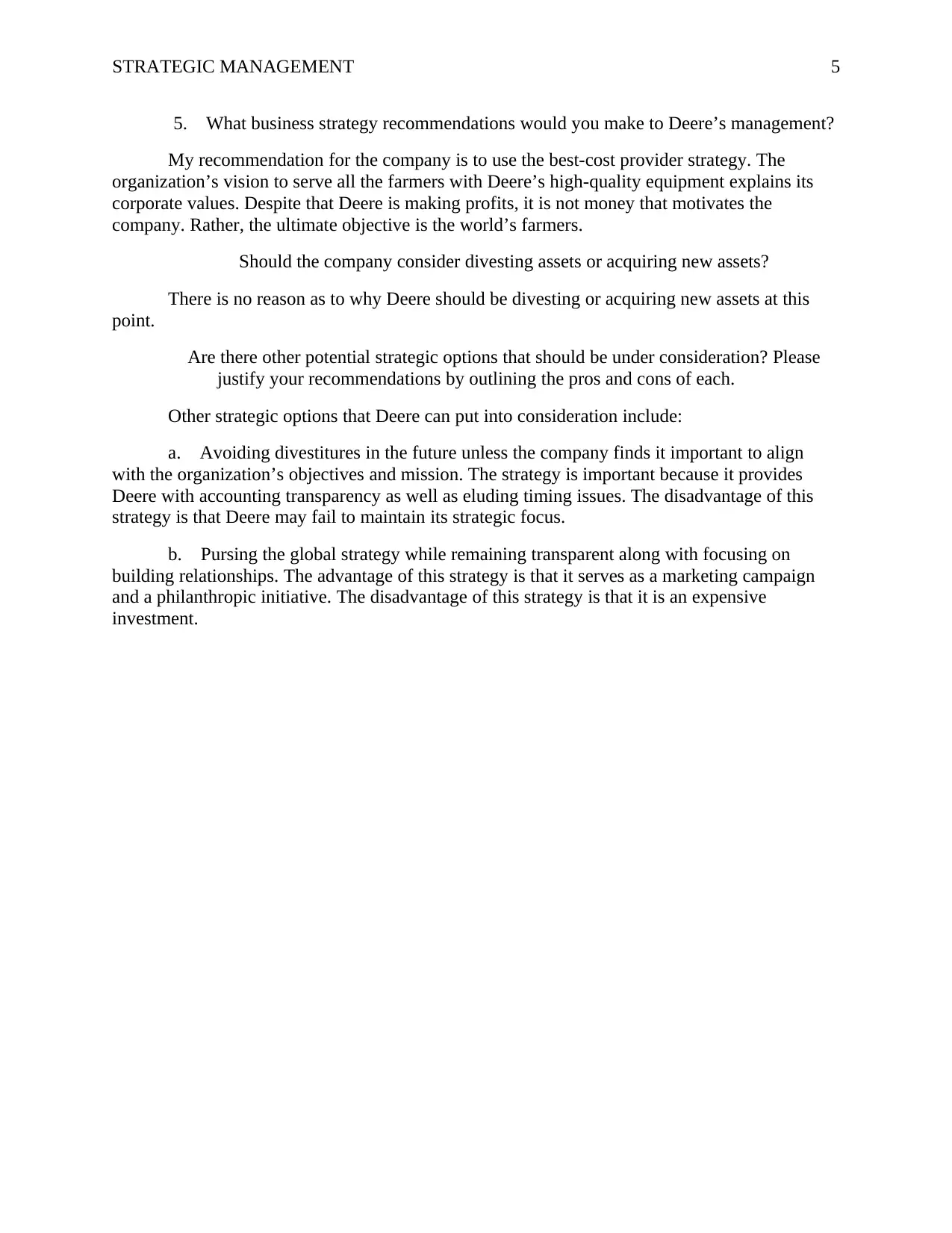
5. What business strategy recommendations would you make to Deere’s management?
My recommendation for the company is to use the best-cost provider strategy. The
organization’s vision to serve all the farmers with Deere’s high-quality equipment explains its
corporate values. Despite that Deere is making profits, it is not money that motivates the
company. Rather, the ultimate objective is the world’s farmers.
Should the company consider divesting assets or acquiring new assets?
There is no reason as to why Deere should be divesting or acquiring new assets at this
point.
Are there other potential strategic options that should be under consideration? Please
justify your recommendations by outlining the pros and cons of each.
Other strategic options that Deere can put into consideration include:
a. Avoiding divestitures in the future unless the company finds it important to align
with the organization’s objectives and mission. The strategy is important because it provides
Deere with accounting transparency as well as eluding timing issues. The disadvantage of this
strategy is that Deere may fail to maintain its strategic focus.
b. Pursing the global strategy while remaining transparent along with focusing on
building relationships. The advantage of this strategy is that it serves as a marketing campaign
and a philanthropic initiative. The disadvantage of this strategy is that it is an expensive
investment.
5. What business strategy recommendations would you make to Deere’s management?
My recommendation for the company is to use the best-cost provider strategy. The
organization’s vision to serve all the farmers with Deere’s high-quality equipment explains its
corporate values. Despite that Deere is making profits, it is not money that motivates the
company. Rather, the ultimate objective is the world’s farmers.
Should the company consider divesting assets or acquiring new assets?
There is no reason as to why Deere should be divesting or acquiring new assets at this
point.
Are there other potential strategic options that should be under consideration? Please
justify your recommendations by outlining the pros and cons of each.
Other strategic options that Deere can put into consideration include:
a. Avoiding divestitures in the future unless the company finds it important to align
with the organization’s objectives and mission. The strategy is important because it provides
Deere with accounting transparency as well as eluding timing issues. The disadvantage of this
strategy is that Deere may fail to maintain its strategic focus.
b. Pursing the global strategy while remaining transparent along with focusing on
building relationships. The advantage of this strategy is that it serves as a marketing campaign
and a philanthropic initiative. The disadvantage of this strategy is that it is an expensive
investment.
STRATEGIC MANAGEMENT 6
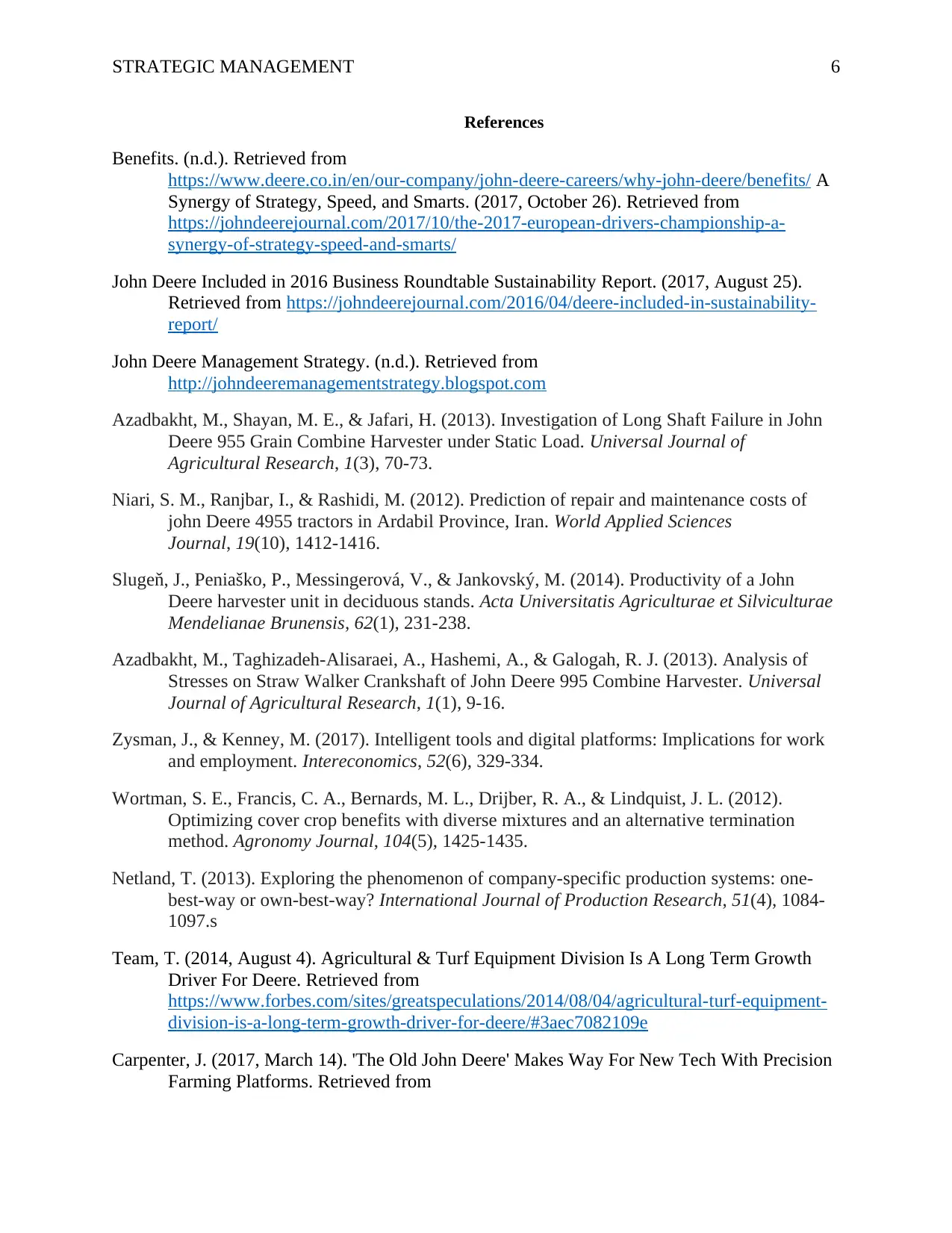
References
Benefits. (n.d.). Retrieved from
https://www.deere.co.in/en/our-company/john-deere-careers/why-john-deere/benefits/ A
Synergy of Strategy, Speed, and Smarts. (2017, October 26). Retrieved from
https://johndeerejournal.com/2017/10/the-2017-european-drivers-championship-a-
synergy-of-strategy-speed-and-smarts/
John Deere Included in 2016 Business Roundtable Sustainability Report. (2017, August 25).
Retrieved from https://johndeerejournal.com/2016/04/deere-included-in-sustainability-
report/
John Deere Management Strategy. (n.d.). Retrieved from
http://johndeeremanagementstrategy.blogspot.com
Azadbakht, M., Shayan, M. E., & Jafari, H. (2013). Investigation of Long Shaft Failure in John
Deere 955 Grain Combine Harvester under Static Load. Universal Journal of
Agricultural Research, 1(3), 70-73.
Niari, S. M., Ranjbar, I., & Rashidi, M. (2012). Prediction of repair and maintenance costs of
john Deere 4955 tractors in Ardabil Province, Iran. World Applied Sciences
Journal, 19(10), 1412-1416.
Slugeň, J., Peniaško, P., Messingerová, V., & Jankovský, M. (2014). Productivity of a John
Deere harvester unit in deciduous stands. Acta Universitatis Agriculturae et Silviculturae
Mendelianae Brunensis, 62(1), 231-238.
Azadbakht, M., Taghizadeh-Alisaraei, A., Hashemi, A., & Galogah, R. J. (2013). Analysis of
Stresses on Straw Walker Crankshaft of John Deere 995 Combine Harvester. Universal
Journal of Agricultural Research, 1(1), 9-16.
Zysman, J., & Kenney, M. (2017). Intelligent tools and digital platforms: Implications for work
and employment. Intereconomics, 52(6), 329-334.
Wortman, S. E., Francis, C. A., Bernards, M. L., Drijber, R. A., & Lindquist, J. L. (2012).
Optimizing cover crop benefits with diverse mixtures and an alternative termination
method. Agronomy Journal, 104(5), 1425-1435.
Netland, T. (2013). Exploring the phenomenon of company-specific production systems: one-
best-way or own-best-way? International Journal of Production Research, 51(4), 1084-
1097.s
Team, T. (2014, August 4). Agricultural & Turf Equipment Division Is A Long Term Growth
Driver For Deere. Retrieved from
https://www.forbes.com/sites/greatspeculations/2014/08/04/agricultural-turf-equipment-
division-is-a-long-term-growth-driver-for-deere/#3aec7082109e
Carpenter, J. (2017, March 14). 'The Old John Deere' Makes Way For New Tech With Precision
Farming Platforms. Retrieved from
References
Benefits. (n.d.). Retrieved from
https://www.deere.co.in/en/our-company/john-deere-careers/why-john-deere/benefits/ A
Synergy of Strategy, Speed, and Smarts. (2017, October 26). Retrieved from
https://johndeerejournal.com/2017/10/the-2017-european-drivers-championship-a-
synergy-of-strategy-speed-and-smarts/
John Deere Included in 2016 Business Roundtable Sustainability Report. (2017, August 25).
Retrieved from https://johndeerejournal.com/2016/04/deere-included-in-sustainability-
report/
John Deere Management Strategy. (n.d.). Retrieved from
http://johndeeremanagementstrategy.blogspot.com
Azadbakht, M., Shayan, M. E., & Jafari, H. (2013). Investigation of Long Shaft Failure in John
Deere 955 Grain Combine Harvester under Static Load. Universal Journal of
Agricultural Research, 1(3), 70-73.
Niari, S. M., Ranjbar, I., & Rashidi, M. (2012). Prediction of repair and maintenance costs of
john Deere 4955 tractors in Ardabil Province, Iran. World Applied Sciences
Journal, 19(10), 1412-1416.
Slugeň, J., Peniaško, P., Messingerová, V., & Jankovský, M. (2014). Productivity of a John
Deere harvester unit in deciduous stands. Acta Universitatis Agriculturae et Silviculturae
Mendelianae Brunensis, 62(1), 231-238.
Azadbakht, M., Taghizadeh-Alisaraei, A., Hashemi, A., & Galogah, R. J. (2013). Analysis of
Stresses on Straw Walker Crankshaft of John Deere 995 Combine Harvester. Universal
Journal of Agricultural Research, 1(1), 9-16.
Zysman, J., & Kenney, M. (2017). Intelligent tools and digital platforms: Implications for work
and employment. Intereconomics, 52(6), 329-334.
Wortman, S. E., Francis, C. A., Bernards, M. L., Drijber, R. A., & Lindquist, J. L. (2012).
Optimizing cover crop benefits with diverse mixtures and an alternative termination
method. Agronomy Journal, 104(5), 1425-1435.
Netland, T. (2013). Exploring the phenomenon of company-specific production systems: one-
best-way or own-best-way? International Journal of Production Research, 51(4), 1084-
1097.s
Team, T. (2014, August 4). Agricultural & Turf Equipment Division Is A Long Term Growth
Driver For Deere. Retrieved from
https://www.forbes.com/sites/greatspeculations/2014/08/04/agricultural-turf-equipment-
division-is-a-long-term-growth-driver-for-deere/#3aec7082109e
Carpenter, J. (2017, March 14). 'The Old John Deere' Makes Way For New Tech With Precision
Farming Platforms. Retrieved from
⊘ This is a preview!⊘
Do you want full access?
Subscribe today to unlock all pages.
Trusted by 1+ million students worldwide

STRATEGIC MANAGEMENT 7
https://www.forbes.com/sites/johncarpenter1/2017/03/13/the-old-john-deere-makes-way-
for-new-tech-with-precision-farming-platforms/#101eca5b4bdb
https://www.forbes.com/sites/johncarpenter1/2017/03/13/the-old-john-deere-makes-way-
for-new-tech-with-precision-farming-platforms/#101eca5b4bdb

1 out of 7


Related Documents


Your All-in-One AI-Powered Toolkit for Academic Success.
+13062052269
info@desklib.com
Available 24*7 on WhatsApp / Email
![[object Object]](/_next/static/media/star-bottom.7253800d.svg)
Unlock your academic potential
Copyright © 2020–2026 A2Z Services. All Rights Reserved. Developed and managed by ZUCOL.