Psychology Module: Déjà Vu, Memory Theories, and Explanations
VerifiedAdded on 2022/08/21
|4
|925
|17
Discussion Board Post
AI Summary
This discussion post explores the phenomenon of déjà vu, examining various memory theories to explain the sensation of 'already seen'. The post begins by defining déjà vu and its commonality, then delves into different theoretical perspectives. These include the Hologram Theory, which suggests that déjà vu arises when a current environment closely matches a past one, and the Dual Processing Theory, which attributes déjà vu to a neurological delay. The post also mentions the theory of 'memories of other sources', which posits that memories from external sources can trigger déjà vu. Additionally, the Leeds Memory group's research on brain processes involved in recognition is discussed. The post concludes by emphasizing the need for further research in this area, highlighting that multiple memory theories offer insights into the experience of déjà vu.
Running head: Déjà Vu
DÉJÀ VU
DÉJÀ VU
Paraphrase This Document
Need a fresh take? Get an instant paraphrase of this document with our AI Paraphraser

1
Déjà Vu
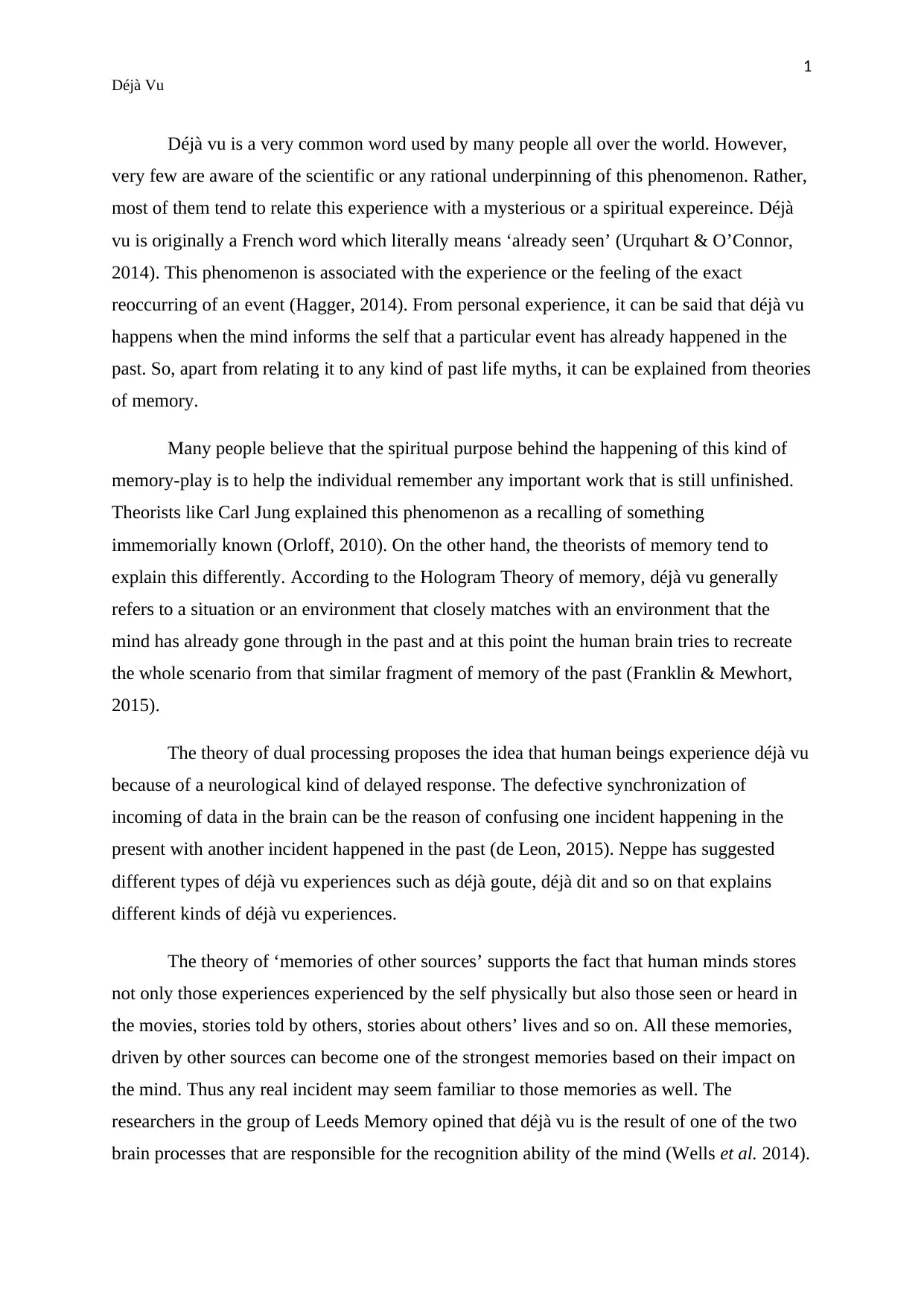
Déjà vu is a very common word used by many people all over the world. However,
very few are aware of the scientific or any rational underpinning of this phenomenon. Rather,
most of them tend to relate this experience with a mysterious or a spiritual expereince. Déjà
vu is originally a French word which literally means ‘already seen’ (Urquhart & O’Connor,
2014). This phenomenon is associated with the experience or the feeling of the exact
reoccurring of an event (Hagger, 2014). From personal experience, it can be said that déjà vu
happens when the mind informs the self that a particular event has already happened in the
past. So, apart from relating it to any kind of past life myths, it can be explained from theories
of memory.
Many people believe that the spiritual purpose behind the happening of this kind of
memory-play is to help the individual remember any important work that is still unfinished.
Theorists like Carl Jung explained this phenomenon as a recalling of something
immemorially known (Orloff, 2010). On the other hand, the theorists of memory tend to
explain this differently. According to the Hologram Theory of memory, déjà vu generally
refers to a situation or an environment that closely matches with an environment that the
mind has already gone through in the past and at this point the human brain tries to recreate
the whole scenario from that similar fragment of memory of the past (Franklin & Mewhort,
2015).
The theory of dual processing proposes the idea that human beings experience déjà vu
because of a neurological kind of delayed response. The defective synchronization of
incoming of data in the brain can be the reason of confusing one incident happening in the
present with another incident happened in the past (de Leon, 2015). Neppe has suggested
different types of déjà vu experiences such as déjà goute, déjà dit and so on that explains
different kinds of déjà vu experiences.
The theory of ‘memories of other sources’ supports the fact that human minds stores
not only those experiences experienced by the self physically but also those seen or heard in
the movies, stories told by others, stories about others’ lives and so on. All these memories,
driven by other sources can become one of the strongest memories based on their impact on
the mind. Thus any real incident may seem familiar to those memories as well. The
researchers in the group of Leeds Memory opined that déjà vu is the result of one of the two
brain processes that are responsible for the recognition ability of the mind (Wells et al. 2014).
Déjà Vu
Déjà vu is a very common word used by many people all over the world. However,
very few are aware of the scientific or any rational underpinning of this phenomenon. Rather,
most of them tend to relate this experience with a mysterious or a spiritual expereince. Déjà
vu is originally a French word which literally means ‘already seen’ (Urquhart & O’Connor,
2014). This phenomenon is associated with the experience or the feeling of the exact
reoccurring of an event (Hagger, 2014). From personal experience, it can be said that déjà vu
happens when the mind informs the self that a particular event has already happened in the
past. So, apart from relating it to any kind of past life myths, it can be explained from theories
of memory.
Many people believe that the spiritual purpose behind the happening of this kind of
memory-play is to help the individual remember any important work that is still unfinished.
Theorists like Carl Jung explained this phenomenon as a recalling of something
immemorially known (Orloff, 2010). On the other hand, the theorists of memory tend to
explain this differently. According to the Hologram Theory of memory, déjà vu generally
refers to a situation or an environment that closely matches with an environment that the
mind has already gone through in the past and at this point the human brain tries to recreate
the whole scenario from that similar fragment of memory of the past (Franklin & Mewhort,
2015).
The theory of dual processing proposes the idea that human beings experience déjà vu
because of a neurological kind of delayed response. The defective synchronization of
incoming of data in the brain can be the reason of confusing one incident happening in the
present with another incident happened in the past (de Leon, 2015). Neppe has suggested
different types of déjà vu experiences such as déjà goute, déjà dit and so on that explains
different kinds of déjà vu experiences.
The theory of ‘memories of other sources’ supports the fact that human minds stores
not only those experiences experienced by the self physically but also those seen or heard in
the movies, stories told by others, stories about others’ lives and so on. All these memories,
driven by other sources can become one of the strongest memories based on their impact on
the mind. Thus any real incident may seem familiar to those memories as well. The
researchers in the group of Leeds Memory opined that déjà vu is the result of one of the two
brain processes that are responsible for the recognition ability of the mind (Wells et al. 2014).

2
Déjà Vu
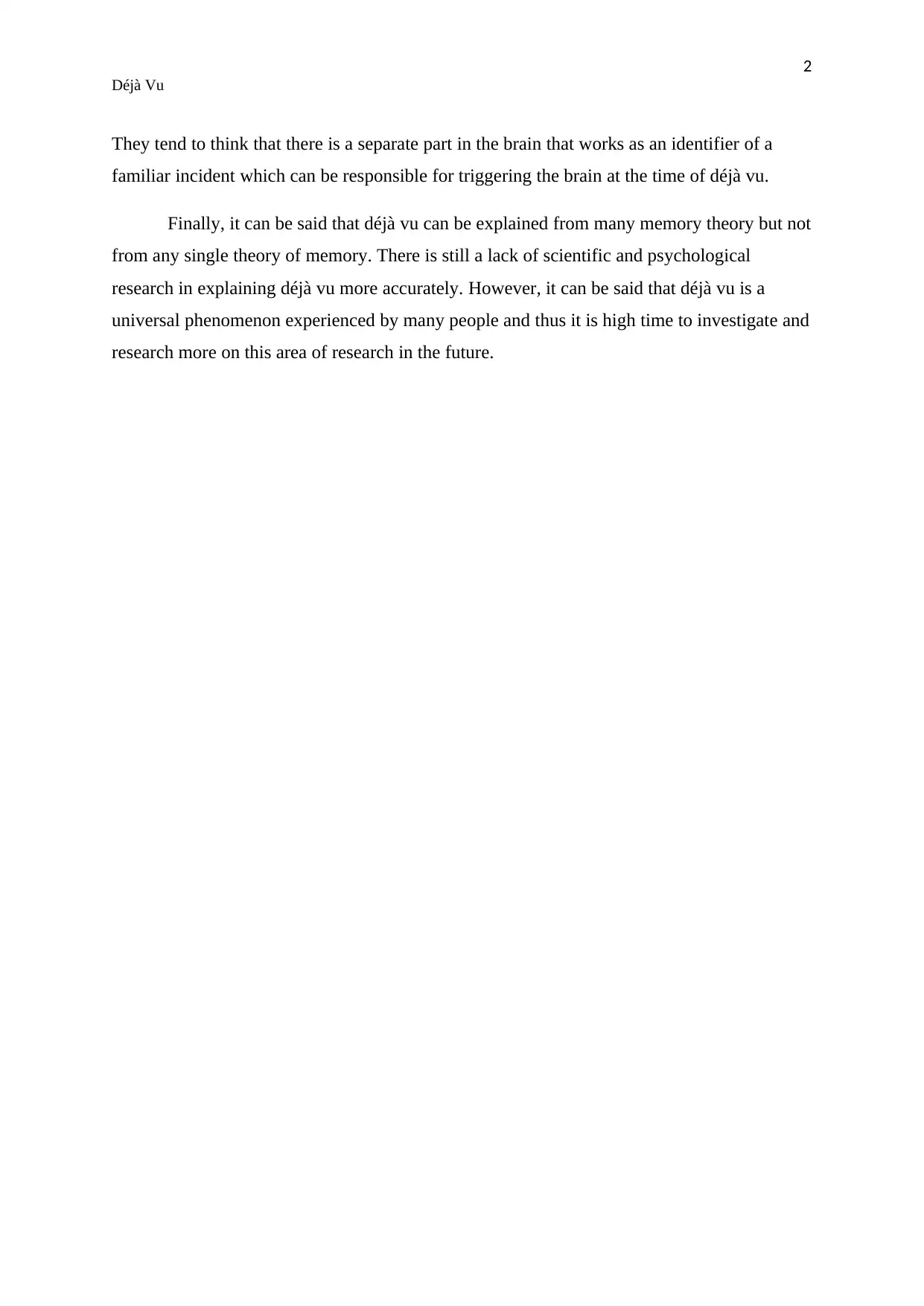
They tend to think that there is a separate part in the brain that works as an identifier of a
familiar incident which can be responsible for triggering the brain at the time of déjà vu.
Finally, it can be said that déjà vu can be explained from many memory theory but not
from any single theory of memory. There is still a lack of scientific and psychological
research in explaining déjà vu more accurately. However, it can be said that déjà vu is a
universal phenomenon experienced by many people and thus it is high time to investigate and
research more on this area of research in the future.
Déjà Vu
They tend to think that there is a separate part in the brain that works as an identifier of a
familiar incident which can be responsible for triggering the brain at the time of déjà vu.
Finally, it can be said that déjà vu can be explained from many memory theory but not
from any single theory of memory. There is still a lack of scientific and psychological
research in explaining déjà vu more accurately. However, it can be said that déjà vu is a
universal phenomenon experienced by many people and thus it is high time to investigate and
research more on this area of research in the future.
⊘ This is a preview!⊘
Do you want full access?
Subscribe today to unlock all pages.

Trusted by 1+ million students worldwide

3
Déjà Vu
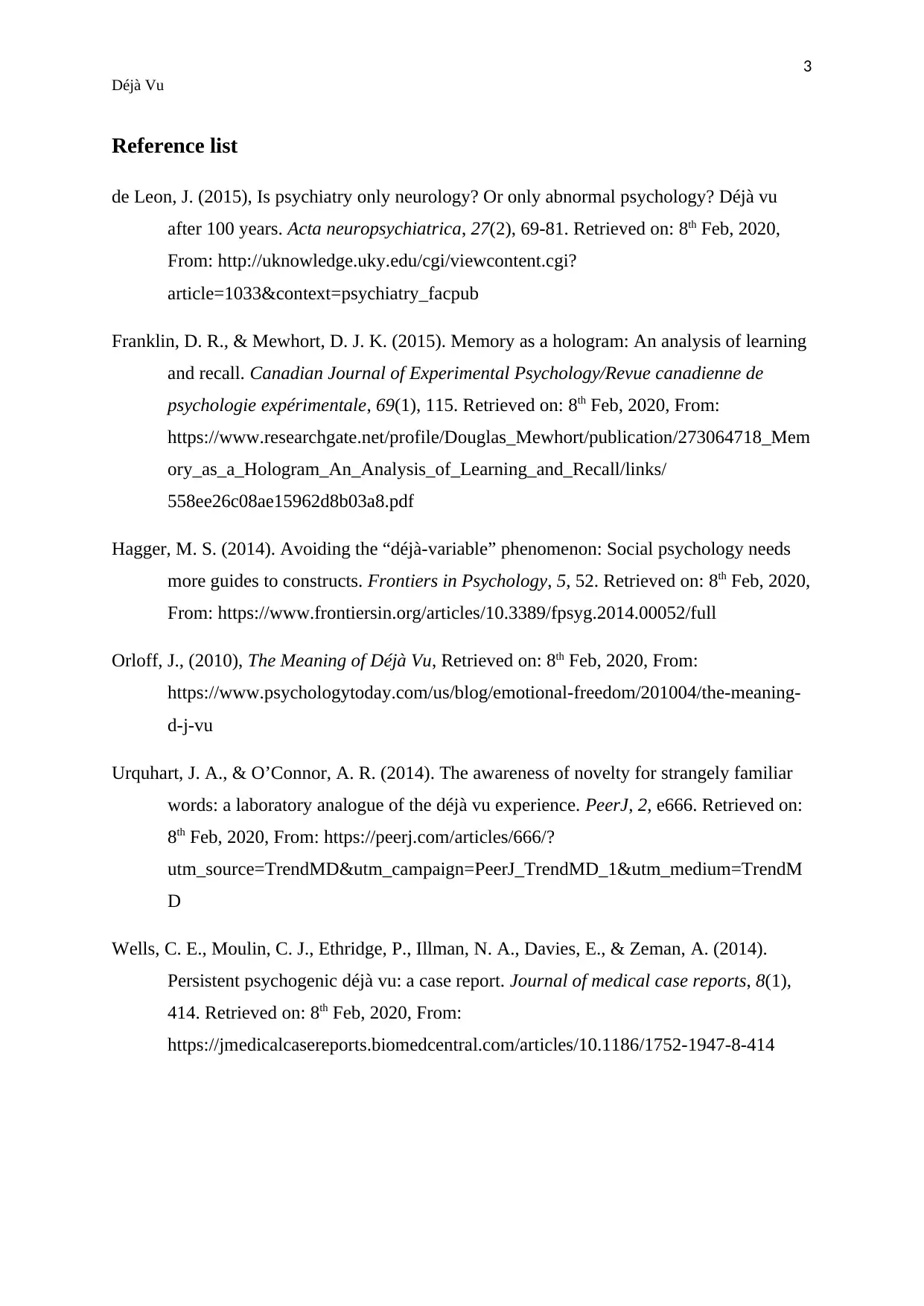
Reference list
de Leon, J. (2015), Is psychiatry only neurology? Or only abnormal psychology? Déjà vu
after 100 years. Acta neuropsychiatrica, 27(2), 69-81. Retrieved on: 8th Feb, 2020,
From: http://uknowledge.uky.edu/cgi/viewcontent.cgi?
article=1033&context=psychiatry_facpub
Franklin, D. R., & Mewhort, D. J. K. (2015). Memory as a hologram: An analysis of learning
and recall. Canadian Journal of Experimental Psychology/Revue canadienne de
psychologie expérimentale, 69(1), 115. Retrieved on: 8th Feb, 2020, From:
https://www.researchgate.net/profile/Douglas_Mewhort/publication/273064718_Mem
ory_as_a_Hologram_An_Analysis_of_Learning_and_Recall/links/
558ee26c08ae15962d8b03a8.pdf
Hagger, M. S. (2014). Avoiding the “déjà-variable” phenomenon: Social psychology needs
more guides to constructs. Frontiers in Psychology, 5, 52. Retrieved on: 8th Feb, 2020,
From: https://www.frontiersin.org/articles/10.3389/fpsyg.2014.00052/full
Orloff, J., (2010), The Meaning of Déjà Vu, Retrieved on: 8th Feb, 2020, From:
https://www.psychologytoday.com/us/blog/emotional-freedom/201004/the-meaning-
d-j-vu
Urquhart, J. A., & O’Connor, A. R. (2014). The awareness of novelty for strangely familiar
words: a laboratory analogue of the déjà vu experience. PeerJ, 2, e666. Retrieved on:
8th Feb, 2020, From: https://peerj.com/articles/666/?
utm_source=TrendMD&utm_campaign=PeerJ_TrendMD_1&utm_medium=TrendM
D
Wells, C. E., Moulin, C. J., Ethridge, P., Illman, N. A., Davies, E., & Zeman, A. (2014).
Persistent psychogenic déjà vu: a case report. Journal of medical case reports, 8(1),
414. Retrieved on: 8th Feb, 2020, From:
https://jmedicalcasereports.biomedcentral.com/articles/10.1186/1752-1947-8-414
Déjà Vu
Reference list
de Leon, J. (2015), Is psychiatry only neurology? Or only abnormal psychology? Déjà vu
after 100 years. Acta neuropsychiatrica, 27(2), 69-81. Retrieved on: 8th Feb, 2020,
From: http://uknowledge.uky.edu/cgi/viewcontent.cgi?
article=1033&context=psychiatry_facpub
Franklin, D. R., & Mewhort, D. J. K. (2015). Memory as a hologram: An analysis of learning
and recall. Canadian Journal of Experimental Psychology/Revue canadienne de
psychologie expérimentale, 69(1), 115. Retrieved on: 8th Feb, 2020, From:
https://www.researchgate.net/profile/Douglas_Mewhort/publication/273064718_Mem
ory_as_a_Hologram_An_Analysis_of_Learning_and_Recall/links/
558ee26c08ae15962d8b03a8.pdf
Hagger, M. S. (2014). Avoiding the “déjà-variable” phenomenon: Social psychology needs
more guides to constructs. Frontiers in Psychology, 5, 52. Retrieved on: 8th Feb, 2020,
From: https://www.frontiersin.org/articles/10.3389/fpsyg.2014.00052/full
Orloff, J., (2010), The Meaning of Déjà Vu, Retrieved on: 8th Feb, 2020, From:
https://www.psychologytoday.com/us/blog/emotional-freedom/201004/the-meaning-
d-j-vu
Urquhart, J. A., & O’Connor, A. R. (2014). The awareness of novelty for strangely familiar
words: a laboratory analogue of the déjà vu experience. PeerJ, 2, e666. Retrieved on:
8th Feb, 2020, From: https://peerj.com/articles/666/?
utm_source=TrendMD&utm_campaign=PeerJ_TrendMD_1&utm_medium=TrendM
D
Wells, C. E., Moulin, C. J., Ethridge, P., Illman, N. A., Davies, E., & Zeman, A. (2014).
Persistent psychogenic déjà vu: a case report. Journal of medical case reports, 8(1),
414. Retrieved on: 8th Feb, 2020, From:
https://jmedicalcasereports.biomedcentral.com/articles/10.1186/1752-1947-8-414
1 out of 4
Related Documents
Your All-in-One AI-Powered Toolkit for Academic Success.
+13062052269
info@desklib.com
Available 24*7 on WhatsApp / Email
Unlock your academic potential
Copyright © 2020–2025 A2Z Services. All Rights Reserved. Developed and managed by ZUCOL.