Art Analysis: Delacroix, Romanticism, and Modern Art's Legacy
VerifiedAdded on 2023/06/04
|6
|1310
|478
Essay
AI Summary
This essay provides an in-depth analysis of the life and art of Eugene Delacroix, a pivotal figure in the Romantic Movement. It examines Delacroix's innovative techniques, including his use of vibrant hues, furious brushstrokes, and emotionally charged subjects, which challenged traditional artistic norms and laid the groundwork for modern art. The essay explores his personal experiences, historical context, and aesthetic significance, highlighting his fascination with the exotic 'other' and his ability to portray human emotions and suffering. It also discusses the influence of literary inspirations like Lord Byron and the impact of his travels on his artistic vision. The analysis includes a detailed examination of his painting "The Orphan Girl at the Cemetery," emphasizing its modern elements and emotional depth, and concludes with a reflection on Delacroix's lasting legacy and his inspiration to contemporary artists.
Surname 1
ART ANALYSIS
Art Analysis
Name of Student
Name of University
Author note
Painters belonging from the Romantic School of France were destined to inspire a
plethora of avant-garde painters in the modern age. The Romantic Movement of the 18th century
sought liberty, freedom of expression and uncensored portrayal of emotions through techniques
that were to lay the foundation for a unique array of modern art forms. Eugene Delacroix is
regarded the pioneer of the Romantic Movement in art for good reasons, considering his works
and his life, which were an embodiment of the movement’s association with exoticism, sublimity
and repressed emotions (Delacroix). The essay analyses the life and art of the Romantic
phenomena, exploring the personal, historical and aesthetic significance of his works and
reflecting on the reasons why he continues to be an inspiration to the artists of the contemporary
world.
What Delacroix seems to have understood brilliantly is the power of provocation, which
is one of the central purposes of art; to provoke. He was bold and rebellious enough to discard
the traditional painting techniques developed by renowned painters before his time, like
Theodore Gericault and Pierre-Narcisse Guerin (Leerssen, 209). Straying away from the
traditional technique of realism, Delacroix embraced furious brushstrokes, vibrant hues and dins
of squirming subjects. His paintings took the traditionalist establishments by storm, while the
avant-garde Parisian applauded his revolutionary approach to traditional genres of painting. His
works were like a volcanic eruption hidden underneath a flowery landscape, a cry for breaking
ART ANALYSIS
Art Analysis
Name of Student
Name of University
Author note
Painters belonging from the Romantic School of France were destined to inspire a
plethora of avant-garde painters in the modern age. The Romantic Movement of the 18th century
sought liberty, freedom of expression and uncensored portrayal of emotions through techniques
that were to lay the foundation for a unique array of modern art forms. Eugene Delacroix is
regarded the pioneer of the Romantic Movement in art for good reasons, considering his works
and his life, which were an embodiment of the movement’s association with exoticism, sublimity
and repressed emotions (Delacroix). The essay analyses the life and art of the Romantic
phenomena, exploring the personal, historical and aesthetic significance of his works and
reflecting on the reasons why he continues to be an inspiration to the artists of the contemporary
world.
What Delacroix seems to have understood brilliantly is the power of provocation, which
is one of the central purposes of art; to provoke. He was bold and rebellious enough to discard
the traditional painting techniques developed by renowned painters before his time, like
Theodore Gericault and Pierre-Narcisse Guerin (Leerssen, 209). Straying away from the
traditional technique of realism, Delacroix embraced furious brushstrokes, vibrant hues and dins
of squirming subjects. His paintings took the traditionalist establishments by storm, while the
avant-garde Parisian applauded his revolutionary approach to traditional genres of painting. His
works were like a volcanic eruption hidden underneath a flowery landscape, a cry for breaking
Paraphrase This Document
Need a fresh take? Get an instant paraphrase of this document with our AI Paraphraser

Surname 2
ART ANALYSIS
free from the dogmas of the bourgeoisie society. The love for life and passion for art united in
his canvas, creating wonders that would later accolade him with befitting titles.
Most of Delacroix’s art reflected the obsession of the romantics with the exotic ‘other’,
which according to scholars and historians was inspired by a trip to North Africa; a journey that
proved transformational for both his personal and professional life. Some of the works by
Delacroix were evidently the outcome of direct and keen observation of nature, which was later
combined with a descriptive imagination. He drew heavily from contemporary literature and
history for depicting dramatic scenes (Mras, 120). Some of the paintings gained a notorious
reputation for their unflinching delineation of human suffering, violence and mayhem. These
works heralded the inception of modern art; emphasizing emotions over rationality and order.
Delacroix was responsible for transforming the pictorial tradition of the Classical Age through
his profound sensitivity to light, his brutally candid and unconventional treatment of historical
and classical subjects and his ecstatic pallet. Delacroix owed all these innovations to his unique
faculty of imagination; as he himself writes in his diary “The source of genius is imagination
alone, the refinement of the senses that sees what others do not see, or sees them
differently.”(Merello, 395).
The artworks of Delacroix were a sharp contrast to the neoclassical perfectionism, as he
drew inspiration from the paintings of Italian artist Rubens and other notable painters of the
Renaissance. Among his literary inspirations was Lord Byron, who shared his sensitivity to the
sublime forces of nature, often violent and tumultuous. The voyage to North Africa was not so
much to study art as it was to escape the bounds of fragile civilization and experience a primitive
culture. The paintings he created while on the trip made valuable contributions to the concept
and study of Orientalism. Something that comes across powerfully though his works is the sheer
ART ANALYSIS
free from the dogmas of the bourgeoisie society. The love for life and passion for art united in
his canvas, creating wonders that would later accolade him with befitting titles.
Most of Delacroix’s art reflected the obsession of the romantics with the exotic ‘other’,
which according to scholars and historians was inspired by a trip to North Africa; a journey that
proved transformational for both his personal and professional life. Some of the works by
Delacroix were evidently the outcome of direct and keen observation of nature, which was later
combined with a descriptive imagination. He drew heavily from contemporary literature and
history for depicting dramatic scenes (Mras, 120). Some of the paintings gained a notorious
reputation for their unflinching delineation of human suffering, violence and mayhem. These
works heralded the inception of modern art; emphasizing emotions over rationality and order.
Delacroix was responsible for transforming the pictorial tradition of the Classical Age through
his profound sensitivity to light, his brutally candid and unconventional treatment of historical
and classical subjects and his ecstatic pallet. Delacroix owed all these innovations to his unique
faculty of imagination; as he himself writes in his diary “The source of genius is imagination
alone, the refinement of the senses that sees what others do not see, or sees them
differently.”(Merello, 395).
The artworks of Delacroix were a sharp contrast to the neoclassical perfectionism, as he
drew inspiration from the paintings of Italian artist Rubens and other notable painters of the
Renaissance. Among his literary inspirations was Lord Byron, who shared his sensitivity to the
sublime forces of nature, often violent and tumultuous. The voyage to North Africa was not so
much to study art as it was to escape the bounds of fragile civilization and experience a primitive
culture. The paintings he created while on the trip made valuable contributions to the concept
and study of Orientalism. Something that comes across powerfully though his works is the sheer

Surname 3
ART ANALYSIS
love for life and the momentary things that comprise it (Woods-Marsden, 211). Delacroix was
driven by an instinct to animate and add colors to the seemingly drab existence of things; and
that is precisely why post-modern painters of the century continue to draw inspiration from him.
His paintings are as valid as life itself, with a cutting-edge honestly that makes more room for
imagination.
Although the political depictions of Delacroix earned him a remarkable reputation as an
artist, his portrayal of the ordinary and the unfortunate is perhaps more appealing to a student
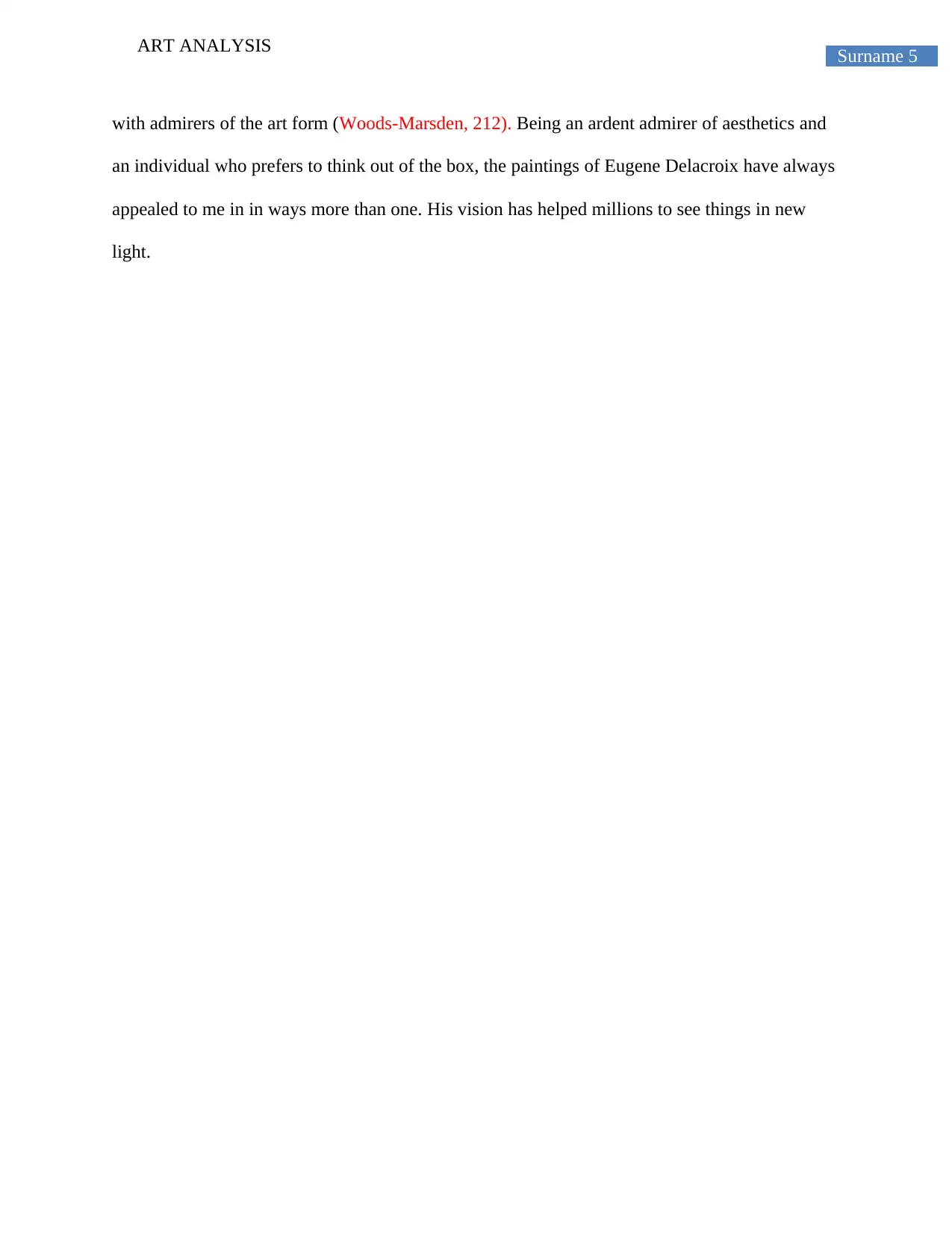
specializing in arts and aesthetics. The Orphan Girl at the Cemetery is one such masterpiece
emanating the awe and anxiety of a barren life, a portraiture that can be associated only with the
genius like Delacroix. An air of uncertainty and despondency characterizes the painting, as the
derelict young girl looks up to a cold, unfeeling sky. Her eyes are welled up with tears, her
clothing and body language evoke the pathos of vulnerability and tragedy. What strikes the
observant onlooker is the close attention to details, the intricate touch of specifics (Merello, 395).
Her melancholic expression is complemented by the sterile landscape and the bleak sky, her
tattered dress droops down her shoulder, she rests her hand warily on her left thigh, the
enveloping darkness surrounding her contrasts the pale, white dress. Delacroix beautifully
combines all these elements to convey a sense of desolation, lost hope and the longing to belong.
The painting has modern elements and would be valued just as preciously in the age of
abstraction and surrealism.
ART ANALYSIS
love for life and the momentary things that comprise it (Woods-Marsden, 211). Delacroix was
driven by an instinct to animate and add colors to the seemingly drab existence of things; and
that is precisely why post-modern painters of the century continue to draw inspiration from him.
His paintings are as valid as life itself, with a cutting-edge honestly that makes more room for
imagination.
Although the political depictions of Delacroix earned him a remarkable reputation as an
artist, his portrayal of the ordinary and the unfortunate is perhaps more appealing to a student
specializing in arts and aesthetics. The Orphan Girl at the Cemetery is one such masterpiece
emanating the awe and anxiety of a barren life, a portraiture that can be associated only with the
genius like Delacroix. An air of uncertainty and despondency characterizes the painting, as the
derelict young girl looks up to a cold, unfeeling sky. Her eyes are welled up with tears, her
clothing and body language evoke the pathos of vulnerability and tragedy. What strikes the
observant onlooker is the close attention to details, the intricate touch of specifics (Merello, 395).
Her melancholic expression is complemented by the sterile landscape and the bleak sky, her
tattered dress droops down her shoulder, she rests her hand warily on her left thigh, the
enveloping darkness surrounding her contrasts the pale, white dress. Delacroix beautifully
combines all these elements to convey a sense of desolation, lost hope and the longing to belong.
The painting has modern elements and would be valued just as preciously in the age of
abstraction and surrealism.
⊘ This is a preview!⊘
Do you want full access?
Subscribe today to unlock all pages.

Trusted by 1+ million students worldwide

Surname 4
ART ANALYSIS
Image: Painting of The Orphan Girl at the Cemetery
Source: Delacroix
I have been particularly fascinated by the narrative style of Eugene Delacroix, his
unflinchingly honest portrayal of life and the massacres that come with civilization. He has
opened up my mind to the beauties of nature and the horrors of the civil society. The fact that he
does not shy away from the gore or doesn’t ignore the disaster that life can be makes him ageless
as an artist. It must be asserted with justifiable reasons that Delacroix was way ahead of his time,
and his works not only laid the foundation for a wide range of new schools of art movements, but
made space for rebels and unconventional thinkers to breath and exercise their creativity without
hindrance. Speaking from individual perspective, art for me has always been about finding an
outlet for expression with an exclusivity of thought and rendition that strikes a responsive chord
ART ANALYSIS
Image: Painting of The Orphan Girl at the Cemetery
Source: Delacroix
I have been particularly fascinated by the narrative style of Eugene Delacroix, his
unflinchingly honest portrayal of life and the massacres that come with civilization. He has
opened up my mind to the beauties of nature and the horrors of the civil society. The fact that he
does not shy away from the gore or doesn’t ignore the disaster that life can be makes him ageless
as an artist. It must be asserted with justifiable reasons that Delacroix was way ahead of his time,
and his works not only laid the foundation for a wide range of new schools of art movements, but
made space for rebels and unconventional thinkers to breath and exercise their creativity without
hindrance. Speaking from individual perspective, art for me has always been about finding an
outlet for expression with an exclusivity of thought and rendition that strikes a responsive chord
Paraphrase This Document
Need a fresh take? Get an instant paraphrase of this document with our AI Paraphraser

Surname 5
ART ANALYSIS
with admirers of the art form (Woods-Marsden, 212). Being an ardent admirer of aesthetics and
an individual who prefers to think out of the box, the paintings of Eugene Delacroix have always
appealed to me in in ways more than one. His vision has helped millions to see things in new
light.
ART ANALYSIS
with admirers of the art form (Woods-Marsden, 212). Being an ardent admirer of aesthetics and
an individual who prefers to think out of the box, the paintings of Eugene Delacroix have always
appealed to me in in ways more than one. His vision has helped millions to see things in new
light.

Surname 6
ART ANALYSIS
Bibliography
Delacroix, Eugene. "Orphan Girl At The Cemetery By Eugene Delacroix". Eugenedelacroix.Net,
2018, http://www.eugenedelacroix.net/orphan-girl-at-the-cemetery/. Accessed 20 Oct 2018.
Leerssen, Joseph Theodoor. National thought in Europe: A cultural history. Amsterdam
University Press, 2006.
Merello, Ida. "Eugène Delacroix, Journal." Studi Francesi. Rivista quadrimestrale fondata da
Franco Simone 161 (LIV| II) (2010): 395.
Mras, George P. "Eugène Delacroix's theory of art." (1968).
Woods-Marsden, Joanna. "“Ritratto al Naturale”: Questions of Realism and Idealism in Early
Renaissance Portraits." Art Journal 46.3 (1987): 209-216.
ART ANALYSIS
Bibliography
Delacroix, Eugene. "Orphan Girl At The Cemetery By Eugene Delacroix". Eugenedelacroix.Net,
2018, http://www.eugenedelacroix.net/orphan-girl-at-the-cemetery/. Accessed 20 Oct 2018.
Leerssen, Joseph Theodoor. National thought in Europe: A cultural history. Amsterdam
University Press, 2006.
Merello, Ida. "Eugène Delacroix, Journal." Studi Francesi. Rivista quadrimestrale fondata da
Franco Simone 161 (LIV| II) (2010): 395.
Mras, George P. "Eugène Delacroix's theory of art." (1968).
Woods-Marsden, Joanna. "“Ritratto al Naturale”: Questions of Realism and Idealism in Early
Renaissance Portraits." Art Journal 46.3 (1987): 209-216.
⊘ This is a preview!⊘
Do you want full access?
Subscribe today to unlock all pages.

Trusted by 1+ million students worldwide
1 out of 6
Related Documents
Your All-in-One AI-Powered Toolkit for Academic Success.
+13062052269
info@desklib.com
Available 24*7 on WhatsApp / Email
Unlock your academic potential
Copyright © 2020–2025 A2Z Services. All Rights Reserved. Developed and managed by ZUCOL.