DECU4015: Analyzing Dell's Enterprise Culture Development
VerifiedAdded on 2023/06/10
|16
|3069
|273
Report
AI Summary
This report provides an overview of developing an enterprise culture, focusing on Dell Technologies Inc. It begins with an executive summary and introduction, setting the scope and tone. A literature review defines the enterprise and entrepreneurial culture concepts. The report includes a detailed case study of Dell, examining its history, sector, and financial turnover. The analysis delves into Dell's organizational culture, providing evidence of its entrepreneurial approach, including customer focus, teamwork, direct relationships, and global citizenship. Findings and analysis explore Dell's complex business model, emphasizing web sales, inventory management, and logistics. The report uses Porter's Five Forces to assess Dell's competitive intensity and attractiveness, highlighting the impact of the company's entrepreneurial culture on its success, including economies of scale, brand loyalty, and servicing quality. The report concludes by summarizing the key aspects of Dell's enterprise culture and its impact on the company's growth and success.
Running head: DEVELOPING AN ENTERPRISES CULTURE
Developing an Enterprises Culture
Name of the Student:
Name of the University:
Author Note:
Developing an Enterprises Culture
Name of the Student:
Name of the University:
Author Note:

Paraphrase This Document
Need a fresh take? Get an instant paraphrase of this document with our AI Paraphraser
1DEVELOPING AN ENTERPRISES CULTURE
Executive Summary:
The report is a discussion on the development of an enterprise culture from the perspective of
Dell Technologies Inc. The report commences with a brief introduction thereby setting the
setting the tone and the scope of the report. The report also puts forward a literature review that
primarily discusses about the concept of the enterprise and the definition of the enterprise and the
entrepreneurial culture. The report also discusses a case study on Dell by focusing primarily on
history, sector and the turnover. There is also an analysis about the organizational culture of Dell
along with evidence supporting how Dell operates under an entrepreneurial culture.
Executive Summary:
The report is a discussion on the development of an enterprise culture from the perspective of
Dell Technologies Inc. The report commences with a brief introduction thereby setting the
setting the tone and the scope of the report. The report also puts forward a literature review that
primarily discusses about the concept of the enterprise and the definition of the enterprise and the
entrepreneurial culture. The report also discusses a case study on Dell by focusing primarily on
history, sector and the turnover. There is also an analysis about the organizational culture of Dell
along with evidence supporting how Dell operates under an entrepreneurial culture.
2DEVELOPING AN ENTERPRISES CULTURE
Table of Contents
Introduction:....................................................................................................................................4
Literature Review:...........................................................................................................................4
Case Study Introduction: DELL......................................................................................................5
History:.........................................................................................................................................5
Sector:..........................................................................................................................................6
Turnover:......................................................................................................................................7
Analysis of Dell:..............................................................................................................................8
Findings and Analysis......................................................................................................................9
Conclusion:....................................................................................................................................11
Bibliography:.................................................................................................................................12
Appendices:...................................................................................................................................12
Table of Contents
Introduction:....................................................................................................................................4
Literature Review:...........................................................................................................................4
Case Study Introduction: DELL......................................................................................................5
History:.........................................................................................................................................5
Sector:..........................................................................................................................................6
Turnover:......................................................................................................................................7
Analysis of Dell:..............................................................................................................................8
Findings and Analysis......................................................................................................................9
Conclusion:....................................................................................................................................11
Bibliography:.................................................................................................................................12
Appendices:...................................................................................................................................12
⊘ This is a preview!⊘
Do you want full access?
Subscribe today to unlock all pages.

Trusted by 1+ million students worldwide
3DEVELOPING AN ENTERPRISES CULTURE
Introduction:
The report aims at providing an overview on developing an enterprise culture in the
perspective of Dell Technologies Inc (delltechnologies.com 2018). An enterprise represents a
business company associated with profit and entrepreneurial ventures. Culture refers to the
means of behaving within the organization. An organization with an enterprise culture consists of
creative and imaginative people and therefore most of the successful business in the country
typifies an enterprise culture. Enterprise culture is important has it allowed one to understand
how an organization did business, how the employees interacted with one another and the
interaction of the team with the outside world specifically the employees, customers, partners,
media, suppliers and the stakeholders. The enterprise culture also acts as the primary platform for
inspiring and motivating people and is a powerful resource for attracting, hiring, recruiting and
retaining the highest talent for the business. This is because the best of the employees always
have the urge for working with the companies with the best culture who then act as the catalyst
for the creation of an ongoing success of the business. Thus, an enterprise culture helps in
defining the business growth. The report will thus put forward a detailed analysis of the
importance of enterprise culture and the scopes associated with it.
Literature Review:
According to Olasky (2013), the concept of enterprise is used for describing a business.
Often the term is used for describing start-ups or various other businesses. More importantly, the
concept of an enterprise is used for describing actions undertaken by a person who shows certain
amount of initiative by undertaking risk of investing, setting up, or running of a business.
Introduction:
The report aims at providing an overview on developing an enterprise culture in the
perspective of Dell Technologies Inc (delltechnologies.com 2018). An enterprise represents a
business company associated with profit and entrepreneurial ventures. Culture refers to the
means of behaving within the organization. An organization with an enterprise culture consists of
creative and imaginative people and therefore most of the successful business in the country
typifies an enterprise culture. Enterprise culture is important has it allowed one to understand
how an organization did business, how the employees interacted with one another and the
interaction of the team with the outside world specifically the employees, customers, partners,
media, suppliers and the stakeholders. The enterprise culture also acts as the primary platform for
inspiring and motivating people and is a powerful resource for attracting, hiring, recruiting and
retaining the highest talent for the business. This is because the best of the employees always
have the urge for working with the companies with the best culture who then act as the catalyst
for the creation of an ongoing success of the business. Thus, an enterprise culture helps in
defining the business growth. The report will thus put forward a detailed analysis of the
importance of enterprise culture and the scopes associated with it.
Literature Review:
According to Olasky (2013), the concept of enterprise is used for describing a business.
Often the term is used for describing start-ups or various other businesses. More importantly, the
concept of an enterprise is used for describing actions undertaken by a person who shows certain
amount of initiative by undertaking risk of investing, setting up, or running of a business.
Paraphrase This Document
Need a fresh take? Get an instant paraphrase of this document with our AI Paraphraser
4DEVELOPING AN ENTERPRISES CULTURE
According to Hayton and Cacciotti (2013), an entrepreneurial culture comprises of the group
of individuals who suppressed the individual interest in the effort of achieving the success of a
group since the success of the group will help in advancing individual interest. An
entrepreneurial culture focuses on empowerment and people and involved value creation takes
place through change and innovation. It also involves attention to the basics and followed hands
on management. Entrepreneurial culture refers to doing right thing along with a freedom of
failing or growing. It also emphasizes on the future with a personal responsibility and
commitment.
The urge for increased competitiveness amongst the business leaders led to the creation of
an entrepreneurial culture as an important advantage. In the present business scenario, the term
entrepreneurial means implies something more than business acumen necessary for turning an
idea into enterprise (Gabrielsson, Gabrielsson and Dimitratos 2014). Therefore, the term
entrepreneurial culture helps in describing a mindset and skill characterized by creativity,
innovation and empowerment and calculated risk taking. The term also applies to the teams,
individuals and the entire organizational culture. The entrepreneurial culture is something that
most of the organizations hope for in the competitive and fast moving industry. However, an
organizational culture requires nurturing and does not grow by its own means. This can be
cultivated thoroughly through concerted action that includes structuring, modeling, positive
reinforcement and continuous communication.
Case Study Introduction: DELL
History: Michael Dell found Dell Computer Corporation also known as PC's Limited in
the year 1984 while he was still a student studying at University of Texas, Austin. Michael Dell
According to Hayton and Cacciotti (2013), an entrepreneurial culture comprises of the group
of individuals who suppressed the individual interest in the effort of achieving the success of a
group since the success of the group will help in advancing individual interest. An
entrepreneurial culture focuses on empowerment and people and involved value creation takes
place through change and innovation. It also involves attention to the basics and followed hands
on management. Entrepreneurial culture refers to doing right thing along with a freedom of
failing or growing. It also emphasizes on the future with a personal responsibility and
commitment.
The urge for increased competitiveness amongst the business leaders led to the creation of
an entrepreneurial culture as an important advantage. In the present business scenario, the term
entrepreneurial means implies something more than business acumen necessary for turning an
idea into enterprise (Gabrielsson, Gabrielsson and Dimitratos 2014). Therefore, the term
entrepreneurial culture helps in describing a mindset and skill characterized by creativity,
innovation and empowerment and calculated risk taking. The term also applies to the teams,
individuals and the entire organizational culture. The entrepreneurial culture is something that
most of the organizations hope for in the competitive and fast moving industry. However, an
organizational culture requires nurturing and does not grow by its own means. This can be
cultivated thoroughly through concerted action that includes structuring, modeling, positive
reinforcement and continuous communication.
Case Study Introduction: DELL
History: Michael Dell found Dell Computer Corporation also known as PC's Limited in
the year 1984 while he was still a student studying at University of Texas, Austin. Michael Dell
5DEVELOPING AN ENTERPRISES CULTURE
began trading with the belief that selling of the personal computer systems directly to the
customers would help his company in better understanding the needs of the customers and
thereby provide effective computing solutions for meeting the needs of the customers (dell.com
2018).
In the year 1984, the company manufactured the first computer known as ‘Turbo PC’ and
sold it as US$795. In 1987, the company began its global expansion rechristened the company as
Dell Computer Corporation. In the year 1990, Dell computer sold its products indirectly through
superstores and warehouse clubs but had little success. The year 1996 marks a year when Dell
began selling its products through the website. In 2002, Dell undertook expansion through
tapping into multimedia and the home entertainment markets by introducing television. In the
annual meeting held in the year 2003, with the approval of the stockholders the name of the
company changed to ‘Dell Inc’ for recognizing the expansion of the company beyond the
computers. In the year 2004, the company declared building a newer assembly plant while the
share of international market sales enhanced during 2005. In the year, 2006, Dell Inc decided to
purchase the computer hardware manufacturer Alienware. The quarterly earnings report
published in the year 2007 showed the gross sales as $14.4 billion and the net income of $6687
million (dell.com 2018).
Dell Technologies Inc was formed later due to the acquisition between Dell and EMC
Corporation. The products of Dell included servers, personal computers, Smartphone, television,
computer and network security, computer software and services related to information security.
In 12 October 2015, Dell made an announcement of acquiring enterprise software and the
storage company EMC Corporation in a transaction of $67 billion that was one of the highest
tech acquisitions of history. The major shareholders of Dell from Singapore supported this
began trading with the belief that selling of the personal computer systems directly to the
customers would help his company in better understanding the needs of the customers and
thereby provide effective computing solutions for meeting the needs of the customers (dell.com
2018).
In the year 1984, the company manufactured the first computer known as ‘Turbo PC’ and
sold it as US$795. In 1987, the company began its global expansion rechristened the company as
Dell Computer Corporation. In the year 1990, Dell computer sold its products indirectly through
superstores and warehouse clubs but had little success. The year 1996 marks a year when Dell
began selling its products through the website. In 2002, Dell undertook expansion through
tapping into multimedia and the home entertainment markets by introducing television. In the
annual meeting held in the year 2003, with the approval of the stockholders the name of the
company changed to ‘Dell Inc’ for recognizing the expansion of the company beyond the
computers. In the year 2004, the company declared building a newer assembly plant while the
share of international market sales enhanced during 2005. In the year, 2006, Dell Inc decided to
purchase the computer hardware manufacturer Alienware. The quarterly earnings report
published in the year 2007 showed the gross sales as $14.4 billion and the net income of $6687
million (dell.com 2018).
Dell Technologies Inc was formed later due to the acquisition between Dell and EMC
Corporation. The products of Dell included servers, personal computers, Smartphone, television,
computer and network security, computer software and services related to information security.
In 12 October 2015, Dell made an announcement of acquiring enterprise software and the
storage company EMC Corporation in a transaction of $67 billion that was one of the highest
tech acquisitions of history. The major shareholders of Dell from Singapore supported this
⊘ This is a preview!⊘
Do you want full access?
Subscribe today to unlock all pages.
Trusted by 1+ million students worldwide
6DEVELOPING AN ENTERPRISES CULTURE
acquisition. In the September 2016, Dell Inc completely merged with the EMC Corporation that
involved the issuance of $45.9 billion in the debt and $4.4 billion in the common stock
(delltechnologies.com 2018).
Sector: The heart of the business lay in serving institutional and commercial customers.
Dell Technologies Inc sold increasing number of computers to the businesses in comparison to
any other company across the world. The part of success enjoyed by the company lay in the
ability of delivering enterprise technology required by the large organizations that includes the
storage, servers and the services (dell.com 2018). A growing area in the enterprise business of
Dell is the virtualization of server. Dell helped organizations in taking advantage of the
technology for easily growing and maintaining the operations more effectively. The data centre
solution division of Dell addressed specific needs of the hyper-scale centers of data for
businesses that relied on the computing solutions of the enterprise. The Dell team also possessed
the ability of creating differentiated product since it designed unique services and servers tailored
as per the specifications of the customer.
Turnover: Close to fifty percent of the revenue of the company is derived from United
States where the company had operations under the following three divisions (dell.com 2018):
1. The Client Solution Group of Dell that manufactures desktop, personal computer,
tablets, notebooks and the peripherals including printers, monitors and projectors accounts for 60
percent of the revenue.
2. The Infrastructure Solution Group of Dell that provides storage solutions accounts for
35 percent of the revenue
acquisition. In the September 2016, Dell Inc completely merged with the EMC Corporation that
involved the issuance of $45.9 billion in the debt and $4.4 billion in the common stock
(delltechnologies.com 2018).
Sector: The heart of the business lay in serving institutional and commercial customers.
Dell Technologies Inc sold increasing number of computers to the businesses in comparison to
any other company across the world. The part of success enjoyed by the company lay in the
ability of delivering enterprise technology required by the large organizations that includes the
storage, servers and the services (dell.com 2018). A growing area in the enterprise business of
Dell is the virtualization of server. Dell helped organizations in taking advantage of the
technology for easily growing and maintaining the operations more effectively. The data centre
solution division of Dell addressed specific needs of the hyper-scale centers of data for
businesses that relied on the computing solutions of the enterprise. The Dell team also possessed
the ability of creating differentiated product since it designed unique services and servers tailored
as per the specifications of the customer.
Turnover: Close to fifty percent of the revenue of the company is derived from United
States where the company had operations under the following three divisions (dell.com 2018):
1. The Client Solution Group of Dell that manufactures desktop, personal computer,
tablets, notebooks and the peripherals including printers, monitors and projectors accounts for 60
percent of the revenue.
2. The Infrastructure Solution Group of Dell that provides storage solutions accounts for
35 percent of the revenue
Paraphrase This Document
Need a fresh take? Get an instant paraphrase of this document with our AI Paraphraser
7DEVELOPING AN ENTERPRISES CULTURE
3. A publicly traded company known as VMware and operating under Dell focuses on
cloud infrastructure and virtualization
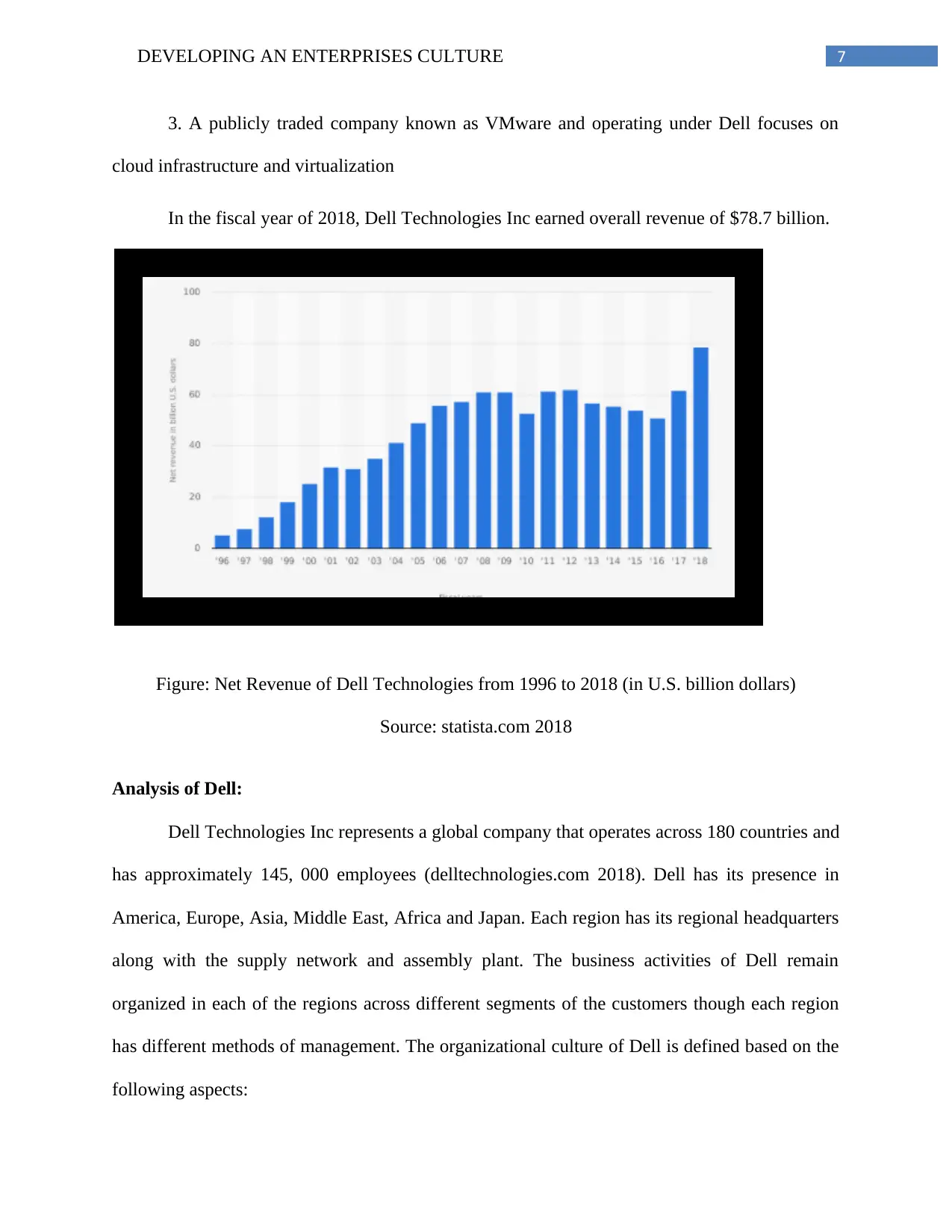
In the fiscal year of 2018, Dell Technologies Inc earned overall revenue of $78.7 billion.
Figure: Net Revenue of Dell Technologies from 1996 to 2018 (in U.S. billion dollars)
Source: statista.com 2018
Analysis of Dell:
Dell Technologies Inc represents a global company that operates across 180 countries and
has approximately 145, 000 employees (delltechnologies.com 2018). Dell has its presence in
America, Europe, Asia, Middle East, Africa and Japan. Each region has its regional headquarters
along with the supply network and assembly plant. The business activities of Dell remain
organized in each of the regions across different segments of the customers though each region
has different methods of management. The organizational culture of Dell is defined based on the
following aspects:
3. A publicly traded company known as VMware and operating under Dell focuses on
cloud infrastructure and virtualization
In the fiscal year of 2018, Dell Technologies Inc earned overall revenue of $78.7 billion.
Figure: Net Revenue of Dell Technologies from 1996 to 2018 (in U.S. billion dollars)
Source: statista.com 2018
Analysis of Dell:
Dell Technologies Inc represents a global company that operates across 180 countries and
has approximately 145, 000 employees (delltechnologies.com 2018). Dell has its presence in
America, Europe, Asia, Middle East, Africa and Japan. Each region has its regional headquarters
along with the supply network and assembly plant. The business activities of Dell remain
organized in each of the regions across different segments of the customers though each region
has different methods of management. The organizational culture of Dell is defined based on the
following aspects:
8DEVELOPING AN ENTERPRISES CULTURE
Customer: Dell Technologies Inc ensures providing the best quality service and product
in terms of technology and outperforms competition by ensuring value and superior experience
to the customers.
Dell Team: They believe that constant success lies in the teamwork and each team
member has to develop, learn and grow based on each opportunity. They remain committed to
attracting, developing and retaining the best members of the staff (dell.com 2018). In fact, the
company sets its standards by defining themselves as business people and inventors and then
setting the goals for the growth of the company. In other words, the people belonging to Dell
help in defining the principles while living up to the standards and values.
Direct Relationship: The Company believes in maintaining direct relationship with the
customers, suppliers, and partners and even with one another. The operation of the company
without following a typical bureaucracy and hierarchy enables them in doing their best compared
to other competitors.
Global Citizenship: The Company is committed to respecting and understanding values,
cultures and laws in whichever place they do business (dell.com 2018). The company tries to
profitably grow in all the markets and positively contribute to all the communities.
Findings and Analysis:
Although Dell operates as an enterprise but its business model is very complex due to the
following reasons:
Firstly, the company does not rely on the storefronts or the agents for selling the
products. They rely on either web sales or channels for selling their computers to the customers.
Customer: Dell Technologies Inc ensures providing the best quality service and product
in terms of technology and outperforms competition by ensuring value and superior experience
to the customers.
Dell Team: They believe that constant success lies in the teamwork and each team
member has to develop, learn and grow based on each opportunity. They remain committed to
attracting, developing and retaining the best members of the staff (dell.com 2018). In fact, the
company sets its standards by defining themselves as business people and inventors and then
setting the goals for the growth of the company. In other words, the people belonging to Dell
help in defining the principles while living up to the standards and values.
Direct Relationship: The Company believes in maintaining direct relationship with the
customers, suppliers, and partners and even with one another. The operation of the company
without following a typical bureaucracy and hierarchy enables them in doing their best compared
to other competitors.
Global Citizenship: The Company is committed to respecting and understanding values,
cultures and laws in whichever place they do business (dell.com 2018). The company tries to
profitably grow in all the markets and positively contribute to all the communities.
Findings and Analysis:
Although Dell operates as an enterprise but its business model is very complex due to the
following reasons:
Firstly, the company does not rely on the storefronts or the agents for selling the
products. They rely on either web sales or channels for selling their computers to the customers.
⊘ This is a preview!⊘
Do you want full access?
Subscribe today to unlock all pages.
Trusted by 1+ million students worldwide
9DEVELOPING AN ENTERPRISES CULTURE
Secondly, the company should have components and parts in stock for building wider
range of specifications based on the user with minimum lead-time.
Thirdly, Dell has outstanding logistics and manufacturing capabilities supported by the
information system that enables the company in substituting information for the inventory. Dell
can use the specific sale channel in gaining more profit and market share. This enables the
company in gaining maximum amount of customer satisfaction through minimum cost of
distribution.
Dell can lead to the creation of similar but distinct functions in every vital region thereby
future customizing the marketing and the service functions for the individual countries.
Globalization has helped in shaping the structure of Dell thereby enabling the company in
running the largest company in comparison to its competitors. This is explained with the help of
Porter’s five forces that refers to a tool for determining Dell’s competitive intensity and
attractiveness and profitability.
Threat of the New Entrants: The cost, technological knowledge and the financial
barriers do not make the process of entry quite significant (E. Dobbs 2014). To overcome such
barriers new businesses should introduce newer products based on the innovative concepts. The
entrepreneurial culture of Dell enables it to manufacture innovative products that help it enjoying
economies of scale that acts as an additional barrier.
Bargaining Power of the Consumers: The buyers are fragmented and there exists low
expected switching cost given the fact that the product specifications remain homogenous. This
might often lead to lower level of product satisfaction (Browning, Chiappori and Lewbel 2013).
The entrepreneurial culture of Dell enables it increasing brand loyalty at lower production cost
Secondly, the company should have components and parts in stock for building wider
range of specifications based on the user with minimum lead-time.
Thirdly, Dell has outstanding logistics and manufacturing capabilities supported by the
information system that enables the company in substituting information for the inventory. Dell
can use the specific sale channel in gaining more profit and market share. This enables the
company in gaining maximum amount of customer satisfaction through minimum cost of
distribution.
Dell can lead to the creation of similar but distinct functions in every vital region thereby
future customizing the marketing and the service functions for the individual countries.
Globalization has helped in shaping the structure of Dell thereby enabling the company in
running the largest company in comparison to its competitors. This is explained with the help of
Porter’s five forces that refers to a tool for determining Dell’s competitive intensity and
attractiveness and profitability.
Threat of the New Entrants: The cost, technological knowledge and the financial
barriers do not make the process of entry quite significant (E. Dobbs 2014). To overcome such
barriers new businesses should introduce newer products based on the innovative concepts. The
entrepreneurial culture of Dell enables it to manufacture innovative products that help it enjoying
economies of scale that acts as an additional barrier.
Bargaining Power of the Consumers: The buyers are fragmented and there exists low
expected switching cost given the fact that the product specifications remain homogenous. This
might often lead to lower level of product satisfaction (Browning, Chiappori and Lewbel 2013).
The entrepreneurial culture of Dell enables it increasing brand loyalty at lower production cost
Paraphrase This Document
Need a fresh take? Get an instant paraphrase of this document with our AI Paraphraser
10DEVELOPING AN ENTERPRISES CULTURE
thereby resulting in higher servicing quality that helps in moderating the bargaining power of the
buyers.
Bargaining Power of the Suppliers: Dell remains dependent on the suppliers since it
does not undertake manufacturing but assembles the products from various parts conveyed by
the external vendors. The entrepreneurial culture of the company encourages it to take supplies
from reputed suppliers located close to the assembling units of Dell thereby increasing the
bargaining power of the suppliers (Fabbri and Klapper 2016).
Threat of Substitutes: Given the irreplaceable functionality of products, the company
faces a weaker threat of substitution. Threats are mostly from the young customers who remain
more attracted towards the game console of next generation. However to establish long-term
profits it is necessary for the company in particularly targeting the youth market (Porter and
Heppelmann 2014). The acquisition of Alienware can act as a strategic move entrepreneurial
culture of Dell focused on expansion and increase of the brand value.
Degree of Rivalry: The degree of the rivalry remains moderate. On this note, Dell
Technologies Inc undertakes specialization in the production efficiency and not much in the
aspect of innovation (dell.com 2018). The organizational culture of the company is not ready for
switching to a production led by innovation. Hence, outsourcing the R&D department might help
the firm with newer solutions.
Conclusion:
To conclude, one can say that Dell Technologies Inc. has been quite successful in global
market due to its direct sell business model. The company however lags behind the competitors
in global position and quality. The focus on these two areas could make the company a top
thereby resulting in higher servicing quality that helps in moderating the bargaining power of the
buyers.
Bargaining Power of the Suppliers: Dell remains dependent on the suppliers since it
does not undertake manufacturing but assembles the products from various parts conveyed by
the external vendors. The entrepreneurial culture of the company encourages it to take supplies
from reputed suppliers located close to the assembling units of Dell thereby increasing the
bargaining power of the suppliers (Fabbri and Klapper 2016).
Threat of Substitutes: Given the irreplaceable functionality of products, the company
faces a weaker threat of substitution. Threats are mostly from the young customers who remain
more attracted towards the game console of next generation. However to establish long-term
profits it is necessary for the company in particularly targeting the youth market (Porter and
Heppelmann 2014). The acquisition of Alienware can act as a strategic move entrepreneurial
culture of Dell focused on expansion and increase of the brand value.
Degree of Rivalry: The degree of the rivalry remains moderate. On this note, Dell
Technologies Inc undertakes specialization in the production efficiency and not much in the
aspect of innovation (dell.com 2018). The organizational culture of the company is not ready for
switching to a production led by innovation. Hence, outsourcing the R&D department might help
the firm with newer solutions.
Conclusion:
To conclude, one can say that Dell Technologies Inc. has been quite successful in global
market due to its direct sell business model. The company however lags behind the competitors
in global position and quality. The focus on these two areas could make the company a top
11DEVELOPING AN ENTERPRISES CULTURE
reseller. Nonetheless, the company has positioned itself as a remarkable computer retailer by
being low cost provider that allowed them in continuing operations and moving towards newer
markets. The company is able to produce different computer for supplying different levels of the
customers. The company also focuses on improving the organizational culture and the business
environment for increasing the base of the customers.
reseller. Nonetheless, the company has positioned itself as a remarkable computer retailer by
being low cost provider that allowed them in continuing operations and moving towards newer
markets. The company is able to produce different computer for supplying different levels of the
customers. The company also focuses on improving the organizational culture and the business
environment for increasing the base of the customers.
⊘ This is a preview!⊘
Do you want full access?
Subscribe today to unlock all pages.
Trusted by 1+ million students worldwide

1 out of 16


Related Documents


Your All-in-One AI-Powered Toolkit for Academic Success.
+13062052269
info@desklib.com
Available 24*7 on WhatsApp / Email
![[object Object]](/_next/static/media/star-bottom.7253800d.svg)
Unlock your academic potential
Copyright © 2020–2026 A2Z Services. All Rights Reserved. Developed and managed by ZUCOL.