Contemporary Business Economics: Demand and Supply in Retail Sector
VerifiedAdded on 2023/01/11
|17
|3008
|21
Report
AI Summary
This report provides an executive summary and in-depth analysis of contemporary business economics, focusing on the laws of demand and supply within the retail sector, using River Island as a case study. It examines how price changes, consumer preferences, substitute goods, income distribution, and consumer expectations influence demand. The report also explores the law of supply, detailing the relationship between price and supply, and considers factors like production costs, alternative product profitability, and producer expectations. Furthermore, it compares 20th and 21st-century economic theories, highlighting the shift from traditional macro and microeconomic concepts to modern approaches that emphasize practical applications and global market dynamics. This analysis provides a comprehensive understanding of the economic principles shaping modern business practices, particularly within the context of the retail industry.
Contemporary Business Economics
Paraphrase This Document
Need a fresh take? Get an instant paraphrase of this document with our AI Paraphraser

Executive Summary
Today, with change in economic theories from traditional to modern, thinking and way of
operating business has also changed. Now, before making any new policy and moving business
at another level, companies concern on applying number of theories like demand and supply law.
This would help in increasing opportunity to gain high profitability with manner, to operate
business successfully at global level.
Today, with change in economic theories from traditional to modern, thinking and way of
operating business has also changed. Now, before making any new policy and moving business
at another level, companies concern on applying number of theories like demand and supply law.
This would help in increasing opportunity to gain high profitability with manner, to operate
business successfully at global level.

Table of Contents
Executive Summary.........................................................................................................................2
INTRODUCTION...........................................................................................................................1
MAIN BODY...................................................................................................................................1
1.1 Description of Demand Law, movement along its curve and changes with respect to
different factors in retail sector....................................................................................................1
1.2 Description of Supply Law, movement along its curve and changes with respect to
different factors in retail sector....................................................................................................6
TASK 2..........................................................................................................................................10
Emerging theories and models in 21st and 20th century of contemporary economics related with
modern business practices.........................................................................................................10
CONCLUSION..............................................................................................................................11
REFERENCES..............................................................................................................................13
Executive Summary.........................................................................................................................2
INTRODUCTION...........................................................................................................................1
MAIN BODY...................................................................................................................................1
1.1 Description of Demand Law, movement along its curve and changes with respect to
different factors in retail sector....................................................................................................1
1.2 Description of Supply Law, movement along its curve and changes with respect to
different factors in retail sector....................................................................................................6
TASK 2..........................................................................................................................................10
Emerging theories and models in 21st and 20th century of contemporary economics related with
modern business practices.........................................................................................................10
CONCLUSION..............................................................................................................................11
REFERENCES..............................................................................................................................13
⊘ This is a preview!⊘
Do you want full access?
Subscribe today to unlock all pages.

Trusted by 1+ million students worldwide

Paraphrase This Document
Need a fresh take? Get an instant paraphrase of this document with our AI Paraphraser

INTRODUCTION
Contemporary economics refers to a process of publishing advanced theoretical research, in
the field of management, economics, finance and more. It mainly concerns on evaluating
changes in demand and supply of commodities, by applying number of economic theories
(Ngouapegne and Chinomona, 2018). The present assignment is going to explain the law of
demand and supply, within in a retail sector, including a number of factors that impact on same.
For this purpose, River Island is chosen, which is a high street fashion brand of UK and offered
its products at worldwide level. As it deals in fashion retail sector, therefore, factors that impact
on pricing policies and other, will be discussed in this report. In addition to this, a comparison is
also made on emerging theories and models of 21st and 20th century.
MAIN BODY
1.1 Description of Demand Law, movement along its curve and changes with respect to different
factors in retail sector
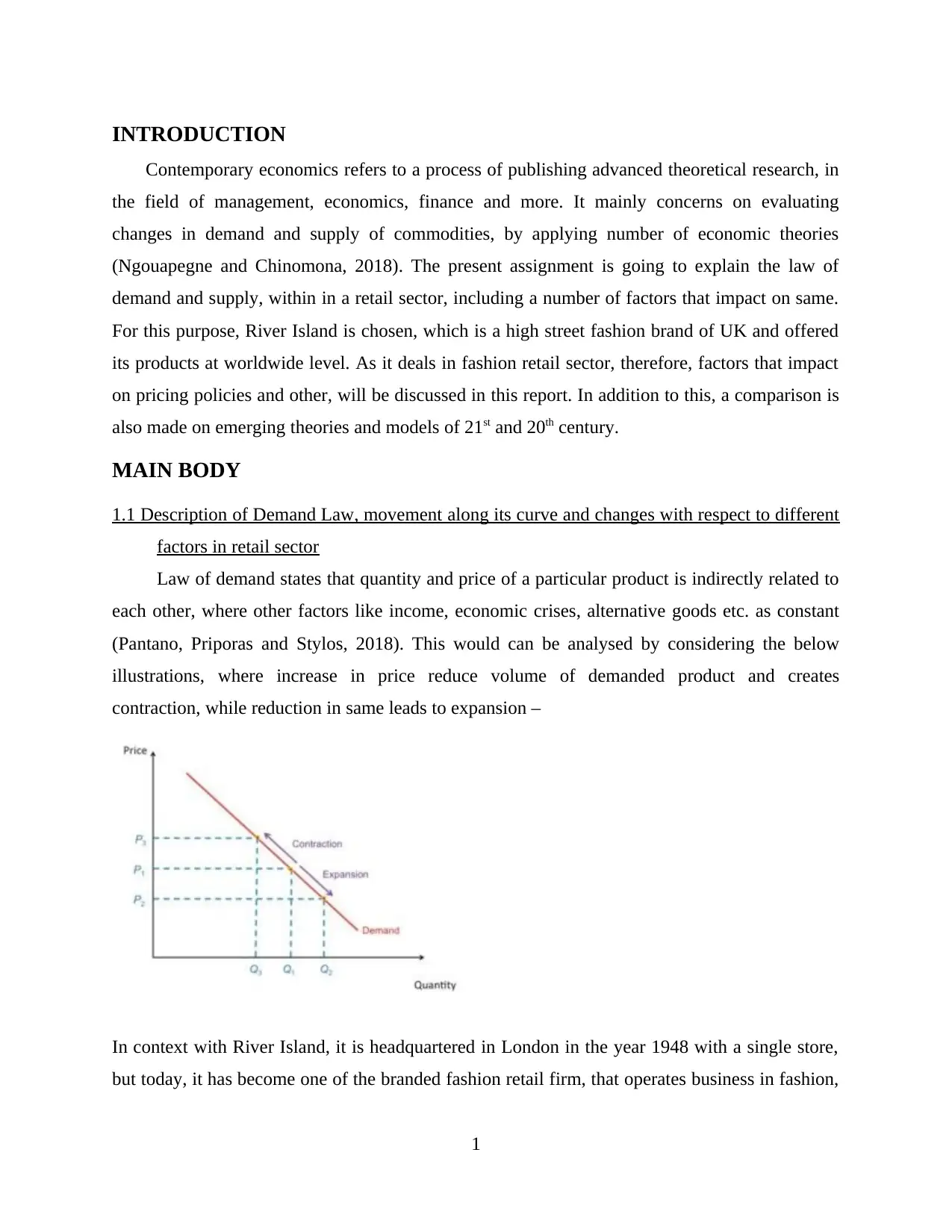
Law of demand states that quantity and price of a particular product is indirectly related to
each other, where other factors like income, economic crises, alternative goods etc. as constant
(Pantano, Priporas and Stylos, 2018). This would can be analysed by considering the below
illustrations, where increase in price reduce volume of demanded product and creates
contraction, while reduction in same leads to expansion –
In context with River Island, it is headquartered in London in the year 1948 with a single store,
but today, it has become one of the branded fashion retail firm, that operates business in fashion,
1
Contemporary economics refers to a process of publishing advanced theoretical research, in
the field of management, economics, finance and more. It mainly concerns on evaluating
changes in demand and supply of commodities, by applying number of economic theories
(Ngouapegne and Chinomona, 2018). The present assignment is going to explain the law of
demand and supply, within in a retail sector, including a number of factors that impact on same.
For this purpose, River Island is chosen, which is a high street fashion brand of UK and offered
its products at worldwide level. As it deals in fashion retail sector, therefore, factors that impact
on pricing policies and other, will be discussed in this report. In addition to this, a comparison is
also made on emerging theories and models of 21st and 20th century.
MAIN BODY
1.1 Description of Demand Law, movement along its curve and changes with respect to different
factors in retail sector
Law of demand states that quantity and price of a particular product is indirectly related to
each other, where other factors like income, economic crises, alternative goods etc. as constant
(Pantano, Priporas and Stylos, 2018). This would can be analysed by considering the below
illustrations, where increase in price reduce volume of demanded product and creates
contraction, while reduction in same leads to expansion –
In context with River Island, it is headquartered in London in the year 1948 with a single store,
but today, it has become one of the branded fashion retail firm, that operates business in fashion,
1

clothing, textiles and retail industries at worldwide level (Dogan, Ayçin and Bulut, 2018). This
brand mainly known for its trendy men, women and children’s clothing, accessories and
footwear, which are available in a wide variety. In order to evaluate how market price of its
goods is determined, an example is taken for one of the product offered by River Island like –
branded footwear.
Price of footwear Mr. X Mr. Y Market Demand
Total demand of
consumers
Fixed price 1 1 2
10% discount on price 2 2 4
20% discount on price 2 3 5
30% discount on price 4 5 9
50% discount on price 6 8 14
2
brand mainly known for its trendy men, women and children’s clothing, accessories and
footwear, which are available in a wide variety. In order to evaluate how market price of its
goods is determined, an example is taken for one of the product offered by River Island like –
branded footwear.
Price of footwear Mr. X Mr. Y Market Demand
Total demand of
consumers
Fixed price 1 1 2
10% discount on price 2 2 4
20% discount on price 2 3 5
30% discount on price 4 5 9
50% discount on price 6 8 14
2
⊘ This is a preview!⊘
Do you want full access?
Subscribe today to unlock all pages.

Trusted by 1+ million students worldwide

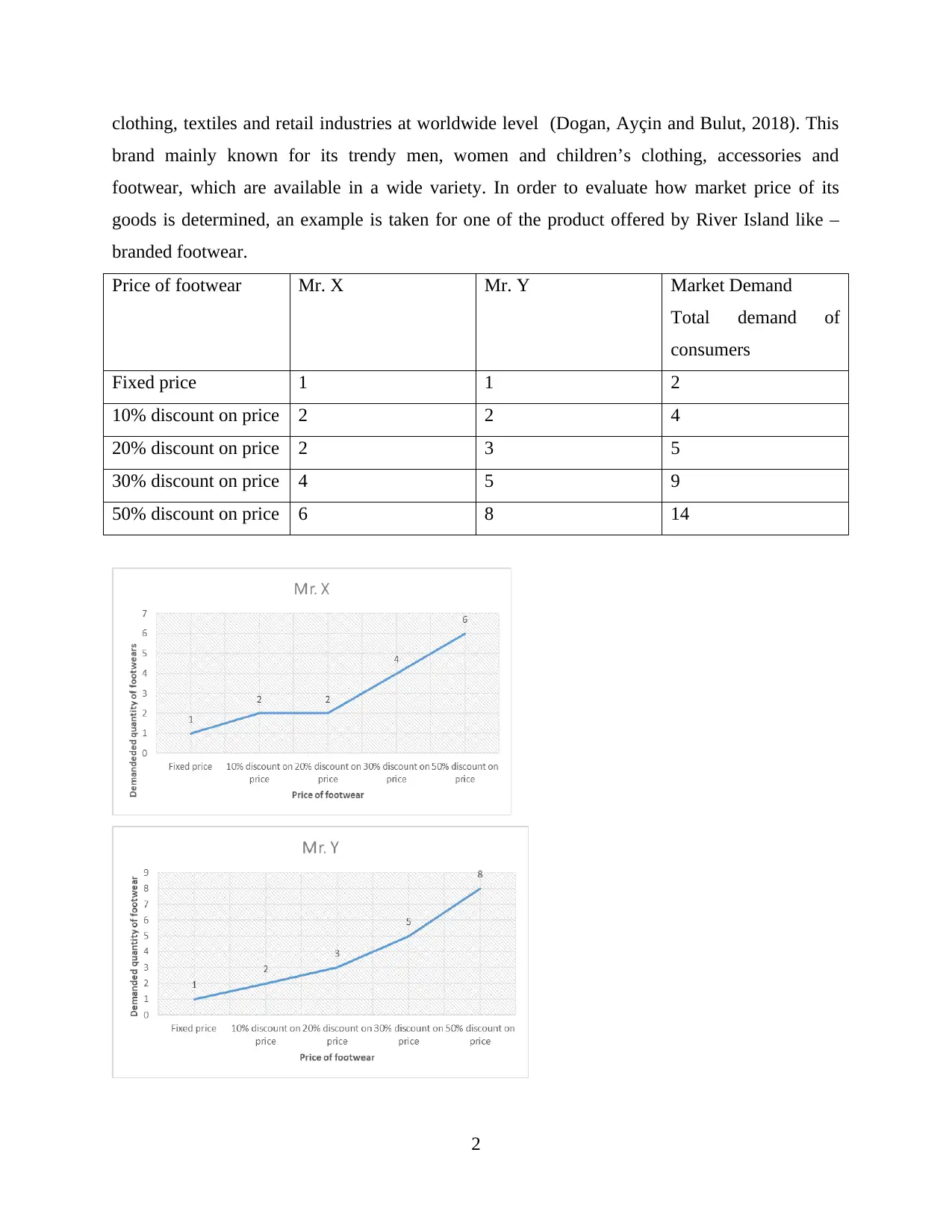
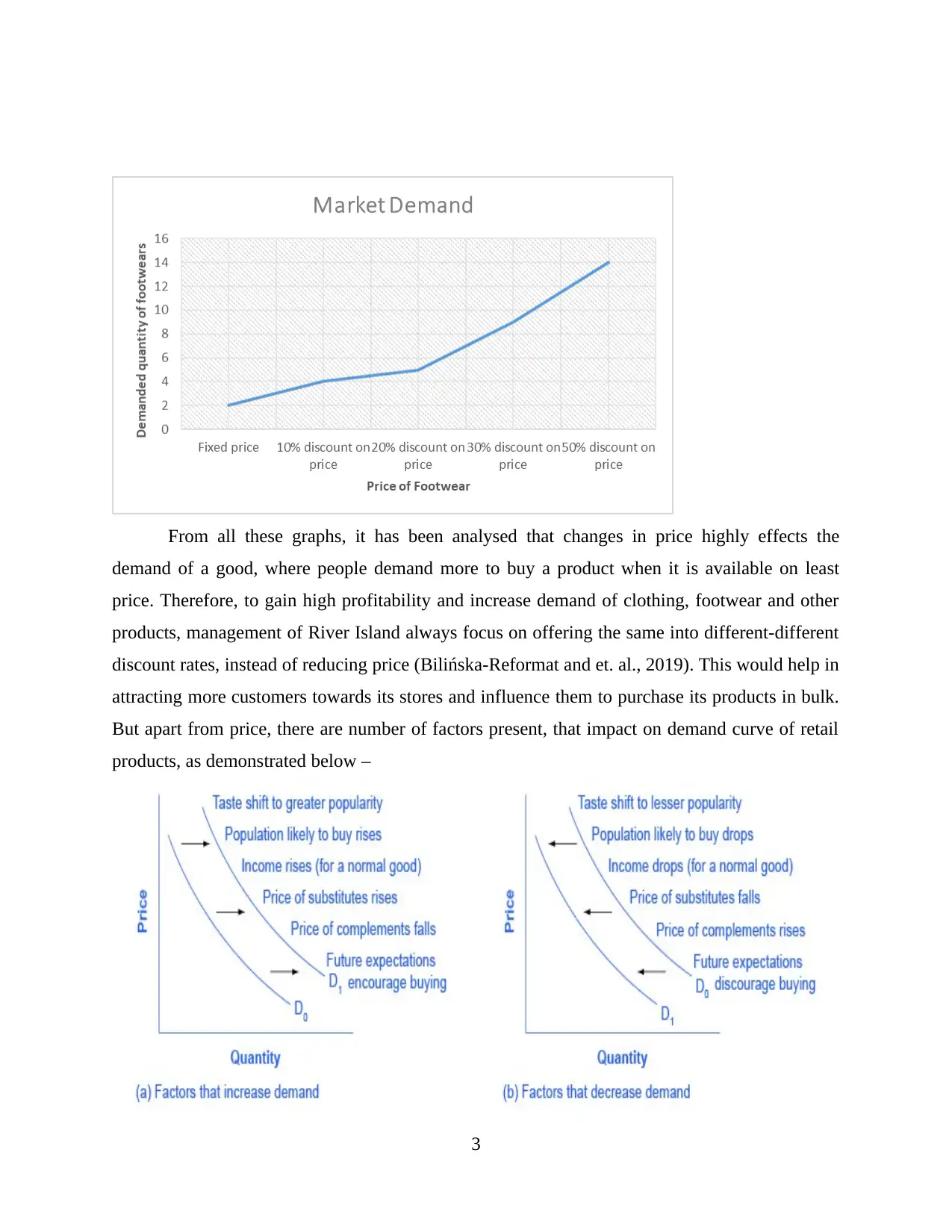
From all these graphs, it has been analysed that changes in price highly effects the
demand of a good, where people demand more to buy a product when it is available on least
price. Therefore, to gain high profitability and increase demand of clothing, footwear and other
products, management of River Island always focus on offering the same into different-different
discount rates, instead of reducing price (Bilińska-Reformat and et. al., 2019). This would help in
attracting more customers towards its stores and influence them to purchase its products in bulk.
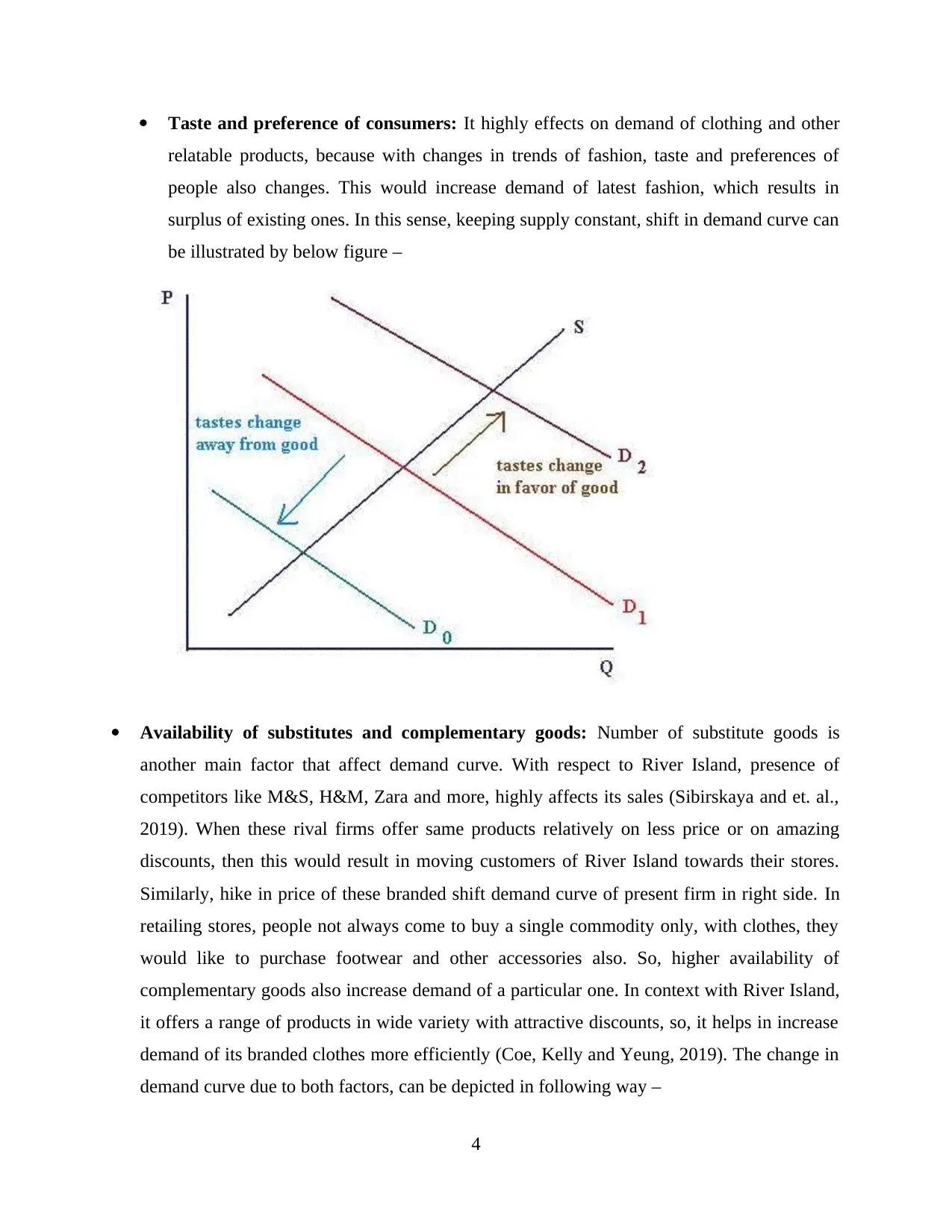
But apart from price, there are number of factors present, that impact on demand curve of retail
products, as demonstrated below –
3
demand of a good, where people demand more to buy a product when it is available on least
price. Therefore, to gain high profitability and increase demand of clothing, footwear and other
products, management of River Island always focus on offering the same into different-different
discount rates, instead of reducing price (Bilińska-Reformat and et. al., 2019). This would help in
attracting more customers towards its stores and influence them to purchase its products in bulk.
But apart from price, there are number of factors present, that impact on demand curve of retail
products, as demonstrated below –
3
Paraphrase This Document
Need a fresh take? Get an instant paraphrase of this document with our AI Paraphraser

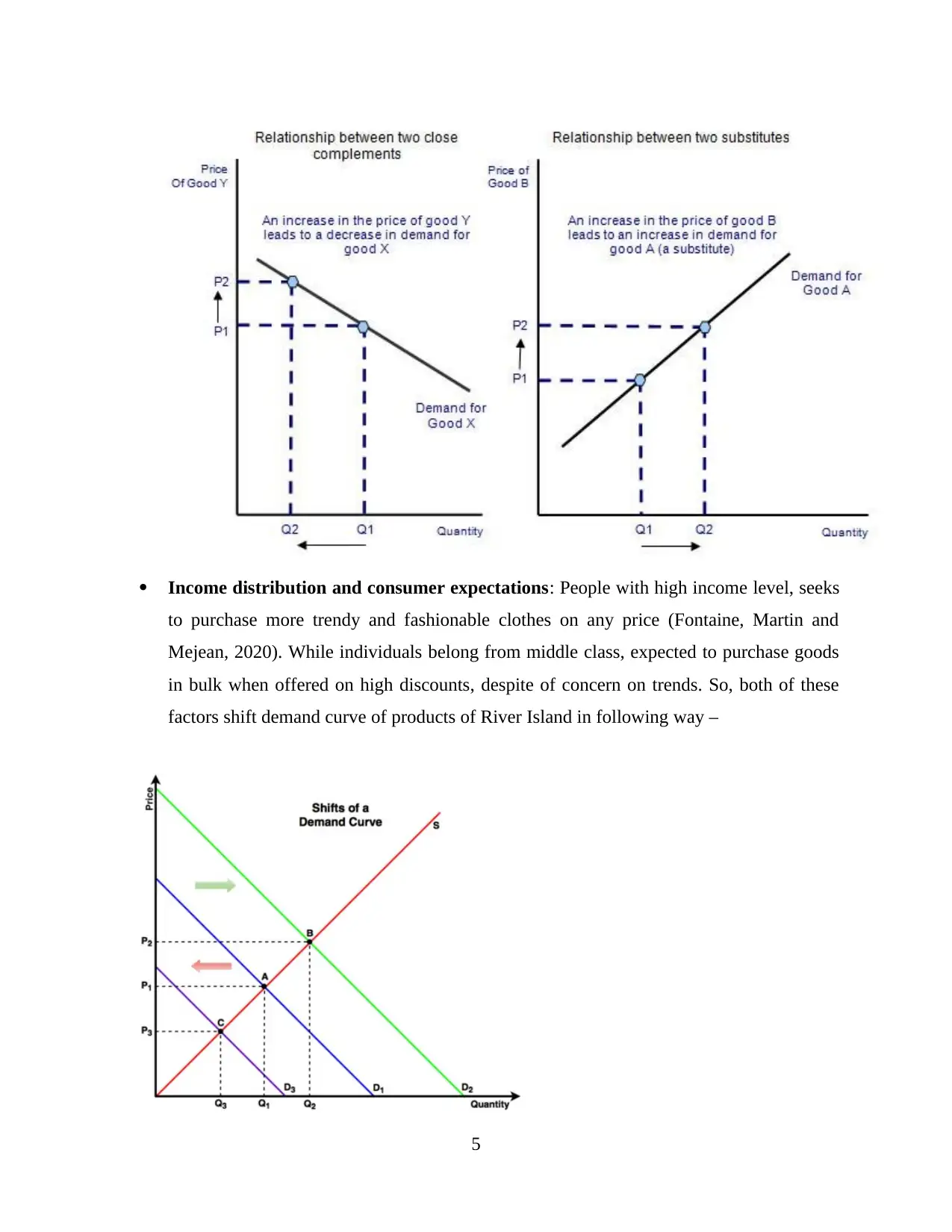
Taste and preference of consumers: It highly effects on demand of clothing and other
relatable products, because with changes in trends of fashion, taste and preferences of
people also changes. This would increase demand of latest fashion, which results in
surplus of existing ones. In this sense, keeping supply constant, shift in demand curve can
be illustrated by below figure –
Availability of substitutes and complementary goods: Number of substitute goods is
another main factor that affect demand curve. With respect to River Island, presence of
competitors like M&S, H&M, Zara and more, highly affects its sales (Sibirskaya and et. al.,
2019). When these rival firms offer same products relatively on less price or on amazing
discounts, then this would result in moving customers of River Island towards their stores.
Similarly, hike in price of these branded shift demand curve of present firm in right side. In
retailing stores, people not always come to buy a single commodity only, with clothes, they
would like to purchase footwear and other accessories also. So, higher availability of
complementary goods also increase demand of a particular one. In context with River Island,
it offers a range of products in wide variety with attractive discounts, so, it helps in increase
demand of its branded clothes more efficiently (Coe, Kelly and Yeung, 2019). The change in
demand curve due to both factors, can be depicted in following way –
4
relatable products, because with changes in trends of fashion, taste and preferences of
people also changes. This would increase demand of latest fashion, which results in
surplus of existing ones. In this sense, keeping supply constant, shift in demand curve can
be illustrated by below figure –
Availability of substitutes and complementary goods: Number of substitute goods is
another main factor that affect demand curve. With respect to River Island, presence of
competitors like M&S, H&M, Zara and more, highly affects its sales (Sibirskaya and et. al.,
2019). When these rival firms offer same products relatively on less price or on amazing
discounts, then this would result in moving customers of River Island towards their stores.
Similarly, hike in price of these branded shift demand curve of present firm in right side. In
retailing stores, people not always come to buy a single commodity only, with clothes, they
would like to purchase footwear and other accessories also. So, higher availability of
complementary goods also increase demand of a particular one. In context with River Island,
it offers a range of products in wide variety with attractive discounts, so, it helps in increase
demand of its branded clothes more efficiently (Coe, Kelly and Yeung, 2019). The change in
demand curve due to both factors, can be depicted in following way –
4

Income distribution and consumer expectations: People with high income level, seeks
to purchase more trendy and fashionable clothes on any price (Fontaine, Martin and
Mejean, 2020). While individuals belong from middle class, expected to purchase goods
in bulk when offered on high discounts, despite of concern on trends. So, both of these
factors shift demand curve of products of River Island in following way –
5
to purchase more trendy and fashionable clothes on any price (Fontaine, Martin and
Mejean, 2020). While individuals belong from middle class, expected to purchase goods
in bulk when offered on high discounts, despite of concern on trends. So, both of these
factors shift demand curve of products of River Island in following way –
5
⊘ This is a preview!⊘
Do you want full access?
Subscribe today to unlock all pages.

Trusted by 1+ million students worldwide

1.2 Description of Supply Law, movement along its curve and changes with respect to different
factors in retail sector
In contrast with Demand law, price and demand are directly related with each other within
Supply law i.e. with increase in price of goods, supply of same also increases and vice versa
(Roldan-Blanco and Gilbukh, 2020). Therefore, suppliers always seek that price of brands raise
continuously so that higher profitability can be obtained. With respect to River Island, taking one
its products like footwear as an example, to illustrate how increase price of same impact on
supply curve. People while purchasing footwear always concern on quality instead of price,
therefore, it helps companies to offer most comfortable footwear on high price (Chang and
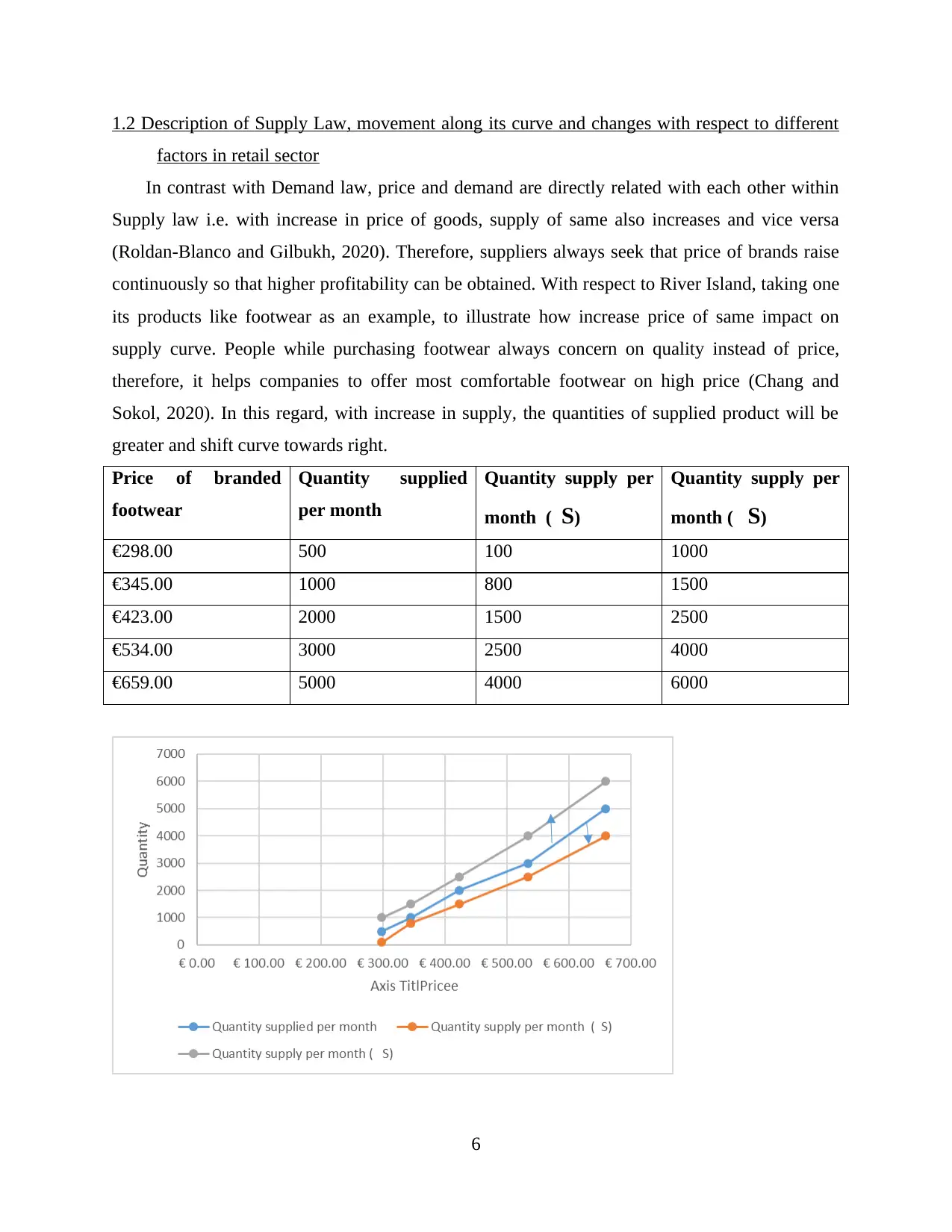
Sokol, 2020). In this regard, with increase in supply, the quantities of supplied product will be
greater and shift curve towards right.
Price of branded
footwear
Quantity supplied
per month
Quantity supply per
month ( S)
Quantity supply per
month ( S)
€298.00 500 100 1000
€345.00 1000 800 1500
€423.00 2000 1500 2500
€534.00 3000 2500 4000
€659.00 5000 4000 6000
6
factors in retail sector
In contrast with Demand law, price and demand are directly related with each other within
Supply law i.e. with increase in price of goods, supply of same also increases and vice versa
(Roldan-Blanco and Gilbukh, 2020). Therefore, suppliers always seek that price of brands raise
continuously so that higher profitability can be obtained. With respect to River Island, taking one
its products like footwear as an example, to illustrate how increase price of same impact on
supply curve. People while purchasing footwear always concern on quality instead of price,
therefore, it helps companies to offer most comfortable footwear on high price (Chang and
Sokol, 2020). In this regard, with increase in supply, the quantities of supplied product will be
greater and shift curve towards right.
Price of branded
footwear
Quantity supplied
per month
Quantity supply per
month ( S)
Quantity supply per
month ( S)
€298.00 500 100 1000
€345.00 1000 800 1500
€423.00 2000 1500 2500
€534.00 3000 2500 4000
€659.00 5000 4000 6000
6
Paraphrase This Document
Need a fresh take? Get an instant paraphrase of this document with our AI Paraphraser

As per this graph, it has illustrated that increase in supply shift curve towards upward and
decrease in the same, in downward (Browning and Zupan, 2020). In this sense, before making
changes in price, management of River Island considered on various factors that shift supply
curve either right or left, as highlighted below –
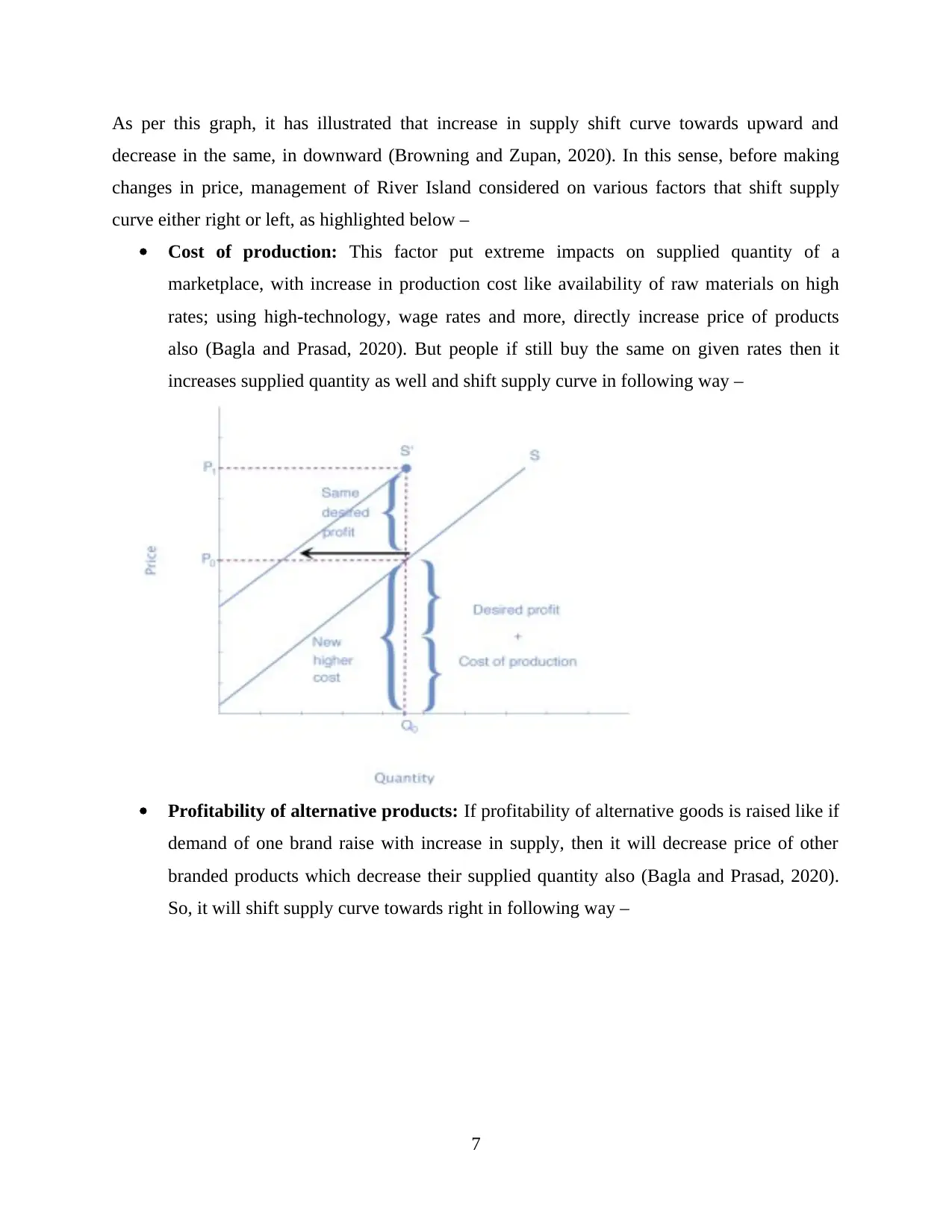
Cost of production: This factor put extreme impacts on supplied quantity of a
marketplace, with increase in production cost like availability of raw materials on high
rates; using high-technology, wage rates and more, directly increase price of products
also (Bagla and Prasad, 2020). But people if still buy the same on given rates then it
increases supplied quantity as well and shift supply curve in following way –
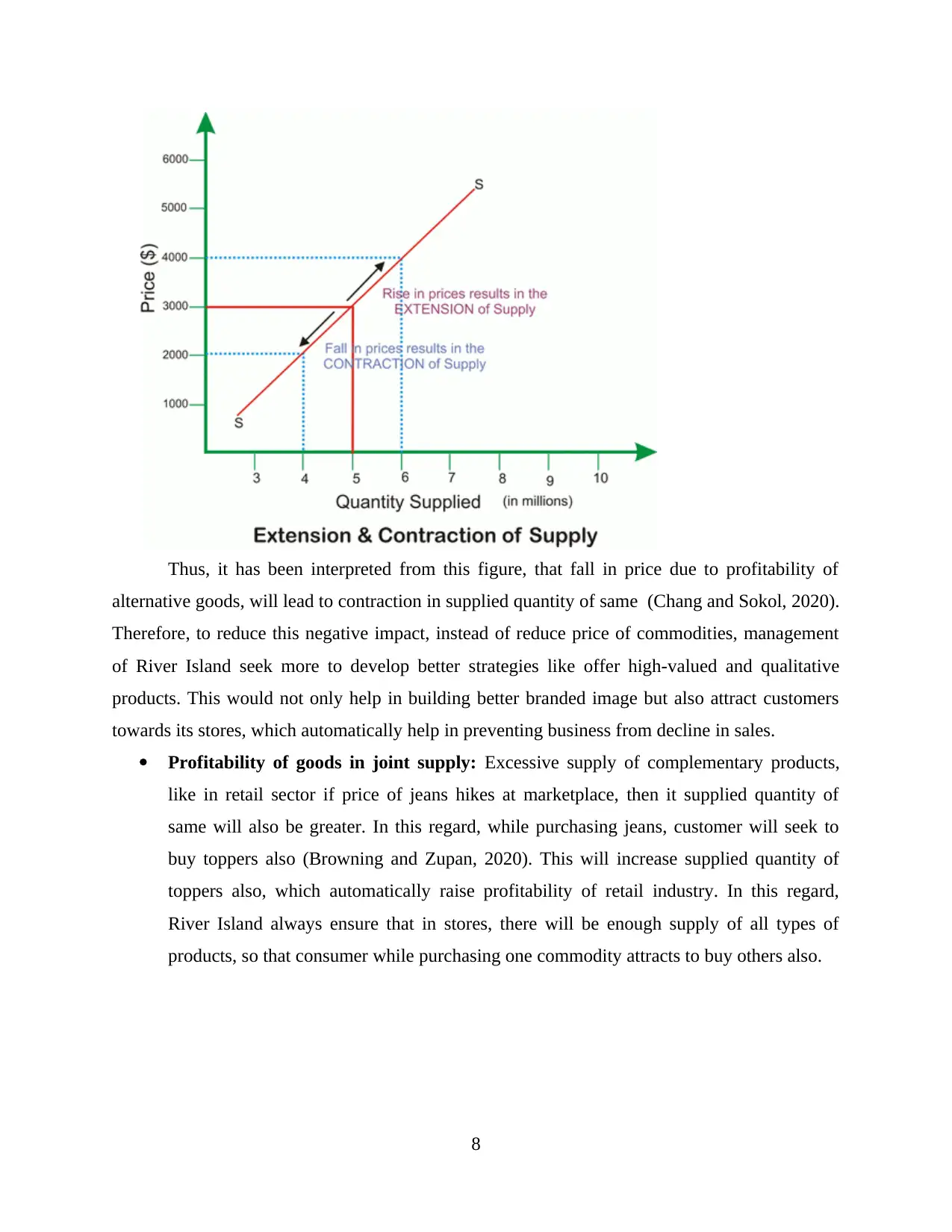
Profitability of alternative products: If profitability of alternative goods is raised like if
demand of one brand raise with increase in supply, then it will decrease price of other
branded products which decrease their supplied quantity also (Bagla and Prasad, 2020).
So, it will shift supply curve towards right in following way –
7
decrease in the same, in downward (Browning and Zupan, 2020). In this sense, before making
changes in price, management of River Island considered on various factors that shift supply
curve either right or left, as highlighted below –
Cost of production: This factor put extreme impacts on supplied quantity of a
marketplace, with increase in production cost like availability of raw materials on high
rates; using high-technology, wage rates and more, directly increase price of products
also (Bagla and Prasad, 2020). But people if still buy the same on given rates then it
increases supplied quantity as well and shift supply curve in following way –
Profitability of alternative products: If profitability of alternative goods is raised like if
demand of one brand raise with increase in supply, then it will decrease price of other
branded products which decrease their supplied quantity also (Bagla and Prasad, 2020).
So, it will shift supply curve towards right in following way –
7

Thus, it has been interpreted from this figure, that fall in price due to profitability of
alternative goods, will lead to contraction in supplied quantity of same (Chang and Sokol, 2020).
Therefore, to reduce this negative impact, instead of reduce price of commodities, management
of River Island seek more to develop better strategies like offer high-valued and qualitative
products. This would not only help in building better branded image but also attract customers
towards its stores, which automatically help in preventing business from decline in sales.
Profitability of goods in joint supply: Excessive supply of complementary products,
like in retail sector if price of jeans hikes at marketplace, then it supplied quantity of
same will also be greater. In this regard, while purchasing jeans, customer will seek to
buy toppers also (Browning and Zupan, 2020). This will increase supplied quantity of
toppers also, which automatically raise profitability of retail industry. In this regard,
River Island always ensure that in stores, there will be enough supply of all types of
products, so that consumer while purchasing one commodity attracts to buy others also.
8
alternative goods, will lead to contraction in supplied quantity of same (Chang and Sokol, 2020).
Therefore, to reduce this negative impact, instead of reduce price of commodities, management
of River Island seek more to develop better strategies like offer high-valued and qualitative
products. This would not only help in building better branded image but also attract customers
towards its stores, which automatically help in preventing business from decline in sales.
Profitability of goods in joint supply: Excessive supply of complementary products,
like in retail sector if price of jeans hikes at marketplace, then it supplied quantity of
same will also be greater. In this regard, while purchasing jeans, customer will seek to
buy toppers also (Browning and Zupan, 2020). This will increase supplied quantity of
toppers also, which automatically raise profitability of retail industry. In this regard,
River Island always ensure that in stores, there will be enough supply of all types of
products, so that consumer while purchasing one commodity attracts to buy others also.
8
⊘ This is a preview!⊘
Do you want full access?
Subscribe today to unlock all pages.

Trusted by 1+ million students worldwide
1 out of 17
Related Documents
Your All-in-One AI-Powered Toolkit for Academic Success.
+13062052269
info@desklib.com
Available 24*7 on WhatsApp / Email
Unlock your academic potential
Copyright © 2020–2025 A2Z Services. All Rights Reserved. Developed and managed by ZUCOL.