Exploring Dementia Nursing: Roles & Responsibilities in Nursing Homes
VerifiedAdded on 2023/04/23
|6
|1674
|120
Report
AI Summary
This report provides an overview of dementia and its impact, particularly within the context of nursing homes. It highlights the crucial role of nurses in dementia care, focusing on their responsibilities in specialized dementia care units (SCUs). The report compares and contrasts dementia nursing with other nursing services, emphasizing the specialized skills and comprehensive care required for dementia patients, including both physical and mental health support. It also references studies indicating the benefits of SCUs and the importance of addressing the unique needs of individuals with progressive dementia. The conclusion underscores the significance of dementia nursing in enhancing the quality of life for patients and their families, advocating for increased recognition and support for this specialized area of healthcare. Desklib provides access to similar past papers and solved assignments for students.
Running Head: NURSING
Nursing
Report
Student name
[Pick the date]
Nursing
Report
Student name
[Pick the date]
Paraphrase This Document
Need a fresh take? Get an instant paraphrase of this document with our AI Paraphraser

NURSING 1
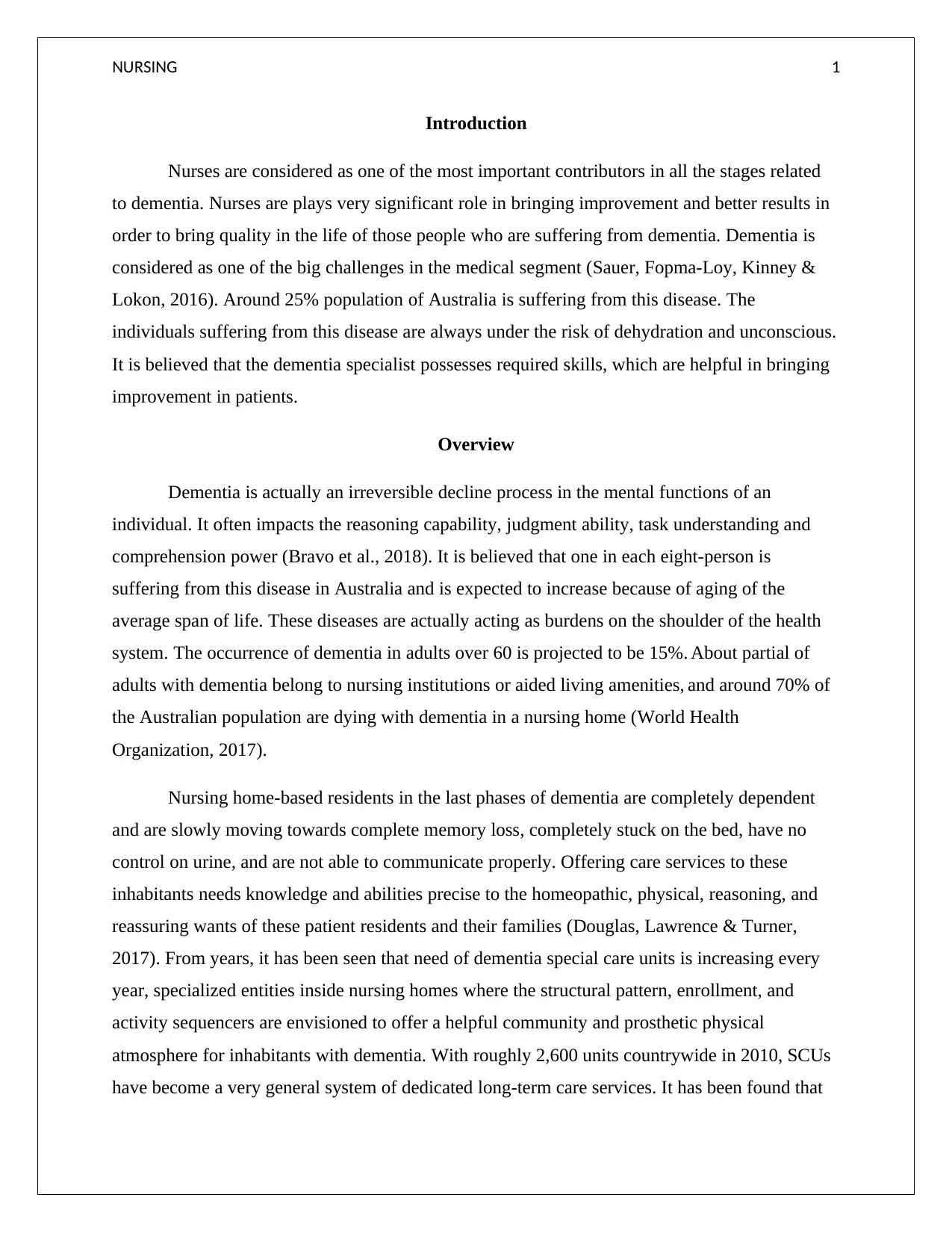
Introduction
Nurses are considered as one of the most important contributors in all the stages related
to dementia. Nurses are plays very significant role in bringing improvement and better results in
order to bring quality in the life of those people who are suffering from dementia. Dementia is
considered as one of the big challenges in the medical segment (Sauer, Fopma-Loy, Kinney &
Lokon, 2016). Around 25% population of Australia is suffering from this disease. The
individuals suffering from this disease are always under the risk of dehydration and unconscious.
It is believed that the dementia specialist possesses required skills, which are helpful in bringing
improvement in patients.
Overview
Dementia is actually an irreversible decline process in the mental functions of an
individual. It often impacts the reasoning capability, judgment ability, task understanding and
comprehension power (Bravo et al., 2018). It is believed that one in each eight-person is
suffering from this disease in Australia and is expected to increase because of aging of the
average span of life. These diseases are actually acting as burdens on the shoulder of the health
system. The occurrence of dementia in adults over 60 is projected to be 15%. About partial of
adults with dementia belong to nursing institutions or aided living amenities, and around 70% of
the Australian population are dying with dementia in a nursing home (World Health
Organization, 2017).
Nursing home-based residents in the last phases of dementia are completely dependent
and are slowly moving towards complete memory loss, completely stuck on the bed, have no
control on urine, and are not able to communicate properly. Offering care services to these
inhabitants needs knowledge and abilities precise to the homeopathic, physical, reasoning, and
reassuring wants of these patient residents and their families (Douglas, Lawrence & Turner,
2017). From years, it has been seen that need of dementia special care units is increasing every
year, specialized entities inside nursing homes where the structural pattern, enrollment, and
activity sequencers are envisioned to offer a helpful community and prosthetic physical
atmosphere for inhabitants with dementia. With roughly 2,600 units countrywide in 2010, SCUs
have become a very general system of dedicated long-term care services. It has been found that
Introduction
Nurses are considered as one of the most important contributors in all the stages related
to dementia. Nurses are plays very significant role in bringing improvement and better results in
order to bring quality in the life of those people who are suffering from dementia. Dementia is
considered as one of the big challenges in the medical segment (Sauer, Fopma-Loy, Kinney &
Lokon, 2016). Around 25% population of Australia is suffering from this disease. The
individuals suffering from this disease are always under the risk of dehydration and unconscious.
It is believed that the dementia specialist possesses required skills, which are helpful in bringing
improvement in patients.
Overview
Dementia is actually an irreversible decline process in the mental functions of an
individual. It often impacts the reasoning capability, judgment ability, task understanding and
comprehension power (Bravo et al., 2018). It is believed that one in each eight-person is
suffering from this disease in Australia and is expected to increase because of aging of the
average span of life. These diseases are actually acting as burdens on the shoulder of the health
system. The occurrence of dementia in adults over 60 is projected to be 15%. About partial of
adults with dementia belong to nursing institutions or aided living amenities, and around 70% of
the Australian population are dying with dementia in a nursing home (World Health
Organization, 2017).
Nursing home-based residents in the last phases of dementia are completely dependent
and are slowly moving towards complete memory loss, completely stuck on the bed, have no
control on urine, and are not able to communicate properly. Offering care services to these
inhabitants needs knowledge and abilities precise to the homeopathic, physical, reasoning, and
reassuring wants of these patient residents and their families (Douglas, Lawrence & Turner,
2017). From years, it has been seen that need of dementia special care units is increasing every
year, specialized entities inside nursing homes where the structural pattern, enrollment, and
activity sequencers are envisioned to offer a helpful community and prosthetic physical
atmosphere for inhabitants with dementia. With roughly 2,600 units countrywide in 2010, SCUs
have become a very general system of dedicated long-term care services. It has been found that

NURSING 2
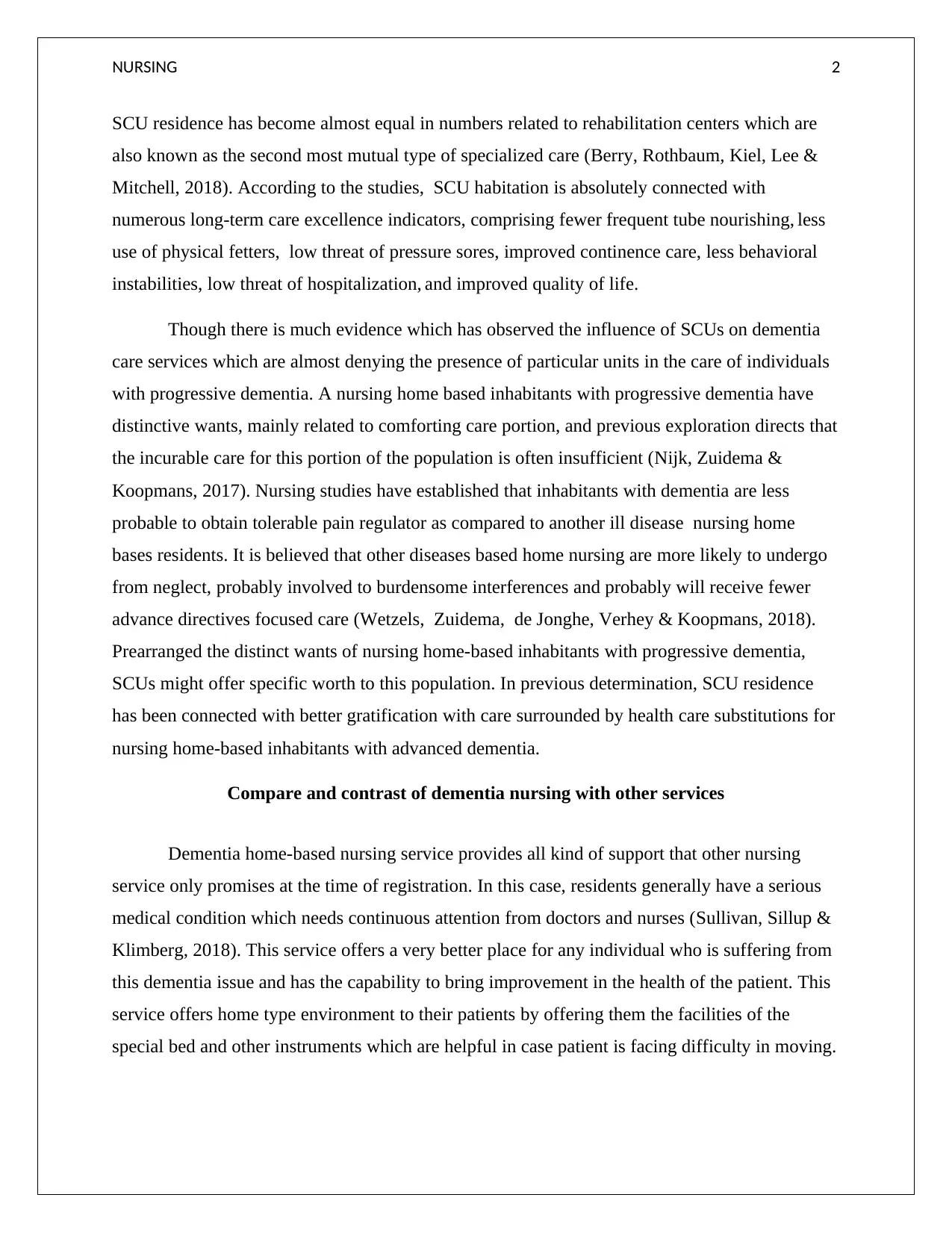
SCU residence has become almost equal in numbers related to rehabilitation centers which are
also known as the second most mutual type of specialized care (Berry, Rothbaum, Kiel, Lee &
Mitchell, 2018). According to the studies, SCU habitation is absolutely connected with
numerous long-term care excellence indicators, comprising fewer frequent tube nourishing, less
use of physical fetters, low threat of pressure sores, improved continence care, less behavioral
instabilities, low threat of hospitalization, and improved quality of life.
Though there is much evidence which has observed the influence of SCUs on dementia
care services which are almost denying the presence of particular units in the care of individuals
with progressive dementia. A nursing home based inhabitants with progressive dementia have
distinctive wants, mainly related to comforting care portion, and previous exploration directs that
the incurable care for this portion of the population is often insufficient (Nijk, Zuidema &
Koopmans, 2017). Nursing studies have established that inhabitants with dementia are less
probable to obtain tolerable pain regulator as compared to another ill disease nursing home
bases residents. It is believed that other diseases based home nursing are more likely to undergo
from neglect, probably involved to burdensome interferences and probably will receive fewer
advance directives focused care (Wetzels, Zuidema, de Jonghe, Verhey & Koopmans, 2018).
Prearranged the distinct wants of nursing home-based inhabitants with progressive dementia,
SCUs might offer specific worth to this population. In previous determination, SCU residence
has been connected with better gratification with care surrounded by health care substitutions for
nursing home-based inhabitants with advanced dementia.
Compare and contrast of dementia nursing with other services
Dementia home-based nursing service provides all kind of support that other nursing
service only promises at the time of registration. In this case, residents generally have a serious
medical condition which needs continuous attention from doctors and nurses (Sullivan, Sillup &
Klimberg, 2018). This service offers a very better place for any individual who is suffering from
this dementia issue and has the capability to bring improvement in the health of the patient. This
service offers home type environment to their patients by offering them the facilities of the
special bed and other instruments which are helpful in case patient is facing difficulty in moving.
SCU residence has become almost equal in numbers related to rehabilitation centers which are
also known as the second most mutual type of specialized care (Berry, Rothbaum, Kiel, Lee &
Mitchell, 2018). According to the studies, SCU habitation is absolutely connected with
numerous long-term care excellence indicators, comprising fewer frequent tube nourishing, less
use of physical fetters, low threat of pressure sores, improved continence care, less behavioral
instabilities, low threat of hospitalization, and improved quality of life.
Though there is much evidence which has observed the influence of SCUs on dementia
care services which are almost denying the presence of particular units in the care of individuals
with progressive dementia. A nursing home based inhabitants with progressive dementia have
distinctive wants, mainly related to comforting care portion, and previous exploration directs that
the incurable care for this portion of the population is often insufficient (Nijk, Zuidema &
Koopmans, 2017). Nursing studies have established that inhabitants with dementia are less
probable to obtain tolerable pain regulator as compared to another ill disease nursing home
bases residents. It is believed that other diseases based home nursing are more likely to undergo
from neglect, probably involved to burdensome interferences and probably will receive fewer
advance directives focused care (Wetzels, Zuidema, de Jonghe, Verhey & Koopmans, 2018).
Prearranged the distinct wants of nursing home-based inhabitants with progressive dementia,
SCUs might offer specific worth to this population. In previous determination, SCU residence
has been connected with better gratification with care surrounded by health care substitutions for
nursing home-based inhabitants with advanced dementia.
Compare and contrast of dementia nursing with other services
Dementia home-based nursing service provides all kind of support that other nursing
service only promises at the time of registration. In this case, residents generally have a serious
medical condition which needs continuous attention from doctors and nurses (Sullivan, Sillup &
Klimberg, 2018). This service offers a very better place for any individual who is suffering from
this dementia issue and has the capability to bring improvement in the health of the patient. This
service offers home type environment to their patients by offering them the facilities of the
special bed and other instruments which are helpful in case patient is facing difficulty in moving.
⊘ This is a preview!⊘
Do you want full access?
Subscribe today to unlock all pages.

Trusted by 1+ million students worldwide

NURSING 3
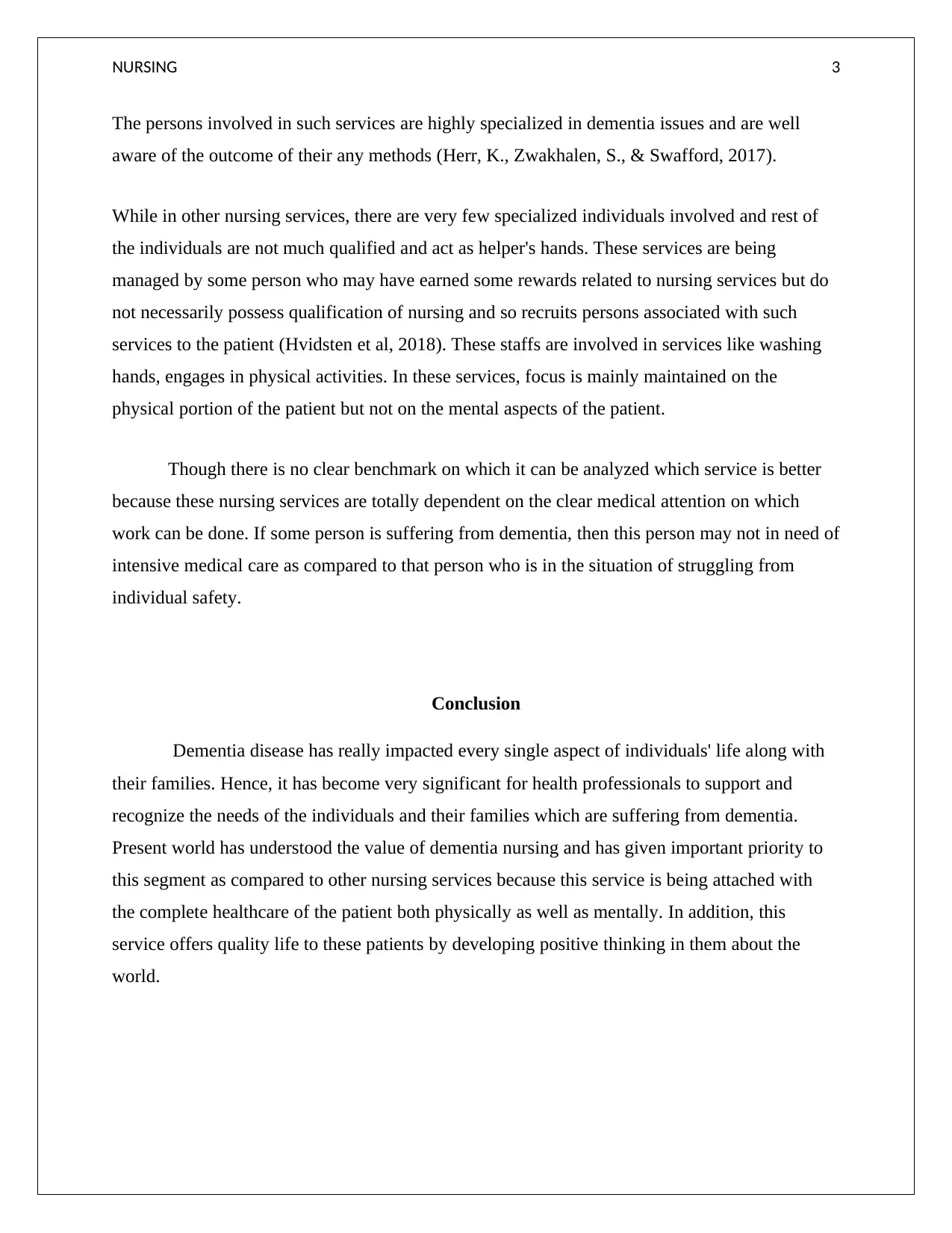
The persons involved in such services are highly specialized in dementia issues and are well
aware of the outcome of their any methods (Herr, K., Zwakhalen, S., & Swafford, 2017).
While in other nursing services, there are very few specialized individuals involved and rest of
the individuals are not much qualified and act as helper's hands. These services are being
managed by some person who may have earned some rewards related to nursing services but do
not necessarily possess qualification of nursing and so recruits persons associated with such
services to the patient (Hvidsten et al, 2018). These staffs are involved in services like washing
hands, engages in physical activities. In these services, focus is mainly maintained on the
physical portion of the patient but not on the mental aspects of the patient.
Though there is no clear benchmark on which it can be analyzed which service is better
because these nursing services are totally dependent on the clear medical attention on which
work can be done. If some person is suffering from dementia, then this person may not in need of
intensive medical care as compared to that person who is in the situation of struggling from
individual safety.
Conclusion
Dementia disease has really impacted every single aspect of individuals' life along with
their families. Hence, it has become very significant for health professionals to support and
recognize the needs of the individuals and their families which are suffering from dementia.
Present world has understood the value of dementia nursing and has given important priority to
this segment as compared to other nursing services because this service is being attached with
the complete healthcare of the patient both physically as well as mentally. In addition, this
service offers quality life to these patients by developing positive thinking in them about the
world.
The persons involved in such services are highly specialized in dementia issues and are well
aware of the outcome of their any methods (Herr, K., Zwakhalen, S., & Swafford, 2017).
While in other nursing services, there are very few specialized individuals involved and rest of
the individuals are not much qualified and act as helper's hands. These services are being
managed by some person who may have earned some rewards related to nursing services but do
not necessarily possess qualification of nursing and so recruits persons associated with such
services to the patient (Hvidsten et al, 2018). These staffs are involved in services like washing
hands, engages in physical activities. In these services, focus is mainly maintained on the
physical portion of the patient but not on the mental aspects of the patient.
Though there is no clear benchmark on which it can be analyzed which service is better
because these nursing services are totally dependent on the clear medical attention on which
work can be done. If some person is suffering from dementia, then this person may not in need of
intensive medical care as compared to that person who is in the situation of struggling from
individual safety.
Conclusion
Dementia disease has really impacted every single aspect of individuals' life along with
their families. Hence, it has become very significant for health professionals to support and
recognize the needs of the individuals and their families which are suffering from dementia.
Present world has understood the value of dementia nursing and has given important priority to
this segment as compared to other nursing services because this service is being attached with
the complete healthcare of the patient both physically as well as mentally. In addition, this
service offers quality life to these patients by developing positive thinking in them about the
world.
Paraphrase This Document
Need a fresh take? Get an instant paraphrase of this document with our AI Paraphraser

NURSING 4
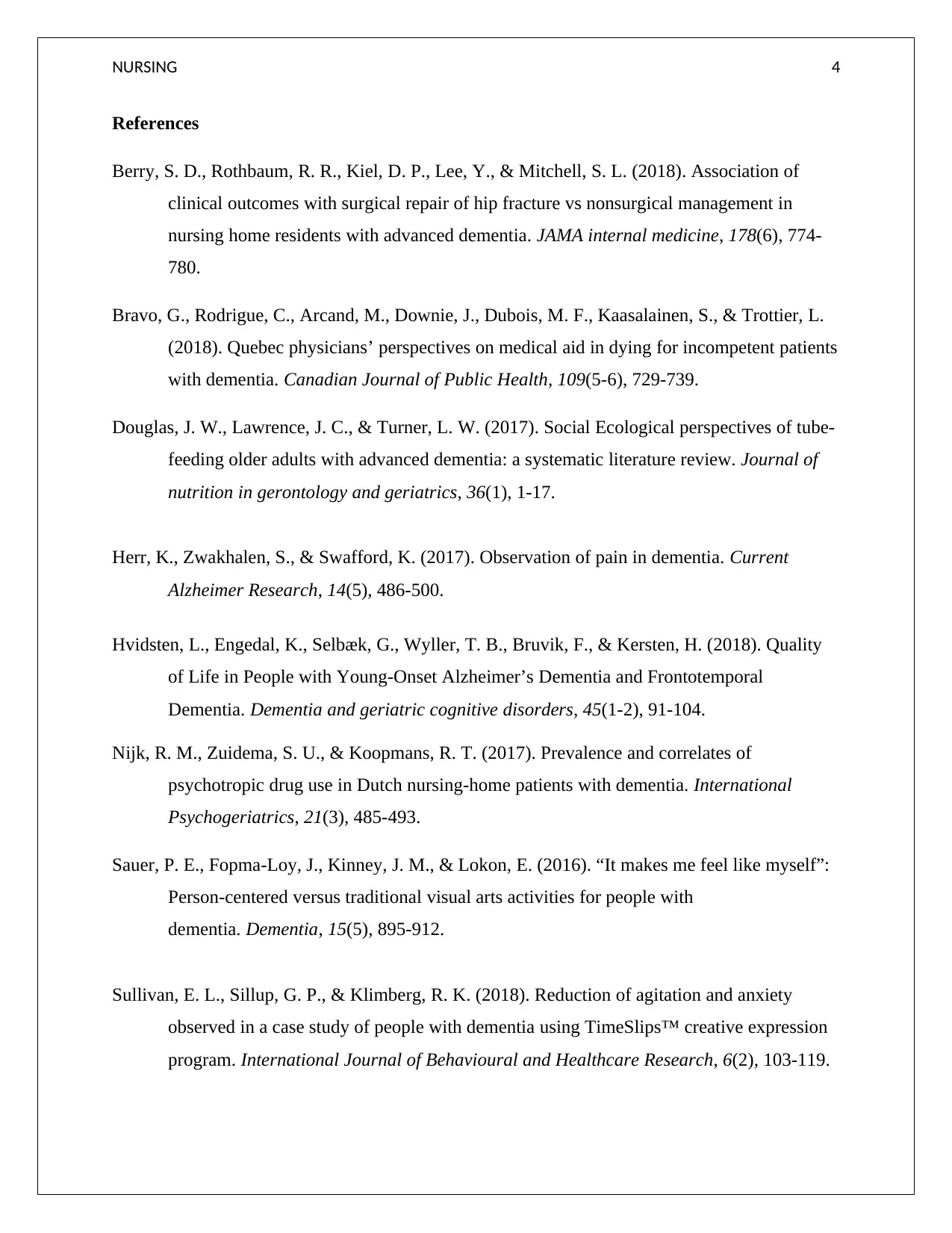
References
Berry, S. D., Rothbaum, R. R., Kiel, D. P., Lee, Y., & Mitchell, S. L. (2018). Association of
clinical outcomes with surgical repair of hip fracture vs nonsurgical management in
nursing home residents with advanced dementia. JAMA internal medicine, 178(6), 774-
780.
Bravo, G., Rodrigue, C., Arcand, M., Downie, J., Dubois, M. F., Kaasalainen, S., & Trottier, L.
(2018). Quebec physicians’ perspectives on medical aid in dying for incompetent patients
with dementia. Canadian Journal of Public Health, 109(5-6), 729-739.
Douglas, J. W., Lawrence, J. C., & Turner, L. W. (2017). Social Ecological perspectives of tube-
feeding older adults with advanced dementia: a systematic literature review. Journal of
nutrition in gerontology and geriatrics, 36(1), 1-17.
Herr, K., Zwakhalen, S., & Swafford, K. (2017). Observation of pain in dementia. Current
Alzheimer Research, 14(5), 486-500.
Hvidsten, L., Engedal, K., Selbæk, G., Wyller, T. B., Bruvik, F., & Kersten, H. (2018). Quality
of Life in People with Young-Onset Alzheimer’s Dementia and Frontotemporal
Dementia. Dementia and geriatric cognitive disorders, 45(1-2), 91-104.
Nijk, R. M., Zuidema, S. U., & Koopmans, R. T. (2017). Prevalence and correlates of
psychotropic drug use in Dutch nursing-home patients with dementia. International
Psychogeriatrics, 21(3), 485-493.
Sauer, P. E., Fopma-Loy, J., Kinney, J. M., & Lokon, E. (2016). “It makes me feel like myself”:
Person-centered versus traditional visual arts activities for people with
dementia. Dementia, 15(5), 895-912.
Sullivan, E. L., Sillup, G. P., & Klimberg, R. K. (2018). Reduction of agitation and anxiety
observed in a case study of people with dementia using TimeSlips™ creative expression
program. International Journal of Behavioural and Healthcare Research, 6(2), 103-119.
References
Berry, S. D., Rothbaum, R. R., Kiel, D. P., Lee, Y., & Mitchell, S. L. (2018). Association of
clinical outcomes with surgical repair of hip fracture vs nonsurgical management in
nursing home residents with advanced dementia. JAMA internal medicine, 178(6), 774-
780.
Bravo, G., Rodrigue, C., Arcand, M., Downie, J., Dubois, M. F., Kaasalainen, S., & Trottier, L.
(2018). Quebec physicians’ perspectives on medical aid in dying for incompetent patients
with dementia. Canadian Journal of Public Health, 109(5-6), 729-739.
Douglas, J. W., Lawrence, J. C., & Turner, L. W. (2017). Social Ecological perspectives of tube-
feeding older adults with advanced dementia: a systematic literature review. Journal of
nutrition in gerontology and geriatrics, 36(1), 1-17.
Herr, K., Zwakhalen, S., & Swafford, K. (2017). Observation of pain in dementia. Current
Alzheimer Research, 14(5), 486-500.
Hvidsten, L., Engedal, K., Selbæk, G., Wyller, T. B., Bruvik, F., & Kersten, H. (2018). Quality
of Life in People with Young-Onset Alzheimer’s Dementia and Frontotemporal
Dementia. Dementia and geriatric cognitive disorders, 45(1-2), 91-104.
Nijk, R. M., Zuidema, S. U., & Koopmans, R. T. (2017). Prevalence and correlates of
psychotropic drug use in Dutch nursing-home patients with dementia. International
Psychogeriatrics, 21(3), 485-493.
Sauer, P. E., Fopma-Loy, J., Kinney, J. M., & Lokon, E. (2016). “It makes me feel like myself”:
Person-centered versus traditional visual arts activities for people with
dementia. Dementia, 15(5), 895-912.
Sullivan, E. L., Sillup, G. P., & Klimberg, R. K. (2018). Reduction of agitation and anxiety
observed in a case study of people with dementia using TimeSlips™ creative expression
program. International Journal of Behavioural and Healthcare Research, 6(2), 103-119.

NURSING 5
Wetzels, R. B., Zuidema, S. U., de Jonghe, J. F., Verhey, F. R. J., & Koopmans, R. T. C. M.
(2018). Determinants of quality of life in nursing home residents with
dementia. Dementia and geriatric cognitive disorders, 29(3), 189-197.
World Health Organization. (2017) Key facts [online]. Retrieved from:
https://www.who.int/news-room/fact-sheets/detail/dementia
Wetzels, R. B., Zuidema, S. U., de Jonghe, J. F., Verhey, F. R. J., & Koopmans, R. T. C. M.
(2018). Determinants of quality of life in nursing home residents with
dementia. Dementia and geriatric cognitive disorders, 29(3), 189-197.
World Health Organization. (2017) Key facts [online]. Retrieved from:
https://www.who.int/news-room/fact-sheets/detail/dementia
⊘ This is a preview!⊘
Do you want full access?
Subscribe today to unlock all pages.

Trusted by 1+ million students worldwide
1 out of 6
Related Documents
Your All-in-One AI-Powered Toolkit for Academic Success.
+13062052269
info@desklib.com
Available 24*7 on WhatsApp / Email
Unlock your academic potential
Copyright © 2020–2026 A2Z Services. All Rights Reserved. Developed and managed by ZUCOL.