Care Plan for Dementia Patient Philip: Communication Strategies

Verified

Added on  2020/03/02

|6
|1412
|99
Practical Assignment
AI Summary
This assignment presents a detailed nursing care plan for a patient named Philip, who has dementia and experiences behavioral and psychological symptoms, including agitation and communication difficulties due to his limited English proficiency. The care plan, developed in consultation with Mrs. Lusk, addresses the patient's needs through various interventions. These include strategies for verbal and non-verbal communication, environmental modifications, and medication management. The plan outlines specific nursing outcomes, interventions, and evaluation methods for each area. The interventions focus on clear and simple communication, creating a supportive environment, and appropriate medication use to manage agitation. The plan also includes educating Mrs. Lusk on effective communication techniques and ensuring her understanding of the care plan. The evaluation section allows for tracking the effectiveness of the interventions, indicating whether the nursing outcomes are met or unmet.
Document Page
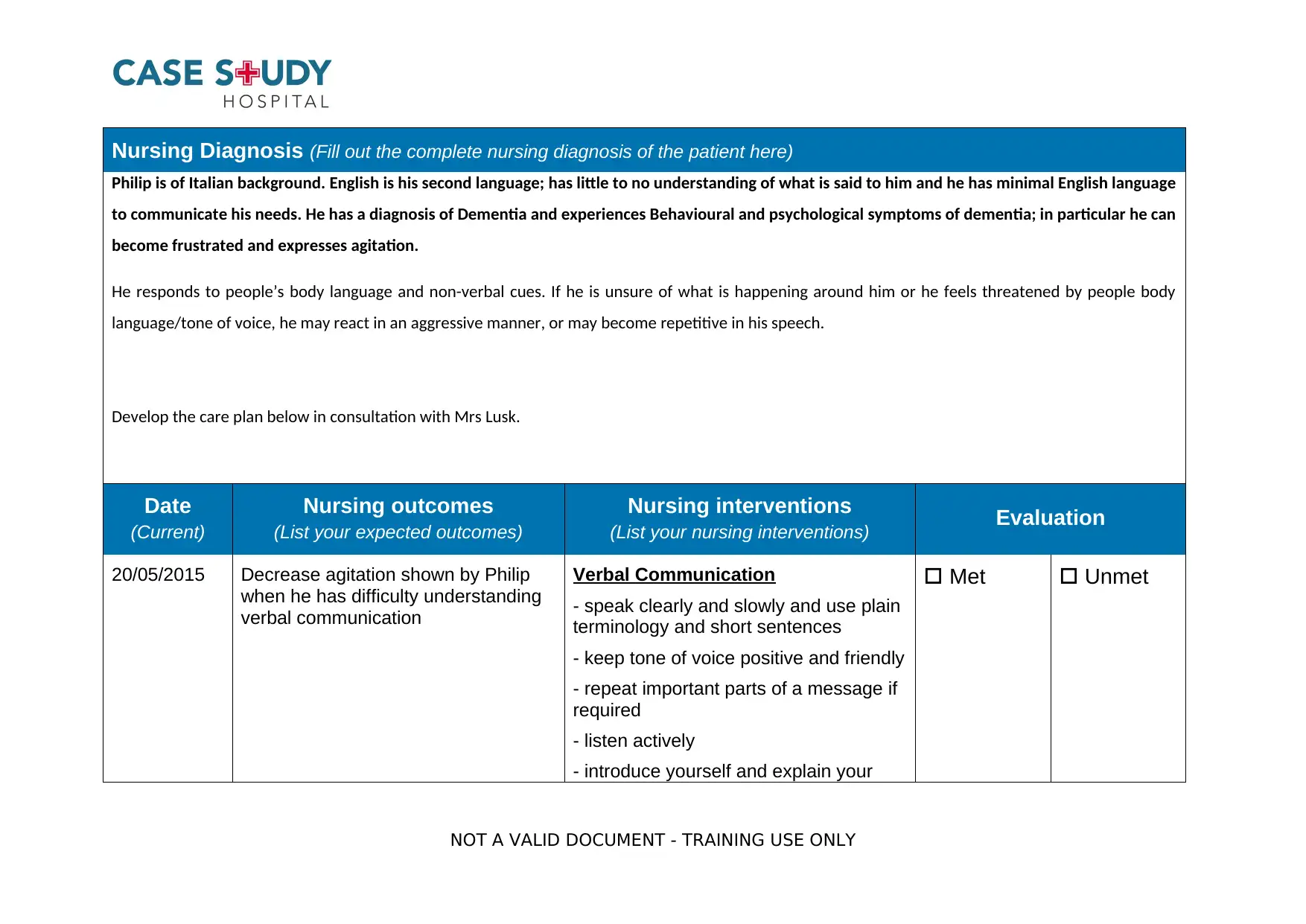
Nursing Diagnosis (Fill out the complete nursing diagnosis of the patient here)
Philip is of Italian background. English is his second language; has little to no understanding of what is said to him and he has minimal English language
to communicate his needs. He has a diagnosis of Dementia and experiences Behavioural and psychological symptoms of dementia; in particular he can
become frustrated and expresses agitation.
He responds to people’s body language and non-verbal cues. If he is unsure of what is happening around him or he feels threatened by people body
language/tone of voice, he may react in an aggressive manner, or may become repetitive in his speech.
Develop the care plan below in consultation with Mrs Lusk.
Date
(Current)
Nursing outcomes
(List your expected outcomes)
Nursing interventions
(List your nursing interventions) Evaluation
20/05/2015 Decrease agitation shown by Philip
when he has difficulty understanding
verbal communication
Verbal Communication
- speak clearly and slowly and use plain
terminology and short sentences
- keep tone of voice positive and friendly
- repeat important parts of a message if
required
- listen actively
- introduce yourself and explain your
Met Unmet
NOT A VALID DOCUMENT - TRAINING USE ONLY
tabler-icon-diamond-filled.svg

Paraphrase This Document

Need a fresh take? Get an instant paraphrase of this document with our AI Paraphraser
Document Page
[Type text]
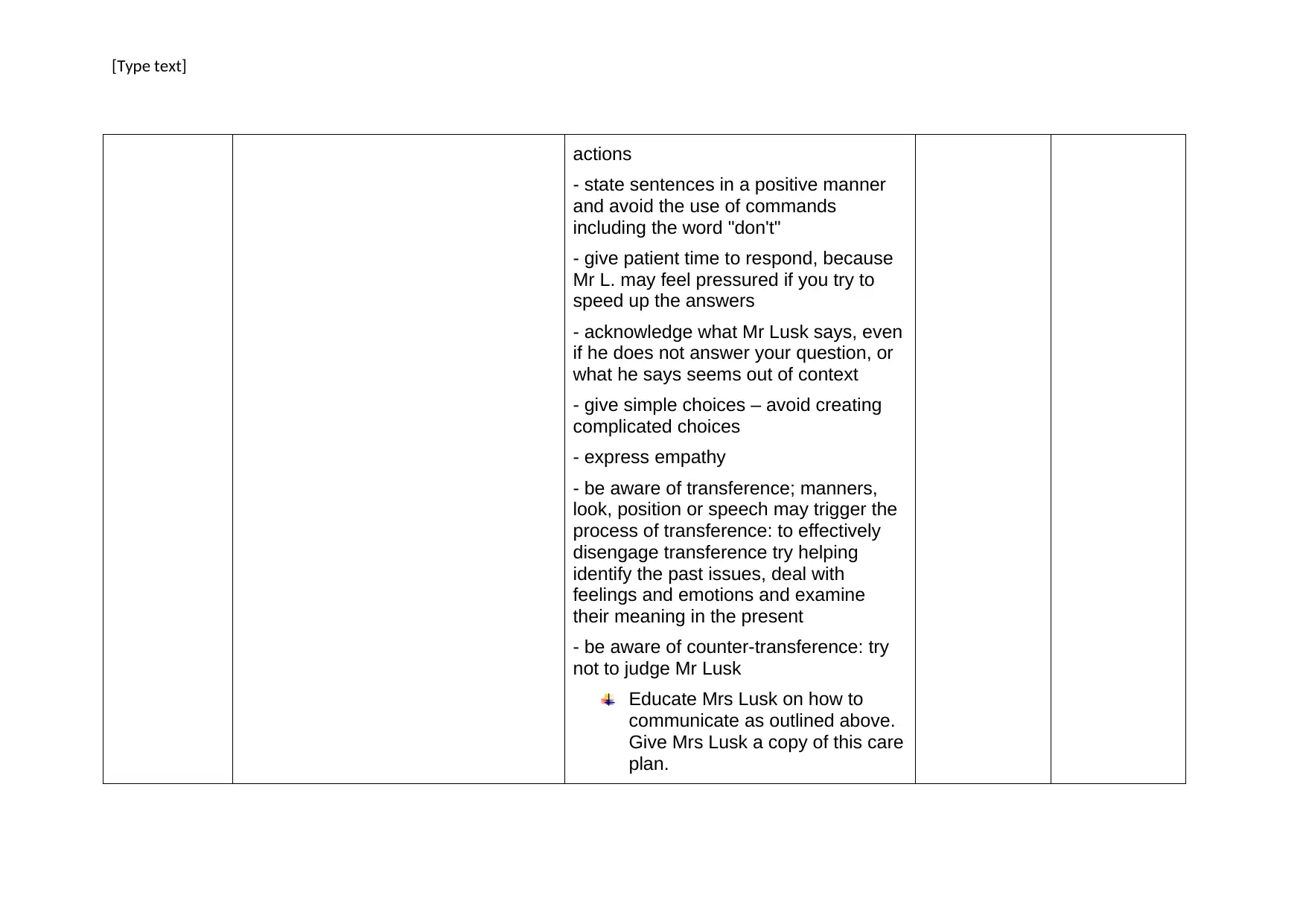
actions
- state sentences in a positive manner
and avoid the use of commands
including the word "don't"
- give patient time to respond, because
Mr L. may feel pressured if you try to
speed up the answers
- acknowledge what Mr Lusk says, even
if he does not answer your question, or
what he says seems out of context
- give simple choices – avoid creating
complicated choices
- express empathy
- be aware of transference; manners,
look, position or speech may trigger the
process of transference: to effectively
disengage transference try helping
identify the past issues, deal with
feelings and emotions and examine
their meaning in the present
- be aware of counter-transference: try
not to judge Mr Lusk
Educate Mrs Lusk on how to
communicate as outlined above.
Give Mrs Lusk a copy of this care
plan.
Document Page
[Type text]
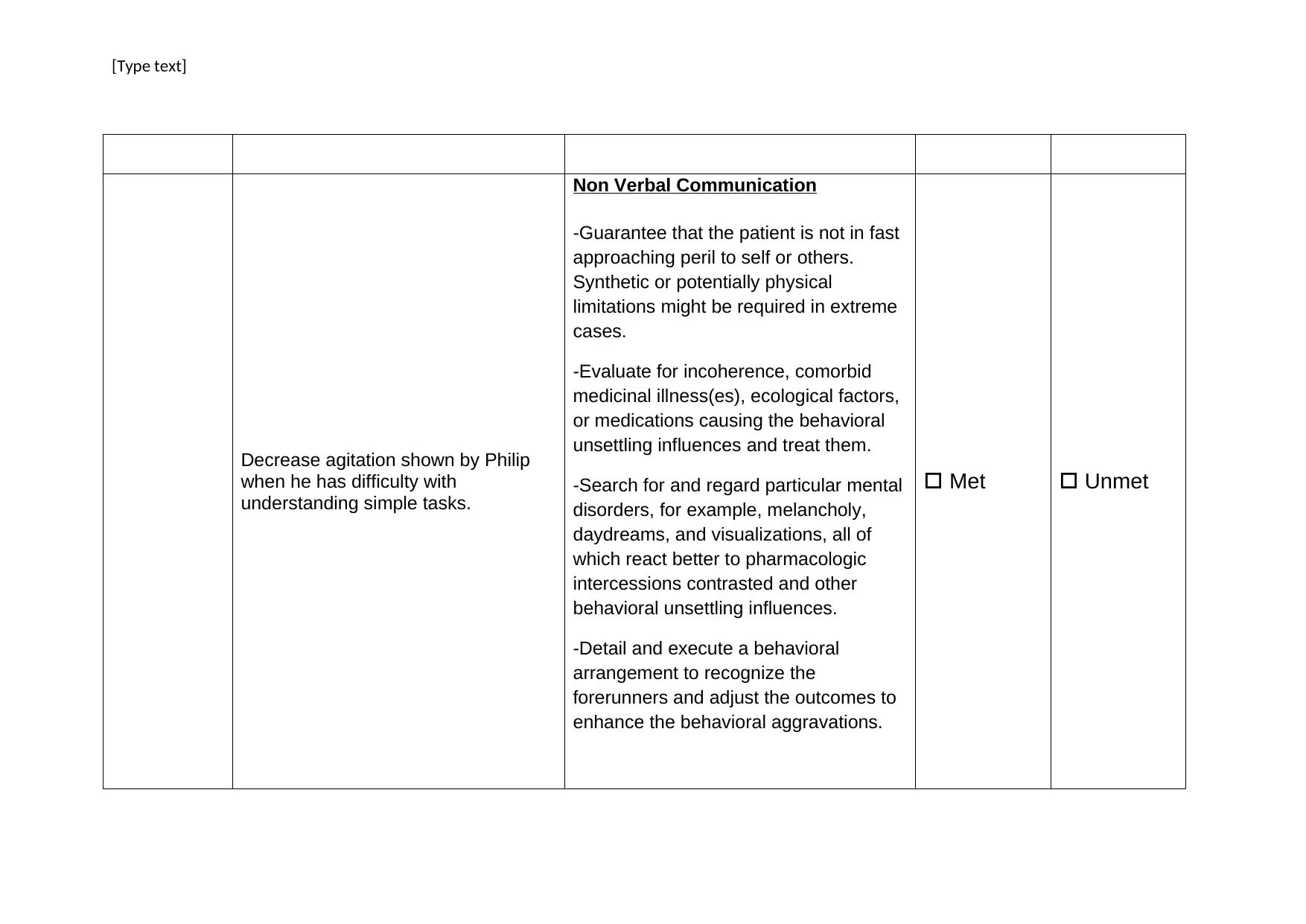
Decrease agitation shown by Philip
when he has difficulty with
understanding simple tasks.
Non Verbal Communication
-Guarantee that the patient is not in fast
approaching peril to self or others.
Synthetic or potentially physical
limitations might be required in extreme
cases.
-Evaluate for incoherence, comorbid
medicinal illness(es), ecological factors,
or medications causing the behavioral
unsettling influences and treat them.
-Search for and regard particular mental
disorders, for example, melancholy,
daydreams, and visualizations, all of
which react better to pharmacologic
intercessions contrasted and other
behavioral unsettling influences.
-Detail and execute a behavioral
arrangement to recognize the
forerunners and adjust the outcomes to
enhance the behavioral aggravations.
Met Unmet
Document Page
[Type text]
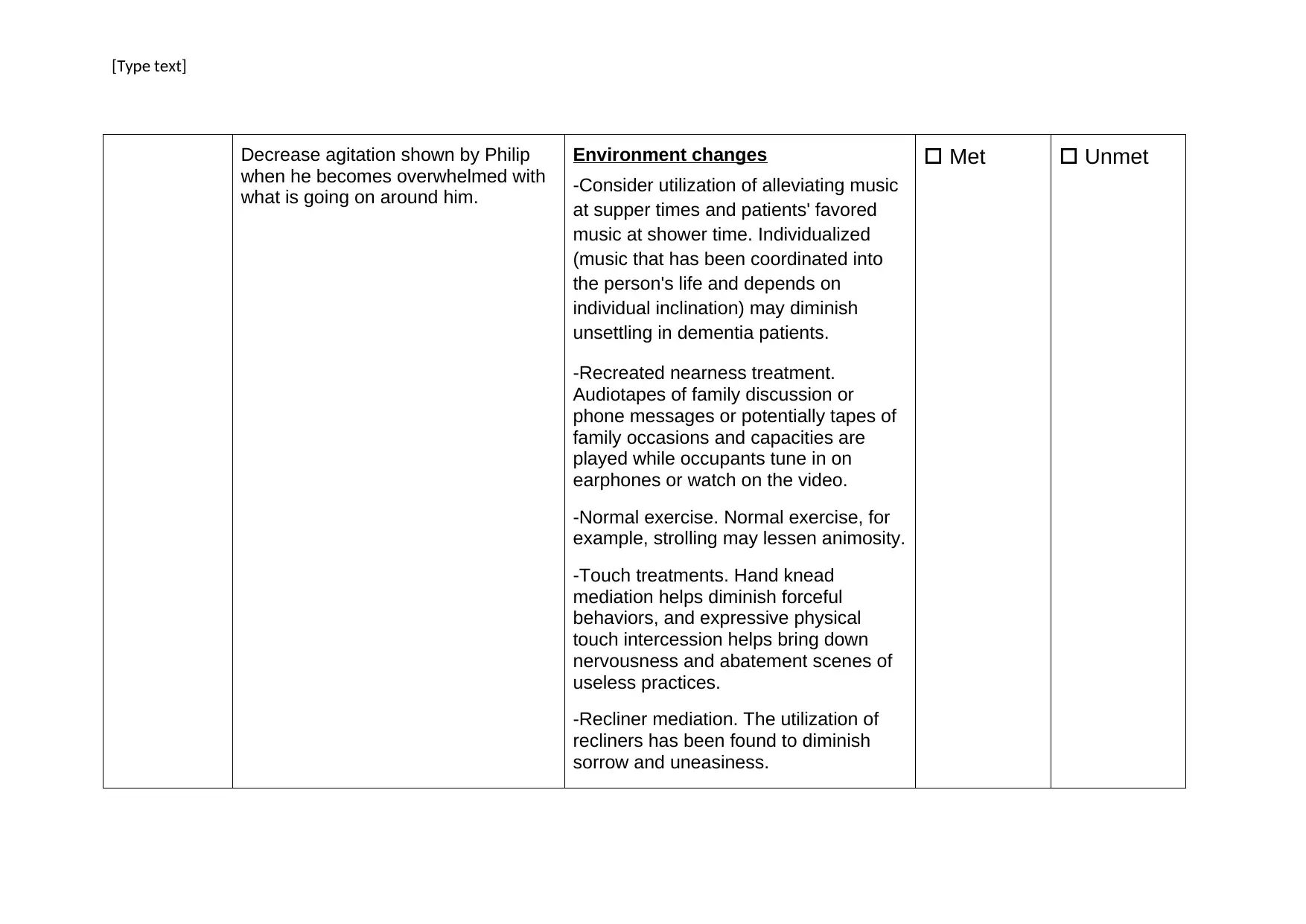
Decrease agitation shown by Philip
when he becomes overwhelmed with
what is going on around him.
Environment changes
-Consider utilization of alleviating music
at supper times and patients' favored
music at shower time. Individualized
(music that has been coordinated into
the person's life and depends on
individual inclination) may diminish
unsettling in dementia patients.
-Recreated nearness treatment.
Audiotapes of family discussion or
phone messages or potentially tapes of
family occasions and capacities are
played while occupants tune in on
earphones or watch on the video.
-Normal exercise. Normal exercise, for
example, strolling may lessen animosity.
-Touch treatments. Hand knead
mediation helps diminish forceful
behaviors, and expressive physical
touch intercession helps bring down
nervousness and abatement scenes of
useless practices.
-Recliner mediation. The utilization of
recliners has been found to diminish
sorrow and uneasiness.
Met Unmet
tabler-icon-diamond-filled.svg

Paraphrase This Document

Need a fresh take? Get an instant paraphrase of this document with our AI Paraphraser
Document Page
[Type text]
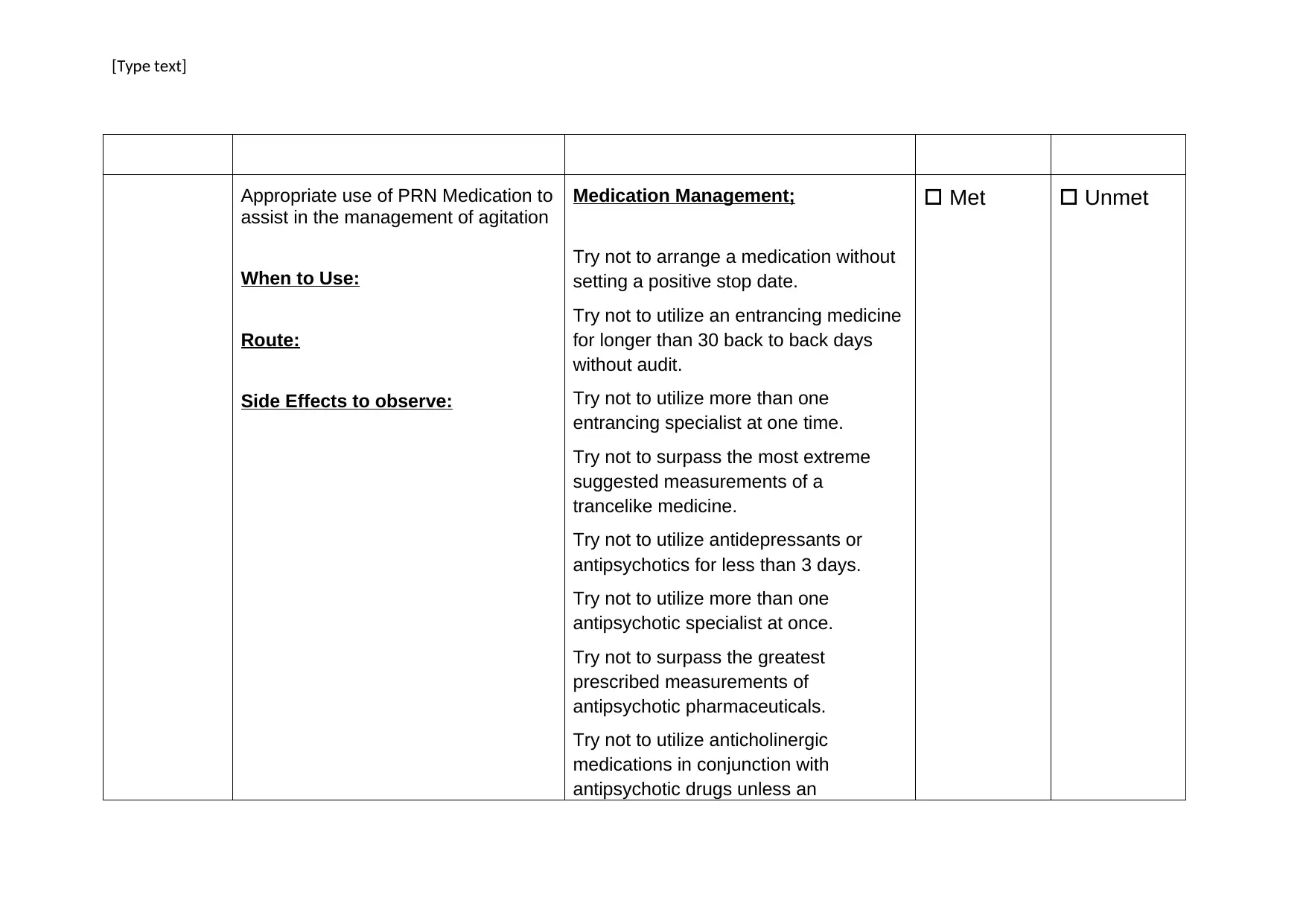
Appropriate use of PRN Medication to
assist in the management of agitation
When to Use:
Route:
Side Effects to observe:
Medication Management;
Try not to arrange a medication without
setting a positive stop date.
Try not to utilize an entrancing medicine
for longer than 30 back to back days
without audit.
Try not to utilize more than one
entrancing specialist at one time.
Try not to surpass the most extreme
suggested measurements of a
trancelike medicine.
Try not to utilize antidepressants or
antipsychotics for less than 3 days.
Try not to utilize more than one
antipsychotic specialist at once.
Try not to surpass the greatest
prescribed measurements of
antipsychotic pharmaceuticals.
Try not to utilize anticholinergic
medications in conjunction with
antipsychotic drugs unless an
Met Unmet
Document Page
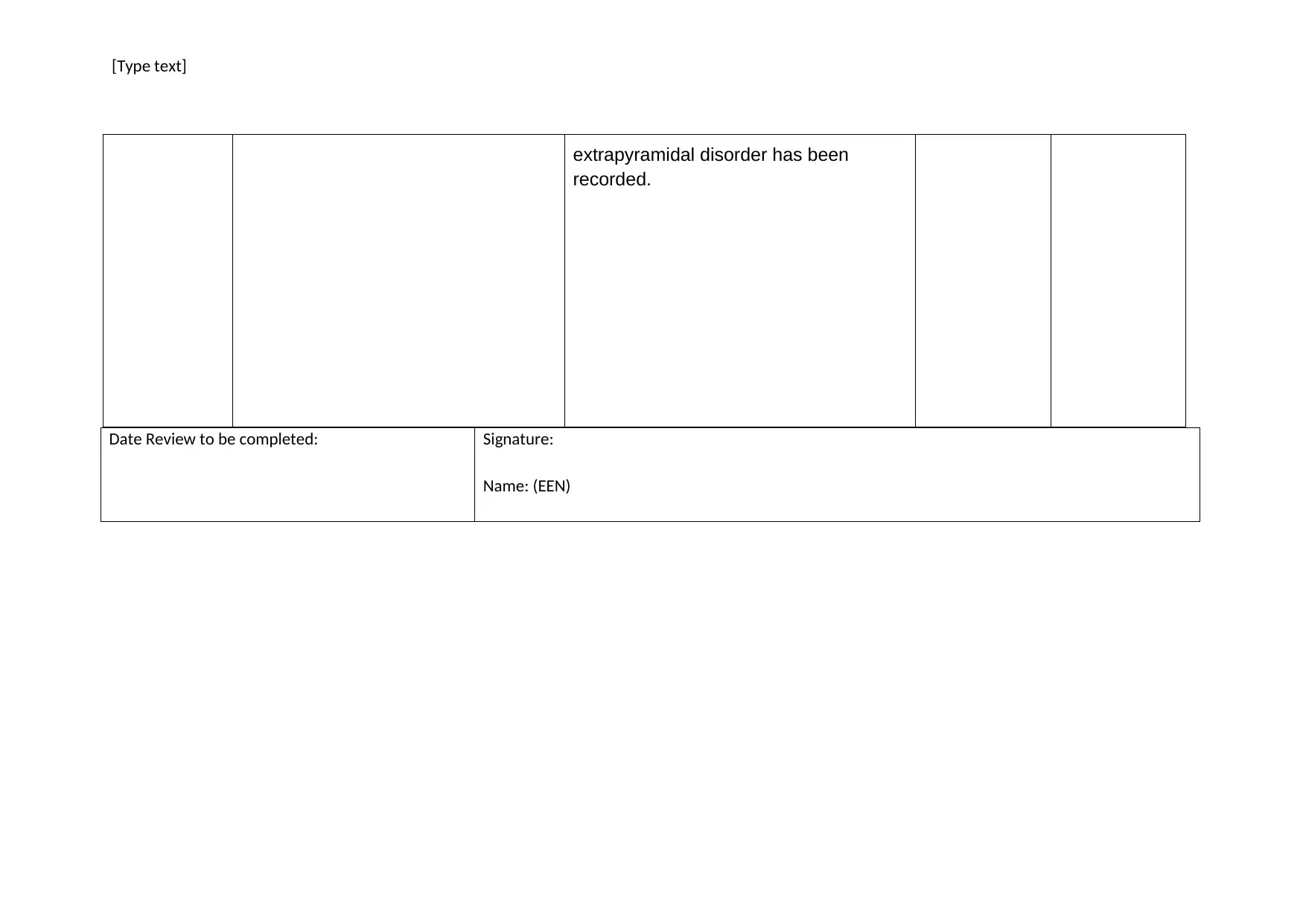
[Type text]
extrapyramidal disorder has been
recorded.
Date Review to be completed: Signature:
Name: (EEN)
chevron_up_icon
1 out of 6
circle_padding
hide_on_mobile
zoom_out_icon
[object Object]