University Radiology Department: Dementia Friendly Environment Report

Verified

Added on  2022/12/08

|4
|821
|214
Report
AI Summary
This report proposes the implementation of a dementia-friendly environment within the radiography department, focusing on improving the experience and care of individuals with dementia. The core idea centers around strategic appointment scheduling to accommodate the unique needs of these patients, considering their challenges with memory, executive function, and potential agitation. By scheduling appointments on less busy days and allocating ample time for procedures, the department aims to reduce patient distress, confusion, and the negative impact of rushed imaging processes. The report highlights the importance of staff training on dementia and the benefits of a calm, engaging environment. The report also references existing research to support the chosen approach, emphasizing the need for flexibility, patience, and a partnership with caregivers to ensure the best possible outcomes from radiography and imaging services for those living with dementia. The report concludes with a call to action for the radiography department to adopt this approach to enhance patient care.
Document Page
Dementia Friendly Environment in the Radiography Department 1
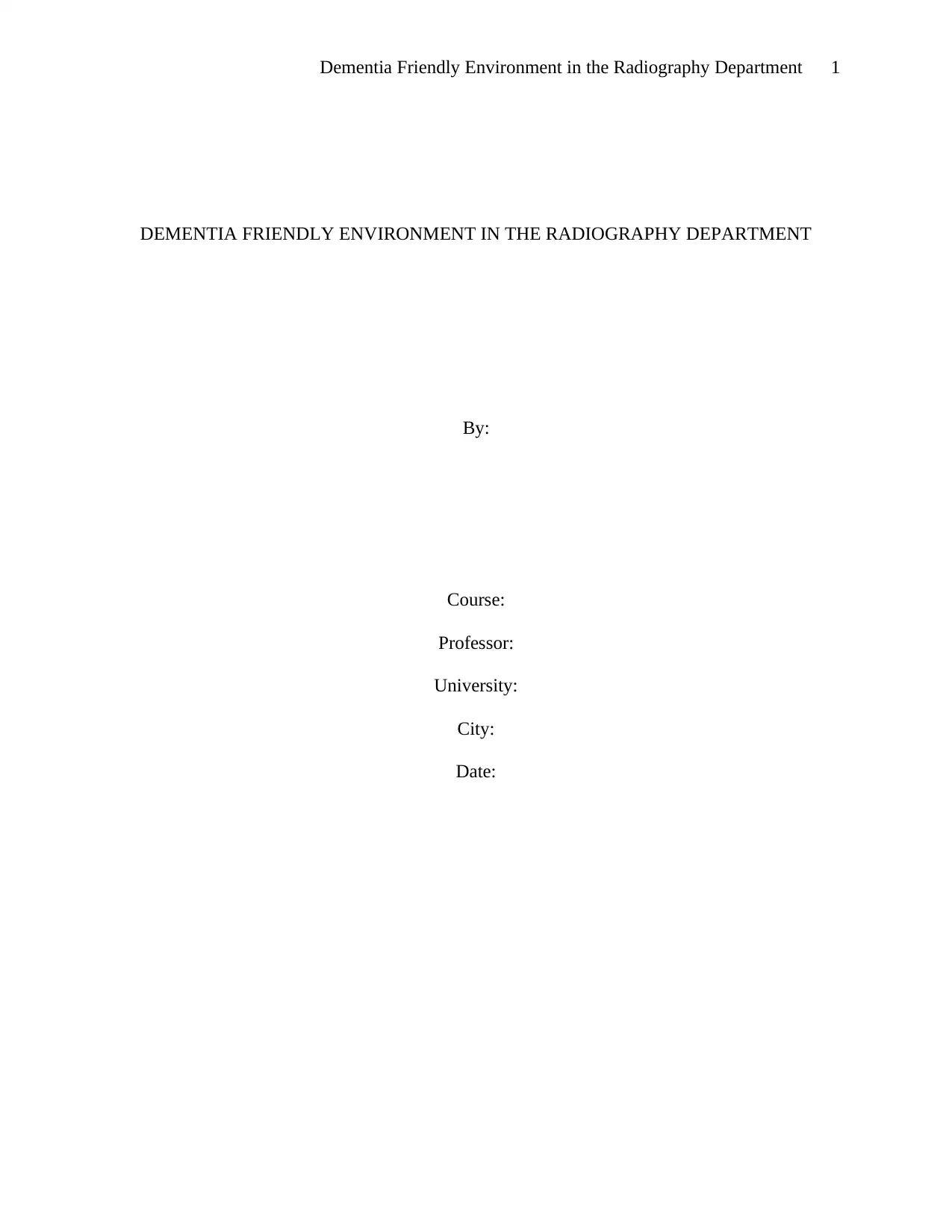
DEMENTIA FRIENDLY ENVIRONMENT IN THE RADIOGRAPHY DEPARTMENT
By:
Course:
Professor:
University:
City:
Date:
tabler-icon-diamond-filled.svg

Paraphrase This Document

Need a fresh take? Get an instant paraphrase of this document with our AI Paraphraser
Document Page
Dementia Friendly Environment in the Radiography Department 2
Dementia Friendly Environment
Globally there is broad acknowledgement that health centre personals and service givers
require to conceptualise the complexity of treating and taking care of individuals living with
dementia. At least 25% of the hospital beds are utilised by individuals living with dementia.
Therefore, there is a need to implement measures to ensure a smooth process when handling
people with the condition (Challen, Low &McEntee, 2018). Radiography technicians and other
members of the radiography department, therefore, are required to support and understand the
needs of the individuals with the condition and their careers to deliver personalised care and
ensure best outcomes from the radiography and imaging. This reports aim is to find an idea that
can be implemented in the radiology department to change the practices when handling
individuals living with dementia.
Individuals living with dementia have challenges with memory, executive behavior, and
functions, which consequently pose a problem during diagnostic imaging. In developing a
dementia-friendly setting in the radiology department, it is important to ensure that the X-ray
examinations are more comfortable for the individuals undergoing the scan (Challen et al.,
2018). The radiology department main goal is creating a calm examination with the least
possible distress to the individuals with the condition in the engagement process. With a calm
environment, the technologists and other staffs will have a chance of engaging the individuals
with dementia which has been shown to have beneficial effects, including an increase of positive
emotions by the patients.
To ensure that engagement with the individuals with dementia is fully utilised the
radiography department will officiate the booking of patients with the condition in less busy days
(Handley, Bunn & Goodman, 2017). To properly handle patients with dementia, flexibility, and
Document Page
Dementia Friendly Environment in the Radiography Department 3
patience are of the essence since the individuals with the condition may become agitated when
simple tasks and procedures become challenging (Handley et al., 2017). Therefore, the
radiography department will schedule appointments with the patients when there is ample time to
completely and effectively handle a patient’s condition. This idea will be of significant help in a
thorough analysis of the individual’s state since the radiography procedures may require more
time than scheduled as dementia occurs differently in individuals hence they experience its
progression and symptoms differently (Lin, 2017).
Lack of proper engagement due to time limitation during the imaging process has been
indicated to be a contributor to negative imaging encounters by the patients. According to Lin
(2017), caregivers describe the long delays in the imaging department when waiting for the
results as a significant contributor to the individual’s agitation. When the individuals with the
condition are rushed through the imaging process they lacked the chance to adjust to the change
of the surrounding leading to distress and confusion (Chang, Singh, Boyd & Lawson, 2016)
However, by proper appointment scheduling the persons with the department are likely to adjust
to the environment hence reducing the confusion.
In conclusion, individuals with dementia and their caregivers experience challenging
situations in the radiography departments, and the technologists find it challenging to work with
the individuals with dementia. The radiography department staffs should undergo training about
dementia, imaging services in addition to the implementation of the appointment scheduling idea
to improve their environment, procedures, and work with a better partnership with the caregivers.
Document Page
Dementia Friendly Environment in the Radiography Department 4
Reference list
Challen, R., Low, L.F., and McEntee, M.F., 2018. Dementia patient care in the diagnostic
medical imaging department. Radiography, 24, pp.S33-S42.
Chang, A., Singh, N., Boyd, L., and Lawson, C., 2016. Strategies to Improve Radiographic
Practices for Patients With Alzheimer's Disease: A Systematic Review. Journal of
medical imaging and radiation sciences, 47(4), pp.362-366.
Handley, M., Bunn, F., and Goodman, C., 2017. Dementia-friendly interventions to improve the
care of people living with dementia admitted to hospitals: a realist review. BMJ Open,
7(7), p.e015257.
Lin, S.Y., 2017. 'Dementia-friendly communities' and being dementia-friendly in healthcare
settings. Current opinion in psychiatry, 30(2), p.145.
chevron_up_icon
1 out of 4
circle_padding
hide_on_mobile
zoom_out_icon
[object Object]