Detailed Demolition Plan for WSI Blue Mountains College - CPCCBC5018A
VerifiedAdded on 2022/11/10
|13
|2302
|135
Report
AI Summary
This report details a preliminary demolition plan for the WSI Blue Mountains College in Katoomba, NSW, for the construction of a new facility for Beauty Therapy and Complementary Health classrooms and offices. The plan covers the demolition of existing buildings (Blocks B, C, D, E, H, I, the basketball court, vegetation, and footpaths), with a focus on safety, environmental management, and adherence to relevant regulations. The report outlines demolition methods, material handling, proposed demolition sequence, protective measures, exclusion zones, traffic management, and a WHS management system. It emphasizes the importance of hazard identification, risk assessment, and waste management, including the handling of hazardous materials. The demolition process is to be conducted in reverse order of the construction sequence, with a strong emphasis on worker safety and environmental protection throughout the 120-day project duration. The report also includes references to relevant standards and regulations, ensuring compliance with all relevant legislative requirements.

Running head: DEMOLITION PLAN
CPCCBC5018A:
Assessment 7
Name
id
CPCCBC5018A:
Assessment 7
Name
id

Paraphrase This Document
Need a fresh take? Get an instant paraphrase of this document with our AI Paraphraser
DEMOLITION PLAN
DEMOLITION PLAN
Job Address: WSI Blue Mountains College, Parke St, Blue Mountains, NSW
Job title: New facility for Beauty Therapy and Complementary Health Classrooms and
Offices
Client: NSW Department of Commerce
Architects: Perumal Pedavoli Architects, Wattle St, Ultimo, NSW
Monday 16th of September 2019
DEMOLITION PLAN
Job Address: WSI Blue Mountains College, Parke St, Blue Mountains, NSW
Job title: New facility for Beauty Therapy and Complementary Health Classrooms and
Offices
Client: NSW Department of Commerce
Architects: Perumal Pedavoli Architects, Wattle St, Ultimo, NSW
Monday 16th of September 2019
DEMOLITION PLAN
Table of Contents
DEMOLITION PLAN.........................................................................................................2
Executive Report.................................................................................................................4
Location...............................................................................................................................5
Heights and Distance to the boundaries...............................................................................5
Types of buildings to be demolished...................................................................................5
Types of buildings to be demolished continued..................................................................5
Demolition methods.............................................................................................................6
Materials Handling..............................................................................................................7
Proposed Sequence..............................................................................................................7
Excavation Management Plan.............................................................................................8
Protective measures.............................................................................................................8
Demolition Exclusion Zones...............................................................................................8
Traffic Management............................................................................................................9
Environmental Management Plan........................................................................................9
WHS Management System..................................................................................................9
References..........................................................................................................................11
Table of Contents
DEMOLITION PLAN.........................................................................................................2
Executive Report.................................................................................................................4
Location...............................................................................................................................5
Heights and Distance to the boundaries...............................................................................5
Types of buildings to be demolished...................................................................................5
Types of buildings to be demolished continued..................................................................5
Demolition methods.............................................................................................................6
Materials Handling..............................................................................................................7
Proposed Sequence..............................................................................................................7
Excavation Management Plan.............................................................................................8
Protective measures.............................................................................................................8
Demolition Exclusion Zones...............................................................................................8
Traffic Management............................................................................................................9
Environmental Management Plan........................................................................................9
WHS Management System..................................................................................................9
References..........................................................................................................................11
⊘ This is a preview!⊘
Do you want full access?
Subscribe today to unlock all pages.

Trusted by 1+ million students worldwide
DEMOLITION PLAN
Executive Report
In this report, a brief overview of the works which are required in the demolition of an
existing building on the ---is presented. The demolition is aimed at reestablishment of a
New facility for Beauty Therapy and Complementary Health Classrooms and Offices.
This preliminary demolition plan will act as the guiding factor to the safe demolition of
the structures so that adverse effects in relation to health are not experience in and around
the site of demolition. This report is just a preliminary document, but can further be
detailed in the conceptual design phase of the demolition. The detailed plan will be
prepared by the contractor and approved by the relevant regulatory bodies as well as the
applicant, upon satisfaction.
This preliminary report is designed to give an outline of the demolition works to be
undertaken to the buildings which are in existence namely; Block B, Block C, Block D,
Block E, Block H, Block I, the basketball court, vegetation and trees, also
some existing concrete footpaths and both masonry walls and metal
mesh fences at WSI Blue Mountains TAFE College, and rebuild new
classroom facilities while also completing a refurbishment of blocks A, F
and G.
Executive Report
In this report, a brief overview of the works which are required in the demolition of an
existing building on the ---is presented. The demolition is aimed at reestablishment of a
New facility for Beauty Therapy and Complementary Health Classrooms and Offices.
This preliminary demolition plan will act as the guiding factor to the safe demolition of
the structures so that adverse effects in relation to health are not experience in and around
the site of demolition. This report is just a preliminary document, but can further be
detailed in the conceptual design phase of the demolition. The detailed plan will be
prepared by the contractor and approved by the relevant regulatory bodies as well as the
applicant, upon satisfaction.
This preliminary report is designed to give an outline of the demolition works to be
undertaken to the buildings which are in existence namely; Block B, Block C, Block D,
Block E, Block H, Block I, the basketball court, vegetation and trees, also
some existing concrete footpaths and both masonry walls and metal
mesh fences at WSI Blue Mountains TAFE College, and rebuild new
classroom facilities while also completing a refurbishment of blocks A, F
and G.
Paraphrase This Document
Need a fresh take? Get an instant paraphrase of this document with our AI Paraphraser
DEMOLITION PLAN
Location
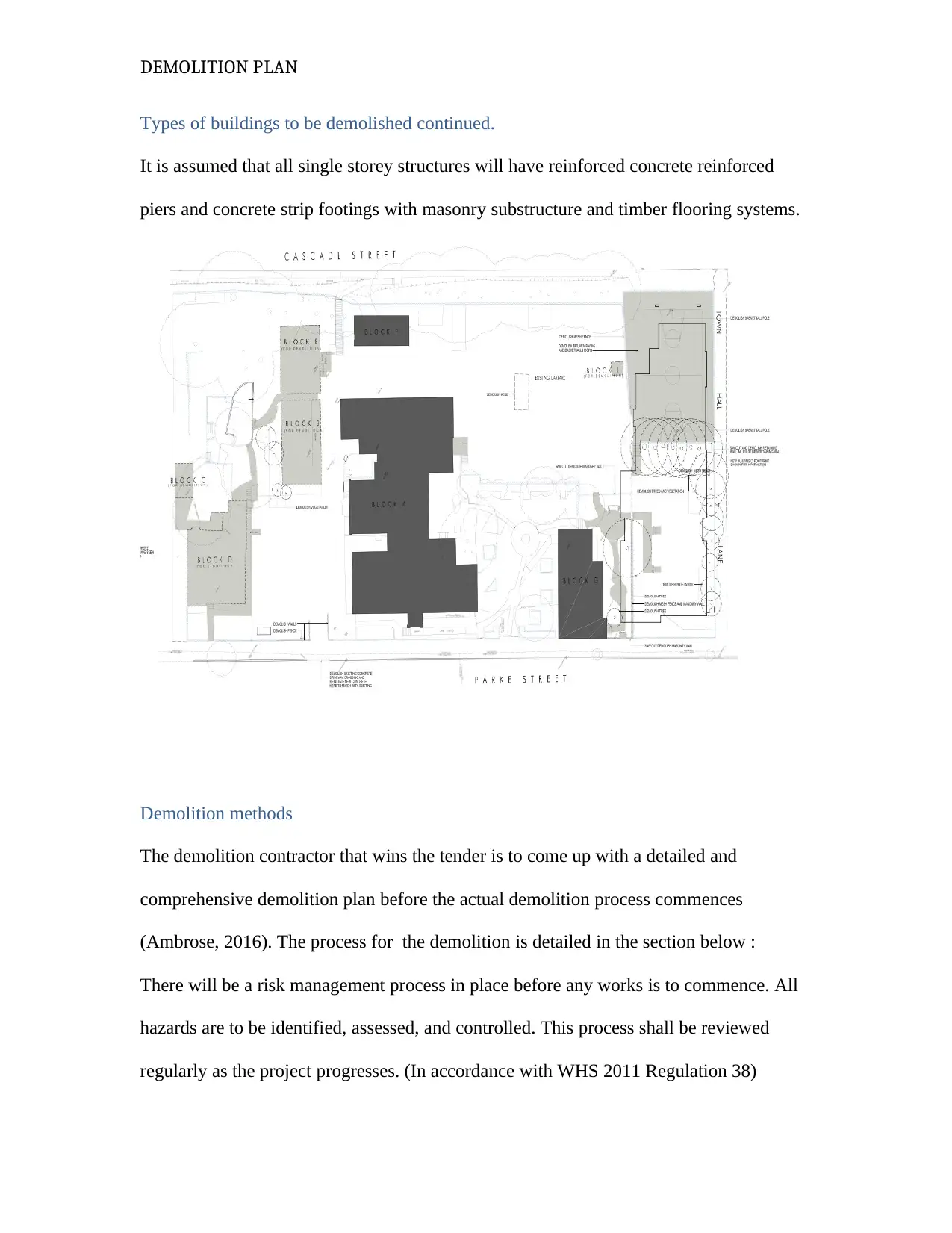
The location of the proposed construction project is located in Katoomba, bounded by
Cascade Street, Town Hall Lane, and Parke Street. Access to the site is to be found on
Parke Street and this access will be used through out the demolition process.
Heights and Distance to the boundaries
The blocks to be demolished are all single storey buildings. Heights of which are
undetermined but is assumed they are all fewer than 5m in height. The distances to the
boundary vary. The closest buildings to the boundaries are within approximately 2
metres.
Types of buildings to be demolished
The types of buildings and structures to be demolished are as follows;
Block B which is a single storey weatherboard clad structure
Block C which is a single storey fibro clad structure
Block D which is a single storey weatherboard clad structure
Block E which is a single storey weatherboard clad structure
Block H which is a brick veneer structure
Block I which is a brick veneer structure
Basketball court which is bitumen paving
Masonry retaining walls
Vegetation and trees (sizes which are unknown)
Concrete stairs, landings and footpaths
Location
The location of the proposed construction project is located in Katoomba, bounded by
Cascade Street, Town Hall Lane, and Parke Street. Access to the site is to be found on
Parke Street and this access will be used through out the demolition process.
Heights and Distance to the boundaries
The blocks to be demolished are all single storey buildings. Heights of which are
undetermined but is assumed they are all fewer than 5m in height. The distances to the
boundary vary. The closest buildings to the boundaries are within approximately 2
metres.
Types of buildings to be demolished
The types of buildings and structures to be demolished are as follows;
Block B which is a single storey weatherboard clad structure
Block C which is a single storey fibro clad structure
Block D which is a single storey weatherboard clad structure
Block E which is a single storey weatherboard clad structure
Block H which is a brick veneer structure
Block I which is a brick veneer structure
Basketball court which is bitumen paving
Masonry retaining walls
Vegetation and trees (sizes which are unknown)
Concrete stairs, landings and footpaths
DEMOLITION PLAN
Types of buildings to be demolished continued.
It is assumed that all single storey structures will have reinforced concrete reinforced
piers and concrete strip footings with masonry substructure and timber flooring systems.
Demolition methods
The demolition contractor that wins the tender is to come up with a detailed and
comprehensive demolition plan before the actual demolition process commences
(Ambrose, 2016). The process for the demolition is detailed in the section below :
There will be a risk management process in place before any works is to commence. All
hazards are to be identified, assessed, and controlled. This process shall be reviewed
regularly as the project progresses. (In accordance with WHS 2011 Regulation 38)
Types of buildings to be demolished continued.
It is assumed that all single storey structures will have reinforced concrete reinforced
piers and concrete strip footings with masonry substructure and timber flooring systems.
Demolition methods
The demolition contractor that wins the tender is to come up with a detailed and
comprehensive demolition plan before the actual demolition process commences
(Ambrose, 2016). The process for the demolition is detailed in the section below :
There will be a risk management process in place before any works is to commence. All
hazards are to be identified, assessed, and controlled. This process shall be reviewed
regularly as the project progresses. (In accordance with WHS 2011 Regulation 38)
⊘ This is a preview!⊘
Do you want full access?
Subscribe today to unlock all pages.
Trusted by 1+ million students worldwide
DEMOLITION PLAN
The demolition contractor must have all appropriate licenses, and safe work method
statements to perform the work identified. As the structures to be demolished are older in
nature asbestos and hazardous materials are suspected to be involved. This will require
appropriate asbestos registering and licensing. (In accordance with WHS 2011 regulation
422, 425, 450, 451 and regulation 458)
Essential services are also to be clearly identified and terminated prior commencing
demolition. (In accordance with WHS 2011 Regulation 304)
The demolition sequence will be in reverse order to the construction sequence. (Refer to
section 3.4 of AS2601 – 2001). Regardless the clad of the structure each building will
start with the strip out of all non-structural elements. This process will be utilised using
manual labour and small plant machinery, likely 3-5t excavators and bobcats. This
process will occur with competent workers with experience in the demolition process.
The masonry structures will be demolished using excavators with rock breaking (and
similar) attachments. The weatherboard and fibro clad structures will be demolished
using manual labour (Cheng et al., 2015).
Once the non-structural elements have been removed, the next stage after strip out will be
removing the roof cladding. Once the roof cladding is removed, the roof structure will be
dismantled carefully, this process will continue until the demolition has reached a
maximum of 900mm above the floor system to ensure safety of the collapsing of the
structures. As indicated earlier the process of demolition will be in accordance with all
safety standards and regulations to ensure workers safety through out the demolition
process.
The demolition contractor must have all appropriate licenses, and safe work method
statements to perform the work identified. As the structures to be demolished are older in
nature asbestos and hazardous materials are suspected to be involved. This will require
appropriate asbestos registering and licensing. (In accordance with WHS 2011 regulation
422, 425, 450, 451 and regulation 458)
Essential services are also to be clearly identified and terminated prior commencing
demolition. (In accordance with WHS 2011 Regulation 304)
The demolition sequence will be in reverse order to the construction sequence. (Refer to
section 3.4 of AS2601 – 2001). Regardless the clad of the structure each building will
start with the strip out of all non-structural elements. This process will be utilised using
manual labour and small plant machinery, likely 3-5t excavators and bobcats. This
process will occur with competent workers with experience in the demolition process.
The masonry structures will be demolished using excavators with rock breaking (and
similar) attachments. The weatherboard and fibro clad structures will be demolished
using manual labour (Cheng et al., 2015).
Once the non-structural elements have been removed, the next stage after strip out will be
removing the roof cladding. Once the roof cladding is removed, the roof structure will be
dismantled carefully, this process will continue until the demolition has reached a
maximum of 900mm above the floor system to ensure safety of the collapsing of the
structures. As indicated earlier the process of demolition will be in accordance with all
safety standards and regulations to ensure workers safety through out the demolition
process.
Paraphrase This Document
Need a fresh take? Get an instant paraphrase of this document with our AI Paraphraser
DEMOLITION PLAN
Once the above ground level structures have been demolished, the commencement of
vegetation, trees, car park and basketball structures will begin demolition.
When the demolition process will be ongoing, various erosion control measures shall be
established. Some of the measures shall include treatment of the discharges and dust
which potentially have a pollution effect on the storm water systems.
Materials Handling
The process of Materials handling will be by a mechanical means; for instance a
mechanical plant such as the bobcats and the excavators which will be loaded into trucks
(semi-trailers and bogie tippers). The debris will be then taken to an offsite location,
either in a recycling facility centre or in an approved waste facility (Doan & Chinda,
2016).
This project will maximise the use of recycling materials. It will optimise minimalistic
approach to general waste disposal. The demolition contractor will have to produce a
demolition waste management plan prior to commencing demolition works.
Hazardous materials will be treated separately in accordance with relevant legislations
and standards. An authorised consultant shall produce a hazardous materials inspection
and then present it to the head contractor. Additionally, using the provisions of the tip
dockets obtained from the waste centres, a final clearance report will be provided by the
consultant.
Proposed Sequence
The demolition contractor will be required to prepare the following documentation prior
to the commencement of demolition and/or excavation works:
Dilapidation Survey
Once the above ground level structures have been demolished, the commencement of
vegetation, trees, car park and basketball structures will begin demolition.
When the demolition process will be ongoing, various erosion control measures shall be
established. Some of the measures shall include treatment of the discharges and dust
which potentially have a pollution effect on the storm water systems.
Materials Handling
The process of Materials handling will be by a mechanical means; for instance a
mechanical plant such as the bobcats and the excavators which will be loaded into trucks
(semi-trailers and bogie tippers). The debris will be then taken to an offsite location,
either in a recycling facility centre or in an approved waste facility (Doan & Chinda,
2016).
This project will maximise the use of recycling materials. It will optimise minimalistic
approach to general waste disposal. The demolition contractor will have to produce a
demolition waste management plan prior to commencing demolition works.
Hazardous materials will be treated separately in accordance with relevant legislations
and standards. An authorised consultant shall produce a hazardous materials inspection
and then present it to the head contractor. Additionally, using the provisions of the tip
dockets obtained from the waste centres, a final clearance report will be provided by the
consultant.
Proposed Sequence
The demolition contractor will be required to prepare the following documentation prior
to the commencement of demolition and/or excavation works:
Dilapidation Survey
DEMOLITION PLAN
Construction Waste Management Plan
Demolition Management Plan
Excavation Management Plan
All demolition is to be completed in accordance with AS2601, Code of practice –
Demolition Work, and environmental planning and assessment act.
As noted in the demolition methods section, the process of demolition will be in reverse
order of the construction sequence. All non-structural elements will be removed from the
structures. All services are to be terminated, and then removed. As noted in the
demolition methods, these steps will be performed by qualified/ competent manual labour
while being in accordance with relevant regulations, sections and legislation.
Furthermore, once these steps have been completed, larger plant machinery will be used
to demolish the structures and separate recyclable material and general waste (Harris,
2017).
Once structures have been stripped, and completely demolished where described, the
demolition of plants and vegetation, bitumen and concrete will take place.
It is assumed that all demolition and remediation works to the site will be completed
within 120 days.
Protective measures
Prior to commencing demolition, Class A hoarding will be erected around the exclusion
zones. As there are no two-storey structures, we will not require any scaffolding with
type b hoardings.
Hoardings will be installed adjacent from entry to the site entry on Parke Street shown
on the plans, and will continue to Cascade Street to the boundaries and continue to follow
Construction Waste Management Plan
Demolition Management Plan
Excavation Management Plan
All demolition is to be completed in accordance with AS2601, Code of practice –
Demolition Work, and environmental planning and assessment act.
As noted in the demolition methods section, the process of demolition will be in reverse
order of the construction sequence. All non-structural elements will be removed from the
structures. All services are to be terminated, and then removed. As noted in the
demolition methods, these steps will be performed by qualified/ competent manual labour
while being in accordance with relevant regulations, sections and legislation.
Furthermore, once these steps have been completed, larger plant machinery will be used
to demolish the structures and separate recyclable material and general waste (Harris,
2017).
Once structures have been stripped, and completely demolished where described, the
demolition of plants and vegetation, bitumen and concrete will take place.
It is assumed that all demolition and remediation works to the site will be completed
within 120 days.
Protective measures
Prior to commencing demolition, Class A hoarding will be erected around the exclusion
zones. As there are no two-storey structures, we will not require any scaffolding with
type b hoardings.
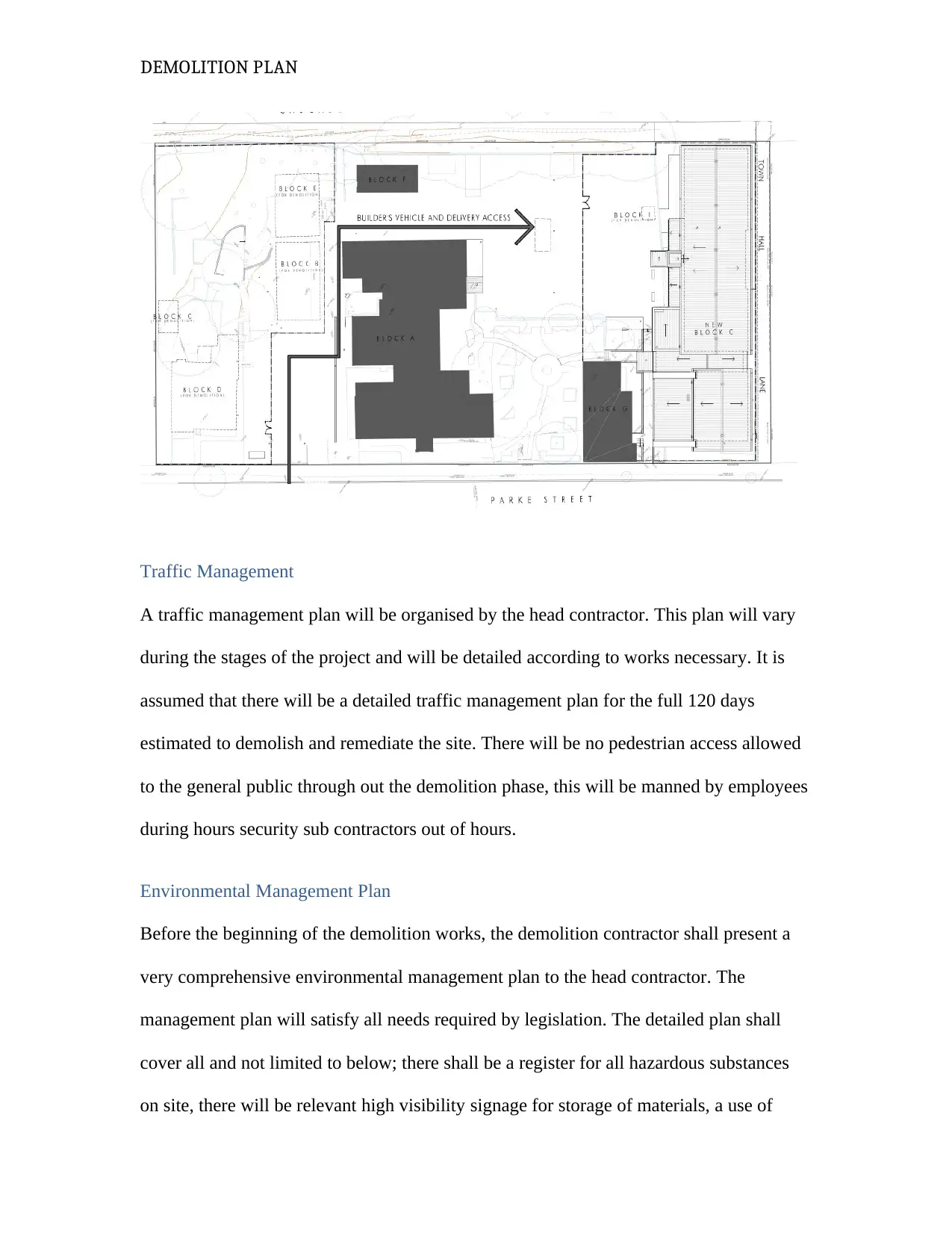
Hoardings will be installed adjacent from entry to the site entry on Parke Street shown
on the plans, and will continue to Cascade Street to the boundaries and continue to follow
⊘ This is a preview!⊘
Do you want full access?
Subscribe today to unlock all pages.
Trusted by 1+ million students worldwide
DEMOLITION PLAN
the boundary around the property. On the northern side hoarding will be installed from
the western wall on Block G and also continue to Cascade Street and return down Town
Hall Lane, and again on to Parke Street back to Block G. The hoarding lay out is shown
on appendix _ .
The hoardings to both lots will have vehicle access gates for workers to enter the
demolition exclusion zones. The hoardings will be constructed from structural plywood 2
metres in height, supported by a timber or metal frame. Temporary fencing will be used
along the boundaries southern, south western and south-eastern covered in protective
mesh. Northern, north eastern and north-western boundaries will consist of ply and
timber or metal frame to safely exclude the public to the demolition zone.
During demolition, dust control measures will be taken to assure dust and floating debris
will not spread from the demolition zone. The demolition contractor will have a senior
supervisor on site at all times during the demolition process to guarantee all safety
guidelines, legislation and agreed work methods.
Demolition Exclusion Zones
Demolition exclusion zones will be set up in the campus, as blocks A,F and G will not be
demolished, the exclusion zones will be set up to accordingly. All Safe Work Method
Statements will be reviewed as the project progresses by the demolition contractor as
well as a Job Safety Analysis. Exclusion zones are shown on a marked up plan attached.
the boundary around the property. On the northern side hoarding will be installed from
the western wall on Block G and also continue to Cascade Street and return down Town
Hall Lane, and again on to Parke Street back to Block G. The hoarding lay out is shown
on appendix _ .
The hoardings to both lots will have vehicle access gates for workers to enter the
demolition exclusion zones. The hoardings will be constructed from structural plywood 2
metres in height, supported by a timber or metal frame. Temporary fencing will be used
along the boundaries southern, south western and south-eastern covered in protective
mesh. Northern, north eastern and north-western boundaries will consist of ply and
timber or metal frame to safely exclude the public to the demolition zone.
During demolition, dust control measures will be taken to assure dust and floating debris
will not spread from the demolition zone. The demolition contractor will have a senior
supervisor on site at all times during the demolition process to guarantee all safety
guidelines, legislation and agreed work methods.
Demolition Exclusion Zones
Demolition exclusion zones will be set up in the campus, as blocks A,F and G will not be
demolished, the exclusion zones will be set up to accordingly. All Safe Work Method
Statements will be reviewed as the project progresses by the demolition contractor as
well as a Job Safety Analysis. Exclusion zones are shown on a marked up plan attached.
Paraphrase This Document
Need a fresh take? Get an instant paraphrase of this document with our AI Paraphraser
DEMOLITION PLAN
Traffic Management
A traffic management plan will be organised by the head contractor. This plan will vary
during the stages of the project and will be detailed according to works necessary. It is
assumed that there will be a detailed traffic management plan for the full 120 days
estimated to demolish and remediate the site. There will be no pedestrian access allowed
to the general public through out the demolition phase, this will be manned by employees
during hours security sub contractors out of hours.
Environmental Management Plan
Before the beginning of the demolition works, the demolition contractor shall present a
very comprehensive environmental management plan to the head contractor. The
management plan will satisfy all needs required by legislation. The detailed plan shall
cover all and not limited to below; there shall be a register for all hazardous substances
on site, there will be relevant high visibility signage for storage of materials, a use of
Traffic Management
A traffic management plan will be organised by the head contractor. This plan will vary
during the stages of the project and will be detailed according to works necessary. It is
assumed that there will be a detailed traffic management plan for the full 120 days
estimated to demolish and remediate the site. There will be no pedestrian access allowed
to the general public through out the demolition phase, this will be manned by employees
during hours security sub contractors out of hours.
Environmental Management Plan
Before the beginning of the demolition works, the demolition contractor shall present a
very comprehensive environmental management plan to the head contractor. The
management plan will satisfy all needs required by legislation. The detailed plan shall
cover all and not limited to below; there shall be a register for all hazardous substances
on site, there will be relevant high visibility signage for storage of materials, a use of
DEMOLITION PLAN
waste minimisation, all subcontractors or employees to have environmental
induction/training, waste disposal shall be treated in a suitable and legal accordance.
WHS Management System
A detailed WHS policy shall be provided by the demolition contract in acquiescence with
AS4801 and will be provided preceding the beginning of demolition works. A detail site
safety plan shall also be arranged for the site-specific duties. The plan should be in
accordance with all OHS policies, planning which shall include planning and
identification of hazards, assessment and control of risks, legal requirements, objectives
and targets, OHS management plans (Li et al., 2016). The policy shall also include
implementation strategies, including responsibilities and accountabilities, training and
competency, consultation, communication and reporting, documentation and data control,
hazard identification, risk assessment and control of risks, measurement and evaluation of
the documented procedures and to be measured on a regular basis, corrective and record
management , preventative action, records, incident investigation, as well as a
management review.
RESPONSIBLE PROFESSIONAL
This WMP is approved by:
September 16th, 2019
waste minimisation, all subcontractors or employees to have environmental
induction/training, waste disposal shall be treated in a suitable and legal accordance.
WHS Management System
A detailed WHS policy shall be provided by the demolition contract in acquiescence with
AS4801 and will be provided preceding the beginning of demolition works. A detail site
safety plan shall also be arranged for the site-specific duties. The plan should be in
accordance with all OHS policies, planning which shall include planning and
identification of hazards, assessment and control of risks, legal requirements, objectives
and targets, OHS management plans (Li et al., 2016). The policy shall also include
implementation strategies, including responsibilities and accountabilities, training and
competency, consultation, communication and reporting, documentation and data control,
hazard identification, risk assessment and control of risks, measurement and evaluation of
the documented procedures and to be measured on a regular basis, corrective and record
management , preventative action, records, incident investigation, as well as a
management review.
RESPONSIBLE PROFESSIONAL
This WMP is approved by:
September 16th, 2019
⊘ This is a preview!⊘
Do you want full access?
Subscribe today to unlock all pages.
Trusted by 1+ million students worldwide

1 out of 13


Your All-in-One AI-Powered Toolkit for Academic Success.
+13062052269
info@desklib.com
Available 24*7 on WhatsApp / Email
![[object Object]](/_next/static/media/star-bottom.7253800d.svg)
Unlock your academic potential
Copyright © 2020–2026 A2Z Services. All Rights Reserved. Developed and managed by ZUCOL.