Dengue Fever: Global Health Program Evaluation Report

Verified

Added on ย 2023/06/03

|5
|1064
|186
Report
AI Summary
This report addresses the global health issue of Dengue fever, a mosquito-borne disease prevalent in the tropics. It analyzes a case study focusing on the Camino Verde program, which aimed to reduce Dengue through community participation. The report details the problem's importance, challenges faced, and the unique features of the intervention, such as social mobilization and education. Key indicators of the program, including increased public awareness and women's empowerment, are discussed. The key players involved are identified, and the report outlines future directions, including the use of alternative chemicals, increased public awareness through education, and healthcare sector involvement. Furthermore, the report compares the Camino Verde program with other programs that impact HIV/AIDS or malaria or Dengue Fever using a table format, offering a comprehensive overview of the program's effectiveness and future prospects in combating the disease.
Document Page
Running head: DENGUE- GLOBAL HEALTH
Dengue- global health
Name of the Student
Name of the University
Author note
tabler-icon-diamond-filled.svg

Paraphrase This Document

Need a fresh take? Get an instant paraphrase of this document with our AI Paraphraser
Document Page
1
DENGUE- GLOBAL HEALTH
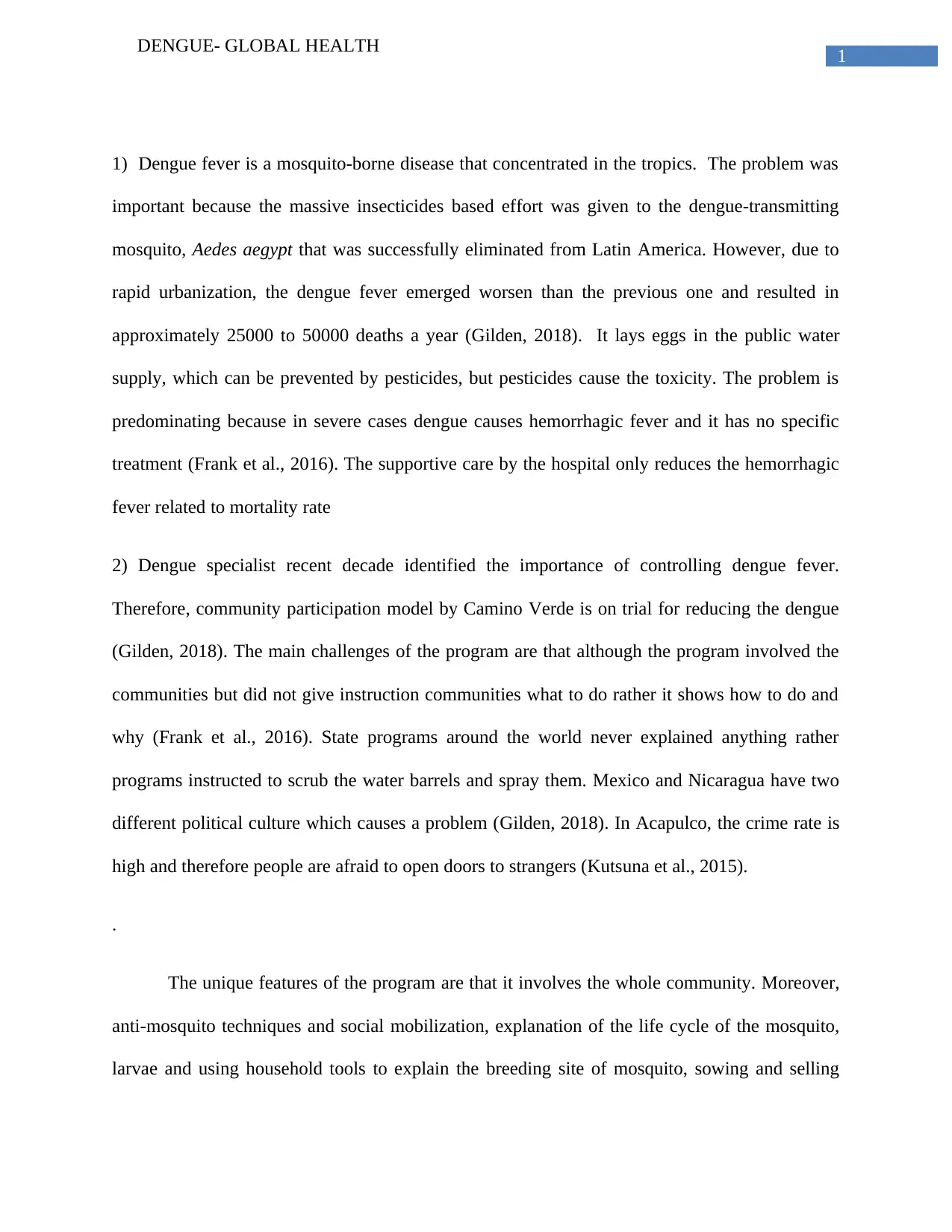
1) Dengue fever is a mosquito-borne disease that concentrated in the tropics. The problem was
important because the massive insecticides based effort was given to the dengue-transmitting
mosquito, Aedes aegypt that was successfully eliminated from Latin America. However, due to
rapid urbanization, the dengue fever emerged worsen than the previous one and resulted in
approximately 25000 to 50000 deaths a year (Gilden, 2018). It lays eggs in the public water
supply, which can be prevented by pesticides, but pesticides cause the toxicity. The problem is
predominating because in severe cases dengue causes hemorrhagic fever and it has no specific
treatment (Frank et al., 2016). The supportive care by the hospital only reduces the hemorrhagic
fever related to mortality rate
2) Dengue specialist recent decade identified the importance of controlling dengue fever.
Therefore, community participation model by Camino Verde is on trial for reducing the dengue
(Gilden, 2018). The main challenges of the program are that although the program involved the
communities but did not give instruction communities what to do rather it shows how to do and
why (Frank et al., 2016). State programs around the world never explained anything rather
programs instructed to scrub the water barrels and spray them. Mexico and Nicaragua have two
different political culture which causes a problem (Gilden, 2018). In Acapulco, the crime rate is
high and therefore people are afraid to open doors to strangers (Kutsuna et al., 2015).
.
The unique features of the program are that it involves the whole community. Moreover,
anti-mosquito techniques and social mobilization, explanation of the life cycle of the mosquito,
larvae and using household tools to explain the breeding site of mosquito, sowing and selling
Document Page
2
DENGUE- GLOBAL HEALTH
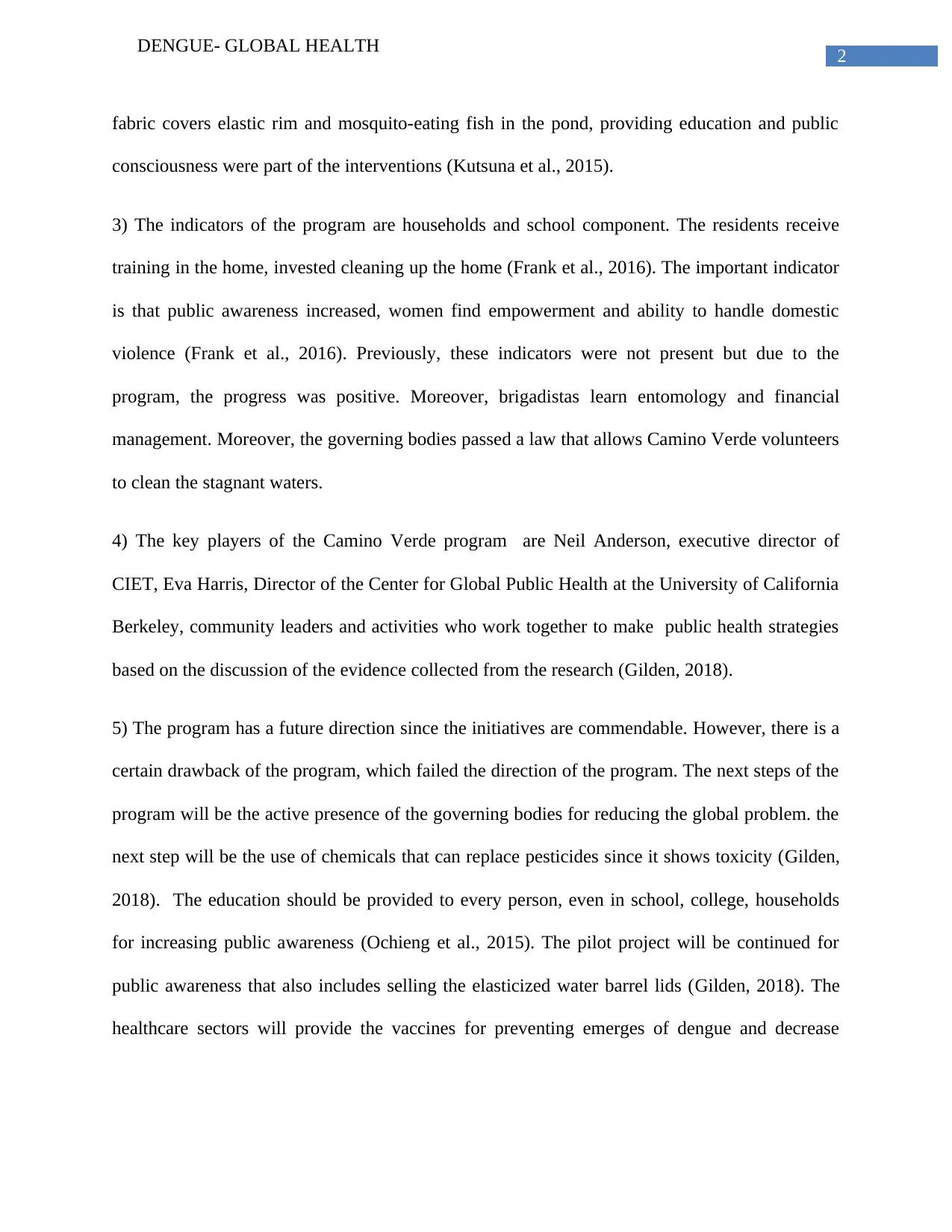
fabric covers elastic rim and mosquito-eating fish in the pond, providing education and public
consciousness were part of the interventions (Kutsuna et al., 2015).
3) The indicators of the program are households and school component. The residents receive
training in the home, invested cleaning up the home (Frank et al., 2016). The important indicator
is that public awareness increased, women find empowerment and ability to handle domestic
violence (Frank et al., 2016). Previously, these indicators were not present but due to the
program, the progress was positive. Moreover, brigadistas learn entomology and financial
management. Moreover, the governing bodies passed a law that allows Camino Verde volunteers
to clean the stagnant waters.
4) The key players of the Camino Verde program are Neil Anderson, executive director of
CIET, Eva Harris, Director of the Center for Global Public Health at the University of California
Berkeley, community leaders and activities who work together to make public health strategies
based on the discussion of the evidence collected from the research (Gilden, 2018).
5) The program has a future direction since the initiatives are commendable. However, there is a
certain drawback of the program, which failed the direction of the program. The next steps of the
program will be the active presence of the governing bodies for reducing the global problem. the
next step will be the use of chemicals that can replace pesticides since it shows toxicity (Gilden,
2018). The education should be provided to every person, even in school, college, households
for increasing public awareness (Ochieng et al., 2015). The pilot project will be continued for
public awareness that also includes selling the elasticized water barrel lids (Gilden, 2018). The
healthcare sectors will provide the vaccines for preventing emerges of dengue and decrease
Document Page
3
DENGUE- GLOBAL HEALTH
domestic violence, especially in the remote area (Gilden, 2018). The program will increase the
economic performance of the country and decrease the mortality rate (Gilden, 2018).
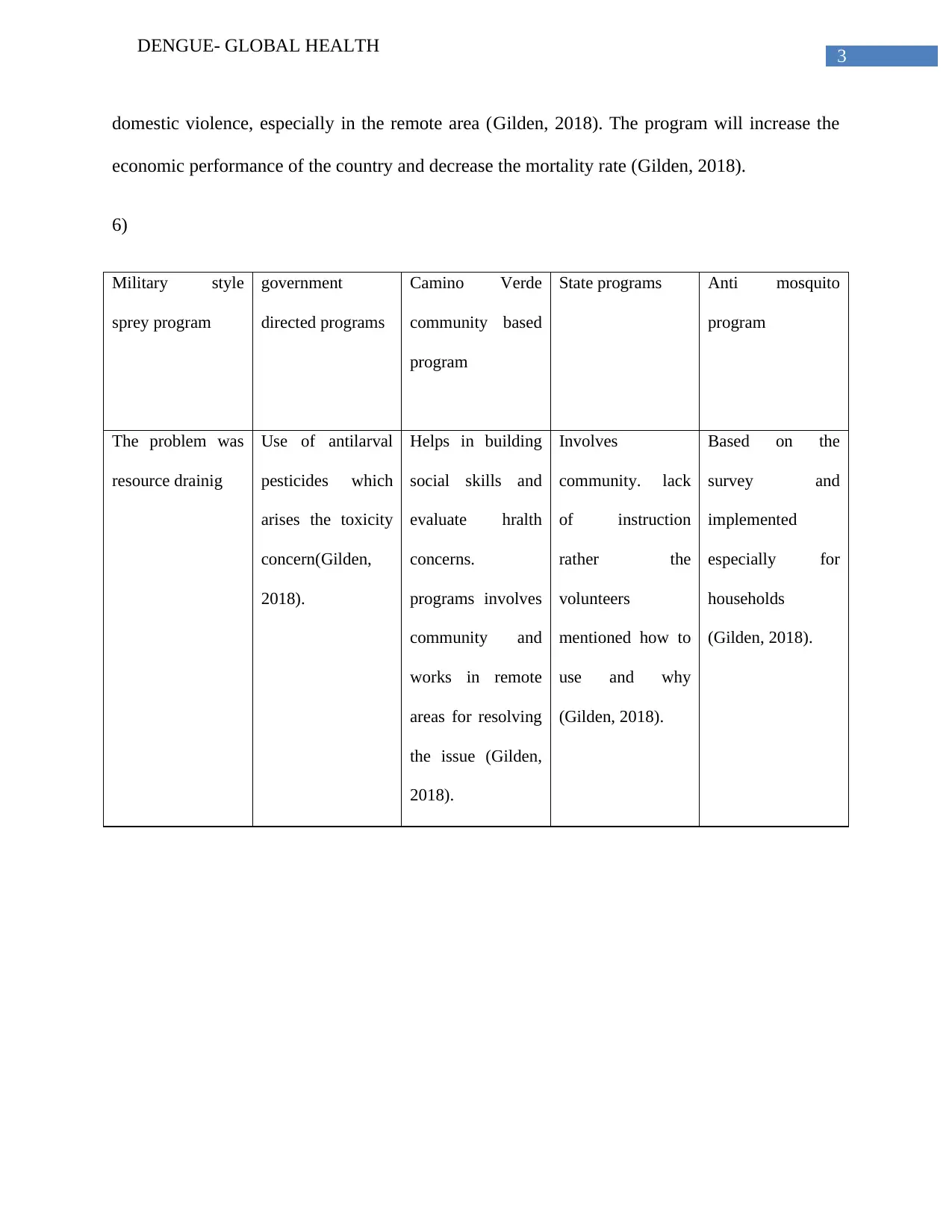
6)
Military style
sprey program
government
directed programs
Camino Verde
community based
program
State programs Anti mosquito
program
The problem was
resource drainig
Use of antilarval
pesticides which
arises the toxicity
concern(Gilden,
2018).
Helps in building
social skills and
evaluate hralth
concerns.
programs involves
community and
works in remote
areas for resolving
the issue (Gilden,
2018).
Involves
community. lack
of instruction
rather the
volunteers
mentioned how to
use and why
(Gilden, 2018).
Based on the
survey and
implemented
especially for
households
(Gilden, 2018).
tabler-icon-diamond-filled.svg

Paraphrase This Document

Need a fresh take? Get an instant paraphrase of this document with our AI Paraphraser
Document Page
4
DENGUE- GLOBAL HEALTH
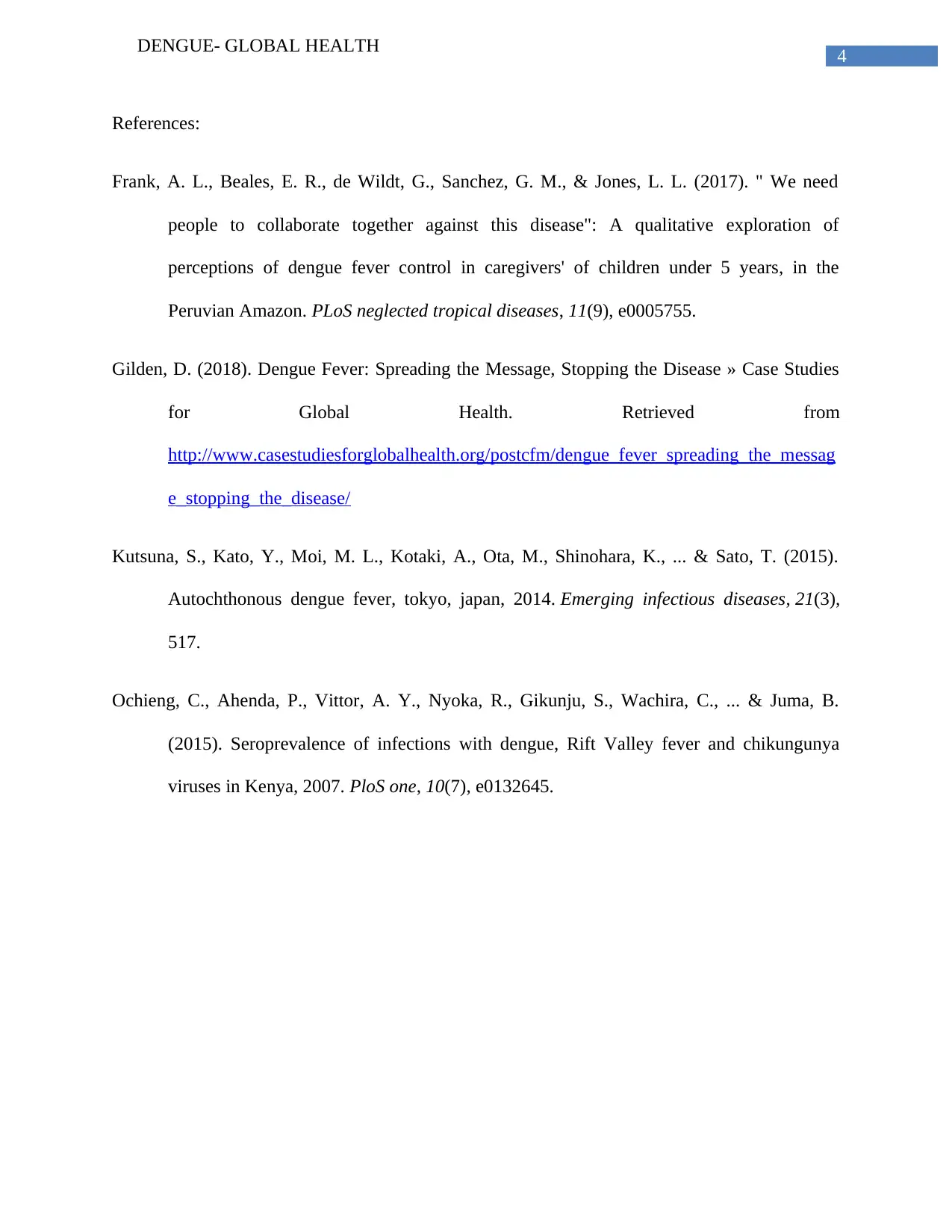
References:
Frank, A. L., Beales, E. R., de Wildt, G., Sanchez, G. M., & Jones, L. L. (2017). " We need
people to collaborate together against this disease": A qualitative exploration of
perceptions of dengue fever control in caregivers' of children under 5 years, in the
Peruvian Amazon. PLoS neglected tropical diseases, 11(9), e0005755.
Gilden, D. (2018). Dengue Fever: Spreading the Message, Stopping the Disease ยป Case Studies
for Global Health. Retrieved from
http://www.casestudiesforglobalhealth.org/postcfm/dengue_fever_spreading_the_messag
e_stopping_the_disease/
Kutsuna, S., Kato, Y., Moi, M. L., Kotaki, A., Ota, M., Shinohara, K., ... & Sato, T. (2015).
Autochthonous dengue fever, tokyo, japan, 2014. Emerging infectious diseases, 21(3),
517.
Ochieng, C., Ahenda, P., Vittor, A. Y., Nyoka, R., Gikunju, S., Wachira, C., ... & Juma, B.
(2015). Seroprevalence of infections with dengue, Rift Valley fever and chikungunya
viruses in Kenya, 2007. PloS one, 10(7), e0132645.
chevron_up_icon
1 out of 5
circle_padding
hide_on_mobile
zoom_out_icon
[object Object]