Medieval Christian Art: Analyzing the Evolution of God's Depiction
VerifiedAdded on 2020/12/07
|10
|2773
|341
Essay
AI Summary
This essay analyzes the evolution of the depictions of God in Medieval Christian art, starting from the early, ambiguous representations influenced by pagan culture to the more defined iconography that emerged with the legalization of Christianity under Constantine. The paper examines significant changes and trends throughout the Middle Ages, including the Byzantine period and the Iconoclastic controversy, and evaluates the artistic significance of different works, focusing on the visual forms of God the Father (represented by the Hand of God), God the Son (often depicted as the Good Shepherd or Christ Enthroned), and the Holy Spirit (symbolized by a dove). It highlights how theological interpretations and social-political forces shaped the artistic representations of the Holy Trinity. The essay further discusses the standardization of religious subjects, the prohibition of God the Father's human form until the 10th century, the appropriation of pagan symbols, and the evolving depictions of Jesus Christ. The essay concludes by acknowledging the limitations of its scope and briefly mentioning subsequent theological debates and architectural trends. The paper emphasizes how the iconography of the Deity demonstrates changing theological understandings and how incredibly complex symbolism in Christian art interacted with.
Keeling 1
Katilynn Keeling
Prof. William Tronzo
VIS 121C
21 November 2020
Essay #2
Depictions of God in the period of Medieval Christian art bears a significance of the
important theological interpretations that evolved over time. To better understand the
complicated, overlapping, and incomplete timeline of Christian art, this paper will briefly
summarize what were significant changes and trends in Christian art throughout the Middle
Ages and will evaluate the artistic significance of different works of Byzantine Christian art,
looking at examples of the visual forms of God in art- referring separately the Holy Trinity: God
the Father, the Son, and the Holy Spirit.
Before the rule of Constantine in the 3rd century, the enforced persecution of Christians
significantly impacted the ability to freely create meaningful religious art. Instead, early Christian
art was deliberately ambiguous- borrowing from the pagan culture and placing new meanings
into their symbolic interpretations (Syndicus, p. 30, 1962). However, the extravagant artistry of
classical pagan art contrasted the desire of early Christians whose art was not meant to be
glorified or idolized- viewing it as misappropriated worship of things other than the Creator
(Stephan & Sullivan, 2020). Exodus 20:4-5 reads, “4You shall not make for yourself a carved
image—any likeness of anything that is in heaven above, or that is in the earth beneath, or that
is in the water under the earth; 5 you shall not bow down to them nor serve them. For I, the Lord
your God, am a jealous God” (NKJV). Early Christian art distinguished themselves from the
Pagans and idol worship by borrowing iconography plainly, then later, characterizing it so that
“[it did] not put the scenes it portrays in an earthly, finite perspective. The figures [stood] flat and
incorporeal on bright backgrounds… thereby [taking] on an unearthly quality…. The pictures are
Katilynn Keeling
Prof. William Tronzo
VIS 121C
21 November 2020
Essay #2
Depictions of God in the period of Medieval Christian art bears a significance of the
important theological interpretations that evolved over time. To better understand the
complicated, overlapping, and incomplete timeline of Christian art, this paper will briefly
summarize what were significant changes and trends in Christian art throughout the Middle
Ages and will evaluate the artistic significance of different works of Byzantine Christian art,
looking at examples of the visual forms of God in art- referring separately the Holy Trinity: God
the Father, the Son, and the Holy Spirit.
Before the rule of Constantine in the 3rd century, the enforced persecution of Christians
significantly impacted the ability to freely create meaningful religious art. Instead, early Christian
art was deliberately ambiguous- borrowing from the pagan culture and placing new meanings
into their symbolic interpretations (Syndicus, p. 30, 1962). However, the extravagant artistry of
classical pagan art contrasted the desire of early Christians whose art was not meant to be
glorified or idolized- viewing it as misappropriated worship of things other than the Creator
(Stephan & Sullivan, 2020). Exodus 20:4-5 reads, “4You shall not make for yourself a carved
image—any likeness of anything that is in heaven above, or that is in the earth beneath, or that
is in the water under the earth; 5 you shall not bow down to them nor serve them. For I, the Lord
your God, am a jealous God” (NKJV). Early Christian art distinguished themselves from the
Pagans and idol worship by borrowing iconography plainly, then later, characterizing it so that
“[it did] not put the scenes it portrays in an earthly, finite perspective. The figures [stood] flat and
incorporeal on bright backgrounds… thereby [taking] on an unearthly quality…. The pictures are

Paraphrase This Document
Need a fresh take? Get an instant paraphrase of this document with our AI Paraphraser
Keeling 2
signposts, informative rather than beautiful…” (Syndicus, p 30, 1962). Holy representations,
therefore, were mostly limited to abstraction and portrayals of artistic metaphors and symbols
that called on followers to interact with the meanings behind the icons, rather than to idolize the
representation of the icons themselves...
By the late 2nd Century, incipient pictorial art began to make an appearance. It is
important to note that the ‘starting point’ of Christian pictorial art-
“lies in the basic teaching of the Christian revelation itself- namely, the
incarnation, the point at which the Christian proclamation is different from
Judaism. The incarnation of the Son of man, the Messiah, in the form of a human
being- who was created in the “image of God”- granted theological approval of a
sort to use the images that symbolized Christan truths” (Stephan & Sullivan).
The 4th Century became marked by Constantine’s support and legalization of Christianity,
freeing them from religious persecution. The Church grew (wealthier), and theological
perspectives pushed Christian iconographic art to become more widely accepted as it
symbolized testament to the faith, rather than seen as iconographic representations to be
worshipped. Narrative-based art could now be freely made according to Christianity (though
borrowed pagan icons/symbols were now fixed into Christian symbolism) and individual portraits
of Jesus originated and grew more elaborate.
Christian art expanded over the 6th and 7th Centuries and ushered in the First Golden
Age of Byzantine art (Demus, p. xiv, 1955). Magnificent churches were erected and lavishly
decorated with religious art which “served as spiritual gateways” (Hurst, 2004). However, the 8th
and 9th centuries became notably defined as the Byzantine Iconoclastic Period, in which social
and political upheavals, led by Emperor Leo III (and his later successor), divided the Orthodox
church regarding theological interpretations of the Old Testament Ten Commandments which
forbade the worship of “graven images” (“Iconoclastic Controversy”). The Church remained
mostly in support of religious iconographic art throughout these periods of divisiveness;
signposts, informative rather than beautiful…” (Syndicus, p 30, 1962). Holy representations,
therefore, were mostly limited to abstraction and portrayals of artistic metaphors and symbols
that called on followers to interact with the meanings behind the icons, rather than to idolize the
representation of the icons themselves...
By the late 2nd Century, incipient pictorial art began to make an appearance. It is
important to note that the ‘starting point’ of Christian pictorial art-
“lies in the basic teaching of the Christian revelation itself- namely, the
incarnation, the point at which the Christian proclamation is different from
Judaism. The incarnation of the Son of man, the Messiah, in the form of a human
being- who was created in the “image of God”- granted theological approval of a
sort to use the images that symbolized Christan truths” (Stephan & Sullivan).
The 4th Century became marked by Constantine’s support and legalization of Christianity,
freeing them from religious persecution. The Church grew (wealthier), and theological
perspectives pushed Christian iconographic art to become more widely accepted as it
symbolized testament to the faith, rather than seen as iconographic representations to be
worshipped. Narrative-based art could now be freely made according to Christianity (though
borrowed pagan icons/symbols were now fixed into Christian symbolism) and individual portraits
of Jesus originated and grew more elaborate.
Christian art expanded over the 6th and 7th Centuries and ushered in the First Golden
Age of Byzantine art (Demus, p. xiv, 1955). Magnificent churches were erected and lavishly
decorated with religious art which “served as spiritual gateways” (Hurst, 2004). However, the 8th
and 9th centuries became notably defined as the Byzantine Iconoclastic Period, in which social
and political upheavals, led by Emperor Leo III (and his later successor), divided the Orthodox
church regarding theological interpretations of the Old Testament Ten Commandments which
forbade the worship of “graven images” (“Iconoclastic Controversy”). The Church remained
mostly in support of religious iconographic art throughout these periods of divisiveness;
Keeling 3
however, theological shifts shaped by the Iconoclastic debate helped establish a set of rules
and expectations for Christian art. The standardization of what and how a religious subject was
to be presented “[did] not aim at evoking the emotions of pity, fear or hope... The pictures make
their appeal to the beholder not as an individual human being, a soul to be saved, but as a
member of the Church, with his own assigned place in the hierarchical organization” (Demus, pp
4-5).
This brief history sheds light on Byzantine art and illuminates the veneration of holy
icons but, most importantly, as religious iconography grew more widely accepted,
representations of God the Father remained prohibited, for “18no one has seen God at any time”
(John 1:18, NKJV). Artistic metaphors were implemented and standardized in this way. Most
frequently, the Hand of God was used to represent divine intervention or approval. This imagery
embodies hundreds of verses in Scripture which involve the hand of God such as; Isaiah 41:40 -
“Fear not for I am with you; be not dismayed...I will strengthen you, I will uphold you with my
righteous right hand” (NKJV), and “Was it not My hand which made all these things?” (Acts 7:50
NKJV). Thus, God the Father is not seen documented until the 6th century on. A later example
is the Codex Aureus of St. Emmeram, circa 870 A.D. (Figure 1.1), a manuscript made for the
Carolingian King Charles the Bald (Pizzinato, p.145, 2018). While this image has a lot to
dissect, we will remain focused on the depiction of God. Here, the Hand of God emerges from
the heavens, positioned downward and outstretched as it hovers above the king’s head to
inform of God’s divine sanctioning of the king. Emphasis is placed on this symbolism by
enforcing it within the focal point- a lush green sun, fringed with golden rays. In some other
instances, God has been depicted as a burning bush in reference to Exodus Chapter three-
where Moses is visited by God in the form of a bush on fire but not burning (Demus, p. 104).
Ultimately the iconographic depiction of God the Father remained prohibited and, “for about a
thousand years, no attempt was made to portray the First Person of the Holy Trinity in human
however, theological shifts shaped by the Iconoclastic debate helped establish a set of rules
and expectations for Christian art. The standardization of what and how a religious subject was
to be presented “[did] not aim at evoking the emotions of pity, fear or hope... The pictures make
their appeal to the beholder not as an individual human being, a soul to be saved, but as a
member of the Church, with his own assigned place in the hierarchical organization” (Demus, pp
4-5).
This brief history sheds light on Byzantine art and illuminates the veneration of holy
icons but, most importantly, as religious iconography grew more widely accepted,
representations of God the Father remained prohibited, for “18no one has seen God at any time”
(John 1:18, NKJV). Artistic metaphors were implemented and standardized in this way. Most
frequently, the Hand of God was used to represent divine intervention or approval. This imagery
embodies hundreds of verses in Scripture which involve the hand of God such as; Isaiah 41:40 -
“Fear not for I am with you; be not dismayed...I will strengthen you, I will uphold you with my
righteous right hand” (NKJV), and “Was it not My hand which made all these things?” (Acts 7:50
NKJV). Thus, God the Father is not seen documented until the 6th century on. A later example
is the Codex Aureus of St. Emmeram, circa 870 A.D. (Figure 1.1), a manuscript made for the
Carolingian King Charles the Bald (Pizzinato, p.145, 2018). While this image has a lot to
dissect, we will remain focused on the depiction of God. Here, the Hand of God emerges from
the heavens, positioned downward and outstretched as it hovers above the king’s head to
inform of God’s divine sanctioning of the king. Emphasis is placed on this symbolism by
enforcing it within the focal point- a lush green sun, fringed with golden rays. In some other
instances, God has been depicted as a burning bush in reference to Exodus Chapter three-
where Moses is visited by God in the form of a bush on fire but not burning (Demus, p. 104).
Ultimately the iconographic depiction of God the Father remained prohibited and, “for about a
thousand years, no attempt was made to portray the First Person of the Holy Trinity in human
⊘ This is a preview!⊘
Do you want full access?
Subscribe today to unlock all pages.

Trusted by 1+ million students worldwide
Keeling 4
form…. the human form of the Father finally [made] its appearance in and after the tenth
century” (Cornwell, 2009).
form…. the human form of the Father finally [made] its appearance in and after the tenth
century” (Cornwell, 2009).
Paraphrase This Document
Need a fresh take? Get an instant paraphrase of this document with our AI Paraphraser
Keeling 5
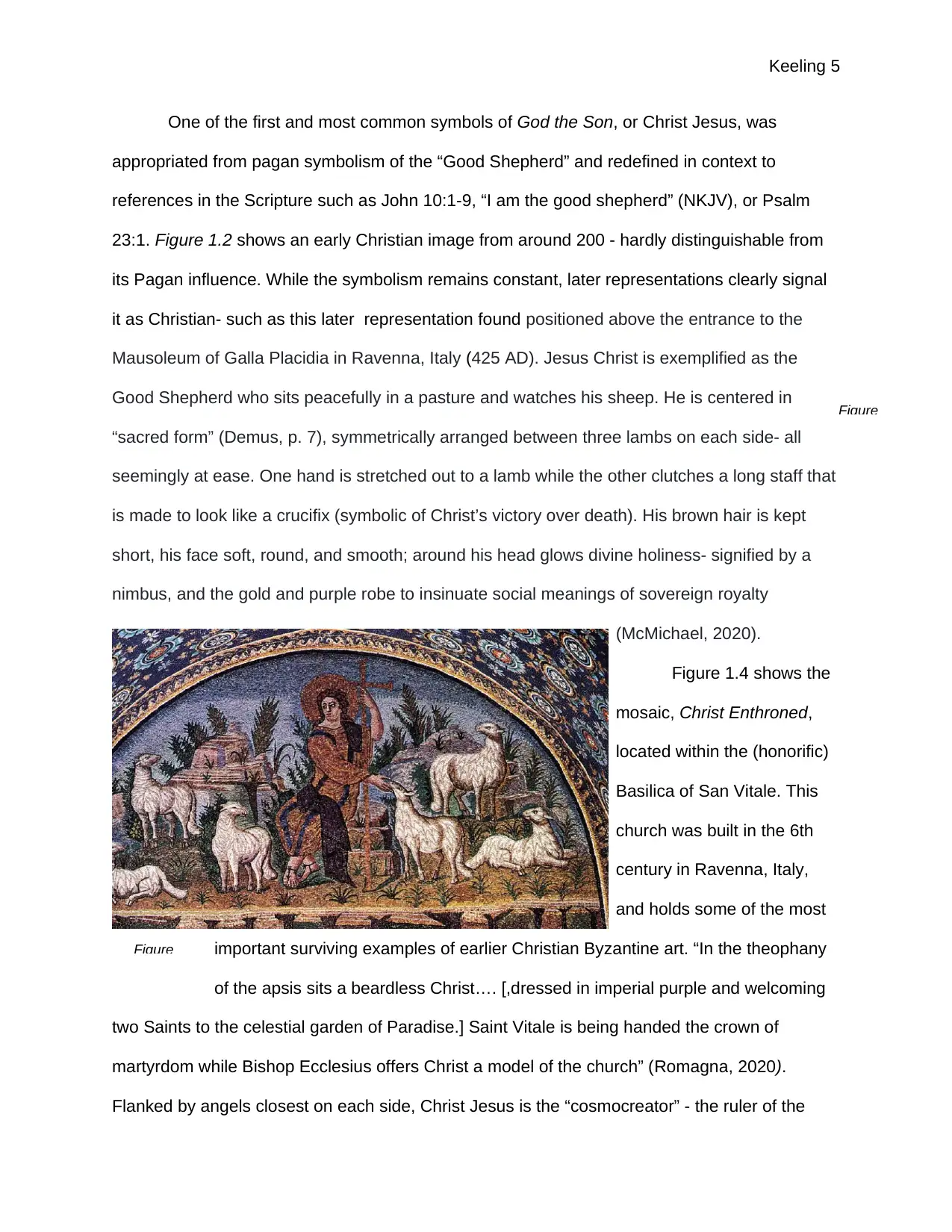
One of the first and most common symbols of God the Son, or Christ Jesus, was
appropriated from pagan symbolism of the “Good Shepherd” and redefined in context to
references in the Scripture such as John 10:1-9, “I am the good shepherd” (NKJV), or Psalm
23:1. Figure 1.2 shows an early Christian image from around 200 - hardly distinguishable from
its Pagan influence. While the symbolism remains constant, later representations clearly signal
it as Christian- such as this later representation found positioned above the entrance to the
Mausoleum of Galla Placidia in Ravenna, Italy (425 AD). Jesus Christ is exemplified as the
Good Shepherd who sits peacefully in a pasture and watches his sheep. He is centered in
“sacred form” (Demus, p. 7), symmetrically arranged between three lambs on each side- all
seemingly at ease. One hand is stretched out to a lamb while the other clutches a long staff that
is made to look like a crucifix (symbolic of Christ’s victory over death). His brown hair is kept
short, his face soft, round, and smooth; around his head glows divine holiness- signified by a
nimbus, and the gold and purple robe to insinuate social meanings of sovereign royalty
(McMichael, 2020).
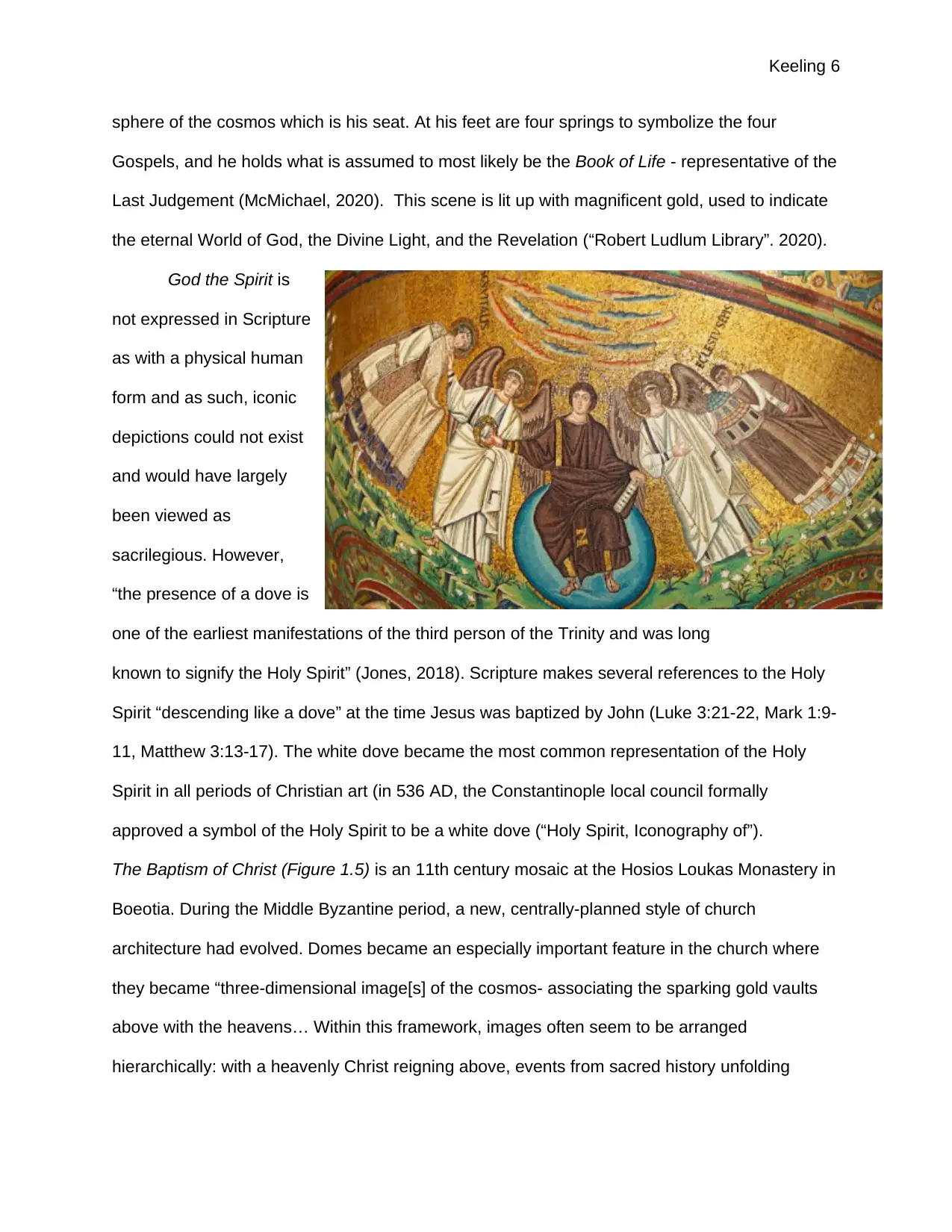
Figure 1.4 shows the
mosaic, Christ Enthroned,
located within the (honorific)
Basilica of San Vitale. This
church was built in the 6th
century in Ravenna, Italy,
and holds some of the most
important surviving examples of earlier Christian Byzantine art. “In the theophany
of the apsis sits a beardless Christ…. [,dressed in imperial purple and welcoming
two Saints to the celestial garden of Paradise.] Saint Vitale is being handed the crown of
martyrdom while Bishop Ecclesius offers Christ a model of the church” (Romagna, 2020).
Flanked by angels closest on each side, Christ Jesus is the “cosmocreator” - the ruler of the
Figure
Figure
One of the first and most common symbols of God the Son, or Christ Jesus, was
appropriated from pagan symbolism of the “Good Shepherd” and redefined in context to
references in the Scripture such as John 10:1-9, “I am the good shepherd” (NKJV), or Psalm
23:1. Figure 1.2 shows an early Christian image from around 200 - hardly distinguishable from
its Pagan influence. While the symbolism remains constant, later representations clearly signal
it as Christian- such as this later representation found positioned above the entrance to the
Mausoleum of Galla Placidia in Ravenna, Italy (425 AD). Jesus Christ is exemplified as the
Good Shepherd who sits peacefully in a pasture and watches his sheep. He is centered in
“sacred form” (Demus, p. 7), symmetrically arranged between three lambs on each side- all
seemingly at ease. One hand is stretched out to a lamb while the other clutches a long staff that
is made to look like a crucifix (symbolic of Christ’s victory over death). His brown hair is kept
short, his face soft, round, and smooth; around his head glows divine holiness- signified by a
nimbus, and the gold and purple robe to insinuate social meanings of sovereign royalty
(McMichael, 2020).
Figure 1.4 shows the
mosaic, Christ Enthroned,
located within the (honorific)
Basilica of San Vitale. This
church was built in the 6th
century in Ravenna, Italy,
and holds some of the most
important surviving examples of earlier Christian Byzantine art. “In the theophany
of the apsis sits a beardless Christ…. [,dressed in imperial purple and welcoming
two Saints to the celestial garden of Paradise.] Saint Vitale is being handed the crown of
martyrdom while Bishop Ecclesius offers Christ a model of the church” (Romagna, 2020).
Flanked by angels closest on each side, Christ Jesus is the “cosmocreator” - the ruler of the
Figure
Figure
Keeling 6
sphere of the cosmos which is his seat. At his feet are four springs to symbolize the four
Gospels, and he holds what is assumed to most likely be the Book of Life - representative of the
Last Judgement (McMichael, 2020). This scene is lit up with magnificent gold, used to indicate
the eternal World of God, the Divine Light, and the Revelation (“Robert Ludlum Library”. 2020).
God the Spirit is
not expressed in Scripture
as with a physical human
form and as such, iconic
depictions could not exist
and would have largely
been viewed as
sacrilegious. However,
“the presence of a dove is
one of the earliest manifestations of the third person of the Trinity and was long
known to signify the Holy Spirit” (Jones, 2018). Scripture makes several references to the Holy
Spirit “descending like a dove” at the time Jesus was baptized by John (Luke 3:21-22, Mark 1:9-
11, Matthew 3:13-17). The white dove became the most common representation of the Holy
Spirit in all periods of Christian art (in 536 AD, the Constantinople local council formally
approved a symbol of the Holy Spirit to be a white dove (“Holy Spirit, Iconography of”).
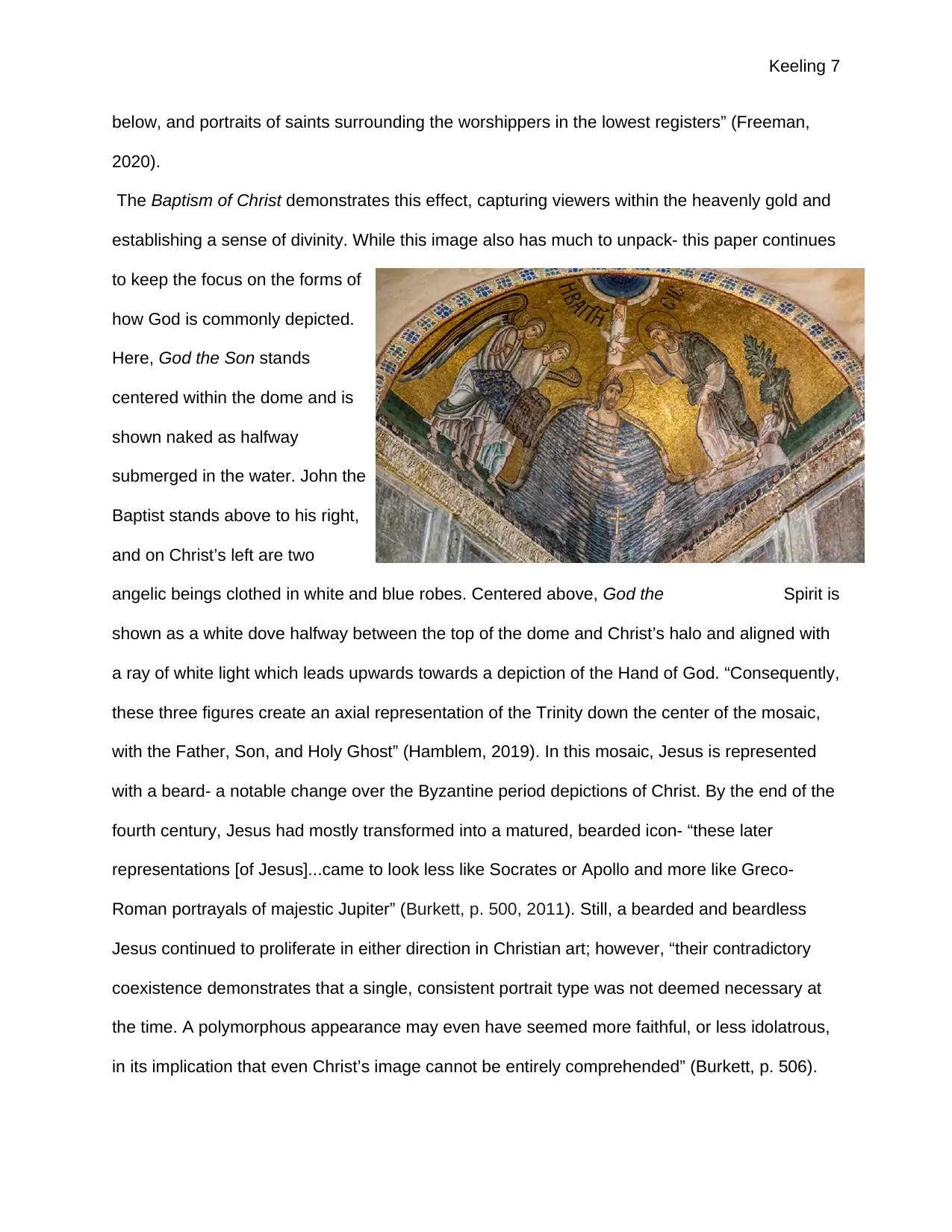
The Baptism of Christ (Figure 1.5) is an 11th century mosaic at the Hosios Loukas Monastery in
Boeotia. During the Middle Byzantine period, a new, centrally-planned style of church
architecture had evolved. Domes became an especially important feature in the church where
they became “three-dimensional image[s] of the cosmos- associating the sparking gold vaults
above with the heavens… Within this framework, images often seem to be arranged
hierarchically: with a heavenly Christ reigning above, events from sacred history unfolding
sphere of the cosmos which is his seat. At his feet are four springs to symbolize the four
Gospels, and he holds what is assumed to most likely be the Book of Life - representative of the
Last Judgement (McMichael, 2020). This scene is lit up with magnificent gold, used to indicate
the eternal World of God, the Divine Light, and the Revelation (“Robert Ludlum Library”. 2020).
God the Spirit is
not expressed in Scripture
as with a physical human
form and as such, iconic
depictions could not exist
and would have largely
been viewed as
sacrilegious. However,
“the presence of a dove is
one of the earliest manifestations of the third person of the Trinity and was long
known to signify the Holy Spirit” (Jones, 2018). Scripture makes several references to the Holy
Spirit “descending like a dove” at the time Jesus was baptized by John (Luke 3:21-22, Mark 1:9-
11, Matthew 3:13-17). The white dove became the most common representation of the Holy
Spirit in all periods of Christian art (in 536 AD, the Constantinople local council formally
approved a symbol of the Holy Spirit to be a white dove (“Holy Spirit, Iconography of”).
The Baptism of Christ (Figure 1.5) is an 11th century mosaic at the Hosios Loukas Monastery in
Boeotia. During the Middle Byzantine period, a new, centrally-planned style of church
architecture had evolved. Domes became an especially important feature in the church where
they became “three-dimensional image[s] of the cosmos- associating the sparking gold vaults
above with the heavens… Within this framework, images often seem to be arranged
hierarchically: with a heavenly Christ reigning above, events from sacred history unfolding
⊘ This is a preview!⊘
Do you want full access?
Subscribe today to unlock all pages.
Trusted by 1+ million students worldwide
Keeling 7
below, and portraits of saints surrounding the worshippers in the lowest registers” (Freeman,
2020).
The Baptism of Christ demonstrates this effect, capturing viewers within the heavenly gold and
establishing a sense of divinity. While this image also has much to unpack- this paper continues
to keep the focus on the forms of
how God is commonly depicted.
Here, God the Son stands
centered within the dome and is
shown naked as halfway
submerged in the water. John the
Baptist stands above to his right,
and on Christ’s left are two
angelic beings clothed in white and blue robes. Centered above, God the Spirit is
shown as a white dove halfway between the top of the dome and Christ’s halo and aligned with
a ray of white light which leads upwards towards a depiction of the Hand of God. “Consequently,
these three figures create an axial representation of the Trinity down the center of the mosaic,
with the Father, Son, and Holy Ghost” (Hamblem, 2019). In this mosaic, Jesus is represented
with a beard- a notable change over the Byzantine period depictions of Christ. By the end of the
fourth century, Jesus had mostly transformed into a matured, bearded icon- “these later
representations [of Jesus]...came to look less like Socrates or Apollo and more like Greco-
Roman portrayals of majestic Jupiter” (Burkett, p. 500, 2011). Still, a bearded and beardless
Jesus continued to proliferate in either direction in Christian art; however, “their contradictory
coexistence demonstrates that a single, consistent portrait type was not deemed necessary at
the time. A polymorphous appearance may even have seemed more faithful, or less idolatrous,
in its implication that even Christ’s image cannot be entirely comprehended” (Burkett, p. 506).
below, and portraits of saints surrounding the worshippers in the lowest registers” (Freeman,
2020).
The Baptism of Christ demonstrates this effect, capturing viewers within the heavenly gold and
establishing a sense of divinity. While this image also has much to unpack- this paper continues
to keep the focus on the forms of
how God is commonly depicted.
Here, God the Son stands
centered within the dome and is
shown naked as halfway
submerged in the water. John the
Baptist stands above to his right,
and on Christ’s left are two
angelic beings clothed in white and blue robes. Centered above, God the Spirit is
shown as a white dove halfway between the top of the dome and Christ’s halo and aligned with
a ray of white light which leads upwards towards a depiction of the Hand of God. “Consequently,
these three figures create an axial representation of the Trinity down the center of the mosaic,
with the Father, Son, and Holy Ghost” (Hamblem, 2019). In this mosaic, Jesus is represented
with a beard- a notable change over the Byzantine period depictions of Christ. By the end of the
fourth century, Jesus had mostly transformed into a matured, bearded icon- “these later
representations [of Jesus]...came to look less like Socrates or Apollo and more like Greco-
Roman portrayals of majestic Jupiter” (Burkett, p. 500, 2011). Still, a bearded and beardless
Jesus continued to proliferate in either direction in Christian art; however, “their contradictory
coexistence demonstrates that a single, consistent portrait type was not deemed necessary at
the time. A polymorphous appearance may even have seemed more faithful, or less idolatrous,
in its implication that even Christ’s image cannot be entirely comprehended” (Burkett, p. 506).
Paraphrase This Document
Need a fresh take? Get an instant paraphrase of this document with our AI Paraphraser
Keeling 8
Eventually, the bearded Jesus became standard by the 6th Century and his features became
more consistent.
. Unfortunately, this paper did not have the length to further discuss proceeding
theological debates and division within the church, and the social and political forces that
especially influenced the 9th Century and the following “high Middle Ages”. Romanesque to
Gothic architecture trends accompanied new forms of Christian art, such as stained-glass
mosaics, “books of hours'', and adaptations in technique and media altogether emphasized
further theological shifts. Still, we now better understand how the iconography of the Deity
demonstrates changing theological understandings and how incredibly complex symbolism in
Christian art interacted with its followers.
Works Cited
Brooks, Sarah. (2009, August), Icons and Iconoclasm in Byzantium, “Met Museum”, Retrieved
November 2020, from https://www.metmuseum.org/toah/hd/icon/hd_icon.htm
Burkett, D. R. (2011). The Blackwell Companion to Jesus. Chichester, West Sussex:
Wiley-Blackwell.
Eventually, the bearded Jesus became standard by the 6th Century and his features became
more consistent.
. Unfortunately, this paper did not have the length to further discuss proceeding
theological debates and division within the church, and the social and political forces that
especially influenced the 9th Century and the following “high Middle Ages”. Romanesque to
Gothic architecture trends accompanied new forms of Christian art, such as stained-glass
mosaics, “books of hours'', and adaptations in technique and media altogether emphasized
further theological shifts. Still, we now better understand how the iconography of the Deity
demonstrates changing theological understandings and how incredibly complex symbolism in
Christian art interacted with its followers.
Works Cited
Brooks, Sarah. (2009, August), Icons and Iconoclasm in Byzantium, “Met Museum”, Retrieved
November 2020, from https://www.metmuseum.org/toah/hd/icon/hd_icon.htm
Burkett, D. R. (2011). The Blackwell Companion to Jesus. Chichester, West Sussex:
Wiley-Blackwell.
Keeling 9
Cornwell, J. (2009). Saints, Signs, and Symbols: The Symbolic Language of Christian Art.
London, NY: Spck Publishing. Retrieved 2020, from
https://www.google.com/books/edition/Saints_Signs_and_Symbols/J2kX8f3iJfEC?hl=en
&gbpv=1
Demus, O. (1952) “The Classical System of Middle Byzantine Church Decoration”. MPublishing,
Ann Arbor, Michigan.
Freeman, E., Ph.D. (2020). Mosaics and microcosm: The monasteries of Hosios Loukas, Nea
Moni, and Daphni. Retrieved 2020, from
https://www.khanacademy.org/humanities/
medieval-world/byzantine1/x4b0eb531:middle-byzantine/a/mosaics-and-microcosm-the-
monasteries-of-hosios-loukas-nea-moni-and-daphni
Hamblem, W., Ph.D. (2019). The Baptism of Christ, Hosios Loukas Mosaic. Retrieved
November 2020, from
https://contentdm.lib.byu.edu/digital/collection/CivilizationHamblin/id/
1893/
“Holy Spirit, Iconography of”, New Catholic Encyclopedia. Retrieved November 2020, from
https://www.encyclopedia.com/religion/encyclopedias-almanacs
-transcripts-and-maps/holy-spirit-iconography
Jones, S. P. (2018). Depictions of the Trinity in Early Christian Art Between 200AD and 400AD
(Unpublished master's thesis). Talbot School of Theology, Biola University.
Retrieved
November 2020, from https://www.academia.edu/38113822/DEPICTIONS_OF_THE_
TRINITY_IN_EARLY_CHRISTIAN_ART_BETWEEN_200AD_AND_400AD
McMichael, A. L. (2020). Iconography of Christ. Retrieved November 21, 2020, from
http://projects.leadr.msu.edu/medievalart/about
Cornwell, J. (2009). Saints, Signs, and Symbols: The Symbolic Language of Christian Art.
London, NY: Spck Publishing. Retrieved 2020, from
https://www.google.com/books/edition/Saints_Signs_and_Symbols/J2kX8f3iJfEC?hl=en
&gbpv=1
Demus, O. (1952) “The Classical System of Middle Byzantine Church Decoration”. MPublishing,
Ann Arbor, Michigan.
Freeman, E., Ph.D. (2020). Mosaics and microcosm: The monasteries of Hosios Loukas, Nea
Moni, and Daphni. Retrieved 2020, from
https://www.khanacademy.org/humanities/
medieval-world/byzantine1/x4b0eb531:middle-byzantine/a/mosaics-and-microcosm-the-
monasteries-of-hosios-loukas-nea-moni-and-daphni
Hamblem, W., Ph.D. (2019). The Baptism of Christ, Hosios Loukas Mosaic. Retrieved
November 2020, from
https://contentdm.lib.byu.edu/digital/collection/CivilizationHamblin/id/
1893/
“Holy Spirit, Iconography of”, New Catholic Encyclopedia. Retrieved November 2020, from
https://www.encyclopedia.com/religion/encyclopedias-almanacs
-transcripts-and-maps/holy-spirit-iconography
Jones, S. P. (2018). Depictions of the Trinity in Early Christian Art Between 200AD and 400AD
(Unpublished master's thesis). Talbot School of Theology, Biola University.
Retrieved
November 2020, from https://www.academia.edu/38113822/DEPICTIONS_OF_THE_
TRINITY_IN_EARLY_CHRISTIAN_ART_BETWEEN_200AD_AND_400AD
McMichael, A. L. (2020). Iconography of Christ. Retrieved November 21, 2020, from
http://projects.leadr.msu.edu/medievalart/about
⊘ This is a preview!⊘
Do you want full access?
Subscribe today to unlock all pages.
Trusted by 1+ million students worldwide
Keeling 10
Pizzinato, R. (2018). “Vision and Christomimesis in the Ruler Portrait of the Codex Aureus of St.
Emmeram”, University of Texas Rio Grande Valley, V27. N2. Retrieved
November 2020, from https://www.journals.uchicago.edu/doi/full/10.1086/698840
“Robert Ludlum Library”, (2020, August 02). Revelations Of The Byzantine World. Retrieved
November 2020, from http://webcache.googleusercontent.com/search?q=cache
%3Aq qqMeCOlPzcJ%3Aabletaxiskettering.co.uk
%2Frevelations_of_the_byzantine_world.pdf
Romagna, E. (2020) See the Basilica of San Vitale in Ravenna, European Traveler. Retrieved
2020, from
https://www.european-traveler.com/italy/see-the-basilica-of-san-vitale-in-
ravenna/
Syndicus, E. (1962). Early Christian art. New York, NY: Hawthorn Books.
Pizzinato, R. (2018). “Vision and Christomimesis in the Ruler Portrait of the Codex Aureus of St.
Emmeram”, University of Texas Rio Grande Valley, V27. N2. Retrieved
November 2020, from https://www.journals.uchicago.edu/doi/full/10.1086/698840
“Robert Ludlum Library”, (2020, August 02). Revelations Of The Byzantine World. Retrieved
November 2020, from http://webcache.googleusercontent.com/search?q=cache
%3Aq qqMeCOlPzcJ%3Aabletaxiskettering.co.uk
%2Frevelations_of_the_byzantine_world.pdf
Romagna, E. (2020) See the Basilica of San Vitale in Ravenna, European Traveler. Retrieved
2020, from
https://www.european-traveler.com/italy/see-the-basilica-of-san-vitale-in-
ravenna/
Syndicus, E. (1962). Early Christian art. New York, NY: Hawthorn Books.

1 out of 10


Your All-in-One AI-Powered Toolkit for Academic Success.
+13062052269
info@desklib.com
Available 24*7 on WhatsApp / Email
![[object Object]](/_next/static/media/star-bottom.7253800d.svg)
Unlock your academic potential
Copyright © 2020–2026 A2Z Services. All Rights Reserved. Developed and managed by ZUCOL.