Analysis of Depression and Suicide: Prevalence, At-Risk Groups, Ethics
VerifiedAdded on 2023/06/13
|11
|3212
|361
Essay
AI Summary
This essay provides an overview of depression and suicide in Australia, examining the incidence of both conditions and highlighting community groups at particular risk. It critically discusses factors contributing to mental health concerns, defines the ethical principles of beneficence and non-maleficence, and references the Mental Health Act 2014 W.A. The essay identifies high-priority mental health risks from a case study and suggests relevant nursing interventions, along with addressing other mental health issues and needs with appropriate interventions. The analysis includes symptoms of depression, suicide statistics, and the importance of addressing mental health issues through supportive and ethical healthcare practices. The case study focuses on Jack, highlighting issues like the death of his father, job-related stress and relationship problems.
Running head: DEPRESSION AND SUICIDE 1
Depression and Suicide
Name
Institutional Affiliation
Depression and Suicide
Name
Institutional Affiliation

Paraphrase This Document
Need a fresh take? Get an instant paraphrase of this document with our AI Paraphraser
DEPRESSION AND SUICIDE 2
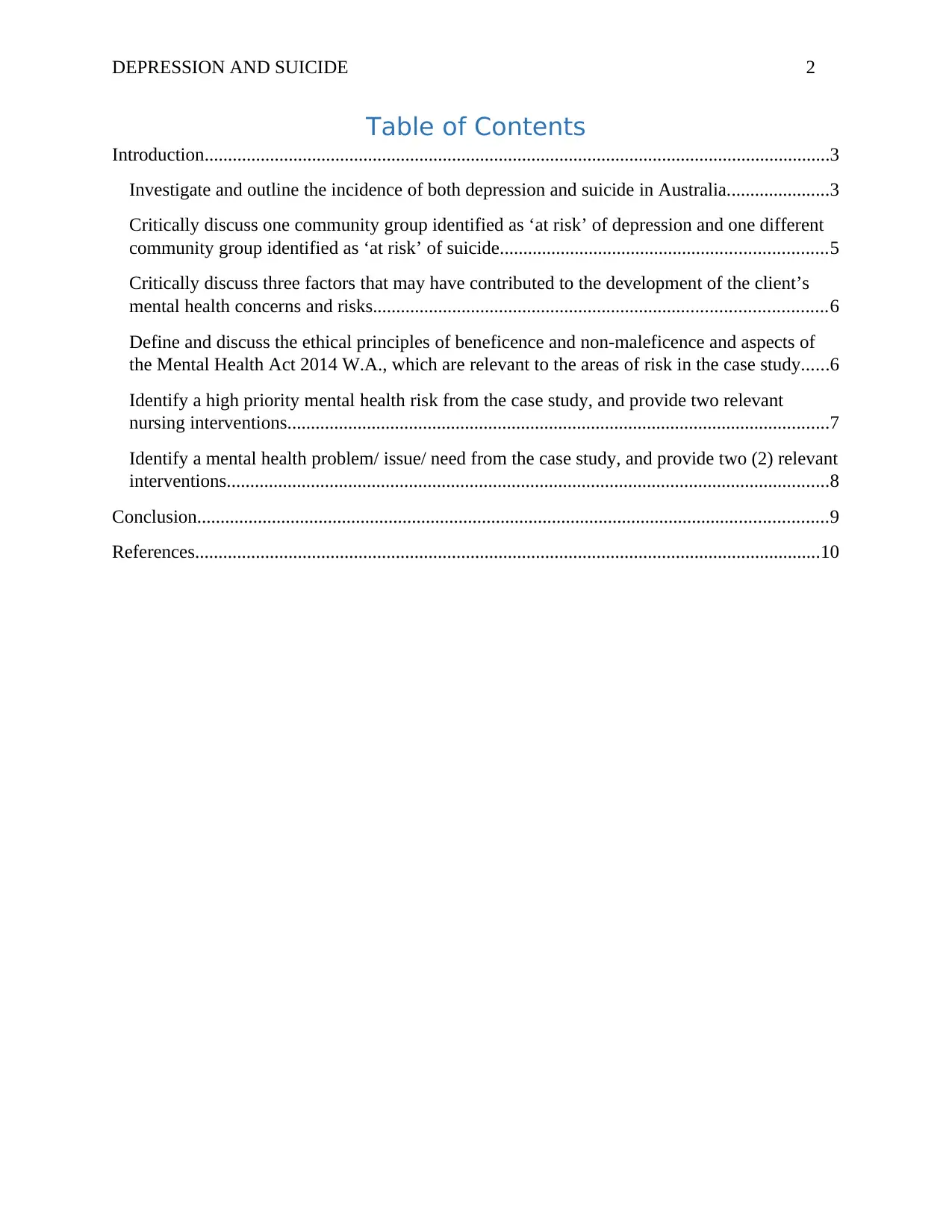
Table of Contents
Introduction......................................................................................................................................3
Investigate and outline the incidence of both depression and suicide in Australia......................3
Critically discuss one community group identified as ‘at risk’ of depression and one different
community group identified as ‘at risk’ of suicide......................................................................5
Critically discuss three factors that may have contributed to the development of the client’s
mental health concerns and risks.................................................................................................6
Define and discuss the ethical principles of beneficence and non-maleficence and aspects of
the Mental Health Act 2014 W.A., which are relevant to the areas of risk in the case study......6
Identify a high priority mental health risk from the case study, and provide two relevant
nursing interventions....................................................................................................................7
Identify a mental health problem/ issue/ need from the case study, and provide two (2) relevant
interventions.................................................................................................................................8
Conclusion.......................................................................................................................................9
References......................................................................................................................................10
Table of Contents
Introduction......................................................................................................................................3
Investigate and outline the incidence of both depression and suicide in Australia......................3
Critically discuss one community group identified as ‘at risk’ of depression and one different
community group identified as ‘at risk’ of suicide......................................................................5
Critically discuss three factors that may have contributed to the development of the client’s
mental health concerns and risks.................................................................................................6
Define and discuss the ethical principles of beneficence and non-maleficence and aspects of
the Mental Health Act 2014 W.A., which are relevant to the areas of risk in the case study......6
Identify a high priority mental health risk from the case study, and provide two relevant
nursing interventions....................................................................................................................7
Identify a mental health problem/ issue/ need from the case study, and provide two (2) relevant
interventions.................................................................................................................................8
Conclusion.......................................................................................................................................9
References......................................................................................................................................10
DEPRESSION AND SUICIDE 3
Depression and suicide.
Introduction
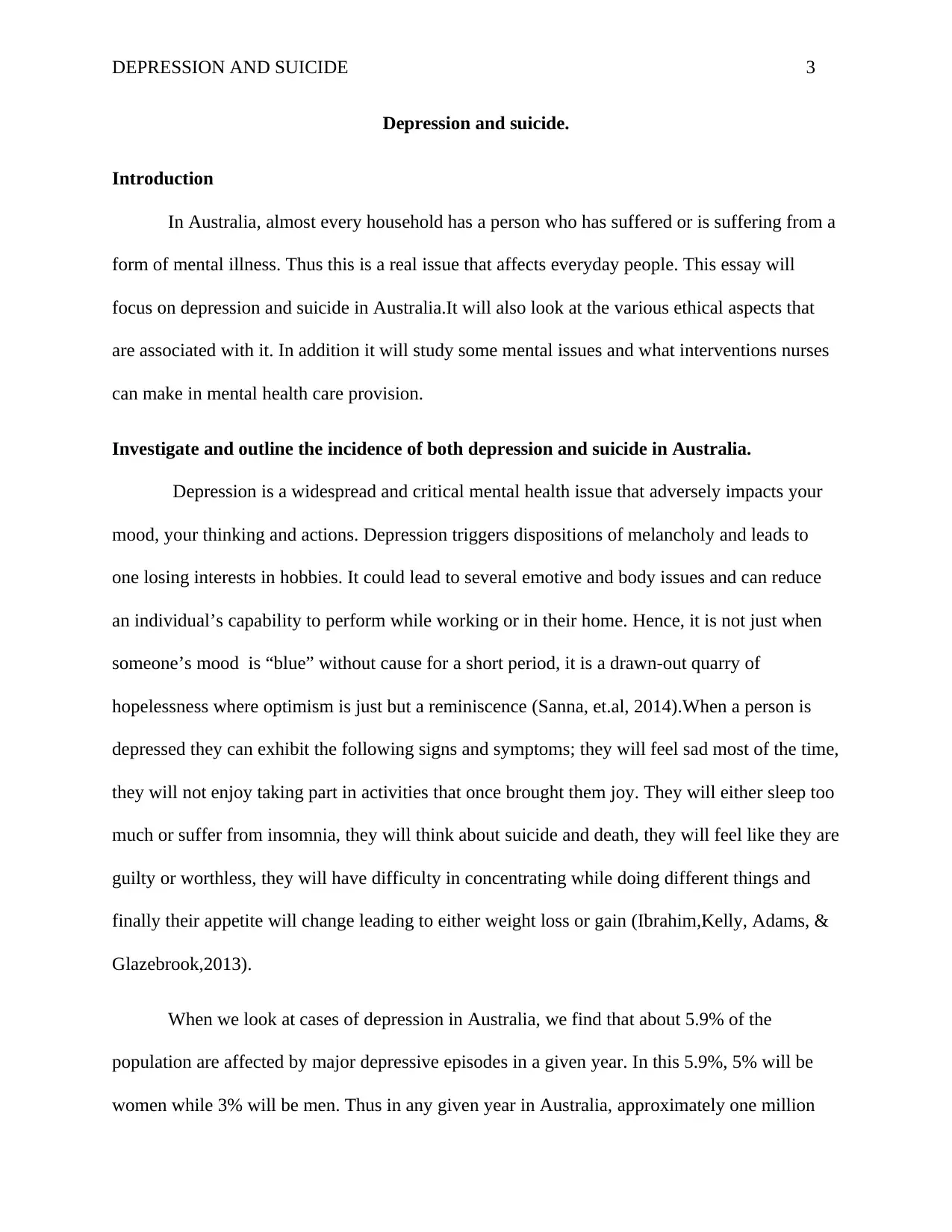
In Australia, almost every household has a person who has suffered or is suffering from a
form of mental illness. Thus this is a real issue that affects everyday people. This essay will
focus on depression and suicide in Australia.It will also look at the various ethical aspects that
are associated with it. In addition it will study some mental issues and what interventions nurses
can make in mental health care provision.
Investigate and outline the incidence of both depression and suicide in Australia.
Depression is a widespread and critical mental health issue that adversely impacts your
mood, your thinking and actions. Depression triggers dispositions of melancholy and leads to
one losing interests in hobbies. It could lead to several emotive and body issues and can reduce
an individual’s capability to perform while working or in their home. Hence, it is not just when
someone’s mood is “blue” without cause for a short period, it is a drawn-out quarry of
hopelessness where optimism is just but a reminiscence (Sanna, et.al, 2014).When a person is
depressed they can exhibit the following signs and symptoms; they will feel sad most of the time,
they will not enjoy taking part in activities that once brought them joy. They will either sleep too
much or suffer from insomnia, they will think about suicide and death, they will feel like they are
guilty or worthless, they will have difficulty in concentrating while doing different things and
finally their appetite will change leading to either weight loss or gain (Ibrahim,Kelly, Adams, &
Glazebrook,2013).
When we look at cases of depression in Australia, we find that about 5.9% of the
population are affected by major depressive episodes in a given year. In this 5.9%, 5% will be
women while 3% will be men. Thus in any given year in Australia, approximately one million
Depression and suicide.
Introduction
In Australia, almost every household has a person who has suffered or is suffering from a
form of mental illness. Thus this is a real issue that affects everyday people. This essay will
focus on depression and suicide in Australia.It will also look at the various ethical aspects that
are associated with it. In addition it will study some mental issues and what interventions nurses
can make in mental health care provision.
Investigate and outline the incidence of both depression and suicide in Australia.
Depression is a widespread and critical mental health issue that adversely impacts your
mood, your thinking and actions. Depression triggers dispositions of melancholy and leads to
one losing interests in hobbies. It could lead to several emotive and body issues and can reduce
an individual’s capability to perform while working or in their home. Hence, it is not just when
someone’s mood is “blue” without cause for a short period, it is a drawn-out quarry of
hopelessness where optimism is just but a reminiscence (Sanna, et.al, 2014).When a person is
depressed they can exhibit the following signs and symptoms; they will feel sad most of the time,
they will not enjoy taking part in activities that once brought them joy. They will either sleep too
much or suffer from insomnia, they will think about suicide and death, they will feel like they are
guilty or worthless, they will have difficulty in concentrating while doing different things and
finally their appetite will change leading to either weight loss or gain (Ibrahim,Kelly, Adams, &
Glazebrook,2013).
When we look at cases of depression in Australia, we find that about 5.9% of the
population are affected by major depressive episodes in a given year. In this 5.9%, 5% will be
women while 3% will be men. Thus in any given year in Australia, approximately one million
⊘ This is a preview!⊘
Do you want full access?
Subscribe today to unlock all pages.

Trusted by 1+ million students worldwide
DEPRESSION AND SUICIDE 4
people will suffer from depression. These statistics make Australia among one of the most
depressed countries in the world and also lets us know that almost every household in Australia
has a person who has been affected with some degree of depression. Also, another fact is that
women in general, and in this case in Australia, are more at risk of being depressed (Sanna, et.al,
2014).
Suicide is when a person intentionally causes harm to themselves with the intent of
killing themselves. People resort to committing suicide as a way of ending their suffering or
dealing with their problems. They also feel that if they do so, they will be removing some pain
from the people around them (Robinson, & Pirkis, 2014). There are various risk aspects that can
make someone to contemplate suicide some of them include; schizophrenia, bipolar disorder and
depression. Most people will hold on to what is affecting them and hide their pain while they are
depressed, then they over-focus on these things that contribute to the depression. This will create
a snowball effect which leads a depressed person to contemplate suicide as the only way to deal
with their problems. Suicide is prevalent in many countries, and Australia is no different
(McNamara, 2013).
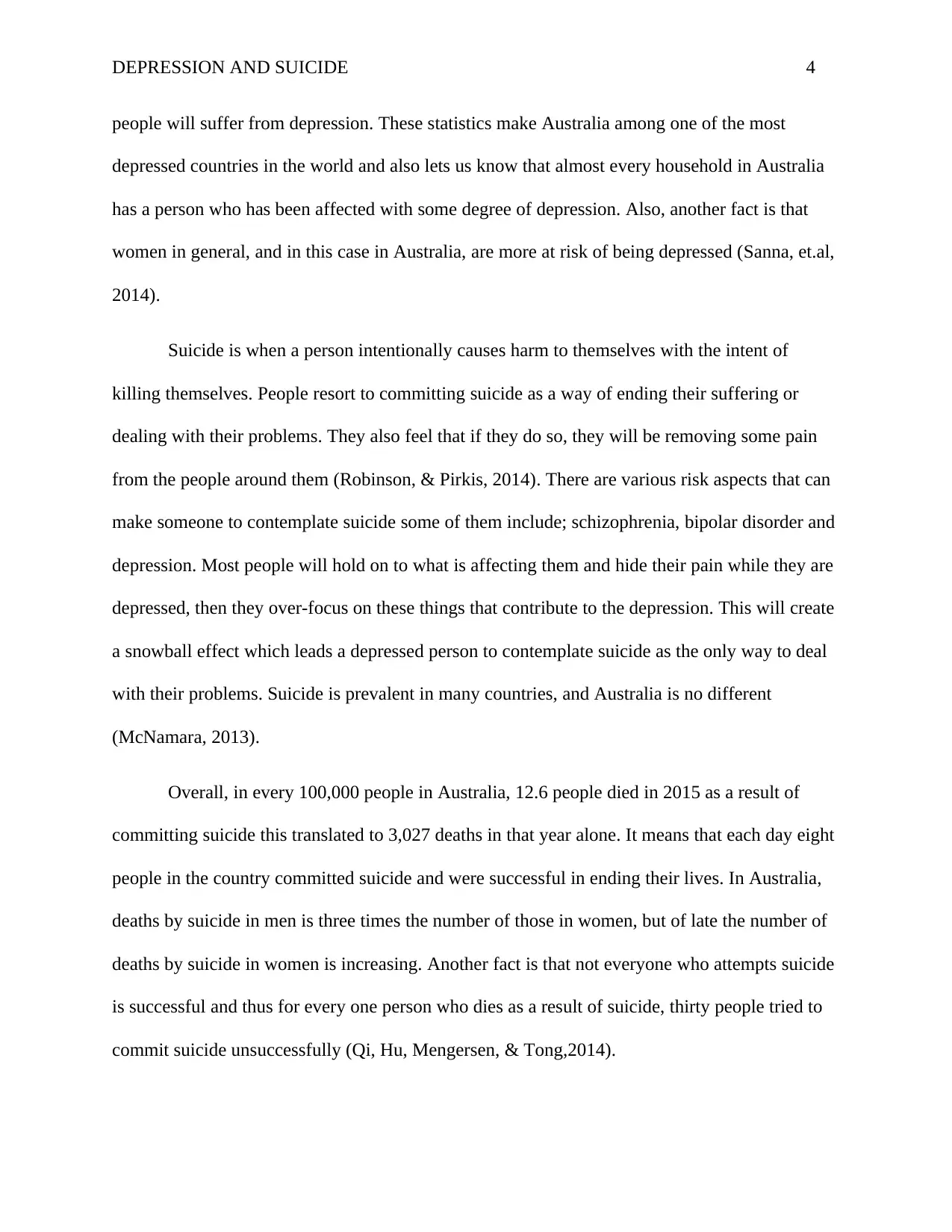
Overall, in every 100,000 people in Australia, 12.6 people died in 2015 as a result of
committing suicide this translated to 3,027 deaths in that year alone. It means that each day eight
people in the country committed suicide and were successful in ending their lives. In Australia,
deaths by suicide in men is three times the number of those in women, but of late the number of
deaths by suicide in women is increasing. Another fact is that not everyone who attempts suicide
is successful and thus for every one person who dies as a result of suicide, thirty people tried to
commit suicide unsuccessfully (Qi, Hu, Mengersen, & Tong,2014).
people will suffer from depression. These statistics make Australia among one of the most
depressed countries in the world and also lets us know that almost every household in Australia
has a person who has been affected with some degree of depression. Also, another fact is that
women in general, and in this case in Australia, are more at risk of being depressed (Sanna, et.al,
2014).
Suicide is when a person intentionally causes harm to themselves with the intent of
killing themselves. People resort to committing suicide as a way of ending their suffering or
dealing with their problems. They also feel that if they do so, they will be removing some pain
from the people around them (Robinson, & Pirkis, 2014). There are various risk aspects that can
make someone to contemplate suicide some of them include; schizophrenia, bipolar disorder and
depression. Most people will hold on to what is affecting them and hide their pain while they are
depressed, then they over-focus on these things that contribute to the depression. This will create
a snowball effect which leads a depressed person to contemplate suicide as the only way to deal
with their problems. Suicide is prevalent in many countries, and Australia is no different
(McNamara, 2013).
Overall, in every 100,000 people in Australia, 12.6 people died in 2015 as a result of
committing suicide this translated to 3,027 deaths in that year alone. It means that each day eight
people in the country committed suicide and were successful in ending their lives. In Australia,
deaths by suicide in men is three times the number of those in women, but of late the number of
deaths by suicide in women is increasing. Another fact is that not everyone who attempts suicide
is successful and thus for every one person who dies as a result of suicide, thirty people tried to
commit suicide unsuccessfully (Qi, Hu, Mengersen, & Tong,2014).
Paraphrase This Document
Need a fresh take? Get an instant paraphrase of this document with our AI Paraphraser
DEPRESSION AND SUICIDE 5
Critically discuss one community group identified as ‘at risk’ of depression and one
different community group identified as ‘at risk’ of suicide.
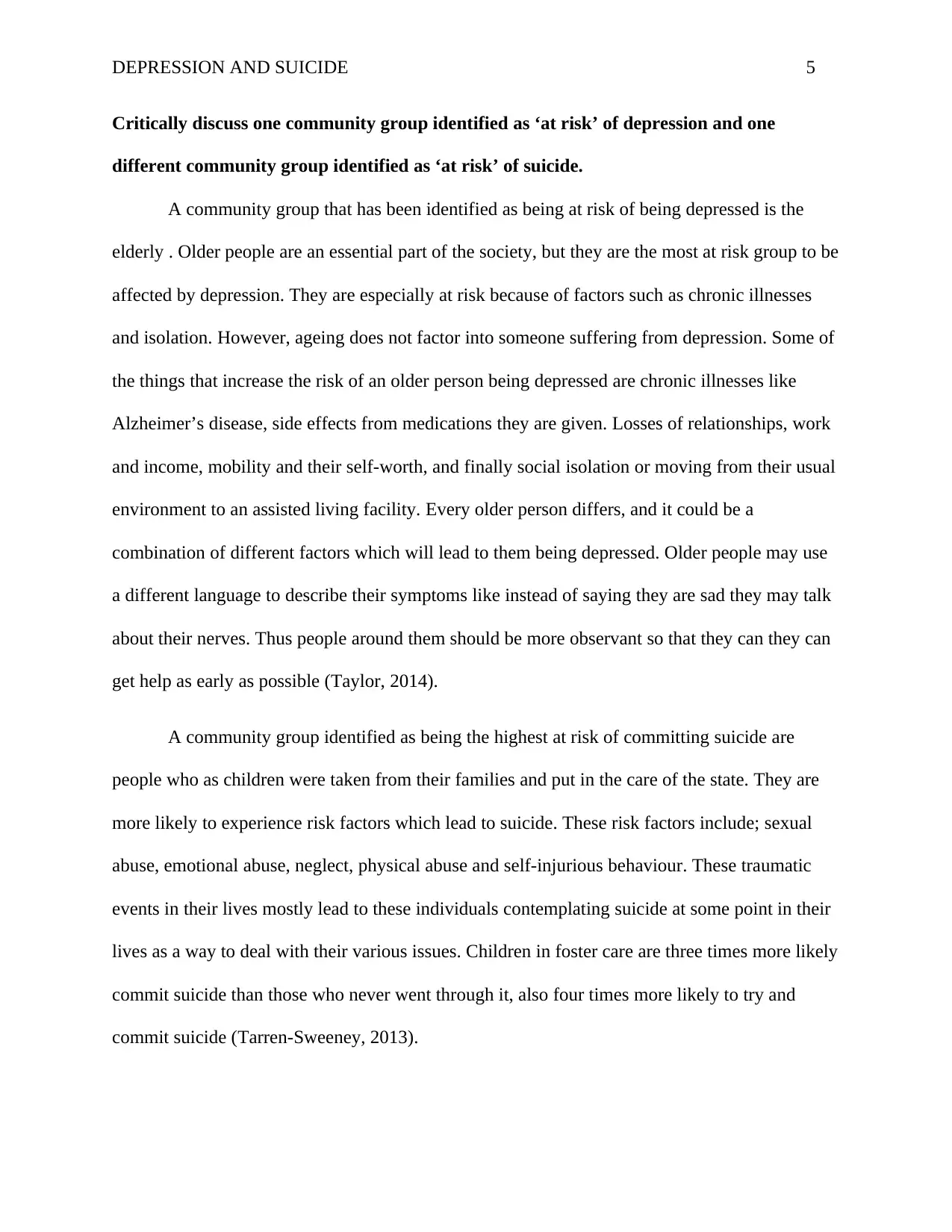
A community group that has been identified as being at risk of being depressed is the
elderly . Older people are an essential part of the society, but they are the most at risk group to be
affected by depression. They are especially at risk because of factors such as chronic illnesses
and isolation. However, ageing does not factor into someone suffering from depression. Some of
the things that increase the risk of an older person being depressed are chronic illnesses like
Alzheimer’s disease, side effects from medications they are given. Losses of relationships, work
and income, mobility and their self-worth, and finally social isolation or moving from their usual
environment to an assisted living facility. Every older person differs, and it could be a
combination of different factors which will lead to them being depressed. Older people may use
a different language to describe their symptoms like instead of saying they are sad they may talk
about their nerves. Thus people around them should be more observant so that they can they can
get help as early as possible (Taylor, 2014).
A community group identified as being the highest at risk of committing suicide are
people who as children were taken from their families and put in the care of the state. They are
more likely to experience risk factors which lead to suicide. These risk factors include; sexual
abuse, emotional abuse, neglect, physical abuse and self-injurious behaviour. These traumatic
events in their lives mostly lead to these individuals contemplating suicide at some point in their
lives as a way to deal with their various issues. Children in foster care are three times more likely
commit suicide than those who never went through it, also four times more likely to try and
commit suicide (Tarren-Sweeney, 2013).
Critically discuss one community group identified as ‘at risk’ of depression and one
different community group identified as ‘at risk’ of suicide.
A community group that has been identified as being at risk of being depressed is the
elderly . Older people are an essential part of the society, but they are the most at risk group to be
affected by depression. They are especially at risk because of factors such as chronic illnesses
and isolation. However, ageing does not factor into someone suffering from depression. Some of
the things that increase the risk of an older person being depressed are chronic illnesses like
Alzheimer’s disease, side effects from medications they are given. Losses of relationships, work
and income, mobility and their self-worth, and finally social isolation or moving from their usual
environment to an assisted living facility. Every older person differs, and it could be a
combination of different factors which will lead to them being depressed. Older people may use
a different language to describe their symptoms like instead of saying they are sad they may talk
about their nerves. Thus people around them should be more observant so that they can they can
get help as early as possible (Taylor, 2014).
A community group identified as being the highest at risk of committing suicide are
people who as children were taken from their families and put in the care of the state. They are
more likely to experience risk factors which lead to suicide. These risk factors include; sexual
abuse, emotional abuse, neglect, physical abuse and self-injurious behaviour. These traumatic
events in their lives mostly lead to these individuals contemplating suicide at some point in their
lives as a way to deal with their various issues. Children in foster care are three times more likely
commit suicide than those who never went through it, also four times more likely to try and
commit suicide (Tarren-Sweeney, 2013).
DEPRESSION AND SUICIDE 6
Critically discuss three factors that may have contributed to the development of the client’s
mental health concerns and risks.
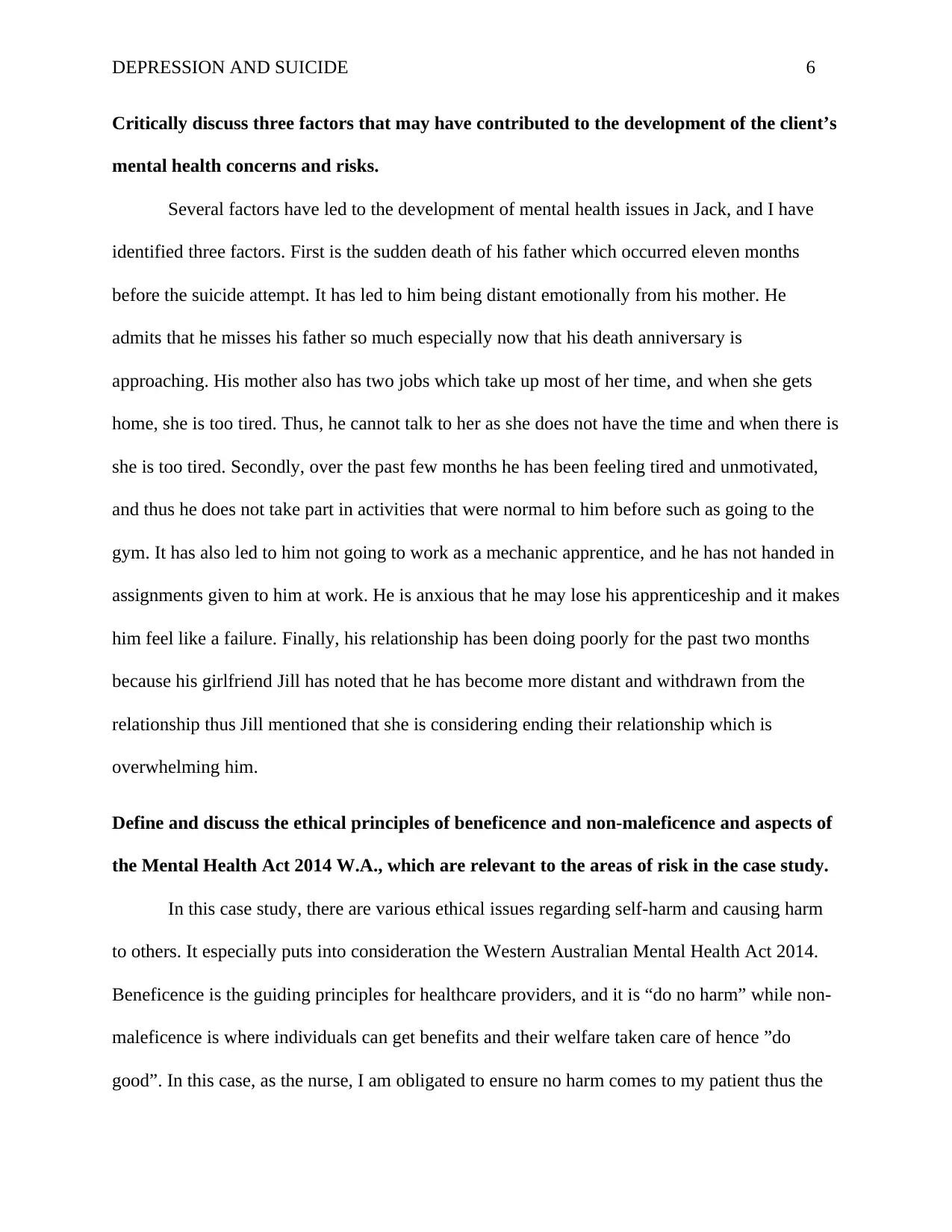
Several factors have led to the development of mental health issues in Jack, and I have
identified three factors. First is the sudden death of his father which occurred eleven months
before the suicide attempt. It has led to him being distant emotionally from his mother. He
admits that he misses his father so much especially now that his death anniversary is
approaching. His mother also has two jobs which take up most of her time, and when she gets
home, she is too tired. Thus, he cannot talk to her as she does not have the time and when there is
she is too tired. Secondly, over the past few months he has been feeling tired and unmotivated,
and thus he does not take part in activities that were normal to him before such as going to the
gym. It has also led to him not going to work as a mechanic apprentice, and he has not handed in
assignments given to him at work. He is anxious that he may lose his apprenticeship and it makes
him feel like a failure. Finally, his relationship has been doing poorly for the past two months
because his girlfriend Jill has noted that he has become more distant and withdrawn from the
relationship thus Jill mentioned that she is considering ending their relationship which is
overwhelming him.
Define and discuss the ethical principles of beneficence and non-maleficence and aspects of
the Mental Health Act 2014 W.A., which are relevant to the areas of risk in the case study.
In this case study, there are various ethical issues regarding self-harm and causing harm
to others. It especially puts into consideration the Western Australian Mental Health Act 2014.
Beneficence is the guiding principles for healthcare providers, and it is “do no harm” while non-
maleficence is where individuals can get benefits and their welfare taken care of hence ”do
good”. In this case, as the nurse, I am obligated to ensure no harm comes to my patient thus the
Critically discuss three factors that may have contributed to the development of the client’s
mental health concerns and risks.
Several factors have led to the development of mental health issues in Jack, and I have
identified three factors. First is the sudden death of his father which occurred eleven months
before the suicide attempt. It has led to him being distant emotionally from his mother. He
admits that he misses his father so much especially now that his death anniversary is
approaching. His mother also has two jobs which take up most of her time, and when she gets
home, she is too tired. Thus, he cannot talk to her as she does not have the time and when there is
she is too tired. Secondly, over the past few months he has been feeling tired and unmotivated,
and thus he does not take part in activities that were normal to him before such as going to the
gym. It has also led to him not going to work as a mechanic apprentice, and he has not handed in
assignments given to him at work. He is anxious that he may lose his apprenticeship and it makes
him feel like a failure. Finally, his relationship has been doing poorly for the past two months
because his girlfriend Jill has noted that he has become more distant and withdrawn from the
relationship thus Jill mentioned that she is considering ending their relationship which is
overwhelming him.
Define and discuss the ethical principles of beneficence and non-maleficence and aspects of
the Mental Health Act 2014 W.A., which are relevant to the areas of risk in the case study.
In this case study, there are various ethical issues regarding self-harm and causing harm
to others. It especially puts into consideration the Western Australian Mental Health Act 2014.
Beneficence is the guiding principles for healthcare providers, and it is “do no harm” while non-
maleficence is where individuals can get benefits and their welfare taken care of hence ”do
good”. In this case, as the nurse, I am obligated to ensure no harm comes to my patient thus the
⊘ This is a preview!⊘
Do you want full access?
Subscribe today to unlock all pages.
Trusted by 1+ million students worldwide
DEPRESSION AND SUICIDE 7
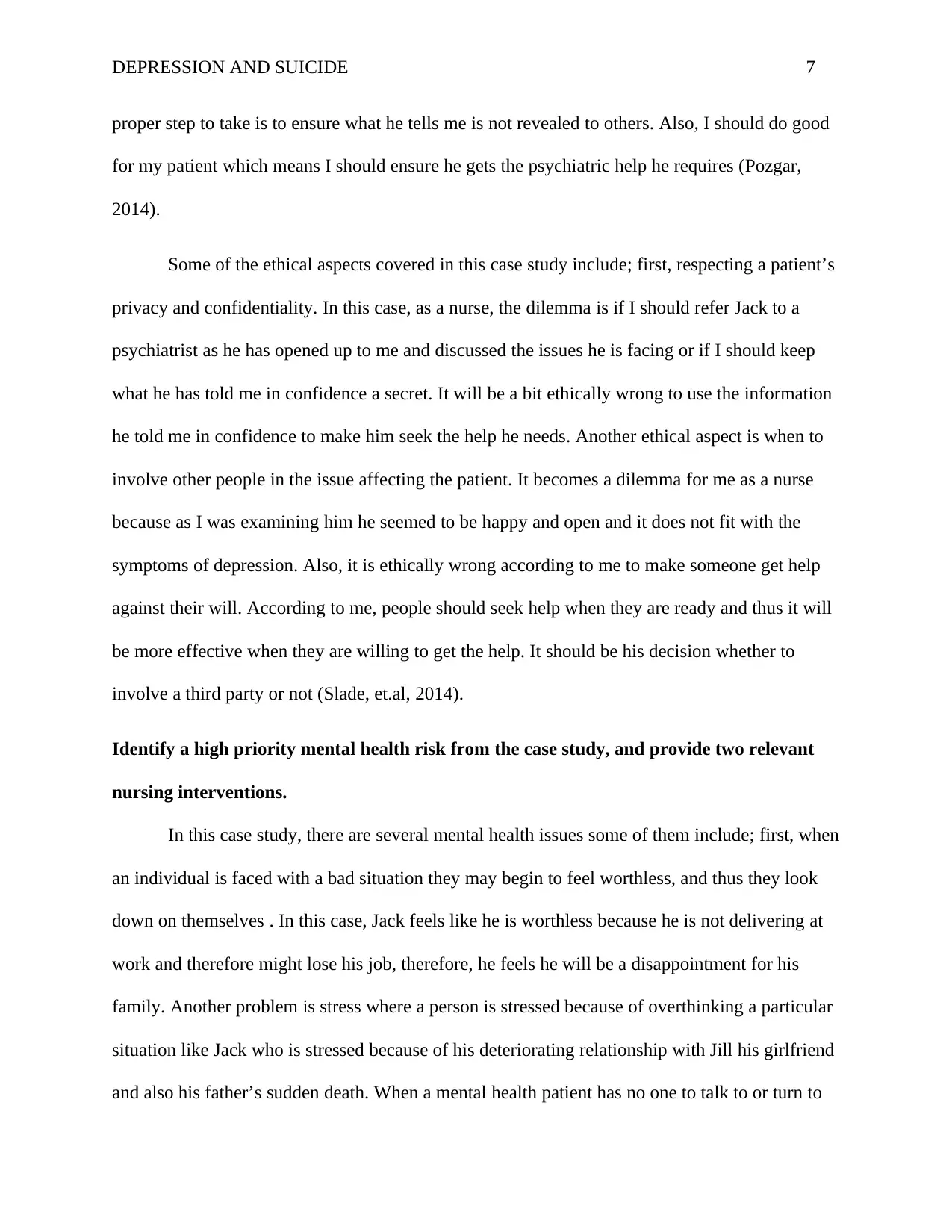
proper step to take is to ensure what he tells me is not revealed to others. Also, I should do good
for my patient which means I should ensure he gets the psychiatric help he requires (Pozgar,
2014).
Some of the ethical aspects covered in this case study include; first, respecting a patient’s
privacy and confidentiality. In this case, as a nurse, the dilemma is if I should refer Jack to a
psychiatrist as he has opened up to me and discussed the issues he is facing or if I should keep
what he has told me in confidence a secret. It will be a bit ethically wrong to use the information
he told me in confidence to make him seek the help he needs. Another ethical aspect is when to
involve other people in the issue affecting the patient. It becomes a dilemma for me as a nurse
because as I was examining him he seemed to be happy and open and it does not fit with the
symptoms of depression. Also, it is ethically wrong according to me to make someone get help
against their will. According to me, people should seek help when they are ready and thus it will
be more effective when they are willing to get the help. It should be his decision whether to
involve a third party or not (Slade, et.al, 2014).
Identify a high priority mental health risk from the case study, and provide two relevant
nursing interventions.
In this case study, there are several mental health issues some of them include; first, when
an individual is faced with a bad situation they may begin to feel worthless, and thus they look
down on themselves . In this case, Jack feels like he is worthless because he is not delivering at
work and therefore might lose his job, therefore, he feels he will be a disappointment for his
family. Another problem is stress where a person is stressed because of overthinking a particular
situation like Jack who is stressed because of his deteriorating relationship with Jill his girlfriend
and also his father’s sudden death. When a mental health patient has no one to talk to or turn to
proper step to take is to ensure what he tells me is not revealed to others. Also, I should do good
for my patient which means I should ensure he gets the psychiatric help he requires (Pozgar,
2014).
Some of the ethical aspects covered in this case study include; first, respecting a patient’s
privacy and confidentiality. In this case, as a nurse, the dilemma is if I should refer Jack to a
psychiatrist as he has opened up to me and discussed the issues he is facing or if I should keep
what he has told me in confidence a secret. It will be a bit ethically wrong to use the information
he told me in confidence to make him seek the help he needs. Another ethical aspect is when to
involve other people in the issue affecting the patient. It becomes a dilemma for me as a nurse
because as I was examining him he seemed to be happy and open and it does not fit with the
symptoms of depression. Also, it is ethically wrong according to me to make someone get help
against their will. According to me, people should seek help when they are ready and thus it will
be more effective when they are willing to get the help. It should be his decision whether to
involve a third party or not (Slade, et.al, 2014).
Identify a high priority mental health risk from the case study, and provide two relevant
nursing interventions.
In this case study, there are several mental health issues some of them include; first, when
an individual is faced with a bad situation they may begin to feel worthless, and thus they look
down on themselves . In this case, Jack feels like he is worthless because he is not delivering at
work and therefore might lose his job, therefore, he feels he will be a disappointment for his
family. Another problem is stress where a person is stressed because of overthinking a particular
situation like Jack who is stressed because of his deteriorating relationship with Jill his girlfriend
and also his father’s sudden death. When a mental health patient has no one to talk to or turn to
Paraphrase This Document
Need a fresh take? Get an instant paraphrase of this document with our AI Paraphraser
DEPRESSION AND SUICIDE 8
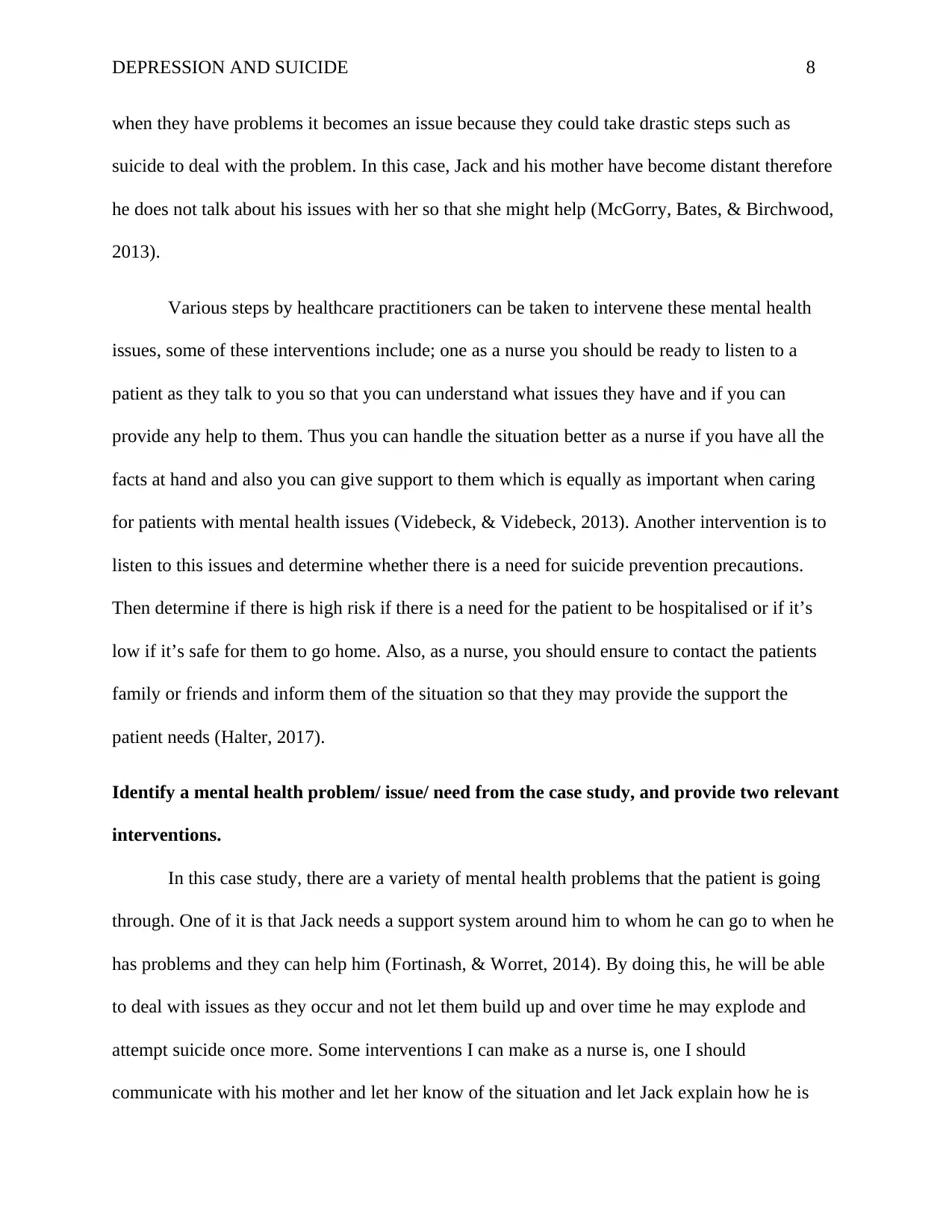
when they have problems it becomes an issue because they could take drastic steps such as
suicide to deal with the problem. In this case, Jack and his mother have become distant therefore
he does not talk about his issues with her so that she might help (McGorry, Bates, & Birchwood,
2013).
Various steps by healthcare practitioners can be taken to intervene these mental health
issues, some of these interventions include; one as a nurse you should be ready to listen to a
patient as they talk to you so that you can understand what issues they have and if you can
provide any help to them. Thus you can handle the situation better as a nurse if you have all the
facts at hand and also you can give support to them which is equally as important when caring
for patients with mental health issues (Videbeck, & Videbeck, 2013). Another intervention is to
listen to this issues and determine whether there is a need for suicide prevention precautions.
Then determine if there is high risk if there is a need for the patient to be hospitalised or if it’s
low if it’s safe for them to go home. Also, as a nurse, you should ensure to contact the patients
family or friends and inform them of the situation so that they may provide the support the
patient needs (Halter, 2017).
Identify a mental health problem/ issue/ need from the case study, and provide two relevant
interventions.
In this case study, there are a variety of mental health problems that the patient is going
through. One of it is that Jack needs a support system around him to whom he can go to when he
has problems and they can help him (Fortinash, & Worret, 2014). By doing this, he will be able
to deal with issues as they occur and not let them build up and over time he may explode and
attempt suicide once more. Some interventions I can make as a nurse is, one I should
communicate with his mother and let her know of the situation and let Jack explain how he is
when they have problems it becomes an issue because they could take drastic steps such as
suicide to deal with the problem. In this case, Jack and his mother have become distant therefore
he does not talk about his issues with her so that she might help (McGorry, Bates, & Birchwood,
2013).
Various steps by healthcare practitioners can be taken to intervene these mental health
issues, some of these interventions include; one as a nurse you should be ready to listen to a
patient as they talk to you so that you can understand what issues they have and if you can
provide any help to them. Thus you can handle the situation better as a nurse if you have all the
facts at hand and also you can give support to them which is equally as important when caring
for patients with mental health issues (Videbeck, & Videbeck, 2013). Another intervention is to
listen to this issues and determine whether there is a need for suicide prevention precautions.
Then determine if there is high risk if there is a need for the patient to be hospitalised or if it’s
low if it’s safe for them to go home. Also, as a nurse, you should ensure to contact the patients
family or friends and inform them of the situation so that they may provide the support the
patient needs (Halter, 2017).
Identify a mental health problem/ issue/ need from the case study, and provide two relevant
interventions.
In this case study, there are a variety of mental health problems that the patient is going
through. One of it is that Jack needs a support system around him to whom he can go to when he
has problems and they can help him (Fortinash, & Worret, 2014). By doing this, he will be able
to deal with issues as they occur and not let them build up and over time he may explode and
attempt suicide once more. Some interventions I can make as a nurse is, one I should
communicate with his mother and let her know of the situation and let Jack explain how he is
DEPRESSION AND SUICIDE 9
feeling. Thus by doing so and teaching her the importance of a support system, she will ensure
that he has one (Muskett, 2014). Another intervention is that I can suggest to Jack to join a
support group for depression patients where he can go and discuss with people who understand
his situation and thus he can find ways to deal with his issues from people who have gone
through similar situations (Townsend, & Morgan, 2017).
Conclusion.
In conclusion, a huge part of the Australian population has been affected by either
depression or suicide. Hence, a country more interventions mental health care and laws that
support mental health interventions. Medical health practitioners should realise that they play a
considerable part in mental health management. By doing so, people with mental health issues
will get the help they require.
feeling. Thus by doing so and teaching her the importance of a support system, she will ensure
that he has one (Muskett, 2014). Another intervention is that I can suggest to Jack to join a
support group for depression patients where he can go and discuss with people who understand
his situation and thus he can find ways to deal with his issues from people who have gone
through similar situations (Townsend, & Morgan, 2017).
Conclusion.
In conclusion, a huge part of the Australian population has been affected by either
depression or suicide. Hence, a country more interventions mental health care and laws that
support mental health interventions. Medical health practitioners should realise that they play a
considerable part in mental health management. By doing so, people with mental health issues
will get the help they require.
⊘ This is a preview!⊘
Do you want full access?
Subscribe today to unlock all pages.
Trusted by 1+ million students worldwide
DEPRESSION AND SUICIDE 10
References
Robinson, J., & Pirkis, J. (2014). Research priorities in suicide prevention: an examination of
Australian-based research 2007–11. Australian Health Review, 38(1), 18-24.Fortinash, K.
M., & Worret, P. A. H. (2014). Psychiatric Mental Health Nursing-E-Book. Elsevier
Health Sciences.
Halter, M. J. (2017). Varcarolis' Foundations of Psychiatric-Mental Health Nursing-E-Book: A
Clinical Approach. Elsevier Health Sciences.
Ibrahim, A. K., Kelly, S. J., Adams, C. E., & Glazebrook, C. (2013). A systematic review of
studies of depression prevalence in university students. Journal of psychiatric
research, 47(3).
McGorry, P., Bates, T., & Birchwood, M. (2013). Designing youth mental health services for the
21st century: examples from Australia, Ireland and the UK. The British Journal of
Psychiatry, 202(s54), s30-s35.
McNamara, P. M. (2013). Adolescent suicide in Australia: rates, risk and resilience. Clinical
child psychology and psychiatry, 18(3).
Muskett, C. (2014). Trauma‐informed care in inpatient mental health settings: A review of the
literature. International journal of mental health nursing, 23(1).
Pozgar, G. D. (2014). Legal and ethical issues for health professionals. Jones & Bartlett
Publishers.
References
Robinson, J., & Pirkis, J. (2014). Research priorities in suicide prevention: an examination of
Australian-based research 2007–11. Australian Health Review, 38(1), 18-24.Fortinash, K.
M., & Worret, P. A. H. (2014). Psychiatric Mental Health Nursing-E-Book. Elsevier
Health Sciences.
Halter, M. J. (2017). Varcarolis' Foundations of Psychiatric-Mental Health Nursing-E-Book: A
Clinical Approach. Elsevier Health Sciences.
Ibrahim, A. K., Kelly, S. J., Adams, C. E., & Glazebrook, C. (2013). A systematic review of
studies of depression prevalence in university students. Journal of psychiatric
research, 47(3).
McGorry, P., Bates, T., & Birchwood, M. (2013). Designing youth mental health services for the
21st century: examples from Australia, Ireland and the UK. The British Journal of
Psychiatry, 202(s54), s30-s35.
McNamara, P. M. (2013). Adolescent suicide in Australia: rates, risk and resilience. Clinical
child psychology and psychiatry, 18(3).
Muskett, C. (2014). Trauma‐informed care in inpatient mental health settings: A review of the
literature. International journal of mental health nursing, 23(1).
Pozgar, G. D. (2014). Legal and ethical issues for health professionals. Jones & Bartlett
Publishers.
Paraphrase This Document
Need a fresh take? Get an instant paraphrase of this document with our AI Paraphraser
DEPRESSION AND SUICIDE 11
Qi, X., Hu, W., Mengersen, K., & Tong, S. (2014). Socio-environmental drivers and suicide in
Australia: Bayesian spatial analysis. BMC public health, 14(1).
Sanna, L., Stuart, A. L., Pasco, J. A., Jacka, F. N., Berk, M., Maes, M., & Williams, L. J. (2014).
Atopic disorders and depression: findings from a large, population-based study. Journal
of affective disorders, 155.
Sanna, L., Stuart, A. L., Pasco, J. A., Kotowicz, M. A., Berk, M., Girardi, P., & Williams, L. J.
(2014). Suicidal ideation and physical illness: does the link lie with depression?. Journal
of affective disorders, 152.
Slade, M., Amering, M., Farkas, M., Hamilton, B., O'Hagan, M., Panther, G., ... & Whitley, R.
(2014). Uses and abuses of recovery: implementing recovery‐oriented practices in mental
health systems. World Psychiatry, 13(1).
Tarren-Sweeney, M. (2013). An investigation of complex attachment-and trauma-related
symptomatology among children in foster and kinship care. Child Psychiatry & Human
Development, 44(6).
Taylor, W. D. (2014). Depression in the elderly. New England journal of medicine, 371(13),.
Townsend, M. C., & Morgan, K. I. (2017). Psychiatric mental health nursing: Concepts of care
in evidence-based practice. FA Davis.
Videbeck, S., & Videbeck, S. (2013). Psychiatric-mental health nursing. Lippincott Williams &
Wilkins.
Qi, X., Hu, W., Mengersen, K., & Tong, S. (2014). Socio-environmental drivers and suicide in
Australia: Bayesian spatial analysis. BMC public health, 14(1).
Sanna, L., Stuart, A. L., Pasco, J. A., Jacka, F. N., Berk, M., Maes, M., & Williams, L. J. (2014).
Atopic disorders and depression: findings from a large, population-based study. Journal
of affective disorders, 155.
Sanna, L., Stuart, A. L., Pasco, J. A., Kotowicz, M. A., Berk, M., Girardi, P., & Williams, L. J.
(2014). Suicidal ideation and physical illness: does the link lie with depression?. Journal
of affective disorders, 152.
Slade, M., Amering, M., Farkas, M., Hamilton, B., O'Hagan, M., Panther, G., ... & Whitley, R.
(2014). Uses and abuses of recovery: implementing recovery‐oriented practices in mental
health systems. World Psychiatry, 13(1).
Tarren-Sweeney, M. (2013). An investigation of complex attachment-and trauma-related
symptomatology among children in foster and kinship care. Child Psychiatry & Human
Development, 44(6).
Taylor, W. D. (2014). Depression in the elderly. New England journal of medicine, 371(13),.
Townsend, M. C., & Morgan, K. I. (2017). Psychiatric mental health nursing: Concepts of care
in evidence-based practice. FA Davis.
Videbeck, S., & Videbeck, S. (2013). Psychiatric-mental health nursing. Lippincott Williams &
Wilkins.

1 out of 11


Related Documents


Your All-in-One AI-Powered Toolkit for Academic Success.
+13062052269
info@desklib.com
Available 24*7 on WhatsApp / Email
![[object Object]](/_next/static/media/star-bottom.7253800d.svg)
Unlock your academic potential
Copyright © 2020–2026 A2Z Services. All Rights Reserved. Developed and managed by ZUCOL.