Descartes' Dream Argument: Philosophical Implications and Analysis

Verified

Added on  2022/08/26

|3
|350
|17
Essay
AI Summary
This essay delves into Descartes' dream argument, a cornerstone of his philosophical inquiry. It examines how Descartes questioned the reliability of sensory experiences, positing that dreams could not be distinguished from waking life, thus casting doubt on the certainty of our perceptions. The assignment explores Descartes' reasoning, including his assertion that the senses can be deceptive, leading to the conclusion that we cannot be certain about the world around us. The essay highlights the core of Descartes’ argument, emphasizing the potential for deception through dreams and the subsequent implications for our understanding of reality. It also references supporting and opposing viewpoints, acknowledging the debates surrounding Descartes' theories and its impact on epistemology. The paper focuses on the arguments made by Descartes in this regard.
Document Page
Running head: PHILOSOPHY
Philosophy
Name of the Student
Name of the University
Author Note
tabler-icon-diamond-filled.svg

Paraphrase This Document

Need a fresh take? Get an instant paraphrase of this document with our AI Paraphraser
Document Page
1PHILOSOPHY
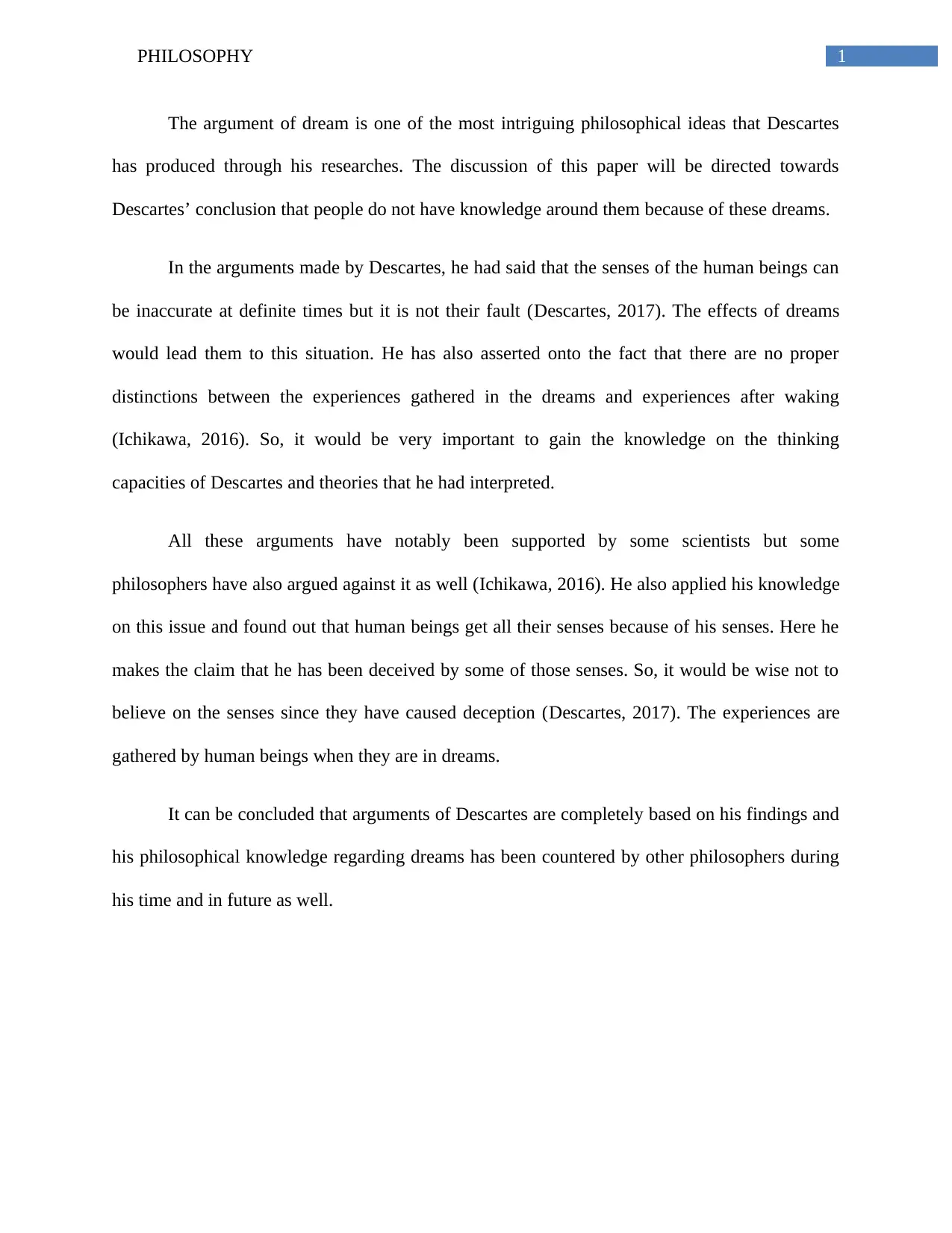
The argument of dream is one of the most intriguing philosophical ideas that Descartes
has produced through his researches. The discussion of this paper will be directed towards
Descartes’ conclusion that people do not have knowledge around them because of these dreams.
In the arguments made by Descartes, he had said that the senses of the human beings can
be inaccurate at definite times but it is not their fault (Descartes, 2017). The effects of dreams
would lead them to this situation. He has also asserted onto the fact that there are no proper
distinctions between the experiences gathered in the dreams and experiences after waking
(Ichikawa, 2016). So, it would be very important to gain the knowledge on the thinking
capacities of Descartes and theories that he had interpreted.
All these arguments have notably been supported by some scientists but some
philosophers have also argued against it as well (Ichikawa, 2016). He also applied his knowledge
on this issue and found out that human beings get all their senses because of his senses. Here he
makes the claim that he has been deceived by some of those senses. So, it would be wise not to
believe on the senses since they have caused deception (Descartes, 2017). The experiences are
gathered by human beings when they are in dreams.
It can be concluded that arguments of Descartes are completely based on his findings and
his philosophical knowledge regarding dreams has been countered by other philosophers during
his time and in future as well.
Document Page
2PHILOSOPHY
References
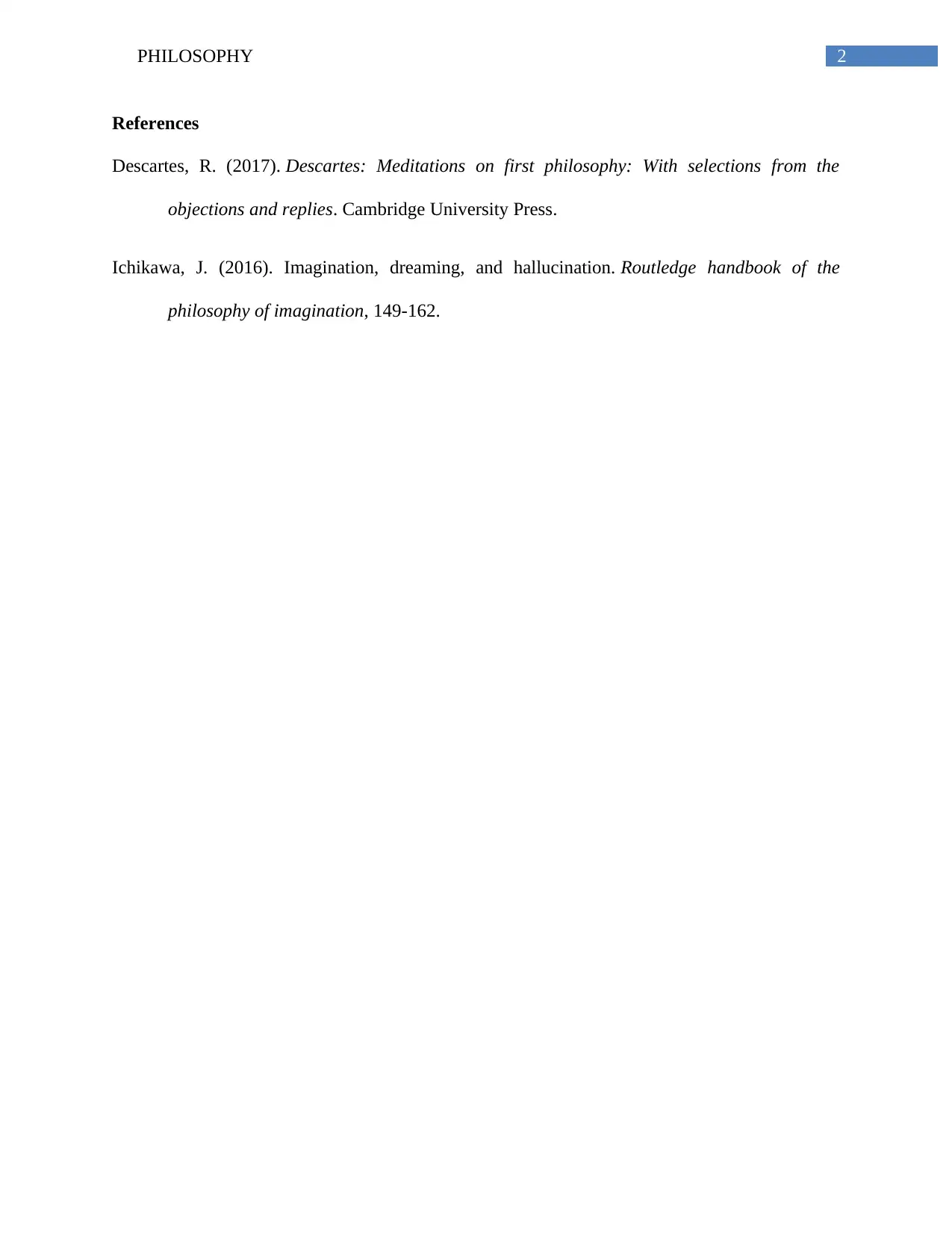
Descartes, R. (2017). Descartes: Meditations on first philosophy: With selections from the
objections and replies. Cambridge University Press.
Ichikawa, J. (2016). Imagination, dreaming, and hallucination. Routledge handbook of the
philosophy of imagination, 149-162.
chevron_up_icon
1 out of 3
circle_padding
hide_on_mobile
zoom_out_icon
[object Object]