PHIL-1200: Analysis of Descartes' Doubt and Locke's Empiricism Theory

Verified

Added on  2023/05/29

|5
|1079
|182
Essay
AI Summary
This essay explores the philosophical contributions of Rene Descartes, focusing on his Cartesian method of doubt and its impact on establishing a foundation for knowledge. It delves into Descartes' famous proposition, "Cogito ergo sum," and contrasts his rationalist approach with John Locke's empiricism. The essay analyzes Locke's critique of rationalism, comparing the plausibility of both perspectives. It further discusses David Hume's problem of induction and its implications for empiricist knowledge accounts. The essay concludes that Descartes' rationalism is more plausible than Locke's empiricism, providing a robust foundation for philosophical studies.
Document Page
Running head: PHILOSOPHY
PHILOSOPHY
Name of the Student
Name of the University
Author Note
tabler-icon-diamond-filled.svg

Paraphrase This Document

Need a fresh take? Get an instant paraphrase of this document with our AI Paraphraser
Document Page
1PHILOSOPHY
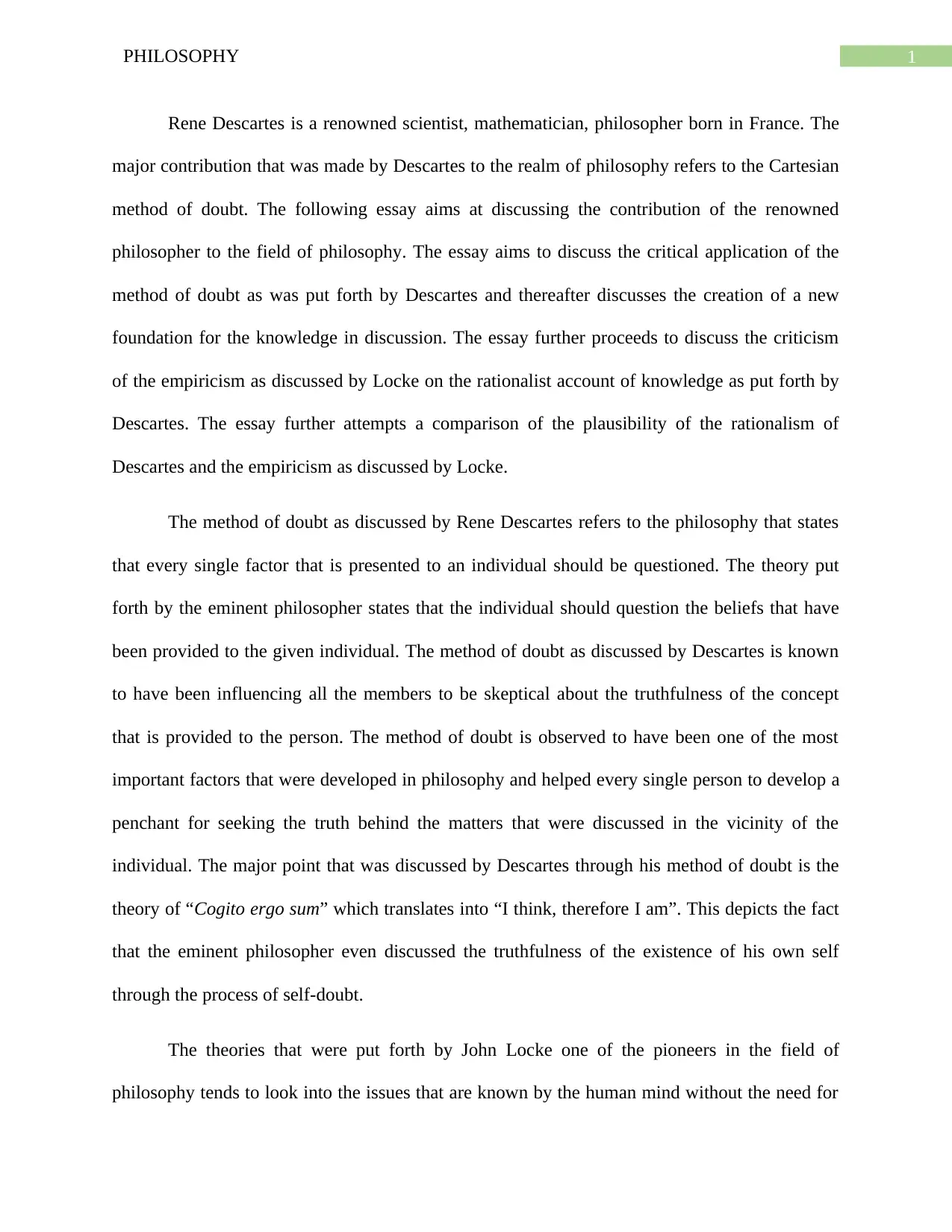
Rene Descartes is a renowned scientist, mathematician, philosopher born in France. The
major contribution that was made by Descartes to the realm of philosophy refers to the Cartesian
method of doubt. The following essay aims at discussing the contribution of the renowned
philosopher to the field of philosophy. The essay aims to discuss the critical application of the
method of doubt as was put forth by Descartes and thereafter discusses the creation of a new
foundation for the knowledge in discussion. The essay further proceeds to discuss the criticism
of the empiricism as discussed by Locke on the rationalist account of knowledge as put forth by
Descartes. The essay further attempts a comparison of the plausibility of the rationalism of
Descartes and the empiricism as discussed by Locke.
The method of doubt as discussed by Rene Descartes refers to the philosophy that states
that every single factor that is presented to an individual should be questioned. The theory put
forth by the eminent philosopher states that the individual should question the beliefs that have
been provided to the given individual. The method of doubt as discussed by Descartes is known
to have been influencing all the members to be skeptical about the truthfulness of the concept
that is provided to the person. The method of doubt is observed to have been one of the most
important factors that were developed in philosophy and helped every single person to develop a
penchant for seeking the truth behind the matters that were discussed in the vicinity of the
individual. The major point that was discussed by Descartes through his method of doubt is the
theory of “Cogito ergo sum” which translates into “I think, therefore I am”. This depicts the fact
that the eminent philosopher even discussed the truthfulness of the existence of his own self
through the process of self-doubt.
The theories that were put forth by John Locke one of the pioneers in the field of
philosophy tends to look into the issues that are known by the human mind without the need for
Document Page
2PHILOSOPHY
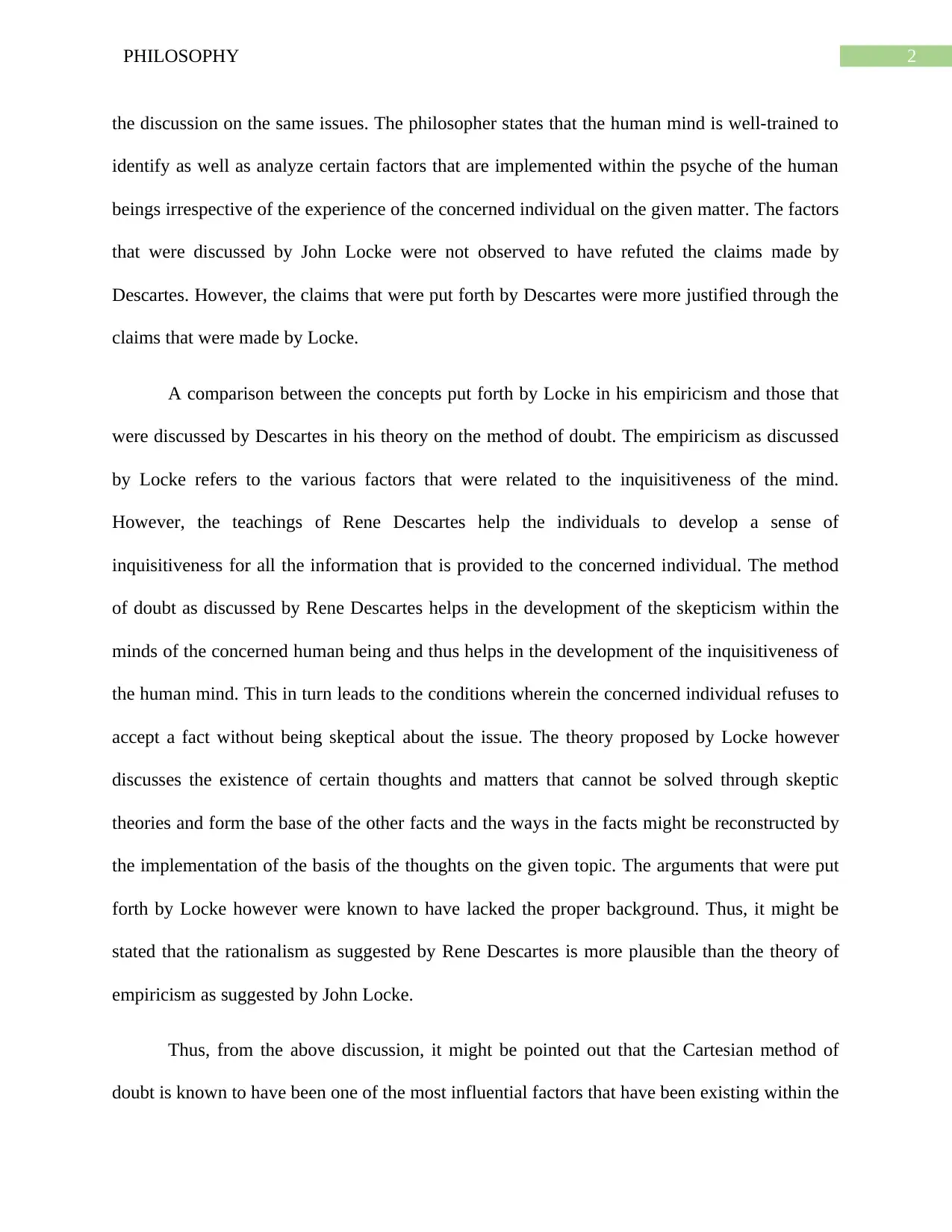
the discussion on the same issues. The philosopher states that the human mind is well-trained to
identify as well as analyze certain factors that are implemented within the psyche of the human
beings irrespective of the experience of the concerned individual on the given matter. The factors
that were discussed by John Locke were not observed to have refuted the claims made by
Descartes. However, the claims that were put forth by Descartes were more justified through the
claims that were made by Locke.
A comparison between the concepts put forth by Locke in his empiricism and those that
were discussed by Descartes in his theory on the method of doubt. The empiricism as discussed
by Locke refers to the various factors that were related to the inquisitiveness of the mind.
However, the teachings of Rene Descartes help the individuals to develop a sense of
inquisitiveness for all the information that is provided to the concerned individual. The method
of doubt as discussed by Rene Descartes helps in the development of the skepticism within the
minds of the concerned human being and thus helps in the development of the inquisitiveness of
the human mind. This in turn leads to the conditions wherein the concerned individual refuses to
accept a fact without being skeptical about the issue. The theory proposed by Locke however
discusses the existence of certain thoughts and matters that cannot be solved through skeptic
theories and form the base of the other facts and the ways in the facts might be reconstructed by
the implementation of the basis of the thoughts on the given topic. The arguments that were put
forth by Locke however were known to have lacked the proper background. Thus, it might be
stated that the rationalism as suggested by Rene Descartes is more plausible than the theory of
empiricism as suggested by John Locke.
Thus, from the above discussion, it might be pointed out that the Cartesian method of
doubt is known to have been one of the most influential factors that have been existing within the
Document Page
3PHILOSOPHY
scope of the philosophical studies that are undertaken by the concerned individuals and provides
a proper base to the establishment of the fundamental beliefs of the concerned individual.
tabler-icon-diamond-filled.svg

Paraphrase This Document

Need a fresh take? Get an instant paraphrase of this document with our AI Paraphraser
Document Page
4PHILOSOPHY
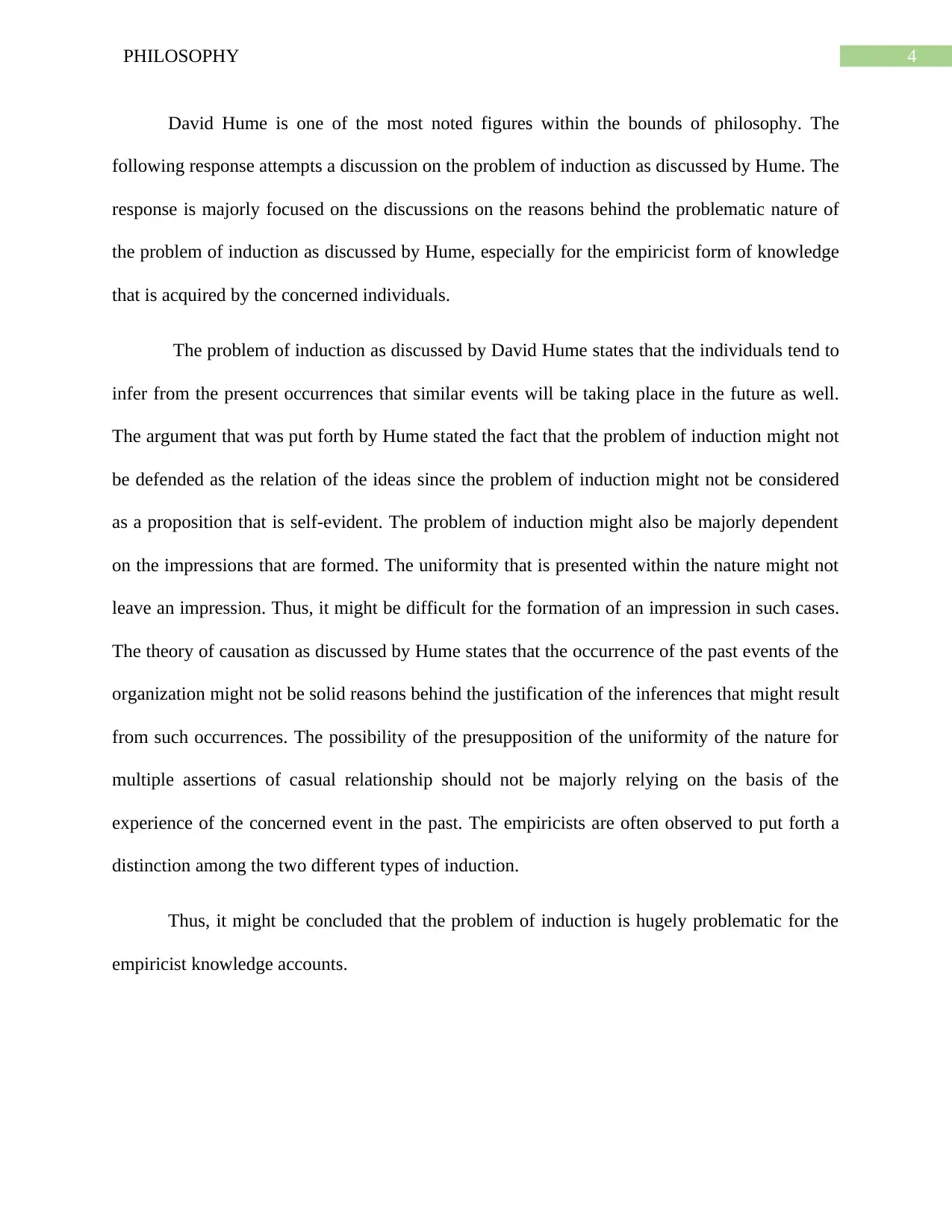
David Hume is one of the most noted figures within the bounds of philosophy. The
following response attempts a discussion on the problem of induction as discussed by Hume. The
response is majorly focused on the discussions on the reasons behind the problematic nature of
the problem of induction as discussed by Hume, especially for the empiricist form of knowledge
that is acquired by the concerned individuals.
The problem of induction as discussed by David Hume states that the individuals tend to
infer from the present occurrences that similar events will be taking place in the future as well.
The argument that was put forth by Hume stated the fact that the problem of induction might not
be defended as the relation of the ideas since the problem of induction might not be considered
as a proposition that is self-evident. The problem of induction might also be majorly dependent
on the impressions that are formed. The uniformity that is presented within the nature might not
leave an impression. Thus, it might be difficult for the formation of an impression in such cases.
The theory of causation as discussed by Hume states that the occurrence of the past events of the
organization might not be solid reasons behind the justification of the inferences that might result
from such occurrences. The possibility of the presupposition of the uniformity of the nature for
multiple assertions of casual relationship should not be majorly relying on the basis of the
experience of the concerned event in the past. The empiricists are often observed to put forth a
distinction among the two different types of induction.
Thus, it might be concluded that the problem of induction is hugely problematic for the
empiricist knowledge accounts.
chevron_up_icon
1 out of 5
circle_padding
hide_on_mobile
zoom_out_icon
[object Object]