FEA Based Designing and Thermal Stress Analysis of Disc Brakes

Verified

Added on  2023/04/20

|2
|700
|453
Project
AI Summary
This project report details the design and analysis of thermal stress in automotive disc brakes using FEA software like ANSYS. The rationale behind the project is the need to control thermal stress generation in disc brakes through proper design, considering factors like geometry, material, and the use of composite materials. The project aims to analyze thermal stresses using FEA, evaluate the effects of different materials on thermal stress and automotive performance, and study the impact of disc brake shapes on stress generation. The methodology involves modeling conventional and alternative disc brake geometries, importing them into ANSYS, assigning different materials, performing meshing with validation, applying appropriate boundary conditions, and conducting post-processing to analyze temperature and heat flux distribution. References to relevant research papers are also included to support the analysis and findings.
Document Page
Project title: Designing and analysis of thermal stress in automotive disc brakes.
Rationale:
Amount of heat generated in the disc brakes are the reasons behind the thermal stress
generation which needs to be controlled by proper designing of disc brakes. This designing
can be done by using FEA (finite element analysis) software likes ANSYS or ABAQUS.
Effect of the geometry or shape of the disc brakes can also be utilized to analysis its effect on
the thermal stress generation. Material of the disc brakes or tyres are also the reasons for
generation of high thermal stresses which can be reduced by using composite materials
available for their manufacturing. These nanocomposites are very lighter in weight compared
to conventional material and this can help in reducing the thermal stress. Composites are the
new class of materials which have high structural and thermal properties compared to the
conventional materials. Some fibre nano-composites can also be used to manufacture the disc
brakes or tyre for improving the automotive performance.
In the present work disc brakes will be numerically designed and analysed with the help of
finite element analysis software like ANSYS. This numerical approach is adopted in the
present work as it helps in saving the money and material spent on the physical
experimentation, as one can change the material in the software setting and can obtain the
results at the end of the simulation. This approach also reduces the time of work, as one can
do multiple analyses in software.
Aims:
To analysis the thermal stresses in disc brakes with the help of FEA software.
To analysis the effects of the different materials like composites on the generated
thermal stresses and automotive performance.
To analysis the effect of disc brakes shapes or geometry on the thermal stress
generation.
Effect of different materials on the weight changes will also be analysed.
Objective:
tabler-icon-diamond-filled.svg

Paraphrase This Document

Need a fresh take? Get an instant paraphrase of this document with our AI Paraphraser
Document Page
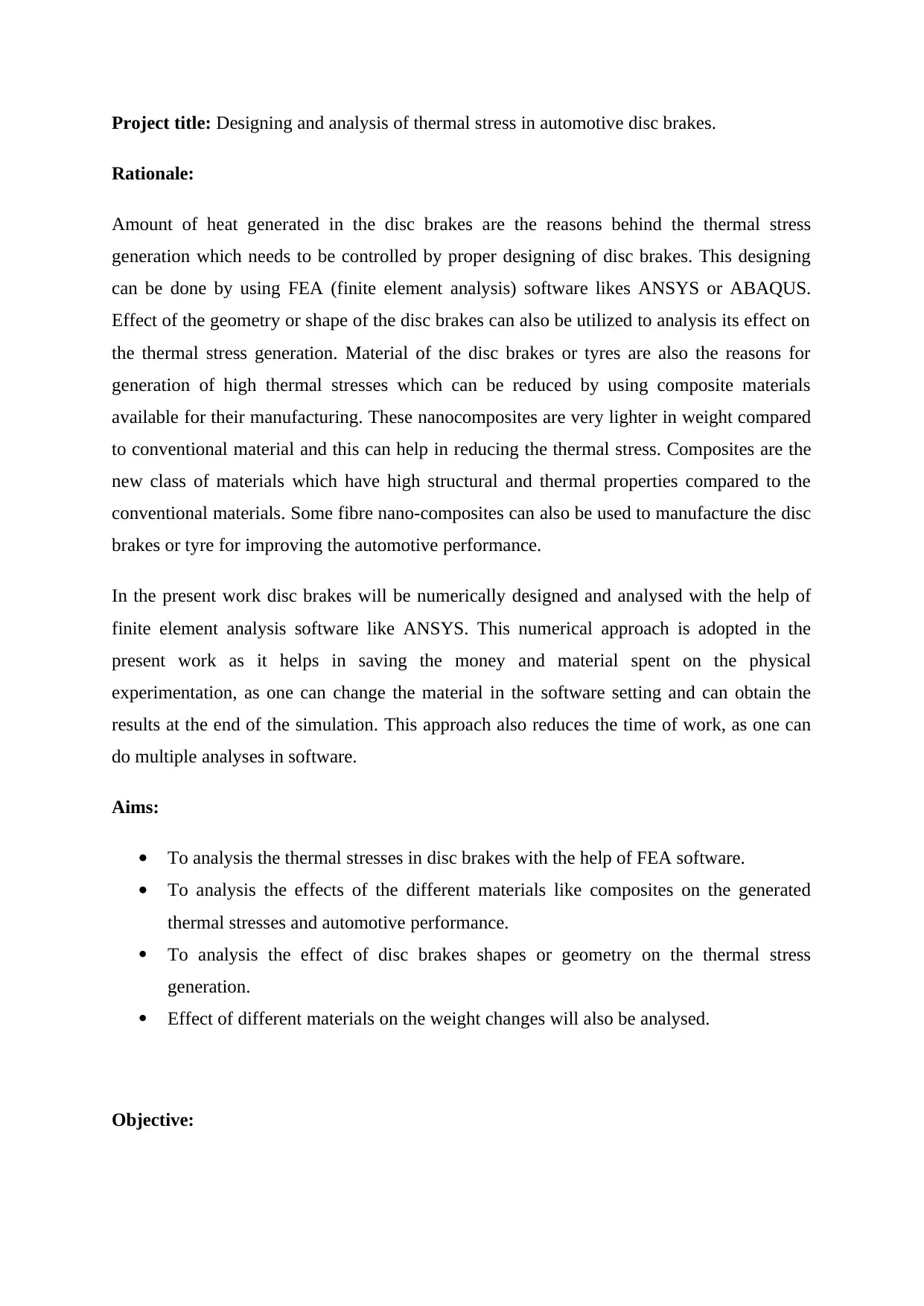
To conduct this analysis first, a conventional geometry of the dis brakes will be
modelled either in the design module available in ANSYS or with the help of other
designing software like Solidworks, CATIA or Pro-E. Then some other geometries of
disc brake will also be modelled to analyse the effect of geometry (Belhocine and
Bouchetara, 2013).
Then this model will be imported into the ANSYS thermal stress analysis module.
Then different materials like rubber, composites and fibre nano-composites will be
allocated in the ANSYS material library.
Then meshing of the imported geometry will be done with the help of meshing tool.
Meshing plays a vital role in the results obtained from finite element analysis. To
ensure the accurate result, a meshing validation test will also be conducted by using
different meshing methods available in the ANSYS software.
Then the boundary condition will be applied to the assembly imported as they plays a
vital role also. Convective boundary, radiative boundary or flux boundary will be
considered as per the problem requirement (Elangovan and Anas 2016).
Then the post processing will be done with the help of temperature distribution and
heat flux distribution etc. in the ANSYS Module (Patel, Raval and Patel 2016).
References:
Belhocine, A., and Bouchetara, M., 2013, Investigation of temperature and thermal stress in
ventilated disc brake based on 3D thermomechanical coupling model, Ain Shams
Engineering Journal, Vol. 4, Issue 3, pp. 475-483.
Elangovan, P., and Anas, O. V., 2015, Problems Associated With Existing Disc Brake Rotors
and Suggestion of Alternate Ways, International Journal of Innovative Science,
Engineering & Technology, Vol. 3 Issue 12, pp. 198-200.
Patel, M., Raval, M., and Patel, J., 2016, Design of Disc Brake’s Rotor, International Journal
of Engineering Development and Research, Vol. 4, Issue 4, pp. 919-926.
chevron_up_icon
1 out of 2
circle_padding
hide_on_mobile
zoom_out_icon
[object Object]