218.150 Built Environment: Design-Build System vs Traditional Approach
VerifiedAdded on 2023/06/13
|4
|1663
|242
Report
AI Summary
This report provides a comprehensive overview of the design-build project delivery system, contrasting it with the traditional design-bid-build approach. Design-build is characterized by a single contract between the owner and a design-builder, integrating design and construction services under one entity, fostering collaboration and streamlining project delivery. The report highlights the advantages of design-build, including single-point responsibility, reduced change orders, and optimized project quality, attributing these benefits to the unified team and coordinated effort from project inception. It also addresses the historical context, noting the shift from the Master Builder concept to specialized roles and the subsequent fragmentation of the construction industry, emphasizing design-build's role in restoring collaboration and teamwork. The analysis underscores that design-build promotes trust, mutual respect, innovation, and creative problem-solving, ultimately delivering projects faster, better, and more cost-effectively. The report concludes by highlighting the importance of a collaborative mindset among all participants for successful design-build projects.

What Is
DESIGN-BUILD?
A Design-Build Done Right Primer
DESIGN-BUILD?
A Design-Build Done Right Primer
Paraphrase This Document
Need a fresh take? Get an instant paraphrase of this document with our AI Paraphraser

WHAT IS DESIGN-BUILD?
A DESIGN-BUILD DONE RIGHT PRIMER
A DESIGN-BUILD INSTITUTE OF AMERICA PUBLICATION
Design-Build is a system of project delivery.
By Project Delivery, we mean a comprehensive process including planning, design and cons
facility or other type of project.
Within the construction industry there are a number of project delivery systems that owners
build is one of those choices.
Over the past few decades, use of design-build in both private and public sectors has greatly
build one of the most significant trends in design and construction today.
Among the project delivery systems that owners may choose are traditional design-bid-build
management at risk and design-build1, 2
. Choosing the right project delivery system is a critical part of the s
owner must develop when embarking on a new project. Owners can influence desired resul
strategically and proactively plan from the beginning of the project.
Design-Build is sole-source responsibility.
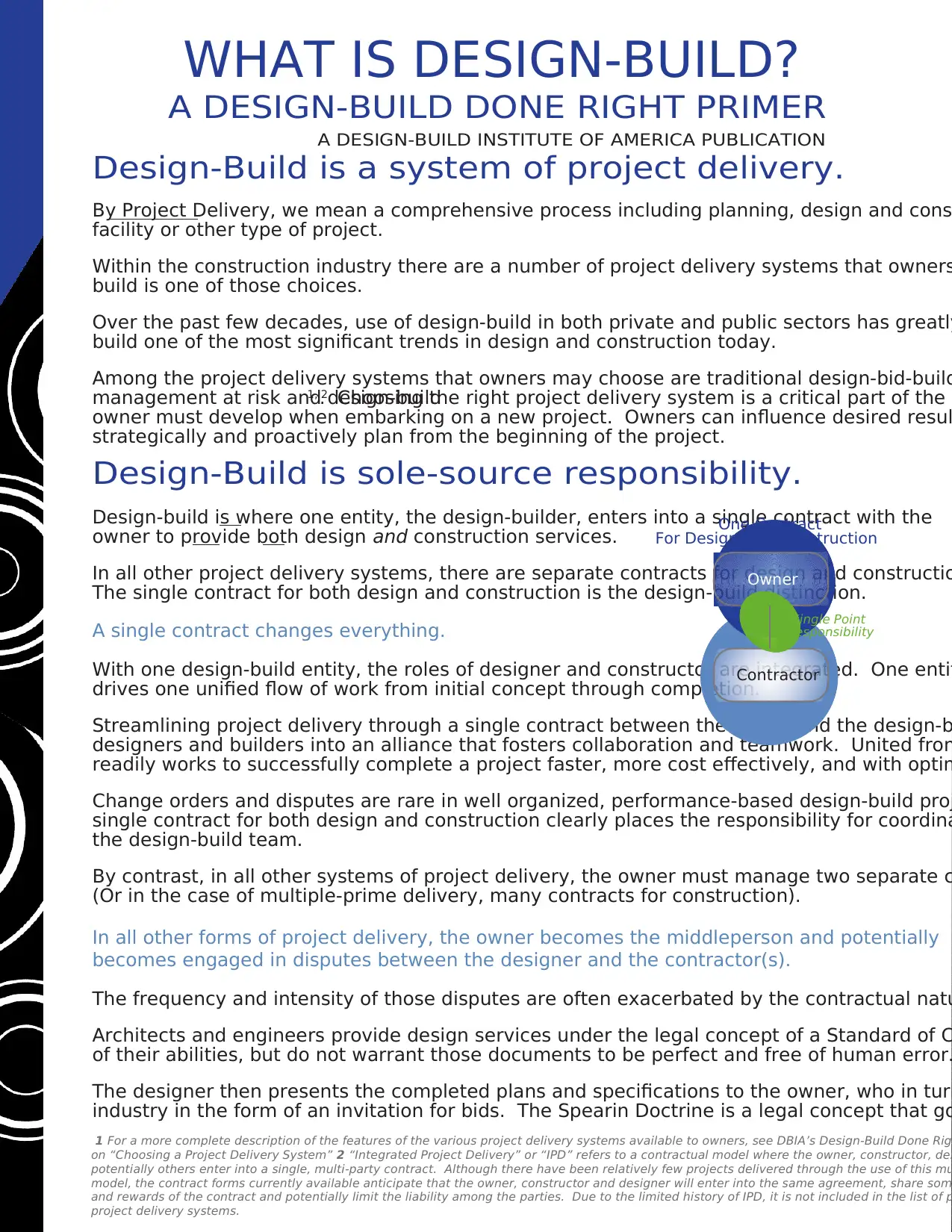
Design-build is where one entity, the design-builder, enters into a single contract with the
owner to provide both design and construction services.
In all other project delivery systems, there are separate contracts for design and constructio
The single contract for both design and construction is the design-build distinction.
A single contract changes everything.
With one design-build entity, the roles of designer and constructor are integrated. One entit
drives one unified flow of work from initial concept through completion.
Streamlining project delivery through a single contract between the owner and the design-b
designers and builders into an alliance that fosters collaboration and teamwork. United from
readily works to successfully complete a project faster, more cost effectively, and with optim
Change orders and disputes are rare in well organized, performance-based design-build proj
single contract for both design and construction clearly places the responsibility for coordina
the design-build team.
By contrast, in all other systems of project delivery, the owner must manage two separate c
(Or in the case of multiple-prime delivery, many contracts for construction).
In all other forms of project delivery, the owner becomes the middleperson and potentially
becomes engaged in disputes between the designer and the contractor(s).
The frequency and intensity of those disputes are often exacerbated by the contractual natu
Architects and engineers provide design services under the legal concept of a Standard of C
of their abilities, but do not warrant those documents to be perfect and free of human error.
The designer then presents the completed plans and specifications to the owner, who in turn
industry in the form of an invitation for bids. The Spearin Doctrine is a legal concept that go
Contractor
Owner
Single Point
Responsibility
One Contract
For Design And Construction
1 For a more complete description of the features of the various project delivery systems available to owners, see DBIA’s Design-Build Done Righ
on “Choosing a Project Delivery System” 2 “Integrated Project Delivery” or “IPD” refers to a contractual model where the owner, constructor, des
potentially others enter into a single, multi-party contract. Although there have been relatively few projects delivered through the use of this mu
model, the contract forms currently available anticipate that the owner, constructor and designer will enter into the same agreement, share som
and rewards of the contract and potentially limit the liability among the parties. Due to the limited history of IPD, it is not included in the list of p
project delivery systems.
A DESIGN-BUILD DONE RIGHT PRIMER
A DESIGN-BUILD INSTITUTE OF AMERICA PUBLICATION
Design-Build is a system of project delivery.
By Project Delivery, we mean a comprehensive process including planning, design and cons
facility or other type of project.
Within the construction industry there are a number of project delivery systems that owners
build is one of those choices.
Over the past few decades, use of design-build in both private and public sectors has greatly
build one of the most significant trends in design and construction today.
Among the project delivery systems that owners may choose are traditional design-bid-build
management at risk and design-build1, 2
. Choosing the right project delivery system is a critical part of the s
owner must develop when embarking on a new project. Owners can influence desired resul
strategically and proactively plan from the beginning of the project.
Design-Build is sole-source responsibility.
Design-build is where one entity, the design-builder, enters into a single contract with the
owner to provide both design and construction services.
In all other project delivery systems, there are separate contracts for design and constructio
The single contract for both design and construction is the design-build distinction.
A single contract changes everything.
With one design-build entity, the roles of designer and constructor are integrated. One entit
drives one unified flow of work from initial concept through completion.
Streamlining project delivery through a single contract between the owner and the design-b
designers and builders into an alliance that fosters collaboration and teamwork. United from
readily works to successfully complete a project faster, more cost effectively, and with optim
Change orders and disputes are rare in well organized, performance-based design-build proj
single contract for both design and construction clearly places the responsibility for coordina
the design-build team.
By contrast, in all other systems of project delivery, the owner must manage two separate c
(Or in the case of multiple-prime delivery, many contracts for construction).
In all other forms of project delivery, the owner becomes the middleperson and potentially
becomes engaged in disputes between the designer and the contractor(s).
The frequency and intensity of those disputes are often exacerbated by the contractual natu
Architects and engineers provide design services under the legal concept of a Standard of C
of their abilities, but do not warrant those documents to be perfect and free of human error.
The designer then presents the completed plans and specifications to the owner, who in turn
industry in the form of an invitation for bids. The Spearin Doctrine is a legal concept that go
Contractor
Owner
Single Point
Responsibility
One Contract
For Design And Construction
1 For a more complete description of the features of the various project delivery systems available to owners, see DBIA’s Design-Build Done Righ
on “Choosing a Project Delivery System” 2 “Integrated Project Delivery” or “IPD” refers to a contractual model where the owner, constructor, des
potentially others enter into a single, multi-party contract. Although there have been relatively few projects delivered through the use of this mu
model, the contract forms currently available anticipate that the owner, constructor and designer will enter into the same agreement, share som
and rewards of the contract and potentially limit the liability among the parties. Due to the limited history of IPD, it is not included in the list of p
project delivery systems.

contractors and eventually enters into a contract for construction of the project.
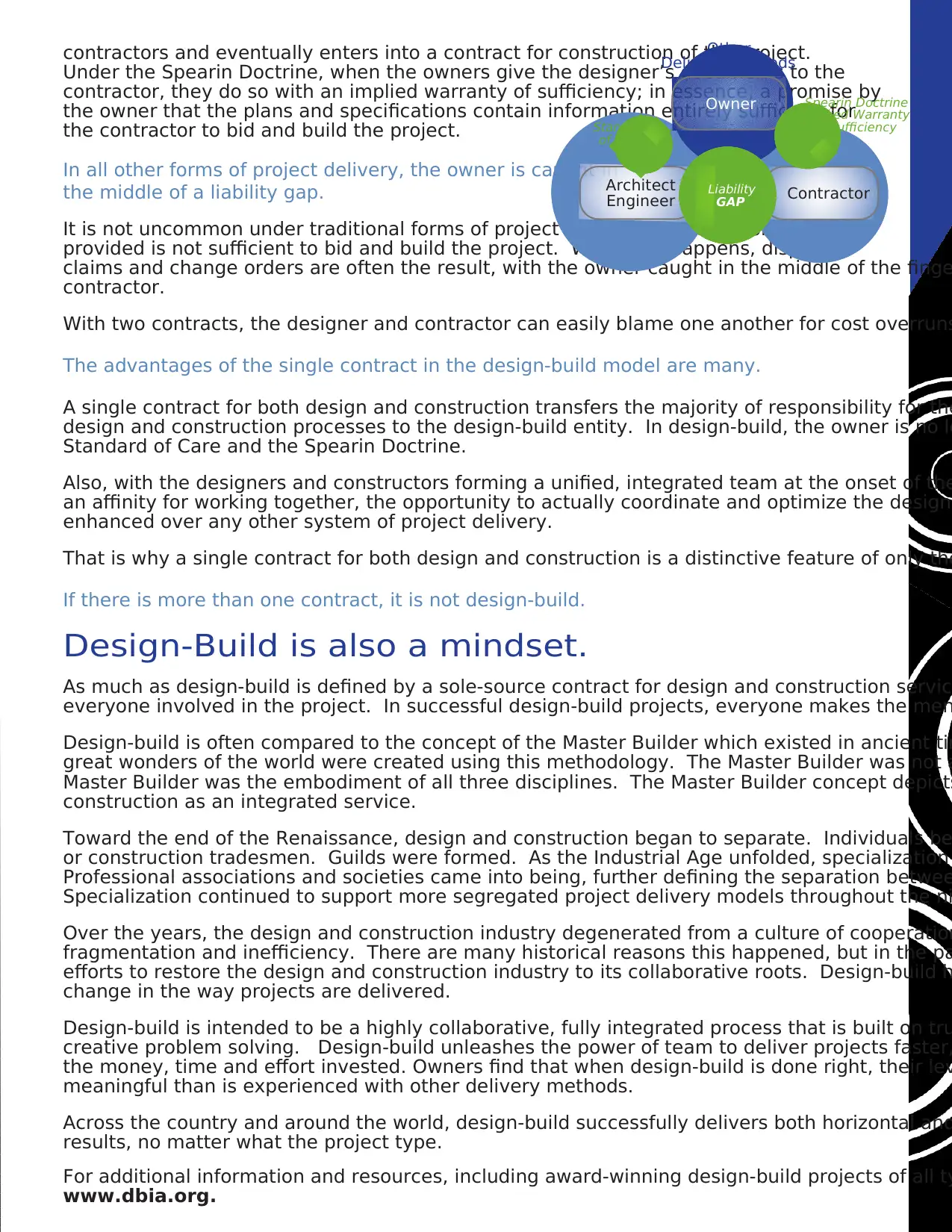
Under the Spearin Doctrine, when the owners give the designer’s documents to the
contractor, they do so with an implied warranty of sufficiency; in essence, a promise by
the owner that the plans and specifications contain information entirely sufficient for
the contractor to bid and build the project.
In all other forms of project delivery, the owner is caught in
the middle of a liability gap.
It is not uncommon under traditional forms of project delivery that the information
provided is not sufficient to bid and build the project. When this happens, disputes,
claims and change orders are often the result, with the owner caught in the middle of the finge
contractor.
With two contracts, the designer and contractor can easily blame one another for cost overruns
The advantages of the single contract in the design-build model are many.
A single contract for both design and construction transfers the majority of responsibility for the
design and construction processes to the design-build entity. In design-build, the owner is no lo
Standard of Care and the Spearin Doctrine.
Also, with the designers and constructors forming a unified, integrated team at the onset of the
an affinity for working together, the opportunity to actually coordinate and optimize the design
enhanced over any other system of project delivery.
That is why a single contract for both design and construction is a distinctive feature of only the
If there is more than one contract, it is not design-build.
Design-Build is also a mindset.
As much as design-build is defined by a sole-source contract for design and construction service
everyone involved in the project. In successful design-build projects, everyone makes the men
Design-build is often compared to the concept of the Master Builder which existed in ancient tim
great wonders of the world were created using this methodology. The Master Builder was not a
Master Builder was the embodiment of all three disciplines. The Master Builder concept depicts
construction as an integrated service.
Toward the end of the Renaissance, design and construction began to separate. Individuals be
or construction tradesmen. Guilds were formed. As the Industrial Age unfolded, specialization
Professional associations and societies came into being, further defining the separation betwee
Specialization continued to support more segregated project delivery models throughout the ni
Over the years, the design and construction industry degenerated from a culture of cooperation
fragmentation and inefficiency. There are many historical reasons this happened, but in the pa
efforts to restore the design and construction industry to its collaborative roots. Design-build h
change in the way projects are delivered.
Design-build is intended to be a highly collaborative, fully integrated process that is built on tru
creative problem solving. Design-build unleashes the power of team to deliver projects faster,
the money, time and effort invested. Owners find that when design-build is done right, their lev
meaningful than is experienced with other delivery methods.
Across the country and around the world, design-build successfully delivers both horizontal and
results, no matter what the project type.
For additional information and resources, including award-winning design-build projects of all ty
www.dbia.org.
Contractor
Architect
Engineer
Standard
of Care
Owner Spearin Doctrine
Implied Warranty
of Sufficiency
Other
Delivery Methods
Liability
GAP
Under the Spearin Doctrine, when the owners give the designer’s documents to the
contractor, they do so with an implied warranty of sufficiency; in essence, a promise by
the owner that the plans and specifications contain information entirely sufficient for
the contractor to bid and build the project.
In all other forms of project delivery, the owner is caught in
the middle of a liability gap.
It is not uncommon under traditional forms of project delivery that the information
provided is not sufficient to bid and build the project. When this happens, disputes,
claims and change orders are often the result, with the owner caught in the middle of the finge
contractor.
With two contracts, the designer and contractor can easily blame one another for cost overruns
The advantages of the single contract in the design-build model are many.
A single contract for both design and construction transfers the majority of responsibility for the
design and construction processes to the design-build entity. In design-build, the owner is no lo
Standard of Care and the Spearin Doctrine.
Also, with the designers and constructors forming a unified, integrated team at the onset of the
an affinity for working together, the opportunity to actually coordinate and optimize the design
enhanced over any other system of project delivery.
That is why a single contract for both design and construction is a distinctive feature of only the
If there is more than one contract, it is not design-build.
Design-Build is also a mindset.
As much as design-build is defined by a sole-source contract for design and construction service
everyone involved in the project. In successful design-build projects, everyone makes the men
Design-build is often compared to the concept of the Master Builder which existed in ancient tim
great wonders of the world were created using this methodology. The Master Builder was not a
Master Builder was the embodiment of all three disciplines. The Master Builder concept depicts
construction as an integrated service.
Toward the end of the Renaissance, design and construction began to separate. Individuals be
or construction tradesmen. Guilds were formed. As the Industrial Age unfolded, specialization
Professional associations and societies came into being, further defining the separation betwee
Specialization continued to support more segregated project delivery models throughout the ni
Over the years, the design and construction industry degenerated from a culture of cooperation
fragmentation and inefficiency. There are many historical reasons this happened, but in the pa
efforts to restore the design and construction industry to its collaborative roots. Design-build h
change in the way projects are delivered.
Design-build is intended to be a highly collaborative, fully integrated process that is built on tru
creative problem solving. Design-build unleashes the power of team to deliver projects faster,
the money, time and effort invested. Owners find that when design-build is done right, their lev
meaningful than is experienced with other delivery methods.
Across the country and around the world, design-build successfully delivers both horizontal and
results, no matter what the project type.
For additional information and resources, including award-winning design-build projects of all ty
www.dbia.org.
Contractor
Architect
Engineer
Standard
of Care
Owner Spearin Doctrine
Implied Warranty
of Sufficiency
Other
Delivery Methods
Liability
GAP
⊘ This is a preview!⊘
Do you want full access?
Subscribe today to unlock all pages.

Trusted by 1+ million students worldwide

DESIGN-BUILD DONE RIGHT
PRIMER
A DESIGN-BUILD INSTITUTE OF AMERICA PUBLICATION
Copyright © October 2014
Cover Photo Credits
Top Row, Left to Right:
Kittredge West and Kittredge Central Residence Halls, Owner: University of Colorado at
Boulder, 2014 National Design-Build Merit Award Winner;Denver Union Station Transit
Improvements, Owner: Denver Union Station Project Authority; Henry M. Jackson Federal
Building Modernization, Owner: U.S. General Services Administration (GSA), 2014
National Design-Build Merit Award Winner
Bottom Row, Left to Right:
Wilsonville Wastewater Treatment Plant Improvements Project, Owner: City of
Wilsonville, 2014 National Design-Build Merit Award Winner; Sharp Memorial Hospital
Seismic Renovation of South and Central Towers & ICU Remodel, Owner: Sharp
Healthcare, 2014 National Design-Build Merit Award Winner; I-85/Yadkin River Bridge,
Owner: North Carolina Department of Transportation, 2014 National Design-Build Merit
Award Winner
PRIMER
A DESIGN-BUILD INSTITUTE OF AMERICA PUBLICATION
Copyright © October 2014
Cover Photo Credits
Top Row, Left to Right:
Kittredge West and Kittredge Central Residence Halls, Owner: University of Colorado at
Boulder, 2014 National Design-Build Merit Award Winner;Denver Union Station Transit
Improvements, Owner: Denver Union Station Project Authority; Henry M. Jackson Federal
Building Modernization, Owner: U.S. General Services Administration (GSA), 2014
National Design-Build Merit Award Winner
Bottom Row, Left to Right:
Wilsonville Wastewater Treatment Plant Improvements Project, Owner: City of
Wilsonville, 2014 National Design-Build Merit Award Winner; Sharp Memorial Hospital
Seismic Renovation of South and Central Towers & ICU Remodel, Owner: Sharp
Healthcare, 2014 National Design-Build Merit Award Winner; I-85/Yadkin River Bridge,
Owner: North Carolina Department of Transportation, 2014 National Design-Build Merit
Award Winner
1 out of 4
Related Documents
Your All-in-One AI-Powered Toolkit for Academic Success.
+13062052269
info@desklib.com
Available 24*7 on WhatsApp / Email
Unlock your academic potential
Copyright © 2020–2025 A2Z Services. All Rights Reserved. Developed and managed by ZUCOL.