UML-Based Approach for Designing Data Stream Applications: Thesis
VerifiedAdded on 2023/05/29
|10
|1485
|388
Thesis and Dissertation
AI Summary
This thesis presents a novel approach to designing data stream applications using the Unified Modeling Language (UML). It addresses the challenges posed by the continuous and high-volume nature of data streams, where traditional data labeling and processing techniques often fall short. The research aims to extend the conventional data stream modeling methods by integrating advanced UML designs, focusing on use case, activity, and class diagrams. The thesis outlines a research structure that includes a literature review, extensions of UML diagrams, documentation using XML, and a real-world case study to demonstrate the practical application of the proposed UML-based design approach. The qualitative research methodology employs a descriptive design and secondary data collection to analyze the issues and benefits of this extended modeling technique for data stream applications.
Running Head: DATA STREAM APPLICATION
UML-based approach to design data stream applications
Name of the Student
Name of the University
Author’s Note
UML-based approach to design data stream applications
Name of the Student
Name of the University
Author’s Note
Paraphrase This Document
Need a fresh take? Get an instant paraphrase of this document with our AI Paraphraser

2
DATA STREAM APPLICATION
Table of Contents
Chapter 1: Introduction....................................................................................................................3
1.1 Background.......................................................................................................................3
1.2 Problem statement.............................................................................................................3
1.3 Aim, Objectives and Research Questions.........................................................................4
1.4 Research Structure............................................................................................................4
Chapter 2: Literature Review...........................................................................................................6
2.1 Data Stream model................................................................................................................6
2.2 An Extension of the Use Case diagram to Model the Functionality of Data Stream
Applications.................................................................................................................................6
2.3 An Extension of the Activity Diagram to Model the Behaviour of Data Stream
Applications.................................................................................................................................6
2.4 An Extension of the Class Diagram to Model the Structure of the Data Stream
Applications.................................................................................................................................7
Chapter 3: Research Methodology..................................................................................................8
Timeline...........................................................................................................................................8
References......................................................................................................................................10
DATA STREAM APPLICATION
Table of Contents
Chapter 1: Introduction....................................................................................................................3
1.1 Background.......................................................................................................................3
1.2 Problem statement.............................................................................................................3
1.3 Aim, Objectives and Research Questions.........................................................................4
1.4 Research Structure............................................................................................................4
Chapter 2: Literature Review...........................................................................................................6
2.1 Data Stream model................................................................................................................6
2.2 An Extension of the Use Case diagram to Model the Functionality of Data Stream
Applications.................................................................................................................................6
2.3 An Extension of the Activity Diagram to Model the Behaviour of Data Stream
Applications.................................................................................................................................6
2.4 An Extension of the Class Diagram to Model the Structure of the Data Stream
Applications.................................................................................................................................7
Chapter 3: Research Methodology..................................................................................................8
Timeline...........................................................................................................................................8
References......................................................................................................................................10

3
DATA STREAM APPLICATION
Chapter 1: Introduction
1.1 Background
Data stream are continuous data and information flow. The sheer volume and speed create a
great challenge for the data mining community to mine them properly. There are various
examples of data streams including sensor data, network traffic, call center records and many
others. Data stream imposes a very unique properties including concept-drift, infinite length,
concept-evolution and limited labeled data (Arasu et al. 2016). Concept drift focuses on
changing of data over time. Concept evolution refers to realizing evolvement of new data in the
streams. Feature evolution focuses on various set with time in data streams. Data streaming
include various data including log files generated by customers through web portal and other
sources. Therefore, this data needs to be processed properly in order to maintain and analyze for
future use.
1.2 Problem statement
Data streams have been suffering with various problems related to scarcity of labeled data as
it is not possible to manually label all data points in the steam. Therefore, each data set create a
new problems for the database. Traditional data streams have been a failure in labeling each data
set properly. Advancement of IT and internet has increased the flow of data from various sources
including Facebook, Twitter, traffic sensors, Television, Live streaming of video and music.
Therefore, labeling each kind of data have been a challenge for the traditional approach.
1.3 Aim, Objectives and Research Questions
The aim of research is to extend traditional approach of data stream modelling into advanced
techniques.
DATA STREAM APPLICATION
Chapter 1: Introduction
1.1 Background
Data stream are continuous data and information flow. The sheer volume and speed create a
great challenge for the data mining community to mine them properly. There are various
examples of data streams including sensor data, network traffic, call center records and many
others. Data stream imposes a very unique properties including concept-drift, infinite length,
concept-evolution and limited labeled data (Arasu et al. 2016). Concept drift focuses on
changing of data over time. Concept evolution refers to realizing evolvement of new data in the
streams. Feature evolution focuses on various set with time in data streams. Data streaming
include various data including log files generated by customers through web portal and other
sources. Therefore, this data needs to be processed properly in order to maintain and analyze for
future use.
1.2 Problem statement
Data streams have been suffering with various problems related to scarcity of labeled data as
it is not possible to manually label all data points in the steam. Therefore, each data set create a
new problems for the database. Traditional data streams have been a failure in labeling each data
set properly. Advancement of IT and internet has increased the flow of data from various sources
including Facebook, Twitter, traffic sensors, Television, Live streaming of video and music.
Therefore, labeling each kind of data have been a challenge for the traditional approach.
1.3 Aim, Objectives and Research Questions
The aim of research is to extend traditional approach of data stream modelling into advanced
techniques.
⊘ This is a preview!⊘
Do you want full access?
Subscribe today to unlock all pages.

Trusted by 1+ million students worldwide

4
DATA STREAM APPLICATION
Following are objectives of the research:
To analyze issues faced due to traditional approach of data labelling of data stream
applications
To propose UML designs for extending traditional approach of data labelling of data
stream applications
Following are the research questions:
What are the issues faced due to traditional approach of data labelling of data stream
applications?
How new UML designs help in extending traditional approach of data labelling of data
stream applications?
DATA STREAM APPLICATION
Following are objectives of the research:
To analyze issues faced due to traditional approach of data labelling of data stream
applications
To propose UML designs for extending traditional approach of data labelling of data
stream applications
Following are the research questions:
What are the issues faced due to traditional approach of data labelling of data stream
applications?
How new UML designs help in extending traditional approach of data labelling of data
stream applications?
Paraphrase This Document
Need a fresh take? Get an instant paraphrase of this document with our AI Paraphraser

5
DATA STREAM APPLICATION
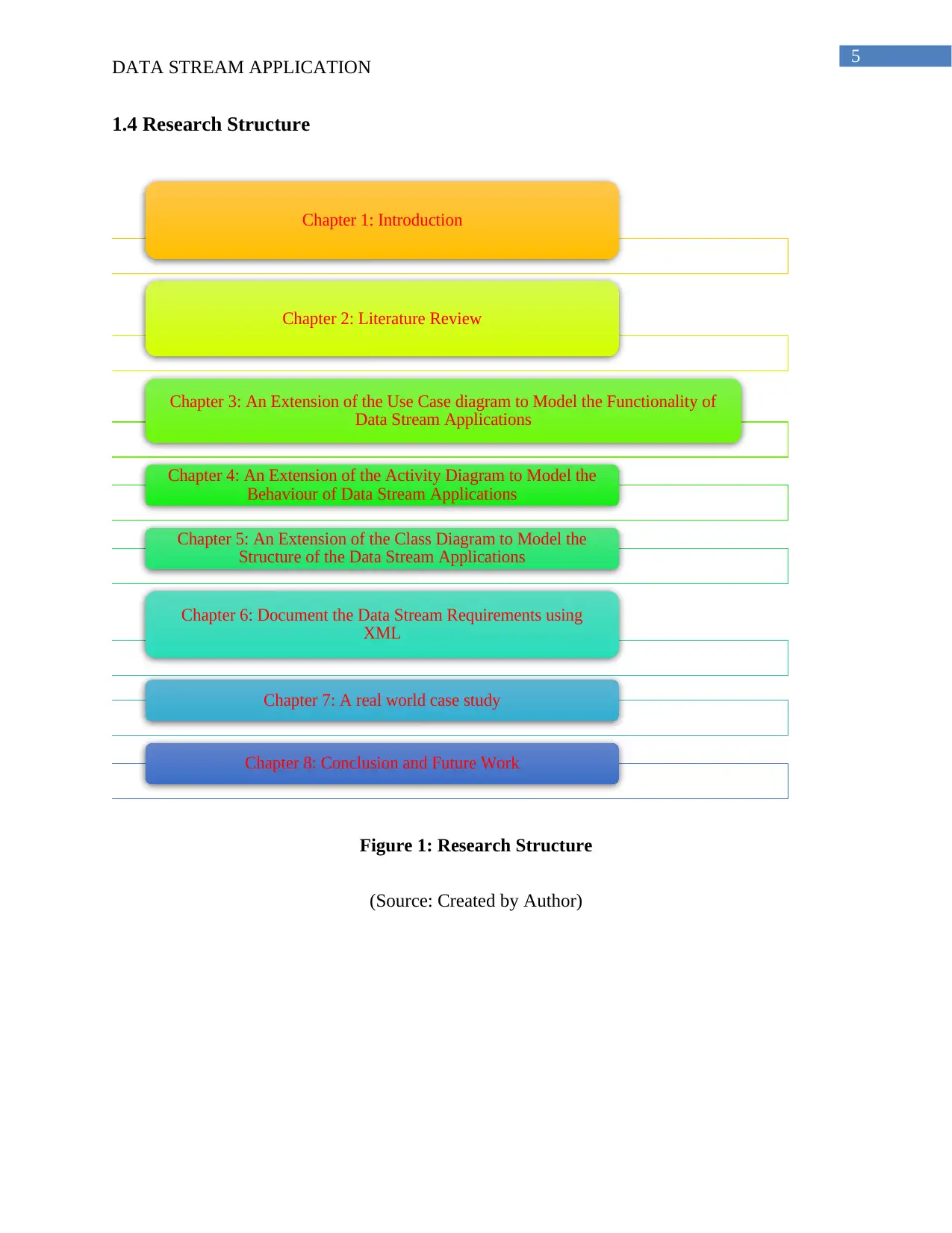
1.4 Research Structure
Figure 1: Research Structure
(Source: Created by Author)
Chapter 1: Introduction
Chapter 2: Literature Review
Chapter 3: An Extension of the Use Case diagram to Model the Functionality of
Data Stream Applications
Chapter 4: An Extension of the Activity Diagram to Model the
Behaviour of Data Stream Applications
Chapter 5: An Extension of the Class Diagram to Model the
Structure of the Data Stream Applications
Chapter 6: Document the Data Stream Requirements using
XML
Chapter 7: A real world case study
Chapter 8: Conclusion and Future Work
DATA STREAM APPLICATION
1.4 Research Structure
Figure 1: Research Structure
(Source: Created by Author)
Chapter 1: Introduction
Chapter 2: Literature Review
Chapter 3: An Extension of the Use Case diagram to Model the Functionality of
Data Stream Applications
Chapter 4: An Extension of the Activity Diagram to Model the
Behaviour of Data Stream Applications
Chapter 5: An Extension of the Class Diagram to Model the
Structure of the Data Stream Applications
Chapter 6: Document the Data Stream Requirements using
XML
Chapter 7: A real world case study
Chapter 8: Conclusion and Future Work

6
DATA STREAM APPLICATION
Chapter 2: Literature Review
2.1 Data Stream model
Data stream is set of data that enough large to store in memory. This type of information
can be of different order including edges, numbers and points. Data Streams require new
algorithms for analyzing huge volume of dataset. There has been a sequence of elements a1,… n
esch element that can be presented in algorithm, in which each element is drawn from a universe
[n] = {1, . . . , n}. The algorithm has helped in allowing a single or small number of passes in
stream. The algorithm has been a typically give single pass. Data over network has not been
stored physically over any network (Krawczyk et al. 2017). The algorithm need to compute a
function over the data stream.
Chapter 3: An Extension of the Use Case diagram to Model the Functionality
of Data Stream Applications
The use case diagram will be provided with traditional approach. After that, extended use
case diagram will be proposed.
Chapter 4: An Extension of the Activity Diagram to Model the Behaviour of
Data Stream Applications
The activity diagram will be provided with traditional approach. After that, extended activity
diagram will be proposed.
DATA STREAM APPLICATION
Chapter 2: Literature Review
2.1 Data Stream model
Data stream is set of data that enough large to store in memory. This type of information
can be of different order including edges, numbers and points. Data Streams require new
algorithms for analyzing huge volume of dataset. There has been a sequence of elements a1,… n
esch element that can be presented in algorithm, in which each element is drawn from a universe
[n] = {1, . . . , n}. The algorithm has helped in allowing a single or small number of passes in
stream. The algorithm has been a typically give single pass. Data over network has not been
stored physically over any network (Krawczyk et al. 2017). The algorithm need to compute a
function over the data stream.
Chapter 3: An Extension of the Use Case diagram to Model the Functionality
of Data Stream Applications
The use case diagram will be provided with traditional approach. After that, extended use
case diagram will be proposed.
Chapter 4: An Extension of the Activity Diagram to Model the Behaviour of
Data Stream Applications
The activity diagram will be provided with traditional approach. After that, extended activity
diagram will be proposed.
⊘ This is a preview!⊘
Do you want full access?
Subscribe today to unlock all pages.

Trusted by 1+ million students worldwide

7
DATA STREAM APPLICATION
Chapter 5: An Extension of the Class Diagram to Model the Structure of the
Data Stream Applications
The activity diagram will be provided with traditional approach. After that, extended
activity diagram will be proposed.
Chapter 6: Document the Data Stream requirements using XML
A framework will be provided for continuous querying of time varying steamed XML data.
DATA STREAM APPLICATION
Chapter 5: An Extension of the Class Diagram to Model the Structure of the
Data Stream Applications
The activity diagram will be provided with traditional approach. After that, extended
activity diagram will be proposed.
Chapter 6: Document the Data Stream requirements using XML
A framework will be provided for continuous querying of time varying steamed XML data.
Paraphrase This Document
Need a fresh take? Get an instant paraphrase of this document with our AI Paraphraser

8
DATA STREAM APPLICATION
Chapter 7: Research Methodology
The research will follow a qualitative approach in order to complete the study. A
descriptive design will be selected in the research. Descriptive research design helps in focusing
on objectives and questions of the research. Therefore, a descriptive analysis can be done in the
data modelling of data stream applications. The use of the descriptive design helps in
maintaining a keen approach to the development of extended UML designs for the new data
stream applications. The research problem can be focused with the help of descriptive research
design (Khanna et al. 2017). Secondary data collection method include data collection from
online journals, books, articles and government databases. This research will use secondary
method of data collection. Data collection will be done using a real world based case study
related to the research topic. Data will be analysis using qualitative data analysis method. The
research will follow a proper ethical consideration. All data and information will be kept safe and
secured under Data Protection Act 1998. Results and outcomes will not be published before the
completion of the study. Data and information related to the research will not be changed or
tampered during the analysis part.
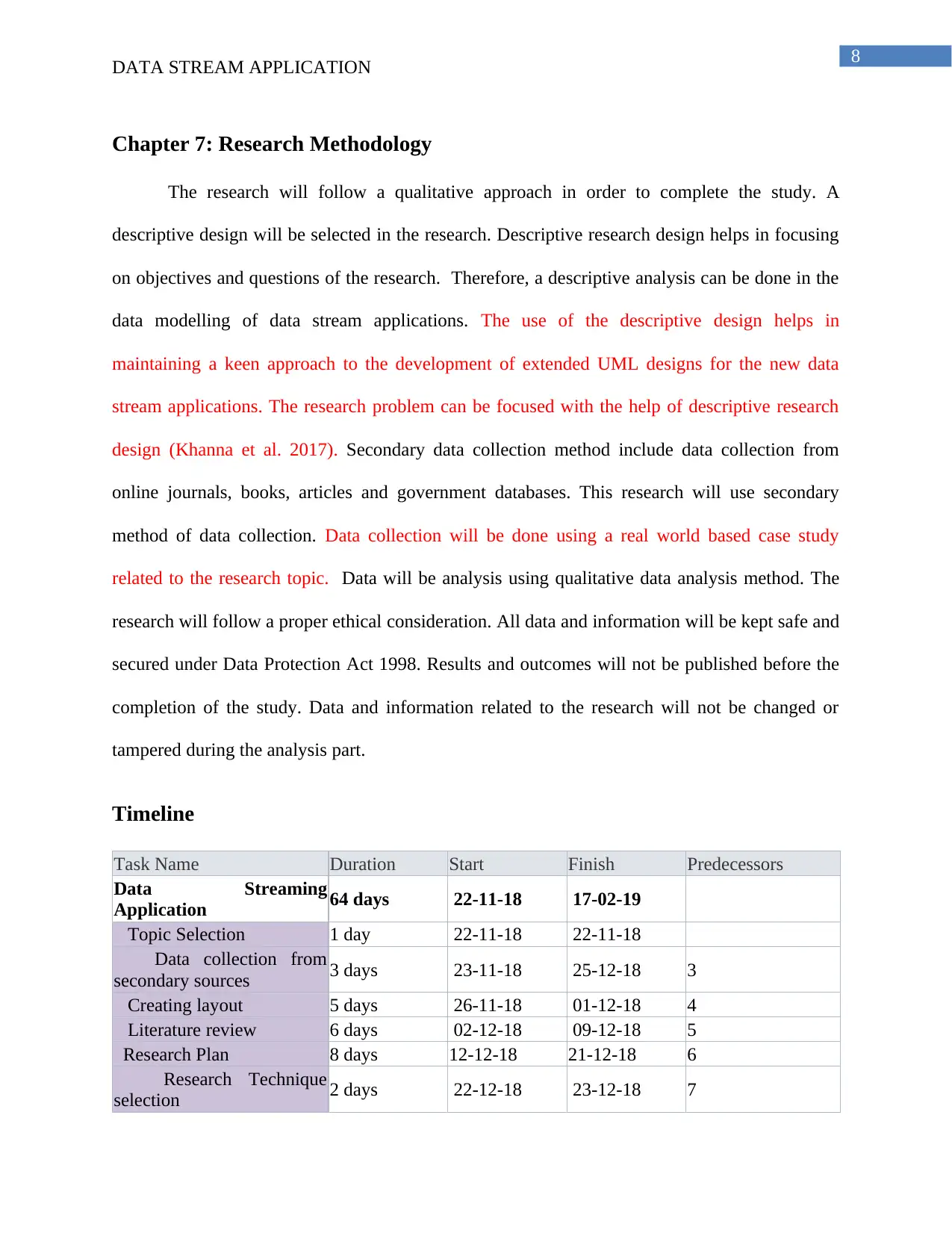
Timeline
Task Name Duration Start Finish Predecessors
Data Streaming
Application 64 days 22-11-18 17-02-19
Topic Selection 1 day 22-11-18 22-11-18
Data collection from
secondary sources 3 days 23-11-18 25-12-18 3
Creating layout 5 days 26-11-18 01-12-18 4
Literature review 6 days 02-12-18 09-12-18 5
Research Plan 8 days 12-12-18 21-12-18 6
Research Technique
selection 2 days 22-12-18 23-12-18 7
DATA STREAM APPLICATION
Chapter 7: Research Methodology
The research will follow a qualitative approach in order to complete the study. A
descriptive design will be selected in the research. Descriptive research design helps in focusing
on objectives and questions of the research. Therefore, a descriptive analysis can be done in the
data modelling of data stream applications. The use of the descriptive design helps in
maintaining a keen approach to the development of extended UML designs for the new data
stream applications. The research problem can be focused with the help of descriptive research
design (Khanna et al. 2017). Secondary data collection method include data collection from
online journals, books, articles and government databases. This research will use secondary
method of data collection. Data collection will be done using a real world based case study
related to the research topic. Data will be analysis using qualitative data analysis method. The
research will follow a proper ethical consideration. All data and information will be kept safe and
secured under Data Protection Act 1998. Results and outcomes will not be published before the
completion of the study. Data and information related to the research will not be changed or
tampered during the analysis part.
Timeline
Task Name Duration Start Finish Predecessors
Data Streaming
Application 64 days 22-11-18 17-02-19
Topic Selection 1 day 22-11-18 22-11-18
Data collection from
secondary sources 3 days 23-11-18 25-12-18 3
Creating layout 5 days 26-11-18 01-12-18 4
Literature review 6 days 02-12-18 09-12-18 5
Research Plan 8 days 12-12-18 21-12-18 6
Research Technique
selection 2 days 22-12-18 23-12-18 7

9
DATA STREAM APPLICATION
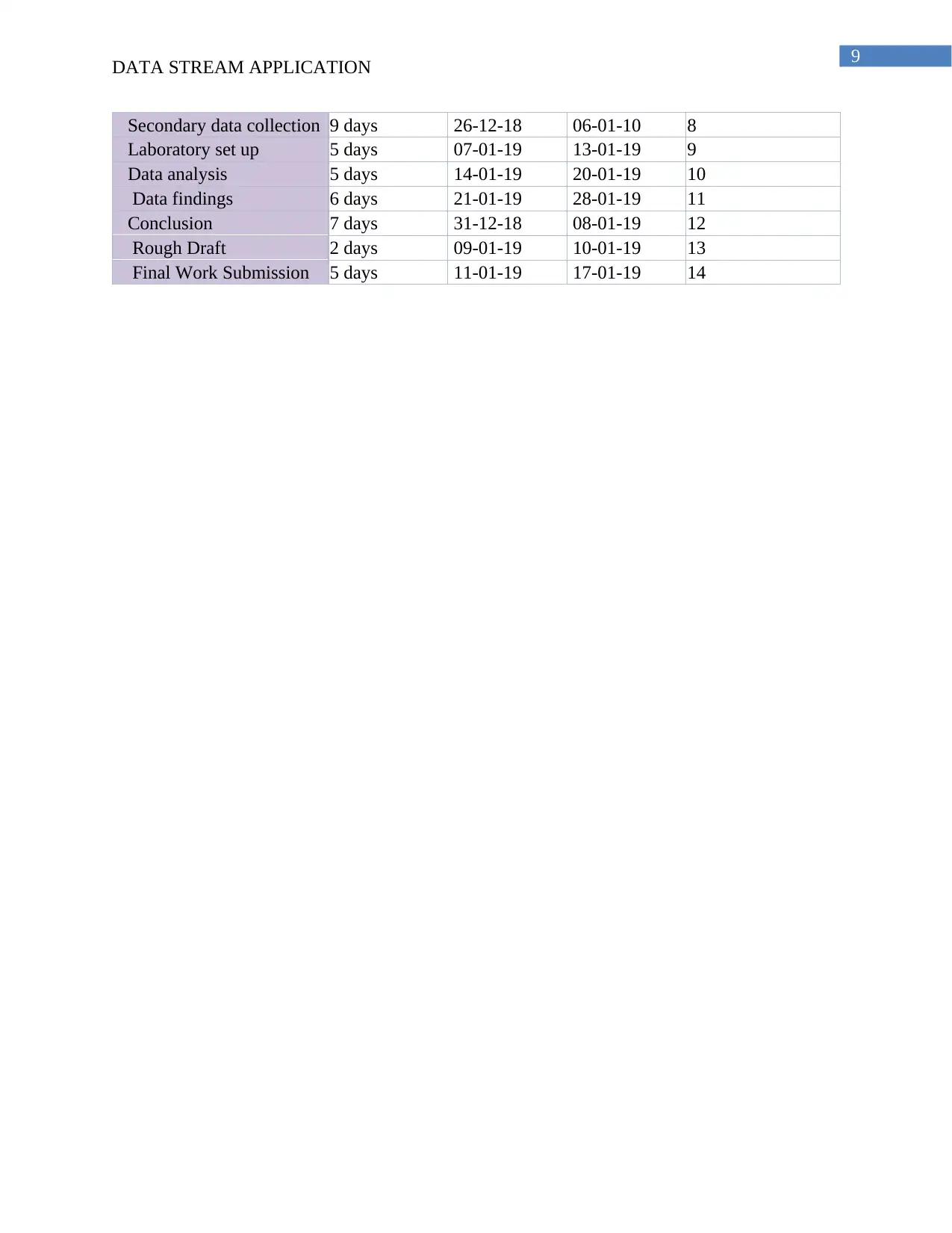
Secondary data collection 9 days 26-12-18 06-01-10 8
Laboratory set up 5 days 07-01-19 13-01-19 9
Data analysis 5 days 14-01-19 20-01-19 10
Data findings 6 days 21-01-19 28-01-19 11
Conclusion 7 days 31-12-18 08-01-19 12
Rough Draft 2 days 09-01-19 10-01-19 13
Final Work Submission 5 days 11-01-19 17-01-19 14
DATA STREAM APPLICATION
Secondary data collection 9 days 26-12-18 06-01-10 8
Laboratory set up 5 days 07-01-19 13-01-19 9
Data analysis 5 days 14-01-19 20-01-19 10
Data findings 6 days 21-01-19 28-01-19 11
Conclusion 7 days 31-12-18 08-01-19 12
Rough Draft 2 days 09-01-19 10-01-19 13
Final Work Submission 5 days 11-01-19 17-01-19 14
⊘ This is a preview!⊘
Do you want full access?
Subscribe today to unlock all pages.

Trusted by 1+ million students worldwide

10
DATA STREAM APPLICATION
References
Arasu, A., Babcock, B., Babu, S., Cieslewicz, J., Datar, M., Ito, K., Motwani, R., Srivastava, U.
and Widom, J., 2016. Stream: The stanford data stream management system. In Data Stream
Management (pp. 317-336). Springer, Berlin, Heidelberg.
Krempl, G., Žliobaite, I., Brzeziński, D., Hüllermeier, E., Last, M., Lemaire, V., Noack, T.,
Shaker, A., Sievi, S., Spiliopoulou, M. and Stefanowski, J., 2014. Open challenges for data
stream mining research. ACM SIGKDD explorations newsletter, 16(1), pp.1-10.
Krawczyk, B., Minku, L.L., Gama, J., Stefanowski, J. and Woźniak, M., 2017. Ensemble
learning for data stream analysis: A survey. Information Fusion, 37, pp.132-156.
Khanna, A., Kero, A., Kumar, D. and Agarwal, A., 2017, September. Adaptive mobile
computation offloading for data stream applications. In Advances in Computing, Communication
& Automation (ICACCA)(Fall), 2017 3rd International Conference on (pp. 1-6). IEEE.
DATA STREAM APPLICATION
References
Arasu, A., Babcock, B., Babu, S., Cieslewicz, J., Datar, M., Ito, K., Motwani, R., Srivastava, U.
and Widom, J., 2016. Stream: The stanford data stream management system. In Data Stream
Management (pp. 317-336). Springer, Berlin, Heidelberg.
Krempl, G., Žliobaite, I., Brzeziński, D., Hüllermeier, E., Last, M., Lemaire, V., Noack, T.,
Shaker, A., Sievi, S., Spiliopoulou, M. and Stefanowski, J., 2014. Open challenges for data
stream mining research. ACM SIGKDD explorations newsletter, 16(1), pp.1-10.
Krawczyk, B., Minku, L.L., Gama, J., Stefanowski, J. and Woźniak, M., 2017. Ensemble
learning for data stream analysis: A survey. Information Fusion, 37, pp.132-156.
Khanna, A., Kero, A., Kumar, D. and Agarwal, A., 2017, September. Adaptive mobile
computation offloading for data stream applications. In Advances in Computing, Communication
& Automation (ICACCA)(Fall), 2017 3rd International Conference on (pp. 1-6). IEEE.
1 out of 10
Related Documents
Your All-in-One AI-Powered Toolkit for Academic Success.
+13062052269
info@desklib.com
Available 24*7 on WhatsApp / Email
Unlock your academic potential
Copyright © 2020–2026 A2Z Services. All Rights Reserved. Developed and managed by ZUCOL.