Organization Design and Management: Structure and Stakeholder Analysis
VerifiedAdded on 2023/06/14
|13
|3236
|340
Essay
AI Summary
This essay explores organization design and management within contemporary companies, focusing on various structural aspects and their implications. It defines organizational structure, its purpose, need, and significance, and then identifies Apple Inc. as a case study to describe different organizational structures like simple, functional, divisional, and matrix. The essay analyzes the implications of Apple's structure on its stakeholders, both internal and external, and discusses relevant theories such as Fayol's Principles of Management and Bureaucracy. It concludes by highlighting the importance of a well-designed organizational structure for achieving company goals and maintaining competitiveness, emphasizing the role of effective leadership and employee engagement in organizational success. Desklib provides access to this and other valuable student-contributed assignments.
ORGANISATION DESIGN
AND MANAGEMENT
AND MANAGEMENT

Paraphrase This Document
Need a fresh take? Get an instant paraphrase of this document with our AI Paraphraser
Table of Contents
INTRODUCTION...........................................................................................................................3
QUESTION- IDENTIFYING DIFFERENT ASPECTS OF STRUCTURE OF VARIOUS
CONTEMPORARY COMPANIES................................................................................................3
A- Defining organizational structure...........................................................................................3
B- Purpose, need and significance of organizational structure....................................................3
C- Identifying a firm and describing different Organization Structures......................................4
D- Implications of the structure on Apple and its stakeholders..................................................5
E- Relevant Theories and empirical evidence.............................................................................6
CONCLUSION................................................................................................................................9
REFERENCES................................................................................................................................1
INTRODUCTION...........................................................................................................................3
QUESTION- IDENTIFYING DIFFERENT ASPECTS OF STRUCTURE OF VARIOUS
CONTEMPORARY COMPANIES................................................................................................3
A- Defining organizational structure...........................................................................................3
B- Purpose, need and significance of organizational structure....................................................3
C- Identifying a firm and describing different Organization Structures......................................4
D- Implications of the structure on Apple and its stakeholders..................................................5
E- Relevant Theories and empirical evidence.............................................................................6
CONCLUSION................................................................................................................................9
REFERENCES................................................................................................................................1
INTRODUCTION
Organization management is defined as the process of effective planning and controlling
the assets & resources of an organization. This procedure provides a lot of benefits to companies,
in term of managing organizational performance and improving the same. With an appropriate
management in the firms, manager has obtained key advantages such fas faster decision, improve
operational efficiency and eliminate employee issues. The current essay will explain key aspects
of structure in various contemporary organization, and implications for company as well as its
stakeholders.
QUESTION- IDENTIFYING DIFFERENT ASPECTS OF STRUCTURE OF
VARIOUS CONTEMPORARY COMPANIES
A- Defining organizational structure
Organizational structure is a system which shows how tasks of a company are directed
in order to achieve the mission of the organization. It defines the order in which the power,
authority and roles are assigned and governed and shows how the information is flowing
between the different hierarchy levels of the organization (Burton and et.al., 2019). An
organizational structure encompasses different types of roles and responsibilities to ensure the
achievement of the goals of the organization. A proper organizational structure benefits an
organization by faster decision making, good performance of the employees and better
communication within the organization.
B- Purpose, need and significance of organizational structure
Purpose : The main motive of a company to utilize specific organizational structure is
continued the flow of productivity and performance in the workplace and to ensure stability in
the organizations as well as employee satisfaction (Aubry and Lavoie-Tremblay, 2018).
Need : The requirement of organizational structure arises to ensure a proper workflow in
the context of management in an organization. It may provide the employees proper guidance by
building better official relationships between employees and management of different
organizations.
Importance : A good organizational structure is important as it helps to ensure the
success and growth of a company. It may support to meet organizational goals and also aid to
stay competitive in the business environment. Organizational design helps at establishing easy
communication in the business environment by providing a uniform structure.
Organization management is defined as the process of effective planning and controlling
the assets & resources of an organization. This procedure provides a lot of benefits to companies,
in term of managing organizational performance and improving the same. With an appropriate
management in the firms, manager has obtained key advantages such fas faster decision, improve
operational efficiency and eliminate employee issues. The current essay will explain key aspects
of structure in various contemporary organization, and implications for company as well as its
stakeholders.
QUESTION- IDENTIFYING DIFFERENT ASPECTS OF STRUCTURE OF
VARIOUS CONTEMPORARY COMPANIES
A- Defining organizational structure
Organizational structure is a system which shows how tasks of a company are directed
in order to achieve the mission of the organization. It defines the order in which the power,
authority and roles are assigned and governed and shows how the information is flowing
between the different hierarchy levels of the organization (Burton and et.al., 2019). An
organizational structure encompasses different types of roles and responsibilities to ensure the
achievement of the goals of the organization. A proper organizational structure benefits an
organization by faster decision making, good performance of the employees and better
communication within the organization.
B- Purpose, need and significance of organizational structure
Purpose : The main motive of a company to utilize specific organizational structure is
continued the flow of productivity and performance in the workplace and to ensure stability in
the organizations as well as employee satisfaction (Aubry and Lavoie-Tremblay, 2018).
Need : The requirement of organizational structure arises to ensure a proper workflow in
the context of management in an organization. It may provide the employees proper guidance by
building better official relationships between employees and management of different
organizations.
Importance : A good organizational structure is important as it helps to ensure the
success and growth of a company. It may support to meet organizational goals and also aid to
stay competitive in the business environment. Organizational design helps at establishing easy
communication in the business environment by providing a uniform structure.
⊘ This is a preview!⊘
Do you want full access?
Subscribe today to unlock all pages.

Trusted by 1+ million students worldwide
C- Identifying a firm and describing different Organization Structures
There are different type of organizational structures available in the business world and
these are :
Simple Structure
This type of organizational structure is used by small businesses as a default operating
system because it helps in the centralization of the decision making of the owner. This is one of
the simplest organizational structure and doesn't have layers of management or formal
departments (Eva and et.al., 2021). It ensures a strong control by the owner on the operations of
the organization. The orders directly comes from the top management to the employees
removing the mediators in between.
Functional structure
Employees are put into same departments based on their similar skill sets, accountability
and capabilities under functional structure. This segmentation of employees helps in effective
communication and thus leads towards better decision making. The advantages of functional
structure is that it makes the productivity more efficient and improves the quality. There is
negligible confusion in coordination as the structure is simple. There is a clear path of growth for
the company as the structure is standardized. Larger organizations which are related to product
are recommended to adapt functional structure for a better working and coordination in a larger
business environment.
Divisional structure
This structure divides activities into specific customer groups, product, service and
markets. The main aim of this structure is to create teams that can create products which are
similar and needs individual emphasis. It can further divided by markets or regions to provide
focus on the competency of each division. The benefits of this structure are that it focuses on
producing products which are specialized and the decision making of the organization achieves
faster and better decisions. Divisional structure is helpful for the expansion of product base.
Matrix structure
It is a combination of the divisional and functional structures and it slows the
decentralization of autonomy power, decision making and inter- departmental interactions. The
structure aims at increasing the innovations and productivity of the business and thus it leads to
higher costs of production creating conflicts between vertical and horizontal product divisions. In
There are different type of organizational structures available in the business world and
these are :
Simple Structure
This type of organizational structure is used by small businesses as a default operating
system because it helps in the centralization of the decision making of the owner. This is one of
the simplest organizational structure and doesn't have layers of management or formal
departments (Eva and et.al., 2021). It ensures a strong control by the owner on the operations of
the organization. The orders directly comes from the top management to the employees
removing the mediators in between.
Functional structure
Employees are put into same departments based on their similar skill sets, accountability
and capabilities under functional structure. This segmentation of employees helps in effective
communication and thus leads towards better decision making. The advantages of functional
structure is that it makes the productivity more efficient and improves the quality. There is
negligible confusion in coordination as the structure is simple. There is a clear path of growth for
the company as the structure is standardized. Larger organizations which are related to product
are recommended to adapt functional structure for a better working and coordination in a larger
business environment.
Divisional structure
This structure divides activities into specific customer groups, product, service and
markets. The main aim of this structure is to create teams that can create products which are
similar and needs individual emphasis. It can further divided by markets or regions to provide
focus on the competency of each division. The benefits of this structure are that it focuses on
producing products which are specialized and the decision making of the organization achieves
faster and better decisions. Divisional structure is helpful for the expansion of product base.
Matrix structure
It is a combination of the divisional and functional structures and it slows the
decentralization of autonomy power, decision making and inter- departmental interactions. The
structure aims at increasing the innovations and productivity of the business and thus it leads to
higher costs of production creating conflicts between vertical and horizontal product divisions. In
Paraphrase This Document
Need a fresh take? Get an instant paraphrase of this document with our AI Paraphraser
this type of structure an employee reports to more than one manager to review his performance.
The benefits of the matrix structure are that it helps in maintaining the cost and time of
completion. It provides a better idea of the product which is manufactured in different
departments and sold by many subsidiaries. A matrix structure provides a better visibility and
governance in complex companies.
Among these different structures, the chosen company, Apple Inc. may choose the
functional structure to maintain its operations
D- Implications of the structure on Apple and its stakeholders
Apple is a multinational organization which manufactures smartphones, personal
computers, tablets, computer software etc. with it services all over the world and the company
may follow the functional structure of organization as it contributes towards encouraging rapid
and effective innovation. The organization focuses on expertise in various departments which
may be design, product marketing and operations and the functional organization structure
provide a proper road map for the proper conduct of its operations. The employees with similar
experience and skills are grouped together which makes the production process of a higher
quality and more efficient (Grimpe, Murmann and Sofka, 2019). This structure functions better
in an environment which is stable and its goal is to put together human resource and information
which is necessary at one place only. The employees are aware of the person they are going to
answer to and may feel satisfied with a standardized system followed by the company.
The functional structure of organization may have some disadvantages as well such as
employees can get sometimes bored due to the repetitive nature of the work assigned top them
and lead to less enthusiasm. If the structure is rigid it can sometimes create pressure on the
employees because there is very less room for changes in functional type of organizational
structure. The structure focuses on segmentation of departments so there is sometimes lack of
coordination between several departments. If the employees are only dedicated towards their
teams it will definitely lead to rigidity and lack of focus on the ultimate goal of the organization.
A large company like Apple is better suited for functional structure as it helps the
organizations to be profitable and run their business based on the expertise and skills of the
employees. There are two types of stakeholders which have an influence in the chosen company
which are internal and external stakeholders. The internal stakeholders of the company include
Board of Directors, employees, executives and shareholders. The top management may include
The benefits of the matrix structure are that it helps in maintaining the cost and time of
completion. It provides a better idea of the product which is manufactured in different
departments and sold by many subsidiaries. A matrix structure provides a better visibility and
governance in complex companies.
Among these different structures, the chosen company, Apple Inc. may choose the
functional structure to maintain its operations
D- Implications of the structure on Apple and its stakeholders
Apple is a multinational organization which manufactures smartphones, personal
computers, tablets, computer software etc. with it services all over the world and the company
may follow the functional structure of organization as it contributes towards encouraging rapid
and effective innovation. The organization focuses on expertise in various departments which
may be design, product marketing and operations and the functional organization structure
provide a proper road map for the proper conduct of its operations. The employees with similar
experience and skills are grouped together which makes the production process of a higher
quality and more efficient (Grimpe, Murmann and Sofka, 2019). This structure functions better
in an environment which is stable and its goal is to put together human resource and information
which is necessary at one place only. The employees are aware of the person they are going to
answer to and may feel satisfied with a standardized system followed by the company.
The functional structure of organization may have some disadvantages as well such as
employees can get sometimes bored due to the repetitive nature of the work assigned top them
and lead to less enthusiasm. If the structure is rigid it can sometimes create pressure on the
employees because there is very less room for changes in functional type of organizational
structure. The structure focuses on segmentation of departments so there is sometimes lack of
coordination between several departments. If the employees are only dedicated towards their
teams it will definitely lead to rigidity and lack of focus on the ultimate goal of the organization.
A large company like Apple is better suited for functional structure as it helps the
organizations to be profitable and run their business based on the expertise and skills of the
employees. There are two types of stakeholders which have an influence in the chosen company
which are internal and external stakeholders. The internal stakeholders of the company include
Board of Directors, employees, executives and shareholders. The top management may include
CEO, Senior Vice President, Vice President and Chief Operating officer. The effective
leadership may be the reason of the success of Apple at a global level (Zhaldak, 2021). The
organization focuses on recruiting highly qualified employees which plays an important role in
the growth of the business. The organization is highly renowned for its unique designs and is
very secretive about them. Apple may have both external an internal and shareholders with have
a prominent holding in the company.
The prime external stakeholders for the organization are its customers, pressure groups,
suppliers, competitors and the government. The organization has a massive reach around the
globe and customers are loyal towards the brand name of Apple. It has strong competitors in the
smart phone and laptop markets but the company owns a major advantage in the market share
due to its massive popularity (Hussain, HAQUE and Baloch, 2019). Apple has hundreds of
suppliers in the market who play an important role in the distribution and production of the
products of the business.
Apple has ample amount of information on its website by which it communicates with its
stakeholders. Information about the products for the customers, career information for the
workforce, business information roof the current and potential investors and many more. The
company regularly uses certain campaigns for advertisement and communication to its
stakeholders. It has a lot of market experience and has made its organizational structure
according to the needs of the stakeholders to grow and successfully achieve its goals.
E- Relevant Theories and empirical evidence
Fayol's Principles of management : This model was introduced as a general theory that can be
applied to all types of departments. It was given by Henry Fay for organizing and regulating the
internal activities of an organization (Schulman, 2020). The model consists of 14 principles
which are as follows :
Division of work : The first step in the process is the segregation of work in the
workforce which will enhance the product. This principle may be applied at the managerial as
well as the technical work level.
Authority and Responsibility : These two are very important aspects in the management
process, authority facilitates efficient work of management and responsibility makes the person
accountable for the work done under his orders.
leadership may be the reason of the success of Apple at a global level (Zhaldak, 2021). The
organization focuses on recruiting highly qualified employees which plays an important role in
the growth of the business. The organization is highly renowned for its unique designs and is
very secretive about them. Apple may have both external an internal and shareholders with have
a prominent holding in the company.
The prime external stakeholders for the organization are its customers, pressure groups,
suppliers, competitors and the government. The organization has a massive reach around the
globe and customers are loyal towards the brand name of Apple. It has strong competitors in the
smart phone and laptop markets but the company owns a major advantage in the market share
due to its massive popularity (Hussain, HAQUE and Baloch, 2019). Apple has hundreds of
suppliers in the market who play an important role in the distribution and production of the
products of the business.
Apple has ample amount of information on its website by which it communicates with its
stakeholders. Information about the products for the customers, career information for the
workforce, business information roof the current and potential investors and many more. The
company regularly uses certain campaigns for advertisement and communication to its
stakeholders. It has a lot of market experience and has made its organizational structure
according to the needs of the stakeholders to grow and successfully achieve its goals.
E- Relevant Theories and empirical evidence
Fayol's Principles of management : This model was introduced as a general theory that can be
applied to all types of departments. It was given by Henry Fay for organizing and regulating the
internal activities of an organization (Schulman, 2020). The model consists of 14 principles
which are as follows :
Division of work : The first step in the process is the segregation of work in the
workforce which will enhance the product. This principle may be applied at the managerial as
well as the technical work level.
Authority and Responsibility : These two are very important aspects in the management
process, authority facilitates efficient work of management and responsibility makes the person
accountable for the work done under his orders.
⊘ This is a preview!⊘
Do you want full access?
Subscribe today to unlock all pages.
Trusted by 1+ million students worldwide
Discipline : Discipline is the most important value for any management and it is difficult
to achieve anything without this principle. Respect for the administration of the organization in
the employees is an important part of discipline.
Unity of Command : This principle means that a subordinate should receive orders from
one superior only. It helps in creating an environment less from confusion and prevents the
possibilities of dual subordination.
Unity of Direction : The principle states that the work should be properly organized and
the employees should work in the direction of one objective using one plan given by the
organization.
Subordination of Individual Interest : The employees of the company should keep the
company's interests ahead of their personal interest.
Remuneration : Employees should be remunerated on the basis of the efforts towards
the operations of the organization (Iranmanesh and et.al., 2021). The remuneration can be in
terms of monetary and non-monetary incentives. The workforce should be regularly encouraged
for their good performance by giving certain rewards.
Centralization : The decision making authority should be neutral towards every
employee in the organization which depends upon the volume of the organization. The principle
suggests that there should be a balance between the division of power and hierarchy.
Scalar Chain : It highlights that the steps of hierarchy should go from top to bottom. It is
important to ensure that every employee is familiar with his senior.
Order : It is important for a company to maintain a well defined work order to promote
a favourable work environment. A positive business environment will lead to positive
productivity.
Equity : The employees must be treated equally and kindly by the management. They
should be in a better state of mind to effectively do the work.
Stability : If the employees find security in their job they tend to show better results and
it is the duty of the management to provide employees with job security.
Initiative : Employees should be encouraged to show initiative in order to stay motivated
and the organizations should encourage them to carry out plans for improvement.
to achieve anything without this principle. Respect for the administration of the organization in
the employees is an important part of discipline.
Unity of Command : This principle means that a subordinate should receive orders from
one superior only. It helps in creating an environment less from confusion and prevents the
possibilities of dual subordination.
Unity of Direction : The principle states that the work should be properly organized and
the employees should work in the direction of one objective using one plan given by the
organization.
Subordination of Individual Interest : The employees of the company should keep the
company's interests ahead of their personal interest.
Remuneration : Employees should be remunerated on the basis of the efforts towards
the operations of the organization (Iranmanesh and et.al., 2021). The remuneration can be in
terms of monetary and non-monetary incentives. The workforce should be regularly encouraged
for their good performance by giving certain rewards.
Centralization : The decision making authority should be neutral towards every
employee in the organization which depends upon the volume of the organization. The principle
suggests that there should be a balance between the division of power and hierarchy.
Scalar Chain : It highlights that the steps of hierarchy should go from top to bottom. It is
important to ensure that every employee is familiar with his senior.
Order : It is important for a company to maintain a well defined work order to promote
a favourable work environment. A positive business environment will lead to positive
productivity.
Equity : The employees must be treated equally and kindly by the management. They
should be in a better state of mind to effectively do the work.
Stability : If the employees find security in their job they tend to show better results and
it is the duty of the management to provide employees with job security.
Initiative : Employees should be encouraged to show initiative in order to stay motivated
and the organizations should encourage them to carry out plans for improvement.
Paraphrase This Document
Need a fresh take? Get an instant paraphrase of this document with our AI Paraphraser
Espirit de Corps : This principle tells that the management should create unity, morale
and team spirit among the employees. This gives strength to the employees and encourages them
to be more productive.
Bureaucracy
It is an organizational structure which is standardized by many procedures, rules,
requirements, clear hierarchies and impersonal interactions with the employees. It describes
bureaucracy as a highly organized institution with clear rules and lines of authority A
bureaucracy theory helps in providing companies with specialization as every person is assigned
with specific tasks (Joseph and Gaba, 2020). A proper structure is created by specifying the
responsibilities and duties with a command hierarchy. The rules and regulations thereby ensures
a proper framework to the organization and ensures stability and control of the business
operations. There are some demerits of the theory as well as the structure is highly rigid and
strict it requires a lot of paperwork which leads to a huge waste of time, money and efforts.
There is a minimal scope for the management of human resource in this structure. There are six
principles that are given in this theory which are as follows :
Principles Role
Task Specialization It suggests that all the business tasks should be divided among the
employees on the basis of specializations and competencies.
Formal Selection Hiring of the employees is based upon the skills and specialities
earned by them due to the education, experience and training.
Impersonal Relationships The relationship between the employees and the managers must not
be personal. It should be of a professional nature to avoid
distractions.
Hierarchical Authority The structure of the organizations is designed in a hierarchy and
each layers may haver employees under it.
Rules and Regulations The theory states that every organization must have a set of rules
and regulations that should be followed without any doubt.
Career Orientation Selecting candidates on the basis of their skills and potential ensures
and team spirit among the employees. This gives strength to the employees and encourages them
to be more productive.
Bureaucracy
It is an organizational structure which is standardized by many procedures, rules,
requirements, clear hierarchies and impersonal interactions with the employees. It describes
bureaucracy as a highly organized institution with clear rules and lines of authority A
bureaucracy theory helps in providing companies with specialization as every person is assigned
with specific tasks (Joseph and Gaba, 2020). A proper structure is created by specifying the
responsibilities and duties with a command hierarchy. The rules and regulations thereby ensures
a proper framework to the organization and ensures stability and control of the business
operations. There are some demerits of the theory as well as the structure is highly rigid and
strict it requires a lot of paperwork which leads to a huge waste of time, money and efforts.
There is a minimal scope for the management of human resource in this structure. There are six
principles that are given in this theory which are as follows :
Principles Role
Task Specialization It suggests that all the business tasks should be divided among the
employees on the basis of specializations and competencies.
Formal Selection Hiring of the employees is based upon the skills and specialities
earned by them due to the education, experience and training.
Impersonal Relationships The relationship between the employees and the managers must not
be personal. It should be of a professional nature to avoid
distractions.
Hierarchical Authority The structure of the organizations is designed in a hierarchy and
each layers may haver employees under it.
Rules and Regulations The theory states that every organization must have a set of rules
and regulations that should be followed without any doubt.
Career Orientation Selecting candidates on the basis of their skills and potential ensures
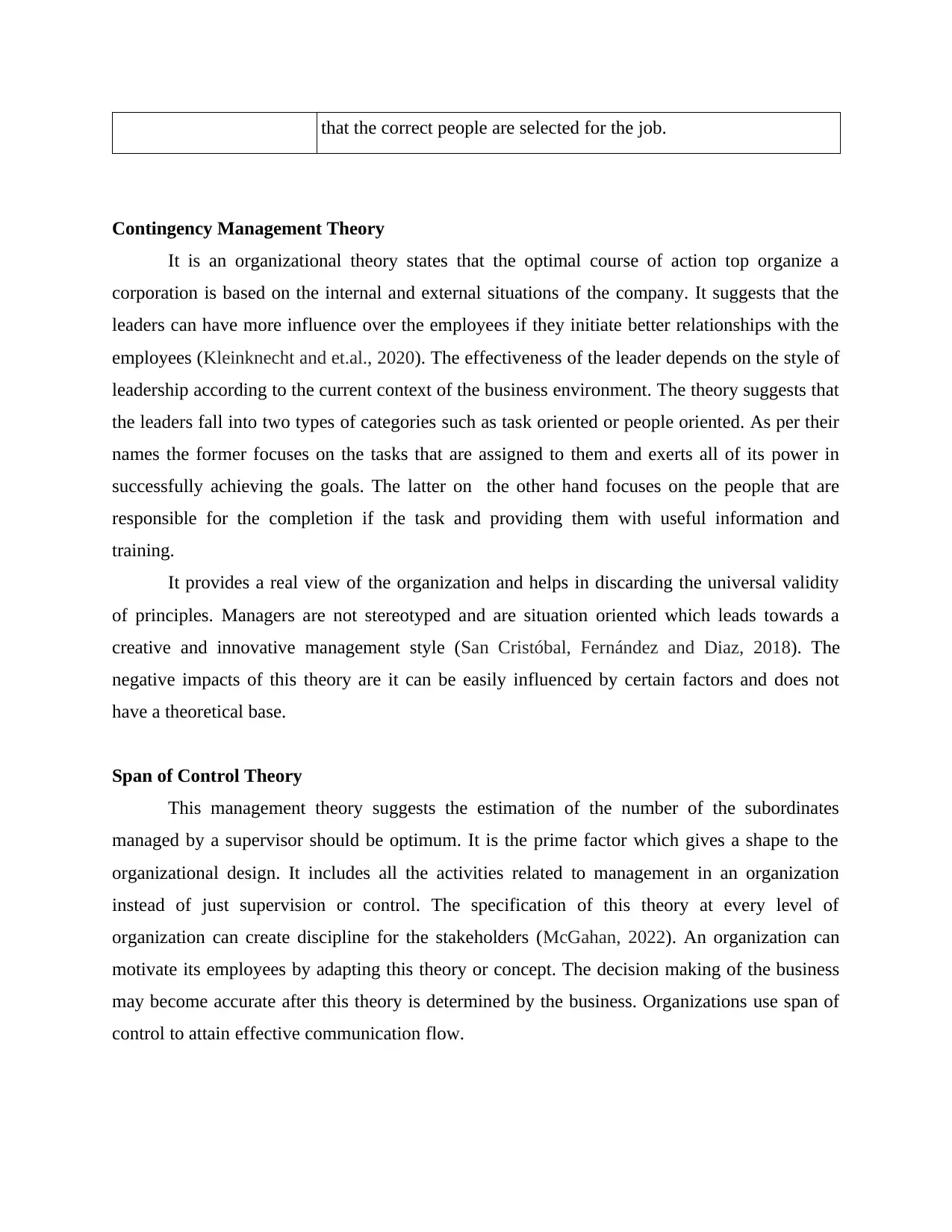
that the correct people are selected for the job.
Contingency Management Theory
It is an organizational theory states that the optimal course of action top organize a
corporation is based on the internal and external situations of the company. It suggests that the
leaders can have more influence over the employees if they initiate better relationships with the
employees (Kleinknecht and et.al., 2020). The effectiveness of the leader depends on the style of
leadership according to the current context of the business environment. The theory suggests that
the leaders fall into two types of categories such as task oriented or people oriented. As per their
names the former focuses on the tasks that are assigned to them and exerts all of its power in
successfully achieving the goals. The latter on the other hand focuses on the people that are
responsible for the completion if the task and providing them with useful information and
training.
It provides a real view of the organization and helps in discarding the universal validity
of principles. Managers are not stereotyped and are situation oriented which leads towards a
creative and innovative management style (San Cristóbal, Fernández and Diaz, 2018). The
negative impacts of this theory are it can be easily influenced by certain factors and does not
have a theoretical base.
Span of Control Theory
This management theory suggests the estimation of the number of the subordinates
managed by a supervisor should be optimum. It is the prime factor which gives a shape to the
organizational design. It includes all the activities related to management in an organization
instead of just supervision or control. The specification of this theory at every level of
organization can create discipline for the stakeholders (McGahan, 2022). An organization can
motivate its employees by adapting this theory or concept. The decision making of the business
may become accurate after this theory is determined by the business. Organizations use span of
control to attain effective communication flow.
Contingency Management Theory
It is an organizational theory states that the optimal course of action top organize a
corporation is based on the internal and external situations of the company. It suggests that the
leaders can have more influence over the employees if they initiate better relationships with the
employees (Kleinknecht and et.al., 2020). The effectiveness of the leader depends on the style of
leadership according to the current context of the business environment. The theory suggests that
the leaders fall into two types of categories such as task oriented or people oriented. As per their
names the former focuses on the tasks that are assigned to them and exerts all of its power in
successfully achieving the goals. The latter on the other hand focuses on the people that are
responsible for the completion if the task and providing them with useful information and
training.
It provides a real view of the organization and helps in discarding the universal validity
of principles. Managers are not stereotyped and are situation oriented which leads towards a
creative and innovative management style (San Cristóbal, Fernández and Diaz, 2018). The
negative impacts of this theory are it can be easily influenced by certain factors and does not
have a theoretical base.
Span of Control Theory
This management theory suggests the estimation of the number of the subordinates
managed by a supervisor should be optimum. It is the prime factor which gives a shape to the
organizational design. It includes all the activities related to management in an organization
instead of just supervision or control. The specification of this theory at every level of
organization can create discipline for the stakeholders (McGahan, 2022). An organization can
motivate its employees by adapting this theory or concept. The decision making of the business
may become accurate after this theory is determined by the business. Organizations use span of
control to attain effective communication flow.
⊘ This is a preview!⊘
Do you want full access?
Subscribe today to unlock all pages.
Trusted by 1+ million students worldwide
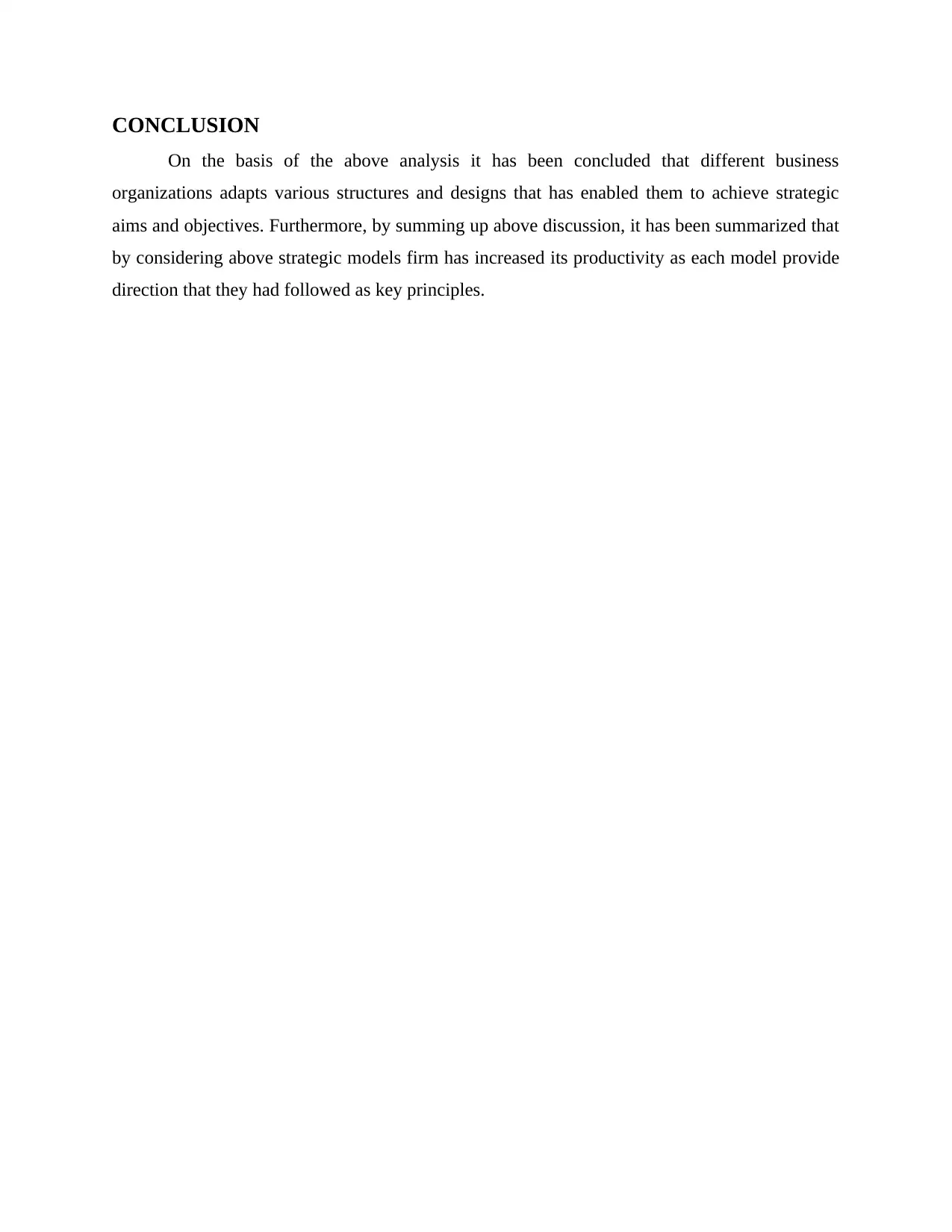
CONCLUSION
On the basis of the above analysis it has been concluded that different business
organizations adapts various structures and designs that has enabled them to achieve strategic
aims and objectives. Furthermore, by summing up above discussion, it has been summarized that
by considering above strategic models firm has increased its productivity as each model provide
direction that they had followed as key principles.
On the basis of the above analysis it has been concluded that different business
organizations adapts various structures and designs that has enabled them to achieve strategic
aims and objectives. Furthermore, by summing up above discussion, it has been summarized that
by considering above strategic models firm has increased its productivity as each model provide
direction that they had followed as key principles.
Paraphrase This Document
Need a fresh take? Get an instant paraphrase of this document with our AI Paraphraser
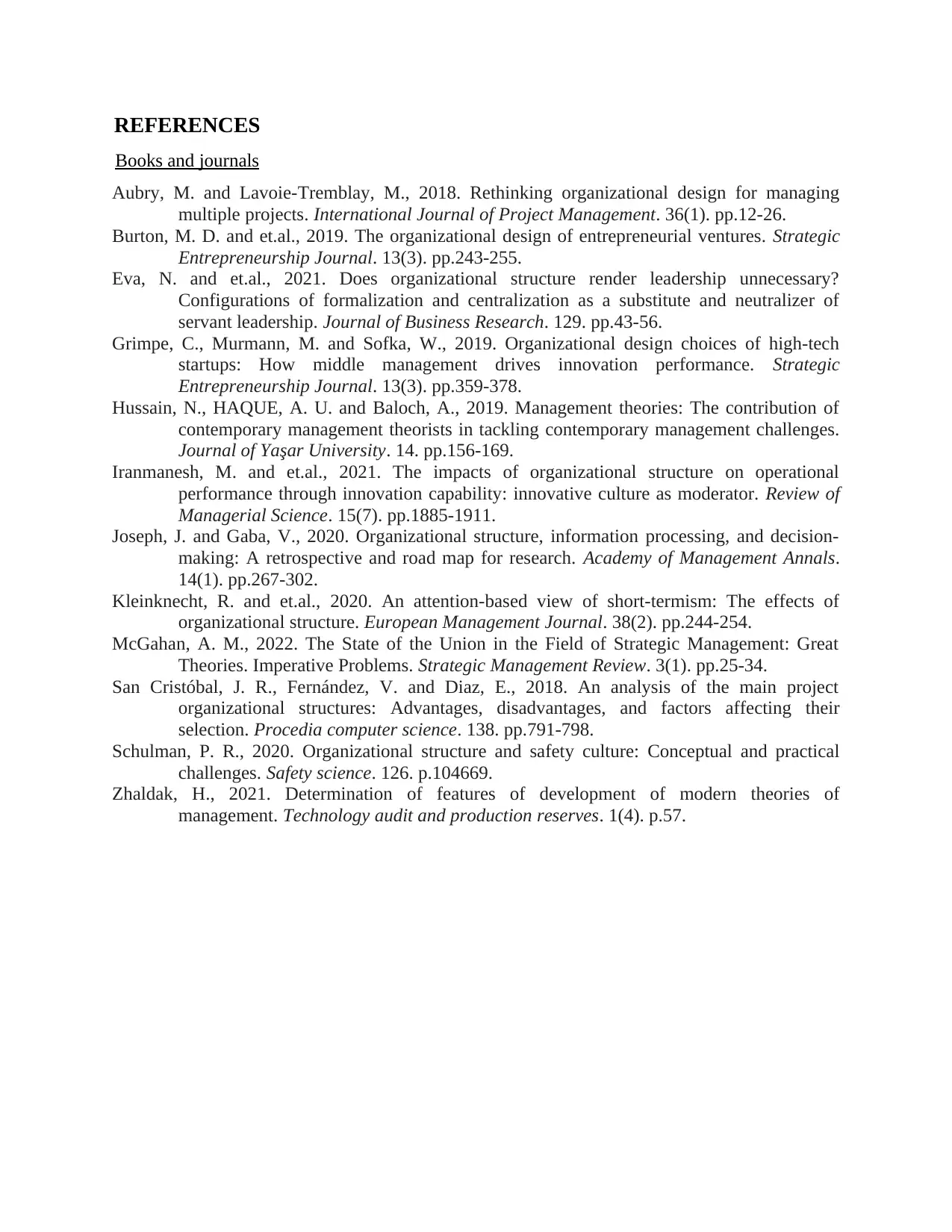
REFERENCES
Books and journals
Aubry, M. and Lavoie-Tremblay, M., 2018. Rethinking organizational design for managing
multiple projects. International Journal of Project Management. 36(1). pp.12-26.
Burton, M. D. and et.al., 2019. The organizational design of entrepreneurial ventures. Strategic
Entrepreneurship Journal. 13(3). pp.243-255.
Eva, N. and et.al., 2021. Does organizational structure render leadership unnecessary?
Configurations of formalization and centralization as a substitute and neutralizer of
servant leadership. Journal of Business Research. 129. pp.43-56.
Grimpe, C., Murmann, M. and Sofka, W., 2019. Organizational design choices of high‐tech
startups: How middle management drives innovation performance. Strategic
Entrepreneurship Journal. 13(3). pp.359-378.
Hussain, N., HAQUE, A. U. and Baloch, A., 2019. Management theories: The contribution of
contemporary management theorists in tackling contemporary management challenges.
Journal of Yaşar University. 14. pp.156-169.
Iranmanesh, M. and et.al., 2021. The impacts of organizational structure on operational
performance through innovation capability: innovative culture as moderator. Review of
Managerial Science. 15(7). pp.1885-1911.
Joseph, J. and Gaba, V., 2020. Organizational structure, information processing, and decision-
making: A retrospective and road map for research. Academy of Management Annals.
14(1). pp.267-302.
Kleinknecht, R. and et.al., 2020. An attention-based view of short-termism: The effects of
organizational structure. European Management Journal. 38(2). pp.244-254.
McGahan, A. M., 2022. The State of the Union in the Field of Strategic Management: Great
Theories. Imperative Problems. Strategic Management Review. 3(1). pp.25-34.
San Cristóbal, J. R., Fernández, V. and Diaz, E., 2018. An analysis of the main project
organizational structures: Advantages, disadvantages, and factors affecting their
selection. Procedia computer science. 138. pp.791-798.
Schulman, P. R., 2020. Organizational structure and safety culture: Conceptual and practical
challenges. Safety science. 126. p.104669.
Zhaldak, H., 2021. Determination of features of development of modern theories of
management. Technology audit and production reserves. 1(4). p.57.
Books and journals
Aubry, M. and Lavoie-Tremblay, M., 2018. Rethinking organizational design for managing
multiple projects. International Journal of Project Management. 36(1). pp.12-26.
Burton, M. D. and et.al., 2019. The organizational design of entrepreneurial ventures. Strategic
Entrepreneurship Journal. 13(3). pp.243-255.
Eva, N. and et.al., 2021. Does organizational structure render leadership unnecessary?
Configurations of formalization and centralization as a substitute and neutralizer of
servant leadership. Journal of Business Research. 129. pp.43-56.
Grimpe, C., Murmann, M. and Sofka, W., 2019. Organizational design choices of high‐tech
startups: How middle management drives innovation performance. Strategic
Entrepreneurship Journal. 13(3). pp.359-378.
Hussain, N., HAQUE, A. U. and Baloch, A., 2019. Management theories: The contribution of
contemporary management theorists in tackling contemporary management challenges.
Journal of Yaşar University. 14. pp.156-169.
Iranmanesh, M. and et.al., 2021. The impacts of organizational structure on operational
performance through innovation capability: innovative culture as moderator. Review of
Managerial Science. 15(7). pp.1885-1911.
Joseph, J. and Gaba, V., 2020. Organizational structure, information processing, and decision-
making: A retrospective and road map for research. Academy of Management Annals.
14(1). pp.267-302.
Kleinknecht, R. and et.al., 2020. An attention-based view of short-termism: The effects of
organizational structure. European Management Journal. 38(2). pp.244-254.
McGahan, A. M., 2022. The State of the Union in the Field of Strategic Management: Great
Theories. Imperative Problems. Strategic Management Review. 3(1). pp.25-34.
San Cristóbal, J. R., Fernández, V. and Diaz, E., 2018. An analysis of the main project
organizational structures: Advantages, disadvantages, and factors affecting their
selection. Procedia computer science. 138. pp.791-798.
Schulman, P. R., 2020. Organizational structure and safety culture: Conceptual and practical
challenges. Safety science. 126. p.104669.
Zhaldak, H., 2021. Determination of features of development of modern theories of
management. Technology audit and production reserves. 1(4). p.57.

⊘ This is a preview!⊘
Do you want full access?
Subscribe today to unlock all pages.
Trusted by 1+ million students worldwide

1 out of 13


Related Documents


Your All-in-One AI-Powered Toolkit for Academic Success.
+13062052269
info@desklib.com
Available 24*7 on WhatsApp / Email
![[object Object]](/_next/static/media/star-bottom.7253800d.svg)
Unlock your academic potential
Copyright © 2020–2025 A2Z Services. All Rights Reserved. Developed and managed by ZUCOL.