Swinburne EDU40002: Report on Early Childhood Play Environment Design
VerifiedAdded on 2022/09/05
|10
|2414
|14
Report
AI Summary
This report provides a detailed analysis of early childhood play environments, covering both 0-5 and 5-8 year age groups. It emphasizes the importance of play-based learning, incorporating natural materials, and creating open-ended play spaces. The report explores key features such as access to play equipment, the use of natural and open-ended resources, and the role of aesthetics and creativity in fostering children's development. It also examines the Early Years Foundation Stage (EYFS) framework and how it supports play-based learning. The report further discusses the importance of natural features, such as herbs, shrubs, and water, in enhancing children's creativity and sensory experiences, while also providing floor plan considerations for different age groups and detailed insights into the aesthetic and creative features of a play environment. The report incorporates references to key readings and resources, offering a comprehensive overview of designing effective and engaging play environments for young children.
EARLY CHILDHOOD PLAN (0-5 Years)
Overview and description:
Young children really are sunk in a world of senses. One can gain much understanding by
trying to attune themselves to the sensory environment nearby the children. That kind of
‘tuning in’ change taking a child for a walk from simply a breath of fresh air into
experiencing fields of colour, sounds and smells; it changes looking at the ceiling to
absorbing a light show of dappled sunlight and shadows.
We can make use of the physical and sensory environment by, for example, how we position
children in relation to shade, light, sound, temperature and colour and making change to suit
the needs of the child. Especially for children who are dependent on adults to move and
position them, we should consider whether they are spending their days in very repetitive
environments with the same colours, range of sounds and smells or whether we have created
enough variation and stimulation.
Key features of play and environment
i) Nature inspires beauty- As we know play natural materials are special treasure to
enhance creativity of the children such as plants, rocks, logs, bark, sticks,
smelling, herbs, shells, pebbles, Knotted logs, Mini pine cones and seed pods etc.
ii) Colour generates interest- New born babies 0-3 years are immersed in world of
senses. They identify most of the things by colour and texture.
iii) Enhance display of play environment By arranging storage materials, eliminating
clutter, and highlighting children’s work classroom becomes great space of joy
iv) Elements highlight atmosphere- Creative use of light is the effective way for
children are able to interact with peers and environment.
Overview and description:
Young children really are sunk in a world of senses. One can gain much understanding by
trying to attune themselves to the sensory environment nearby the children. That kind of
‘tuning in’ change taking a child for a walk from simply a breath of fresh air into
experiencing fields of colour, sounds and smells; it changes looking at the ceiling to
absorbing a light show of dappled sunlight and shadows.
We can make use of the physical and sensory environment by, for example, how we position
children in relation to shade, light, sound, temperature and colour and making change to suit
the needs of the child. Especially for children who are dependent on adults to move and
position them, we should consider whether they are spending their days in very repetitive
environments with the same colours, range of sounds and smells or whether we have created
enough variation and stimulation.
Key features of play and environment
i) Nature inspires beauty- As we know play natural materials are special treasure to
enhance creativity of the children such as plants, rocks, logs, bark, sticks,
smelling, herbs, shells, pebbles, Knotted logs, Mini pine cones and seed pods etc.
ii) Colour generates interest- New born babies 0-3 years are immersed in world of
senses. They identify most of the things by colour and texture.
iii) Enhance display of play environment By arranging storage materials, eliminating
clutter, and highlighting children’s work classroom becomes great space of joy
iv) Elements highlight atmosphere- Creative use of light is the effective way for
children are able to interact with peers and environment.

Paraphrase This Document
Need a fresh take? Get an instant paraphrase of this document with our AI Paraphraser
Aesthetic and creative features of play environment
While creating play area we focus on following four features:
Play–based learning
Open-ended play spaces
Access to play equipment and
Natural and open-ended resources
These attribute enhance children’s play experiences, enabling them to show the
Characteristics of Effective Learning (CEL). These features provide excellent settings for the
early years as described by OFSTED guidance.
Play-based learning
The Early Year Foundation Stage EYFS gives emphasis on learning based on play in the
early years, whole area of learning and development need to be designed through a planned,
purposeful way managed and led by adults and child friendly events. Play helps in building
their personality as they gain an understanding to explore and interact with others. Casey, T.
(2007)
Open-ended play spaces
Every child has its own speed of catching particular thing if they are given the freedom to
choose the resources and choice should be at their own level. They must be given freedom
and must not be criticised for not learning a particular task at slow speed.
Access to play equipment
We need to find the requirements and respond to a request and give inspiring resources in a
way that is accessible to the children. Good observation will help in identifying the children’s
interests, where additional resources might improve or extend the play.
Natural and open-ended resources
While creating play area we focus on following four features:
Play–based learning
Open-ended play spaces
Access to play equipment and
Natural and open-ended resources
These attribute enhance children’s play experiences, enabling them to show the
Characteristics of Effective Learning (CEL). These features provide excellent settings for the
early years as described by OFSTED guidance.
Play-based learning
The Early Year Foundation Stage EYFS gives emphasis on learning based on play in the
early years, whole area of learning and development need to be designed through a planned,
purposeful way managed and led by adults and child friendly events. Play helps in building
their personality as they gain an understanding to explore and interact with others. Casey, T.
(2007)
Open-ended play spaces
Every child has its own speed of catching particular thing if they are given the freedom to
choose the resources and choice should be at their own level. They must be given freedom
and must not be criticised for not learning a particular task at slow speed.
Access to play equipment
We need to find the requirements and respond to a request and give inspiring resources in a
way that is accessible to the children. Good observation will help in identifying the children’s
interests, where additional resources might improve or extend the play.
Natural and open-ended resources
An ample amount of these resources should be incorporated in play environment, as they are
found to be important in developing effective learning critical thinking and creative. Natural
products such as pebbles, stones, wood logs, shells, flowers, seeds, plants, cones and
branches, long grasses and more are all easily assessable for use indoors and outside. Adding
some ‘loose parts’ such as glass beads, tyres and wheels, washers, nuts and bolts, and small
world people and animals will enhance children’s work with water, sand, mud, compost,
paper shredding, clay, dough or other malleable materials.
Nature and natural materials in play environment
These resources are found to be effective in learning and creative thinking. If you take the
children on regular walks in your locality, and also encourage them to bring objects from
week off days and family walks, these resources can be topped up easily.
Natural features such as herbs and shrubs, long grass, water, stones, logs are excellent method
of gaining many of the benefits from centre of interest, shelter and flexibility (Milchen,
2010). With their visual, tactile and auditory qualities, they can help children to enhance their
creativity and imaginative powers.
Natural features such as bushes, up and down gradient help to give shelter and lessen the
effects of some of the difficulty related to senses children might encounter. They also act as a
landmark that helps children to locate themselves. Natural features are designed to give
children a feeling of privacy while in spaces that can be looked after from a distance. (Tovey,
2007)'
found to be important in developing effective learning critical thinking and creative. Natural
products such as pebbles, stones, wood logs, shells, flowers, seeds, plants, cones and
branches, long grasses and more are all easily assessable for use indoors and outside. Adding
some ‘loose parts’ such as glass beads, tyres and wheels, washers, nuts and bolts, and small
world people and animals will enhance children’s work with water, sand, mud, compost,
paper shredding, clay, dough or other malleable materials.
Nature and natural materials in play environment
These resources are found to be effective in learning and creative thinking. If you take the
children on regular walks in your locality, and also encourage them to bring objects from
week off days and family walks, these resources can be topped up easily.
Natural features such as herbs and shrubs, long grass, water, stones, logs are excellent method
of gaining many of the benefits from centre of interest, shelter and flexibility (Milchen,
2010). With their visual, tactile and auditory qualities, they can help children to enhance their
creativity and imaginative powers.
Natural features such as bushes, up and down gradient help to give shelter and lessen the
effects of some of the difficulty related to senses children might encounter. They also act as a
landmark that helps children to locate themselves. Natural features are designed to give
children a feeling of privacy while in spaces that can be looked after from a distance. (Tovey,
2007)'
⊘ This is a preview!⊘
Do you want full access?
Subscribe today to unlock all pages.

Trusted by 1+ million students worldwide
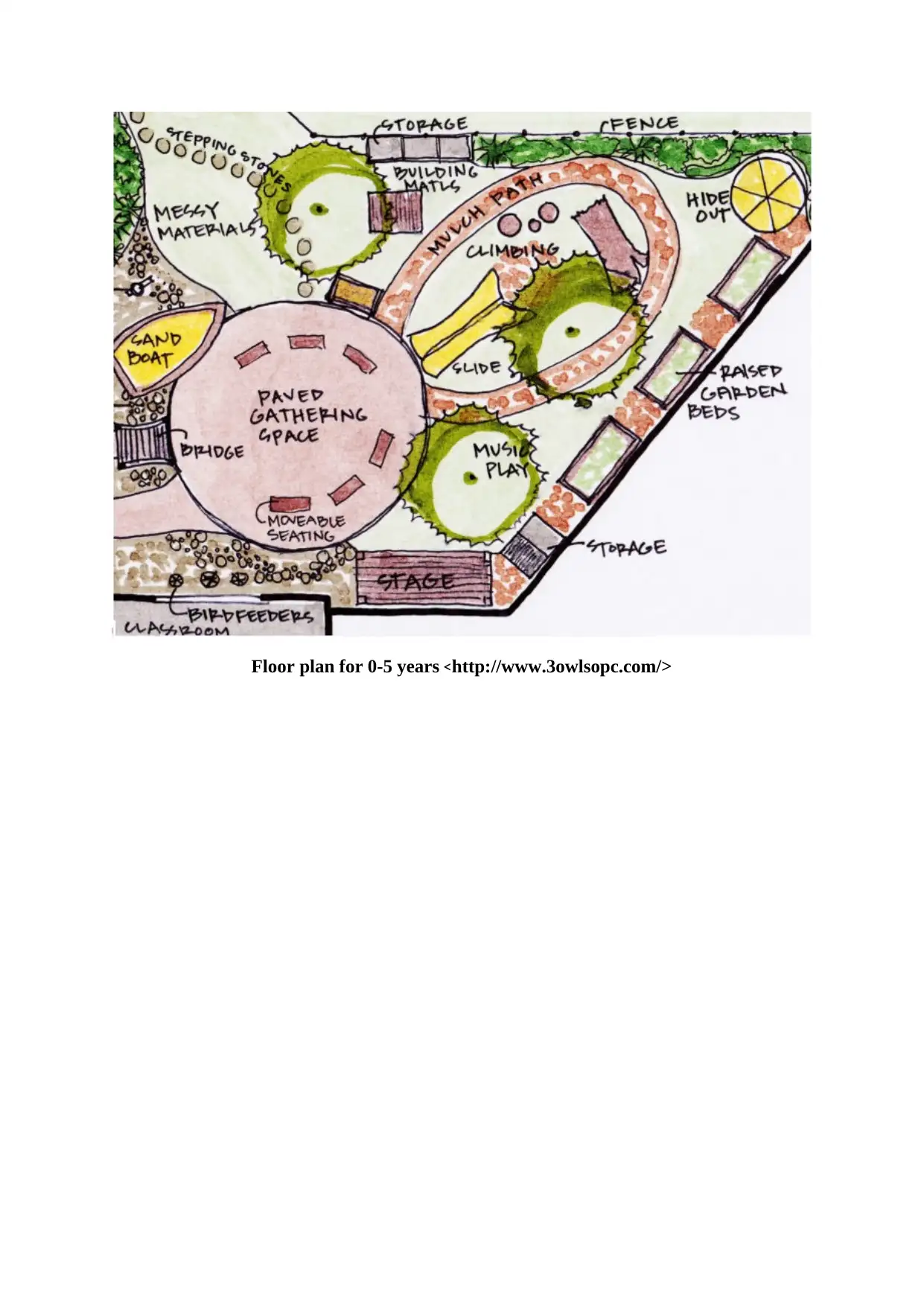
Floor plan for 0-5 years <http://www.3owlsopc.com/>
Paraphrase This Document
Need a fresh take? Get an instant paraphrase of this document with our AI Paraphraser
Plan for early childhood (5-8 Years old)
Overview and description
Play based approach is supported by The Early Years Learning Framework for Australia
(EYLF) (DEEWR, 2009). There are some basics on which design of play environment is
based such as earth, water, sand, changing weather, natural cycles fire, and people to interact
with. (Casey, 2010)
A number of principles and parameter can be applied to settings to provide for play (with new
designs or upgrades of existing provision). The specifics of such guidance vary.
For example, the areas to consider suggested by Stirling Council’s design guide (Gutteridge
et al., 2007) are useful and can be summarized as:
i) Access (including maximum possible integration between indoors and outdoors),
storage (for outdoor equipment) and surfaces (coarse sand, trimmed grass, bark, etc.,
safe surfaces should be mostly used)
ii) Space (dealing with negotiating adequate space and creative solutions for shared
space) and boundaries (to create a secure space)
iii) Levelling (with a change of perspective and height)
iv) Malleable materials (sand offers a variety of play like making shapes, images etc.
from it.
v) Water ( playing with is a great mean of joy to children)
vi) Shade and shelter
vii) Seating and perches (fallen tree trunks and story circles to boulders, etc.)
viii) Autonomy, supervision and care (balancing need, autonomy and privacy with
instruction given by adults).
ix) Challenge is what children needs while playing.
Overview and description
Play based approach is supported by The Early Years Learning Framework for Australia
(EYLF) (DEEWR, 2009). There are some basics on which design of play environment is
based such as earth, water, sand, changing weather, natural cycles fire, and people to interact
with. (Casey, 2010)
A number of principles and parameter can be applied to settings to provide for play (with new
designs or upgrades of existing provision). The specifics of such guidance vary.
For example, the areas to consider suggested by Stirling Council’s design guide (Gutteridge
et al., 2007) are useful and can be summarized as:
i) Access (including maximum possible integration between indoors and outdoors),
storage (for outdoor equipment) and surfaces (coarse sand, trimmed grass, bark, etc.,
safe surfaces should be mostly used)
ii) Space (dealing with negotiating adequate space and creative solutions for shared
space) and boundaries (to create a secure space)
iii) Levelling (with a change of perspective and height)
iv) Malleable materials (sand offers a variety of play like making shapes, images etc.
from it.
v) Water ( playing with is a great mean of joy to children)
vi) Shade and shelter
vii) Seating and perches (fallen tree trunks and story circles to boulders, etc.)
viii) Autonomy, supervision and care (balancing need, autonomy and privacy with
instruction given by adults).
ix) Challenge is what children needs while playing.
Aesthetic and creative features of play environment
Creativity is largely dependent on environment in which child learn. We know that the
physical, direct experiences children have are basics of their learning about a sense of self
through realization and connectedness to others; and we also know that these are the bases of
behaviour and creativity of all kinds. Creative feature of play environment that invite
engagement are. (Bruce, 2011)
i) Creative entrance area - The first thing the children will see will be the entrance
area. Buildings are often full of nooks and crannies, which are very appealing to
children.
ii) Creative use of rooms
iii) Book room- The book area should be warm, light and cosy.
iv) Wooden unit blocks- This is a good way forward where space is at such a
premium. It makes sense to have this provision outside, because this is the only
place where there is the space to make large constructions.
v) Workshop area- The workshop area is usually placed near to the woodwork area.
There is usually a table with basic equipment on it, such as gums, masking tape,
cello tape, colour pencils for labelling or decorating, left- and right-handed
scissors. There might be shelves next to the table with enticing boxes with
materials that can be used for collage or model-making.
vi) Drawing and painting area- There are times when children want to paint and want
to find the colours and paper available and ready to use.
vii) Garden- In one of the settings, the first areas of provision that children will see as
they go outside.
viii) Sand and digging areas- Sand area is a great place of joy and the senses with water
for mixing plus pebbles, fresh smelling herbs, pinecones, leaves and flowers to be
used for 'cooking' ingredients.
Nature and natural materials in play environment
Play environment’s natural features like smelling herbs, long grass, water, loose stones, tree
logs are best way of attaining many of the benefits obtained from centres of interest, shelter
Creativity is largely dependent on environment in which child learn. We know that the
physical, direct experiences children have are basics of their learning about a sense of self
through realization and connectedness to others; and we also know that these are the bases of
behaviour and creativity of all kinds. Creative feature of play environment that invite
engagement are. (Bruce, 2011)
i) Creative entrance area - The first thing the children will see will be the entrance
area. Buildings are often full of nooks and crannies, which are very appealing to
children.
ii) Creative use of rooms
iii) Book room- The book area should be warm, light and cosy.
iv) Wooden unit blocks- This is a good way forward where space is at such a
premium. It makes sense to have this provision outside, because this is the only
place where there is the space to make large constructions.
v) Workshop area- The workshop area is usually placed near to the woodwork area.
There is usually a table with basic equipment on it, such as gums, masking tape,
cello tape, colour pencils for labelling or decorating, left- and right-handed
scissors. There might be shelves next to the table with enticing boxes with
materials that can be used for collage or model-making.
vi) Drawing and painting area- There are times when children want to paint and want
to find the colours and paper available and ready to use.
vii) Garden- In one of the settings, the first areas of provision that children will see as
they go outside.
viii) Sand and digging areas- Sand area is a great place of joy and the senses with water
for mixing plus pebbles, fresh smelling herbs, pinecones, leaves and flowers to be
used for 'cooking' ingredients.
Nature and natural materials in play environment
Play environment’s natural features like smelling herbs, long grass, water, loose stones, tree
logs are best way of attaining many of the benefits obtained from centres of interest, shelter
⊘ This is a preview!⊘
Do you want full access?
Subscribe today to unlock all pages.
Trusted by 1+ million students worldwide
and flexibility. With their auditory, haptic and visual qualities, these features provide, softer
environment than a harder, built environment.
Natural constituents such as shrubs and slopes assist to provide shelter and soften the effects
of some of the sensory difficulties children might feel. (Rosback, & Coulson, 2015)
Creative outputs of children such as planting, paintings, sculptures, installations should be
fused into the environment whenever situation arises. When an environment is working,
children’s creativity enhances which can be practiced by making sculptures made from found
objects; images made into the soil; dens, bridges, mazes and tunnels constructed.
Boundaries can be made from varied logs, raised beds and wooden material, and hedgerows
(a good resource in themselves as wildlife habitats), while climbing plants can be trained over
wire fencing.
Features of the space, including particular age group, nature of environment (indoor &
outdoor), and objectives of the plan
Looking through a play ‘lens’ is fundamental – a space for play is not the same as an outside
classroom or a garden, even if they share some of the same qualities and have the potential to
offer similar experiences. This can be used to stimulate thought on the current or future
dimensions of the play space available.
Criteria for a good play environment include:
i) Creative physical environment
ii) Challenge is what children needs in physical environment
iii) Giving importance on playing with natural entities like fire, earth, water etc.
iv) Movement helps in enhancing creativity these movement may be, jumping, running,
balancing and climbing
v) Changing natural and artificial materials
vi) Incitement of the senses
vii) Stimulation of the natural and manmade environment
viii) Interaction with other
ix) Enjoy oneself
x) Experiencing variety of emotions.
environment than a harder, built environment.
Natural constituents such as shrubs and slopes assist to provide shelter and soften the effects
of some of the sensory difficulties children might feel. (Rosback, & Coulson, 2015)
Creative outputs of children such as planting, paintings, sculptures, installations should be
fused into the environment whenever situation arises. When an environment is working,
children’s creativity enhances which can be practiced by making sculptures made from found
objects; images made into the soil; dens, bridges, mazes and tunnels constructed.
Boundaries can be made from varied logs, raised beds and wooden material, and hedgerows
(a good resource in themselves as wildlife habitats), while climbing plants can be trained over
wire fencing.
Features of the space, including particular age group, nature of environment (indoor &
outdoor), and objectives of the plan
Looking through a play ‘lens’ is fundamental – a space for play is not the same as an outside
classroom or a garden, even if they share some of the same qualities and have the potential to
offer similar experiences. This can be used to stimulate thought on the current or future
dimensions of the play space available.
Criteria for a good play environment include:
i) Creative physical environment
ii) Challenge is what children needs in physical environment
iii) Giving importance on playing with natural entities like fire, earth, water etc.
iv) Movement helps in enhancing creativity these movement may be, jumping, running,
balancing and climbing
v) Changing natural and artificial materials
vi) Incitement of the senses
vii) Stimulation of the natural and manmade environment
viii) Interaction with other
ix) Enjoy oneself
x) Experiencing variety of emotions.
Paraphrase This Document
Need a fresh take? Get an instant paraphrase of this document with our AI Paraphraser
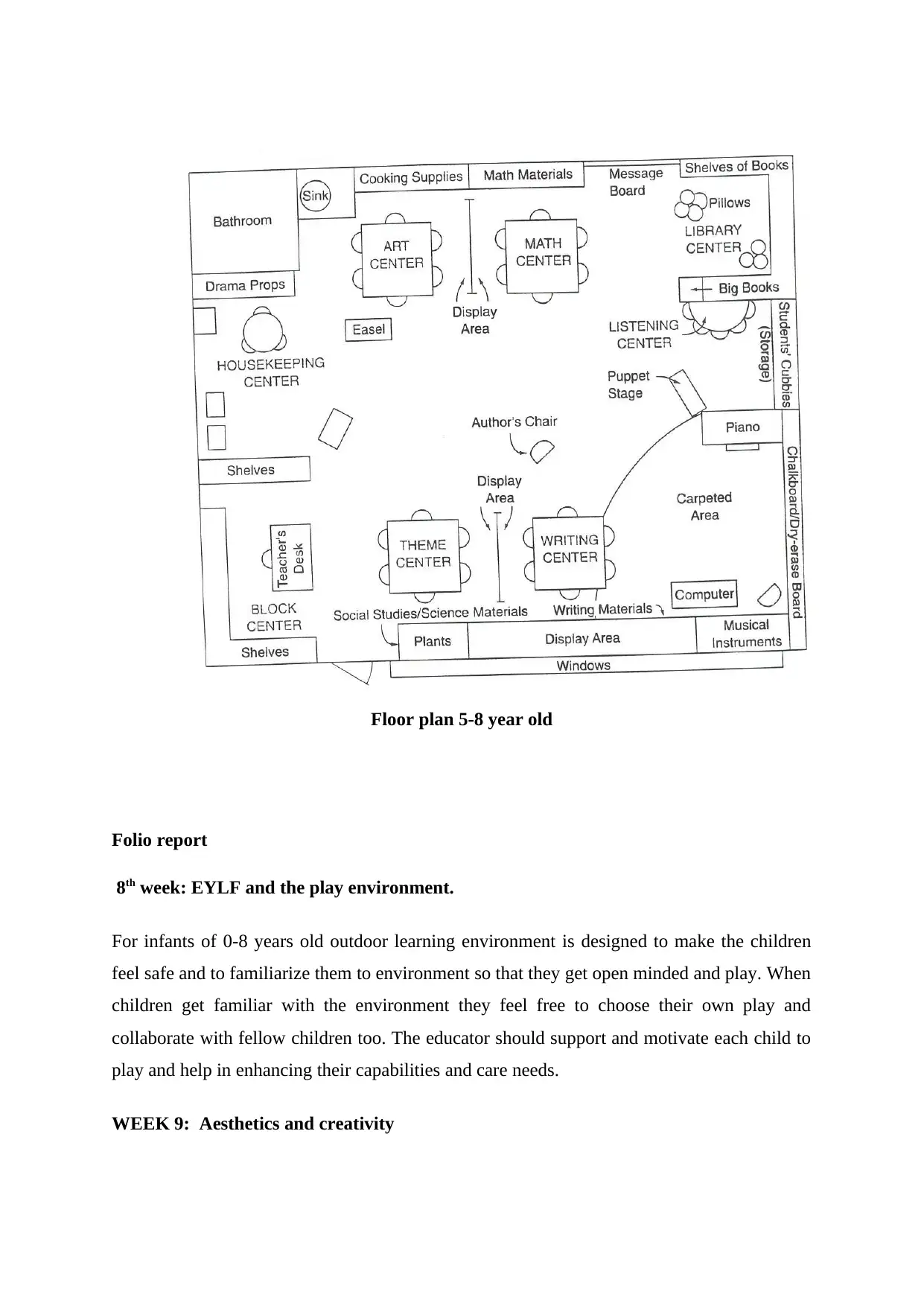
Floor plan 5-8 year old
Folio report
8th week: EYLF and the play environment.
For infants of 0-8 years old outdoor learning environment is designed to make the children
feel safe and to familiarize them to environment so that they get open minded and play. When
children get familiar with the environment they feel free to choose their own play and
collaborate with fellow children too. The educator should support and motivate each child to
play and help in enhancing their capabilities and care needs.
WEEK 9: Aesthetics and creativity
Folio report
8th week: EYLF and the play environment.
For infants of 0-8 years old outdoor learning environment is designed to make the children
feel safe and to familiarize them to environment so that they get open minded and play. When
children get familiar with the environment they feel free to choose their own play and
collaborate with fellow children too. The educator should support and motivate each child to
play and help in enhancing their capabilities and care needs.
WEEK 9: Aesthetics and creativity
With support and motivation from teacher as well as parent child can improve aesthetic and
creativity. Children feel free to express them when they are engaged in dancing, listening to
music, reading literature and involved in creative role play.
Week 10
Features of nature, natural materials and outdoor play spaces
A well designed play spaces necessitates open ended and flexible features incorporated with
small play area for various activities such as creative play area, drawing, dancing, making
sculptures on sand, exploring with natural resources, quiet play areas for reading books.
Open-ended materials and resources insist children to, make new discoveries and build new
connections between past and new experience. They can support children’s development in
every area and help them to choose, insist them to use of their knowledge and skills, tackle
problem, and be imaginative, creative and innovative. A variety of these materials also offer
them flexibility to meet children’s learning needs from various backgrounds.
Week 11
Incorporation of resources and materials into the play environment
Adequate supervision by educators at all times need to be provided in play environment from
a distance is must so that requirements of both supervision and adult free environment for is
achieved. Play environment must consist a large variety of activities that are so arranged that
it can support individual learning ability and requirements according to their age. A well
designed play spaces necessitates an intelligent control where children’s learning takes place,
as infants are learn via senses only who use their senses of smell, taste, touch, visuals and
hearing to observe the surroundings nearby.
creativity. Children feel free to express them when they are engaged in dancing, listening to
music, reading literature and involved in creative role play.
Week 10
Features of nature, natural materials and outdoor play spaces
A well designed play spaces necessitates open ended and flexible features incorporated with
small play area for various activities such as creative play area, drawing, dancing, making
sculptures on sand, exploring with natural resources, quiet play areas for reading books.
Open-ended materials and resources insist children to, make new discoveries and build new
connections between past and new experience. They can support children’s development in
every area and help them to choose, insist them to use of their knowledge and skills, tackle
problem, and be imaginative, creative and innovative. A variety of these materials also offer
them flexibility to meet children’s learning needs from various backgrounds.
Week 11
Incorporation of resources and materials into the play environment
Adequate supervision by educators at all times need to be provided in play environment from
a distance is must so that requirements of both supervision and adult free environment for is
achieved. Play environment must consist a large variety of activities that are so arranged that
it can support individual learning ability and requirements according to their age. A well
designed play spaces necessitates an intelligent control where children’s learning takes place,
as infants are learn via senses only who use their senses of smell, taste, touch, visuals and
hearing to observe the surroundings nearby.
⊘ This is a preview!⊘
Do you want full access?
Subscribe today to unlock all pages.
Trusted by 1+ million students worldwide
References
Casey, T. (2010). Practical Strategies for Children from Birth to Eight. Retrieved from
http://ebookcentral.proquest.com/lib/swin/detail.action?docID=743635
Bruce, T. (2011). Cultivating Creativity : Toddlers and Young Children. Retrieved from
http://ebookcentral.proquest.com/lib/swin/detail.action?docID=771714
Rosback, S. & Coulson, N. (2015). Inspiring play space. Retrieved from
http://ebookcentral.proquest.com
Casey, T. (2007) Environments for Outdoor Play: A Practical Guide to Making Space
for Children. London: Sage
Nutbrown, C. (2005). Key concepts in early childhood education and care. Retrieved from
http://ebookcentral.proquest.com
Devlin, D. (2012). valuing-play-early-years-learning-framework-schools. Retrieved from
http://www.earlychildhoodaustralia.org.au.
Milchen, K. (2010). Reconnecting with nature through Froebelian pedagogy, early childhood
practice. The Urban Forest School, 11(1), 106-117.
Tovey, H. (2007). Playing Outdoors: Spaces and Places, Risk and Challenge. (1 ed.).
Maidenhead: Open University Press. 15-29.
Casey, T. (2010). Practical Strategies for Children from Birth to Eight. Retrieved from
http://ebookcentral.proquest.com/lib/swin/detail.action?docID=743635
Bruce, T. (2011). Cultivating Creativity : Toddlers and Young Children. Retrieved from
http://ebookcentral.proquest.com/lib/swin/detail.action?docID=771714
Rosback, S. & Coulson, N. (2015). Inspiring play space. Retrieved from
http://ebookcentral.proquest.com
Casey, T. (2007) Environments for Outdoor Play: A Practical Guide to Making Space
for Children. London: Sage
Nutbrown, C. (2005). Key concepts in early childhood education and care. Retrieved from
http://ebookcentral.proquest.com
Devlin, D. (2012). valuing-play-early-years-learning-framework-schools. Retrieved from
http://www.earlychildhoodaustralia.org.au.
Milchen, K. (2010). Reconnecting with nature through Froebelian pedagogy, early childhood
practice. The Urban Forest School, 11(1), 106-117.
Tovey, H. (2007). Playing Outdoors: Spaces and Places, Risk and Challenge. (1 ed.).
Maidenhead: Open University Press. 15-29.

1 out of 10


Related Documents


Your All-in-One AI-Powered Toolkit for Academic Success.
+13062052269
info@desklib.com
Available 24*7 on WhatsApp / Email
![[object Object]](/_next/static/media/star-bottom.7253800d.svg)
Unlock your academic potential
Copyright © 2020–2026 A2Z Services. All Rights Reserved. Developed and managed by ZUCOL.