Designing an Innovative Solution with Design Thinking
VerifiedAdded on 2020/04/07
|16
|3452
|162
AI Summary
This is a two-part assessment designed to evaluate students' ability to apply Design Thinking methods and project management tools. Initially, students must identify a relevant problem or opportunity that can be addressed through innovative design solutions. Using a variety of Design Thinking tools and methodologies, they will develop a novel concept aimed at improving, capturing, or solving the identified issue. The innovation could address social, service-oriented, commercial, or digital challenges. Following the development phase, students are required to use project planning techniques to devise a detailed launch readiness plan that outlines all necessary steps for bringing their innovation to market. This includes creating an oral presentation to showcase their Design Thinking process and drafting a comprehensive written report detailing the strategic pre-launch activities. Throughout this assessment, templates will be provided to facilitate planning tasks, ensuring students can effectively demonstrate their ability to translate ideas into actionable plans.

Running Head: DESIGN THINKING
Design Thinking
Name of the Student
Name of the University
Design Thinking
Name of the Student
Name of the University

Paraphrase This Document
Need a fresh take? Get an instant paraphrase of this document with our AI Paraphraser
1DESIGN THINKING
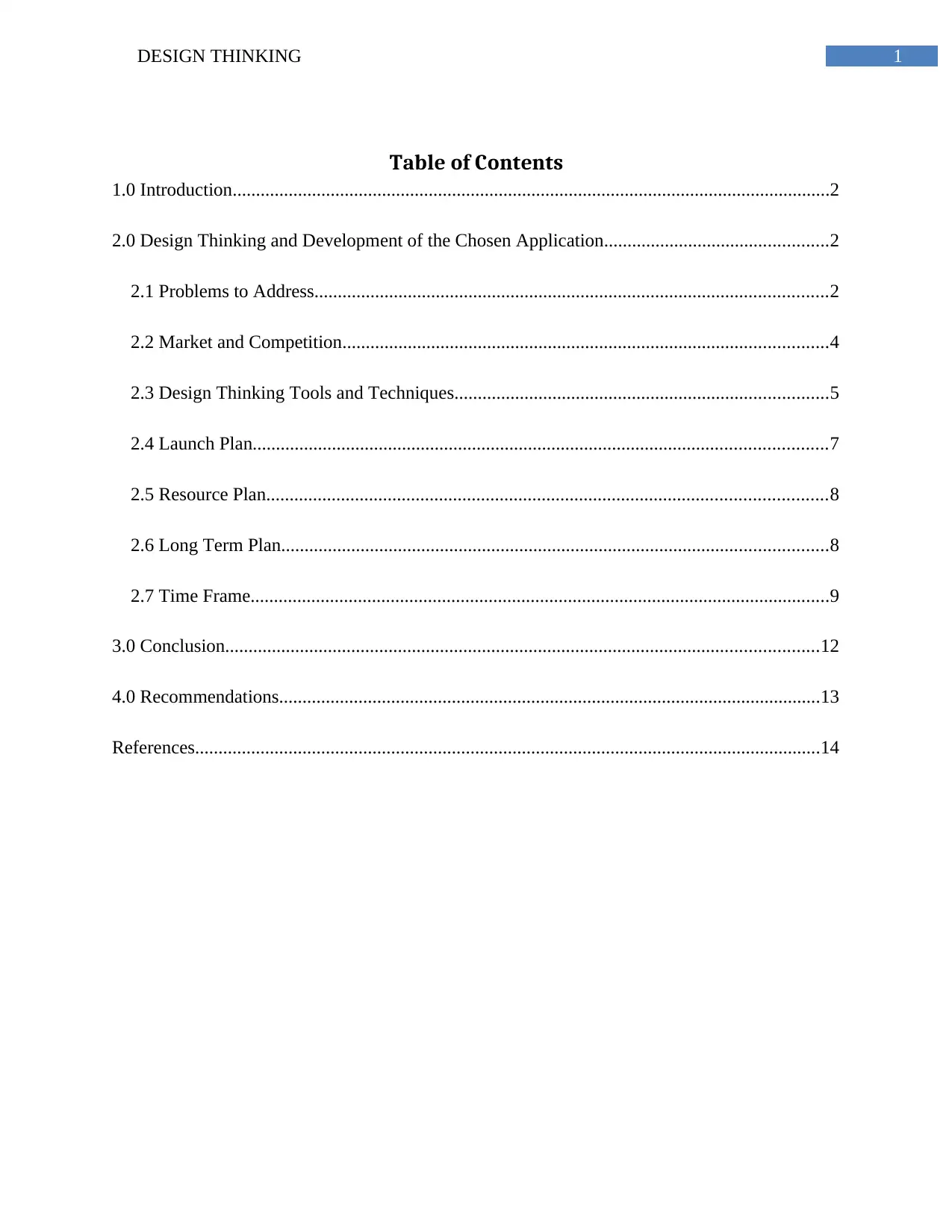
Table of Contents
1.0 Introduction................................................................................................................................2
2.0 Design Thinking and Development of the Chosen Application................................................2
2.1 Problems to Address..............................................................................................................2
2.2 Market and Competition........................................................................................................4
2.3 Design Thinking Tools and Techniques................................................................................5
2.4 Launch Plan...........................................................................................................................7
2.5 Resource Plan........................................................................................................................8
2.6 Long Term Plan.....................................................................................................................8
2.7 Time Frame............................................................................................................................9
3.0 Conclusion...............................................................................................................................12
4.0 Recommendations....................................................................................................................13
References......................................................................................................................................14
Table of Contents
1.0 Introduction................................................................................................................................2
2.0 Design Thinking and Development of the Chosen Application................................................2
2.1 Problems to Address..............................................................................................................2
2.2 Market and Competition........................................................................................................4
2.3 Design Thinking Tools and Techniques................................................................................5
2.4 Launch Plan...........................................................................................................................7
2.5 Resource Plan........................................................................................................................8
2.6 Long Term Plan.....................................................................................................................8
2.7 Time Frame............................................................................................................................9
3.0 Conclusion...............................................................................................................................12
4.0 Recommendations....................................................................................................................13
References......................................................................................................................................14
2DESIGN THINKING
1.0 Introduction
The scenario of the topic stated about inconvenience in doctor appointment booking.
Often scenario arises that patient wants to book appointment with doctor for hospitals and clinic;
they need to call the healthcare personnel for knowing doctors’ availability date and time (Behm,
Culvenor & Dixon, 2014). In case, the doctor is not available at the moment, the patient will
need find another well-equipped and service provider hospital for booking appointment of
doctor. In some cases, the inconvenience increases with repeated phone calls, doctor
appointment booking becomes time-consuming and difficult for every patient (Huq et al., 2017).
Therefore, to address this particular problem statement/scenario, the report aimed to prepare an
application on Medical Information System so that all the issues and inconvenience can be
reduced.
The report includes some primary problems that should be addressed by the proposed
new application. Furthermore, the report states about market and competition scenario for
Medical Information System. The major factors and considerable constraints are identified for
Medical Information System application. Once, the market and identified problems are depicted
in the report; the design thinking techniques are utilized to state how the application should be
developed. A detailed scheduling plan is provided in the report for identifying activities in
application development and priority based scheduling to complete the project in time.
1.0 Introduction
The scenario of the topic stated about inconvenience in doctor appointment booking.
Often scenario arises that patient wants to book appointment with doctor for hospitals and clinic;
they need to call the healthcare personnel for knowing doctors’ availability date and time (Behm,
Culvenor & Dixon, 2014). In case, the doctor is not available at the moment, the patient will
need find another well-equipped and service provider hospital for booking appointment of
doctor. In some cases, the inconvenience increases with repeated phone calls, doctor
appointment booking becomes time-consuming and difficult for every patient (Huq et al., 2017).
Therefore, to address this particular problem statement/scenario, the report aimed to prepare an
application on Medical Information System so that all the issues and inconvenience can be
reduced.
The report includes some primary problems that should be addressed by the proposed
new application. Furthermore, the report states about market and competition scenario for
Medical Information System. The major factors and considerable constraints are identified for
Medical Information System application. Once, the market and identified problems are depicted
in the report; the design thinking techniques are utilized to state how the application should be
developed. A detailed scheduling plan is provided in the report for identifying activities in
application development and priority based scheduling to complete the project in time.
⊘ This is a preview!⊘
Do you want full access?
Subscribe today to unlock all pages.

Trusted by 1+ million students worldwide
3DESIGN THINKING
2.0 Design Thinking and Development of the Chosen Application
2.1 Problems to Address
In the existing medical department of hospital often faces the major problem of handling
several patients in one work shift. The booking appointment, diagnostic checkup scheduling,
patient checkup scheduling, emergency patient admission process; all these activities often get
stuck with one another due to poor management skills from medical staffs and personnel
(Liedtka, 2015). It is not yet feasible to address all of these activities within certain point of time;
when suddenly patients should be accommodated with urgent care. Most of the cases, the
patients’ condition becomes worse with much rush and time passed away. Therefore, to address
this particular issue in medical operation, an automated application should be developed for
proper and scheduled arrangements of patients’ needs (Bowerman & DeLorme, 2014). This
concern is of major significance behind the Medical Information System application
development.
Furthermore, some other primary problems are identified as often patients look for
certain medical departmental doctors such as neurologist, child specialist, and others. In certain
point of time, the doctors are not available for taking appointment from patients. If one
application is developed that can look for doctor availability at certain point of time; then the
harassment for patients would be reduced.
Moreover, the payment system in existing medical departments is not well organized.
The existing payment system seeks for patient identification and belonging persons’
identification proofs. Often in rush of emergency and patient admission rush, they forget to bring
the identification details (Yeager et al., 2016). Therefore, payment process becomes delayed and
2.0 Design Thinking and Development of the Chosen Application
2.1 Problems to Address
In the existing medical department of hospital often faces the major problem of handling
several patients in one work shift. The booking appointment, diagnostic checkup scheduling,
patient checkup scheduling, emergency patient admission process; all these activities often get
stuck with one another due to poor management skills from medical staffs and personnel
(Liedtka, 2015). It is not yet feasible to address all of these activities within certain point of time;
when suddenly patients should be accommodated with urgent care. Most of the cases, the
patients’ condition becomes worse with much rush and time passed away. Therefore, to address
this particular issue in medical operation, an automated application should be developed for
proper and scheduled arrangements of patients’ needs (Bowerman & DeLorme, 2014). This
concern is of major significance behind the Medical Information System application
development.
Furthermore, some other primary problems are identified as often patients look for
certain medical departmental doctors such as neurologist, child specialist, and others. In certain
point of time, the doctors are not available for taking appointment from patients. If one
application is developed that can look for doctor availability at certain point of time; then the
harassment for patients would be reduced.
Moreover, the payment system in existing medical departments is not well organized.
The existing payment system seeks for patient identification and belonging persons’
identification proofs. Often in rush of emergency and patient admission rush, they forget to bring
the identification details (Yeager et al., 2016). Therefore, payment process becomes delayed and
Paraphrase This Document
Need a fresh take? Get an instant paraphrase of this document with our AI Paraphraser
4DESIGN THINKING
the services are stuck. Once, the identification is completed, the payment negotiation is
conducted; the services are charged with additional delays as well (Cooner, Knowles & Stout,
2016). Therefore, if one application exists with included patient identification with proofs; then it
will be convenient to incur instant service and medicinal payments without covering for
unnecessary delays.
These are the existing problems in the medical departments, institutions and hospitals; the
application should be developed to reduce the impacts of the identified problems.
2.2 Market and Competition
The market is highly competitive for medical and healthcare sector. In medical and
healthcare sectors, the market is considered with multiple elements and attributes. The elements
and attributes of healthcare market are identified as service quality, patient satisfaction,
healthcare personnel performance, service cost and convenience (Aguirre, McCoy & Roan,
2013). In this section, the market and competition elements are considered to provide a brief
overview of the healthcare market nature and scenario.
The measurement of healthcare market competition can be conducted with considering
Herfindahl-Hirshman Index (HHI); this HHI is estimated as sum of total market shares that
participates in the market. While measuring competition of healthcare markets, two additional
parameters are of more importance; are extent of integration between healthcare firms and role of
managed care (Huckvale et al., 2015). For considering the level of service quality and patient
satisfaction, two specific sub-dimensions are considered over healthcare market aspects. These
two sub-dimensions are necessity of services provided and skills required for appropriate care.
Patient satisfaction and broadly speaking, satisfaction with care is entirely related with health
the services are stuck. Once, the identification is completed, the payment negotiation is
conducted; the services are charged with additional delays as well (Cooner, Knowles & Stout,
2016). Therefore, if one application exists with included patient identification with proofs; then it
will be convenient to incur instant service and medicinal payments without covering for
unnecessary delays.
These are the existing problems in the medical departments, institutions and hospitals; the
application should be developed to reduce the impacts of the identified problems.
2.2 Market and Competition
The market is highly competitive for medical and healthcare sector. In medical and
healthcare sectors, the market is considered with multiple elements and attributes. The elements
and attributes of healthcare market are identified as service quality, patient satisfaction,
healthcare personnel performance, service cost and convenience (Aguirre, McCoy & Roan,
2013). In this section, the market and competition elements are considered to provide a brief
overview of the healthcare market nature and scenario.
The measurement of healthcare market competition can be conducted with considering
Herfindahl-Hirshman Index (HHI); this HHI is estimated as sum of total market shares that
participates in the market. While measuring competition of healthcare markets, two additional
parameters are of more importance; are extent of integration between healthcare firms and role of
managed care (Huckvale et al., 2015). For considering the level of service quality and patient
satisfaction, two specific sub-dimensions are considered over healthcare market aspects. These
two sub-dimensions are necessity of services provided and skills required for appropriate care.
Patient satisfaction and broadly speaking, satisfaction with care is entirely related with health
5DESIGN THINKING
care quality. Johansson‐Sköldberg, Woodilla and Çetinkaya (2013) opined that client/patient
satisfaction is important part of care quality and it contributes to quality definition from patient
perspective of values and expectations.
Measurement of patient satisfaction can be performed with considering technical
competence, service outcomes, patient expectations, and perceptions. Healthcare personnel
performance is moreover dependent on provided services to the patients (Bedell et al., 2017).
The patients provide better reviews against delivered services and this reviewing can be part of
philosophical implications to assess patient satisfaction. In healthcare sector market, the
satisfaction constraint of patient contributes to perform monitoring of quality and service
improvement and the patient satisfaction serves as major attraction to other patients and insurers
(Wang, Duong & Chen, 2016). The managed care plans are conducted with aim to convince the
administration about providing benefits to medical staffs, convince patients to admit, and provide
satisfaction to patients as well.
2.3 Design Thinking Tools and Techniques
There are several design thinking tools and techniques that are applied in order to execute
a particular project based on the requirements. The design thinking tools and techniques include
SWOT Analysis, Mind Mapping, Rapid Prototyping, Lotus Blossom Diagram and others (Leifer
& Steinert, 2014). The selection of a particular tool depends on the type of the project and the
choice of the tool significantly affects the outcome of the project. This particular project is based
on the development of an application for aiding healthcare support to the people. Hence, it is a
digital development project and the most suitable design thinking tool is rapid prototyping
(Levick-Parkin & Hanson, 2015). However, since this application is also supposed to be used
commercially, a SWOT analysis technique will also be applied.
care quality. Johansson‐Sköldberg, Woodilla and Çetinkaya (2013) opined that client/patient
satisfaction is important part of care quality and it contributes to quality definition from patient
perspective of values and expectations.
Measurement of patient satisfaction can be performed with considering technical
competence, service outcomes, patient expectations, and perceptions. Healthcare personnel
performance is moreover dependent on provided services to the patients (Bedell et al., 2017).
The patients provide better reviews against delivered services and this reviewing can be part of
philosophical implications to assess patient satisfaction. In healthcare sector market, the
satisfaction constraint of patient contributes to perform monitoring of quality and service
improvement and the patient satisfaction serves as major attraction to other patients and insurers
(Wang, Duong & Chen, 2016). The managed care plans are conducted with aim to convince the
administration about providing benefits to medical staffs, convince patients to admit, and provide
satisfaction to patients as well.
2.3 Design Thinking Tools and Techniques
There are several design thinking tools and techniques that are applied in order to execute
a particular project based on the requirements. The design thinking tools and techniques include
SWOT Analysis, Mind Mapping, Rapid Prototyping, Lotus Blossom Diagram and others (Leifer
& Steinert, 2014). The selection of a particular tool depends on the type of the project and the
choice of the tool significantly affects the outcome of the project. This particular project is based
on the development of an application for aiding healthcare support to the people. Hence, it is a
digital development project and the most suitable design thinking tool is rapid prototyping
(Levick-Parkin & Hanson, 2015). However, since this application is also supposed to be used
commercially, a SWOT analysis technique will also be applied.
⊘ This is a preview!⊘
Do you want full access?
Subscribe today to unlock all pages.
Trusted by 1+ million students worldwide
6DESIGN THINKING
Rapid Prototyping – During the course of the project, the application will be developed
and the proposed features will be added. After the beta version is completed, the app will be
tested by the developers to find errors and bugs (Khalid et al., 2015). Then the app will be
released as demo version to be used by the customers for testing for a limited period of time. If
they find any existing errors or bugs, they will provide suitable feedbacks to the developers and
they will resolve the issue accordingly (Koh et al., 2015). Finally, when all the bugs have been
removed and the errors resolved, the full version of the app will be released for download by the
customers.
SWOT Analysis – This tool is utilized in this project for one reason – this app will be
commercialized. The users will need to pay subscription fees to use this app and additional
revenue will be earned per each download by a user (McIlroy et al., 2016). Hence, a SWOT
analysis has been conducted and the results are shown in the following table.
Strengths Weaknesses
i. This app will resolve healthcare
response issues faced by patients all
over the world
ii. All smartphone users (with Android,
iOS or Windows) will be able to use
the app
iii. This app will be of great commercial
value and high revenues are expected
i. Acceptability of this app among users
is currently unknown
ii. Many people, especially living in rural
areas will not be benefitted much from
this app
iii. This will not be a free to use app, there
will be subscription fee structure for the
users
Opportunities Threats
i. This app will be able to reduce i. Market competition is growing rapidly
Rapid Prototyping – During the course of the project, the application will be developed
and the proposed features will be added. After the beta version is completed, the app will be
tested by the developers to find errors and bugs (Khalid et al., 2015). Then the app will be
released as demo version to be used by the customers for testing for a limited period of time. If
they find any existing errors or bugs, they will provide suitable feedbacks to the developers and
they will resolve the issue accordingly (Koh et al., 2015). Finally, when all the bugs have been
removed and the errors resolved, the full version of the app will be released for download by the
customers.
SWOT Analysis – This tool is utilized in this project for one reason – this app will be
commercialized. The users will need to pay subscription fees to use this app and additional
revenue will be earned per each download by a user (McIlroy et al., 2016). Hence, a SWOT
analysis has been conducted and the results are shown in the following table.
Strengths Weaknesses
i. This app will resolve healthcare
response issues faced by patients all
over the world
ii. All smartphone users (with Android,
iOS or Windows) will be able to use
the app
iii. This app will be of great commercial
value and high revenues are expected
i. Acceptability of this app among users
is currently unknown
ii. Many people, especially living in rural
areas will not be benefitted much from
this app
iii. This will not be a free to use app, there
will be subscription fee structure for the
users
Opportunities Threats
i. This app will be able to reduce i. Market competition is growing rapidly
Paraphrase This Document
Need a fresh take? Get an instant paraphrase of this document with our AI Paraphraser
7DESIGN THINKING
healthcare response time significantly
and will be convenient for the patients
ii. This app has commercial value and can
be used for earning significant amount
of revenues
as there are many alternative apps in
the app store already
ii. There are many scam apps that may
negatively affect the reputation of this
app
iii. Limited budget is another significant
threat to this project
2.4 Launch Plan
The application will be launched commercially after the development is complete and all
the errors and bugs have been removed. However, before that, the application will go through a
number of processes as follows.
Initial Development and Testing – The app will first be developed using coding and
programming and the proposed features will be added to it one by one. After the initial prototype
of the app is complete, several testing will be done in order to identify and address any errors and
bugs.
Launch of Beta/Demo Version – Since rapid prototyping technique is followed, the beta
version will be completed and released for download as limited time demo version. The
customers will be able to test the app and will provide necessary feedbacks. Following the
feedbacks, the developers will make changes to the app features on the way to the development
of the full version.
healthcare response time significantly
and will be convenient for the patients
ii. This app has commercial value and can
be used for earning significant amount
of revenues
as there are many alternative apps in
the app store already
ii. There are many scam apps that may
negatively affect the reputation of this
app
iii. Limited budget is another significant
threat to this project
2.4 Launch Plan
The application will be launched commercially after the development is complete and all
the errors and bugs have been removed. However, before that, the application will go through a
number of processes as follows.
Initial Development and Testing – The app will first be developed using coding and
programming and the proposed features will be added to it one by one. After the initial prototype
of the app is complete, several testing will be done in order to identify and address any errors and
bugs.
Launch of Beta/Demo Version – Since rapid prototyping technique is followed, the beta
version will be completed and released for download as limited time demo version. The
customers will be able to test the app and will provide necessary feedbacks. Following the
feedbacks, the developers will make changes to the app features on the way to the development
of the full version.
8DESIGN THINKING
Preparation of Subscription Structure – Before the final version is launched, a
subscription structure with different plans will be prepared. There will be three different plans
for the users – monthly, quarterly and yearly. There will be extra discounts for the users who will
choose the yearly subscription plan.
Promotion and Final Launch – Using the public forums like social media, some
advertisements will be spread regarding this new app for the purpose of global promotion.
Finally, when the development is completed successfully, the app will be released for public in
the app stores of the respective operating systems (Windows Store for Windows, Play Store for
Android and iTunes for iOS). The download will be free of cost for the users.
2.5 Resource Plan
Any project requires availability of sufficient resources that must be procured using the
allocated budget. The necessary resources required for this project along with their estimated
costs are listed in the following table.
Resource Required Estimated Expense
Necessary Software Tools for Development $1000
Development Platform from Different OS $500
Necessary Hardware $1500
Support Softwares $500
Promotional Advertisements and SEO* $500
Licensing and Other Expenses $500
Total $4500
*SEO = Search Engine Optimization
Preparation of Subscription Structure – Before the final version is launched, a
subscription structure with different plans will be prepared. There will be three different plans
for the users – monthly, quarterly and yearly. There will be extra discounts for the users who will
choose the yearly subscription plan.
Promotion and Final Launch – Using the public forums like social media, some
advertisements will be spread regarding this new app for the purpose of global promotion.
Finally, when the development is completed successfully, the app will be released for public in
the app stores of the respective operating systems (Windows Store for Windows, Play Store for
Android and iTunes for iOS). The download will be free of cost for the users.
2.5 Resource Plan
Any project requires availability of sufficient resources that must be procured using the
allocated budget. The necessary resources required for this project along with their estimated
costs are listed in the following table.
Resource Required Estimated Expense
Necessary Software Tools for Development $1000
Development Platform from Different OS $500
Necessary Hardware $1500
Support Softwares $500
Promotional Advertisements and SEO* $500
Licensing and Other Expenses $500
Total $4500
*SEO = Search Engine Optimization
⊘ This is a preview!⊘
Do you want full access?
Subscribe today to unlock all pages.
Trusted by 1+ million students worldwide
9DESIGN THINKING
2.6 Long Term Plan
The long term plan that has been included in the project is to include even more features
in the app that will bring more convenience to the users like online booking of ambulance, online
shopping for medicines from the nearby stores and others. However, all these proposed features
will be extremely expensive to implement and hence, will require time as well as stocking up of
revenue. However, if these features are added, the app will earn a major share in the market and
will be able to compete with the rivals without any significant difficulty.
2.7 Time Frame
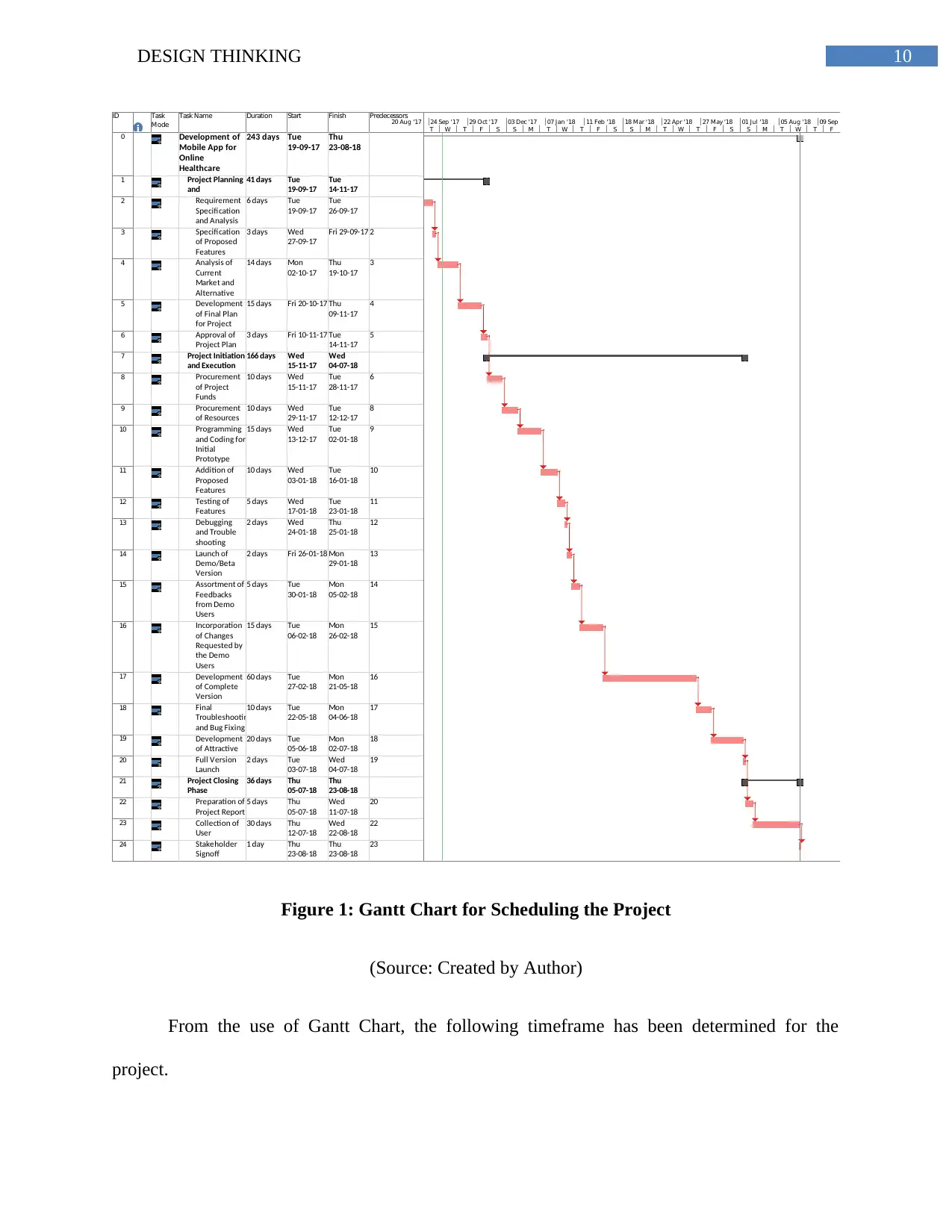
The scheduling of the project for the preparation of a sufficient time frame is shown in
the following Gantt Chart.
2.6 Long Term Plan
The long term plan that has been included in the project is to include even more features
in the app that will bring more convenience to the users like online booking of ambulance, online
shopping for medicines from the nearby stores and others. However, all these proposed features
will be extremely expensive to implement and hence, will require time as well as stocking up of
revenue. However, if these features are added, the app will earn a major share in the market and
will be able to compete with the rivals without any significant difficulty.
2.7 Time Frame
The scheduling of the project for the preparation of a sufficient time frame is shown in
the following Gantt Chart.
Paraphrase This Document
Need a fresh take? Get an instant paraphrase of this document with our AI Paraphraser
10DESIGN THINKING
ID Task
Mode
Task Name Duration Start Finish Predecessors
0 Development of
Mobile App for
Online
Healthcare
Response
243 days Tue
19-09-17
Thu
23-08-18
1 Project Planning
and
Development
41 days Tue
19-09-17
Tue
14-11-17
2 Requirement
Specification
and Analysis
6 days Tue
19-09-17
Tue
26-09-17
3 Specification
of Proposed
Features
3 days Wed
27-09-17
Fri 29-09-17 2
4 Analysis of
Current
Market and
Alternative
Apps
14 days Mon
02-10-17
Thu
19-10-17
3
5 Development
of Final Plan
for Project
15 days Fri 20-10-17 Thu
09-11-17
4
6 Approval of
Project Plan
3 days Fri 10-11-17 Tue
14-11-17
5
7 Project Initiation
and Execution
166 days Wed
15-11-17
Wed
04-07-18
8 Procurement
of Project
Funds
10 days Wed
15-11-17
Tue
28-11-17
6
9 Procurement
of Resources
10 days Wed
29-11-17
Tue
12-12-17
8
10 Programming
and Coding for
Initial
Prototype
15 days Wed
13-12-17
Tue
02-01-18
9
11 Addition of
Proposed
Features
10 days Wed
03-01-18
Tue
16-01-18
10
12 Testing of
Features
5 days Wed
17-01-18
Tue
23-01-18
11
13 Debugging
and Trouble
shooting
2 days Wed
24-01-18
Thu
25-01-18
12
14 Launch of
Demo/Beta
Version
2 days Fri 26-01-18 Mon
29-01-18
13
15 Assortment of
Feedbacks
from Demo
Users
5 days Tue
30-01-18
Mon
05-02-18
14
16 Incorporation
of Changes
Requested by
the Demo
Users
15 days Tue
06-02-18
Mon
26-02-18
15
17 Development
of Complete
Version
60 days Tue
27-02-18
Mon
21-05-18
16
18 Final
Troubleshooting
and Bug Fixing
10 days Tue
22-05-18
Mon
04-06-18
17
19 Development
of Attractive
UI
20 days Tue
05-06-18
Mon
02-07-18
18
20 Full Version
Launch
2 days Tue
03-07-18
Wed
04-07-18
19
21 Project Closing
Phase
36 days Thu
05-07-18
Thu
23-08-18
22 Preparation of
Project Report
5 days Thu
05-07-18
Wed
11-07-18
20
23 Collection of
User
Feedbacks
30 days Thu
12-07-18
Wed
22-08-18
22
24 Stakeholder
Signoff
1 day Thu
23-08-18
Thu
23-08-18
23
T W T F S S M T W T F S S M T W T F S S M T W T F S
20 Aug '17 24 Sep '17 29 Oct '17 03 Dec '17 07 Jan '18 11 Feb '18 18 Mar '18 22 Apr '18 27 May '18 01 Jul '18 05 Aug '18 09 Sep '18
Figure 1: Gantt Chart for Scheduling the Project
(Source: Created by Author)
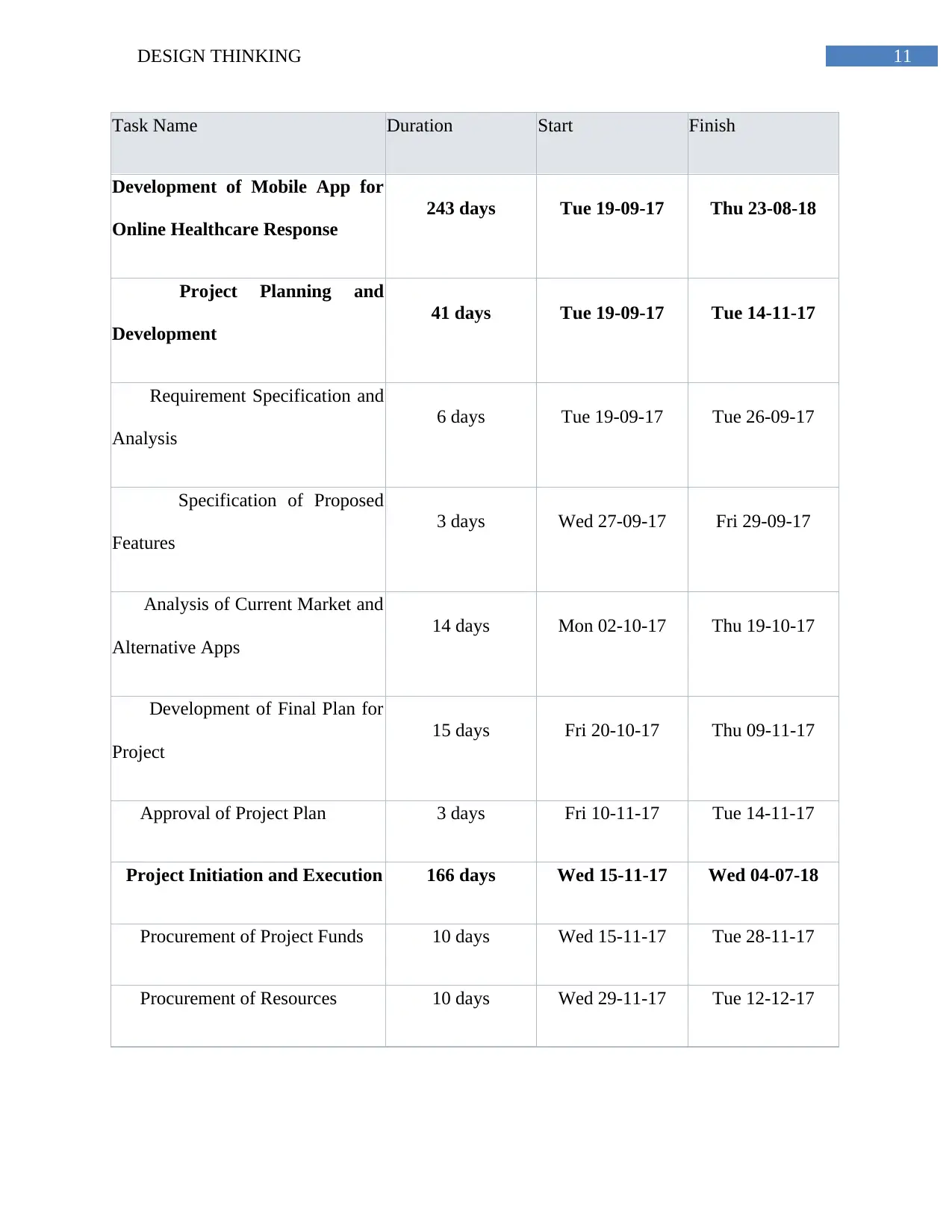
From the use of Gantt Chart, the following timeframe has been determined for the
project.
ID Task
Mode
Task Name Duration Start Finish Predecessors
0 Development of
Mobile App for
Online
Healthcare
Response
243 days Tue
19-09-17
Thu
23-08-18
1 Project Planning
and
Development
41 days Tue
19-09-17
Tue
14-11-17
2 Requirement
Specification
and Analysis
6 days Tue
19-09-17
Tue
26-09-17
3 Specification
of Proposed
Features
3 days Wed
27-09-17
Fri 29-09-17 2
4 Analysis of
Current
Market and
Alternative
Apps
14 days Mon
02-10-17
Thu
19-10-17
3
5 Development
of Final Plan
for Project
15 days Fri 20-10-17 Thu
09-11-17
4
6 Approval of
Project Plan
3 days Fri 10-11-17 Tue
14-11-17
5
7 Project Initiation
and Execution
166 days Wed
15-11-17
Wed
04-07-18
8 Procurement
of Project
Funds
10 days Wed
15-11-17
Tue
28-11-17
6
9 Procurement
of Resources
10 days Wed
29-11-17
Tue
12-12-17
8
10 Programming
and Coding for
Initial
Prototype
15 days Wed
13-12-17
Tue
02-01-18
9
11 Addition of
Proposed
Features
10 days Wed
03-01-18
Tue
16-01-18
10
12 Testing of
Features
5 days Wed
17-01-18
Tue
23-01-18
11
13 Debugging
and Trouble
shooting
2 days Wed
24-01-18
Thu
25-01-18
12
14 Launch of
Demo/Beta
Version
2 days Fri 26-01-18 Mon
29-01-18
13
15 Assortment of
Feedbacks
from Demo
Users
5 days Tue
30-01-18
Mon
05-02-18
14
16 Incorporation
of Changes
Requested by
the Demo
Users
15 days Tue
06-02-18
Mon
26-02-18
15
17 Development
of Complete
Version
60 days Tue
27-02-18
Mon
21-05-18
16
18 Final
Troubleshooting
and Bug Fixing
10 days Tue
22-05-18
Mon
04-06-18
17
19 Development
of Attractive
UI
20 days Tue
05-06-18
Mon
02-07-18
18
20 Full Version
Launch
2 days Tue
03-07-18
Wed
04-07-18
19
21 Project Closing
Phase
36 days Thu
05-07-18
Thu
23-08-18
22 Preparation of
Project Report
5 days Thu
05-07-18
Wed
11-07-18
20
23 Collection of
User
Feedbacks
30 days Thu
12-07-18
Wed
22-08-18
22
24 Stakeholder
Signoff
1 day Thu
23-08-18
Thu
23-08-18
23
T W T F S S M T W T F S S M T W T F S S M T W T F S
20 Aug '17 24 Sep '17 29 Oct '17 03 Dec '17 07 Jan '18 11 Feb '18 18 Mar '18 22 Apr '18 27 May '18 01 Jul '18 05 Aug '18 09 Sep '18
Figure 1: Gantt Chart for Scheduling the Project
(Source: Created by Author)
From the use of Gantt Chart, the following timeframe has been determined for the
project.
11DESIGN THINKING
Task Name Duration Start Finish
Development of Mobile App for
Online Healthcare Response
243 days Tue 19-09-17 Thu 23-08-18
Project Planning and
Development
41 days Tue 19-09-17 Tue 14-11-17
Requirement Specification and
Analysis
6 days Tue 19-09-17 Tue 26-09-17
Specification of Proposed
Features
3 days Wed 27-09-17 Fri 29-09-17
Analysis of Current Market and
Alternative Apps
14 days Mon 02-10-17 Thu 19-10-17
Development of Final Plan for
Project
15 days Fri 20-10-17 Thu 09-11-17
Approval of Project Plan 3 days Fri 10-11-17 Tue 14-11-17
Project Initiation and Execution 166 days Wed 15-11-17 Wed 04-07-18
Procurement of Project Funds 10 days Wed 15-11-17 Tue 28-11-17
Procurement of Resources 10 days Wed 29-11-17 Tue 12-12-17
Task Name Duration Start Finish
Development of Mobile App for
Online Healthcare Response
243 days Tue 19-09-17 Thu 23-08-18
Project Planning and
Development
41 days Tue 19-09-17 Tue 14-11-17
Requirement Specification and
Analysis
6 days Tue 19-09-17 Tue 26-09-17
Specification of Proposed
Features
3 days Wed 27-09-17 Fri 29-09-17
Analysis of Current Market and
Alternative Apps
14 days Mon 02-10-17 Thu 19-10-17
Development of Final Plan for
Project
15 days Fri 20-10-17 Thu 09-11-17
Approval of Project Plan 3 days Fri 10-11-17 Tue 14-11-17
Project Initiation and Execution 166 days Wed 15-11-17 Wed 04-07-18
Procurement of Project Funds 10 days Wed 15-11-17 Tue 28-11-17
Procurement of Resources 10 days Wed 29-11-17 Tue 12-12-17
⊘ This is a preview!⊘
Do you want full access?
Subscribe today to unlock all pages.
Trusted by 1+ million students worldwide

1 out of 16


Related Documents


Your All-in-One AI-Powered Toolkit for Academic Success.
+13062052269
info@desklib.com
Available 24*7 on WhatsApp / Email
![[object Object]](/_next/static/media/star-bottom.7253800d.svg)
Unlock your academic potential
Copyright © 2020–2026 A2Z Services. All Rights Reserved. Developed and managed by ZUCOL.