Designing and Delivering Effective Leadership Training Programs Report
VerifiedAdded on 2022/05/25
|16
|3562
|29
Report
AI Summary
This report examines the design and delivery of leadership training programs, with a focus on the aviation industry and a case study of Libyan Wings. It explores the importance of effective training, particularly for adult learners, and discusses various learning methods, including experiential learning and the development of competencies. The report reviews literature on training and change, highlighting the impact of transformational and incremental changes. It also analyzes the Libyan Wings case, detailing the airline's leadership development strategy and the use of an integrated system for leadership and management development (LMD). The report further discusses the key components of LMD, including analysis, design, delivery, and program features, such as specified and emergent learning, and provides a diagrammatic representation of LMD activities and HRD choices.

Running head: DESIGNING AND DELIVERING TRAINING
Leadership
Name of the Student:
Name of the University:
Author Note:
Leadership
Name of the Student:
Name of the University:
Author Note:

Paraphrase This Document
Need a fresh take? Get an instant paraphrase of this document with our AI Paraphraser
1DESIGNING AND DELIVERING TRAINING
Introduction:
The essay provides an insight into designing and delivering the aspects of training
focused on leadership. It has found that training puts across greater dividends for Airline industry
where a variable change in the staff quality had leads to an improved response. The question lies
in how to design the effective training program for the employees. This is crucial as adults seem
to learn in an effective manner when allowed to undertake discussion related to the experiences
thereby discovering the value of skills. This kind of learning is quite resource intensive. The
involvement of the resource commitment makes various training sessions lecture based. It has
been found that employees do not learn well when they are spoken to since in most cases they
express the urge to be involved actively in learning experience. Training which is mostly learner
centered requires commitment, experiential gains and personal involvement and it mostly
involves learning by doing. There have been arguments stating that competence instead of
knowledge constitutes the real power. Training takes place when there is development of skills
beyond the competence level. The aim of training lies in providing the employees with the
performance improvement (Dhar 2015). The outcomes of the training should not only be tangible
but should facilitate and support the strategic aims of the organization. In other words, training is
also necessary for imparting skills for the successful development of the human resource.
The report here focuses on the evaluation and the comparison of the issues related to the
national or the international training practice. It also focuses on moving beyond descriptive
account of procedures and process and put forward a critical discussion and analytical argument
related to training. The report also reviews models, frameworks and theories along with
demonstrating a clearer understanding of key issues.
Introduction:
The essay provides an insight into designing and delivering the aspects of training
focused on leadership. It has found that training puts across greater dividends for Airline industry
where a variable change in the staff quality had leads to an improved response. The question lies
in how to design the effective training program for the employees. This is crucial as adults seem
to learn in an effective manner when allowed to undertake discussion related to the experiences
thereby discovering the value of skills. This kind of learning is quite resource intensive. The
involvement of the resource commitment makes various training sessions lecture based. It has
been found that employees do not learn well when they are spoken to since in most cases they
express the urge to be involved actively in learning experience. Training which is mostly learner
centered requires commitment, experiential gains and personal involvement and it mostly
involves learning by doing. There have been arguments stating that competence instead of
knowledge constitutes the real power. Training takes place when there is development of skills
beyond the competence level. The aim of training lies in providing the employees with the
performance improvement (Dhar 2015). The outcomes of the training should not only be tangible
but should facilitate and support the strategic aims of the organization. In other words, training is
also necessary for imparting skills for the successful development of the human resource.
The report here focuses on the evaluation and the comparison of the issues related to the
national or the international training practice. It also focuses on moving beyond descriptive
account of procedures and process and put forward a critical discussion and analytical argument
related to training. The report also reviews models, frameworks and theories along with
demonstrating a clearer understanding of key issues.
2DESIGNING AND DELIVERING TRAINING
Discussion:
Literature Review
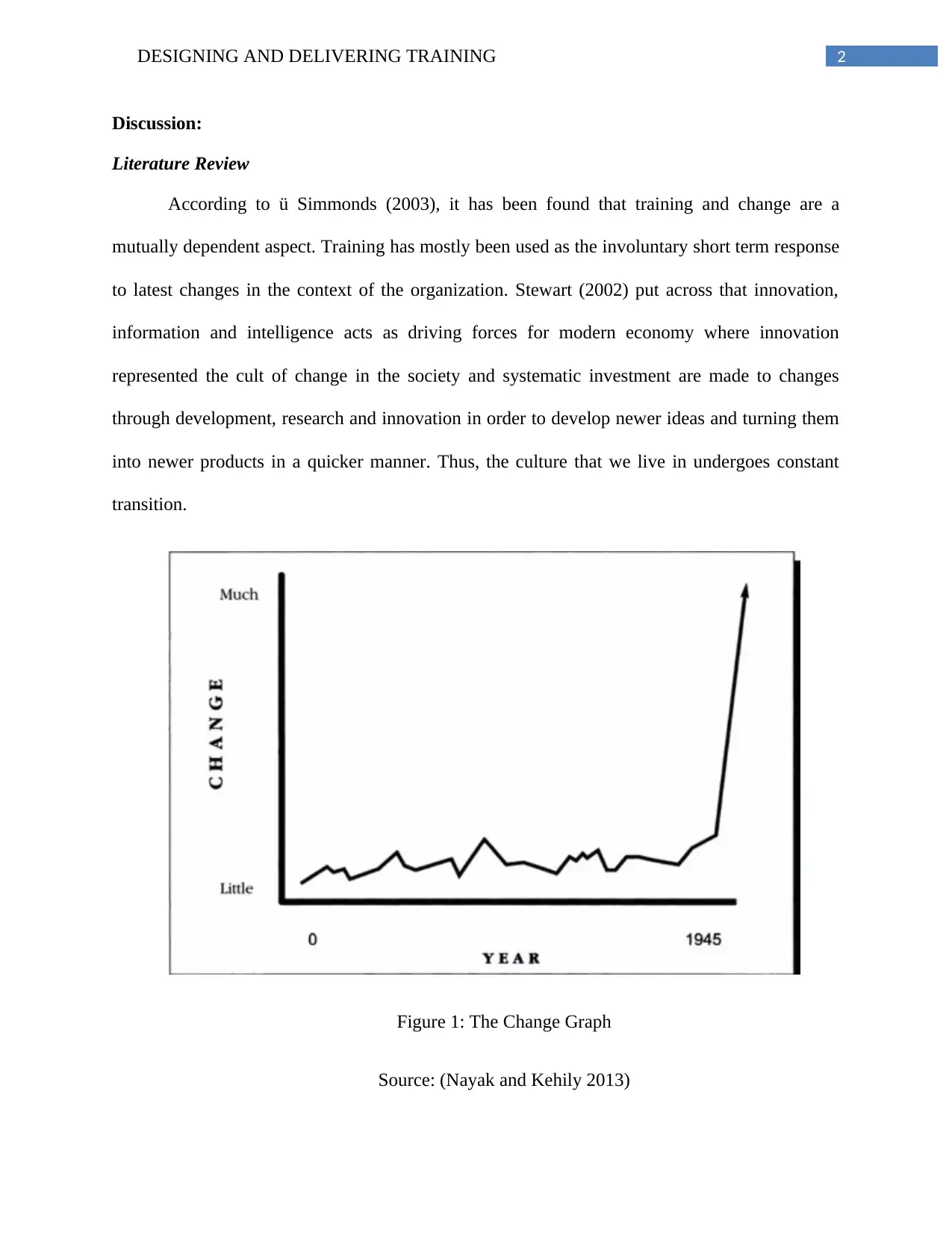
According to ü Simmonds (2003), it has been found that training and change are a
mutually dependent aspect. Training has mostly been used as the involuntary short term response
to latest changes in the context of the organization. Stewart (2002) put across that innovation,
information and intelligence acts as driving forces for modern economy where innovation
represented the cult of change in the society and systematic investment are made to changes
through development, research and innovation in order to develop newer ideas and turning them
into newer products in a quicker manner. Thus, the culture that we live in undergoes constant
transition.
Figure 1: The Change Graph
Source: (Nayak and Kehily 2013)
Discussion:
Literature Review
According to ü Simmonds (2003), it has been found that training and change are a
mutually dependent aspect. Training has mostly been used as the involuntary short term response
to latest changes in the context of the organization. Stewart (2002) put across that innovation,
information and intelligence acts as driving forces for modern economy where innovation
represented the cult of change in the society and systematic investment are made to changes
through development, research and innovation in order to develop newer ideas and turning them
into newer products in a quicker manner. Thus, the culture that we live in undergoes constant
transition.
Figure 1: The Change Graph
Source: (Nayak and Kehily 2013)
⊘ This is a preview!⊘
Do you want full access?
Subscribe today to unlock all pages.

Trusted by 1+ million students worldwide
3DESIGNING AND DELIVERING TRAINING
Hence, it can be said that change will stay but the alarming aspect lies in the rate of the
change. Change can however take two basic forms which includes transformational change and
incremental change (Ashleigh & Mansi, 2012). Transformational change is something that takes
place quickly while the incremental change happens in a relatively slower manner (Schein 2015).
In addition to this there has been transitional and transactional change. Bamberger, Meshoulam
and Biron (2014) put across that there has been number of changes emerging in the human
resource theory and practice which include connection to the corporate strategy, clarification of
the aspects as to who benefits from the training, individuals undertaking the responsibility of
own learning, broadening of HRD constituency, extension into the team learning, incorporation
of the career development, incorporation of the organizational development, emphasizing on the
internal consultancy, focusing on the organizational learning and drawing linkage between
intellectual capital and knowledge management
These appear in contradicting the view that training remains mostly concerned with the
delivery of the newer programs. It has however been found that training should remain integrated
with the strategy of the organization and it is necessary for the learning practitioner to remain
aware of the organizational strategy. The various elements of the strategic planning process
include purpose, vision, mission, directions, priorities, goals, plans and actions (Cassidy 2016).
The whole process of strategic planning should depend on the continuous cycle of feedback,
improvement and reflection which will lead to the learning at not only the organizational level
but also the individual and the departmental level (Wheelen et al. 2017).
Analytical Argument and Critical Discussion Using Theories
Organization:
Hence, it can be said that change will stay but the alarming aspect lies in the rate of the
change. Change can however take two basic forms which includes transformational change and
incremental change (Ashleigh & Mansi, 2012). Transformational change is something that takes
place quickly while the incremental change happens in a relatively slower manner (Schein 2015).
In addition to this there has been transitional and transactional change. Bamberger, Meshoulam
and Biron (2014) put across that there has been number of changes emerging in the human
resource theory and practice which include connection to the corporate strategy, clarification of
the aspects as to who benefits from the training, individuals undertaking the responsibility of
own learning, broadening of HRD constituency, extension into the team learning, incorporation
of the career development, incorporation of the organizational development, emphasizing on the
internal consultancy, focusing on the organizational learning and drawing linkage between
intellectual capital and knowledge management
These appear in contradicting the view that training remains mostly concerned with the
delivery of the newer programs. It has however been found that training should remain integrated
with the strategy of the organization and it is necessary for the learning practitioner to remain
aware of the organizational strategy. The various elements of the strategic planning process
include purpose, vision, mission, directions, priorities, goals, plans and actions (Cassidy 2016).
The whole process of strategic planning should depend on the continuous cycle of feedback,
improvement and reflection which will lead to the learning at not only the organizational level
but also the individual and the departmental level (Wheelen et al. 2017).
Analytical Argument and Critical Discussion Using Theories
Organization:
Paraphrase This Document
Need a fresh take? Get an instant paraphrase of this document with our AI Paraphraser
4DESIGNING AND DELIVERING TRAINING
Libyan Wings represented an airline based in Mitiga International Airport in Tripoli,
Libya (libyanwings.ly 2019). The airline began its operation in the year September, 2015 and
faced delays due to the political instability in Libya. As per the reports in November 2016, the
airline operated two airbuses to close to five destinations like Tunisia, Turkey and Libya. In the
year June 2013, the Libyan Wing intended in starting its operations. In the year November 2013,
there was a memorandum of understanding signed by the airline for four Airbus A320 neos and
three Airbus A350-900s whose launch date was shifted towards the early, 2014. In the year May
2014, the Libyan Wing signed for leasing two AirbusA319 from the Dubai based company that
planned in launching the flights sometime later that year. The deteriorating political scenario in
Libya forced the airline in delaying the launch further. The airlines waited for the situation to
improve for launching Airbus A319s instead of returning them. However for attaining the air
operator certificate, the airline had to take up a flight with the passengers. Although, Tripoli
remained unsafe, the airline operated its flight in Turkey with the officials of Libyan Civil
Aviation Authority on board. The operation of the Libyan Wings commenced in the year 2015
with the flight connecting Tripoli to Istanbul. It was after four days that Turkey made a
declaration that all the Libyan citizens needed to possess Visa before making an entry into the
country. In the meantime, the airlines have to withhold its operations while the passengers
travelled to Turkish consulate Misrata which is 200 kilometers away for obtaining the visas. The
flights connecting Tunis commenced in the year October 2015 along with the resuming of the
operations of Istanbul. The memorandum of understanding is still in the effect although the
finalization has been still pending.
The airline represents one of the key stakeholders in facilitation of trade and newer
investment from the regional and the international markets
Libyan Wings represented an airline based in Mitiga International Airport in Tripoli,
Libya (libyanwings.ly 2019). The airline began its operation in the year September, 2015 and
faced delays due to the political instability in Libya. As per the reports in November 2016, the
airline operated two airbuses to close to five destinations like Tunisia, Turkey and Libya. In the
year June 2013, the Libyan Wing intended in starting its operations. In the year November 2013,
there was a memorandum of understanding signed by the airline for four Airbus A320 neos and
three Airbus A350-900s whose launch date was shifted towards the early, 2014. In the year May
2014, the Libyan Wing signed for leasing two AirbusA319 from the Dubai based company that
planned in launching the flights sometime later that year. The deteriorating political scenario in
Libya forced the airline in delaying the launch further. The airlines waited for the situation to
improve for launching Airbus A319s instead of returning them. However for attaining the air
operator certificate, the airline had to take up a flight with the passengers. Although, Tripoli
remained unsafe, the airline operated its flight in Turkey with the officials of Libyan Civil
Aviation Authority on board. The operation of the Libyan Wings commenced in the year 2015
with the flight connecting Tripoli to Istanbul. It was after four days that Turkey made a
declaration that all the Libyan citizens needed to possess Visa before making an entry into the
country. In the meantime, the airlines have to withhold its operations while the passengers
travelled to Turkish consulate Misrata which is 200 kilometers away for obtaining the visas. The
flights connecting Tunis commenced in the year October 2015 along with the resuming of the
operations of Istanbul. The memorandum of understanding is still in the effect although the
finalization has been still pending.
The airline represents one of the key stakeholders in facilitation of trade and newer
investment from the regional and the international markets
5DESIGNING AND DELIVERING TRAINING
Leadership Development Strategy:
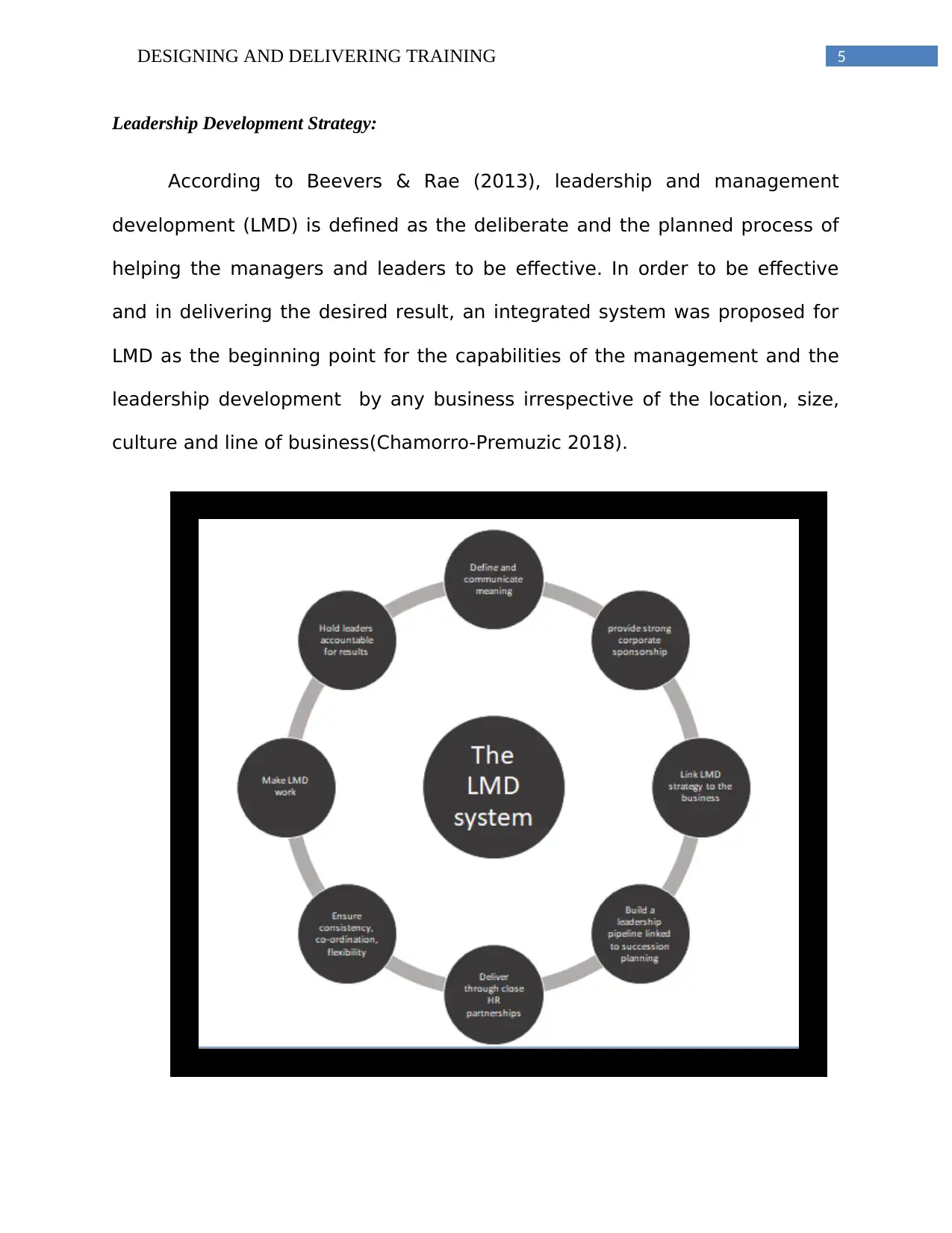
According to Beevers & Rae (2013), leadership and management
development (LMD) is defined as the deliberate and the planned process of
helping the managers and leaders to be effective. In order to be effective
and in delivering the desired result, an integrated system was proposed for
LMD as the beginning point for the capabilities of the management and the
leadership development by any business irrespective of the location, size,
culture and line of business(Chamorro-Premuzic 2018).
Leadership Development Strategy:
According to Beevers & Rae (2013), leadership and management
development (LMD) is defined as the deliberate and the planned process of
helping the managers and leaders to be effective. In order to be effective
and in delivering the desired result, an integrated system was proposed for
LMD as the beginning point for the capabilities of the management and the
leadership development by any business irrespective of the location, size,
culture and line of business(Chamorro-Premuzic 2018).
⊘ This is a preview!⊘
Do you want full access?
Subscribe today to unlock all pages.
Trusted by 1+ million students worldwide
6DESIGNING AND DELIVERING TRAINING
Figure 2: Diagrammatic Representation of LMD Development
Source: (Gold et al. 2013)
Elkaseer (2014) put across that the LMD strategy represented part of
the strategy related to corporate learning and development developed for
helping and supporting the business in achieving the business goals along
with the plans for expansion and growth. It is possible only when the
principle of the alignment which is vertical alignment with business strategy
and the horizontal alignment with the other HR strategies is achieved with
the business. However, lack of alignment acts as the enemy of complex and
diversified organizations. Nevertheless, in the developing the management
and leadership, most organization follows a systems approach which is
described as the process of ‘good practice’.
Analysis: It constituted the base of the learning and development
intervention. It is mostly conducted for determining the present
organizational or individual capability, determining the desired or the
required capability, identifying the gaps between two and identifying on
bridging the gaps. The outcomes of the process is carried forward to next
stage which involves designing or development, determining features of the
program, learning outcomes, media and methods of implementation and the
ways in which results and learning is evaluated. The process of analyzing the
results leads to the creation of the framework for leadership and the
management competences (LMC) for the whole organization. The LMC
Figure 2: Diagrammatic Representation of LMD Development
Source: (Gold et al. 2013)
Elkaseer (2014) put across that the LMD strategy represented part of
the strategy related to corporate learning and development developed for
helping and supporting the business in achieving the business goals along
with the plans for expansion and growth. It is possible only when the
principle of the alignment which is vertical alignment with business strategy
and the horizontal alignment with the other HR strategies is achieved with
the business. However, lack of alignment acts as the enemy of complex and
diversified organizations. Nevertheless, in the developing the management
and leadership, most organization follows a systems approach which is
described as the process of ‘good practice’.
Analysis: It constituted the base of the learning and development
intervention. It is mostly conducted for determining the present
organizational or individual capability, determining the desired or the
required capability, identifying the gaps between two and identifying on
bridging the gaps. The outcomes of the process is carried forward to next
stage which involves designing or development, determining features of the
program, learning outcomes, media and methods of implementation and the
ways in which results and learning is evaluated. The process of analyzing the
results leads to the creation of the framework for leadership and the
management competences (LMC) for the whole organization. The LMC
Paraphrase This Document
Need a fresh take? Get an instant paraphrase of this document with our AI Paraphraser
7DESIGNING AND DELIVERING TRAINING
comprises of four focus areas. There are a number of key competencies in
leadership that falls under each of the areas of focus. It has been found that
there have been three bands of competencies in leadership, each for every
leadership level within organization.
. Development and Design: The process of designing involves making
critical decisions that might have greater impact on success of
developmental endeavors undertaken by organization. This decision includes
identification of the features that includes determination of the sequence
and the objectives of the learning content. It also involves the identification
of the factors influencing effectiveness of learning. These factors include
individual factors such as prior experience and knowledge, learning style and
preferences and the personal circumstances. It also includes the
organizational factors such as the availability of the resources, business
priorities and the organizational values and culture and legislative
requirements such as equal opportunities, health and safety and copyright
and data protection. It also involves deciding on the approaches and the
learning methods to be deployed which includes individual versus the
collective, formal vs. the informal along with the selection of the evaluation
method and approach.
One of the crucial documents used in design process that falls off the
process of analysis and is dependent on the LMC represents learning scalar.
This represents the tabulation of all preferred objectives of learning that are
comprises of four focus areas. There are a number of key competencies in
leadership that falls under each of the areas of focus. It has been found that
there have been three bands of competencies in leadership, each for every
leadership level within organization.
. Development and Design: The process of designing involves making
critical decisions that might have greater impact on success of
developmental endeavors undertaken by organization. This decision includes
identification of the features that includes determination of the sequence
and the objectives of the learning content. It also involves the identification
of the factors influencing effectiveness of learning. These factors include
individual factors such as prior experience and knowledge, learning style and
preferences and the personal circumstances. It also includes the
organizational factors such as the availability of the resources, business
priorities and the organizational values and culture and legislative
requirements such as equal opportunities, health and safety and copyright
and data protection. It also involves deciding on the approaches and the
learning methods to be deployed which includes individual versus the
collective, formal vs. the informal along with the selection of the evaluation
method and approach.
One of the crucial documents used in design process that falls off the
process of analysis and is dependent on the LMC represents learning scalar.
This represents the tabulation of all preferred objectives of learning that are
8DESIGNING AND DELIVERING TRAINING
crashed down not only into the enabling objectives but further into points of
learning.
Delivery: This stage refers to the manifestation of plans devised
through previous delivery/design stage. Depending on nature of Leadership
and Development (L&D) method and intervention it remains intended for
delivering in and the L&D specialist assume roles in the observation of the
progress of these activities thereby ensuring that they take a place in
planned manner. The effective leadership development program helps in
recognizing the various methods of learning and the different learning
preferences of the individuals, groups and teams. However, at Libyan Wings
there exists a wide range of the L&D interventions for developing the leaders
of the top tier including the structured sessions of group and the individual,
interactive experiential learning of the activities and the projects and the
sets related to action learning. Besides, emergent or informal learning is not
only encouraged but recognized that includes counseling and coaching, job
rotation and the tasks and projects related to the intergroup.
Program Features: The effective leadership and development
program (ELDP) follows mixed approach in the development of the
leadership competencies and qualities. The activities related to leadership
and management development ranges between the individual and collective
and the specified and the emergent. This remains in accordance with the
general human resource development model
crashed down not only into the enabling objectives but further into points of
learning.
Delivery: This stage refers to the manifestation of plans devised
through previous delivery/design stage. Depending on nature of Leadership
and Development (L&D) method and intervention it remains intended for
delivering in and the L&D specialist assume roles in the observation of the
progress of these activities thereby ensuring that they take a place in
planned manner. The effective leadership development program helps in
recognizing the various methods of learning and the different learning
preferences of the individuals, groups and teams. However, at Libyan Wings
there exists a wide range of the L&D interventions for developing the leaders
of the top tier including the structured sessions of group and the individual,
interactive experiential learning of the activities and the projects and the
sets related to action learning. Besides, emergent or informal learning is not
only encouraged but recognized that includes counseling and coaching, job
rotation and the tasks and projects related to the intergroup.
Program Features: The effective leadership and development
program (ELDP) follows mixed approach in the development of the
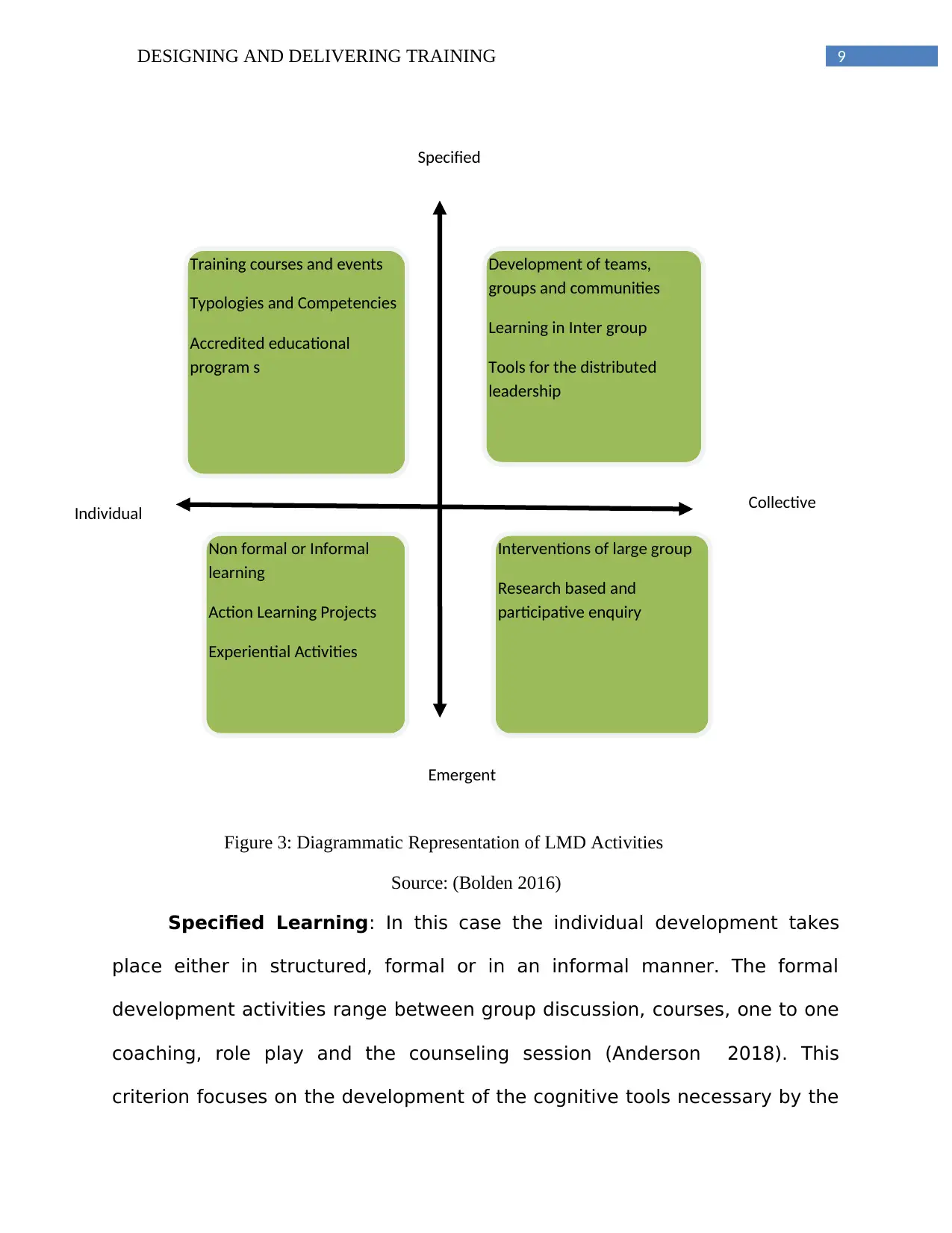
leadership competencies and qualities. The activities related to leadership
and management development ranges between the individual and collective
and the specified and the emergent. This remains in accordance with the
general human resource development model
⊘ This is a preview!⊘
Do you want full access?
Subscribe today to unlock all pages.
Trusted by 1+ million students worldwide
9DESIGNING AND DELIVERING TRAINING
Figure 3: Diagrammatic Representation of LMD Activities
Source: (Bolden 2016)
Specified Learning: In this case the individual development takes
place either in structured, formal or in an informal manner. The formal
development activities range between group discussion, courses, one to one
coaching, role play and the counseling session (Anderson 2018). This
criterion focuses on the development of the cognitive tools necessary by the
Training courses and events
Typologies and Competencies
Accredited educational
program s
Development of teams,
groups and communities
Learning in Inter group
Tools for the distributed
leadership
Non formal or Informal
learning
Action Learning Projects
Experiential Activities
Interventions of large group
Research based and
participative enquiry
Collective
Individual
Specified
Emergent
Figure 3: Diagrammatic Representation of LMD Activities
Source: (Bolden 2016)
Specified Learning: In this case the individual development takes
place either in structured, formal or in an informal manner. The formal
development activities range between group discussion, courses, one to one
coaching, role play and the counseling session (Anderson 2018). This
criterion focuses on the development of the cognitive tools necessary by the
Training courses and events
Typologies and Competencies
Accredited educational
program s
Development of teams,
groups and communities
Learning in Inter group
Tools for the distributed
leadership
Non formal or Informal
learning
Action Learning Projects
Experiential Activities
Interventions of large group
Research based and
participative enquiry
Collective
Individual
Specified
Emergent
Paraphrase This Document
Need a fresh take? Get an instant paraphrase of this document with our AI Paraphraser
10DESIGNING AND DELIVERING TRAINING
leaders in honing their skills, knowledge, attitude and abilities. Besides, it
also helps in the development of basic psychological features for a
successful leadership through social and cultural awareness.
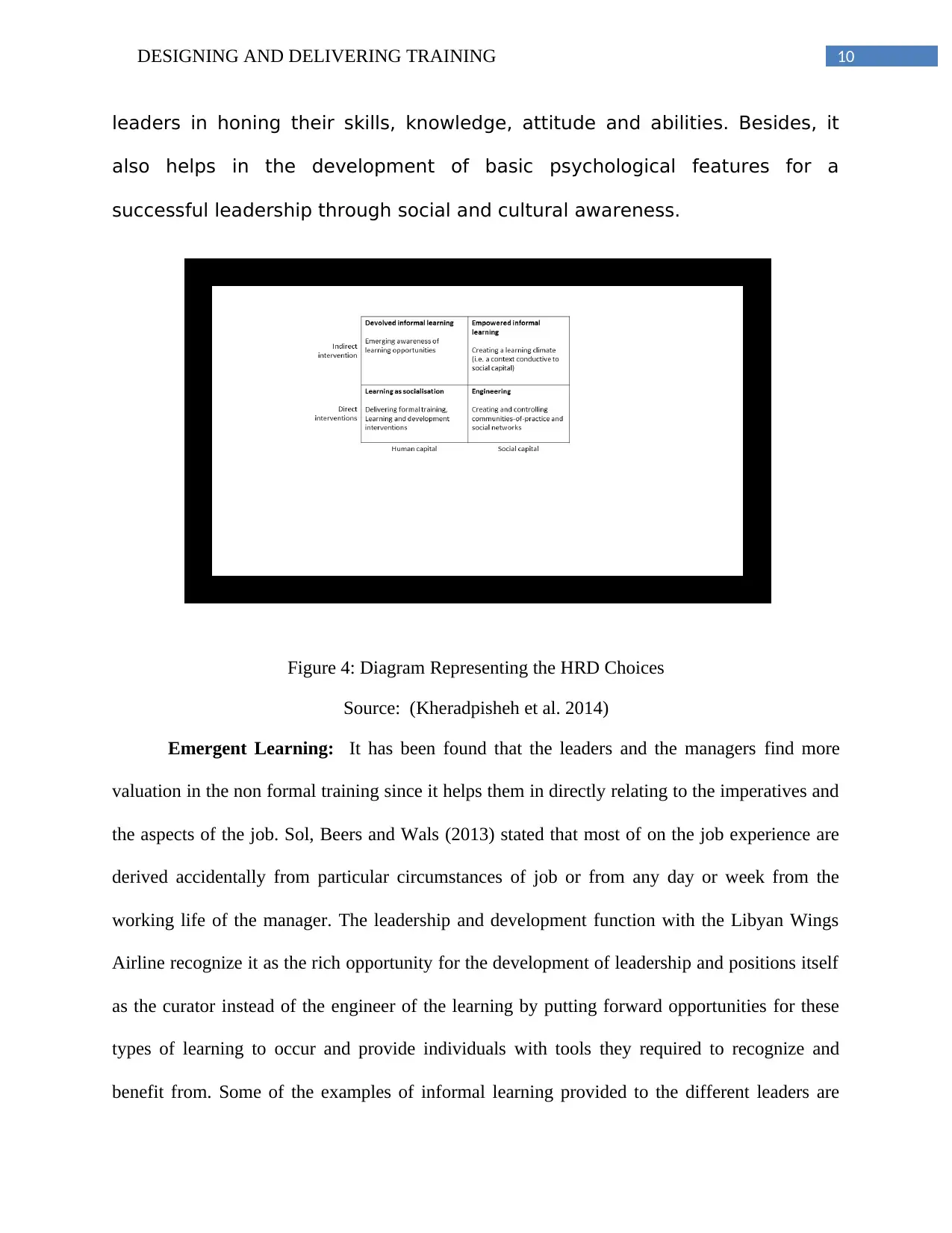
Figure 4: Diagram Representing the HRD Choices
Source: (Kheradpisheh et al. 2014)
Emergent Learning: It has been found that the leaders and the managers find more
valuation in the non formal training since it helps them in directly relating to the imperatives and
the aspects of the job. Sol, Beers and Wals (2013) stated that most of on the job experience are
derived accidentally from particular circumstances of job or from any day or week from the
working life of the manager. The leadership and development function with the Libyan Wings
Airline recognize it as the rich opportunity for the development of leadership and positions itself
as the curator instead of the engineer of the learning by putting forward opportunities for these
types of learning to occur and provide individuals with tools they required to recognize and
benefit from. Some of the examples of informal learning provided to the different leaders are
leaders in honing their skills, knowledge, attitude and abilities. Besides, it
also helps in the development of basic psychological features for a
successful leadership through social and cultural awareness.
Figure 4: Diagram Representing the HRD Choices
Source: (Kheradpisheh et al. 2014)
Emergent Learning: It has been found that the leaders and the managers find more
valuation in the non formal training since it helps them in directly relating to the imperatives and
the aspects of the job. Sol, Beers and Wals (2013) stated that most of on the job experience are
derived accidentally from particular circumstances of job or from any day or week from the
working life of the manager. The leadership and development function with the Libyan Wings
Airline recognize it as the rich opportunity for the development of leadership and positions itself
as the curator instead of the engineer of the learning by putting forward opportunities for these
types of learning to occur and provide individuals with tools they required to recognize and
benefit from. Some of the examples of informal learning provided to the different leaders are
11DESIGNING AND DELIVERING TRAINING
through inter function projects, foreign assignments and seconding. The inter function projects
includes more than one team from the different business function that work together, require
interaction, co-operation and join planning between the team members and the leaders. When
managers are seconded for leading different departments then it not only allows them in
broadening the experience and providing them with the opportunity of acting outside comfort
zone. In foreign assignments, managers travel to different countries for leading short term
projects.
Action Learning: There has been a great deal of emphasis on the action learning in
Libyan Wings airline. It is the one of the most significant approach in the development of
leadership (Kirkpatrick & Kirkpatrick, 2016). Usually a group of ten leaders get together into
the action learning set where the leaders heads various business functions and belongs to
different regions. During the action learning meeting, leaders discuss varied problems faced
during the course of the performance of the leadership and managerial task thereby not only
exchanging but also exploring the different problems faced during the performance of the
leadership and managerial task.
Demonstration of Key Issues
According to ü Parkin (2010), there are various approaches to training need analysis
which includes comprehensive analysis, problem centered analysis and key task analysis.
Comprehensive analysis comprises of an exhaustive analysis of all the aspects of job. It helps
in producing detailed specification of the task and the requirements of the associated
performance. Key task analysis refers to the determination of the task critical for successful
performance. Problem centered analysis particularly focuses on the specific areas that are held
through inter function projects, foreign assignments and seconding. The inter function projects
includes more than one team from the different business function that work together, require
interaction, co-operation and join planning between the team members and the leaders. When
managers are seconded for leading different departments then it not only allows them in
broadening the experience and providing them with the opportunity of acting outside comfort
zone. In foreign assignments, managers travel to different countries for leading short term
projects.
Action Learning: There has been a great deal of emphasis on the action learning in
Libyan Wings airline. It is the one of the most significant approach in the development of
leadership (Kirkpatrick & Kirkpatrick, 2016). Usually a group of ten leaders get together into
the action learning set where the leaders heads various business functions and belongs to
different regions. During the action learning meeting, leaders discuss varied problems faced
during the course of the performance of the leadership and managerial task thereby not only
exchanging but also exploring the different problems faced during the performance of the
leadership and managerial task.
Demonstration of Key Issues
According to ü Parkin (2010), there are various approaches to training need analysis
which includes comprehensive analysis, problem centered analysis and key task analysis.
Comprehensive analysis comprises of an exhaustive analysis of all the aspects of job. It helps
in producing detailed specification of the task and the requirements of the associated
performance. Key task analysis refers to the determination of the task critical for successful
performance. Problem centered analysis particularly focuses on the specific areas that are held
⊘ This is a preview!⊘
Do you want full access?
Subscribe today to unlock all pages.
Trusted by 1+ million students worldwide

1 out of 16


Related Documents


Your All-in-One AI-Powered Toolkit for Academic Success.
+13062052269
info@desklib.com
Available 24*7 on WhatsApp / Email
![[object Object]](/_next/static/media/star-bottom.7253800d.svg)
Unlock your academic potential
Copyright © 2020–2026 A2Z Services. All Rights Reserved. Developed and managed by ZUCOL.