Designing Learning for Diversity: Case Study of Susan's Inclusion
VerifiedAdded on 2023/06/04
|12
|2934
|407
Case Study
AI Summary
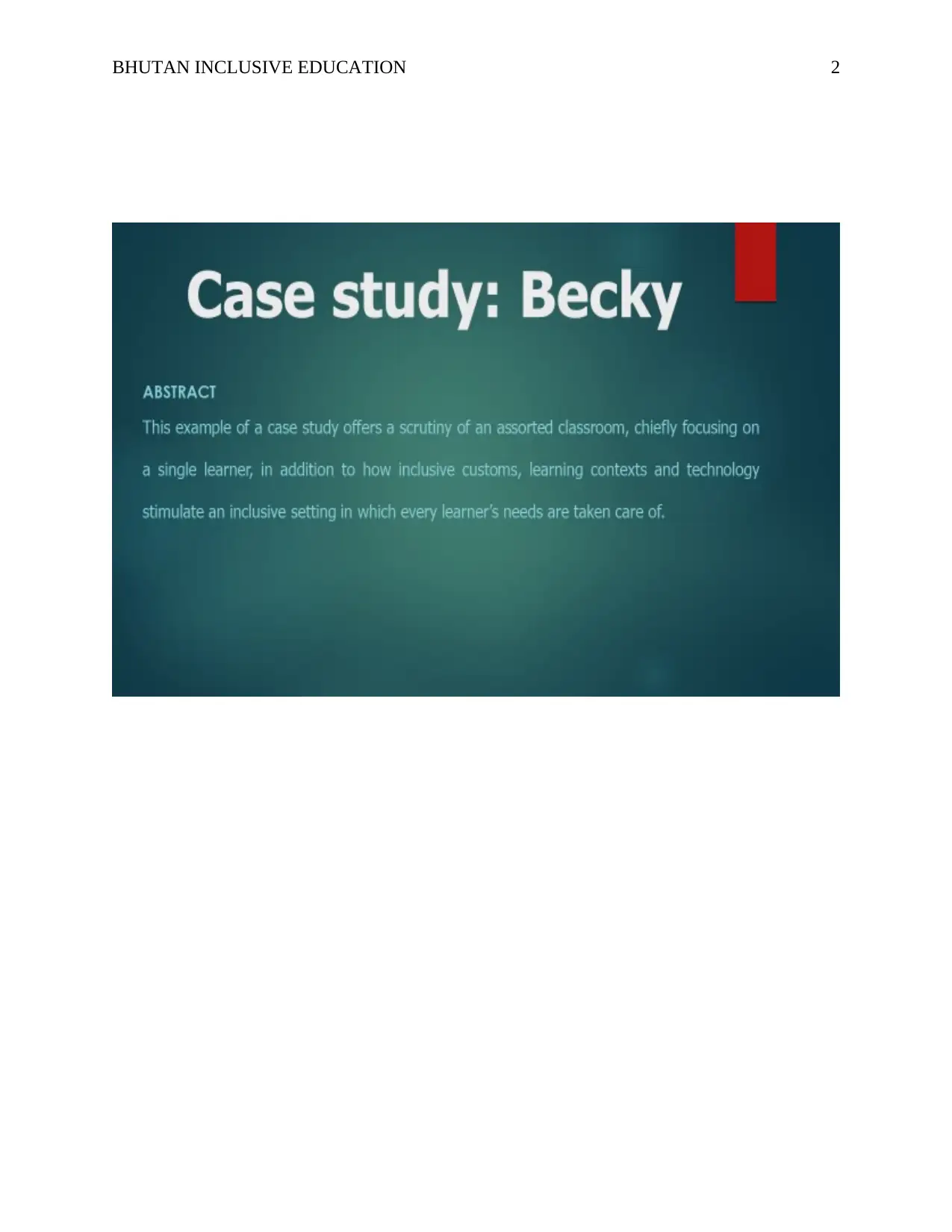
This case study delves into the inclusive education practices required to support a student named Becky, who has a vision impairment and moderate learning challenges. It emphasizes the importance of tangible experiences, active participation in daily tasks, and unified learning experiences tailored to Becky's needs. The study highlights the significance of collaboration in teaching, where regular and special needs tutors work together to create an inclusive classroom environment. It also advocates for cooperative education to foster academic excellence and social relations among students with diverse learning abilities. The strategies discussed aim to promote Becky's independence, problem-solving skills, and overall potential within an inclusive educational setting, with a focus on utilizing technology and appropriate policies to meet her unique learning requirements.
BHUTAN INCLUSIVE EDUCATION 1
Assignment Coversheet
Student ID number
Unit name Designing Learning for Diversity and Inclusion
Unit number
Name of tutor
Assignment name Assignment 2 Case Study: Susan
Due date
Student declaration
I certify that the attached assignment is my own work. Material drawn from other sources has
been appropriately and fully acknowledged as to author/creator, source and other bibliographic
details. Such referencing may need to meet unit-specific requirements as to format and style.
Signature of student: ___________ _______________________Date:
Assignment Coversheet
Student ID number
Unit name Designing Learning for Diversity and Inclusion
Unit number
Name of tutor
Assignment name Assignment 2 Case Study: Susan
Due date
Student declaration
I certify that the attached assignment is my own work. Material drawn from other sources has
been appropriately and fully acknowledged as to author/creator, source and other bibliographic
details. Such referencing may need to meet unit-specific requirements as to format and style.
Signature of student: ___________ _______________________Date:

Paraphrase This Document
Need a fresh take? Get an instant paraphrase of this document with our AI Paraphraser
BHUTAN INCLUSIVE EDUCATION 2
BHUTAN INCLUSIVE EDUCATION 3
Contents
Assignment coversheet 1
Abstract 2
Contents 3
Introduction to Bhutan inclusive education system 4
Overview to Becky’s case study 5
Tangible Experiences 6
Study through performing the duties 7-8
Unified experiences 8
Collaboration in teaching (Co-teaching) 9
Boosting Cooperative Education 9-10
References 11-12
Contents
Assignment coversheet 1
Abstract 2
Contents 3
Introduction to Bhutan inclusive education system 4
Overview to Becky’s case study 5
Tangible Experiences 6
Study through performing the duties 7-8
Unified experiences 8
Collaboration in teaching (Co-teaching) 9
Boosting Cooperative Education 9-10
References 11-12
⊘ This is a preview!⊘
Do you want full access?
Subscribe today to unlock all pages.

Trusted by 1+ million students worldwide
BHUTAN INCLUSIVE EDUCATION 4
Introduction to Bhutan inclusive education system
The main challenge in the contemporary education organization in Bhutan remains
struggling with diverse human abilities. While the reclusive education scheme in the nation of
Bhutan chose children who showed interest to education – whereas the bigger population were
left to engage in agricultural activities because this career was assumed that it did not require
education – the current education scheme allows all the children to go to class and the teacher is
expected to teacher them and deliver good results (Dorji, 2015). This situation makes it quit
difficult for these teachers since a good number of the learners have diverse learning problems.
Commitment to mandatory education for all calls for the predicament of the how to edify the
children with diverse capabilities efficiently and successfully using the merge resources
provided. Bhutan is addressing the mentioned apprehensions by growing attention on inclusive
education and special education (Schuelka, 2018).
Bhutan at present follows a variety of delivery focused on inclusive and separate schemes
to offer education for kids with infirmities. Learners who have mild or moderate education
incapacities are incorporated into conventional learning institutions, while learning for learners
with severe requirements together with other sets of infirmities for instance those who have
hearing and visual impairments are provided with amenities in isolated special learning
institutions (Dukpa, 2014). The school admirations in many schools sometimes refuse to admit
learners who have moderate or severe learning challenges particularly if lack the capability to
support these learners (Jigyel et al., 2018).
Introduction to Bhutan inclusive education system
The main challenge in the contemporary education organization in Bhutan remains
struggling with diverse human abilities. While the reclusive education scheme in the nation of
Bhutan chose children who showed interest to education – whereas the bigger population were
left to engage in agricultural activities because this career was assumed that it did not require
education – the current education scheme allows all the children to go to class and the teacher is
expected to teacher them and deliver good results (Dorji, 2015). This situation makes it quit
difficult for these teachers since a good number of the learners have diverse learning problems.
Commitment to mandatory education for all calls for the predicament of the how to edify the
children with diverse capabilities efficiently and successfully using the merge resources
provided. Bhutan is addressing the mentioned apprehensions by growing attention on inclusive
education and special education (Schuelka, 2018).
Bhutan at present follows a variety of delivery focused on inclusive and separate schemes
to offer education for kids with infirmities. Learners who have mild or moderate education
incapacities are incorporated into conventional learning institutions, while learning for learners
with severe requirements together with other sets of infirmities for instance those who have
hearing and visual impairments are provided with amenities in isolated special learning
institutions (Dukpa, 2014). The school admirations in many schools sometimes refuse to admit
learners who have moderate or severe learning challenges particularly if lack the capability to
support these learners (Jigyel et al., 2018).
Paraphrase This Document
Need a fresh take? Get an instant paraphrase of this document with our AI Paraphraser
BHUTAN INCLUSIVE EDUCATION 5
Overview to Becky’s case study
Becky has a vision impairment. She is legally blind and has moderate learning
challenges. Her vision is stable and is measured as 10/200 in each eye. Her visual deficits were
caused by accidental hypoxia (reduction of oxygen in body tissues below physiologic levels) due
to smoke inhalation from a fire in the home. She is a friendly and motivated student. She
receives Orientation & Mobility services from a consultant who works within the building and
the nearby community. She is currently using a closed circuit TV to read print. All information
must be enlarged for her to use. She also uses talking books. A focusable telescope was offered
but she is not interested in using it. In a recent assessment, her IQ was assessed at 83
Becky’s teacher is wondering which of the curriculum outcomes will be appropriate for
her and which will need to be modified.
Becky’s needs include but not limited to the following:
Developing skills for reading
Seating in a strategic position so that she can see the teacher, or the whiteboards.
Wearing glasses, using magnifiers, or even using additional lighting for classwork
Need large printouts or audio materials for reading
Voice stimulated laptops or other technology for assisting
Additional time finish assigned assignments
Sometimes miss classes to see the consultant to receive orientation and mobility
Overview to Becky’s case study
Becky has a vision impairment. She is legally blind and has moderate learning
challenges. Her vision is stable and is measured as 10/200 in each eye. Her visual deficits were
caused by accidental hypoxia (reduction of oxygen in body tissues below physiologic levels) due
to smoke inhalation from a fire in the home. She is a friendly and motivated student. She
receives Orientation & Mobility services from a consultant who works within the building and
the nearby community. She is currently using a closed circuit TV to read print. All information
must be enlarged for her to use. She also uses talking books. A focusable telescope was offered
but she is not interested in using it. In a recent assessment, her IQ was assessed at 83
Becky’s teacher is wondering which of the curriculum outcomes will be appropriate for
her and which will need to be modified.
Becky’s needs include but not limited to the following:
Developing skills for reading
Seating in a strategic position so that she can see the teacher, or the whiteboards.
Wearing glasses, using magnifiers, or even using additional lighting for classwork
Need large printouts or audio materials for reading
Voice stimulated laptops or other technology for assisting
Additional time finish assigned assignments
Sometimes miss classes to see the consultant to receive orientation and mobility
BHUTAN INCLUSIVE EDUCATION 6
In order to meet Becky’s needs and develop her skills and all other aforementioned
challenges, the tutor will use approaches which are based on class settings as well as the quality
coaching in addition to worldwide design for learning contexts. These contexts emphasis the
classroom setting, plain coaching and various engagement, and expression representation
(Ganesh & Narendran, 2018). The teacher should also include teaching using tangible and
uniting experiences as well as learning through doing. There exists various tools which can help
Becky together with other pupils with visual problems to achieve the learning objectives.
Expertise can drastically modify the ability of learning among pupils particularly those with
visual problems in order to overcome the challenges they face on a daily basis. (Ibrahim et al.,
2016). In all the frameworks applied here, technology and appropriate policies which will be able
to give room and adjust the teaching methods so as to meet the pupils’ learning needs.
Tangible Experiences
Interacting with models does not equal the interaction on can have with a real article or
thing, especially if the pupils have not had a direct contact with the item. This remains quite true
amongst all pupils especially those who have visual problems. For instance, frolicking using a
plastic doll means nothing for blind pupil before they touch, smell, has the doll and has had an
opportunity to interact with it. It’s quite essential to provide contact with real items initially and
then resolve if the pupil can connect the knowledge to the models they have already interacted
with (Simon et al., 2010). The teacher should never assume that the pupil is familiar with even
common items and things. A good illustration is where the pupil’s family possess a car, however
the pupil might not have interacted with any vehicles. In such a scenario, it is best to converse
with the pupil concerning the similarities and disparities through actual contacts with an
assortment of cars (Alice, 2017).
In order to meet Becky’s needs and develop her skills and all other aforementioned
challenges, the tutor will use approaches which are based on class settings as well as the quality
coaching in addition to worldwide design for learning contexts. These contexts emphasis the
classroom setting, plain coaching and various engagement, and expression representation
(Ganesh & Narendran, 2018). The teacher should also include teaching using tangible and
uniting experiences as well as learning through doing. There exists various tools which can help
Becky together with other pupils with visual problems to achieve the learning objectives.
Expertise can drastically modify the ability of learning among pupils particularly those with
visual problems in order to overcome the challenges they face on a daily basis. (Ibrahim et al.,
2016). In all the frameworks applied here, technology and appropriate policies which will be able
to give room and adjust the teaching methods so as to meet the pupils’ learning needs.
Tangible Experiences
Interacting with models does not equal the interaction on can have with a real article or
thing, especially if the pupils have not had a direct contact with the item. This remains quite true
amongst all pupils especially those who have visual problems. For instance, frolicking using a
plastic doll means nothing for blind pupil before they touch, smell, has the doll and has had an
opportunity to interact with it. It’s quite essential to provide contact with real items initially and
then resolve if the pupil can connect the knowledge to the models they have already interacted
with (Simon et al., 2010). The teacher should never assume that the pupil is familiar with even
common items and things. A good illustration is where the pupil’s family possess a car, however
the pupil might not have interacted with any vehicles. In such a scenario, it is best to converse
with the pupil concerning the similarities and disparities through actual contacts with an
assortment of cars (Alice, 2017).
⊘ This is a preview!⊘
Do you want full access?
Subscribe today to unlock all pages.
Trusted by 1+ million students worldwide
BHUTAN INCLUSIVE EDUCATION 7
Study through performing the duties
Pupils who have visual deficiencies should directly participate in every aspect the duties
and chores on a daily basis so that they can better apprehend the domain. This will help
understand where things are stored, the procedure involved in food preparation, completing
errands in addition to other everyday schedules. Participation in these recurring sequences will
stimulate independence and reduce the pupil's reliance on other people (Simon et al., 2010).
Good meaning persons in order to show compassion and kindness, sometimes may
generate learning vulnerability in pupils with visual impairment. For instance, coats mysteriously
get hanged up, food miraculously is put on the table and the utensils cleared once they finish
eating, while playing dolls dropped or thrown away mystically resurface (Avornyo, 2017). That
is “A Noble Pixey Syndrome” which should be replaced by the need of being part and parcel of
the activity in order to be autonomous. Here the teacher should prevent the learning vulnerability
for Becky through giving her some duties and responsibilities.
The teacher can grow this level of independence by encouraging Becky to carry out tasks
on their own where possible. The teacher ought to allow Becky to walk around her accustomed
classroom and get information or materials as well as to be liable for her personal items. If the
teacher is instructing the class on a procedure involving a number of steps, the teacher should
ensure that all pupils including Becky take part in every step from the start till the finish of the
procedure. Here, if Becky only finishes just some steps, she will definitely be uninformed
concerning the other procedures other students have finished. The soonest possible, the teacher
should let Becky go through the task individually so that she does not become highly reliant on
other pupil in doing other related tasks (Habulezi et al., 2016).
Study through performing the duties
Pupils who have visual deficiencies should directly participate in every aspect the duties
and chores on a daily basis so that they can better apprehend the domain. This will help
understand where things are stored, the procedure involved in food preparation, completing
errands in addition to other everyday schedules. Participation in these recurring sequences will
stimulate independence and reduce the pupil's reliance on other people (Simon et al., 2010).
Good meaning persons in order to show compassion and kindness, sometimes may
generate learning vulnerability in pupils with visual impairment. For instance, coats mysteriously
get hanged up, food miraculously is put on the table and the utensils cleared once they finish
eating, while playing dolls dropped or thrown away mystically resurface (Avornyo, 2017). That
is “A Noble Pixey Syndrome” which should be replaced by the need of being part and parcel of
the activity in order to be autonomous. Here the teacher should prevent the learning vulnerability
for Becky through giving her some duties and responsibilities.
The teacher can grow this level of independence by encouraging Becky to carry out tasks
on their own where possible. The teacher ought to allow Becky to walk around her accustomed
classroom and get information or materials as well as to be liable for her personal items. If the
teacher is instructing the class on a procedure involving a number of steps, the teacher should
ensure that all pupils including Becky take part in every step from the start till the finish of the
procedure. Here, if Becky only finishes just some steps, she will definitely be uninformed
concerning the other procedures other students have finished. The soonest possible, the teacher
should let Becky go through the task individually so that she does not become highly reliant on
other pupil in doing other related tasks (Habulezi et al., 2016).
Paraphrase This Document
Need a fresh take? Get an instant paraphrase of this document with our AI Paraphraser
BHUTAN INCLUSIVE EDUCATION 8
In case Becky is not able to take part fully on her own, the teacher should explore other
ways in which Becky can be aided through the task, in order to allow her finish the phases that
she is able to do on her own. Progressively the teacher should dwindle aid until Becky becomes
sovereign. The teacher should gently take Becky through the action so that she understands what
is projected from the activity. These recurring natural experiences and opportunities will aid
Becky make relations. Autonomy and responsibility are significant aspects to help Becky attain
her topmost potential (DiDonato, 2012).
The other indispensable skill Becky ought to learn is problem resolving. In case Becky
requires various sorts of assistance, the teacher should show her alternative methods of handling
circumstance, instead of automatically offering the aid. The teacher needs to challenge Becky to
come up with other options and reinforce her when she gives a resolve. It is quite important to
never do a task for Becky which she can comfortably do on her own (Newman, 2012).
Unified experiences
Considered, pertinent and decisive lesson preparation is vital for all pupils. The teacher
should purposely incorporate concept expansion into all lessons strategies. Majority of the
concepts ought to be directly imparted through teaching without any assumptions that Becky can
learn the skills on her won or by passively listening to the teacher. The teacher should strategize
the lessons in such a way that Becky gets challenged and can participate at the levels they are
comfortable (Haakma et al., 2017). The teacher should develop learning events in a way that
accommodates the variations in interest and ability of the pupils. They should also integrate
assignment analysis, regressive chaining, motoring, modeling, illustrations, applying schedules
and reinforcement. So as to remember what every pupil is handling, the teacher should make
diagrams that show articles from every pupil’s Individualized Education Plan (IEP). These
In case Becky is not able to take part fully on her own, the teacher should explore other
ways in which Becky can be aided through the task, in order to allow her finish the phases that
she is able to do on her own. Progressively the teacher should dwindle aid until Becky becomes
sovereign. The teacher should gently take Becky through the action so that she understands what
is projected from the activity. These recurring natural experiences and opportunities will aid
Becky make relations. Autonomy and responsibility are significant aspects to help Becky attain
her topmost potential (DiDonato, 2012).
The other indispensable skill Becky ought to learn is problem resolving. In case Becky
requires various sorts of assistance, the teacher should show her alternative methods of handling
circumstance, instead of automatically offering the aid. The teacher needs to challenge Becky to
come up with other options and reinforce her when she gives a resolve. It is quite important to
never do a task for Becky which she can comfortably do on her own (Newman, 2012).
Unified experiences
Considered, pertinent and decisive lesson preparation is vital for all pupils. The teacher
should purposely incorporate concept expansion into all lessons strategies. Majority of the
concepts ought to be directly imparted through teaching without any assumptions that Becky can
learn the skills on her won or by passively listening to the teacher. The teacher should strategize
the lessons in such a way that Becky gets challenged and can participate at the levels they are
comfortable (Haakma et al., 2017). The teacher should develop learning events in a way that
accommodates the variations in interest and ability of the pupils. They should also integrate
assignment analysis, regressive chaining, motoring, modeling, illustrations, applying schedules
and reinforcement. So as to remember what every pupil is handling, the teacher should make
diagrams that show articles from every pupil’s Individualized Education Plan (IEP). These
BHUTAN INCLUSIVE EDUCATION 9
should be displayed on classroom walls and the facilitator should identify each pupil not by
name but rather by use of a shape, colour or other unique codes (Haakma et al., 2017).
Collaboration in teaching (Co-teaching)
Co-teaching where teachers collaborate is an essential feature of inclusive learning, since
inclusive schoolrooms comprise of learners who have different learning requirements. There
isn’t any tutor who possess all the expertise needed to meet learners’ varied requirements in an
inclusive tutorial. Tutor collaboration basically encompasses two tutors training the identical
learners simultaneously, the standard tutor takes the duty of the core coaching, while an
exceptional needs tutor, handles disability explicit needs of learners, for instance Becky in this
inclusive class. A tutor with expertise on how to handle visual impairments, thus, should
participate in educating learners who are mixed up with learners suffering from visual problems
and blindness. This special needs’ tutor will assist the regular tutor to prepare the learning
environment as well as the instructing materials which are befitting learners who have visual
deficiency. This special tutor will teach the learners with visual impairment like Becky on how to
use braille, magnifying lenses and glasses. The co-tutor will also be responsible to teach Becky
on how to use the closed circuit TV as well as the talking books. Co-teaching has some benefits
which include enriched communication and guidelines between the instructor and the learner as
well as enhanced zeal for training on the part of the teacher (Haakma et al., 2017).
Boosting Cooperative Education
It is true that in an education course learners are different in abilities. Learners who have
low capacity of learning have an opportunity to learn from their skilled classmates. Collaborative
education amongst learners with diverse learning abilities and requirements, inside an inclusive
should be displayed on classroom walls and the facilitator should identify each pupil not by
name but rather by use of a shape, colour or other unique codes (Haakma et al., 2017).
Collaboration in teaching (Co-teaching)
Co-teaching where teachers collaborate is an essential feature of inclusive learning, since
inclusive schoolrooms comprise of learners who have different learning requirements. There
isn’t any tutor who possess all the expertise needed to meet learners’ varied requirements in an
inclusive tutorial. Tutor collaboration basically encompasses two tutors training the identical
learners simultaneously, the standard tutor takes the duty of the core coaching, while an
exceptional needs tutor, handles disability explicit needs of learners, for instance Becky in this
inclusive class. A tutor with expertise on how to handle visual impairments, thus, should
participate in educating learners who are mixed up with learners suffering from visual problems
and blindness. This special needs’ tutor will assist the regular tutor to prepare the learning
environment as well as the instructing materials which are befitting learners who have visual
deficiency. This special tutor will teach the learners with visual impairment like Becky on how to
use braille, magnifying lenses and glasses. The co-tutor will also be responsible to teach Becky
on how to use the closed circuit TV as well as the talking books. Co-teaching has some benefits
which include enriched communication and guidelines between the instructor and the learner as
well as enhanced zeal for training on the part of the teacher (Haakma et al., 2017).
Boosting Cooperative Education
It is true that in an education course learners are different in abilities. Learners who have
low capacity of learning have an opportunity to learn from their skilled classmates. Collaborative
education amongst learners with diverse learning abilities and requirements, inside an inclusive
⊘ This is a preview!⊘
Do you want full access?
Subscribe today to unlock all pages.
Trusted by 1+ million students worldwide
BHUTAN INCLUSIVE EDUCATION 10
tutorial room, has ascertained to be efficient in promotion of academic excellence, optimistic
approach on the subject, and cultivating social relations amongst learners (Habulezi et al., 2016).
If the teacher in the inclusive class will encourage the learner to apply collaborative learning, it
will help Becky greatly in focusing on the telescope which she seemed not to be interested in.
This is because the other students are likely to be interested in knowing how the telescope works
which will draw Becky’s attention to use it.
Collaborative set education encompasses students collaborating in small groups of say
five students in order to learn together. This encourages learners to assist one another to do
various assignments. This is a noble approach of instructing learners who have visual deficiency,
for instance Becky, mainly in the varied capacity sets. It is particularly significant in Bhutan
nation in which classes may be sometimes quite large. The teacher should constitute the learning
groups in such a way that learners like Becky who has visual problems are teamed up with well
sighted learners in order to assist them in organizing their workings, finding the exact pages and
repeating the tutor’s instructions (Peters, 2003).
tutorial room, has ascertained to be efficient in promotion of academic excellence, optimistic
approach on the subject, and cultivating social relations amongst learners (Habulezi et al., 2016).
If the teacher in the inclusive class will encourage the learner to apply collaborative learning, it
will help Becky greatly in focusing on the telescope which she seemed not to be interested in.
This is because the other students are likely to be interested in knowing how the telescope works
which will draw Becky’s attention to use it.
Collaborative set education encompasses students collaborating in small groups of say
five students in order to learn together. This encourages learners to assist one another to do
various assignments. This is a noble approach of instructing learners who have visual deficiency,
for instance Becky, mainly in the varied capacity sets. It is particularly significant in Bhutan
nation in which classes may be sometimes quite large. The teacher should constitute the learning
groups in such a way that learners like Becky who has visual problems are teamed up with well
sighted learners in order to assist them in organizing their workings, finding the exact pages and
repeating the tutor’s instructions (Peters, 2003).
Paraphrase This Document
Need a fresh take? Get an instant paraphrase of this document with our AI Paraphraser
BHUTAN INCLUSIVE EDUCATION 11
References
Alice, A., (2017). Participation of students with visual impairments in physical education
activities in Wenchi Methodist Senior High School, Ghana (Doctoral dissertation).
Avornyo, A., (2017). Participation of students with visual impairments in physical education
activities in Wenchi Methodist Senior High School, Ghana (Doctoral dissertation,
University of Education, Winneba).
DiDonato, N. (2012). Effective self- and co-regulation in collaborative learning groups: An
analysis of how students regulate problem solving of authentic interdisciplinary tasks.
Instructional Science, 41(1), 25-47.
Dorji, R. (2015). Exploring ‘disability’ and ‘inclusive education’ in the context of Bhutanese
education. Bhutan Journal of Research & Development, 4(1), 1-16.
Dukpa D. (2014). Inclusion and disability: Bhutanese teachers’ perspective. (Dissertation,
University of Roehampton), London.
Ganesh, S. and Narendran, K. (2018). Expert comments on: Are children with low vision
adapted to the visual environment in classrooms of mainstream schools? Indian journal
of ophthalmology, 66(2), 1-9.
Haakma, I., Janssen, M. and Minnaert, A. (2017). The Influence of Need-Supportive Teacher
Behavior on the Motivation of Students with Congenital Deaf-blindness. Journal of
Visual Impairment & Blindness, 111(3), 247-260.
Habulezi, J., Molao, O., Mphuting, S. & Kebotlositswe, K.M. (2016). Inclusive education and
challenges of providing classroom support to students with blindness in a general
References
Alice, A., (2017). Participation of students with visual impairments in physical education
activities in Wenchi Methodist Senior High School, Ghana (Doctoral dissertation).
Avornyo, A., (2017). Participation of students with visual impairments in physical education
activities in Wenchi Methodist Senior High School, Ghana (Doctoral dissertation,
University of Education, Winneba).
DiDonato, N. (2012). Effective self- and co-regulation in collaborative learning groups: An
analysis of how students regulate problem solving of authentic interdisciplinary tasks.
Instructional Science, 41(1), 25-47.
Dorji, R. (2015). Exploring ‘disability’ and ‘inclusive education’ in the context of Bhutanese
education. Bhutan Journal of Research & Development, 4(1), 1-16.
Dukpa D. (2014). Inclusion and disability: Bhutanese teachers’ perspective. (Dissertation,
University of Roehampton), London.
Ganesh, S. and Narendran, K. (2018). Expert comments on: Are children with low vision
adapted to the visual environment in classrooms of mainstream schools? Indian journal
of ophthalmology, 66(2), 1-9.
Haakma, I., Janssen, M. and Minnaert, A. (2017). The Influence of Need-Supportive Teacher
Behavior on the Motivation of Students with Congenital Deaf-blindness. Journal of
Visual Impairment & Blindness, 111(3), 247-260.
Habulezi, J., Molao, O., Mphuting, S. & Kebotlositswe, K.M. (2016). Inclusive education and
challenges of providing classroom support to students with blindness in a general
BHUTAN INCLUSIVE EDUCATION 12
education classroom at a school in Botswana. International Journal of Learning,
Teaching and Educational Research, 15(1), 1-14.
Habulezi, J., Molao, O., Mphuting, S. & Kebotlositswe, K.M. (2016). Inclusive education and
challenges of providing classroom support to students with blindness in a general
education classroom at a school in Botswana. International Journal of Learning,
Teaching and Educational Research, 15(1), 1-14.
Ibrahim, Z., Alias, N. & Nordin, A. (2016). Needs analysis for graphic design learning module
based on technology & learning styles of deaf students. Cogent Education, 3(1), 1-14.
Jigyel, K., Miller, J. A., Mavropoulou, S., & Berman, J. (2018). Benefits and concerns: parents’
perceptions of inclusive schooling for children with special educational needs (SEN) in
Bhutan. International Journal of Inclusive Education, 1-17.
Newman, R. (2012). Goal setting to achieve results. Leadership, 41(3), 12-38.
Peters, S.J. (2003). Achieving Education for All by Including those with Disability and Special
Educational Needs. World Bank.
Schuelka, M. (2018). The Cultural Production of the “Disabled” Person: Constructing Difference
in Bhutanese Schools. Anthropology & Education Quarterly, 49(2), 183-200.
Simon, C., Echeita, G., Sandoval, M. & Lopez, M. (2010). The inclusive educational process of
students with visual impairments in Spain: An analysis from the perspective of
organizations. Journal of Visual Impairment & Blindness, 104(9), 565-572.
education classroom at a school in Botswana. International Journal of Learning,
Teaching and Educational Research, 15(1), 1-14.
Habulezi, J., Molao, O., Mphuting, S. & Kebotlositswe, K.M. (2016). Inclusive education and
challenges of providing classroom support to students with blindness in a general
education classroom at a school in Botswana. International Journal of Learning,
Teaching and Educational Research, 15(1), 1-14.
Ibrahim, Z., Alias, N. & Nordin, A. (2016). Needs analysis for graphic design learning module
based on technology & learning styles of deaf students. Cogent Education, 3(1), 1-14.
Jigyel, K., Miller, J. A., Mavropoulou, S., & Berman, J. (2018). Benefits and concerns: parents’
perceptions of inclusive schooling for children with special educational needs (SEN) in
Bhutan. International Journal of Inclusive Education, 1-17.
Newman, R. (2012). Goal setting to achieve results. Leadership, 41(3), 12-38.
Peters, S.J. (2003). Achieving Education for All by Including those with Disability and Special
Educational Needs. World Bank.
Schuelka, M. (2018). The Cultural Production of the “Disabled” Person: Constructing Difference
in Bhutanese Schools. Anthropology & Education Quarterly, 49(2), 183-200.
Simon, C., Echeita, G., Sandoval, M. & Lopez, M. (2010). The inclusive educational process of
students with visual impairments in Spain: An analysis from the perspective of
organizations. Journal of Visual Impairment & Blindness, 104(9), 565-572.
⊘ This is a preview!⊘
Do you want full access?
Subscribe today to unlock all pages.
Trusted by 1+ million students worldwide

1 out of 12


Related Documents


Your All-in-One AI-Powered Toolkit for Academic Success.
+13062052269
info@desklib.com
Available 24*7 on WhatsApp / Email
![[object Object]](/_next/static/media/star-bottom.7253800d.svg)
Unlock your academic potential
Copyright © 2020–2026 A2Z Services. All Rights Reserved. Developed and managed by ZUCOL.