Research Report: Designing Out Waste in Civil Construction
VerifiedAdded on 2020/03/04
|12
|2265
|39
Report
AI Summary
This report delves into the critical issue of designing out waste within the construction industry, exploring its principles, applications, and benefits. The research examines various aspects, including waste management strategies, the principles of designing for reuse, offsite construction, material optimization, and procurement efficiency. It reviews relevant literature, including papers on waste reduction, reuse, recycling, and landfill management. The study employs both inductive and deductive research designs, utilizing secondary research through literature reviews and primary research involving interviews with construction managers and surveys of employees and stakeholders. Data collection methods include focused group interviews and structured questionnaires, with data analysis employing qualitative and quantitative techniques. The report concludes by analyzing the advantages of applying designing out waste principles, contributing to the development of more sustainable and efficient construction practices. The research aims to understand and evaluate the modes, applications, and advantages of Designing out Waste in the construction industry, with a focus on civil construction works.
1
Research Methods on Designing out
Waste
Research Methods on Designing out
Waste

Paraphrase This Document
Need a fresh take? Get an instant paraphrase of this document with our AI Paraphraser
2
Table of Contents
Research Aim and Objectives....................................................................................................4
Research Aims.......................................................................................................................4
Research Objectives...............................................................................................................4
Study of Relevant Literature......................................................................................................4
Designing out Waste..............................................................................................................4
Review of First Paper.........................................................................................................4
Review of Second Paper....................................................................................................5
Review of Third Paper: Process for Waste Design and Management...................................7
Reduction of Waste Production at Source.........................................................................7
Reuse..................................................................................................................................7
Recycling............................................................................................................................7
Landfill Wastes..................................................................................................................7
Review of Fourth Paper: Application of the Principles of Designing out Waste..................7
Designing for Reuse Principle...........................................................................................7
Designing for activities involving Offsite Construction....................................................8
Designing for Optimal Utilisation of Materials.................................................................8
Designing for Enhancing Procurement Efficiency............................................................8
Designing for Deconstruction and also for generating Flexibility.....................................8
Method for Undertaking the Study............................................................................................8
Research Design.....................................................................................................................8
Research Strategy...................................................................................................................9
Data Collection.....................................................................................................................10
Sampling..............................................................................................................................10
Data Analysis.......................................................................................................................10
References................................................................................................................................12
Table of Contents
Research Aim and Objectives....................................................................................................4
Research Aims.......................................................................................................................4
Research Objectives...............................................................................................................4
Study of Relevant Literature......................................................................................................4
Designing out Waste..............................................................................................................4
Review of First Paper.........................................................................................................4
Review of Second Paper....................................................................................................5
Review of Third Paper: Process for Waste Design and Management...................................7
Reduction of Waste Production at Source.........................................................................7
Reuse..................................................................................................................................7
Recycling............................................................................................................................7
Landfill Wastes..................................................................................................................7
Review of Fourth Paper: Application of the Principles of Designing out Waste..................7
Designing for Reuse Principle...........................................................................................7
Designing for activities involving Offsite Construction....................................................8
Designing for Optimal Utilisation of Materials.................................................................8
Designing for Enhancing Procurement Efficiency............................................................8
Designing for Deconstruction and also for generating Flexibility.....................................8
Method for Undertaking the Study............................................................................................8
Research Design.....................................................................................................................8
Research Strategy...................................................................................................................9
Data Collection.....................................................................................................................10
Sampling..............................................................................................................................10
Data Analysis.......................................................................................................................10
References................................................................................................................................12

3
⊘ This is a preview!⊘
Do you want full access?
Subscribe today to unlock all pages.

Trusted by 1+ million students worldwide
4
Research Aim and Objectives
Research Aims
The research aims in understanding the modes and applications of Designing out Waste in the
construction industry. It also aims to understand the applications of Designing out Wastes in
civil construction works and also the benefits and advantages accruing from the same.
Research Objectives
The objectives for conducting the research activity are underlined as follows.
To understand the aspect of Designing out Wastes in the construction industry.
To know the principles of Designing out Wastes.
To understand the pattern of application of the principles of Designing out Wastes.
To evaluate the benefits and advantages of applying Designing out Wastes principles
in construction industry.
Study of Relevant Literature
Designing out Waste
Review of First Paper
Management and Designing out Waste is viewed as a significant issue in the construction
industry of United Kingdom owing to the fact that around 25 million tonnes of waste
production are sent for landfill purposes on an annual basis. Apart from the legislation
governing the management and also disposal of construction wastes different initiatives are
being undertaken by the government and the construction industry in triggering the reduction
of waste production from construction works. Designing out Waste in the UK Construction
Industry is essentially guided by five main principles underlined as follows.
-Designing for recovery and also reuse of the waste products
-Incorporating designs for offsite construction activity
-Developing designs for optimal utilisation of the construction materials
-Generating designs for reducing waste concerning procurement activities
Research Aim and Objectives
Research Aims
The research aims in understanding the modes and applications of Designing out Waste in the
construction industry. It also aims to understand the applications of Designing out Wastes in
civil construction works and also the benefits and advantages accruing from the same.
Research Objectives
The objectives for conducting the research activity are underlined as follows.
To understand the aspect of Designing out Wastes in the construction industry.
To know the principles of Designing out Wastes.
To understand the pattern of application of the principles of Designing out Wastes.
To evaluate the benefits and advantages of applying Designing out Wastes principles
in construction industry.
Study of Relevant Literature
Designing out Waste
Review of First Paper
Management and Designing out Waste is viewed as a significant issue in the construction
industry of United Kingdom owing to the fact that around 25 million tonnes of waste
production are sent for landfill purposes on an annual basis. Apart from the legislation
governing the management and also disposal of construction wastes different initiatives are
being undertaken by the government and the construction industry in triggering the reduction
of waste production from construction works. Designing out Waste in the UK Construction
Industry is essentially guided by five main principles underlined as follows.
-Designing for recovery and also reuse of the waste products
-Incorporating designs for offsite construction activity
-Developing designs for optimal utilisation of the construction materials
-Generating designs for reducing waste concerning procurement activities
Paraphrase This Document
Need a fresh take? Get an instant paraphrase of this document with our AI Paraphraser
5
-Developing designs for generating flexibility and deconstruction purposes (Wrap, 2011).
Review of Second Paper
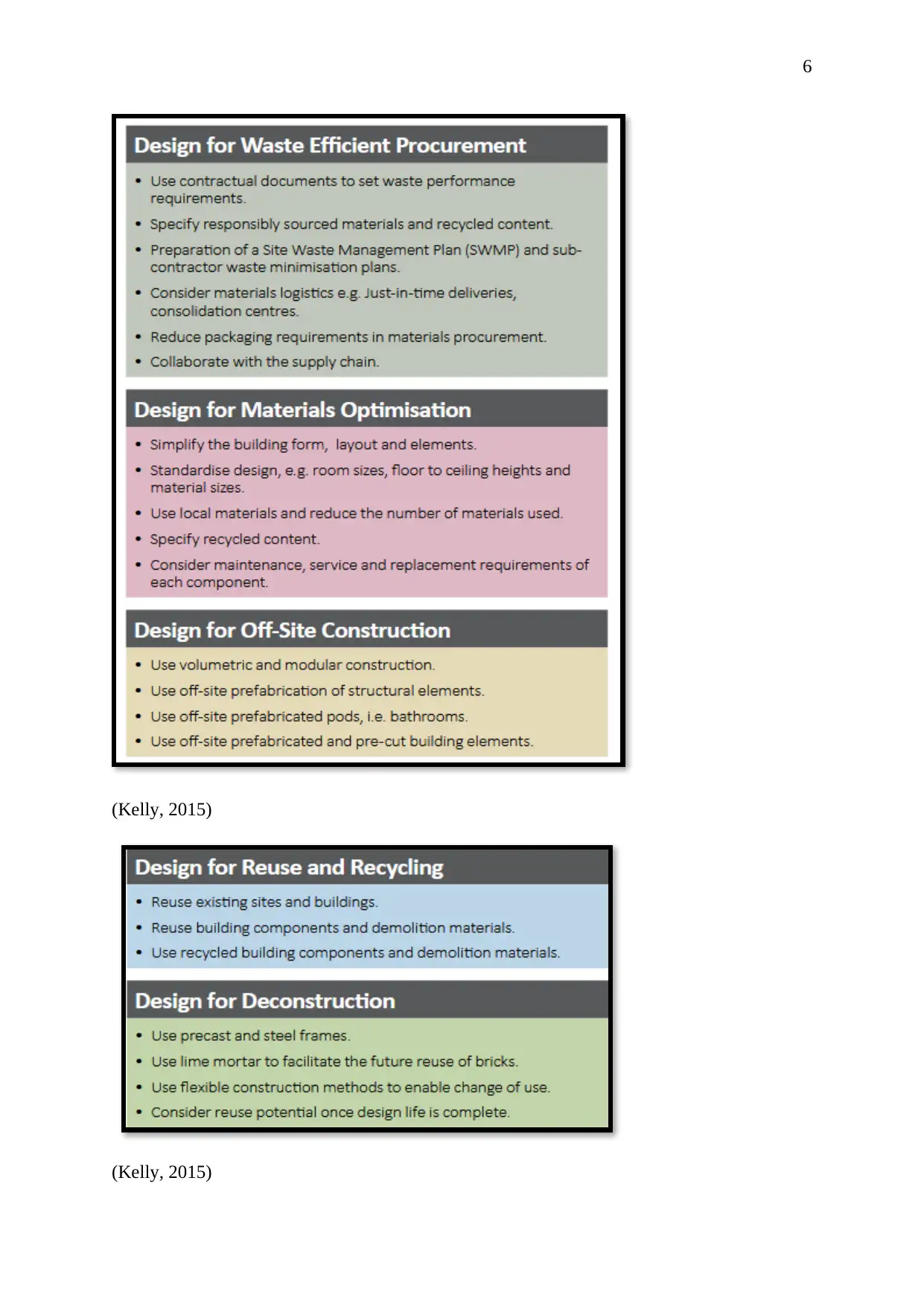
The design of waste for recycling activities and reused purposes focus on reusing of already
existing sites, use of both reused and recycled components of buildings and other demolition
materials. For offsite construction activity, the Designing out Wastes encompasses
employment of off-site prefabrication of pods, already cut building elements and also the
prefabrication of different structural elements. Designing for optimisation of materials
focuses on simplifying the construction layout, standardisation of designs, usage of local
materials and also in reducing the amount of materials used. Generation of designs for
enhancing procurement efficiency requires the incorporation of techniques like Just-in-Time
(JIT) deliveries, reduction of packaging requirements and also effective collaboration with
the supply chain. Similarly the design of waste during deconstruction activities is carried out
through use of steel frames, using of lime mortar for helping in further reuse of bricks,
incorporation of flexibility in the construction methods for enabling future changes and also
in evaluating the reuse potential after the completion of design life (Kelly, 2015). The same is
illustrated as under.
-Developing designs for generating flexibility and deconstruction purposes (Wrap, 2011).
Review of Second Paper
The design of waste for recycling activities and reused purposes focus on reusing of already
existing sites, use of both reused and recycled components of buildings and other demolition
materials. For offsite construction activity, the Designing out Wastes encompasses
employment of off-site prefabrication of pods, already cut building elements and also the
prefabrication of different structural elements. Designing for optimisation of materials
focuses on simplifying the construction layout, standardisation of designs, usage of local
materials and also in reducing the amount of materials used. Generation of designs for
enhancing procurement efficiency requires the incorporation of techniques like Just-in-Time
(JIT) deliveries, reduction of packaging requirements and also effective collaboration with
the supply chain. Similarly the design of waste during deconstruction activities is carried out
through use of steel frames, using of lime mortar for helping in further reuse of bricks,
incorporation of flexibility in the construction methods for enabling future changes and also
in evaluating the reuse potential after the completion of design life (Kelly, 2015). The same is
illustrated as under.
6
(Kelly, 2015)
(Kelly, 2015)
(Kelly, 2015)
(Kelly, 2015)
⊘ This is a preview!⊘
Do you want full access?
Subscribe today to unlock all pages.
Trusted by 1+ million students worldwide
7
Review of Third Paper: Process for Waste Design and Management
Four different processes are identified through which the waste emanating from the
construction industry can be effectively designed and managed.
Reduction of Waste Production at Source
Herein, different types of techniques like reduction of the amount and types of construction
materials, substitution of construction materials, and substitution of the construction process
and also the total elimination of the process involved ideally contribute in eliminating the
level of wastage regarding construction activities.
Reuse
Different types of construction materials like pipes, plywood and asphalt singles to name a
few are such that can be reused and also recycled for further construction activities. Reuse of
the stated products ideally contributes in reduction of waste and generates environmental,
economic and social benefits (KalilurRahman & Janagan, 2015).
Recycling
Recycling is identified as the reprocessing of used materials for converting them into novel
products for further usage. Recyclable materials are largely demanded for their economic and
aesthetic value and are valued differently depending on the availability of recyclable
materials and recycling centres.
Landfill Wastes
Generation of landfills are considered as the last option available for treating of construction
wastes such that the same raises environmental and regulatory concerns. Waste products that
are identified to reflect no value are put for land filling purposes (KalilurRahman & Janagan,
2015).
Review of Fourth Paper: Application of the Principles of Designing out
Waste
Designing for Reuse Principle
The application of the principle in civil construction works is carried out through reusing of
already laid foundations, structures, floor slabs and drainage systems, manufacturing and
treating of soils through diverse techniques and designing the layout of the site. The above
Review of Third Paper: Process for Waste Design and Management
Four different processes are identified through which the waste emanating from the
construction industry can be effectively designed and managed.
Reduction of Waste Production at Source
Herein, different types of techniques like reduction of the amount and types of construction
materials, substitution of construction materials, and substitution of the construction process
and also the total elimination of the process involved ideally contribute in eliminating the
level of wastage regarding construction activities.
Reuse
Different types of construction materials like pipes, plywood and asphalt singles to name a
few are such that can be reused and also recycled for further construction activities. Reuse of
the stated products ideally contributes in reduction of waste and generates environmental,
economic and social benefits (KalilurRahman & Janagan, 2015).
Recycling
Recycling is identified as the reprocessing of used materials for converting them into novel
products for further usage. Recyclable materials are largely demanded for their economic and
aesthetic value and are valued differently depending on the availability of recyclable
materials and recycling centres.
Landfill Wastes
Generation of landfills are considered as the last option available for treating of construction
wastes such that the same raises environmental and regulatory concerns. Waste products that
are identified to reflect no value are put for land filling purposes (KalilurRahman & Janagan,
2015).
Review of Fourth Paper: Application of the Principles of Designing out
Waste
Designing for Reuse Principle
The application of the principle in civil construction works is carried out through reusing of
already laid foundations, structures, floor slabs and drainage systems, manufacturing and
treating of soils through diverse techniques and designing the layout of the site. The above
Paraphrase This Document
Need a fresh take? Get an instant paraphrase of this document with our AI Paraphraser
8
activities would help in reducing the amount of materials required for carrying out the
construction work.
Designing for activities involving Offsite Construction
The principle is applied in civil engineering through reduction of movement of construction
associated transports, enhancing the quality of life in construction sites through improving of
health and safety parameters, developing the quality of workmanship through reduction of
errors and reworking and through reduction of timelines for meeting of construction activities
(Hashemi et al., 2014).
Designing for Optimal Utilisation of Materials
Application of the above principle can be made through incorporation of innovative means
for reducing material usage like use of lightweight materials like fibre based composites and
lightweight composites in concrete.
Designing for Enhancing Procurement Efficiency
The designing for generating efficiency in procurement activities is rendered through the
detailed sequencing and planning of work stages and also through development of effective
programming for increasing work efficiency.
Designing for Deconstruction and also for generating Flexibility
The principle is applied through potentially avoiding the employment of hazardous materials
that would affect future recycling initiatives. Further, such materials that would make future
recycling activity difficult to be undertaken are required to be potentially avoided (Hashemi
et al., 2014).
Method for Undertaking the Study
Research Design
The research activity focuses on the incorporation of both inductive and deductive research
designs. Employment of inductive research design in the research requires the study of
previous theories and concepts associated to Designing out Wastes. The study of previous
theories, principles and concepts would contribute in the generation of newer concepts and
principles (Cao & Li, 2015).
activities would help in reducing the amount of materials required for carrying out the
construction work.
Designing for activities involving Offsite Construction
The principle is applied in civil engineering through reduction of movement of construction
associated transports, enhancing the quality of life in construction sites through improving of
health and safety parameters, developing the quality of workmanship through reduction of
errors and reworking and through reduction of timelines for meeting of construction activities
(Hashemi et al., 2014).
Designing for Optimal Utilisation of Materials
Application of the above principle can be made through incorporation of innovative means
for reducing material usage like use of lightweight materials like fibre based composites and
lightweight composites in concrete.
Designing for Enhancing Procurement Efficiency
The designing for generating efficiency in procurement activities is rendered through the
detailed sequencing and planning of work stages and also through development of effective
programming for increasing work efficiency.
Designing for Deconstruction and also for generating Flexibility
The principle is applied through potentially avoiding the employment of hazardous materials
that would affect future recycling initiatives. Further, such materials that would make future
recycling activity difficult to be undertaken are required to be potentially avoided (Hashemi
et al., 2014).
Method for Undertaking the Study
Research Design
The research activity focuses on the incorporation of both inductive and deductive research
designs. Employment of inductive research design in the research requires the study of
previous theories and concepts associated to Designing out Wastes. The study of previous
theories, principles and concepts would contribute in the generation of newer concepts and
principles (Cao & Li, 2015).
9
Employment of deductive research design requires the development of research hypotheses
like null and alternative.
H0: The application of principles associated to Designing out Waste fails to generate needed
efficiency to construction activities.
H1: The application of principles associated to Designing out Waste generates needed
efficiency to construction activities.
The use of deductive research activities potentially contributes in narrowing down the scope
of the research and in conducting survey activities for generation of quantitative inferences.
The application of quantitative analysis would rightly help in proving the research hypotheses
(Verhoef, Kannan, & Inman, 2015).
Research Strategy
Application of both secondary and primary research activities are required to be employed for
carrying out the research activity.
The secondary research activity requires the study of different literature from accessing of
books, journals, reports and other online articles associated to the principles and application
of Designing out Waste. Similarly, the use of case studies associated to different construction
companies would further contribute in understanding of real-time applications of Designing
out Waste principles. The employment of secondary research would actively help in reducing
both research cost and time and also generates authentic information about the subject
(Brown, 2010).
Primary research activity is planned to be conducted through the development of unstructured
and structured questionnaires such that the same is applied for interviewing and survey
activity respectively. Interviews are required to be conducted through the formation of
focused groups of managers associated to the construction industry. Interviewing of focused
group respondents ideally contributes in generation of qualitative and narrative inferences.
Survey is required to be carried out for employee groups and other stakeholders like suppliers
through the employment of closed or structured questionnaires. It would help in generation of
quantitative inferences for addressing the research objectives (Babbie, 2009).
Employment of deductive research design requires the development of research hypotheses
like null and alternative.
H0: The application of principles associated to Designing out Waste fails to generate needed
efficiency to construction activities.
H1: The application of principles associated to Designing out Waste generates needed
efficiency to construction activities.
The use of deductive research activities potentially contributes in narrowing down the scope
of the research and in conducting survey activities for generation of quantitative inferences.
The application of quantitative analysis would rightly help in proving the research hypotheses
(Verhoef, Kannan, & Inman, 2015).
Research Strategy
Application of both secondary and primary research activities are required to be employed for
carrying out the research activity.
The secondary research activity requires the study of different literature from accessing of
books, journals, reports and other online articles associated to the principles and application
of Designing out Waste. Similarly, the use of case studies associated to different construction
companies would further contribute in understanding of real-time applications of Designing
out Waste principles. The employment of secondary research would actively help in reducing
both research cost and time and also generates authentic information about the subject
(Brown, 2010).
Primary research activity is planned to be conducted through the development of unstructured
and structured questionnaires such that the same is applied for interviewing and survey
activity respectively. Interviews are required to be conducted through the formation of
focused groups of managers associated to the construction industry. Interviewing of focused
group respondents ideally contributes in generation of qualitative and narrative inferences.
Survey is required to be carried out for employee groups and other stakeholders like suppliers
through the employment of closed or structured questionnaires. It would help in generation of
quantitative inferences for addressing the research objectives (Babbie, 2009).
⊘ This is a preview!⊘
Do you want full access?
Subscribe today to unlock all pages.
Trusted by 1+ million students worldwide
10
Data Collection
Data collection for focused group interviews are made by the interviewer through
interviewing focused groups based on the use of unstructured questionnaires. The researcher
further focuses on the use of microphones and recording instruments for recording of
inferences rendered by the respondents and also of pen and paper for generation of interview
transcripts (Lynch, 2012).
Regarding survey activity, the structured questionnaire sets are despatched to the respondents
through the use of mailers, online survey tools like survey monkey and also based on e-
mailing of questionnaires. Distribution is made to a larger sample such that effective
responses can be gained from the target population. Use of five point likert scale is made
against the different questions wherein the respondents are required to render their responses
through selection of a specific option. The responses gained are tabulated in an excel sheet in
terms of percentage of responses gained (Frazer & Stiehler, 2014).
Sampling
The sampling population for constituting the focused group would be constituted through the
use of the convenience sampling method. The use of convenience sampling contributes in
selection of sample respondents in a simple and faster manner from a larger section of
managerial respondents working in the construction industry. A sample population of 20
managerial respondents constituting both of higher and middle level managers would be
chosen for constituting the focused group.
For the survey activity, the respondents belonging to two strata sets like those belonging to
the operation and supply chain team would be chosen through the use of stratified random
sampling. Use of stratified random sampling helps in reduction of sampling errors obtained in
cases of simple random sampling and thereby is taken for selection of 100 respondents in a
collective fashion (Srinivasan, Sridhar, & Narayanan, 2013).
Data Analysis
Qualitative data gained from the interview activity is analysed through the process of
codification such that specific words, phrases and sentences can be identified and grouped
wherein inferring the correlation between the different groups serves as the need for
addressing the research aims. Quantitative data gained from the survey activity is analysed
Data Collection
Data collection for focused group interviews are made by the interviewer through
interviewing focused groups based on the use of unstructured questionnaires. The researcher
further focuses on the use of microphones and recording instruments for recording of
inferences rendered by the respondents and also of pen and paper for generation of interview
transcripts (Lynch, 2012).
Regarding survey activity, the structured questionnaire sets are despatched to the respondents
through the use of mailers, online survey tools like survey monkey and also based on e-
mailing of questionnaires. Distribution is made to a larger sample such that effective
responses can be gained from the target population. Use of five point likert scale is made
against the different questions wherein the respondents are required to render their responses
through selection of a specific option. The responses gained are tabulated in an excel sheet in
terms of percentage of responses gained (Frazer & Stiehler, 2014).
Sampling
The sampling population for constituting the focused group would be constituted through the
use of the convenience sampling method. The use of convenience sampling contributes in
selection of sample respondents in a simple and faster manner from a larger section of
managerial respondents working in the construction industry. A sample population of 20
managerial respondents constituting both of higher and middle level managers would be
chosen for constituting the focused group.
For the survey activity, the respondents belonging to two strata sets like those belonging to
the operation and supply chain team would be chosen through the use of stratified random
sampling. Use of stratified random sampling helps in reduction of sampling errors obtained in
cases of simple random sampling and thereby is taken for selection of 100 respondents in a
collective fashion (Srinivasan, Sridhar, & Narayanan, 2013).
Data Analysis
Qualitative data gained from the interview activity is analysed through the process of
codification such that specific words, phrases and sentences can be identified and grouped
wherein inferring the correlation between the different groups serves as the need for
addressing the research aims. Quantitative data gained from the survey activity is analysed
Paraphrase This Document
Need a fresh take? Get an instant paraphrase of this document with our AI Paraphraser
11
through the involvement of diagrammatic analysis like the use of pie, bar and line charts for
reflecting the different inferences (Oh, Teo, & Sambamurthy, 2012).
through the involvement of diagrammatic analysis like the use of pie, bar and line charts for
reflecting the different inferences (Oh, Teo, & Sambamurthy, 2012).
12
References
Babbie, E., 2009. The Practice of Social Research. USA: Wadsworth Cengage Learning.
Brown, A.P., 2010. Qualitative method and compromise in applied social research.
Qualitative Research, 10(2), pp.229-48.
Cao, L. & Li, L., 2015. The Impact of Cross-Channel Integration on Retailers’ Sales Growth.
Journal of Retailing , pp.1-19.
Frazer, M. & Stiehler, B.E., 2014. OMNICHANNEL RETAILING: THE MERGING OF
THE ONLINE AND OFF-LINE ENVIRONMENT. Global Conference on Business and
Finance Proceedings, 9(1), pp.655-57.
Hashemi, H., Mamaghani, N.H.M.H. & Daei, M., 2014. DESIGN AND UTILIZATION
WASTES IN CONSTRUCTION. ARPN Journal of Engineering and Applied Sciences, 9(11),
pp.2212-19.
KalilurRahman, M. & Janagan, S.S., 2015. Construction Waste Minimization and Reuse
Management. International Research Journal of Engineering and Technology (IRJET), 2(8),
pp.266-71.
Kelly, M., 2015. Design out Waste. Dublin: EPA Research.
Lynch, D., 2012. Preparing Teachers in Times of Change. United States : Lulu.com.
Oh, L.-B., Teo, H.-T. & Sambamurthy, V., 2012. The effects of retail channel integration
through the use of information technologies on firm performance. Journal of Operations
Management, 30, pp.368-81.
Srinivasan, R., Sridhar, S. & Narayanan, S., 2013. Effects of opening and closing stores on
chain retailer performance. Journal of Retailing , 89(2), pp.126-39.
Verhoef, P.C., Kannan, P.K. & Inman, J.J., 2015. From Multi-Channel Retailing to Omni-
Channel Retailing Introduction to the Special Issue on Multi-Channel Retailing. Journal of
Retailing , pp.1-8.
Wrap, 2011. Designing out Waste: A design team guide for buildings. Oxon: Wrap.
References
Babbie, E., 2009. The Practice of Social Research. USA: Wadsworth Cengage Learning.
Brown, A.P., 2010. Qualitative method and compromise in applied social research.
Qualitative Research, 10(2), pp.229-48.
Cao, L. & Li, L., 2015. The Impact of Cross-Channel Integration on Retailers’ Sales Growth.
Journal of Retailing , pp.1-19.
Frazer, M. & Stiehler, B.E., 2014. OMNICHANNEL RETAILING: THE MERGING OF
THE ONLINE AND OFF-LINE ENVIRONMENT. Global Conference on Business and
Finance Proceedings, 9(1), pp.655-57.
Hashemi, H., Mamaghani, N.H.M.H. & Daei, M., 2014. DESIGN AND UTILIZATION
WASTES IN CONSTRUCTION. ARPN Journal of Engineering and Applied Sciences, 9(11),
pp.2212-19.
KalilurRahman, M. & Janagan, S.S., 2015. Construction Waste Minimization and Reuse
Management. International Research Journal of Engineering and Technology (IRJET), 2(8),
pp.266-71.
Kelly, M., 2015. Design out Waste. Dublin: EPA Research.
Lynch, D., 2012. Preparing Teachers in Times of Change. United States : Lulu.com.
Oh, L.-B., Teo, H.-T. & Sambamurthy, V., 2012. The effects of retail channel integration
through the use of information technologies on firm performance. Journal of Operations
Management, 30, pp.368-81.
Srinivasan, R., Sridhar, S. & Narayanan, S., 2013. Effects of opening and closing stores on
chain retailer performance. Journal of Retailing , 89(2), pp.126-39.
Verhoef, P.C., Kannan, P.K. & Inman, J.J., 2015. From Multi-Channel Retailing to Omni-
Channel Retailing Introduction to the Special Issue on Multi-Channel Retailing. Journal of
Retailing , pp.1-8.
Wrap, 2011. Designing out Waste: A design team guide for buildings. Oxon: Wrap.
⊘ This is a preview!⊘
Do you want full access?
Subscribe today to unlock all pages.
Trusted by 1+ million students worldwide

1 out of 12


Related Documents


Your All-in-One AI-Powered Toolkit for Academic Success.
+13062052269
info@desklib.com
Available 24*7 on WhatsApp / Email
![[object Object]](/_next/static/media/star-bottom.7253800d.svg)
Unlock your academic potential
Copyright © 2020–2026 A2Z Services. All Rights Reserved. Developed and managed by ZUCOL.