Analysis and Design of High-Speed Wireless Data Link: Link Budget

Verified

Added on  2023/03/30

|5
|477
|311
Case Study
AI Summary
This case study provides a solution for designing a high-speed wireless data link, focusing on line of sight (LOS) link budget analysis. It calculates the free space path loss (FSPL) at distances of 5km and 10km for frequencies of 2.4 GHz and 5.8 GHz, determining the received power and link margin. The analysis considers factors such as transmitted power, antenna gains, and receiver sensitivity to ensure reliable communication. The study concludes that a link margin of 21.3 dBm at a 5-kilometer distance ensures high availability and reliability, emphasizing the importance of link margin and receiver sensitivity in wireless link development. Desklib offers a wealth of resources, including solved assignments and past papers, to aid students in understanding complex engineering concepts.
Document Page
[Designing a High speed Wireless Data Link]
tabler-icon-diamond-filled.svg

Paraphrase This Document

Need a fresh take? Get an instant paraphrase of this document with our AI Paraphraser
Document Page
WIRELESS NETWORKS AND COMMUNICATION 1
Solution- (a)
In this question there are following parameters are given for finding total free space path
loss:
Distances- 5km and 10 km
Frequencies- 2.4 GHz and 5.8 GHz
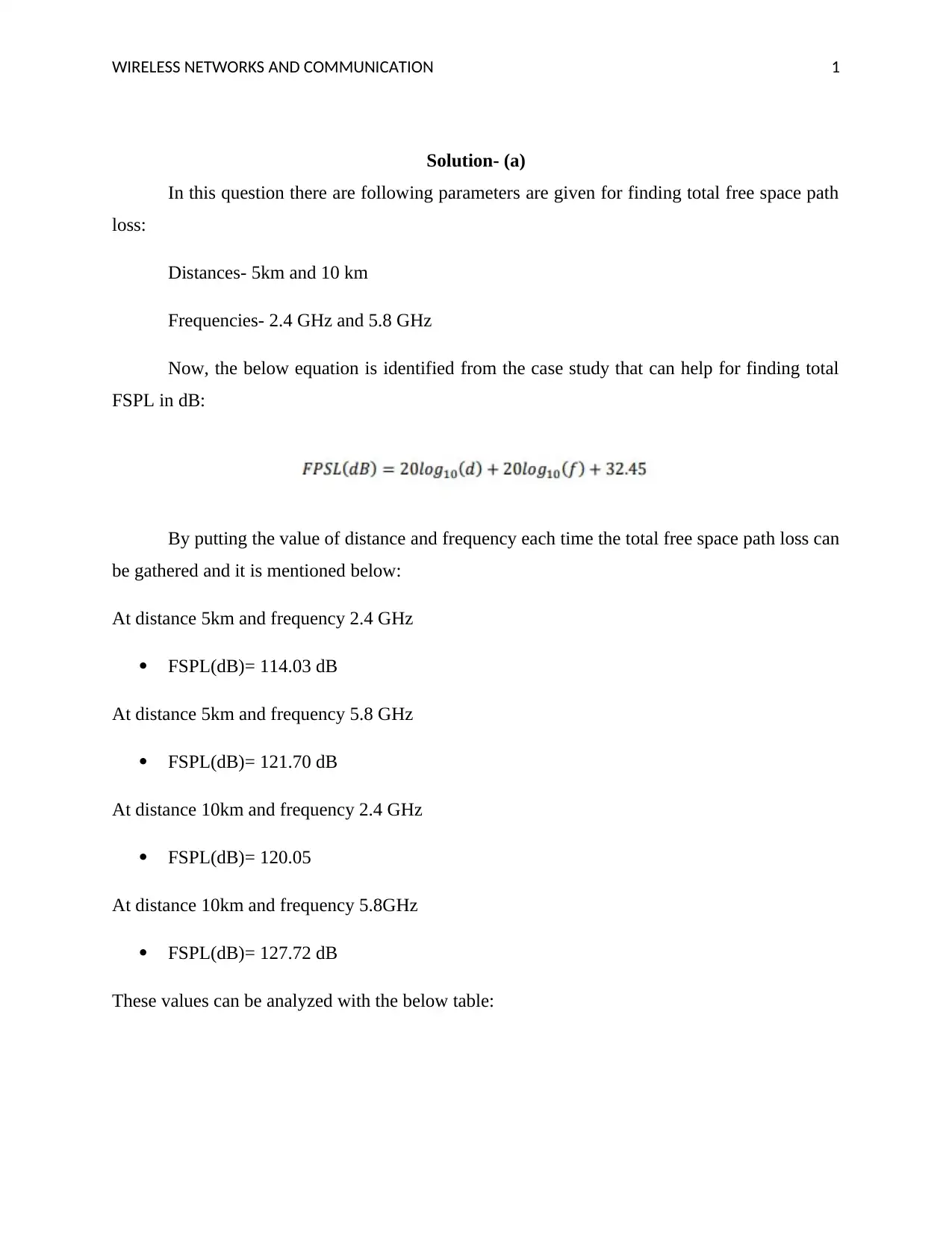
Now, the below equation is identified from the case study that can help for finding total
FSPL in dB:
By putting the value of distance and frequency each time the total free space path loss can
be gathered and it is mentioned below:
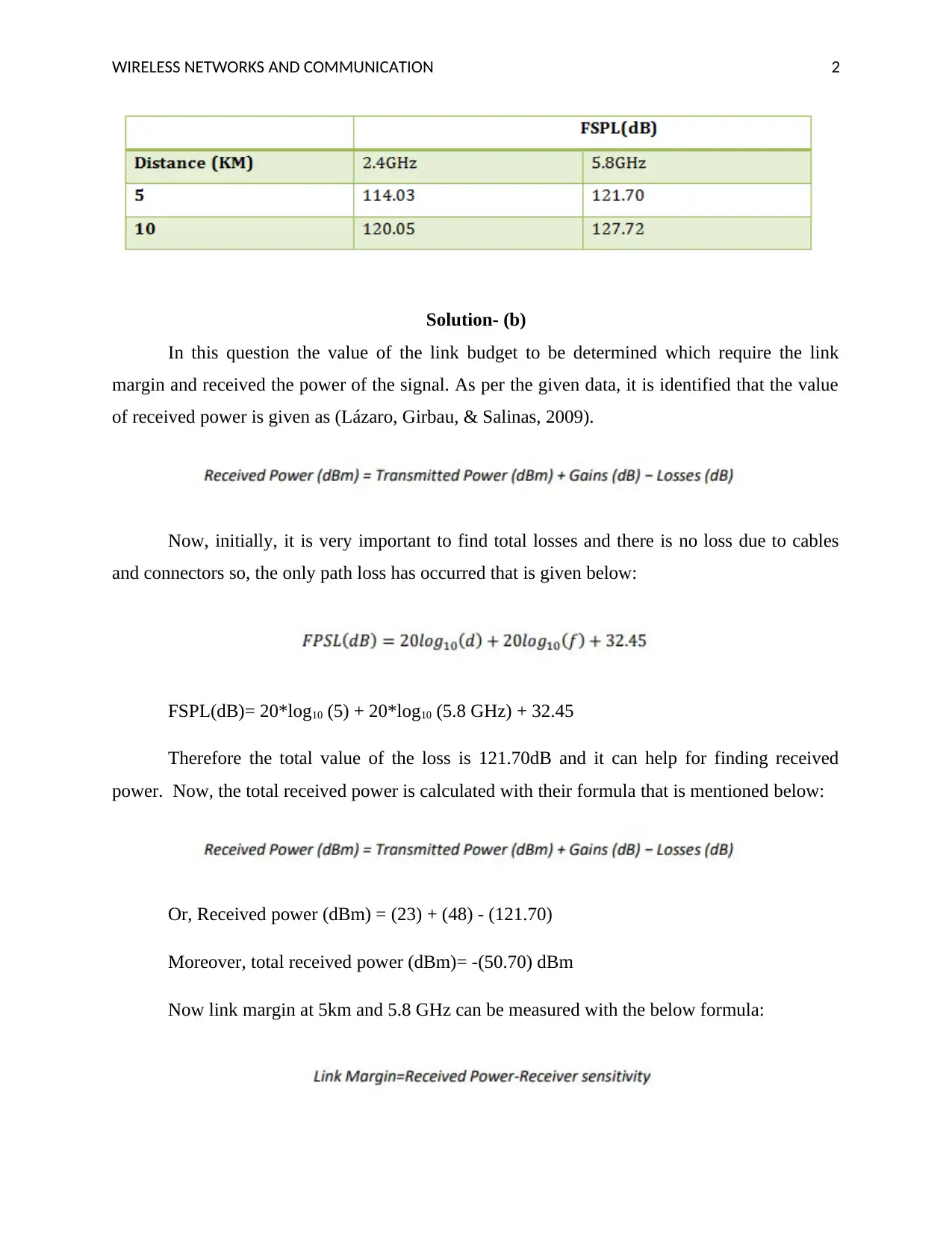
At distance 5km and frequency 2.4 GHz
FSPL(dB)= 114.03 dB
At distance 5km and frequency 5.8 GHz
FSPL(dB)= 121.70 dB
At distance 10km and frequency 2.4 GHz
FSPL(dB)= 120.05
At distance 10km and frequency 5.8GHz
FSPL(dB)= 127.72 dB
These values can be analyzed with the below table:
Document Page
WIRELESS NETWORKS AND COMMUNICATION 2
Solution- (b)
In this question the value of the link budget to be determined which require the link
margin and received the power of the signal. As per the given data, it is identified that the value
of received power is given as (Lázaro, Girbau, & Salinas, 2009).
Now, initially, it is very important to find total losses and there is no loss due to cables
and connectors so, the only path loss has occurred that is given below:
FSPL(dB)= 20*log10 (5) + 20*log10 (5.8 GHz) + 32.45
Therefore the total value of the loss is 121.70dB and it can help for finding received
power. Now, the total received power is calculated with their formula that is mentioned below:
Or, Received power (dBm) = (23) + (48) - (121.70)
Moreover, total received power (dBm)= -(50.70) dBm
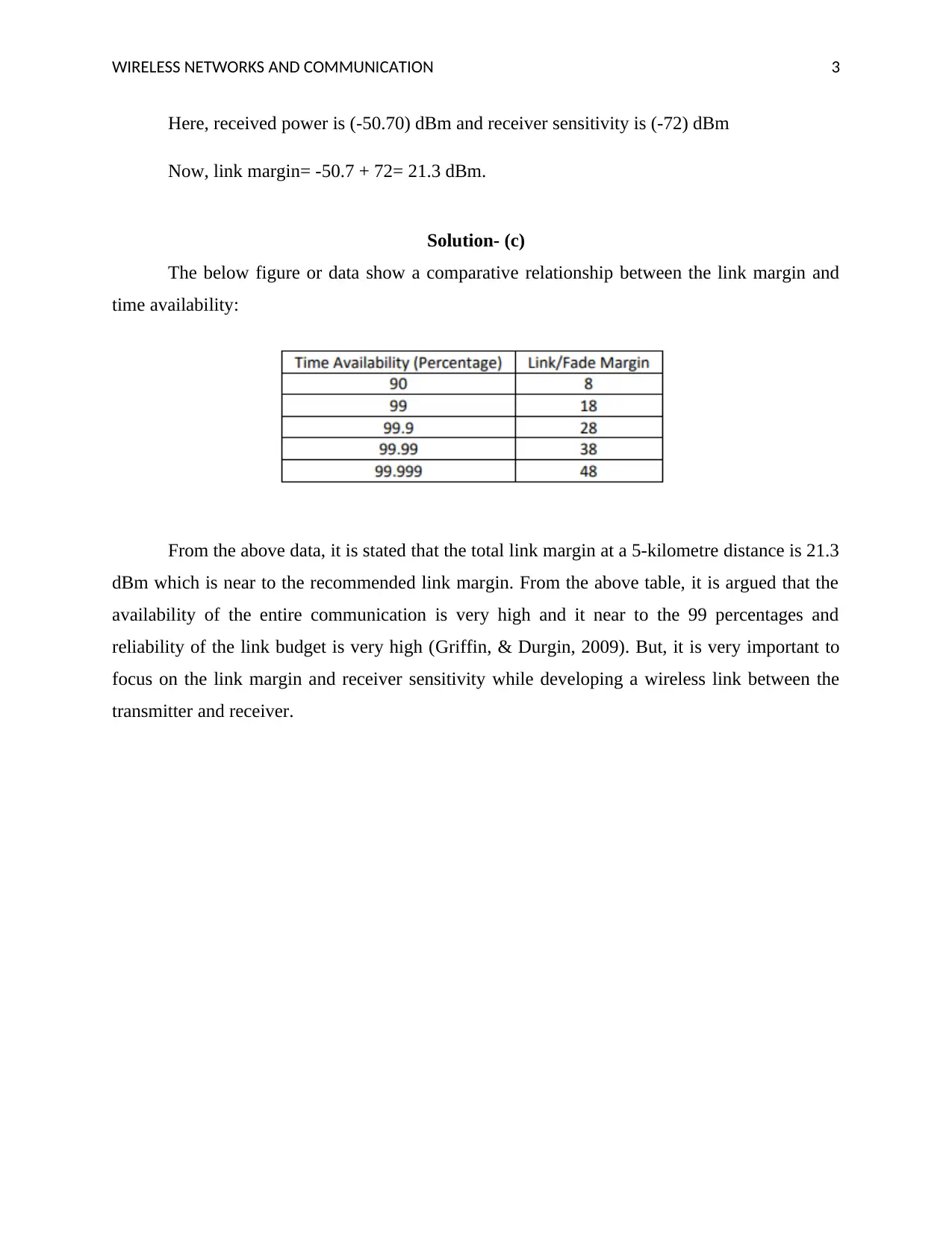
Now link margin at 5km and 5.8 GHz can be measured with the below formula:
Document Page
WIRELESS NETWORKS AND COMMUNICATION 3
Here, received power is (-50.70) dBm and receiver sensitivity is (-72) dBm
Now, link margin= -50.7 + 72= 21.3 dBm.
Solution- (c)
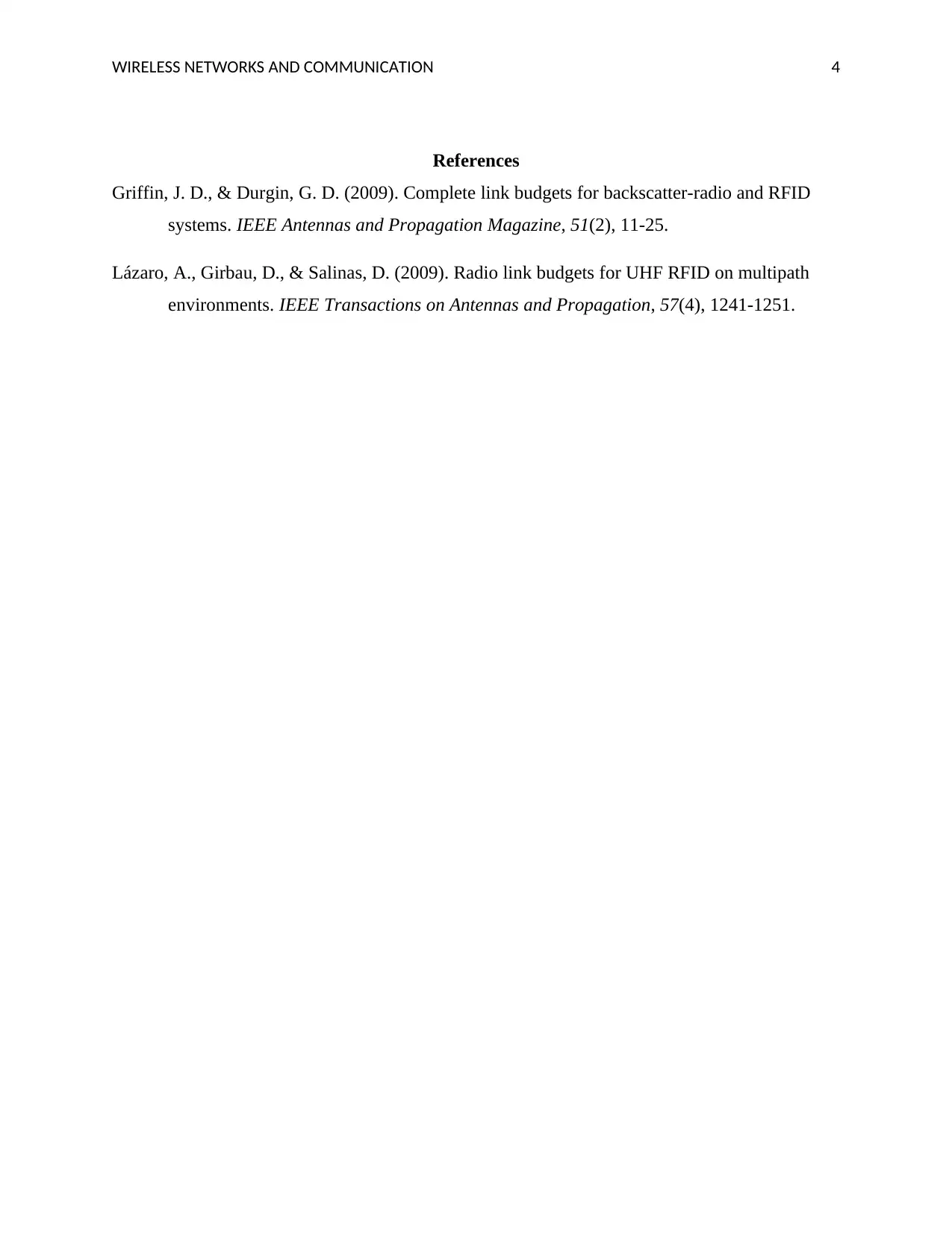
The below figure or data show a comparative relationship between the link margin and
time availability:
From the above data, it is stated that the total link margin at a 5-kilometre distance is 21.3
dBm which is near to the recommended link margin. From the above table, it is argued that the
availability of the entire communication is very high and it near to the 99 percentages and
reliability of the link budget is very high (Griffin, & Durgin, 2009). But, it is very important to
focus on the link margin and receiver sensitivity while developing a wireless link between the
transmitter and receiver.
tabler-icon-diamond-filled.svg

Paraphrase This Document

Need a fresh take? Get an instant paraphrase of this document with our AI Paraphraser
Document Page
WIRELESS NETWORKS AND COMMUNICATION 4
References
Griffin, J. D., & Durgin, G. D. (2009). Complete link budgets for backscatter-radio and RFID
systems. IEEE Antennas and Propagation Magazine, 51(2), 11-25.
Lázaro, A., Girbau, D., & Salinas, D. (2009). Radio link budgets for UHF RFID on multipath
environments. IEEE Transactions on Antennas and Propagation, 57(4), 1241-1251.
chevron_up_icon
1 out of 5
circle_padding
hide_on_mobile
zoom_out_icon
[object Object]