Annotated Bibliography: Tourism Destination Case Study Analysis
VerifiedAdded on 2022/12/14
|7
|2056
|297
Annotated Bibliography
AI Summary
This annotated bibliography examines the impacts of tourism on host communities, destination development, and policy implications. It analyzes various academic and industry sources, including studies on community well-being, tourism's effects on local economies, and destination image management. The bibliography covers topics such as the relationship between tourism development and job opportunities, the importance of defining tourism's scope, the role of information in destination marketing, and the factors that contribute to destination competitiveness. It also delves into policy implications, emphasizing the need for sustainable and inclusive tourism growth, integrated policy approaches, and collaboration between public and private sectors. The sources highlight the importance of considering both current and future social, environmental, and economic impacts of tourism to ensure its long-term viability and benefit to all stakeholders.

1
Management
Management

Paraphrase This Document
Need a fresh take? Get an instant paraphrase of this document with our AI Paraphraser
2
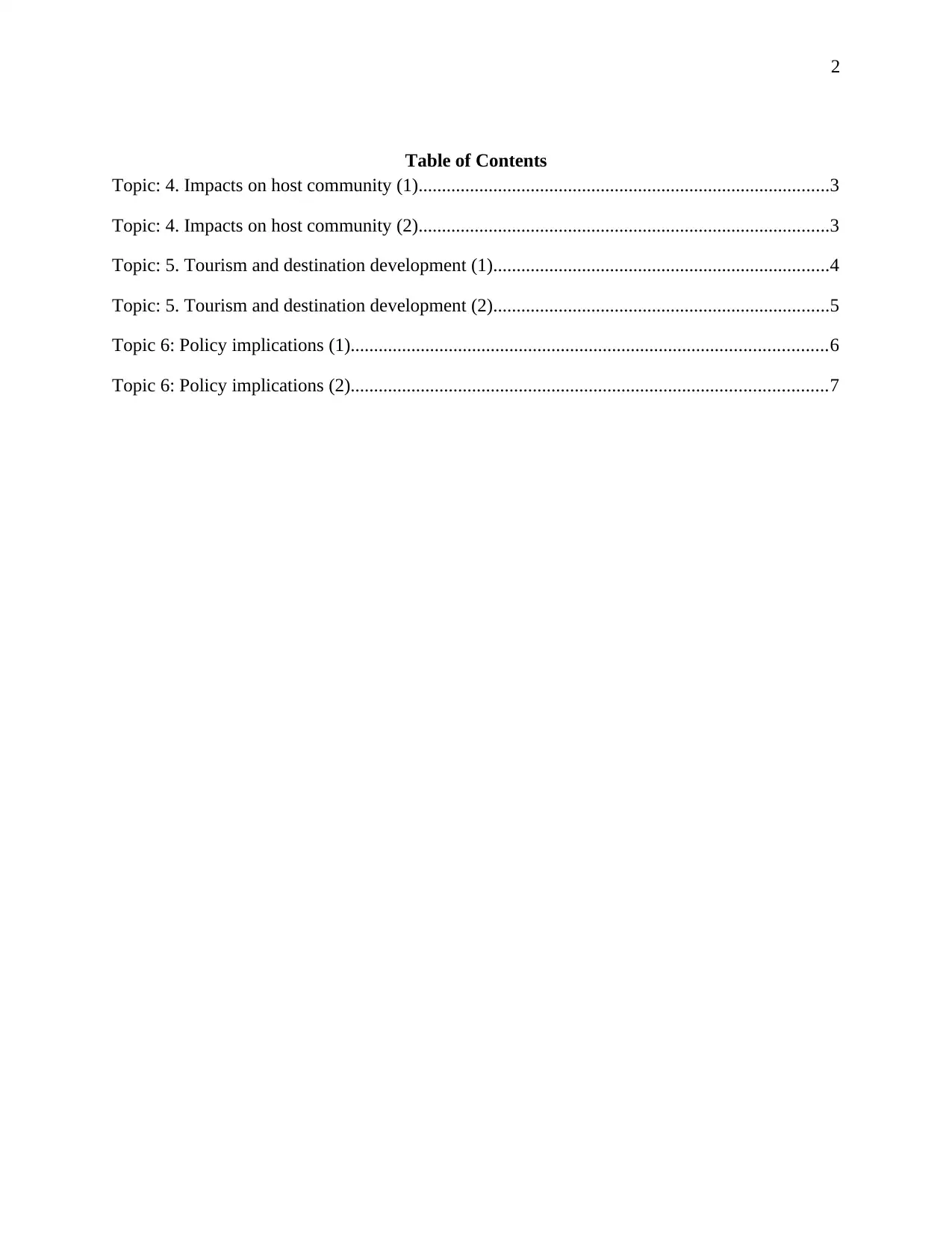
Table of Contents
Topic: 4. Impacts on host community (1)........................................................................................3
Topic: 4. Impacts on host community (2)........................................................................................3
Topic: 5. Tourism and destination development (1)........................................................................4
Topic: 5. Tourism and destination development (2)........................................................................5
Topic 6: Policy implications (1)......................................................................................................6
Topic 6: Policy implications (2)......................................................................................................7
Table of Contents
Topic: 4. Impacts on host community (1)........................................................................................3
Topic: 4. Impacts on host community (2)........................................................................................3
Topic: 5. Tourism and destination development (1)........................................................................4
Topic: 5. Tourism and destination development (2)........................................................................5
Topic 6: Policy implications (1)......................................................................................................6
Topic 6: Policy implications (2)......................................................................................................7
3
Topic: 4. Impacts on host community (1)
Konovalov, E., 2016. Tourism and community well-being: Social impacts of tourism in
Australian tropical communities. PhD thesis. Queensland, Australia: James Cook University.
Pp.126-131.
The primary objective of this article was assessing and understanding the main impacts of
tourism on the social aspects of the well-being of the community of Australia, which was the
primary research question of the formulated thesis. The relationship between the various aspects
was quite complex and was impacted by the kind of tourism development at a specific
destination. Various links were revealed by the comparison of the locations on the basis of
community well-being social aspects. In the human capital aspect, the relationship pattern with
tourism was mostly discovered to be firm and consistent. Observations also revealed that there
was a connection between tourism developments at a greater scale and more opportunities for
jobs and obtaining further education. However, such a connection leads to further investigation
as the medium scaled tourism development region had the highest level of unemployment
amongst all of the three regions. This region also had the lowest opportunities for employment
and employment resident evaluation. The primary reason for this is the fact that other factors
have the potential of impacting it within the economic environment of a particular destination.
The middle scaled tourism development region significantly relies upon the mining industries.
Due to the wind down of the mining industry, the labor market of such a region had undergone a
major restructuring. The rate of unemployment within this region was measured to be the highest
in the entire state. At the time of workshop in this region, it had become obvious that the
stakeholders of the community were looking for opportunities for the regeneration of the
economy of the region. According to the stakeholders, for doing so, tourism development could
potentially be an alternative and new strategy. Previous researches implied that development of
tourism in the rural and remote areas had the potential of restructuring and counter declining the
economic activities, rural industrialization and out-migration.
Topic: 4. Impacts on host community (2)
Musinguzi, D., 2011. The impacts of tourism on local communities: developing and
operationalising a comprehensive monitoring framework. Pp. 30-31.
Topic: 4. Impacts on host community (1)
Konovalov, E., 2016. Tourism and community well-being: Social impacts of tourism in
Australian tropical communities. PhD thesis. Queensland, Australia: James Cook University.
Pp.126-131.
The primary objective of this article was assessing and understanding the main impacts of
tourism on the social aspects of the well-being of the community of Australia, which was the
primary research question of the formulated thesis. The relationship between the various aspects
was quite complex and was impacted by the kind of tourism development at a specific
destination. Various links were revealed by the comparison of the locations on the basis of
community well-being social aspects. In the human capital aspect, the relationship pattern with
tourism was mostly discovered to be firm and consistent. Observations also revealed that there
was a connection between tourism developments at a greater scale and more opportunities for
jobs and obtaining further education. However, such a connection leads to further investigation
as the medium scaled tourism development region had the highest level of unemployment
amongst all of the three regions. This region also had the lowest opportunities for employment
and employment resident evaluation. The primary reason for this is the fact that other factors
have the potential of impacting it within the economic environment of a particular destination.
The middle scaled tourism development region significantly relies upon the mining industries.
Due to the wind down of the mining industry, the labor market of such a region had undergone a
major restructuring. The rate of unemployment within this region was measured to be the highest
in the entire state. At the time of workshop in this region, it had become obvious that the
stakeholders of the community were looking for opportunities for the regeneration of the
economy of the region. According to the stakeholders, for doing so, tourism development could
potentially be an alternative and new strategy. Previous researches implied that development of
tourism in the rural and remote areas had the potential of restructuring and counter declining the
economic activities, rural industrialization and out-migration.
Topic: 4. Impacts on host community (2)
Musinguzi, D., 2011. The impacts of tourism on local communities: developing and
operationalising a comprehensive monitoring framework. Pp. 30-31.
⊘ This is a preview!⊘
Do you want full access?
Subscribe today to unlock all pages.

Trusted by 1+ million students worldwide
4
This article primarily focuses upon the overall impacts of tourism on the local communities. The
manner in which tourism has been defined is important in the assessment of its impacts. For
understanding tourism and its impacts completely as well as the aspects which make it different
from the other industries, defining tourism is very important. The term has a wide range of
definitions. Tourism is basically the temporary movement of individuals towards the destinations
external to their usual locations of residence and work. It also includes the activities which are
undertaken at the time when people stay at such destinations as well as the facilities which are
created for fulfilling their requirements. Two major points have been highlighted in such a
definition which assists in understanding between tourism and other activities as well as its effect
on the destinations. First of all, the movement of individuals to a specific location, the
accommodation requirement and residing at a location far from home, implies that an interaction
between the host communities and visitors exists. The result of the interaction between these
groups could either be negative as well as positive. These results would be in the form of impacts
and reactions. Now, since the visitors do not stay permanently at a particular location, the host
communities are the ones which are greatly impacted because they are the ones who stay at
destinations where consumption of tourism resources takes place. The issues related to tourism
are different from other resources because their consumption takes place at the point of location
of production. As such, the destinations of tourism are more prone and vulnerable towards the
effects then other locations where the consumption of products take place far from the
production point.
Topic: 5. Tourism and destination development (1)
Molina, A., Gomez, M., and Martin-Consuegra D., 2010. Tourism marketing information and
destination image management.
Destination image is widely accepted as an integral aspect within the success of destination
marketing and tourism management. The information regarding a particular destination is a
significant way of promoting the industry of tourism and it impacts the destination image. The
primary objective of this article in this above context, is the identification of the particular
features of destination that contribute towards the establishment of an image of destination that is
positive and analyzing the relationship between the image created by the brochures and the
features mentioned above. Accordingly, the article has been developed on the basis of previous
This article primarily focuses upon the overall impacts of tourism on the local communities. The
manner in which tourism has been defined is important in the assessment of its impacts. For
understanding tourism and its impacts completely as well as the aspects which make it different
from the other industries, defining tourism is very important. The term has a wide range of
definitions. Tourism is basically the temporary movement of individuals towards the destinations
external to their usual locations of residence and work. It also includes the activities which are
undertaken at the time when people stay at such destinations as well as the facilities which are
created for fulfilling their requirements. Two major points have been highlighted in such a
definition which assists in understanding between tourism and other activities as well as its effect
on the destinations. First of all, the movement of individuals to a specific location, the
accommodation requirement and residing at a location far from home, implies that an interaction
between the host communities and visitors exists. The result of the interaction between these
groups could either be negative as well as positive. These results would be in the form of impacts
and reactions. Now, since the visitors do not stay permanently at a particular location, the host
communities are the ones which are greatly impacted because they are the ones who stay at
destinations where consumption of tourism resources takes place. The issues related to tourism
are different from other resources because their consumption takes place at the point of location
of production. As such, the destinations of tourism are more prone and vulnerable towards the
effects then other locations where the consumption of products take place far from the
production point.
Topic: 5. Tourism and destination development (1)
Molina, A., Gomez, M., and Martin-Consuegra D., 2010. Tourism marketing information and
destination image management.
Destination image is widely accepted as an integral aspect within the success of destination
marketing and tourism management. The information regarding a particular destination is a
significant way of promoting the industry of tourism and it impacts the destination image. The
primary objective of this article in this above context, is the identification of the particular
features of destination that contribute towards the establishment of an image of destination that is
positive and analyzing the relationship between the image created by the brochures and the
features mentioned above. Accordingly, the article has been developed on the basis of previous
Paraphrase This Document
Need a fresh take? Get an instant paraphrase of this document with our AI Paraphraser
5
researches regarding the affect of sources of tourist information in the promotion of destination
and also tends to argue that brochures have a significant impact on the image of the destination.
On the basis of the previous discussions related to destination image, an empirical research was
initiated for testing the relationship that has been proposed in this article.
For decisions related to marketing management, understanding of the process of information
acquiring by the customers is quite important. This is true especially in the case of tourism and
travel products and services. According to previous research and studies, it was analyzed that
tourist information in a significant concept in understanding the destination choice procedure of
tourists and destination image. The significant factors in the tourist behavior analysis in most of
the research work include sources of information. For example, firstly, most of the models of
tourist behavior assimilated external information searching as an integral aspect. Secondly, the
impact of sources of information on the intentions and preferences of tourists has been examined
by some studies. Thirdly, the relationship between travel, selection of destination and sources of
information has been centered by other studies.
Topic: 5. Tourism and destination development (2)
Wilde, SJ & Cox, C 2008. ‘Linking destination competitiveness and destination development:
findings from a mature Australian tourism destination’, Proceedings of the Travel and Tourism
Research Association (TTRA) European Chapter Conference - Competition in tourism: business
and destination perspectives. pp. 467-478.
The article focuses upon examining the tourism development and competitiveness within the
same. While tourism researchers continue to gain more interest ad work more upon the studies of
tourism destination, there is hardly much identifiable research which links the wide concept of
competitiveness of tourism destination with the evaluation and development of these
destinations. These research works even fail in suggesting the importance or significance of the
important variables of competitiveness for the tourism destination at various developmental
stages. During the exploration of such an association, the discussions of focus groups related to
the stakeholders of tourism sector, were incorporated in the Australian East Coast. The
preliminary outcomes from such a discussion indicate towards the factors of competitiveness in
relation with the destination’s management appears to be very important for the local
researches regarding the affect of sources of tourist information in the promotion of destination
and also tends to argue that brochures have a significant impact on the image of the destination.
On the basis of the previous discussions related to destination image, an empirical research was
initiated for testing the relationship that has been proposed in this article.
For decisions related to marketing management, understanding of the process of information
acquiring by the customers is quite important. This is true especially in the case of tourism and
travel products and services. According to previous research and studies, it was analyzed that
tourist information in a significant concept in understanding the destination choice procedure of
tourists and destination image. The significant factors in the tourist behavior analysis in most of
the research work include sources of information. For example, firstly, most of the models of
tourist behavior assimilated external information searching as an integral aspect. Secondly, the
impact of sources of information on the intentions and preferences of tourists has been examined
by some studies. Thirdly, the relationship between travel, selection of destination and sources of
information has been centered by other studies.
Topic: 5. Tourism and destination development (2)
Wilde, SJ & Cox, C 2008. ‘Linking destination competitiveness and destination development:
findings from a mature Australian tourism destination’, Proceedings of the Travel and Tourism
Research Association (TTRA) European Chapter Conference - Competition in tourism: business
and destination perspectives. pp. 467-478.
The article focuses upon examining the tourism development and competitiveness within the
same. While tourism researchers continue to gain more interest ad work more upon the studies of
tourism destination, there is hardly much identifiable research which links the wide concept of
competitiveness of tourism destination with the evaluation and development of these
destinations. These research works even fail in suggesting the importance or significance of the
important variables of competitiveness for the tourism destination at various developmental
stages. During the exploration of such an association, the discussions of focus groups related to
the stakeholders of tourism sector, were incorporated in the Australian East Coast. The
preliminary outcomes from such a discussion indicate towards the factors of competitiveness in
relation with the destination’s management appears to be very important for the local
6
shareholders, provided the identified developmental stage. The respondents identified the three
of the fundamental elements which were: the ability of the governing bodies and the local
industry of tourism for cooperating in the form of a driving force for the sustainability of the
destination; the capability of the tourism infrastructure for being introduced and maintained for
sustaining the appeal of the destination; and the existence of a firm vision of the community
towards tourism’s future.
Topic 6: Policy implications (1)
OECD, 2017. Policy Statement - Tourism Policies for Sustainable and Inclusive Growth.
Available at: https://www.oecd.org/cfe/tourism/OECD-Policy-Statement-Tourism-Policies-for-
Sustainable-and-Inclusive-Growth.pdf [Accessed on: 30 April 2019]
The article emphasizes on the major advances and improvements which have been made towards
the implementation and incorporation of effective programmes and policies related to tourism.
The article facilitates open discussions regarding the long term objectives for inclusive and
sustainable development of tourism. Moving towards approaches that are comprehensive and
coherent for tourism policy making, would assist the nations in reframing the growth of tourism
and in spreading the benefits in a better way. It would also help in bringing improvements within
the resilience of the economies and addressing the inequalities. Long-term policies and strategies
which are emphasized on the promotion of significant employment, skills development, job
creation, innovation, integrated regional development, effective investment and entrepreneurship,
are all important for the achievement of inclusive and sustainable tourism growth. The growth
here is referred as such a growth which taken into consideration the future as well as current
social, environmental and economic impacts, and also helps in addressing the various
requirements of the industry, visitors, host communities and the environment. The Government
of the country should work and aims towards further developing responses of tourism policy
which are coherent and integrated and reflect upon the local communities’ and individual
nations’ circumstances. The Government should have various objectives such as: providing
access to the consumers of safe, reliable and high quality experiences of self tourism; increasing
the overall level of productivity within the sector of tourism, especially for the small and medium
enterprises; protecting, managing and enhance the cultural and natural resources; enhancing the
overall competitiveness; and promoting the inclusive development and growth across and within
shareholders, provided the identified developmental stage. The respondents identified the three
of the fundamental elements which were: the ability of the governing bodies and the local
industry of tourism for cooperating in the form of a driving force for the sustainability of the
destination; the capability of the tourism infrastructure for being introduced and maintained for
sustaining the appeal of the destination; and the existence of a firm vision of the community
towards tourism’s future.
Topic 6: Policy implications (1)
OECD, 2017. Policy Statement - Tourism Policies for Sustainable and Inclusive Growth.
Available at: https://www.oecd.org/cfe/tourism/OECD-Policy-Statement-Tourism-Policies-for-
Sustainable-and-Inclusive-Growth.pdf [Accessed on: 30 April 2019]
The article emphasizes on the major advances and improvements which have been made towards
the implementation and incorporation of effective programmes and policies related to tourism.
The article facilitates open discussions regarding the long term objectives for inclusive and
sustainable development of tourism. Moving towards approaches that are comprehensive and
coherent for tourism policy making, would assist the nations in reframing the growth of tourism
and in spreading the benefits in a better way. It would also help in bringing improvements within
the resilience of the economies and addressing the inequalities. Long-term policies and strategies
which are emphasized on the promotion of significant employment, skills development, job
creation, innovation, integrated regional development, effective investment and entrepreneurship,
are all important for the achievement of inclusive and sustainable tourism growth. The growth
here is referred as such a growth which taken into consideration the future as well as current
social, environmental and economic impacts, and also helps in addressing the various
requirements of the industry, visitors, host communities and the environment. The Government
of the country should work and aims towards further developing responses of tourism policy
which are coherent and integrated and reflect upon the local communities’ and individual
nations’ circumstances. The Government should have various objectives such as: providing
access to the consumers of safe, reliable and high quality experiences of self tourism; increasing
the overall level of productivity within the sector of tourism, especially for the small and medium
enterprises; protecting, managing and enhance the cultural and natural resources; enhancing the
overall competitiveness; and promoting the inclusive development and growth across and within
⊘ This is a preview!⊘
Do you want full access?
Subscribe today to unlock all pages.
Trusted by 1+ million students worldwide
7
nations. Apart from these, the Government should also: identify the interactions, functions and
roles of the important private and public sector stakeholders clearly, and should focus upon
bringing them together in an efficient way; it should have the leadership and support of the
various policy makers; the complementarities and trade-offs should be fully considered with
respect to the related areas of policy.
Topic 6: Policy implications (2)
OECD, 2010. Tourism 2020: Policies to Promote Competitive and Sustainable Tourism.
Available at: https://www.oecd-ilibrary.org/docserver/tour-2010-4-en.pdf?
expires=1556618228&id=id&accname=guest&checksum=B8D16ABC3954D2FCA962764F87B
17A97 [Accessed on: 30 April 2019]
The article describes that in order to address the multi-faceted and major challenges and issues of
the tourism industry; an integrated approach is required towards the development of policies
across the departments of the Government. Consistency and coherence are very important in the
application and design of policies between various governmental levels for ensuring the
effectiveness and efficiency of the policies of tourism. The development of strategies and
policies of tourism can play an important role in engaging and bringing together the various
stakeholders, destination communities, government and industry for the identification of a
direction and vision for the development of tourism. It would also be helpful in setting priorities
for the implementation of a sustainable and long-term vision for the tourism industry. The
strategies and policies of tourism are rapidly focusing upon the cooperation and collaboration of
the private and public sector. The article offers various pointers towards specific areas within
which interventions of the public policy would be the most effective.
nations. Apart from these, the Government should also: identify the interactions, functions and
roles of the important private and public sector stakeholders clearly, and should focus upon
bringing them together in an efficient way; it should have the leadership and support of the
various policy makers; the complementarities and trade-offs should be fully considered with
respect to the related areas of policy.
Topic 6: Policy implications (2)
OECD, 2010. Tourism 2020: Policies to Promote Competitive and Sustainable Tourism.
Available at: https://www.oecd-ilibrary.org/docserver/tour-2010-4-en.pdf?
expires=1556618228&id=id&accname=guest&checksum=B8D16ABC3954D2FCA962764F87B
17A97 [Accessed on: 30 April 2019]
The article describes that in order to address the multi-faceted and major challenges and issues of
the tourism industry; an integrated approach is required towards the development of policies
across the departments of the Government. Consistency and coherence are very important in the
application and design of policies between various governmental levels for ensuring the
effectiveness and efficiency of the policies of tourism. The development of strategies and
policies of tourism can play an important role in engaging and bringing together the various
stakeholders, destination communities, government and industry for the identification of a
direction and vision for the development of tourism. It would also be helpful in setting priorities
for the implementation of a sustainable and long-term vision for the tourism industry. The
strategies and policies of tourism are rapidly focusing upon the cooperation and collaboration of
the private and public sector. The article offers various pointers towards specific areas within
which interventions of the public policy would be the most effective.

1 out of 7


Related Documents


Your All-in-One AI-Powered Toolkit for Academic Success.
+13062052269
info@desklib.com
Available 24*7 on WhatsApp / Email
![[object Object]](/_next/static/media/star-bottom.7253800d.svg)
Unlock your academic potential
Copyright © 2020–2026 A2Z Services. All Rights Reserved. Developed and managed by ZUCOL.